IntroductIon
Due to increasing numbers of people spending longer time in space and with the possibility of long-term human travel to Mars in future, it is crucial to understand the long-term effects of exposure to the space environment like microgravity and space radiation on various cellular and biological functions. Caenorhabditis elegans (C. elegans), a small nematode, provides a lot of advantages as the model organism to measure the long term exposure to microgravity as it is robust, easy to grow and is able to survive starvation. They have at least 60-80% of their genes homologous with humans (22, 27). C. elegans has previously been used in five spaceflights experiments, the first being onboard the STS-42 flight (1992) where it was observed that the male C. elegans mated successfully and the full life-cycle of C. elegans occurred in space without
* Correspondence to: [email protected]
Multi-Generational Culture of
C. Elegans
on a Long-Term Space Flight Revealed
Changes in Expression of Genes Involved in Longevity, DNA Repair,
and Locomotion
1Sue Mian Then, 1Nurul-Faizah Jusoh, 1Roslan Harun, 2Sheila Nathan, 3Nathaniel J. Szewczyk, 4Louis Stodieck and 1Rahman Jamal
1UKM Medical Molecular Biology Institute, UKM Medical Centre, 2Malaysia Genome Institute, Universiti Kebangsaan Malaysia, 3Department of Biological Sciences, University of Pittsburgh, Pittsburgh,
4Bioserve Space Technology, University of Colorado
Received on 17/04/2014 / Accepted on 31/05/2014
ABStrAct
Scientists are trying to determine the long term effects of exposure to microgravity and space radiation on various cellular and biological functions. We used C. elegans as the model organism to study the changes in gene expression. Wild type worms were grown in a liquid medium using the cHab hardware. the cHab was flown on the StS116 flight to the International Space Station (ISS) and returned to earth on the StS118 flight. upon landing, surviving worms were extracted and rnAlater added. Ground controls were grown at Bioserve in colorado and passaged synchronously. rnA was later extracted and mrnA gene expression was analysed using Affymetrix Genechip® C. elegans Genome Array. the results revealed that 858 known genes were differentially expressed (p-value ≤ 0.05 and fold change ≥ ± 2); namely 608 genes were up-regulated and 250 genes down-regulated. The genes dod-19 and dod-3 which are the downstream effectors of the forkhead transcription factor daf-16 were up-regulated. Daf-16 regulates insulin/tGF signaling pathway that influence metabolic alterations, increased stress and microbial resistance. the glutathione S-transferase (gst-1), Flavin-containing Monooxygenase (fmo-3) and radiation sensitive genes (rad-51 and him-6) were all up-regulated suggesting responses to oxidative stress. the down-regulation of muscle-related genes (mua-3, col-97, col-109, and col-113) maybe due to reduced mechanical stress in muscle exposed to long-term microgravity. this was the longest exposure of a multi-generational cohort of C. elegans to microgravity which were passaged through at least 10 generations in space. The results suggest key changes in genes involved in ageing, dnA repair, oxidative stress and muscle growth.
2
(41). The ICE-FIRST study group reported that apoptosis level was normal with some increment of ced-1 which demonstrated that the rate of apoptosis and the engulfment of cell corpses occurred normally during spaceflight. Similar gene expression on checkpoint and apoptosis related genes, ced-1, -2, -3, -4, -9, egl-1, nuc-1, cep-1, atl-1, mrt-2, rad-5 and rad-51/rdh-1 for both spaceflight and ground control animals suggested that there was no difference in apoptosis in response to spaceflight (19). This suggests that animals, perhaps human beings too, retain the ability to eliminate cells that failed to repair DNA lesions caused by cosmic radiation during short-term spaceflight (25). The gene transcription response to the 10-day spaceflight was examined and found that the bulk of these genes were thought to be regulated by two signaling pathways, insulin and TGF-beta pathways that the worm used to sense and also respond to the external environment (32). The results suggested that altered Insulin and /or TGF-beta signalling in space may underlie many biological changes seen in response to the short-term spaceflight (1).
In the short term exposure of C. elegans to microgravity and space radiation, there was no significant difference in the mutation rate of the unc-22 gene and there was no chromosomal rearrangement detected between spaceflight and control samples (46). However, there was a decreased expression of myogenic transcription factors and myosin in spaceflight which suggested changes in the muscular development under microgravity (43). The genes coding F-actin also showed no changes after 10 days spaceflight. Their results demonstrated that the expression of dys-1 increased significantly in body-wall muscles, while hlh-1, myo-3, unc-54 and egl-19 RNA levels showed a decrease. They postulated that the increased dys-1 expression after flight implied that myocytes would accept more gravity signals by dystrophin-glycoprotein complex (DGC) in microgravity in order to keep mechanical balance within the cells. It was concluded that DGC was involved in the mechanical transduction in body-wall muscles of C. elegans when gravity varied, which potentially played a vital role in gravitational sensing. The changes of hlh-1, myo-3, unc-54 and egl-19 suggested that they had the effects of promoting microgravity-induced muscular atrophy both in structure and function (14, 43, 46).
It is probable that a longer exposure of C. elegans in space may give a clearer view of the changes either in terms of mutations or gene expression. Our study was the first opportunity to culture C. elegans for more than 6 months in space and it has allowed the worms to multiply through successive generations including adaptation to the space conditions. The premise here was that the surviving worms at the end of the experiment would give us an insight to the cumulative adaptative changes occurring in and transferred from one generation to another. This study has enabled us to study the long term exposure of microgravity and space radiation on the genome-wide gene expression of the worms. Results yielded from this study would help
us better understand the cellular adaptation mechanism to microgravity which can be extrapolated to other organisms including humans. Our experiment was flown on the Space Shuttle Discovery STS-116 on 9th December 2006 to the International Space Station (ISS). The worms, in a specially constructed CHab hardware, were incubated in the commercial generic processing apparatus (CGBA) and were passaged every month from one opticell to the next. Ground controls were grown at Bioserve and passaged synchronously. The CHab returned to earth on the STS118 flight (Space Shuttle Endeavour) on 21st August 2007. After landing, surviving worms were extracted and RNAlater® added. Both ground controls and space-flown samples were transported to our laboratory in Malaysia whereby the RNA was later extracted and mRNA gene expression was analysed using Affymetrix GeneChip® C. elegans Genome Array. Three technical replicates from each sample were used in the hybridization experiments.
Materials and Methods
PREPARATION OF wORMS FOR SPACEFLIGHT
The wild type C. elegans (CC1 strain) was from a batch of 2,000 worms grown at the Jacobson Laboratory in the University of Pittsburgh’s Department of Biological Sciences and latercultured in the C. elegans maintenance medium (CeMM) as previously described (39, 40) using the CHab hardware at the Bioserve Space Technology, University of Colorado, USA).
ExTRACTION OF TOTAL RNA
After thawing the samples, CeMM was removed by washing twice with M9 buffer (37). The worms were repeatedly frozen and thawed five times (18). Total RNA was extracted from the space flown and ground control worms using TRI Reagent (Molecular Research Center, Cincinnati, OH, USA) following the supplied protocol. The RNA was purified using RNeasy Mini kit and DNase 1 Solution (Qiagen, Valencia, CA, USA) according to the manufacturer’s instructions. The average concentration and purity were assessed by micro capillary electrophoresis Agilent 2100 Bioanalyzer (Agilent Technologies, Santa Clara, CA, USA) and an RNA Integrity Number equal to or higher than 6 were selected for microarray genomic profiling.
3’ IVT ExPRESSION ANALySIS
3 database release and GenBank® release 121 (December
05, 2000). All sequences were functionally re-annotated by Affymetrix for improved descriptions (Affymetrix, Santa Clara, CA, USA). Hybridization results were scanned using the GeneChip Scanner 3000. The scanning process was conducted according to the fluidics protocols FS450_0007. Each probe set was treated as a separate gene. Internal controls of housekeeping genes and a test chip trial were run prior to test samples. The quality control process was done using the GeneChip Operation Software.
GENE CHIP SCANNING AND PRELIMINARy ANALySIS
The quality of all GeneChip expression data were within the ‘‘good sample’’ limits according to preliminary data analysis parameters (GeneChip Operation Software) such as background and noise averages, percentage of present calls, presence of internal hybridization controls in increasing signals, presence of poly-A controls as decreasing signals and GAPDH to beta actin 30/50 signal ratios.
MICROARRAy DATA ANALySIS
Expression profiles were analyzed using Partek® Genomics Suite™6.4 Software (Partek Inc, St. Louis, USA). After background correction, normalization for each array and gene was performed. Data were filtered based on both signal intensity and detection call. Genes with signal intensities < 50 under two conditions [Spaceflight (n = 3) vs. Ground Control (n = 3)] were filtered, as were those genes for which data were absent from six or more of 12 compared samples. Gene expression was considered different between spaceflight and ground control for P-value < 0.05 when compared by the unpaired Student’s t-test (called as ANOVA in Partek® Genomics Suite™6.4 Software) using multiple testing correction (Benjamini and Hochberg False Discovery Rate) and cut off fold change less than -2 and more than 2 were applied. Average linkage hierarchical clustering on both the genes and the samples was built. The general functional classes by Gene Ontology classification were identified.
QUANTITATIVE REAL-TIME PCR
Full-length gene sequences were extracted from worm-Base (Release wS190) and primers were designed by the Primer3 software and tested for specificity using NCBI BLAST. Quantitative PCR was carried out using the DyNAmo™ SyBR® Green 2-Step qRT-PCR Kit (Finnzyme, Finland). The RNA was reverse transcribed into cDNA followed by subsequent qPCR which were performed separately (two-step qRT-PCR) according to manufacturer instructions. The samples were amplified separately using the RotorGene 6000 (Corbett Life Science). The RHO GTPase, cdc-42 gene was used as reference (20). The following primer pairs were used for PCR amplification:
mua-3 (5’-TCCAACACTCAAAGGAAGAG-3’ and 5’-TGGGCAGTCACATTCATAAG-3’), rad-51 (5’-CACATCATCGCTCACATGTCT-3’ and 5’-GCGTGCGTCCTCAATACCAT-3’), him-6 (5’C A (5’C (5’C T (5’C AT (5’C G (5’C T (5’C G (5’C AT G T (5’C T 3 ’ a n d 5 ’ -G C -G T -G C -G T C C T C C AT T C C AT- 3 ’ ) , d o d - 1 9 ( 5 ’ - G A G A A A G G C C C AT G C C A G A A - 3 ’ a n d 5’-CCTCGACTTTCGGGTACAG-3’) and fmo-3 (GAGAAAGGCCAATGCCAGAA-3’ and 5’-CCTCGACATTCGGGTACAG-3’). Each reaction included a no-template control and was performed in duplicates. The cycling conditions were as follows: 50°C for 2 min, initial denaturation at 95°C for 15 min, followed by 40 cycles of 10 s at 94°C, 25 s at 60°C, and 30 s at 72°C (gain set at 8 for SYBR Green). Following the final cycle, melting curve analysis was performed to examine the specificity in each reaction tube (absence of primer dimers and other nonspecific products). Upon completion of amplification, the program continued directly to a melting-curve analysis in which temperature was ramped from 72°C to 95°C in steps of 1°C increments with a 5 s hold at each degree. A single melt peak for each reaction confirmed the identity of each PCR product.
DATA ANALySIS OF REAL-TIME QRT-PCR NON TEMPLATE
For both calibration and quantification of reactions tenfold serial dilution (1x, 10x, 102x, 103x) of cDNA were applied including controls of NTC (no DNA-template control) and ddH2O. Data were analyzed by relative quantification of the 2–DDCq method (24). Cq values (quantification cycle) is the threshold of fluorescence value of the amplified PCR products was determined manually above the background of fluorescence signals. Standard curve correlating Cq values to log amount of DNA were plotted at high R2-ratio
(0.9 – 1.0). ΔCq: ΔCq values were calculated as Cq(target)
– Cq(reference) for sample and Cq(target)– Cq(reference)
for control (14) ΔΔCq values: ΔΔCq values were
determined as mean Cq(sample) – mean Cq(calibrator) and calculated the 2–DDCq value (23).
results
The microarray data was analyzed and comparison made between spaceflight and ground control samples. Data from the three technical replicates from each sample were used in the analysis, allowing us to identify putative significant genes involved in cellular adaptation to spaceflight conditions.
wHOLE-GENOME TRANSCRIPTOME ANALySIS, GENE LISTS AND EVALUATION
Out of 22,625 genes contained in the genome array which we used, 858 known genes were differentially expressed
4
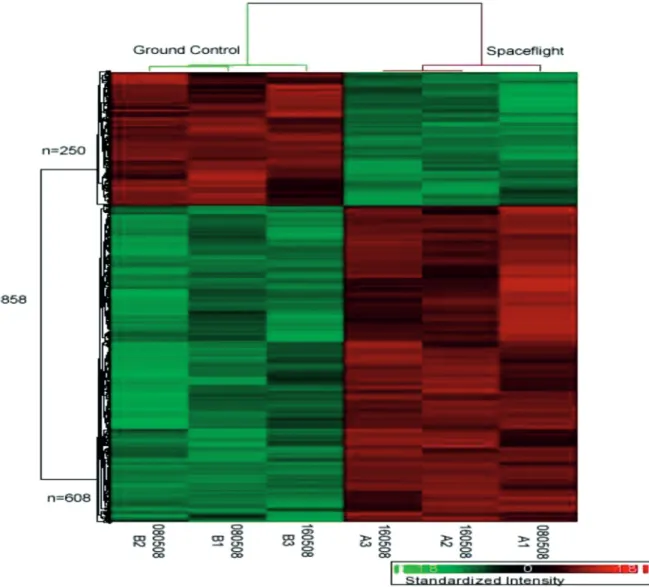
clustering performed for these 858 genes revealed that the genes were clustered according to conditions (space and ground) [refer to Figure 1 for expression patterns and complete gene list in Table 1. The genes whose expression level changed in between 2- and -2-fold were considered
as not significant (NS) when constructing the gene lists. Amongst the 858 genes, 608 of these increased by more than two fold, and 250 others decreased to less than negative two fold, in the spaceflight samples relative to the ground controls (P < 0.05) (Figure 1).
Figure 1: Hierarchical clustering of 858 differentially expressed genes which were differentially expressed (p-value ≤ 0.05, fold change ≥ ± 2) between space flown and ground control samples. Each row represents a single transcript, and each column
an experimental sample. Red and green colours correspond to up and down regulation, respectively, with a darker colour denoting less differential expression. Transcripts were hierarchically clustered into those with similar profiles, which were
showed to cluster according to the experiment conditions. Amongst these genes, 608 genes were up-regulated, while 250 genes were down-regulated under the same conditions.
GENE ONTOLOGy CLASSIFICATION
To further understand the changes observed in the gene expression of the worms grown in space especially in terms of biological functions, we used the GO classification for both the down-regulated and the up-regulated genes. Each gene was classified according to its ontology,by which genes are organized into hierarchical categories based on biological process (Partek) (4, 9, 10). The Chi-Square test was used; gene ontology categories were identified
5 meiotic chromosome segregation. Up-regulation of him-8
and zim-3, two genes encoded in the same operon and appearing in meiotic chromosome segregation biological functions, indicated that expression of these two genes is involved in the regulation of transcription factor activity (38). The expression of him-6 and rad-51 appeared together in biological functions such as embryonic development, cellular response to stress, cellular response to stimulus, cellular response to DNA damage stimulus and DNA repair suggesting that both genes were crucial for maintaining genome stability and survival of the worms in space. Spo-11 (homolog to homolog of yeast SPOrulation gene) which is the upstream effector of rad-51 and him-6 is involved in the cell cycle, DNA metabolic process, embryonic development and chromosome segregation. Up-regulated expression of msh-2 (which is homologous to the mismatch repair gene MSH), xpc-1 (xeroderma Pigmentosum group C DNA repair gene homolog) and brd-1 BaRD homolog (tumor suppressor gene Bard1) suggested the cellular responses to stimuli (including DNA damage) and the activation of DNA repair mechanisms in the worms grown in space.
Genes involved in biological adhesion and muscle tissue integrity that were down-regulated included the MUscle Attachment abnormal (mua-3) gene and the collagen genes, col-97, col-109 and col-113, indicating that biological adhesion in microgravity was less crucial. The MyOsin heavy chain structural (myo-3) gene which is involved in muscle tissue integrity was found to be up-regulated in the spaceflight samples. Expression of daf-19 gene which is crucial for cilia formation was down-regulated, indicating adaptation to microgravity environment which requires less movement and detection of environmental signals.
Other genes that were not from the top 25 GO list but were also involved in significant pathways included the Downstream of DAF-16 (dod) genes. There was up-regulated expression of dod-19, dod-3 and the heat shock protein hsp-16 gene which are all downstream effectors of DAF-16 of the TGF-beta pathway. The xenobiotic metabolizing enzymes such as cytochrome P450 ( cyp-13B1, -14A4, -34A9, -35B1, -35B2, -37B1 and -37B1) were all up-regulated in spaceflight samples. The genes for another xenobiotic enzyme, UDP-glucosyl transferase, Table 1: Gene Ontology: Top 25 enriched biological processes as classified by gene ontology biological process
GO category Enrichment Score % of genes in list Genes in list
GO: 45132: meiotic chromosome segregation 44.06 25.42 30
GO: 7059: chromosome segregation 42.86 24.22 31
GO: 51301: cell division 27.82 19.29 27
GO: 910: cytokinesis 26.77 20.34 24
GO: 22402: cell cycle process 21.44 16.56 26
GO: 51383: kinetochore organization 20.78 100.00 4
GO: 70: mitotic sister chromatid segregation 17.35 55.56 5
GO: 819: sister chromatid segregation 17.35 55.56 5
GO: 51304: chromosome separation 16.15 66.67 4
GO: 51382: kinetochore assembly 15.96 100.00 3
GO: 33554: cellular response to stress 15.55 19.72 14
GO: 9790: embryonic development 13.47 6.77 174
GO: 34453: microtubule anchoring 13.46 75.00 3
GO: 51313: attachment of spindle microtubules to chromosome 13.46 75.00 3
GO: 22403: cell cycle phase 13.37 20.76 11
GO: 51716: cellular response to stimulus 13.17 17.50 14
GO: 6974:response to DNA damage stimulus 13.06 50.00 4
GO: 9792: embryonic development ending in birth or egg hatching 12.16 6.68 170
GO: 51052: regulation of DNA metabolic process 11.87 44.44 4
GO: 70193: synaptonemal complex organization 11.87 44.44 4
GO: 34984: cellular response to DNA damage stimulus 11.87 18.97 11
GO: 6281: DNA repair 11.40 19.61 10
GO: 51276: chromosome organization 10.82 17.74 11
GO: 6259: DNA metabolic process 10.31 23.33 7
6
Table 2: List of significant genes related to cellular response to DNA damage and DNA repair mechanism, muscle-related genes, oxidative stress related genes and transcription factor related genes
Gene Gene Ontology (Biological Function) Probe ID Fold change P Value (A) Cellular response to DNA damage and DNA repair mechanism related genes
brd-1 Required for homologous recombination and DNA double-strand 179791_s_at 2.49648 0.000135 break repair
msh-2 Involved in mismatch repair after exposure to radiation 193072_s_at 2.15574 0.000437
rad-51 Required for double stranded breaks repairs induced by irradiation 193054_s_at 3.29784 0.000538
xpc-1 Required for nucleotide excision repair induced by UV light 187080_at 2.02433 0.001346
him-6 DNA damage checkpoint signaling in response to ion irradiation 189916_at 2.16031 0.000825
mut-2 Involved in transposon silencing and RNA interference 184510_at 2.31091 0.000055
spo-1 Maintain genomic stability 188650_at 2.63585 0.000166
(B) Muscle related genes
mua-3 Positive regulation of growth rate 189800_s_at -2.49227 0.0002675
myo-3 Myosin A 191856_s_at 3.11556 0.0011562
col-97 Extracellular matrix or adhesion 174960_at -4.73784 0.0008101
col-109 173235_at -9.09213 0.0000085
col-113 173518_s_at -4.46384 0.0014773
(C) Longevity related genes
dod-19 Downstream effector of DAF-16/TGF beta signaling pathway 175170_s_at 2.41566 0.0028085
dod-3 173335_s_at 4.046 0.0006910
hsp-16 188282_at 2.28231 0.0000120
(D) Oxidative stress related genes
fmo-1 xenobiotic metabolizing enzyme 191850_s_at 2.62025 0.00068966
fmo-3 194135_at -2.38922 0.0008818
gsto-1 Protects from long-term oxidative stress 175993_at 2.60862 0.0010937
gst-13 Involved in the oxidative stress response by detoxicification of 190852_at 4.05802 0.0000379
xenobiotics
gst-17 190932_at 2.17239 0.0015696
gst-26 191431_at 2.39447 0.0004633
gst-27 191393_s_at 5.03714 0.0001351
gst-36 191221_at 2.39447 0.0011611
gst-22 190899_at -2.3688 0.0032545
gst-29 191303_at -3.46122 0.0000268
gst-31 191307_at -2.42005 0.0017632
gst-39 191337_at -2.61787 0.0008503
cyp-13B1 Involved in the oxidative stress response by detoxicification of 185599_s_at 2.39574 0.0034556
xenobiotics
cyp-14A4 189218_at 2.18539 0.00113924
cyp-34A9 189457_at 3.23857 0.00000308
cyp-35B1 189366_at 4.51908 0.000230574
cyp-35B2 189256_at 3.50233 0.000877842
cyp-37B1 189221_at 3.9097 0.001077
cyp-43A1 189413_at 2.05028 0.00256461
ugt-9 Involved in the oxidative stress response by detoxicification of 191776_at -2.39168 0.00188094
xenobiotics
ugt-13 188934_at 2.01688 0.000466988
ugt-17 191689_s_at 2.53381 0.00210593
ugt-41 190849_at -2.72725 0.000194547
ugt-44 191445_at 2.35085 0.000483495
ugt-45 175194_at -3.43084 0.000135254
ugt-46 173204_s_at 3.14785 0.0014191
ugt-62 190886_at 3.1026 0.000286272
(E) Transcription factor activity
zim-2 Involved in meiosis (sexual reproduction) 190765_at 4.30691 0.00120765
zim-3 190670_at 2.34034 0.0002350
7 showed up-regulation in the isoforms ugt-13, ugt-17,
ugt-44, ugt-46 and ugt-62, whilst the isoforms ugt-9, ugt-41 and ugt-45 were down-regulated. Flavin-containing MonoOxygenase family (fmo-3), a recently discovered xenobiotic metabolizing enzyme (xME) orthologous to the same human gene was also up-regulated in the spaceflight samples. Various isoforms of oxidative stress-related genes such as (gluthathione S transferase) gst were significantly expressed, with increased expression of gsto-1, gst-13, gst-17, gst-26, gst-27, gst-36 and decreased expression of gst-22, gst-29, gst-31 and gst-39.
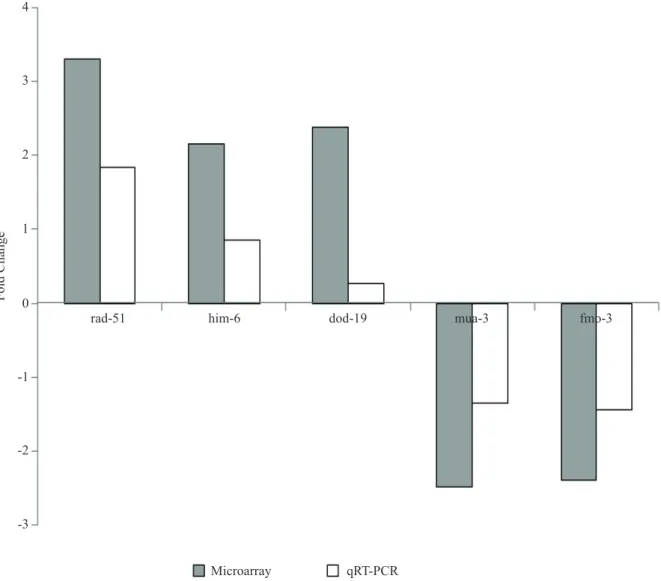
VALIDATION OF THE DIFFERENTIALLy ExPRESSED GENES USING REAL-TIME QUANTITATIVE PCR
To validate and evaluate more quantitatively the differences in gene expression as showed by the DNA microarrays, real-time quantitative PCR was performed. The RHO GTPase gene, cdc-42, is considered a ‘housekeeping gene’ that should be expressed at a steady level under most conditions, including spaceflight (20). we used cdc-42 as an internal standard against the genes of interest to normalize the quantitative PCR data. Expression of the muscle-related genes mua-3 decreased by 1.35 fold while the expression for DNA repair genes rad-51 and him-6 increased by 1.84 fold and 0.86 fold respectively. The expression of insulin/ TGF-beta signaling related genes, dod-19 increased by 0.26 fold compared with ground control worms, while the expression for fmo-3 genes decreased by 1.44 fold. The qRT-PCR correlated well with the microarray data (R2 = 0.917) which qualitatively validated and confirmed the observations made using the DNA microarray analysis, and gave a quantitative evaluation of the extent of mRNA expression.
discussion
whole genome transcriptome profiling has been used previously to investigate the changes in C. elegans cultured in the space environment (18, 19, 33); however their findings were attributed to the short term space exposure of 11 days. This was the first study to look at whole transcriptome profiling of C. elegans grown in space for more than 6 months and which had passed through at least 10 full generations in the ISS. The limitations of this study included the fact that the starting batch of worms was asynchronous and due to limitations of the hardware, we were not able to have biological replicates for the microarray study. Nonetheless, this study provides an insight on the adaptation of the worms through changes in gene expression as they grow and pass through multiple generation cycles in the space environment. The vital design here was the comparison of the survivors from the space flown worms with the ground controls which were passaged synchronously over the 6 months period.
we showed that expression of genes involved in gross development, apoptosis and DNA repair were consistent
with the profiles reported by previous studies (19, 45). From the GO classification, it was noted that him-6 and rad-51 were highly expressed in the top 25 genes list, which also included genes involved in other major biological functions such as meiotic chromosome segregation, cellular response to stress, cellular response to DNA damage (refer to Table 2) highlighting that the worms’ cellular adaptation to radiation in space. These 2 genes have been shown to be crucial in maintaining genome stability in the germ line by repairing double stranded DNA breaks induced by irradiation in normal proliferating germ cells (44). Him-6 is the ortholog of the human Bloom’s syndrome RecQ-like helicase genes (BLM) in which mutant genes cause increased genomic instability that can eventually lead to cancer (42). This study also showed that him-6 functions downstream of spo-11 and rad-51; while him-6 is required for normal levels of recombination during meiosis (44). Another study confirmed this observation in him-6 mutants and correlated the lost of him-6 function to significantly reduced life span from genomic instability caused by increased number of irreversible DNA lesions (13). Damage caused by radiation treatment in late embryonic stages in animals depleted from rad-51 resulted in several developmental defects in vulva and gonad formation (36). A dramatic increase in germ cell apoptosis was observed when rad-51 is inactivated (36). Loss of DNA damage checkpoint function can lead to genome instability which is one of the driving forces towards carcinogenesis (36). Up-regulation of him-10 in spaceflight also indicate involvement of this gene in the mitosis checkpoint, especially in the kinetochore organization in chromosome segregation of worms under microgravity condition, which is necessary to maintain normal cell cycle process of the worms (35). Up-regulation of him-8 together with zim-2 and zim-3 in space suggest increased transcription factor activity, chromosomal homologous pairing and synapsis during meiosis, which is crucial for the sexual reproduction of the worms (31, 38).
8
stress which were up-regulated. All of the cytochrome P450 genes were up-regulated in space suggested that the different isoforms were activated by the same xenobiotics, probably due to the increasing excretion of toxic metabolites in the CeMM (28). The fmo-1 and fmo-3 gene encodes for a xenobiotic-metabolizing enzyme which is expressed hypodermally in C. elegans and is inducible by exposure to xenobiotic FMO substrate benzydamine (30), therefore the up-regulation of fmo-1 gene and down-regulation of fmo-3 genes in space suggested that activation of the different isoforms could be responses to environmental stress in space. Studies have shown that gst-5, -6, -8, -10, -24 are involved in metabolizing 4-hydroxynon-2-enal (4-HNE), an eletrophilic aldehyde which act in parallel with reactive oxygen species (ROS) to cause lipid peroxidation (5, 16, 17). The studies also showed that these gst isoforms that
are involved in 4-HNE metabolism belong to two distant phylogenetic branches. Gst-26, -27, -29, -39 which were differentially expressed in spaceflight belong to the same phylogenetic branch. These gst isoforms were not found to be sensitive to 4-HNE (5), however, the role of these isoforms are still unclear in preventing oxidative stress. On the other hand, the gsto-1 gene was shown to be crucial in protecting worms from environmental pro-oxidant-induced stress (11), thus the increased expression of gsto-1 gene in spaceflight suggested that the space environment to be highly pro-oxidant and up-regulation of this genes, other DNA repair genes and stress-responsive genes could be part of the adaptative changes crucial for the survival of the worms in long-term space flight.
It is a known fact that microgravity in space resulted in muscle atrophy, which included muscle volume and
Figure 2: Comparison of expression of representative genes selected from microarray data with qRT-PCR. Comparison of fold change values from microarray data with expression ratios calculated from qRT-PCR. Values were determined using qRT-PCR and represents relative expression of genes between spaceflight and ground control sample. The relative expression of the target genes [dod-19: Downstream Of DAF-16 (regulated by DAF-16), mua-3: MUscle Attachment abnormal, fmo-3: Flavin-containing
MonoOxygenase family gene, him-6: High Incidence of Males and rad-51: RADiation sensitivity abnormal/yeast RAD-related gene] normalized to cdc-42: Cell Division Cycle related gene and relative to the expression of control. Bars represent standard errors calculated from 3 replicates of each experiment. *Significant difference (P < 0.05) between qRT-PCR and microarray data.
4
3
2
1
0
rad-51 him-6
Microarray
Fold Change
qRT-PCR
dod-19 mua-3 fmo-3
-1
-2
9 strength (12), while cosmic radiation caused reduction
in muscle fibers (6). A recent study on the effects of spaceflight on murine skeletal muscle gene expression revealed that besides the physical signs of muscle atrophy, genes involved in extracellular matrix or adhesion such as collagen (col-1a2, col-1a1, col-3a1, col-4a3bp) were down-regulated (3). we observed similar changes in our study with the down-regulation of col-97, col-109, col-113. The mua-3 gene codes for the MUA-3 protein, which is a novel transmembrane protein that localizes to hypodermal hemidesmosomes at the sites of skeletal muscle and to other epithelial sites where stress-resistant cuticular adhesion is required.
This MUA-3 protein is also required for muscle tissue integrity during normal locomotion of the worms (8). Down-regulation of this gene in the space flight samples could be an adaptative change due to the reduced locomotion in microgravity. we also showed that the expression of myo-3 was up-regulated in space, whereas previous studies involving worms grown over 10 days of spaceflight showed reduced expression of myosin heavy chain in the absence or reduction of muscle activity (2, 14, 43, 46). The daf-19, gene, which is involved in
environmental sensing and movement, was down regulated. This could be due to the decreased cilia formation and sensory detection in microgravity which could be crucial for the worms to respond to environmental signals such as food, dauer pheromone, or nose touch (34).
In conclusion, long term exposure and multi-generational culture of C. elegans in microgravity revealed key changes in the expression of genes involved in ageing, DNA repair, oxidative stress and muscle growth. These changes are most likely due to adaptation to the environmental signals as the worms divide and reproduce, over at least 10 generations, in space conditions. This study provided a preliminary insight of cellular and genetic adaptation to long term spaceflight environment through transcriptome regulation.
acknowledgeMent
we thank all supporting team members at Kennedy Space Center, Johnson Space Center, Ames Research Center, Marshall Space Flight Center, and BioServe Space Technologies; the Crew of STS-116 and STS-118. Figure 3: Correlation between the fold change values from microarray and the expression ratios calculated from qRT-PCR presented as level of gene expression. Correlation coefficient between the fold change values from microarray and qRT-PCR showed that mirroarray and qRT-PCR results are highly correlated indicated that the qRT-PCR validates the microarray data.
2.5
Microarray
qRT-PCR
qRT-PCR qRT-PCR Linear (qRT-PCR)
-2
-3 -1 1 3
R2 = 0.917
-2 0 2 4
-0.5 2
-1.5 1
0
-1 1.5
10
we would like to also thank the staff and students at the Caenorhabditis elegans Research Facility of the Malaysian Genome Institute for helping us set up the C. elegans laboratory at UMBI. This study was funded by the Ministry of Science, Technology and Innovation Malaysia under the grant UKM-ANGKASA-NBD-0019-2007.
references
1. Adenle AA, Johnsen B, and Szewczyk NJ. Review of the results from the International C. elegans first experiment (ICE-FIRST). Advances in Space Research 44 210-216, 2009.
2. Agbulut O, Vignaud A, Hourde C, Mouisel E, Fougerousse F, Butler-Browne GS, and Ferry A. Slow myosin heavy chain expression in the absence of muscle activity. Am J Physiol
296 C205-C214, 2009.
3. Allen DL, Bandstra ER, Harrison BC, Thorng S, Stodieck LS, Kostenuik PJ, Morony S, Lacey DL, Hammond TG, Leinwand LL, Argraves wS, Bateman TA, and Barth JL. Effects of space flight on murine skeletal muscle gene expression. J Appl Physiol 106: 582-595, 2009.
4. Ashburner M, Ball CA, Blake JA, Botstein D, Butler H, Cherry JM, Davis AP, Dolinski K, Dwight SS, Eppig JT, Harris MA, Hill DP, Issel-Tarver L, Kasarskis A, Lewis S, Matese JC, Rchardson JE, Ringwald M, Rubin GM, and Sherlock G. Gene ontology: tool for the unification of biology. The Gene Ontology Consortium. Nat Genet 25: 25-29, 2000.
5. Ayyadevara S, Dandapat A, Singh SP, Siegel ER, Shmookler Reis RJ, Zimniak L, and Zimniak P. Life span and stress resistance of Caenorhabditis elegans are differentially affected by glutathione transferases metabolizing 4-hydroxynon-2-enal. Mech Ageing Dev 128: 196-205, 2007.
6. Bandstra ER, Thompson Rw, Nelson GA, willey JS, Judex S, Cairns MA, Benton ER, Vazquez ME, Carson JA, and Bateman TA. Musculoskeletal changes in mice from 20-50 cGy of simulated galactic cosmic rays. Radiat Res 172: 21-29., 2009.
7. Bart P. Braeckman JRV. Genetic control of longevity in C. elegans. Experimental Gerontology 42: 90-98, 2007. 8. Bercher M, wahl J, Vogel BE, Lu C, Hedgecock wM,
Hall DH, and Plenefisch JD. mua-3, a gene required for mechanical tissue integrity in Caenorhabditis elegans, encodes a novel transmembrane protein of epithelial attachment complexes. The Journal of Cell Biology 154: 415-426, 2001
9. Boyle EI, weng S, Gollub J, Jin H, Botstein D, Cherry JM, and G. S. GO::TermFinder--open source software for accessing Gene Ontology information and finding significantly enriched Gene Ontology terms associated with a list of genes. Bioinformatics 20: 3710-3715, 2004. 10. Boyle EL, weng S, Gollub J, Jin H, Botstein D, Cherry JM,
and Sherlock G. GO::TermFinder--open source software for accessing Gene Ontology information and finding significantly enriched Gene Ontology terms associated with a list of genes. Bioinformatics 20: 3710-3715, 2004. 11. Burmeister C, Lüersen K, Heinick A, Hussein A,
Domagalski M, walter RD, and Liebau E. Oxidative stress in Caenorhabditis elegans: protective effects of the Omega
class glutathione transferase (GSTO-1). FASEB J 22: 343-354, 2008.
12. Gopalakrishnan R, Genc KO, Rice AJ, Lee SM, Evans HJ, Maender CC, Ilaslan H, and Cavanagh PR. Muscle volume, strength, endurance, and exercise loads during 6-month missions in space. Aviat Space Environ Med 81: 91-102, 2010.
13. Grabowski MM, Svrzikapa N, and Tissenbaum HA. Bloom syndrome ortholog HIM-6 maintains genomic stability in
C. elegans.Mechanism of Ageing and Development 126: 1314-1321, 2005.
14. Harrison BC, Allen DL, Girten B, Stodieck LS, Kostenuik PJ, Bateman TA, Morony S, Lacey D, and Leinwand LA. Skeletal muscle adaptations to microgravity exposure in the mouse. Journal of Applied Physiology 95 2462-2470, 2003.
15. Hartman PS, Hlavacek A, wilde H, Lewicki D, Schubert w, Kern RG, Kazarians GA, Benton EV, Benton ER, and Nelson GA. A comparison of mutations induced by accelerated iron particles versus those induced by low earth orbit space radiation in the FEM-3 gene of Caenorhabditis elegans.
Mutation Research 474: 47-55, 2001.
16. Hasegawa K, and Miwa J. Genetic and cellular characterization of Caenorhabditis elegans mutants abnormal in the regulation of many phase II enzymes. PLoS One 5: e11194, 2010.
17. Hasegawa K, Miwa S, Tsutsumiuchi K, and Miwa J. Allyl isothiocyanate that induces GST and UGT expression confers oxidative stress resistance on C. elegans, as demonstrated by nematode biosensor. PLoS One 5: e9267, 2010. 18. Higashibata A, Szewczyk NJ, Conley CA, Imamizo-Sato
M, Higashitani A, and Ishioka N. Decreased expression of myogenic transcription factors and myosin heavy chains in Caenorhabditis elegans muscles developed during spaceflight. The Journal of Experimental Biology 209: 3209-3218, 2006.
19. Higashitani A, Higashibata A, Sasagawa y, Sugimoto T, Miyazawa y, Szewczyk NJ, Viso M, Gasset G, Eche B, Fukui K, Shimazu T, Fujimoto N, Kuriyama K, and Ishioka N. Checkpoint and physiological apoptosis in germ cells proceeds normally in spaceflown Caenorhabditis elegans.
Apoptosis 10: 949-954, 2005.
20. Hoogewijs D, Houthoofd K, Matthijssens F, Vandesompele J, and Vanfleterenb JR. Selection and validation of a set of reliable reference genes for quantitative sod gene expression analysis in C. elegans. BMC Molecular Biology 9: 9, 2008.
21. Joshua McElwee KBaJHT. Transcriptional outputs of the Caenorhabditis elegans forkhead protein DAF-16. Aging Cell 2: 2003.
22. Kaletta T, and Hengartner MO. Finding function in novel targets: C. elegans as a model organism. Nature Reviews Drug Discovery 5: 387-399, 2006.
23. Livak KJ, and Schmittgen TD. Analysis of Relative Gene Expression Data Using Real-Time Quantitative PCR and the 22DDCT Method. METHODS 25: 402-408, 2001. 24. Livak KJ, and Schmittgen TD. Analysis of Relative Gene
Expression Data Using Real-Time Quantitative PCR and the 22DDCT Method. Methods 25: 402-408, 2001. 25. Longnecker DE, Manning FJ, and worth MHJ editors.
Review of NASA’s Longitudinal Study of Astronaut Health.
11 26. McElwee J, Bubb K, and Thomas JH. Transcriptional outputs
of the Caenorhabditis elegans forkhead protein DAF-16.
Aging Cell 2: 111-121, 2003.
27. McKay SJ, Johnsen R, Khattra J, Asano J, Baillie DL, Chan S, Dube N, Fang L, Goszczynski B, Ha E, Halfnight E, Hollebakken R, Huang P, Hung K, Jensen V, Jones SJ, Kai H LD, Mah A, Marra M, McGhee J, Newbury R, Pouzyrev A, Riddle DL, Sonnhammer E, Tian H, Tu D, Tyson JR, Vatcher G, warner A, wong K, Zhao Z, and Moerman DG. Gene expression profiling of cells, tissues, and developmental stages of the nematode C. elegans. Cold Spring Harb Symp Quant Biol 68: 159-169, 2003.
28. Menzel R, Rödel M, Kulas J, and Steinberg CE. CyP35: xenobiotically induced gene expression in the nematode Caenorhabditis elegans. Arch Biochem Biophys 438: 93-102, 2005.
29. Nelson GA, Schubert ww, Kazaxians GA, Richards GF, Benton EV, Benton ER, and Henke R. Radiation effects in nematodes: Results from IML-1 experiments. Advances in Space Research Vol. 14: 87-91, 1994.
30. Petalcorin MIR, Joshua Gw, Agapow P-M, and Dolphin CT. The fmo genes of Caenorhabditis elegans and C. briggsae: characterisation, gene expression and comparative genomic analysis. Gene 346: 83-96, 2005.
31. Phillips CM, Meng x, Zhang L, Chretien JH, Urnov FD, and Dernburg AF. Identification of chromosome sequence motifs that mediate meiotic pairing and synapsis in C. elegans. Nat Cell Biol 11: 934-942, 2009.
32. Selch F, Higashibata A, Imamizo-Sato M, Higashitani A, Ishioka N, Szewczyk NJ, and Conley CA. Genomic response of the nematode Caenorhabditis elegans to spaceflight.
Advances in Space Research 41: 807-815, 2008.
33. Selch F, Higashibata A, Imamizo-Sato M, Higashitani A, Ishioka N, Szewczyk NJ, and Conley CA. Genomic response of the nematode Caenorhabditis elegans to spaceflight.
Advances in Space Research 41: 807-815, 2008.
34. Senti G, and Swoboda P. Distinct isoforms of the RFx transcription factor DAF-19 regulate ciliogenesis and maintenance of synaptic activity. Mol Biol Cell 19: 5517-5528, 2008.
35. Stear JH, and Roth MB. The Caenorhabditis elegans kinetochore reorganizes at prometaphase and in response to checkpoint stimuli. Mol Biol Cell 15: 5187-5196, 2004. 36. Stergiou L, and Hengartner MO. Review: Death and more:
DNA damage response pathways in the nematode C. elegans.
Cell Death and Differentiation 11: 21-28, 2004.
37. Sulston J, and Hodgkin J. Method. In The Nematode Caenorhabditis elegans New york: Cold Spring Harbor Laboratory Press, 1988.
38. Sun H, Nelms BL, Sleiman SF, Chamberlin HM, and Hanna-Rose w. Modulation of Caenorhabditis elegans transcription factor activity by HIM-8 and the related Zinc-Finger ZIM proteins. Genetics 177: 1221-1226, 2007.
39. Szewczyk NJ, Kozak E, and Conley CA. Chemically defined medium and Caenorhabditis elegans. BMC Biotechnology
3: 19, 2003.
40. Szewczyk NJ, Mancinelli R, McLamb w, Reed D, Blumberg BS, and Conley CA. Caenorhabditis elegans survives atmospheric breakup of STS-107, space shuttle Columbia.
Astrobiology 5: 690-705, 2005.
41. Szewczyk NJ, Tillman J, Conley CA, Granger L, Segalat L, Higashitani A, Honda S, Honda y, Kagawa H, Adachi R, Higashibata A, Fujimoto N, Kuriyama K, Ishioka N, Fukui K, Baillie D, Rose A, Gasset G, Eche B, Chaput D, and Visom M. Description of International Caenorhabditis elegans Experiment first flight (ICE-FIRST). Advances in Space Research 42: 1072-1079, 2008.
42. van Brabant AJ, and Stan R. DNA helicases, genomic instability, and human genetic disease. Annu Rev Genomics Hum Genet 1: 409-459, 2000.
43. wang C, Sang C, Higashibata A, Ishioka N, Rong L, yang C, Sun y, yi ZC, and Zhuang Fy. Changes of Muscle-related Genes and Proteins After Spaceflight in Caenorhabditis elegans. Progress in Biochemistry and Biophysics 35: 1195-1201, 2008.
44. wicky C, Alpi A, Passannante M, Rose A, Gartner A,
and Mϋller F. Multiple Genetic Pathways Involving the
Caenorhabditis elegans Bloom’s Syndrome Genes him-6, rad-51, and top-3 Are Needed To Maintain Genome Stability in the Germ Line. MOLECULAR AND CELLULAR BIOLOGY 24: 5016-5027, 2004.
45. Zhao y, Lai K, Cheung I, youds J, Tarailo M, Tarailo S, and Rose A. A mutational analysis of Caenorhabditis elegans in space. Mutation Research 601: 19-29, 2006.