THE EFFICIENCY OF SUCTION DRAIN USAGE
IN ARTHROSCOPIC KNEE SURGERY
Oncel Cuneyt
,
1Ozcan Mert,
2Erem Murat,
2Copuroglu Cem,
2Ciftdemir Mert,
2Turan Nesrin Fatma
31
Yücelen Hospital, Department of Orthopaedic Surgery and Traumatology, Mu…la, Turkey 2
Trakya University, Medical Faculty, Department of Orthopaedic Surgery and Traumatology, Edirne, Turkey 3
Trakya University, Medical Faculty, Department of Biostatistics, Edirne, Turkey
Primljen/Received 27. 08. 2018. god. Prihva}en/Accepted 27. 09. 2018. god.
Abstract:Aim:The study was designed to inves-tigate the efficiency of suction drain after arthroscopic knee surgery. It is hypothesized that suction drain dec-reases postoperative hemarthrosis after arthroscopic knee surgery.
Methods:Patients were randomized into two gro-ups. Suction drain was used in Group I and no drain was used in Group II. The groups were compared in terms of rest and activity pain, range of motion, Lysholm and International Knee Documentation Com-mittee (IKDC) scores, patellar shock, need for postop-erative knee puncture, amount of drainage, time of hos-pitalization, and loss of labor. Arthroscopic interventi-ons like meniscectomy, synovectomy, meniscus repair and microfracture were also compared for the amount of patellar shock, need for postoperative knee puncture and amount of drainage.
Results:The difference for activity pain and ran-ge of motion between the two groups was statistically nonsignificant. Rest pain improved faster in control group. Lysholm and IKDC scores were improved in both groups but the amount of increase was statisti-cally nonsignificant. The amount of patellar shock was also statistically nonsignificant between the two gro-ups. The amount of patellar shock, need for postopera-tive knee puncture and amount of drainage were also statistically nonsignifiant for arthroscopic interventi-ons like meniscectomy and synovectomy.
Conclusions:Suction drain application was un-necessary in many situations after arthroscopic knee surgery in this study. Although suction drain usage de-layed the recovery from postoperative pain in this study, other parameters of pain were not affected from suction drain usage. Routine usage of a suction drain after arthroscopic knee surgery was not recommended.
Key words:Suction drain, knee arthroscopy, he-marthrosis, postoperative pain, patellar shock.
INTRODUCTION
Suction drains are widely used after knee surgery in orthopaedic practice to decrease the amount of post-operative hematoma however benefits of suction drain usage is still controversial (1, 2). Suction drain usage is not a routine procedure after arthroscopic knee surgery, and it is a controversial subject (2, 3).
It was thought that the postoperative hematoma af-ter arthroscopic knee surgery may irritate the synovium causing postoperative effusion and capsular distension and eventual patient discomfort (3, 4). Postoperative complaints, mobilization capacity, hospitalization time and time of occupation loss can change according to amount of hematoma and rehabilitation can be delayed. There is no study in the literature which proves the effect of suction drain usage on postoperative hemarhrosis and effusion after knee arthroscopy. Most of the studies abo-ut this subject was performed after anterior cruciate liga-ment (ACL) reconstruction. There are a few case series about this subject however they are away from explain-ing the problem (1, 3). Therefore we aimed to clarify suction drain usage after arthroscopic knee surgery.
According to our hypothesis suction drain usage after arthroscopic knee surgery decreases postoperati-ve hemarthrosis and subsequent knee effusion and in-creases postoperative comfort.
MATERIAL AND METHODS
In this randomized double blind study 113 pati-ents who underwent arthroscopic knee surgery were evaluated. Arthrotomy was needed in three patients
du-2018; 13(3): 243–251 ID: 271677196
ring operation, therefore these three patients were re-moved from the study. The patients who were treated for ACL reconstruction were not included to the study. The patients with systemic disorder, bleeding diathe-sis, history of acute major knee trauma or synovial dis-order were also excluded from the study. Institutional review board approval and patient informed consent were obtained for all patients.
The patients were randomly divided into two gro-ups by a computer program. Group 1 (mean age 41.42, 33 male (60%) and 22 female (40%)) included 55 pati-ents with a suction drain and Group 2 (mean age 41.62, 32 male (58%) and 23 female (42%)) included 55 pati-ents without a suction drain. The study was designed do-uble blind, meaning that the surgeon and the follow-up physicians were not informed about the drain status of the patients. All patients were operated by the samesur-geon under spinal or general anesthesia. Arthroscopic pump was not used in any of the patients. Standart tour-niquet which was inflated to 300 mmHg was used in all operations. Asuction drain (Bæcakcilar, Turkey, B-VAK 400 Wound Drainage System 12CH) with an external diameter of 4mm was inserted at the end of operation in Group 1. After a compressive dressing was applied from tigh to ankle, the clamp of the drain was opened.
Suction drains were removed 24h after the opera-tion and the amount of drainage was noted. The same rehabilitation programme was applied to all patients including active quadriceps strengthening and range of motion increasing exercises, and they were allowed to bear weight as soon as they tolerated.
The patients were controlled four times postoper-atively (first day, second and sixth week, and third month). Pain during daily routine activities (climbing upstairs, walking, squatting etc.) of the patients were recorded before and after the surgery and called as rou-tine activity pain. Rest pain of the patients were also re-corded before and after the operation and called as rest pain. Preoperative knee range of motion of the patients were measured and compared with postoperative mea-surements. Severity of pain was evaluated with Visual Analogue Scale (VAS). VAS is a horizontal line divi-ded into ten equal intervals in which zero represents no pain and ten represents the worst pain ever felt. Opera-tive findings and surgical interventions were noted for each patient. The most common surgical interventions were meniscectomy, synovectomy, meniscal repair and subchondral microfracture.
Preoperative and postoperative sixth week and third Lysholm scores (5) and International Knee Docu-mentation (IKDC) 2000 knee evaluation scores (6) of the patients were measured and noted.
Postoperative knee effusion was determined by patellar shock. Patellar shock was graded in four
sca-les: Grade 1, some notable fluid, Grade 2, minimally elevated patella, Grade 3, patellar ballottement, and Grade 4, tense knee capsule, unable to compress patel-la (7). Knee puncture was applied to all Grade 4 and symptomatic Grade 3 patients. The patients who nee-ded postoperative knee puncture and the amount of the fluid (puncture fluid) were noted.
A power analysis was conducted to minimize error and bias. According to post hoc power analysis enroll-ing 55 subjects in each group would provide an adequa-te sample size to achieve a power of > 80% at a p < 0.05 significance level to detect a difference of ten points in the knee score (Lysholm) improvement and a difference of ten degrees in the knee motion improvement.
The Statistical Package for the Social Sciences for Windows (Version 20, serial 10240642) was used for statistical analysis. Suitability of quantitative data to normal distribution was determined by one sample Kolmogorov Smirnov test.
For normally distributed data variance analysis was used to make comparisons between the groups, and to describe changes in repeated measurements in each group. T-test was used in comparisons of indepen-dent groups. For the data that was not normally distrib-uted, Mann Whitney-U test was used to compare gro-ups, Friedman and Wilcoxon two sample tests were used in intra-group comparisons. Yates corrected X2, Fisher’s exact X2and KolmogorovSmirnov two sam-ple tests were used in qualitative data. Median (mini-mum – maxi(mini-mum) and mean value ± standart deviati-ons were given as descriptive statistics. The level of significance was set at p < 0.05.
RESULTS
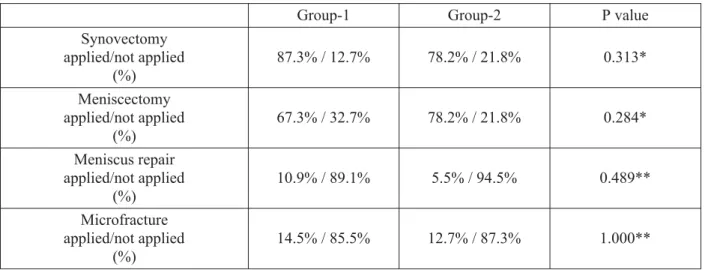
The groups were comperable in terms of age and gender (p = 0.912 for age (t-test for independent gro-ups) and p = 1.000 for gender (Fisher’s exact Chi-Squ-are test). Arthroscopic interventions were summarized in Table 1, and also there was no statistically signifi-cant difference between the groups in terms of arthro-scopic interventions.
The decrease in rest and routine activity pain dur-ing follow-up was statistically siginificant for both groups. Rest and routine activity pain was summarized in Table 2.
statisti-cally significant (p = 0.873, Wilcoxon signed rank test). In Group 2 rest pain increased for males and fe-males significantly (p = 0.025 for fe-males, p = 0.002 for females, Wilcoxon signed rank test).
Postoperative 15th day rest pain was compared with preoperative rest pain. In Group 1 no statistically significant difference was found (p = 0.086, Wilcoxon Signed Rank test), however in Group 2 postoperative 15th day rest pain was a statistically lower than preope-rative pain (p = 0.005, Wilcoxon Signed Rank test).
Preoperative flexion values were compared with postoperative first and 15th day flexion values in both groups. The first postoperative and 15th day flexion values were decreased when compared with preopera-tive values and this decrease was statistically signifi-cant for both groups (p < 0.001 for both groups for all measurements, Wilkinson signed ranks test). However no statistically significant differrence was observed
between the groups for flexion decrease (p = 0.474 and p = 0.395 for first and 15th day follow-up respecti-vely). On the other hand flexion was increased gradu-ally from first postoperative control till last one for both groups (p < 0.001 for both groups, Friedman test) final flexion values were reached in last control (3 months) in both groups.
Extension lost was also compared by the same manner between the two groups. Extension lost was seen in postoperative first and 15th day follow-up con-trols and it was statistically significant for both groups groups (p < 0.001 for both groups for all measure-ments, Wilkinson signed ranks test). Extension loss was not statistically different between the two groups in first and 15th postoperative days (p = 0.397 and p = 0.160 for first and 15th day follow-up respectively). Extension values were also improved gradually during follow-up period and this increase was statistically
sig-Table 1.Arthroscopic interventions and distribution between two groups
Group-1 Group-2 P value
Synovectomy applied/not applied
(%)
87.3% / 12.7% 78.2% / 21.8% 0.313*
Meniscectomy applied/not applied
(%)
67.3% / 32.7% 78.2% / 21.8% 0.284*
Meniscus repair applied/not applied
(%)
10.9% / 89.1% 5.5% / 94.5% 0.489**
Microfracture applied/not applied
(%)
14.5% / 85.5% 12.7% / 87.3% 1.000**
*Chi-Square Continuity Correction. **Fisher’s exact Chi-Square test.
Table 2.Postoperative rest and routine activity pain in follow-up controls
Pain Follow-up
control number
Grup-1 mean (min-max)
Grup-1 mean (min-max)
Rest pain 1 3.55 (0-8) 3.05 (0-8)
2 2.69 (0-6) 1.85 (0-5)
3 2.07 (0-6) 1.27 (0-5)
4 1.78 (0-6) 1.09 (0-4)
P value < 0.001* < 0.001*
Activity pain 1 5.47 (2-8) 5.31 (1-8)
2 4.40 (1-7) 3.64 (0-7)
3 3.55 (0-7) 2.76 (0-7)
4 3.04 (0-8) 2.35 (0-6)
P value < 0.001* < 0.001*
nificant for both groups (p < 0.001 for both groups, Fri-edman test). The patients in Group 1 reached their pre-opertative extension values in third control (6 weeks), however the patients in Group 2 reached it in second control (second week). Recovery of extension was fa-ster in Group 2.
Preoperative Lysholm and IKDC scores were im-proved significantly in both groups after operation (p < 0.001 for both groups and scores). The amount of in-crease was not statistically different between the two groups (p = 0,735 for Lysholm and p = 0.729 for IKDC-repeated measures of ANOVA). Lysholm and IKDC scores were given in Table 3.
Knee puncture was applied to 14 patients in Gro-up 1 and 11 patients in GroGro-up 2. Need of puncture was not statistically different between the two groups (p = 0.649, continuity to correction). The mean amount of aspirated fluid was 45cc (20cc-110cc) in Group 1 and 60cc (30cc-145cc) in Group 2. The amount of fluid which was aspirated from the knee was not also statisti-cally different between the two groups (p = 0.151, Mann-Whitney U test).
The relationship between the arthroscopic inter-ventions and need of puncture was compared between the two groups. Need of puncture was not statistically different between the groups for synovectomy, meni-scectomy, meniscus repair and microfracture (p = 1.000, 0.341, 1.000 and 0.604 respectively, Fisher’s Exact Chi-Square) (Table 4).
The grade of patellar shock was not statistically different between the two groups in all four postopera-tive follow-up controls (p = 0.606 and 1.000 for control one and two respectively, Two Sample Kolmogorov Smirnov test, p = 0.740 for control three, Continuity to Correction, p = 1.000 for control four, Fisher’s Exact Chi-square).
The patients with and without synovectomy were compared in first and second postoperative controls for patellar shock in Group 1, and no statistically significant difference was found (p = 1.000 and p = 0.860 for con-trols one and two respectively, Two Sample Kolmogorov Smirnov test). It was no also statistically different in Gro-up 2 (p = 0.095 and p = 0.819 for controls one and two re-spectively, Two Sample Kolmogorov Smirnov test). Lysholm-1
(mean ± std. dev.)
Lysholm-2 (mean ± std. dev.)
Lysholm-3 (mean ± std. dev.)
Group-1
(n = 55) 57.80 ± 18.35 67.71 ± 17.378 75.56 ± 15.33
Group-2
(n = 55) 58.18 ± 17.598 69.60 ± 16.186 76.35 ± 16.463
IKDC-1 (mean ± std. dev.)
IKDC -2 (mean ± std. dev.)
IKDC -3 (mean ± std. dev.)
Group-1
(n = 55) 54.87 ± 17.313 63.87 ± 16.488 71.16 ± 15.561
Group-2
(n = 55) 55.40 ± 16.346 65.22 ± 16.582 72.44 ± 17.427
std. dev. = Standart deviation
Table 3.Preoperative (Lysholm-1), postoperative 6th week (Lysholm-2) and postoperative 3rd month (Lysholm-3) Lysholm scores, and preoperative (IKDC-1), postoperative 6th week (IKDC-2)
and postoperative 3rd month (IKDC-3) IKDC scores
Table 4.Need of puncture for each arthroscopic intervention and comparisons between the two groups
Group-1 (n = 55)
Group-2 (n = 55)
P value (for puncture)
Synovectomy (% of total)
/ Puncture (% in synovectomy) 87.3% / 25% 78.2% / 20.9% 1.000
Meniscectomy (% of total)
/ Puncture (% in meniscectomy) 67.3% / 27% 78.2% / 23% 0.341
Meniscus repair (% of total)
/ Puncture (% in meniscus repair) 10.9% / 16.7% 5.5% / 0% 1.000
Microfracture (% of total)
The same comparisons were also done for patients with meniscectomy and without meniscectomy. No sta-tistical difference was found for both groups in first and second controls (p = 0.184 and p = 0.856 for Group-1 in first and second controls respectively; p = 0.994 and p = 0.972 for Group 2 in first and second controls respecti-vely, Two Sample Kolmogorov Smirnov test).
The comparison of patellar shock was not done for microfracture and meniscal repair due to small number of patient population.
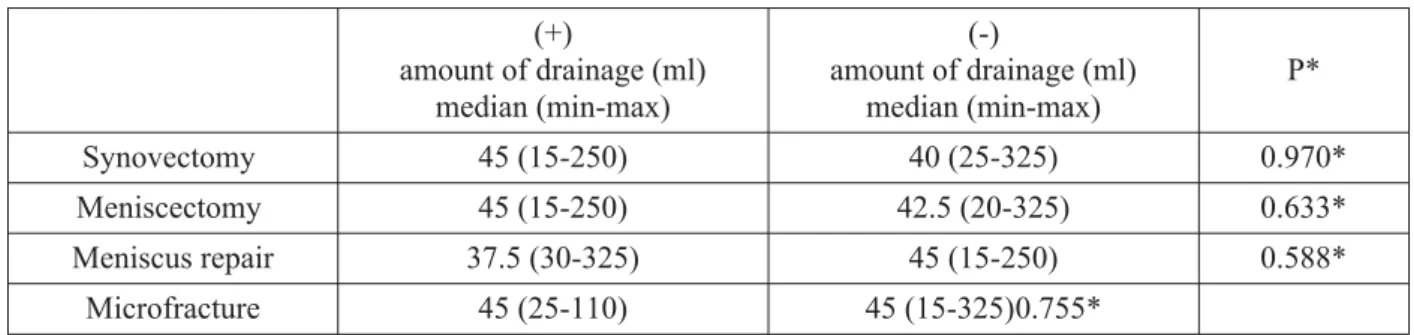
The patients with synovectomy and without syno-vectomy in Group-1 were compared for the amount of drainage. The same comparison was also done for me-niscectomy, meniscal repair and microfracture. The amount of fluid was not statistically different for all ar-throscopic interventions in Group 1 (Table 5).
The patients with synovectomy were compared for patellar shock between the two groups. No statistically significant difference was found between the two gro-ups in all four follow-up controls (p = 0.765 and p = 0.999 for controls one and two, Two Sample Kolmogo-rov Smirnov test, p = 0.717 and p = 1.000 for control three and four, Fisher’s Exact Chi-square). Need for knee puncture (p = 0.833, Continuity to Correction) and amount of fluid from knee puncture (p = 0.114, Mann Whitney U test) were not also statistically different bet-ween the two groups in patients with synovectomy.
The patients with meniscectomy were compared for patellar shock between the two groups. No statisti-cally significant difference was found between the two groups in all four follow-up controls (p = 0.990 and p = 1.000 for controls one and two, Two Sample Kolmogo-rov Smirnov test, 1.000 and p = 0.462 for control three and four, Fisher’s Exact Chi-square). Need for knee puncture (p = 0.987, Continuity to Correction) and amount of fluid from knee puncture (p = 0.149, Mann Whitney U test) were not also statistically different be-tween the two groups in patients with meniscectomy.
Type of anesthesia (spinal block or general anest-hesia) and the amount of drainage fluid were compared
and no statistically significant difference was found (p = 0.867, Mann Whitney U).
Time of hospitalization was not statistically diffe-rent between Group 1 (4.02 ± 2.649 days) and Group 2 (3.18 ± 1.906 days) (p = 0.132 Mann Whitney U test).
Time to return occupation was 20.36 ± 13.012 days for Group 1 and 18.15 ± 11.715 days fro Group 2. There was not a statistically significant difference between the two groups (p = 0.310, Mann Whitney U test).
DISCUSSION
According to our hypothesis suction drain usage after arthroscopic knee surgery decreases postoperati-ve hemarthrosis and subsequent knee effusion and in-creases postoperative comfort. This hypothesis was re-fused after this investigation.
Suction drains are useful in drainage of hematoma or fluid from cavitary regions (4). During knee arthro-scopy some surgical interventions like synovectomy or meniscectomy may lead to bleeding and hemarthrosis (2, 8, 9). Hemarthrosis may irritate synovium and may stretch joint capsule causing to postoperative pain (1). Postoperative pain is one of the most important param-eters decreasing patient complience to postoperative rehabilitation, therefore may alter recovery (4). In tory suction drains can decrease the formation of he-marthrosis and indirectly may affect recovery. This study was designed to investigate the benefits of suc-tion drain applicasuc-tion after arthroscopic knee surgery.
Rest pain and routine activity pain were both dec-reased statistically after the operation in both groups. This result was an indicator of patient recovery after the operation.
Postoperative first day rest pain was statistically increased in both groups when compared with preoper-ative rest pain. Increased rest pain was observed in both groups, therefore it was thought that increase in pain was not related with suction drain usage. This pain increase was interpreted as postoperative surgical pain. (+)
amount of drainage (ml) median (min-max)
(-)
amount of drainage (ml) median (min-max)
P*
Synovectomy 45 (15-250) 40 (25-325) 0.970*
Meniscectomy 45 (15-250) 42.5 (20-325) 0.633*
Meniscus repair 37.5 (30-325) 45 (15-250) 0.588*
Microfracture 45 (25-110) 45 (15-325)0.755*
(+) represents the patients with the corresponding intervention (-) represents the patients without corresponding intervention min-max: minimum – maximum
* Mann Whitney U
In control group post operative rest pain increase did not differ between the two sex. However, in suction drain group postoperative first day rest pain increase was observed in males but it was not observed in fema-les. It can be thought that females might be more toler-able for drain usage.
Postoperative 15th day rest pain was compared with preoperative rest pain to evaluate the relief of sur-gical pain. In suction drain group no statistical differ-ence was found between the preoperative and postope-rative 15th day rest pain. However, in control group, postoperative 15th day rest pain was statistically lower than preoperative rest pain. Therefore it was thought that, suction drain usage after knee arthroscopy may delay the recovery of postoperative pain.
Some amount of flexion - extension loss is expec-ted after arthroscopic knee surgery during the early stoperative period due to hemarthrosis, edema and po-stoperative pain (10). Flexion and extension values of both groups were compared to evaluate the effect of suction drain inpostoperative loss of range of motion.
When postoperative 1st and 15th day flexion de-grees were compared with preoperative flexion values, a statistically significant decrease was observed in both groups. This loss in flexion values was an expected fin-ding. Postoperative loss of flexion was not statistically different for both groups, therefore it was thought that, loss of flexion during the early postoperative period was not related with suction drain usage. Flexion valu-es were increased gradually during the follow-up pe-riod and preoperative flexion values were reached in the last control (postoperative 3rd month) in both gro-ups. It was thought that recovery of flexion values dur-ing the postoperative period was not affected by suc-tion drain usage in this study.
Extension loss was also observed in both groups postoperatively, however it was not statistically differ-ent between the two groups. Therefore it was thought that, loss of extension in the early postoperative period was due to postoperative changes. Extension values were also improved gradually during the postoperative period, and this improvement was not statistically dif-ferent between the two groups. Preoperative extention values were obtained in second week control in control group, and in 6th week in suction drain group. Preoper-ative extension values were reached in both groups, however this recovery of extension was faster in con-trol group. Therefore it can be thought that, suction drain usage may delay recovery of extension after ar-throscopic knee surgery.
When the scoring systems were evaluated it was observed that both IKDC and Lysholm scores were im-proved statistically in both groups. Improvement in IKDC and Lysholm scores were not statistically
differ-ent between the two groups. According to these results, it was observed that, the pain of the patients was decre-ased, and quality of life was increased after arthroscop-ic knee surgery, however suction drain usage did not affect these results.
Knee hemarthrosis is one of the most commonly seen complications after knee arthroscopy (11). Occasi-onally hemarthrosis stretches the joint capsule leading to pain and tenderness and it decreases patient compli-ance to postoperative rehabilitation (1). When hemar-throsis is observed in the postoperative period a knee puncture may be needed to drain the knee. In this study 25 patients needed knee puncture. Need of knee punctu-re was not statistically diffepunctu-rent between the two groups, therefore using suction drains did not decrease the need of knee puncture in this study. The amount of aspirated fluid was also measured and compared between the two groups. The amount of aspirate was not also statistically different between the two groups. Therefore, usage of suction drains after knee arthroscopy did not improve the need of knee puncture and did not decrease the amo-unt of aspirate material in this study.
Some interventions during arthroscopic knee sur-gery may cause more bleeding than the others like syno-vectomy and microfracture (11). In these synosyno-vectomy and microfracture patients, more bleeding is expected after the operation, which increases the need of knee puncture due to hemarthrosis. Need of knee puncture and the effect of suction drain usage were investigated for each arthroscopic procedure in the study. The relati-onship between the arthroscopic interventions and need of puncture was compared between the two groups. Need of puncture was not statistically different between the groups for synovectomy, meniscectomy, meniscus repair and microfracture. It was observed that, suction drain usage did not decrease the need of postoperative knee puncture even in synovectomy and microfracture patients where much bleeding is expected.
Patellar shock is a valuable finding in the fol-low-up of postoperative knee effusion. Both groups were investigated for the development of patellar shock during the follow-up periods. Patellar shock was not statistically different between the two groups in all four postoperative follow-up controls. Using postoper-ative suction drain did not affect the development of patellar shock in this study.
patellar shock in first and second postoperative con-trols to investigate the benefits of suction drain usage in synovectomy patients. However no statistically sig-nificant difference was observed for patellar shock in first and second controls between the patients with synovectomy and without synovectomy. The same comparisons were also done for Group 2 and no statis-tically significant difference was observed. According to these results it was thought that, synovectomy did not increase the risk of hemarthrosis and patellar shock development alone. It was thought that, causes of knee hemarthrosis after synovectomy must be investigated with further studies. It was also observed that suction drain usage did not decrease the hemarthrosis after ar-throscopic synovectomy. As a result it was concluded that, using suction drain after arthroscopic synovec-tomy to decrease the amount of hemarthrosis is an in-valuable procedure.
The same comparisons about patellar shock were also done for patients with meniscectomy and without meniscectomy. No statistical difference was found bet-ween the patients with meniscectomy and without me-niscectomy for both groups in first and second con-trols. It was also concluded that using suction drain af-ter arthroscopic meniscectomy to decrease the amount of hemarthrosis is an invaluable procedure.
The amount of drainage fluid in the suction drain was measured in the patient Group 1. This drainage was composed of blood in all cases, therefore it is used as a measurement of early postoperative bleeding. The patients with synovectomy and without synovectomy in Group 1 were compared for the amount of drainage. The same comparison was also done for meniscec-tomy, meniscal repair and microfracture. The amount of fluid was not statistically different for all arthrosco-pic interventions in Group 1. It was thought that, the amount of drainage was not directly related with ar-throscopic intervention. However such a result may not be correct since, more than one interventions were applied to all patients during arthroscopy. This is one of the weak points of this study.
The patients with synovectomy in two groups we-re compawe-red for patellar shock. No statistically signifi-cant difference was found between the two groups in all four follow-up controls. The same comparisons we-re also done for need of knee punctuwe-re and amount of fluid which was aspirated during knee puncture. Need for knee puncture and the amount of fluid from knee puncture were not also statistically different between the two groups in patients with synovectomy. Therefo-re it was thought that using suction drain after arthro-scopic knee surgery did not affect patellar shock devel-opment, need of knee puncture and the amount of fluid from knee puncture after arthroscopic synovectomy.
The patients with meniscectomy in two groups were also compared for the parameters above. No stati-stically significant difference was found between the two groups in all four follow-up controls for the devel-opment of patellar shock. Need for knee puncture and amount of fluid from knee puncture were not also stati-stically different between the two groups in patients with meniscectomy. Therefore it was thought that us-ing suction drain after arthroscopic knee surgery did not affect patellar shock development, need of knee puncture and the amount of fluid from knee puncture after arthroscopic meniscectomy.
As a result, it was thought that, development of postoperative knee effusion (hemarthrosis) after ar-throscopic meniscectomy and synovectomy was inde-pendent of suction drain usage.
There are three meta analysis in the literature abo-ut the comparison of general and regional anesthesia in knee and hip surgery (12, 13, 14). Although there is a marked heterogenity about peroperative blood loss and need of blood transfusion, there is a tendency of increa-sed blood loss in general anesthesia. The effect of anes-thesia on bleeding after arthroscopic knee surgery was also investigated in this study. The amount of drainage fluid from suction drain was compared between the pa-tients who had spinal or general anesthesia. There was no statistically significant difference between the two anesthesia types for the amount of drainage. Therefore it can be suggested that early postoperative hemorrha-ge after arthroscopic knee surhemorrha-gery is not related with the type of anesthesia in this study.
Hospitalization time was not statistically different between the two groups. The patients with suction drain did not discharge early from the hospital. The ti-me from the operation till return to occupation was also compared between the two groups and again no statis-tical difference was observed. Loss of labor did not de-crease after the usage of suction drains.
Limitations
Statistical comparisons cannot be done for meni-scal repair and microfracture subgroups due to small sample size to evaluate the risk of hemarthrosis. Further studies with much larger series are needed development after arthroscopic meniscal repair and microfracture.
arthro-scopy, additional pathologies can be observed, and pre-operative plan can be changed according to these new findings.
CONCLUSION
We do not suggest routine usage of a suction drain after arthroscopic knee surgery. Although recovery of extension loss was faster in the control group, preoper-ative flexion and extension values were obtained in both groups in the last follow up. Although suction drain usage delayed the recovery of postoperative pain in this study other parameters of pain were not affected from suction drain usage. It can be used selectively in patients with high risk of bleeding like total arthrosco-pic synovectomy.
Acknowledgements
This subject was graduation thesis of Dr. Cüneyt Öncel (one of our residents in Trakya University,
Edir-ne, Turkey) and preliminary results were reported as graduation thesis (about a total of 70 patients). The study was finished by us and a manuscript was prepa-red. These preliminary results were also reported in the XXIIth National Turkish Orthopedics and Traumato-logy Congress in 2011 Antalya, TURKEY as an oral presentation. Dr Nurhak Yavuz was also helped in data collection for this research. We confirm that, this ma-nuscript is original and has not been submitted elsew-here for publication or has been published elsewelsew-here.
DECLARATION OF INTEREST
The autors declare that there are no conflicts of in-terests.
Licensing
This work is licensed under a Creative Commons Attribution 4.0 International (CC BY 4.0) License.
Sa`etak
EFIKASNOST PRIMENE DRENA@E
U ARTROSKOPSKOJ OPERACIJI KOLENA
Oncel Cuneyt,1Ozcan Mert,2Erem Murat,2Copuroglu Cem,2 Ciftdemir Mert,2Turan Nesrin Fatma3
1
Yücelen Hospital, Department of Orthopaedic Surgery and Traumatology, Mu…la, Turkey
2
Trakya University, Medical Faculty, Department of Orthopaedic Surgery and Traumatology, Edirne, Turkey
3
Trakya University, Medical Faculty, Department of Biostatistics, Edirne, Turkey
Cilj:Cilj ove studije bio je da se ispita efikasnost sukcionog drena nakon artoskopske operacije kolena. Hipoteti~ki govore}i, po{li smo od pretpostavke da sukcioni dren smanjuje postoperativnu hemartrozu na-kon artroskopske operacije kolena.
Metode:Pacijenti su nasumi~no podeljeni u dve grupe. U Grupi I kori{}en je sukcioni dren, a u Grupi II nije kori{}ena sukciona drena`a postoperativno. Grupe su pore|ene u pogledu oporavka, bolova pri pokreti-ma, opsega pokreta, prema tablicama Lisholma i inter-nacionalnog saveta za dokumetaciju o operacijama ko-lena (IKDC), patelarnog stresa, potrebe za postopera-tivnom punkcijom kolena, koli~ine dreniranog sadr`a-ja, vremena provedenog u hospitalizaciji i gubitka rad-ne snage obolelog kolena. Artroskopske intervencije koje su bile kori{}ene uklju~ivale su meniscektomiju, sinoviektomiju, popravku meniskusa i mikrofrakture. Ove intervencije su tako|e bile upore|ivane u pogledu ukupnog stresa po patelu, potrebe za postoperativnom drena`om i koli~ine dreniranog sadr`aja.
Rezultati:Nije na|ena statisti~ki zna~ajna razlika u pogledu postoperativnog bola i opsega pokreta u
zglobu kolena izme|u grupa. Parametar – bol u miro-vanju je zna~ajno br`e zaceljivao u kontrolnoj grupi. Lisholm vrednosti skorova I IKDS skor su zna~ajno bi-li bolji u obe grupe, abi-li brzina porasta nije bila od stati-sti~ke zna~ajnosti. Statisti~ka zna~ajnost u pogledu pa-rametra – koli~ina patelarnog stresa tako|e nije bila od statisti~ke zna~ajnosti me|u grupama. Stepen patelar-nog stresa, potreba za postoperativnom punkcijom ko-lena i koli~ina dreniranog sadr`aja nisu bili statisti~ki zna~ajni za artroskopske intervencije kao {to su meni-scektomija i sinoviektomija.
Zaklju~ak:Primena sukcionog drena bila je ne-potrebna u mnogim slu~ajevima nakon artoskopske operacije kolena u ovoj studiji. Iako je primena sukcio-ne drena`e imala za posledicu du`i period oporavka od postoperativnog bola, drugi parametri bola nisu bili uzrokovani primenom sukcionog drena. Prema rezul-tatima ove studije, rutinsko kori{}enje sukcionog dre-na dre-nakon artroskopske operacije koledre-na se ne preporu-~uje.
REFERENCES
1. Akan K, Ünay L, Berkem L, Güven M, Poyanl2 O. Suc-tion drainage influence on knee effusion following partial fat pad or synovium resection. Acta Orthop Traumatol Turc. 2001; 45(4): 221-4.
2. Coupens SD, Yates CK. The effect of tourniquet use and hemovac drainage on postoperative hemarthrosis. Arthroscopy. 1991; 7(3): 278-82doi:10.1016/0749-8063(91)90127-J.
3. Tatari H, Derviºbey M, Muratl2 K, Ergör A. Report of experience in 190 patients with the use of closed suction drainage in arthroscopic knee procedures. Knee Surg Sports Traumatol Arthrosc. 2005; 13(6): 458-62.
4. Browett JP, Gibbs AN, Copeland SA, Deliss Lj. The use of suction drainage in the operation of meniscectomy. J Bone Joint Surg. 1978; 60-B(4): 516-9.
5. Lysholm J, Gillquist J. Evaluation of knee ligament su-rgery results with special emphasis on use of a scoring scale. Am J Sports Med. 1982; 10(3): 150-4.
6. Anderson AF, Irrgang JJ, Kocher MS, Mann BJ, Harrast JJ. International Knee Documentation Committee. The Inter-national knee documentation committee subjective knee eval-uation form: normative data. Am J Sports Med. 2006; 34(1): 128-35.
7. Nett MP, Pedersen HB, Roehring GJ, Tria AJ, Scott WN. Clinical examination of the knee. In: Scott WN, ed. Surge-ry of the Knee. Philadelphia: Elsevier, 2012; 47-60.
8. Clifton R, Haleem S, McKee A, Parker MJ. Closed su-ction surgical wound drainage after anterior cruciate ligament reconstruction: a systemic review of randomised controlled tri-als. Knee. 2007; 14: 348-51.
9. Johnson LL. Characteristics of the immediate po-starthroscopic blood cloth formation in the knee joint. Arthros-copy. 1991; 7(1): 14-23.
10. Kissin YD, Scott WN, Cushner FD. Arthroscopic meniscal resection. In: Scott WN, ed. Surgery of the Knee. Phil-adelphia: Elsevier, 2012; 268-74.
11. Monchik K, Fadale P. Arthroscopic approaches to synovial pathology. In: Johnson DH, ed. Operative Arthroscopy. Philadelphia: Lippincott, 2013; 923-31.
12. Sorenson RM, Pace NL. Anesthetic techniques during surgical repair of femoral neck fractures. A meta analysis. Anes-thesiology. 1992; 77(6): 1095-104.
13. Hu S, Zhang ZY, Hua YQ, Li J, Cai ZD. A comparison of regional and general anesthesia for total replacement of the hip or knee. A meta analysis. J Bone Joint Surg (Br). 2009; 91(7): 935-42.
14. Urwin SC, Parker MJ, Griffiths R. General versus reg-ional anaesthesia for hip fracture surgery. A meta analysis of randomized trials. Br J Anesthes. 2000; 84(4): 450-5.
Correspondence to/Autor za korespondenciju Mert Özcan, MD, Assoc. Prof.
Trakya Universitesi Tip Fakultesi Ortopedi ve Travmatoloji AD, Edirne, Turkey
Telephone: +905334144819 Fax: +902842233314