• No results found

Helping people help themselves

N/A
N/A
Protected

Academic year: 2021

Share "Helping people help themselves"

Copied!
52
0
0

Loading.... (view fulltext now)

Full text

(1)

Evidence:

Helping people

help themselves

A review of the evidence considering whether it is

worthwhile to support self-management

May 2011

(2)

Author

Dr Debra de Silva

The Evidence Centre

Institution

Contact

[email protected]

© 2011 Health Foundation

Evidence: Helping people help themselves is published by the Health Foundation 90 Long Acre, London WC2E 9RA

(3)

Contents

Foreword

iv

Executive summary

v

Chapter 1

What is self-management support?

1

Chapter 2

Impacts of self-management

3

Chapter 3

What works to support self-management

10

Chapter 4

Issues that need more attention

18

References

20

(4)

Foreword

When it comes to putting self-management

support at the heart of routine healthcare, there

is a huge gulf between political rhetoric and the

reality of UK clinical practice. many clinicians

question the notion that their role should change

to support self-management. Why should clinical

practice change? What is the evidence that

self-management support works?

The Health Foundation has produced this

literature review to respond to the questions

and challenges of clinicians wanting to appraise

the benefits of self-management support. The

literature shows that proactive, behaviourally

focused self-management support designed

to increase self-efficacy can have a positive

impact on people’s clinical symptoms, attitudes

and behaviours, quality of life and patterns of

healthcare resource use. This echoes the experience

of the hundreds of clinicians and patients across

the UK that have been involved in Co-creating

Health, our demonstration programme to test

the implementation of strategies for embedding

self-management into routine care. our

independent evaluation of the programme will

report in 2011.

So what is to be done? two conclusions of

this review stand out. First, it provides a new

perspective on self-management support.

traditionally, a wide range of methods have

been described as supporting self-management –

interventions as varied as handing out leaflets,

tele-monitoring, intensive telephone coaching

and structured education. This review shows that

some approaches are significantly more effective

than others.

Thus, it is essential that healthcare providers

critically appraise this evidence and focus efforts

on those methods with the strongest evidence.

Second, it shows that proactively supporting

self-management and focusing on behaviour

change can have an impact, in some circumstances,

on clinical outcomes and emergency service

use. Furthermore a focus on behaviour change

is a necessary component in facilitating the

effectiveness of other methods such as information

provision.

The review reminds us that self-management

support is still in its infancy. While there is a

growing research base, we know much less about

how to replicate the positive results produced in

research contexts in real-world healthcare. We

need many more opportunities, like those provided

by Co-creating Health, that allow healthcare

professionals and system leaders to explore the best

ways to make self-management support a part of

routine healthcare.

The UK healthcare system can’t afford to ignore

this evidence. Already the 30% of the population

with long term conditions accounts for 70% of NHS

spending. Reducing people’s dependence on health

professionals and increasing their sense of control

and wellbeing is a more intelligent and effective

way of working.

Natalie Grazin

Assistant Director

Improvement programmes

The Health Foundation

(5)

Executive summary

Self-management works

This review of more than 550 pieces of high quality

research suggests that it is worthwhile to support

self-management, in particular through focusing

on behaviour change and supporting self-efficacy.

Hundreds of systematic reviews, randomised

controlled trials and large observational studies

have examined the impact of supporting

self-management for people with long term

conditions. Whilst the findings of individual

studies are mixed, the totality of evidence suggests

that supporting self-management can have benefits

for people’s attitudes and behaviours, quality of life,

clinical symptoms and use of healthcare resources.

Some suggest that the evidence for supporting

self-management is only moderate but this is

because a wide range of activity is described as

‘self-management support’ and some interventions

may be more effective than others. past reviews

have tended to combine initiatives that focus

solely on information provision with interventions

that more actively target behaviour change and

self-efficacy. However, these varying interventions

may have different outcomes so combining them

could dilute the findings.

Supporting self-management has the potential to

alleviate the pressure on health and social services

caused by workforce shortages, rising demand

for services, population increases and budgetary

constraints. However, implementing one off

interventions is unlikely to make a significant

impact on the overall health of the population or on

the sustainability of health and social care systems.

Supporting self-management is not a panacea, and

is likely to work best when implemented as part of

wider initiatives to improve care through educating

practitioners, applying best evidence, and using

technology, decision aids and community

partnerships effectively.

Proactive strategies work best

There are a wide range of initiatives to support

self-management. These can be categorised

along a continuum of interventions, with passive

information provision about healthy behaviours

and other ‘technical’ topics at one end of the scale

and initiatives that more actively seek to support

behaviour change and increase self-efficacy at the

other end of the continuum.

Different clinical conditions may require varying

approaches to support self-management. For

instance, people with conditions such as diabetes

may benefit from structured education about

how to eat, exercise and take medications. For

conditions such as depression or chronic pain on

the other hand, less ‘technical’ or clinical education

may be needed because the service user has less

‘technical work’ to do.

1

Therefore, evidence about

self-management support for these groups tends to

focus on cognitive and behavioural interventions.

Such interventions may be equally valuable

for people with diabetes and other conditions,

even though the focus to date has been mainly

‘technical’.

2–4

(6)

All of the different types of support are important

components of the jigsaw needed to encourage

self-management, but information provision alone

is unlikely to be sufficient to motivate sustainable

behaviour change and improve clinical outcomes.

more active goal setting and behavioural change

interventions are necessary. There is also emerging

evidence that strategies co-created by service users

and professionals or co-led by service users have

positive outcomes.

5–7

A co-created teaching approach better meets

the learning needs of adults with type 2 diabetes

mellitus and results in enhanced ability to

perform the self-care activities required for

successful diabetes control.

8

Evidence is developing

Knowledge in this area is developing so evidence

about the best strategies to support behaviour

change may be limited at this stage,

9–10

though

much work suggests that in order to change

behaviour, people need to really want to change.

11

general components that have been found to work

well to support self-management include:

12–27

– involving people in decision making

– emphasising problem solving

– developing care plans as a partnership between

service users and professionals

– setting goals and following up on the extent to

which these are achieved over time

– promoting healthy lifestyles and educating

people about their conditions and how to

self-manage

– motivating people to self-manage using targeted

approaches and structured information

and support

– helping people to monitor their symptoms and

know when to take appropriate action

– helping people to manage the social, emotional

and physical impacts of their conditions

– proactive follow up

– providing opportunities to share and learn from

other service users.

However, the best strategies for implementing

these principles and the related barriers and

facilitators remain uncertain.

28

There is a need for

high-quality research and evaluation that focuses

on building relationships between service users

and practitioners and exploring the most effective

strategies for encouraging behaviour change.

29

Another core component of supporting

self-management is enabling and encouraging

clinicians and lay trainers to work with people

to improve their motivation to change.

30

It is

important to understand the skills that clinicians

need to help people make changes and the barriers

that may stop them from offering such support.

31–33

Whilst evidence is emerging, there is still a long

way to go before we understand the education and

support necessary to optimise clinicians’ attitudes,

skills and behaviours towards self-management.

34

This also calls for a fundamental shift in power

dynamics and the way both patients and

professionals view their roles.

35–37

Self-management support is the assistance

caregivers give patients with chronic disease

in order to encourage daily decisions that

improve health related behaviors and clinical

outcomes. Self-management support can be

viewed in two ways: as a portfolio of techniques

and tools that help patients choose healthy

behaviours; and a fundamental transformation

of the patient–caregiver relationship into a

collaborative partnership.

38

Some suggest that training strategies need to

account for practitioners’ stage of change as well as

that of patients.

39

In order to do this we need to understand more

about how best to increase self-efficacy and

encourage behaviour change, and how we can

motivate all members of the team, including

clinicians and patients themselves, to be

part of this.

(7)

Key messages

An increasing number of people are living with

long term health conditions which they manage

most of the time by themselves. Helping people

to better care for themselves can improve their

physical and mental wellbeing and change how

they use services. There is good evidence that

supporting self-management works.

What is self-management?

As the population ages and our lifestyles and habits

change, more and more people are living with long

term conditions that cannot currently be cured. In

the UK more than 17 million adults have a long

term condition such as diabetes, asthma, heart

failure, arthritis dementia or depression.

40

Health and social care services support people

with long term conditions by providing equipment,

specialist staff and medicines to control symptoms.

In fact, it is estimated that about two thirds of all

healthcare resources are spent supporting people

with long term conditions.

41

Even so, 80% to 90% of all care for people

with long term conditions is undertaken by

patients themselves and their families.

42

This

self-management or self-care includes eating well,

exercising, taking medicines, keeping in good

mental health, watching for changes, coping if

symptoms worsen and knowing when to seek

professional help.

Supporting self-management involves educating

people about their condition and care and

motivating them to care for themselves better.

Self-management support can be viewed in

two ways: as a portfolio of techniques and tools

that help patients choose healthy behaviours;

and a fundamental transformation of the

patient–caregiver relationship into a collaborative

partnership.

43

Does self-management work?

planners and practitioners increasingly recognise

the benefits of supporting people to manage

their own conditions. This rapid review compiles

research about supporting self-management.

Based on the results of almost 600 studies published

in the UK and internationally, there is evidence that

supporting self-management can improve people’s

quality of life, clinical outcomes and health service

use. Research suggests that proactively supporting

self-management and focusing on self-efficacy (a

person’s confidence about looking after themselves)

and behaviour change can have an impact on

clinical outcomes and emergency service use.

Some studies suggest that the evidence for

supporting self-management is only moderate

but this is because a wide range of initiatives are

described as ‘self-management support’ and some

may be more effective than others. It would dilute

the findings to combine initiatives that focus solely

on information provision with interventions that

target behaviour change and self-efficacy.

Some studies argue that supporting

self-management reduces the use and costs of

health services. However this focus may be too

simplistic. It is more likely that patterns of service

use change rather than reduce overall. For example,

people may engage more frequently with a practice

nurse, telephone coach or with peers, but less with

hospital services. The aim is not to reduce contact

overall, but rather to support a different pattern

of contact which may lead to fewer crises and

inpatient admissions.

What type of support works?

There are a wide range of initiatives to support

self-management including information leaflets,

online peer support, one to one counselling,

group education sessions, telephone coaching,

monitoring symptoms with technology, and

psychological behaviour change interventions.

Initiatives can be categorised along a continuum,

with passive information provision about people’s

condition and ‘technical skills’ at one end of the

scale and initiatives that more actively seek to

support behaviour change and increase self-efficacy

at the other end of the continuum.

All of the different types of support are

important components of the jigsaw needed to

encourage self-management, but information

provision alone is unlikely to be sufficient to

(8)

Figure 1: continuum strategies to support self management

Focus on self-efficacy

Focus on technical skills

Behaviour change

Information provision

motivational interviewing

telephone coaching

goal setting

group education

Electronic information

Active group education

Self-monitoring

Care plans

patient held records

Written information

online courses

more active goal setting and behavioural change

interventions are needed.

Different clinical conditions may require varying

approaches to support self-management. For

instance, because of the nature of conditions

such as diabetes, there is a role for structured

patient education focused on technical or clinical

information about diet, exercise and medication.

For conditions such as depression on the other

hand, there may be fewer ‘technical’ changes

that people can make so the focus is instead on

cognitive and behavioural interventions. Such

interventions may be equally valuable for people

with diabetes and other conditions where the focus

to date has been mainly on providing ‘technical’

information, but this remains an emerging field of

knowledge.

What else do we need to know?

There is evidence that several general principles

are important when supporting self-management.

These include: involving people in decision making;

developing care plans as a partnership between

service users and professionals; setting goals

and following up on the extent to which these are

achieved over time; helping people manage the social,

emotional and physical impacts of their conditions;

motivating people to self-manage using targeted

approaches and structured support; helping people

to monitor their symptoms and know when to take

appropriate action; promoting healthy lifestyles

and educating people about their conditions

and how to self-manage; and proactive follow up,

including providing opportunities to share with

and learn from other service users.

Knowledge about how to support behaviour change

and put these principles into practice is still being

developed. Research suggests that in order to

change behaviour, people need to want to change.

‘Stage of change’ models have been found to be

useful in developing successful programmes.

Another core component is supporting clinicians

to work with people to improve their motivation

to change. It is important to understand the skills

that clinicians need to help people make changes.

There may also be a need to fundamentally change

the way patients and practitioners see their roles to

create more of a partnership approach, but to date

evidence about this is limited.

to conclude, research suggests that supporting

self-management works, and can have a real

impact on how people think, feel and act. The

challenge is to explore the best ways to support

self-management and to help service users,

clinicians and managers make this a reality.

(9)

Chapter 1

What is self-management

support?

Health services in Britain are facing an enormous

challenge. The population is growing in size and

age and people are more likely to suffer from long

term illnesses that require ongoing care.

44

There

is a need to change the way systems work and this

includes helping people to help themselves.

Long term conditions are leading causes of

death and disability worldwide.

45

In Britain, the

Department of Health estimates that 17.5 million

adults may be living with one or more long term

conditions.

46

At least 60% of adults report having

one long term condition and this figure continues

to grow due to an aging population and escalating

risk factors such as obesity.

47

medical advances mean that people with illnesses

such as heart disease and stroke now receive

treatments that enable them to live longer and to

enjoy a higher quality of life than would previously

have been possible, but this also brings challenges.

Health and social care services provide help when

symptoms worsen, but most of the time people and

their families are responsible for making decisions

and influencing their own wellbeing. In the UK,

about 80% of gp consultations, 60% of days spent

in hospital and two thirds of emergency admissions

are related to long term conditions,

48

but more than

80% of the care for people with long term illnesses

is undertaken by the patient themselves or their

carers.

49

This is known as self-management.

The Department of Health defines

self-management as:

The actions individuals and carers take for

themselves, their children, their families and

others to stay fit and maintain good physical and

mental health; meet social and psychological

needs; prevent illness or accidents; care for minor

ailments and long term conditions; and maintain

health and wellbeing after an acute illness or

discharge from hospital.

50

Supporting self-management means providing

information and encouragement to help people

maintain greater control by understanding their

condition and being able to monitor and take

appropriate action. Interventions to support

self-management can be used at different points

of the health continuum, from those who do not

have a long term condition through to those who

are living with severe and multiple long term

conditions.

Health and social care services can support people

to self-manage their conditions by encouraging

engagement in decision making, educating

people about their condition and care, motivating

people to adopt healthy behaviours and helping

them know when and how to seek help from

professionals.

51

(10)

over the past decade there has been an increasing

focus in the UK and around the world on

supporting self-management. many strategies

have been tested, with varying success, including

providing accessible information; communication

skills training for service users and professionals;

self-management skills training facilitated

by lay people; nurse led telephone support;

self-monitoring of clinical symptoms; and even text

messages, computer forums and video games. This

rapid review compiles evidence about the effects of

supporting self-management on people’s quality of

life, clinical outcomes and health service use.

The review methods are summarised at the end

of this document in appendix 1. In brief, two

reviewers searched more than 10 bibliographic

databases for research evidence published up

until September 2010. more than 100,000 reports

were scanned and the findings from over 550 high

quality studies are included in the review.

The review does not aim to be exhaustive

but instead provides a rapid and easy to use

compilation of up to date evidence. First, we

explore whether supporting self-management

improves outcomes, then we examine the most

effective types of support and areas in need of

further development.

(11)

Chapter 2

Impacts of self-management

Evidence suggests that supporting self-management

works. Supporting people to look after themselves

can improve their motivation, the extent to which

they eat well and exercise, their symptoms and

clinical outcomes and can even change how they

use health services.

Interventions to encourage and support

self-management vary considerably in their aims,

approach, content, delivery, duration and target

group.

52

Therefore it would be misleading to refer to

‘self-management initiatives’ as an integrated whole.

This section describes evidence about the impact of

supporting self-management on people’s attitudes,

behaviours and outcomes, but it is important to

emphasise from the outset that these results vary

according to the type of support provided. The

next section explores differences between various

approaches.

2.1 Impact on self-efficacy

How people think and feel about their condition

can have a big impact on their health behaviours

and outcomes.

53–57

Self-efficacy refers to an individual’s belief in

their capacity to successfully learn and perform a

specific behaviour. A strong sense of self-efficacy

leads to a feeling of control, and willingness to

take on and persist with new and difficult tasks.

When applied to health, this theory suggests

that patients are empowered and motivated to

manage their health problems when they feel

confident in their ability to achieve this goal.

58

There is evidence that improved self-efficacy is

correlated with improved health behaviours and

clinical outcomes so it is valid to examine the

impact of self-management support on self-efficacy

as representative of other outcomes.

59–71

A literature review found that involving

people in ongoing health decision making and

self-management can increase patient and family

responsibility for the delivery of care, and help

people adapt care regimens to their own lifestyles.

72

However, the best strategies to encourage

self-efficacy remain uncertain. A trial in the

US examined the impact of empowerment and

motivation on self-management behaviours. Those

who felt more empowered and active were most

likely to self-manage effectively. However specific

self-management education programmes did not

seem to make people more activated. The authors

concluded that more research is needed to examine

the best ways to support self-management in order

to increase empowerment and motivation.

73

others

suggest that it is important to understand why

people wish to receive self-management support in

order to target assistance to their needs.

74

A number of self-management interventions focus

on confidence building and providing service

users with the knowledge and skills to set personal

goals and develop effective strategies for achieving

them.

75–84

(12)

For instance, UK studies suggest that people

with arthritis taking part in self-management

programmes feel more confident in their ability

to manage and control their symptoms, feel less

anxious about their disease, and may visit the

doctor less frequently.

85–88

Similar studies are

available for people with heart disease, lung

disease, diabetes, asthma, stroke and many other

conditions.

89–94

Some suggest that supporting self-management

can help people move through stages of change

(transtheoretical model), becoming more

motivated to alter their behaviours and sustain

this long term.

95–99

others have found that the

effectiveness of self-management support varies

depending on people’s stage of change.

100–111

Examples of targeting self-efficacy

A small randomised trial in taiwan investigated

the effectiveness of an empowerment programme

in 50 people with end stage renal disease. The

programme included identifying problem areas for

self-management, exploring emotions associated

with these problems, developing a set of goals

and strategies to overcome problems and achieve

goals, creating and implementing behavioural

change plans and stress management. There

were improvements in empowerment, self-care,

self-efficacy and depression.

112

Similarly, a trial in China examined layperson

led self-management education for 954 people

with hypertension, heart disease, chronic lung

disease, arthritis, stroke, or diabetes.

113

There were

improvements in self-care behaviour, self-efficacy,

and health status, and reduced hospitalisations six

months after the course. Integrating the delivery

model into community organisations and working

with service users as lay educators were key

success factors.

2.2 Impact on self-care

behaviour

There is evidence that self-management support can

improve people’s knowledge about their condition

and care, how they feel about their condition, and

their ability to cope day to day. It also develops

self-management behaviours.

114–124

For instance, a meta analysis of 82 studies found

that self-management education improved

knowledge, self-care behaviour, and metabolic

control in adults with diabetes.

125

Another review of randomised trials found that

self-management education increases participants’

self-efficacy, knowledge, symptom management,

use of self-management behaviours and aspects of

health status. The effects for children, young adults,

and carers remain uncertain.

126

Research has explored the perceived barriers and

facilitators for lifestyle modification. For example

a qualitative study with people with chronic

obstructive pulmonary disease (CopD) found

that the most successful self-management support

requires a multifaceted approach incorporating

strategies to show people how to change their

behaviour. This and other studies suggest that

self-management support that includes behaviour

change strategies and problem solving skills is

more likely to lead to improved self-efficacy and

lifestyle modification.

130–133

programmes which combine multiple support

strategies often work best. A randomised trial in

New Zealand used interventions including a diary

for recording daily weights and goals, attendance

at a specialist clinic, and three self-management

education sessions for people with heart failure.

After one year, those taking part in the trial were

more likely to have better self-management

knowledge and behaviours compared to the

usual care group. patients who did not adopt

self-management strategies had a greater chance of

death or readmission to hospital.

134

However, other studies have found no difference

between self-management support and usual

care regarding self-efficacy, behaviours and

awareness.

135

most of the studies that found

no benefits were small scale, sometimes

non-randomised, and often focused on

less structured forms of self-management

support. Thus, while the reported outcomes

for self-management support vary, this may be

due to research methods rather than inherent to

self-management support itself.

(13)

Examples of impact on behaviour

most of the available research focuses on the

impact of group education sessions. For example,

a five year randomised trial with more than 1,000

people in the UK found that self-management

courses were associated with improved healthy

behaviours, coping, communication with

physicians and self reported health status, and

fewer days in hospital.

127

A comparison of routinely collected data for 15,190

older people with diabetes found that those who

had attended self-management education were

more likely to self monitor blood glucose levels,

take appropriate medications and go for regular eye

examinations.

128

Benefits from other types of support have also been

documented. For instance, researchers in the US

found that sending weekly educational newsletters

improved self-management behaviours among

African Americans with diabetes.

129

2.3 Impact on quality of life

Research suggests that supporting

self-management can improve quality of life.

136–142

A number of studies have found a link between

self-management education, self-care behaviours

and psychological outcomes, stress, coping or

quality of life.

143–151

There is evidence that supporting self-management

results in both improved confidence to self-manage

and improved quality of life

152–155

and that self-efficacy or perceived control is

correlated with improved quality of life.

156–158

Examples of interlinkages

There is a close relationship between

self-management attitudes, behaviours and quality

of life. For instance, trials in China found that

self-management education was associated with

improved self-care behaviours which in turn

were associated with improvements in quality of

life, clinical outcomes and healthcare resource

use.

159–160

Another randomised trial in the US assessed a

self-management programme for older people with

deteriorating eyesight.

The programme focused on enhancing problem

solving skills and resulted in improved mood and

reduced emotional distress, which in turn was

associated with increased self-efficacy. Functional

status and quality of life also improved, especially

for those who were initially depressed. This

suggests a link between active self-management

education, self-management behaviours and

quality of life.

161

Similarly, a randomised trial in the UK found that

a self-management planning intervention was

associated with improved self-care for people with

angina, including better diet and more exercise.

The programme was also associated with improved

anxiety and quality of life.

162

There are some conflicting findings. A Cochrane

review found that self-management education by

lay educators may lead to short term improvements

in self-efficacy, self rated health status and self-care

behaviours but no improvements in quality

of life.

163

Likewise, a randomised trial with 131 people with

asthma in Switzerland found that self-management

education helped to improve self-management

skills, self-efficacy and people’s knowledge of

their condition and care. However there was

no improvement in quality of life or health

outcomes.

164

Another small trial in the UK found that

supporting self-management improved self-efficacy

and self-care in people with stroke but did not

improve quality of life.

165

Studies that have not found any effect tend to be

small or to use less proactive strategies to support

self-management, such as written information or

short education sessions focusing on providing

technical information.

2.4 Impact on clinical outcomes

overall, the evidence suggests that there is

likely to be a relationship between supporting

self-management and clinical outcomes.

166–175

Some studies suggest direct relationships between

supporting self-management and improved clinical

outcomes.

176–183

other studies show a correlation,

(14)

various types of self-management support have

been found to improve physical symptoms or

clinical outcomes in people with arthritis, asthma,

diabetes, hypertension, heart disease, heart failure,

stroke, cancer and other conditions, at least in the

short term.

190–196

For instance, a systematic review collated 71 trials

of self-management education for people with long

term conditions. The reviewers found that people

with diabetes participating in self-management

education had improved glycaemic control and

blood pressure. people with asthma experienced

fewer attacks after self-management education.

Arthritis self-management education programmes

had no significant effects. The authors concluded

that self-management education programmes

may have small to moderate effects for people with

selected long term conditions. They noted, however,

that study methods varied widely and were not

optimal.

197

Studies have also assessed interventions involving

the family members of people with long term

conditions.

206

For instance a randomised study

of children with diabetes found that a family

teamwork intervention prevented deterioration in

glycaemic control.

207

There are exceptions to these positive trends.

208

Some studies suggest no improvements in clinical

outcomes. For instance, a randomised trial in

London evaluated a card and letter encouraging

people to prepare questions to ask at a hospital

consultation. Half of those sent a card said they got

more out of their consultation as a result, but there

were no significant differences in outcomes.

209

Another randomised trial with 131 people with

asthma found that improved self-management

skills and self-efficacy did not result in health

improvements.

210

others suggest that any improvements are short

lived. A systematic review of 31 studies found

that self-management education for people with

diabetes improves clinical outcomes in the short

term. The longer the self-management intervention,

the longer the effect tends to last. Any benefits

tend to decrease 1–3 months after the intervention

ceases, suggesting that learned behaviours change

over time.

211

As with other outcomes, the level of engagement

and activity may be an important success factor

for improving clinical outcomes. A randomised

trial in Argentina compared self-management

education aimed at improving communication

skills and empowerment versus a compliance based

relationship between patients and professionals.

The study found that the self-management

approach was associated with improved clinical

outcomes; in this case increased blood pressure

control.

212

The research methods used may be one of the

reasons for differences in findings between studies.

A systematic review found that while there were

small improvements in mortality and healthcare

resource use from self-management education,

most studies were small and suffered from biases

or methodological design flaws.

213

Thus, whilst

overall findings about supporting self-management

generally suggest positive impacts on clinical

outcomes, the varied quality of research in this

area emphasises that ongoing evaluations of

self-management interventions are needed to

continue to build the evidence base.

Examples of clinical improvements

A meta analysis assessed the effectiveness of

self-management education in children and

adolescents with asthma. The reviewers included

32 randomised trials with 3,706 children aged

between two and 18 years. Self-management

education was associated with improved lung

function and self-efficacy and reduced absenteeism

from school, days of restricted activity, and visits to

A&E. programmes based on peak flow monitoring,

targeted interventions, and interventions with

children with severe asthma had the most effect on

clinical outcomes.

198

Similarly, a cohort study in the US examined the

relationship between self-management education,

self-management behaviours and clinical

outcomes for 428 people with diabetes. Education

was associated with improved self-care and more

controlled blood glucose.

199

people in the early

stages or with less severe illness were more likely

to benefit, and this finding has been replicated for

other conditions.

200–201

(15)

Another study in the US found that active

self-management education was associated with

improved empowerment and engagement between

people with diabetes and clinicians. This resulted in

improved glycaemic control.

202

A review of self-management education in arthritis

found reductions in pain and fatigue, improved

activity levels, aerobic capacity and exercise

endurance, reduced levels of disability and

functional limitations, and improved self-reported

health status.

203

Numerous similar studies are

available about measures of pain and quality of

life.

204–205

2.5 Impact on health service use

There is evidence from the UK and elsewhere that

self-management support can alter the pattern of

healthcare service use and subsequent healthcare

costs,

though the evidence is more varied than for

clinical outcomes.

214–223

It has been suggested that self-management support

programmes may reduce visits to health services by

up to 80%.

224–229

Numerous trials are available suggesting a link

between self-management education and reduced

or altered patterns of health service use.

247–252

But we need to be cautious when interpreting

the findings because some research suggests

correlations rather than direct links. many studies

have found that supporting self-management

improves self-care knowledge or behaviours and

reduces hospitalisations but they have not proven

that self-care causes reduced resource use.

253–257

The mechanism by which outcomes change

remains uncertain. A randomised trial in

the US for people with chronic depression

and post traumatic stress disorder found that

self-management support led to reduced healthcare

resource use without any significant change in

self-management behaviours.

258

Similar findings

are apparent in research about asthma.

259

other evidence suggests limited impacts on service

use or costs.

260–264

A systematic review of nine trials

of self-management education versus usual care

for people with chronic obstructive pulmonary

disease found that self-management education

reduced the need for rescue medication and

increased courses of oral steroids and antibiotics for

respiratory symptoms, but had no effect on hospital

admissions, emergency department visits, days lost

from work, or lung function.

265

Similarly, an evaluation of self-management

courses run in the UK by volunteer tutors at

Depression Alliance, Diabetes UK, National

Endometriosis Society, Haemophilia Society,

British Liver trust, mE Association, Action for

mE, National osteoporosis Society, British polio

Fellowship, Breakthrough Deaf Integration, and

the LINK centre for Deafened people found

small improvements in self-efficacy, but no

significant impacts on the use of health services.

The evaluators suggested that disease specific

information may need to be included within the

generic course structure.

266

A randomised trial found that sending reminders

about gp visits improved primary care visits

and reduced emergency department visits in 174

children with asthma in Australia.

270

However

another trial in the US found that teaching nurses

about self-management as well as providing patient

education did not affect hospitalisations.

271

This

demonstrates that the link between supporting

self-management and outcomes is complex and

does not necessarily follow a linear pattern.

It also shows that most of the available evidence

focuses on self-management education courses

rather than the wider range of support initiatives

available.

However, assuming that supporting self-

management will reduce healthcare resource use

is somewhat simplistic. The aim of supporting

self-management may be to alter the pattern of

behaviour and service use rather than reducing

service use itself. Therefore it may be more useful

to focus on whether different types of services are

being used (such as primary care versus secondary

care or telephone and online resources versus in

person resources).

(16)

overall however, despite some conflicting findings,

the evidence suggests that proactively supporting

self-management and focusing on self-efficacy and

behaviour change can have an impact on clinical

outcomes, crises and unplanned admissions or

other costly emergency service use.

Examples of impact on resources

Benefits may remain over the long term

230–231

and

have been found throughout the world.

232

Evidence about health service use tends to focus

on complex mixed method approaches to support

self-management, or group education courses.

The following randomised trial in the UK can be

used as an example of a mixed method approach.

In the trail 203 people with ulcerative colitis who

were undergoing hospital follow up were either

given patient centred self-management training

and follow up on request, or usual care and

routine follow up. Self-management training was

associated with faster access to treatment when

needed, reduced hospital visits (0.9 versus 2.9 per

patient per year), and fewer gp visits (0.3 versus

0.9 per patient per year).

233–234

A success factor was

giving service users the control to access care when

they felt they needed it.

Another randomised trial in 19 hospitals in

northwest England examined whether a whole

systems approach to self-management was cost

effective among 700 people. Consultants were

trained to provide a patient centred approach

to care and patient guidebooks were developed

in partnership with service users. All patients

prepared written self-management plans. After one

year, the self-management group had fewer hospital

visits and patients felt more able to cope with their

condition. Cost effectiveness analyses favoured

self-management over usual care.

235

trials and descriptive studies in the UK suggest that

group education sessions such as the Expert patient

programme have the potential to reduce hospital

admissions and days spent in hospital.

236–237

However evaluations to date have been uncertain

about the impact on healthcare resource use.

238

A survey with 1000 people who had attended an

Expert patient programme in England found

that people reported improved self-management,

reduced medication use and fewer unscheduled

visits to the gp and A&E,

239

but administrative

data were not available to confirm this.

Evidence is available about similar types of

self-management courses from around the

world. A literature review found that structured

Self-management education programmes improve

self-care behaviours and can reduce healthcare

resource use and expenditure. potential benefits

include fewer A&E visits, fewer hospitalisations,

and reduced days spent in hospital.240 Even in

low income settings, or where resources are poor,

supporting self-management has been found to be

useful.241

A meta analysis found that self-management

education programmes improved knowledge

of diabetes and clinical outcomes and reduced

medication use. The authors concluded that for

every five people attending a group based education

programme, one person would be expected to

reduce diabetes medication and this would impact

on overall costs.

242

Another example is a randomised trial in

seven hospitals in Canada, which evaluated

self-management education among people with

moderate to severe chronic obstructive pulmonary

disease hospitalised within the past year.

The programme involved weekly visits by health

professionals over two months, with monthly

telephone follow up. Self-management education

was associated with 40% fewer hospital visits for

chronic obstructive pulmonary disease and 57%

fewer hospital admissions for other problems.

Emergency department visits reduced by 41% and

unscheduled physician visits by 60%.

243

Similarly, a trial in the US assessed seven weekly

sessions of peer facilitated self-management

education, each of 2.5 hours duration, provided

in community settings with groups of 15 to 20

participants. The programme reduced emergency

department and outpatient visits, improved health

behaviours, reduced symptoms, and improved

health status. Reductions in service use and

emotional distress were evident two years after the

programme.

244

(17)

Another randomised controlled trial in Norway

assessed self-management education for people

with asthma. The intervention included two

education sessions plus two follow ups by nurses or

physiotherapists.

At one year follow up those taking part in

self-management education had reduced visits to

gps, reduced overall costs and improved quality

of life.

245

A randomised trial with children with asthma

examined self-management education using

interactive multimedia tools. The initiative was

associated with increased asthma knowledge

among children and caregivers, decreased

asthma symptom days, fewer emergency

department visits, and lower average daily doses

of inhaled corticosteroids. Increased asthma

self-management knowledge and behaviours were

associated with fewer urgent physician visits and

less frequent use of quick relief medicines.

246

Examples of contradictory findings

A number of studies have found that supporting

self-management has little or no effect on the use

or costs of healthcare resources. For instance, a

UK cost effectiveness analysis with more than

800 people with arthritis found that a six session

self-management education programme may

not save costs overall or be any more effective

than usual care or providing written information

alone.

267

Another randomised trial in the UK found that a

self-management cd rom for children with asthma

improved self-management, self-efficacy and

feelings of control but there were no significant

reductions in crisis medication use or days off

school.

268

A Cochrane review found that education by lay

educators may lead to short term improvements in

self-management attitudes and behaviours but no

improvements in healthcare resource use.

269

(18)

Chapter 3

What works to support

self-management

3.1 Self-management support

approaches

A multitude of approaches have been tested to

support self-management. These range from more

passive information sharing approaches at one

end of the spectrum to more active behavioural

change interventions at the other. Another way

to conceptualise self-management support is

to divide interventions into those that focus on

building knowledge and technical skills (such as

insulin management) versus those that aim to

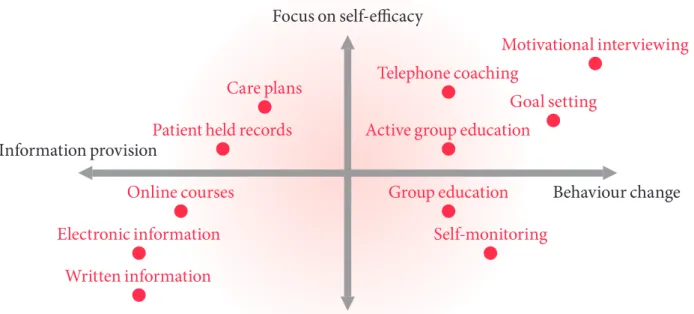
build self-efficacy (confidence in self-care). Figure 1

illustrates these typologies and positions various

types of self-management support along the

continuum.

It is difficult to categorise interventions in this

way because there is wide variation. For instance,

one type of group education may focus solely

on information provision whereas another

group education programme may seek to build

confidence and change behaviours.

While the placement of each individual

intervention is illustrative only, and a matter for

debate, conceptualising support approaches as a

continuum is useful. Evidence from hundreds of

studies suggests that the proactive interventions

located in the top right hand quadrant of figure 1

may be associated with greater change or more

sustained levels of behavioural and clinical benefits.

This section provides a summary of key evidence

about what works to support self-management.

3.2 Providing information

providing information about people’s condition

and how to manage it is an important component

of supporting self-management. Information can

be provided using leaflets, websites, email, text

messages, electronic forums, by telephone and in

person individually or in groups.

A great deal has been written about different ways

to provide information to people with health

conditions. We identified more than 60 systematic

reviews and randomised trials about providing

accessible information through written materials,

educational sessions, and technologies such as the

internet and video.

Researchers have examined the value of different

approaches for supporting people with long term

conditions generally as well as subgroups such

as children and young people, older people and

those from minority ethnic groups and deprived

neighbourhoods.

Written information

A number of written information materials to

support self-management have been evaluated,

including guidebooks and printed educational

materials.

272

There is some evidence that written

motivational leaflets or letters can help people feel

more confident to raise their concerns and discuss

their symptoms,

273

but there is sparse evidence

that such methods improve self-management

behaviours or clinical outcomes.

274–275

(19)

Figure 1: continuum strategies to support self-management

Focus on self-efficacy

Focus on technical skills

Behaviour change

Information provision

motivational interviewing

telephone coaching

goal setting

group education

Electronic information

Active group education

Self-monitoring

Care plans

patient held records

Written information

online courses

other reviews suggest that printed materials can

improve knowledge,

276–278

but may not impact

behaviour when used alone.

279–280

But findings are mixed. Some trials suggest that

postal educational materials are as effective for

improving symptoms and self-efficacy as group

education sessions.

281

There is also evidence that

combining written information with lectures or

other educational activities can be more effective

than written information alone.

282–283

to understand these differences, it is worth

considering the characteristics of the most

effective written information tools. There is

some evidence that targeting and personalising

written information is more effective than

standardised printed materials.

284–287

For

example, a randomised trial in Scotland compared

posting four personalised asthma education

booklets versus conventional oral education at

outpatient or surgery visits. personalised booklets

improved self-management and reduced hospital

admissions.

288

other studies have reinforced these

findings.

289

Electronic information sources

Self-management support can also be delivered

using audiovisual technology, computers and the

mass media.

291–294

There is evidence that providing structured

education programmes by video/dvd, audio

or computer may be as effective as in person

education groups.

295–296

For instance, a randomised

trial with older people with long term conditions

compared group education, a home study

intervention using videotapes and booklets, and

a control group. Compared with controls, both

educational interventions were associated with

reduced pain, sleep difficulties, and symptoms of

depression and anxiety. The video course was also

associated with reduced symptoms. The authors

concluded that lower cost, more accessible home

study education using video or dvd may be an

effective alternative to group instruction for people

with long term conditions.

297

other research has

similar findings.

298

other novel approaches have been tried. A

randomised trial in the US tested an asthma

education video game as part of a self-management

programme for high risk children with asthma.

The video game was associated with improved

(20)

Researchers in many parts of the world have tested

using computers to provide self-management

information and education.

300–310

For instance, a

systematic review of 22 randomised trials found

that computerised patient education improved

health status in people with various conditions.

311

Studies also suggest some benefits for children

and young people

312–313

and less advantaged

socio-economic and ethnic groups.

314

However while there are some positive trends,

other studies have found limited or mixed

benefits from online information and support

programmes.

315–317

A number of computer based peer to peer

communities and electronic groups have been set

up to support self-management but their effects

remain uncertain.

318

Some descriptive studies

suggest that computer chat rooms, coaching and

other online forums can provide a good motivator

for self-care,

319–321

but the effect on clinical

outcomes is uncertain.

Another novel approach is using text messages

or pager messages as reminders and support

mechanisms.

322–323

one trial found that, when

combined with other strategies, sending text

messages to young people with diabetes helped to

improve self-management behaviours.

324

one randomised trial assessed sending

standardised health promotion email messages to

people weekly for 12 weeks. people who received

emails had better self-management behaviours

and reported favourable changes in healthy eating

and physical activity.

325

other studies suggest that

email interventions can be targeted to the person’s

‘stage of change’, thus providing more tailored and

meaningful support.

326

to summarise, evidence suggests that providing

information in writing or electronically can

improve people’s knowledge about their condition

and care. This may or may not translate into feeling

more confident about looking after themselves and

improved self-management behaviours.

327–328

Systematic reviews, randomised trials and other

high quality research has found that when used

alone, information provision can improve some

health behaviours but this does not tend to have

lasting follow on effects on clinical outcomes or

health service use. However, when used as part of a

broader support initiative, information provision

has been found to be useful, especially if it is

targeted or personalised to account for people’s

individual needs.

329

Example of tailored information

A systematic review of 60 randomised control

trials examined the effectiveness of self help

interventions for smoking cessation. The review

found that the personalised written materials

were more effective than individualised advice

from a clinician, which was in turn more effective

than non-personalised written materials. Adding

additional face-to-face or other advice to tailored

written materials did not improve effectiveness

compared to personalised materials alone.

290

3.3 Providing support

Another type of self-management support

involves helping people to change their attitudes,

perhaps through care planning, patient held

records, decision support tools or other support

mechanisms. This is different from information

provision alone because the interventions aim to

provide incentives for change or help people learn

new skills or practical strategies for coping.

Decision support tools

For example, decision support tools have been

used to support self-management.

330

Such tools

may encourage service users and their carers

to take more responsibility for their care, help

people with long term conditions feel more in

control, encourage health professionals to follow

recommended care protocols, and have some

impacts on quality of life.

331–332

But reviews

about written decision aids suggest that such aids

generally affect attitudes and knowledge rather

than behaviours.

333–334

(21)

Patient held records

A number of strategies have been trialled to

increase people’s involvement in healthcare

processes and decision making as a way of

facilitating self-management. Sometimes people

are given their medical records to keep and bring

to each consultation, which is known as patient

held records.

A number of reviews and trials suggest that

patient held records have limited effects on

self-management. For instance, a trial of patient

held records for people who had suffered stroke in

the US found that while participants were pleased

to have a copy of their records, took them when

they visited doctors, and reported learning more

about their stroke, there was no difference in health

practices or behaviours compared to usual care.

335

Randomised trials in the UK have drawn similar

conclusions about patient held records.

336–337

There is also interest in making records available

electronically for service users.

338–340

A randomised

trial in the US provided patient records online to

people with heart failure. After one year, those

who had access to their records online were more

likely to adhere to treatment, but there were no

differences in self-efficacy or satisfaction with

care.

341

This suggests that patient held records may

have some impacts on self-management strategies,

but these impacts are not clear cut. The evidence is

too mixed to suggest that patient held records are a

useful enabler for self-management.

Planning and agenda setting

A care plan is a written document collaboratively

designed by service users and professionals

covering issues, interventions and review

processes.

342

Care plans may include both goal setting and

developing plans for how to achieve these

goals.

343

most of the available evidence about

self-management treatment plans focuses on

people with asthma or CopD, though there is

emerging evidence about other conditions.

344

There is evidence that action plans or proactive

planning support may improve self-management

behaviours for people with long term

conditions,

345–354

and this may impact on

healthcare resource use.

355–357

Numerous examples are available. For instance,

systematic reviews support an agenda setting

action plan coupled with self adjustment of

medications and regular medical review for people

with asthma.

358–359

A randomised trial of 140 adults with asthma or

chronic obstructive pulmonary disease assessed

developing a written self-management plan in

groups coupled with individual educational

sessions. The plans were associated with improved

medication compliance among people with asthma,

but not chronic obstructive pulmonary disease.

360

In New Zealand, a randomised trial found similar

benefits from written self-management plans for

children with asthma.

361

However, there are questions about whether

agenda setting and care planning are supported

by practitioners and service users

362

or directly

impact on clinical outcomes.

363

A Cochrane review

with seven randomised trials examined whether a

written asthma self-management plan increased

adherence to medications and improved clinical

outcomes. There was no strong evidence that

written plans improved patient outcomes. one

type of agenda setting was not consistently more

effective than another.

364

Another review found that adding written

self treatment guidelines to self-management

programmes may improve health outcomes, but

the only two controlled studies on this topic found

no effect.

365

A randomised trial in France found that when

agenda setting and plans were used as part of a

self-management programme, only those who

adhered fully to the self-management plan had

improved symptoms.

366

Figure

Figure 1: continuum strategies to support self management Focus on self-efficacy
Figure 1: continuum strategies to support self-management Focus on self-efficacy

References

Related documents

The relationship between economic insecurity and the subjective well-being of public and private sector workers in Ireland is identified using data from the

Since the purpose of a CDN service is to speed page load times, hosting customers doing serious business on the Web should benefit accordingly by purchasing CDN service...

As shown above, a number of studies have used Briscoe et al.’s (2006) PCO scales, providing empirical support for various aspects of the PCC. However, Inkson et al. 13) cautioned

• Impersonal market: If (i) impersonal exchange became highly lucrative, and (ii) there was large population of initial adoptees of standardized routines, such that the elites did

The findings reveal that while the architectural form of the Italian Trans-national houses built in Brisbane is influenced by the need to continue architectural

Mean tropospheric ozone bias in % of MACC reanalysis minus ozone sondes (left) and minus MOZAIC data (right) for the period January 2003 to December 2010 averaged between 200–1000

Therefore, the purpose of my study was to describe and explain elementary general education teachers’ assessment practices within the context of response to intervention and more