By Caroline Wolf Harlow, Ph.D. BJS Statistician
Approximately 203,300 prisoners serving a sentence in a State or Federal prison in 1997 were armed when they committed the crime for which they were serving time. An estimated 18% of State prison inmates and 15% of Federal inmates reported using, carrying, or possessing a firearm during the crime for which they were sentenced. In 1991, 16% of State inmates and 12% of Federal inmates said they were armed at the time of their offense.
Among all inmates in 1997, 9% of those in State prisons and 2% of those in Federal prisons said they fired a gun while committing their current offense. Of violent offenders, 18% of State inmates and 9% of Federal inmates discharged a firearm. Less than 2% of inmates serving time for a drug, property, or public-order offense fired a gun during the crime that resulted in their prison sentence.
Among prisoners who carried a firearm during the offense for which they were serving time in 1997, 14% had bought or traded for the gun from a store, pawnshop, flea market, or gun show. The 1997 percentage who had acquired their firearm at a retail outlet represented a significant drop from 21% in 1991. The percentage of inmates receiving their gun from family or friends rose from 34% in 1991 to 40% in 1997.
• During the offense that brought them to prison, 15% of State inmates and 13% of Federal inmates carried a handgun; about 2% had a military-style semiautomatic gun or machine gun. • Among inmates in prison for homicide, a sexual assault, robbery, assault or other violent crime, 30% of State offenders and 35% of Federal offenders carried a firearm when committing the crime. Almost a fourth of State inmates and almost a third of Federal inmates serving a sentence for a violent crime had carried a handgun during the offense.
• 29% of State inmates under age 25 at the time of the survey were carrying a gun when they committed their current offense compared to 15% of those 35 or older.
• In 1997 among State inmates possessing a gun, fewer than 2% bought their firearm at a flea market or gun show, about 12% from a retail store or pawnshop, and 80% from family, friends, a street buy, or an illegal source.
• On average, State inmates possess-ing a firearm received sentences of 18 years, while those without a weapon had an average sentence of 12 years. • Among prisoners carrying a firearm during their crime, 40% of State inmates and 56% of Federal inmates received a sentence enhancement because of the firearm.
Highlights
24.9 41.1
Defend self
29.3 48.6
Scare someone
46.2 73.2
Brandished to –
7.8 26.3
Other
5.0 22.8
Killed/injured victim
12.8 49.1
Fired
% 100.0 % 100.0 Total
Federal State
Use of firearm
Percent of prison inmates possessing a firearm
40.8 39.2
Street/illegal source
33.8 39.6
Friends or family
0.6 0.7
Gun show
1.3 1.0
Flea market
4.2 3.8
Pawnshop
14.7 8.3
Retail store
20.8 13.9
Purchased from –
% 100.0 % 100.0 Total
1991 1997
Source of gun
Percent of State inmates possessing a firearm
18.4 17.2
Recidivist
% 9.5 % 22.3 First-time offender
Criminal history
13.6 14.8
35 or older
15.5 16.5
25-34
% 19.1 % 29.4 24 or younger
Age
6.2 7.3
Female
% 15.5 % 19.1 Male
Gender
27.3 19.1
Public-order
8.7 8.1
Drug
2.9 3.1
Property
% 35.4 % 30.2 Violent
Federal State
Offense
Percent of prison Inmates possessing a firearm Characteristic of
inmates who carried firearms
2.0 2.4
Shotgun
1.3 1.3
Rifle
12.8 15.3
Handgun
% 14.8 % 18.4 Total
Federal State
Type of firearm
Percent of prison inmates U.S. Department of Justice
Office of Justice Programs Revised 2/04/02, th
Bureau of Justice Statistics
Special Report
November 2001, NCJ 189369
Survey of Inmates in State and Federal Correctional Facilities
Data for this report are based primarily on personal interviews with large nationally representative samples of State and Federal prison inmates. In the 1997 and 1991 Surveys of Inmates in State and Federal Correctional Facilities, inmates were questioned about any firearms they may have used when committing a crime and asked to specify the type of weapon, its source, and its use in committing crimes. In addition, inmates were queried about the types of both current and past of-fenses for which they were sentenced, including any weapons offenses. Almost a fifth of prison inmates carried a gun during their crime An estimated 18% of State prison inmates and 15% of Federal inmates reported that they used, carried, or possessed a firearm when they committed the crime for which they were serving a sentence to prison (table 1).1
When asked if they had ever been armed while committing a crime, about a quarter of State prison inmates and a fifth of Federal inmates reported that they had carried a gun while commit-ting at least one crime.
Almost half of both State and Federal inmates said that they had owned or possessed a firearm at some time in their lives. Equivalent measures for lifetime gun ownership among adults in the general population are difficult to find. Personal or telephone interviews and polls provide estimates for persons in the general population owning a firearm at the time of the survey. An estimated 25% to 29% of the adult population reported currently owning a firearm when surveyed.2 According to public opinion polls, members of 4 in every 10 U.S. households have access to a gun.
Less than 2% of inmates reported carrying a fully automatic or
military-style semiautomatic firearm Fewer than 1 in 50 State and Federal inmates used, carried, or possessed a
military-style semiautomatic gun or a fully automatic gun during their current offense (table 2). These guns, as used in the questions and definitions for the personal interviews with prison inmates, include the following:
• military-style semiautomatic pistol — similar to a conventional semiauto-matic pistol except that the magazine or clip is visible3
• military-style semiautomatic rifle — a semiautomatic rifle with military fea-tures such as a pistol grip, folding stock, flash suppressor, or bayonet mount
• military-style semiautomatic shotgun — a semiautomatic shotgun with military features such as a pistol grip, folding stock, flash suppressor, or bayonet mount
• machine gun — a fully automatic gun which, if the trigger is held down, will fire rapidly and continuously.
Some examples of these firearms are the UZI, TEC-9, and MAC10 for hand-guns; the AR-15 and AK-47 for rifles; and the "Street Sweeper" for shotguns. Possession of these models meeting criteria specified in Federal statutes can be unlawful.
To be understood by inmate respon-dents who were asked about their gun use, the questions and definitions in the survey reflect terminology com-monly used by prisoners to describe types of weapons. If questioned by respondents, interviewers read to them the definitions included on pages 14 and 15 of this report. Of necessity, this language is similar in concept but may differ in wording from technical descrip-tions in Federal statutes pertaining to firearms.
The Violent Crime Control and Law Enforcement Act of 1994 made it unlawful, with certain exceptions, to manufacture, transfer, or possess military-style semiautomatic weapons, Revised 2/04/02, th
1For definitions of firearms, see Methodology on pages 14 and 15.
2Phillip J. Cook and Jens Ludwig, Guns in America: Summary Report, Washington, DC, Police Foundation, 1996, table 2.3.
Note: Detail do not add to total because inmates may have had more than one firearm. % 51.1 %
53.1 %
80.0 %
74.9 %
85.2 % 81.6 No firearm
2.3 2.7
0.9 1.1
0.6 0.5
Other
15.6 13.7
3.0 3.5
2.0 2.4
Shotgun
14.6 12.4
1.9 2.0
1.3 1.3
Rifle
38.6 36.0
17.2 21.3
12.8 15.3
Handgun
% 48.9 %
46.9 %
20.0 %
25.1 %
14.8 % 18.4 Firearm
% 100.0 %
100.0 %
100.0 %
100.0 %
100.0 % 100.0 Total
Federal State
Federal State
Federal State
Type of firearm
Ever used or possessed firearm Ever armed while
committing offense Armed during
current offense
Percent of prison inmates
Table 1. Possession of firearms by State and Federal prison inmates, by type of firearm, 1997
Note: Columns do not add to total percent with firearms because inmates may have possessed more than one firearm. See text above and pages 14 and 15 for definitions.
5.6 5.6
2.3 2.5
1.7 1.5
Military-style semiautomatic or fully automatic
26.0 22.6
9.8 10.9
7.7 7.9
Conventional semiautomatic
% 31.4 % 31.0 %
10.6 % 14.2 %
7.3 % 9.9 Single shot
Federal State
Federal State
Federal State
type of firearm
Ever used or possessed firearm Ever armed while
committing offense Armed during
current offense Specific
Percent of prison inmates Table 2. Possession of firearms by State and Federal prison inmates, by whether the firearm was single shot, conventional semiautomatic, or military-style semiautomatic or fully automatic, 1997
3The survey interview included in the operational definition of a military-style semiautomatic pistol the phrase "can hold more than 19 bullets."
if not lawfully possessed on September 13, 1994.5
Of inmates who carried a firearm during their offense, 8 in 10 had a handgun
Inmates reported that a handgun was their preferred firearm; of those carry-ing a firearm, 83% of State inmates and 87% of Federal inmates said that they carried a handgun during the offense for which they were serving their longest sentence. About 8% of State inmates who had carried a firearm during the commission of their crime reported having a military-style semiautomatic (7%) or fully automatic (2%) firearm, with some carrying both.
Firearm use during crimes increased from 1991 to 1997 Over the 6 years between surveys of inmates, 1991-97, possession of a firearm during a crime increased from 16% to 18% of State inmates and from 12% to 15% of Federal inmates (table 3). Because of the growth in the prison population, the estimated number of inmates carrying a firearm increased dramatically — from 114,100 in 1991 to 190,400 in 1997 in State prisons and from 6,300 in 1991 to 12,900 in 1997 in Federal prisons. These estimates were based on inmates who reported carrying a firearm during the offense for which they received their longest sentence.
8% of drug offenders and 3% of property offenders armed while committing their crimes
Fewer than 1 in 10 offenders serving a sentence for selling or carrying illegal drugs and 1 in 30 inmates in prison for a property crime — burglary, larceny, fraud, or destruction of property—had a firearm with them while committing their current offense (table 4). Inmates who had been sentenced for violent crimes used firearms more often than other prisoners. They were more likely than property, drug, or
public-order offenders to have used or possessed a gun during their crime. An estimated 30% of violent offenders in State prisons and 35% in Federal prisons had a firearm at the time of the offense.
Offenders sentenced for homicide or for robbery reported the most extensive use of firearms. Among inmates sentenced for homicide, about 43% in State prisons and 39% in Federal prisons said they were carrying a firearm when they committed the offense. About 35% serving time for robbery in State prisons and 40% in Federal prison had a gun.
Revised 2/04/02, th
Note: Inmates could report carrying more than one type of firearm. For definitions of weapon categories, see pages 2, 14, and 15.
12,936 190,383
Number of inmates
3.8 2.4
Fully automatic
9.3 6.8
Military-style semiautomatic
51.8 43.2
Conventional semiautomatic
% 49.2 %
53.9 Single shot
13.7 13.1
Shotgun
8.9 7.3
Rifle
% 86.7 %
83.2 Handgun
Federal State
Type of firearm
Percent of prison inmates carrying a firearm during current offense
28.5 4,964
27.3 12,708
Public-order offense
3.9 30,788
8.7 54,561
Drug offense
2.1 7,011
2.9 5,811
Property offense
38.0 9,113
35.4 12,604
Violent offense
% 11.8 53,348
% 14.8 87,466
All inmates Federal
16.1 47,001
19.1 99,396
Public-order offense
4.1 148,743
8.1 213,974
Drug offense
3.2 171,749
3.1 227,726
Property offense
29.1 323,653
30.2 483,713
Violent offense
% 16.3 700,050
% 18.4 1,037,241
All inmates State
Percent who possessed a firearm during current offense Number
Percent who possessed a firearm during current offense Number
Current offense
1991 1997
Prison inmates Table 3. Possession of firearms, by type of offense,
by State and Federal prison inmates, 1997 and 1991
5See P.L. 103-22 and Commerce in Firearms in the United States, Department of the Treasury, Bureau of Alcohol, Tobacco and Firearms, February 2000, page C-5.
5.9 6,803
3.5 74,139
Other public-order
51.9 5,905
64.9 25,257
Weapons
% 27.3 12,708
% 19.1 99,396
Public-order offense
8.7 4,834
3.1 5,885
Other drug
9.1 39,769
8.6 116,578
Trafficking
7.0 9,959
7.8 91,511
Possession
% 8.7 54,561
% 8.1 213,974
Drug offense
2.5 5,531
2.3 116,528
Other property
10.1 279
4.0 111,198
Burglary
% 2.9 5,811
% 3.1 227,726
Property offense
22.4 989
27.1 19,459
Other violent
26.0 1,108
31.2 95,756
Assault
40.3 8,554
34.5 145,318
Robbery
0.0 679
2.9 87,687
Sexual assault
39.3 1,273
42.9 135,493
Homicide
% 35.4 12,604
% 30.2 483,713
Violent offense
Percent who possessed a firearm during current offense Number
Percent who possessed a firearm during current offense Number
Current offense
Federal State
Prison inmates
Table 4. Firearm possession during current offense, by type of offense, for State and Federal prison inmates, 1997
Male inmates and young inmates carried firearms Male State and Federal offenders were more likely than their female counterparts to have carried a firearm when committing their offense. About 19% of men in State prison and 16% in Federal prison reported using or possessing a firearm when committing their most serious offense, compared to 7% of women in State prison and 6% in Federal prison (table 5). An estimated 21% of black non-Hispanic inmates in State prison, 18% of Hispanics, and 15% of white non-Hispanics said they had a gun with them while committing their most serious offense. About 18% of black and white inmates in Federal facilities and 8% of Hispanics had carried a firearm.
Young State inmates were more likely than older inmates to use firearms. About 29% of inmates under the age of 25 at the time of the survey were carrying a gun when they committed their current offense, compared to 15% of those 35 or older. Among Federal inmates, about 19% under age 25 and 14% age 35 or older said they had a gun with them.
Weapon offenses include unlawful distribution, sale, manufacture, alteration, transport, possession, or use of a deadly or dangerous weapon or accessory. In 1998 an estimated 195,000 persons were arrested by State or local law enforcement or referred to a U.S. attorney for prosecution for a weapon offense — counting only the most important offense and no secondary offenses. Over 35,000 persons were convicted of a weapon offense. About 49,000 per-sons were in a local jail or State or Federal prison for a weapon offense in 1998. An additional 100,000 were serving a sentence in the community on proba-tion, parole, or supervised release.
An estimated 12% of State prison inmates and 19% of Federal inmates were either currently serving a sentence for a weapon offense or had been sentenced for a weapon offense in the past. Weapon offenses and offenders
% 81.4 %
87.8 Other current and/or past offenses
5.1 5.8
Current other/past weapon offenses
2.7 1.1
Current weapon/no past offenses
8.5 4.1
Current weapon/past other offenses
2.2 1.3
Current and past weapon offenses
% 18.6 %
12.2 Current or past weapon offense
% 100.0 %
100.0 Total
Federal State
or past offense
Percent of prison inmates Any current
Current and past sentences for a weapon offense, for State and Federal prison inmates, 1997 Note: The weapon offense is the offenders' most serious offense. Statistics on persons in Federal jurisdiction are for fiscal year 1998.
--Not available.
Sources: Data on weapon offenders come from the FBI's Crime in the United States, 1998, table 29; from BJS' Compendium of Federal Justice Statistics, 1998; from BJS' Survey of Inmates in Local Jails, 1996, and Survey of Inmates in State and Federal Correctional Facilities, 1997, and from the following BJS reports available through <www.ojp.usdoj. gov/pubalp2.htm>: Felony Defendants in Large Urban Counties, 1998; Felony Sentences in the United States, 1998; Prisoners in 1999; and the press release for probation and parole surveys 2000.
4.4 4,038 On probation/supervised release/parole
8.0 8,742 In Federal prison
5.6 3,413 Convicted
5.1 3,347 Prosecuted
% 4.3 4,907 Received by U.S. attorneys as suspects
Federal jurisdiction
2.3 100,440 On probation/parole
2.4 26,730 In State prisons
2.3 13,630 In local jails
3.4 31,904 Convicted of a felony
2.8 --Defendants at initial filing
% 1.3 190,600 Arrested
State/local jurisdictions
Percent of total Number
Weapons as the most serious offense or charge in the criminal justice system, 1998
14.4 74,676
18.6 907,142
Did not serve
% 17.2 12,746
% 16.4 129,913
Served Military service
2.4 1,376
22.0 4,609
Other
5.7 14,638
14.5 47,257
Latin America
% 16.9 71,307
% 18.5 983,876
United States Citizenship
8.3 7,963
12.1 27,649
College graduate
15.1 15,233
16.5 110,122
Some college
14.5 21,292
16.7 190,805
High school diploma
19.2 17,150
23.6 260,743
GED
% 13.9 25,642
% 16.8 445,479
Some high school or less Educational attainment
13.0 6,667
21.7 29,980
55 or older
15.3 14,393
17.4 100,133
45-54
12.8 26,636
13.3 305,765
35-44
15.5 31,970
16.5 396,166
25-34
18.6 6,865
26.8 143,533
21-24
% 23.0 935
% 35.5 61,663
20 or younger Age
17.9 4,349
19.3 32,662
Other
8.1 24,040
17.6 176,089
Hispanic
17.7 33,100
21.1 482,302
Black
% 16.7 25,977
% 14.8 346,188
White
Race/Hispanic origin
6.2 6,364
7.3 64,669
Female
% 15.5 81,102
% 19.1 972,572
Male Gender
Percent who possessed a firearm during current offense Number Percent who
possessed a firearm during current offense Number Selected
characteristic
Federal State
Prison inmates Table 5. Possession of a firearm during current offense, by selected characteristics for State and Federal prison inmates, 1997
Background characteristics account for relatively small differences in firearm use
When inmates were interviewed for the 1997 Surveys, they were asked about their family background and experi-ences they had when growing up. Characteristics about which the inmates reported include parental upbringing, parental incarceration, welfare assistance to their family,
parental use of alcohol and drugs, and peer participation in criminal behavior. Inmates who grew up living with both parents were less likely to be using or carrying a firearm than those who grew up primarily living with one parent, grandparents, other relatives, friends, or a foster family. An estimated 16% of State inmates and 13% of Federal inmates living with both parents had a gun with them, compared to 20% of State inmates and 17% of Federal
inmates living in some other arrange-ment while growing up (table 6). A higher percentage of State inmates with a parent who had served a
sentence to incarceration carried a gun (23%) than those whose parents had never been in prison or jail (17%). For Federal inmates, 18% of inmates who had incarcerated parents and 15% of those who did not carried a firearm. Inmates who lived in families receiving welfare or living in publicly-subsidized housing while growing up were more likely than those who did not live under these types of government programs to be carrying a weapon. About 1 in 5 inmates whose family received welfare or who lived in publicly financed housing carried a firearm. About 1 in 6 State inmates and 1 in 7 Federal inmates whose parents were not receiving welfare benefits or living in publicly-financed housing had a gun. A quarter of State inmates who said they had a parent who had abused drugs reported that they were carrying a gun while committing their current offense. In contrast, less than a fifth of those whose parents did not abuse substances had a firearm.
About 20% of State and Federal inmates whose friends while growing up used or traded drugs, stole,
destroyed or damaged property, broke or entered private property, or robbed someone reported that they had a firearm with them when they committed their controlling offense. An estimated 15% of State inmates and 9% of Federal inmates who did not have friends involved in illegal activities
As one measure of violence in inmates' lives, inmates were asked if they had ever been shot at. This
experience could have been at any time in their lives, including when they were committing the crime for which
they were in prison. About half of State prisoners reported that in the past they had been shot at by someone, and more than a fifth had actually been wounded by gunfire. A quarter of State and Federal inmates who had been shot at were carrying a firearm during their current offense, compared to a tenth of those who had never been shot at.
Inmates who had ever been shot at
10.1 56,679
12.1 514,676
Never shot at
23.6 17,131
23.1 302,765
Shot at but not wounded
24.4 12,933
26.7 213,429
Wounded
% 24.0 30,064
% 24.6 516,194
Ever shot at with a gun
Percent carrying a firearm Number Percent
carrying a firearm Number
Federal prison inmates State prison inmates
*Includes vandalism, shoplifting, stealing motor vehicles or parts, selling stolen property, and breaking and entering.
9.3 36,718
14.6 249,739
Peers did not engage in any illegal activity
32.5 8,400
30.4 203,745
Robbery
22.4 20,731
24.3 395,042
Drug trafficking
22.6 33,793
21.1 616,874
Damaged/stole/sold property*
18.5 42,764
19.7 688,497
Used drugs
% 19.0 49,941
% 19.6 780,234
while growing up
Peers engaged in illegal activity
14.1 68,424
18.3 698,716
Parent did not abuse alcohol or drugs
17.0 2,752
22.9 66,986
Both
17.7 735
27.5 18,618
Drugs
17.8 14,541
16.6 241,521
Alcohol
% 17.6 18,041
% 18.5 327,404
Parent abused alcohol or drugs
14.5 74,656
17.8 835,540
Inmate did not live in public housing
% 17.9 11,807
% 21.1 186,847
Inmate lived in public housing
13.2 65,146
17.0 634,795
Parent did not receive welfare
% 20.0 20,328
% 20.8 374,340
Parent received welfare
14.5 76,382
17.4 833,005
Parent never incarcerated
% 18.0 9,843
% 22.7 188,166
Parent ever incarcerated
18.8 9,452
20.7 137,253
Other
16.2 30,146
19.7 438,741
Single parent
% 13.2 47,279
% 16.3 455,313
Both parents Lived with growing up
Percent who possessed a firearm dur-ing current offense Number
Percent who possessed a firearm dur-ing current offense Number
Inmates' family of origin and other background characteristics
Federal State
Prison inmates
Table 6. State and Federal prison inmates possessing a firearm during their most serious offense, by characteristics of their family and background, 1997
used or possessed a firearm during their current offense.
Violent recidivists were as likely as first time violent offenders to have carried a gun
Recidivism does not appear to be related to whether inmates were carry-ing guns when the type of current offense is taken into account. Violent offenders who had served a prior sentence and first time violent offend-ers were about equally likely to be carrying a firearm when committing their current offense — about 30% of violent offenders in State prisons carried a firearm (table 7). About a third of violent Federal offenders, whether recidivist or first time, carried a firearm.
Less than 10% of both first time and repeat State offenders serving time for property, drug, and public-order
offenses carried a gun. Drug offenders who were recidivists were more likely to be carrying a firearm than first-time drug offenders (9% versus 6% of State inmates and 11% versus 5% of
Federal inmates).
Inmates who had served prior sentences as a juvenile were more likely to have had a gun than those who did not have a juvenile record. For State offenders 22% who had a juvenile record and 13% with only an adult record had a firearm while committing their current offense; for Federal offenders 27% with a juvenile record and 14% with only an adult record possessed a firearm.
Inmates' retail purchase of firearms fell between 1991 and 1997
In 1997, 14% of State inmates who had used or possessed a firearm during their current offense bought or traded for it from a retail store, pawnshop, flea market, or gun show (table 8). Nearly 40% of State inmates carrying a firearm obtained the weapon from family or friends. About 3 in 10 received the weapon from drug dealers, off the street, or through the black market. Another 1 in 10 obtained their gun during a robbery, burglary, or other type of theft.
From 1991 to 1997 the percent of State inmates with guns who acquired them at a retail outlet fell from 21% to 14%. At the same time the percentage reporting that they used firearms furnished by family or friends increased from 34% to 40%. Between the two surveys the Brady Handgun Violence Prevention Act of 1993 was enacted. The act requires background checks for persons purchasing firearms from federally licensed firearm dealers. Changes in how inmates obtained firearms, when the two surveys are compared, may or may not reflect the requirements in the Brady Act. Inmates may have procured their firearm or entered prison before the Brady Act became effective in 1994.
32.9 248
17.9 7,013
Escape
21.3 11,736
14.1 252,355
Parole
14.0 11,644
15.0 229,952
Probation
17.8 23,628
14.6 489,320
On status
% 13.7 63,320
% 21.8 543,238
New court commitment
Criminal justice status at arrest
27.3 15,897
19.4 309,002
Both juvenile and adult
13.5 34,294
12.7 404,646
Adult only
% 25.8 2,835
% 34.4 66,742
Juvenile only Prior sentences
22.3 10,047
6.5 244,692
Other
11.2 32,706
9.0 177,922
Drug
38.4 9,866
28.4 360,564
Violent Current offense
18.4 52,619
17.2 783,178
Recidivists
10.2 9,354
9.1 47,347
Other
4.8 20,425
5.8 44,744
Drug
31.8 3,952
31.1 155,195
Violent Current offense
% 9.5 33,731
% 22.3 247,287
No previous sentence Criminal history
Percent who possessed a firearm during current offense Number
Percent who possessed a firearm during current offense Number
Criminal justice characteristic
Federal State
Prison inmates
Table 7. Possession of firearm during current offense, by criminal history, prior sentences, and criminal justice status at arrest,
for State and Federal prison inmates, 1997
% 4.6 % 7.4 Other
7.8 8.4
Fence/black market
22.5 20.8
Drug dealer/off street
10.5 9.9
Theft or burglary
% 40.8 % 39.2 Street/illegal source
10.2 8.3
Other
10.1 18.5
Rented or borrowed
13.5 12.8
Purchased or traded
% 33.8 % 39.6 Family or friend
0.6 0.7
Gun show
1.3 1.0
Flea market
4.2 3.8
Pawnshop
14.7 8.3
Retail store
% 20.8 % 13.9 Purchased or traded from retail outlet
% 100.0 % 100.0 Total
1991 1997
Source of firearms
Percent of State prison inmates who possessed a firearm during current offense Table 8. Source of firearms
possessed during the current offense of State prison inmates, 1997
Revised 2/04/02, th
About 30% of State inmates and 35% of Federal inmates sentenced for a violent offense — homicide, sexual assault, robbery, or assault — used or possessed a firearm when committing their current offense. A quarter of violent State prisoners and almost a third of Federal prisoners carried a handgun. Fewer than 1 in 10, however, carried a long gun — a rifle or shotgun — or a military-style semiautomatic or fully automatic weapon. Inmates serving time for violent crimes were more likely to use a firearm when their victims were male rather than female, 18 or older rather than under age 18, and strangers, known by sight, or known casually rather than persons the inmates knew well.
• About 40% of violent State offenders who victimized a male had a gun compared to 17% of offenders when the victim was female.
• 39% of violent State inmates with a black victim and 33% of those with a Hispanic victim used a firearm, signifi-cantly more than the 25% with a white victim.
• Less than 10% of those who victimized persons 17 or younger, compared to over 33% of those who victimized persons 18 or older, possessed a firearm.
• Over a third of violent offenders used guns when their victims were strangers and casual acquaintances, compared to a fifth who used guns against persons they knew.
• 27% of offenders who victimized a current or former spouse, boyfriend, or girlfriend were armed while committing the crime. About 8% used guns against other relatives, including children, siblings, and other family members. Victims of violent offenders possessing firearms
*Includes spouse, ex-spouse, boyfriend, girlfriend, ex-boyfriend, and ex-girlfriend. 23.9 Other
26.3 Friend
8.2 Other relative
27.0 Intimate*
20.6 Well known
36.2 Known by sight or casually
% 35.6 Stranger
Relationship to offender
33.8 35 or older
37.0 25-34
40.9 18-24
% 8.2 17 or younger
Age
29.1 Other
32.8 Hispanic
38.6 Black
% 25.4 White
Race/Hispanic origin
16.8 Female
% 39.8 Male
Gender
Percent of violent State prison inmates who possessed a firearm during current offense Characteristics
of victim
Characteristics of victims of violent crime, by whether the State prison inmate possessed a firearm, 1997
4.0 2.1
Military-style semi-automatic or fully automatic
16.3 12.1
Conventional semiautomatic
% 18.0 %
17.0 Single shot
Type of firearm
1.2 0.7
Other
3.6 4.1
Shotgun
2.4 2.0
Rifle
30.4 24.7
Handgun
% 35.4 %
30.2
Any firearm
% 100 %
100 Total
Federal State
Type of firearm
Percent of prison inmates who possessed a firearm during current violent offense
Possession of a firearm, by type of firearm, for State and Federal prison inmates sentenced for a violent offense, 1997
Recidivists less likely than first timers to buy their gun from a retail establishment
Although existence of a prior record did not change inmates' likelihood of having carried a gun while committing
their current crime, it did influence where they acquired their gun. Recidi-vists were less likely than those who were first time offenders to have purchased their gun from a retail store, pawnshop, flea market, or gun show. About a tenth of recidivists and a fifth
of first timers purchased their gun from a retail establishment (table 9). A larger percentage of recidivists than first time offenders obtained their weapon through illegal activities or from the street or a black market source — 42% of recidivists and 31% of first timers.
Recidivists with firearms were as likely as first time offenders to obtain their gun from a family member or friends in 1997— about 40% acquired their guns from either family or friends.
The percentage of inmates who purchased or traded from a retail outlet, such as a store or pawnshop, fell during this period for both those with prior sentences and those without them. For repeat offenders, purchas-ing from retail fell from 17% to 11%, and for first time offenders from 33% to 20%.
For recidivists the percentage of inmates with firearms who obtained them from family or friends rose from 1991 to 1997 — for recidivists from 33% in 1991 to 39% in 1997 and for first timers from 36% in 1991 to 41% in 1997.
70,728 127,664
22,444 51,152
Number of prison inmates
% 4.3 %
6.9 %
4.4 %
8.5 Other
8.1 8.8
7.3 7.6
Fence/black market
25.2 22.8
14.7 15.7
Drug dealer/off street
12.4 10.9
4.7 7.6
Theft or burglary
% 45.7 %
42.4 %
26.7 %
30.9 Street/illegal source
9.9 7.8
11.6 9.5
Other
9.3 17.9
12.9 20.0
Rented or borrowed
14.0 13.5
11.5 11.0
Purchased or traded
% 33.1 %
39.2 %
36.1 %
40.5 Family or friend
0.4 0.7
1.0 0.8
Gun show
1.4 1.1
1.0 0.9
Flea market
3.9 3.7
5.4 4.2
Pawnshop
11.0 6.0
25.5 14.2
Retail store
% 16.8 %
11.4 %
32.9 %
20.1 Purchased or traded from
a retail outlet
% 100.0 %
100.0 %
100.0 %
100.0 Total
1991 1997
1991 1997
Source of firearms
Recidivists First timers
Percent of State prison inmates possessing a firearm who were — Table 9. Source of firearms possessed during current offense,
by criminal history, for State prison inmates, 1997 and 1991
The FBI reports that over two-thirds of homicide victims were killed with a firearm. About 4 in 10 inmates serving a sentence for murder or
manslaughter in State and Federal correctional facilities said that they had used a gun in committing the crime.
About 23% of robbery victims and 28% of aggravated assault victims told the National Crime Victimization Survey that the offender used a gun. Victim, police, and inmate reports of gun use during violent crime
26.0 31.2
20.0 28.4
Aggravated assault
40.5 34.5
39.7 23.0
Robbery
0.0 2.9
% 2.4 Sexual assault
% 39.3 %
42.9 %
67.8 Homicide
Survey of Inmates in Federal Correctional Facilities Survey of Inmates
in State Correctional Facilities Violent crime
Percent of offenders possessing a firearm during a violent crime Percent of
offenses in the FBI’s Supplemental Homicide Reports/ Uniform Crime Reports Percent of
victimizations in the National Crime Victimization Survey
Possession of firearms during violent crime,
1 in 5 military-style semiautomatic or fully automatic guns bought from retailstore
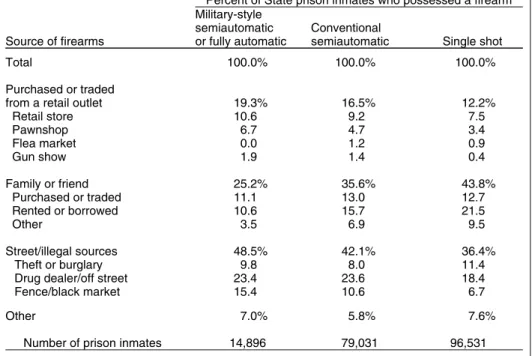
About a fifth of inmates with a military-style semiautomatic or fully automatic weapon bought it retail — at a store, flea market, or gun show (table 10). About a sixth of inmates with a conven-tional semiautomatic weapon and an eighth with a single-shot gun also had made a retail purchase.
While family and friends provided a quarter of military-style semiautomatic or fully automatic firearms, they gave inmates over a third of the conventional semiautomatic weapons and just under half of the single-shot guns.
Almost half of inmates possessing military-style semiautomatic or fully automatic weapons, about two-fifths of those with conventional semiautomatic firearms, and over a third of offenders having single-shot guns had got their firearm in a theft or burglary, or from a drug dealer, fence, or black market.
Young offenders less likely than older ones to have bought a firearm from a retail source
Young offenders were less likely than older inmates to have bought their gun from a retail outlet (table 11). About 7% of inmates 24 or younger and 22% of those 35 or older obtained their gun from a retail outlet.
About half of inmates who were 24 or younger, compared to less than a third of those 35 or older, acquired their gun through illegal activities, a drug dealer, or a black market.
Among those possessing a firearm during their current offense, an estimated 17% of women and 14% of men purchased their guns from a retail establishment. About 3 in 10 women offenders and 4 in 10 male inmates acquired their firearms from a theft, burglary, drug dealer, fence, or black market. Family and friends provided guns to about 46% of female inmates with firearms and 39% of male inmates.
Revised 2/04/02, th
Note: See note on table 2 and definitions on page 14.
96,531 79,031
14,896 Number of prison inmates
% 7.6 %
5.8 %
7.0 Other
6.7 10.6
15.4 Fence/black market
18.4 23.6
23.4 Drug dealer/off street
11.4 8.0
9.8 Theft or burglary
% 36.4 %
42.1 %
48.5 Street/illegal sources
9.5 6.9
3.5 Other
21.5 15.7
10.6 Rented or borrowed
12.7 13.0
11.1 Purchased or traded
% 43.8 %
35.6 %
25.2 Family or friend
0.4 1.4
1.9 Gun show
0.9 1.2
0.0 Flea market
3.4 4.7
6.7 Pawnshop
7.5 9.2
10.6 Retail store
% 12.2 %
16.5 %
19.3 Purchased or traded
from a retail outlet
% 100.0 %
100.0 %
100.0 Total
Single shot Conventional
semiautomatic Military-style
semiautomatic or fully automatic Source of firearms
Percent of State prison inmates who possessed a firearm
Table 10. Source of firearms possessed during current offense,
by whether the firearm was single shot, conventional semiautomatic, or military-style semiautomatic or fully automatic, for State prison inmates, 1997
60,897 60,818
57,194 4,421
174,488 Number of prison inmates
% 8.5 %
7.1 %
6.5 %
6.6 %
7.4 Other
7.8 8.6
9.0 4.3
8.5 Fence/black market
12.1 22.9
27.8 13.0
21.0 Drug dealer/off street
10.1 9.8
10.0 13.1
9.9 Theft or burglary
% 29.9 %
41.2 %
46.8 %
30.5 %
39.4 Street/illegal sources
9.9 8.1
6.8 12.1
8.2 Other
16.6 18.8
20.3 28.4
18.3 Rented or borrowed
13.3 12.1
13.0 5.9
12.9 Purchased or traded
% 39.8 %
38.9 %
40.1 %
46.4 %
39.4 Family or friend
0.4 0.8
0.9 0.0
0.8 Gun show
1.9 0.9
0.1 0.4
1.0 Flea market
4.5 4.0
2.9 5.5
3.8 Pawnshop
15.0 7.0
2.6 10.6
8.3 Retail store
% 21.9 %
12.7 %
6.6 %
16.5 %
13.8 from a retail outlet
Purchased or traded
% 100.0 %
100.0 %
100.0 %
100.0 %
100.0 Total
35 or older 25-34
24 or younger Female
Male Source of firearms
Percent of State prison inmates who possessed a firearm during their current offense, by gender and age
Table 11. Source of firearms possessed during current offense, by gender and age, for State prison inmates, 1997
Federal law may have disqualified over 8 in 10 inmates from buying a firearm
The Gun Control Act of 1968, as amended, and other Federal statutes list conditions which disqualify an individual from possessing a firearm or purchasing it from a licensed dealer. Some of these conditions include a prior felony conviction or indictment, current illegal drug use or addiction, dishonorable discharge from the Armed Forces, or being a fugitive from justice, a mental incompetent, or a nonresident alien. The Brady Act,
effective in 1994, mandated that feder-ally licensed firearm dealers obtain background checks of potential purchasers, based on the conditions of eligibility.
A slightly lower percentage of State prisoners who had a gun, compared to those who did not, reported having a characteristic which may have disquali-fied them, as defined by Federal law. About 84% of State inmates who had possessed a gun and 88% who did not have a gun may have met at least one of the conditions, as measured in the inmate survey (table 12).
Among State inmates, those with and without guns answered differently on only two conditions. About 50% of those with a firearm and 56% without had a prior sentence to incarceration; about 37% with a gun and 49% without were on probation or parole. On other factors, about the same percentages reported meeting a condition that could have made them ineligible to purchase a firearm. Almost 6 in 10 said they had used illegal drugs before their control-ling offense, about 1 in 10 had stayed in a mental health facility overnight, and 1 in 20 was a noncitizen.
Higher percentages of Federal inmates with guns than without them reported meeting at least one of the conditions of the Federal laws. About 83% with a firearm and 78% without one may have been disqualified from purchasing a gun. Higher percentages of inmates using guns compared to those without a gun had a prior incarceration (55% versus 37%), were on probation or parole when arrested (32% versus. 26%), or had used illegal drugs shortly before committing their current offense (56% versus 43%).
9% of all State prison inmates and 2% of all Federal inmates shot a gun while committing their current offense
In total, about 1 in 10 State inmates and 1 in 50 Federal inmates fired their gun while committing their current offense (table 13). Among inmates serving a sentence for a single violent crime incident, 18% of State inmates and 9% of Federal inmates said they fired the gun they were carrying.
Revised 2/04/02, th
0.2 0.7
0.3 0.3
Dishonorable discharge from U.S. military
22.6 7.8
6.0 5.2
Not a U.S. citizen
4.2 6.7
10.7 10.7
Ever treated overnight in mental health facility
43.0 56.0
56.3 58.8
Illegal drug use in month before or at time of offense
0.2 0.6
0.7 0.7
On escape when arrested
26.0 32.0
48.9 37.0
On probation or parole when arrested
36.9 55.1
55.9 49.8
Prior incarceration for serious offense
% 77.7 %
83.1 %
87.7 %
84.1 Total meeting at least one condition
which may have made inmates ineligible to purchase a firearm
Did not possess firearm Possessed
firearm Did not
possess firearm Possessed
firearm Selected characteristic
Federal inmates State inmates
Percent of inmates during current offense
Table 12. Selected characteristics that may make a gun purchase illegal under Federal law, by possession of firearm during current offense, for State and Federal prison inmates, 1997
Note: Table excludes prison inmates serving a sentence for multiple incidents.
58,266 515,532
12,249 468,757
71,325 993,305 Number
88.0 91.0
55.0 57.2
82.4 75.0
Did not possess weapon
0.1 0.6
2.7 1.4
0.5 1.0
Possessed other weapon
8.4 4.1
7.2 3.0
8.2 3.6
Possessed but did not use
2.9 3.2
26.6 20.7
6.9 11.5
Did not discharge
0.6 1.1
8.5 17.7
2.0 8.9
Discharged
3.5 4.3
% 35.1 % 38.5 % 8.9 % 20.4 Used firearm
% 100.0 % 100.0 %
100.0 % 100.0 % 100.0 % 100.0 Total
Federal State
Federal State
Federal State
Firearm use
Other offenders Violent offenders
All inmates
Percent of prison inmates
Table 13. Extent of weapon use during current offense, for State and Federal prison inmates, 1997
About 1% of inmates serving a
sentence for a single property, drug, or public-order incident discharged a gun. Fewer than 1 in 20 State inmates and 1 in 10 Federal inmates, regardless of type of offense, said they possessed a firearm but did not use it. Another 2% reported they had another weapon, including a knife, scissors, ax, rock, club or other sharp or blunt object.
About half of inmates carrying a gun during their offense fired itand half of those injured or killed someone
If inmates carried a firearm, they tended to use it. Among inmates possessing a firearm and committing only one incident, four-fifths of State inmates and half of Federal inmates either fired the weapon or brandished or displayed it while committing the crime (table 14).
An estimated 23% of State inmates and 5% of Federal inmates with a gun either killed or injured their victim. Another 26% of State inmates and 8% of Federal inmates with a gun discharged the gun but did not injure or kill anyone with it.
Besides firing their weapon, inmates used their guns for other purposes. About half of State inmates said they used it to scare someone, about two-fifths to defend themselves, and a fifth to "get away."
About 81% of State inmates with a single-shot gun, 79% with a conven-tional semiautomatic, and 75% with a military-style semiautomatic weapon or a fully automatic weapon either fired or brandished it (table 15). About 51% with a single-shot gun, 46% with a conventional semiautomatic firearm, and 43% with a military-style semiauto-matic weapon or a fully autosemiauto-matic weapon discharged their firearm. About a fifth either injured or killed their victim, regardless of the type of
firearm.
About a quarter of inmates carrying military-style semiautomatic weapon or a fully automatic weapon and a fifth of those with a conventional semiauto-matic or single-shot weapon did not actively use the gun in any way, discharging it or displaying it to scare someone, defend oneself, or "get away."
Revised 2/04/02, th
Note: Percents of subtotals do not add to totals because inmates may have used a firearm in more than one way. Table excludes prison inmates serving a sentence for multiple incidents.
11,250 178,646
Number
% 51.4 % 19.8 Did not actively
use firearm
11.6 18.9
To "get away"
24.9 41.1
To defend self
29.3 48.6
To scare someone
46.2 73.2
Brandished/displayed
7.8 26.3
Neither killed nor injured
3.5 15.4
Injured victim
3.0 14.6
Killed victim
12.8 49.1
Discharged
% 48.6 % 80.2 Used firearm
% 100.0 % 100.0 Total
Federal State
Firearm use
Percent of prison inmates possessing a firearm
Table 14. Extent of firearm use during current offense for State and Federal prison inmates possessing a firearm, 1997
Note: Percents of subtotals do not add to totals because inmates may have used a firearm in more than one way. Table excludes prison inmates serving a sentence for multiple incidents. See pages 2, 14, and 15 for definitions of firearms.
96,810 76,010
14,280 Number
% 19.2 %
21.1 %
25.4 Did not actively use firearm
18.7 18.5
20.4 To "get away"
39.9 42.4
39.7 To defend self
49.6 48.0
45.3 To scare someone
73.2 72.1
70.5 Brandished/displayed
27.3 24.0
23.4 Neither killed nor injured
15.3 15.1
14.2 Injured victim
15.7 13.5
11.2 Killed victim
50.6 46.3
42.9 Discharged
% 80.8 %
78.9 %
74.6 Used firearm
% 100.0 %
100.0 %
100.0 Total
Single-shot Conventional
semiautomatic Military-style
semiautomatic or fully automatic Firearm use
Percent of State prison inmates possessing a firearm
Table 15. Extent of firearm use during current offense, for State prison inmates possessing a firearm, 1997
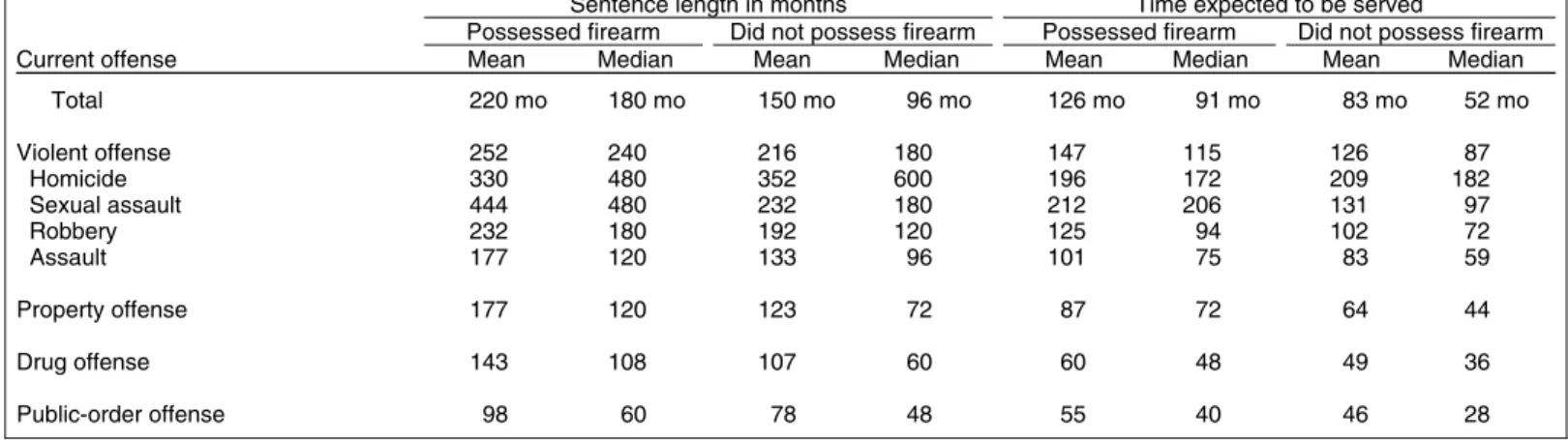
Possession of a firearm during an offense increased sentences and expected time served of inmates On average, inmates possessing a firearm had longer sentences and expected to serve a longer time than those who had not used or possessed a firearm while committing their offense. Sentences for State inmates with firearms had an average of about 18 years, while those for inmates without a firearm were about 12 years (table 16). Those who had carried a firearm expected to serve about 10 years on their sentence, and those without a firearm, 7 years.
Violent offenders with firearms had on average a sentence of over 20 years and those without firearms, about 18
years. Violent offenders who had carried a gun also expected to serve 12 years on average and those who did not carry them, 10 years.
Significantly higher percentages of inmates who possessed firearms, compared to those who did not, received a sentence enhancement, generally for possessing a firearm. About 40% of State inmates who carried a firearm during their current offense and 6% who were not carrying a firearm were given an enhancement to their sentence because of a firearm offense (table 17). About 56% of Federal inmates who carried a firearm and 14% who did not carry one received a weapons offense enhancement.
Methodology
The U.S. Census Bureau conducted the 1997 Survey of Inmates in State Correctional Facilities (SISCF) for the Bureau of Justice Statistics (BJS) and the 1997 Survey of Inmates in Federal Correctional Facilities (SIFCF) for BJS and the Bureau of Prisons. From June through October, 1997, inmates were interviewed about their current offense and sentences, criminal histories, family and personal backgrounds, gun possession and use, prior drug and alcohol use and treatment, educational programs, and other services provided while in prison. Similar surveys of State prison inmates were conducted in 1974, 1979, 1986, and 1991. Federal inmates were surveyed for the first time in 1991.
Sample design
The samples for the SISCF and SIFCF were taken from a universe of 1,409 State prisons and 127 Federal prisons enumerated in the 1995 Census of State and Federal Adult Correctional Facilities or opened between comple-tion of the census and June 30, 1996. The sample design for both surveys was a stratified two-stage selection; first, selecting prisons, and second, selecting inmates in those prisons. In the first stage correctional facilities were separated into two sampling frames: one for prisons with male inmates and one for prisons with female inmates. Prisons holding both genders were included on both lists. *Type of drug offense includes type of drug, quantity of drug,
or activity involved with the drug offense.
25.7 23.3
9.8 7.0
Type of drug offense*
18.5 26.0
20.0 16.4
2nd or 3rd strike
13.7 55.7
5.5 39.9
Firearm offense
% 42.3 %
68.9 %
29.7 %
50.4 Any enhancement
% 57.7 %
31.1 %
70.3 %
49.6 No enhancement
% 100.0 %
100.0 %
100.0 %
100.0 Total
Did not possess firearm Possessed firearm Did not possess
firearm Possessed
firearm Enhancements
to sentence
Federal inmates State inmates
Percent of inmates during current offense Table 17. Sentence enhancements, by possession of a firearm during current offense, for State and Federal prison inmates, 1997
28 46
40 55
48 78
60 98
Public-order offense
36 49
48 60
60 107
108 143
Drug offense
44 64
72 87
72 123
120 177
Property offense
59 83
75 101
96 133
120 177
Assault
72 102
94 125
120 192
180 232
Robbery
97 131
206 212
180 232
480 444
Sexual assault
182 209
172 196
600 352
480 330
Homicide
87 126
115 147
180 216
240 252
Violent offense
mo 52 mo 83 mo
91 mo 126 mo
96 mo 150 mo
180 mo
220 Total
Median Mean
Median Mean
Median Mean
Median Mean
Current offense
Did not possess firearm Possessed firearm
Did not possess firearm Possessed firearm
Time expected to be served Sentence length in months
Table 16. Sentence length and time to be served, by possession of a firearm and type of offense, for State prison inmates, 1997
In the sampling of State facilities, the 13 largest male prisons and 17 largest female prisons were selected with certainty. The remaining 1,265 male facilities and 261 female facilities were stratified into 14 strata defined by census region (Northeast except New York, New York, Midwest, South except Texas, Texas, West except California, and California). Within each stratum facilities were ordered by facil-ity type (confinement and communfacil-ity- community-based), security level (maximum, medium, minimum, and none), and size of population. A systematic sample of prisons was then selected within strata with probabilities propor-tionate to the size of each prison. For the sample of Federal prisons, one male prison and two female prisons were selected with certainty. The remaining 112 male facilities were classified into 5 strata defined by security level (administrative, high, medium, low, and minimum). The 20 remaining female facilities were strati-fied into 2 strata by security level (minimum and not minimum). Within security level, facilities were ordered by size of population and then selected with probability proportionate to size. For the State survey 280 prisons were selected, 220 male facilities and 60 female facilities. Of the 280 facilities 3 refused to allow interviewing and 2 closed before the survey could be conducted. Overall, 32 male facilities and 8 female facilities were selected for the Federal survey, and all participated.
In the second stage, inmates were selected for interviewing. For State facilities interviewers selected the sample systematically using a random start and a total number of interviews based on the gender of the inmates and the size of the facility. For Federal facilities, a sample of inmates was selected for each facility from the Bureau of Prisons central list, using a random start and predetermined sampling interval.
All selected drug offenders were then subsampled so that only a third were eligible for interview. As a result, approximately 1 in every 75 men and 1 in 17 women were selected for the State survey, and 1 in every 13 men and 1 in every 3 women were selected for the Federal survey.
A total of 14,285 interviews were completed for the State survey and 4,041 for the Federal survey, for overall response rates of 92.5% in the State survey and 90.2% in the Federal survey.
The interviews, about an hour in length, used computer-assisted personal inter-viewing (CAPI). With CAPI, computers provide questions for the interviewer, including follow-up questions tailored to preceding answers. Before the inter-view, inmates were told verbally and in writing that participation was voluntary and that all information provided would be held in confidence. Participants were assured that the survey was solely for statistical purposes and that no individual who participated could be identified through use of survey results.
Estimates of prisoner counts
Based on the completed interviews, estimates for the entire population were developed using weighting factors derived from the original probability of selection in the sample. These factors were adjusted for variable rates of nonresponse across strata and inmates’ characteristics and offenses. The sample for the State survey was adjusted to midyear custody counts for June 30, 1997, from data obtained in the National Prisoner Statistics series (NPS-1A). The sample from the Federal facilities was weighted to the total known sentenced custody popula-tion at midyear 1997.
Excluded from the estimate of Federal inmates were unsentenced inmates and those prisoners under Federal jurisdiction but housed in State and private contract facilities. Those prisoners who were under State juris-diction, yet held in local jails or private-facilities, were excluded from the estimated number of State prisoners. As a result, the estimated prisoner counts do not match those in other BJS data series. The estimated prisoner counts vary according to the particular data items analyzed. Estimates are based on the number of prisoners who provided information on selected items.
Accuracy of the estimates
The accuracy of the estimates presented in this report depends on two types of error: sampling and nonsampling. Sampling error is the variation that may occur by chance because a sample rather than a complete enumeration of the popula-tion was conducted. Nonsampling error can be attributed to many
sources, such as nonresponses, differ-ences in the interpretation of questions among inmates, recall difficulties, and processing errors. In any survey the full extent of the nonsampling error is never known. The sampling error, as measured by an estimated standard error, varies by the size of the estimate and the size of the base population.
Estimates of the standard errors have been calculated for the 1997 surveys. (See appendix tables 1 and 2.) For example, the 95-percent confidence interval around the percentage of State inmates who carried a firearm during current offense is approximately 18.4% plus or minus 1.96 times 0.42% (or 17.6% to 19.2%).
These standard errors may also be used to test the significance of the difference between two sample statis-tics by pooling the standard errors of the two sample estimates. For example, the standard error of the difference between violent or drug offenders carrying firearms when committing their current offense would be 1.0% (or the square root of the sum of the squared standard errors for each group). The 95%-confidence interval around the difference would be 1.96 times 1.0% or 1.9%. Since the differ-ence, 22.1% (30.2% - 8.1%) is greater than 1.9%, the difference would be considered statistically significant. The same procedure can be used to test the significance of the difference between estimates from the two surveys. For example, the standard error of the difference between Federal and State prison inmates carrying a firearm would be 0.9%. The
95-percent confidence interval around the difference would be 1.96 times .9% (or 1.7%). Since the difference of 3.6% (18.4% minus 14.8%) is greater than 1.6%, the difference would be considered statistically significant. All comparisons discussed in this report were statistically significant at the 95-percent confidence level.
Definitions
The survey questionnaire used the following definitions in language and terms familiar to the respondents. Interviewers read the definitions to the inmates when needed.
Handguns include both pistols and
revolvers. They are firearms held and fired with one hand and include the following:
— Revolver is a handgun with a revolv-ing cylinder with several cartridge chambers. The chambers are succes-sively lined up with the barrel and then discharged. (Classified as single shot
for analysis.)
— Derringer is a short-barreled, single shot pocket pistol. A pistol has a chamber integral with the barrel. (Classified as single shotfor analysis.) — A conventional semiautomatic pistol
uses a shell which is ejected and the next round of ammunition is loaded automatically from a magazine or clip internal to the pistol grip or handle. The trigger must be pulled for each shot.5 (Classified as conventional
semiautomaticfor analysis.)
— Military-style semiautomatic pistol
is similar to a conventional semiauto-matic pistol except that the magazine or clip is visible.5 Primary examples are the UZI, TEC-9, and MAC-10.
(Classified as military-style semiauto-matic for analysis.)
A rifle is a firearm intended to be shot from the shoulder. It has a long barrel which shoots bullets. Types include: — Bolt-action, pump-action, lever-action, or single-shot rifles require physical movement by the operator of some part of the rifle — a bolt, lever, or pump — to reload. A single shot rifle must be loaded after each shot. (Classified as single shotfor analysis.) — Semiautomatic hunting-style rifle is a rifle in which a shell is ejected and the next round of ammunition is loaded automatically from a magazine or clip. The trigger must be pulled for each shot. (Classified as conventional semiautomaticfor analysis.)
— Semiautomatic military-style rifle has the characteristics of a semiautomatic hunting-style rifle. It also has military features such as a pistol grip, folding stock, flash suppressor, and bayonet mount. (Classified asmilitary-style semiautomaticfor analysis.)
A shotgun is a firearm intended to be
shot from the shoulder with either a single- or double-barrel for firing shot
Revised 2/4/02, th
Note: See tables 1 and 2 for survey estimates.
0.27 0.13
Military-style
0.56 0.30
Conventional Semiautomatic
0.55 0.33
Single shot
0.29 0.17
Shotgun
0.24 0.12
Rifle
0.70 0.39
Handgun
0.75% 0.42%
Any firearm
Federal State
Type of firearm
Standard error for esti-mated percent armed during current offense Appendix table 1. Standard errors for type of firearm during current offense, for State and Federal prison inmates, 1997
Note: See table 4 for survey estimates. 1.78 0.75
Other public-order
4.05 3.35
Weapons
% 2.46 % 1.39 Public-order offenses
2.52 2.52
Other drug
0.86 0.90
Trafficking
1.59 0.98
Possession
% 0.73 % 0.65 Drug offenses
1.31 0.49
Other property
11.23 0.66
Burglary
% 1.37 % 0.41 Property offense
8.26 3.55
Other violent
8.21 1.67
Assault
3.31 1.39
Robbery
0.00 0.63
Sexual assault
8.52 1.50
Homicide
% 2.66 % 0.74 Violent offense
Federal State
Current offense
Standard error for estimated percent armed during current offense
Appendix table 2. Standard errors for firearm possession during current offense, for State and Federal prison inmates, 1997
5The survey interview included in the
opera-tional definition of a convenopera-tional semiauto-matic pistol "can hold a maximum of 19 bullets" and of a military-style semiautomatic pistol "can hold more than 19 bullets."
(a concentration of small pellets) at short ranges. Types include: — Bolt-action, pump-action, lever-action, or single shot shotgun requires physical movement by the operator of some part of the shotgun — a bolt, lever, or pump — to reload. A single shot shotgun must be loaded after each shot. (Classified as single-shot
for analysis.)
— Semiautomatic hunting-style
shotgun is a shotgun in which a shell is ejected and the next round of ammuni-tion is loaded automatically from a magazine or clip. The trigger must be pulled for each shot. (Classified as
conventional semiautomaticfor analysis.)
— Semiautomatic military-style shotgun has the characteristics of a semiautomatic hunting-style shotgun.
In addition, the shotgun has military features, such as a pistol grip, folding-stock, and detachable magazine or clip. It looks like a semiautomatic military-style rifle. (Classified as
military-style semiautomaticfor analysis.)
A semiautomatic gun is a firearm in
which a shell is ejected and the next round of ammunition is loaded
automatically from a magazine or clip. The trigger must be pulled for each shot. Semiautomatic guns may be classified as handguns, rifles, or shotguns.
A machine gun is an automatic gun
which, if the trigger is held down, will fire rapidly and continuously. It is not a semi-automatic gun for which the trigger must be pulled for each shot. (Classified as fully automaticfor analysis.)
A BB gun shoots a single pellet, using
air rather than an explosive to propel the pellet. (Excluded from analysis, as were toy guns.)
Revised 2/4/02, th
This report in portable document format and in ASCII, its tables, and related statistical data are available at the BJS World Wide Web Internet site:
http://www.ojp.usdoj.gov/bjs/
The data for this report may be obtained from the National Archive of Criminal Justice Data at the Univer-sity of Michigan. The archive may be accessed through the BJS website.
The Bureau of Justice Statistics is the statistical agency of the U.S. Department of Justice. Lawrence A. Greenfeld is the acting director.
BJS Special Reports address a specific topic in depth from one or more datasets that cover many topics. Caroline Wolf Harlow wrote this report.
Tom Bonczar and Lara Reynolds provided statistical assistance and verification. Terry Austin, Chief, National Tracing Center Division of the Bureau of Alcohol, Tobacco and Firearms, provided comments. Tom Hester and Tina Dorsey edited the report. Jayne Robinson administered final production.