Rajakaruna, N. 2017. Published in The Botanical Review, 84(1): 39-78.
Lessons on Evolution from the Study
of Edaphic Specialization
Nishanta Rajakaruna1,2,3
1
Biological Sciences Department, California Polytechnic State University, San Luis Obispo, CA 93407, USA
2
Unit for Environmental Sciences and Management, North-West University, Private Bag X6001, Potchefstroom 2520, South Africa
3
Author for Correspondence; e-mail: [email protected]
Abstract Plants adapted to special soil types are ideal for investigating evolutionary processes, including maintenance of intraspecific variation, adaptation, reproductive isola-tion, ecotypic differentiaisola-tion, and the tempo and mode of speciation. Common garden and reciprocal transplant approaches show that both local adaptation and phenotypic plasticity contribute to edaphic (soil-related) specialization. Edaphic specialists evolve rapidly and repeatedly in some lineages, offering opportunities to investigate parallel evolution, a process less commonly documented in plants than in animals. Adaptations to soil features are often under the control of major genes and they frequently have direct or indirect effects on genes that contribute to reproductive isolation. Both reduced competitiveness and greater susceptibility to herbivory have been documented among some edaphic specialists when grown in ‘normal’ soils, suggesting that a high physiological cost of tolerance may result in strong divergent selection across soil boundaries. Interactions with microbes, herbivores, and pollinators influence soil specialization either by directly enhancing tolerance to extremes in soil conditions or by reducing gene flow between divergent populations. Climate change may further restrict the distribution of edaphic specialists due to increased competition from other taxa or, expand their ranges, if preadaptations to drought or other abiotic stressors render them more competitive under a novel climate.
Keywords Ecological Speciation . Edaphic Endemism . Harsh Environments . Cost of Tolerance . Serpentine . Metal Tolerance . Parallel Speciation . Geobotany . Plant-Soil Relations . Local Adaptation
BThe red-rock forest may seem hellish to us, but it is a refuge to its flora...it is the obdurate physical (and chemical) adversity of things such as peridotite bedrock which often drives life to its most surprising transformations^ (Wallace, 1983)
Introduction
2012). The study of ecological speciation marks a central theme in evolutionary biology, with a major focus on understanding the role of adaptation in reproductive isolation (Baack et al., 2015) and species divergence (Schemske, 2010).
Plants found on ‘extreme’ soils, those characterized by unusual chemical (pH, ionic strength, nutrients, or heavy metals) or physical conditions (soil moisture, temperature, texture, structure, or depth), provide model systems to examine the role of edaphic (soil-related) adaptation in ecological speciation (Rajakaruna, 2004; Kay et al., 2011) and adaptive radiation (Ellis & Weis, 2005; Paun et al., 2016; Shimizu-Inatsugi et al., 2016). The landmark papers BEvolution in closely adjacent plant populations^ (Antonovics,
2006 and references therein) focused on the evolution of metal tolerance in the grasses
Anthoxanthum odoratum and Agrostis tenuis on mine tailings in Europe. These classic papers, along with early studies of ecotypes on western North American serpentine soils (Anacker, 2014 and references therein), illustrated how strong selection can maintain distinct sub-populations in the face of gene flow, highlighting three key lessons from edaphic specialization pertinent to evolution: first, edaphic transitions often have direct or indirect effects on reproductive isolation between ecologically-divergent populations (Christie & Macnair, 1987; Wright et al., 2013), suggesting a link between adaptation and speciation; second, some populations can evolve (or lose) tolerance to edaphic conditions rapidly and with relative ease, suggesting that major gene loci (i.e., loci with large phenotypic effects) could be driving adaptive evolution (Macnair, 1983; Bratteler et al., 2006,2006; Lowry et al., 2012); and third, populations within some species can independently evolve tolerance to edaphic conditions (i.e., tolerance evolves multiple times within a species), suggesting a tendency towards parallel evolution (Rajakaruna & Whitton, 2004; Ostevik et al., 2012; Roda et al., 2013). Edaphic specialists, especially plants growing in ultramafic (Harrison & Rajakaruna, 2011; Anacker, 2014), gypsum (Moore et al., 2014; Escudero et al., 2015; Bolukbasi et al., 2016), mine tailing (Ernst,
2006), seleniferous (Schiavon & Pilon-Smits, 2017), and saline (Saslis-Lagoudakis et al.,
2014; Cheeseman,2015) habitats, are now at the forefront of plant evolutionary research, providing model systems for exploring factors and mechanisms driving evolutionary processes from the species to community level (Cheplick, 2015).
In this review, I highlight studies of edaphic specialists from serpentine outcrops, saline soils, gypsum and other carbonate deposits, and heavy metal-rich mine tailings, and explore such questions as:
& How do edaphic endemics evolve (i.e., what are the major pathways to edaphic specialization)?
& Are edaphic endemics new or old species?
& How does adaptation contribute to reproductive isolation?
& Is the transition to edaphic endemism directional, and are edaphic endemics evolutionary dead-ends?
& Does parallel evolution of traits conferring adaptations and reproductive isolation occur frequently in edaphic specialists?
& How does tolerance to edaphic extremes influence competitiveness in ‘normal’ soils, i.e., what is the cost of tolerance?
& Do interactions with herbivores or microbes drive the evolution of edaphic specialization?
& What is the genetic basis of edaphic specialization and speciation? Is there evidence for horizontal gene flow conferring edaphic adaptation or for genetic similarity among the mechanisms used by different species under any given edaphic stress?
Finally, I outline directions for future research on the use of edaphic specialists as model systems to study evolutionary processes across cellular, organismic, population, and community levels.
How do Edaphic Endemics Evolve?
Colonization of new environments, including edaphic islands, can be achieved by ecotypic differentiation via local adaptation or by phenotypic plasticity (Hereford,
2009; Palacio-López et al., 2015). Early studies in Sweden (Turesson, 1922) and California (Clausen et al., 1940) demonstrated that local adaptation is common in species distributed across altitudinal and climatic gradients. Similarly, elegant transplant experiments conducted by the British Ecological Society from the 1920s to the 1930s highlighted edaphic factors as potent agents of selection (Marsden-Jones & Turrill,
1938). The long-term Park Grass Experiment in Rothamsted, UK (Silvertown et al.,
2006), in which the grass Anthoxanthum odoratum was subjected to different fertilizer and lime treatments across multiple plots, showed local adaptation to soil types over a relatively short period. These studies exemplified how experimental methods such as common garden and reciprocal transplant experimentation can be used to examine how phenotypic plasticity and local adaptation contribute to habitat specialization (Wright & Stanton, 2011).
Species living in harsh environments, including on edaphic islands, have genotypes either broadly tolerant to wide-ranging environmental conditions (Bradshaw, 2006) or locally adapted to specific ecological factors characteristic of the ‘home’ environment,
i.e., ecotypes (Lowry, 2012). Ecotypes are a critical stage in the speciation process, and the recognition of such populations is vital for evolutionary studies (Via, 2009). The existence of sharp habitat boundaries between ecotypes is a compelling phenomenon that has provided some of the best experimental evidence of natural selection in the wild (Rajakaruna & Whitton, 2004). Although there is much support for ecotypic differentiation and species-level endemism among flowering plants found on edaphic islands (O’Dell & Rajakaruna, 2011), such edaphic specialization is not as well-documented among ferns, gymnosperms, mycorrhizal fungi, lichens, or bryophytes (Rajakaruna et al., 2014).
adaptation showed that only 45% of population pairs (out of 1,032 compared) had better performance of the ‘home’ population relative to the ‘away’ population at both sites (Leimu & Fischer, 2008). This suggests that habitat-mediated selection may not be as common in plants as generally assumed. Lack of local adaptation may result from reasons other than the lack of necessary genetic variance (Bell, 2012; Cheplick,2015), including insufficient time for adaptive evolution, a high degree of phenotypic plastic-ity, extensive gene flow, and random genetic drift due to founder events. Further, lack of local adaptation may be a statistical/methodological artifact of choosing study habitats that are too similar in their major selection pressures (Cheplick, 2015).
Landmark papers on factors and mechanisms driving habitat specialization (Mason, 1946a, b; Raven, 1964) provided an early framework for understanding the role played by soil-based selection in the origin of new species. These ideas offered a context to envision a set of stages that may lead to the establishment of an edaphically endemic species, from the initial tolerance of an edaphic condition by preadapted genotypes to clear-cut species formation (Kruckeberg, 1986). While this sequence represents a relatively precise picture of the evolutionary pathways to endemism, it does not indicate why some genotypes evolve through all the steps and others do not. It is possible that there is a relatively higher cost of broad tolerance in edaphic endemic species relative to the cost of tolerance found in widespread taxa with broad edaphic tolerance (Kazakou et al., 2008; Maestri et al., 2010). Thus, only lineages experiencing a high cost of broad tolerance will be subjected to strong divergent selection across an edaphic boundary, leading to evolution of ecotypes and edaphic endemic species. The decisive step distinguishing an ecotype from an endemic species is likely the acquisition of complete reproductive isolation between the ancestral population and the ecotype, allowing an independent gene pool to evolve (Macnair & Gardner, 1998; Lowry,
2012). How this occurs, especially when populations are not geographically isolat-ed, is a fundamental question in speciation research (Kay et al., 2011; O’Dell & Rajakaruna, 2011).
Populations that become geographically isolated can gradually acquire genetic dif-ferences through selection and drift, and eventually become reproductively isolated through the process of allopatric speciation. Past climate fluctuations and other dramatic environmental changes may have led to the extinction of widespread populations due to massive vegetation shifts such as those that occurred during postglacial reforestation (Slovák et al., 2012). Those surviving relict populations, especially those isolated on edaphic islands, may have become differentiated by means of allopatric speciation. Further, chance dispersal into novel edaphic habitats, particularly during strong climatic oscillations of the Quaternary, would have also provided conditions of relaxed compe-tition, facilitating the evolution of edaphic specialization (Dillenberger & Kadereit,
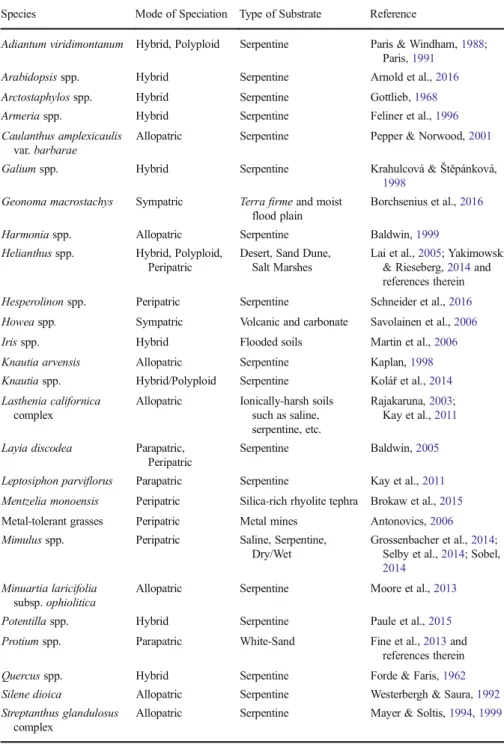
Table 1 Proposed modes of speciation and substrate type for some taxa having presumably diversified under edaphic selection
Species Mode of Speciation Type of Substrate Reference
Adiantum viridimontanum Hybrid, Polyploid Serpentine Paris & Windham,1988;
Paris, 1991
Arabidopsis spp. Hybrid Serpentine Arnold et al.,2016
Arctostaphylos spp. Hybrid Serpentine Gottlieb,1968
Armeria spp. Hybrid Serpentine Feliner et al., 1996
Caulanthus amplexicaulis Allopatric Serpentine Pepper & Norwood,2001
var. barbarae
Galium spp. Hybrid Serpentine Krahulcová &Štěpánková,
1998
Geonoma macrostachys Sympatric Terra firme and moist Borchsenius et al., 2016
flood plain
Harmonia spp. Allopatric Serpentine Baldwin, 1999
Helianthus spp. Hybrid, Polyploid, Desert, Sand Dune, Lai et al., 2005; Yakimowski
Peripatric Salt Marshes & Rieseberg,2014 and
references therein
Hesperolinon spp. Peripatric Serpentine Schneider et al., 2016
Howeaspp. Sympatric Volcanic and carbonate Savolainen et al., 2006
Iris spp. Hybrid Flooded soils Martin et al., 2006
Knautia arvensis Allopatric Serpentine Kaplan, 1998
Knautia spp. Hybrid/Polyploid Serpentine Kolářet al., 2014
Lasthenia californica Allopatric Ionically-harsh soils Rajakaruna, 2003;
complex such as saline, Kay et al., 2011
serpentine, etc.
Layia discodea Parapatric, Serpentine Baldwin, 2005
Peripatric
Leptosiphon parviflorus Parapatric Serpentine Kay et al., 2011
Mentzelia monoensis Peripatric Silica-rich rhyolite tephra Brokaw et al., 2015
Metal-tolerant grasses Peripatric Metal mines Antonovics,2006
Mimulus spp. Peripatric Saline, Serpentine, Grossenbacher et al.,2014;
Dry/Wet Selby et al., 2014; Sobel,
2014
Minuartia laricifolia Allopatric Serpentine Moore et al., 2013
subsp. ophiolitica
Potentilla spp. Hybrid Serpentine Paule et al., 2015
Protium spp. Parapatric White-Sand Fine et al., 2013 and references therein
Quercusspp. Hybrid Serpentine Forde & Faris, 1962
Silene dioica Allopatric Serpentine Westerbergh & Saura,1992
Streptanthus glandulosus Allopatric Serpentine Mayer & Soltis, 1994, 1999
the initial evolution of traits driving reproductive isolation may have occurred under allopatric conditions (Pettengill & Moeller, 2012); a new species that evolved under allopatry may subsequently come into contact along an edaphic boundary and appear identical to parapatric species in being relatively young, ecologically divergent, and reproductively isolated. Further, reinforcement of reproductive isolation (Pfennig & Pfennig, 2009), a process by which selection can minimize maladaptive hybridization, may take place upon contact with those populations that initially diverged under allopatry, thereby completing the speciation process. Genetic analyses can help distin-guish whether divergence first occurred in allopatry and speciation was completed by reinforcement (Widmer et al., 2009), although extensive introgression and hybridization following secondary contact may make such determinations difficult (Barraclough & Vogler, 2000; Ortiz-Barrientos et al., 2009; Strasburg et al.,2012). How speciation can proceed in the face of gene flow between potentially interbreeding populations, includ-ing among parents and newly formed hybrid species (Andrew et al., 2012; Renaut et al.,
2013), is especially revealing of the challenges associated with habitat specialization under parapatry. Gene flow can dilute the adaptive differences that selection generates between divergent populations; this may be especially problematic when one population is significantly larger than the other, as in the case of a newly divergent population found adjacent to an ancestral population, or in the presence of asymmetric gene flow (Ellstrand, 2014). However, if the edaphic condition confers strong selection pressures on one side of the edaphic barrier and there is strong selection against the tolerance genes on the other side of the edaphic boundary (i.e., low ‘Haldanian’ fitness), then one could expect evolution to occur even in the presence of gene flow.
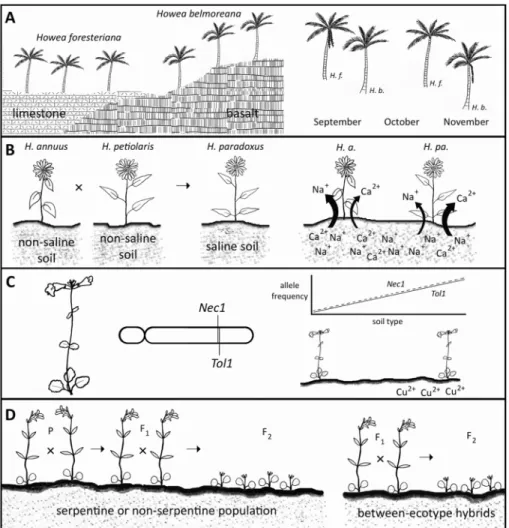
Similarly, case studies of sympatric speciation (i.e., evolution from a single ancestral species in the same location) must demonstrate species co-existence, sister relation-ships, reproductive isolation, and that a former allopatric phase is highly unlikely. In two palm species of Howea, endemic to the remote Lord Howe Island, Australia, divergence in blooming periods is strongly correlated with soil type; only a few genetic loci are more divergent between the two species than expected under neutrality, a finding consistent with sympatric speciation involving disruptive or divergent selection (Savolainen et al., 2006; Fig.1a). Morphotypes of the palm Geonoma macrostachys in Peruvian lowland forests provide another example of sympatric speciation likely occurring between ecologically divergent (via soil and light) and reproductively isolat-ed (via phenology and pollinators) populations (Borchsenius et al., 2016).
Budding or peripatric speciation is a diversification process through which new species form at the periphery of an ancestral population. In this case, a few preadapted genotypes encounter and colonize an edaphic island resulting in edaphic specialization. Budding speciation appears to be especially common in plants (Crawford, 2010), as high rates of selfing (Antonovics, 1968) and polyploidization (Soltis et al., 2004) result in abrupt reproductive isolation between the ancestral and derivative populations. As the initial peripheral populations are small, they can often quickly acquire reproductive isolation via catastrophic selection, i.e., differential survival during an episode of mass extinction (Gottlieb, 2004), or strong divergent selection (Grossenbacher et al., 2014). At the time of speciation, sister taxa will exhibit highly asymmetrical and completely or partially overlapping distributions, yet occupy distinct microhabitats (Gottlieb, 2004), such as edaphically contrasting microsites. Eighty percent of the sister species of
Fig. 1 Examples of edaphic influence on speciation and reproductive isolation. A Howea foresteriana is
largely restricted to limestone, while H. belmoreana is largely restricted to basalt (Savolainen et al., 2006;
Hipperson et al.,2016). Their geographic separation is accompanied by reproductive isolation via a difference
in flowering time: peak flowering inH. foresteriana (H. f.) occurs around two months before H. belmoreana
(H. b.). B Helianthus annuus (H. a.) and H. petiolaris are salt-intolerant species (glycophytes), but H. paradoxus(H. pa.), which originated as a hybrid between the former two species, is a halophyte (Lexer
et al., 2003;2004). Genetic studies suggest that this may be due to changes in the expression of genes for ion
transporters, with increased calcium uptake limiting sodium uptake in the halophyte (Edelist et al., 2009). C
Mimulus guttatus has both copper-tolerant and -intolerant populations in California. The alleles for copper
tolerance (Tol1) and hybrid lethality (Nec1) are at closely linked genetic loci; as selection for copper tolerance
occurred, both alleles rose to high frequency in the population on copper-contaminated soil (Wright et al.,
2013). DCollinsia sparsiflorahas serpentine and nonserpentine ecotypes. Progeny of within-ecotype crosses have high fertility; between-ecotype hybrids do occur, but the genetic distance between the ecotypes is maintained because these hybrids have reduced fertility (ca. 26% reduction in seed viability in F1; Moyle
et al., 2012). Image Credit: Ian D. Medeiros
have highly asymmetric distributions, and occupy distinct habitats (Grossenbacher et al., 2014), suggesting that ecologically divergent taxa in this genus (Lowry et al.,
A meta-analysis of phylogenies available for plants in the California Floristic Province (CFP) showed that of 71 sister pairs from 12 families, 57 pairs (80%) were broadly sympatric (Anacker & Strauss, 2014). Range sizes of sisters differed by a mean of 10-fold and range overlap and range asymmetry were greatest in younger sisters, suggesting that in the CFP, budding speciation has been an important pathway for the origin of neoendemic species. Interestingly, of the 71 sister pairs they examined, 29 (41%) showed complete edaphic shifts whereas 20 (28%) showed partial edaphic shifts, strongly implying that budding speciation via edaphic specialization is commonplace in the edaphically-heterogeneous landscape of the CFP. Similarly, in the Cape Floristic Region (CFR) of South Africa, 87% of sister species show partial or complete ecological shifts; however, complete edaphic shifts were found in only 17% of CFR pairs (van der Niet & Johnson, 2009) versus in 41% of the CFP pairs. This difference may be attributable to lower levels of edaphic and topographic heterogeneity in the CFR compared to the CFP, likely making edaphic transitions less significant in speciation (Anacker & Strauss, 2014).
Hybridization, with or without polyploidy, can play a critical role in the origin and establishment of edaphic specialists (Abbott et al., 2013; De Storme & Mason,2014), especially under parapatric, sympatric, and peripatric modes of speciation. Studies of the relative importance of hybridization and polyploidization on the origin of edaphic endemics show that introgression between close relatives and subsequent adaptation of hybrid offspring to novel edaphic conditions, when directly or indirectly resulting in reproductive isolation with parental taxa, can result in the origin and establishment of hybrid species (Table 1). Edaphic divergence of the hybrid species from its parental taxa appears to be central to the successful origin of several hybrid species, occurring even in the absence of post-zygotic isolation caused by chromosomal and other genetic incompatibilities (Abbott et al., 2010). There is strong evidence, via reciprocal trans-plant and common garden approaches, for greater fitness of a hybrid in a novel edaphic habitat relative to that of parental taxa for the sand dune specialist Helianthus anomalus
and the salt marsh specialist H. paradoxus(Fig. 1b), although such conclusive evidence is lacking for another hybrid species, H. deserticola (Edelist et al., 2009; Donovan et al., 2010). Similarly, a Salix hybrid complex from the European Alps has greater tolerance to cold temperatures and nutrient-poor/low pH soils than either parent (Gramlich et al., 2016). The hybrids appear to have originated after glaciers retreated and established persistent populations within a few decades. A major factor contribut-ing to hybrid establishment under sympatric settcontribut-ings is the ability to occupy more extreme edaphic niches relative to either parent species (Abbott et al., 2010; Gramlich et al., 2016).
Are Edaphic Endemics New or Old Species?
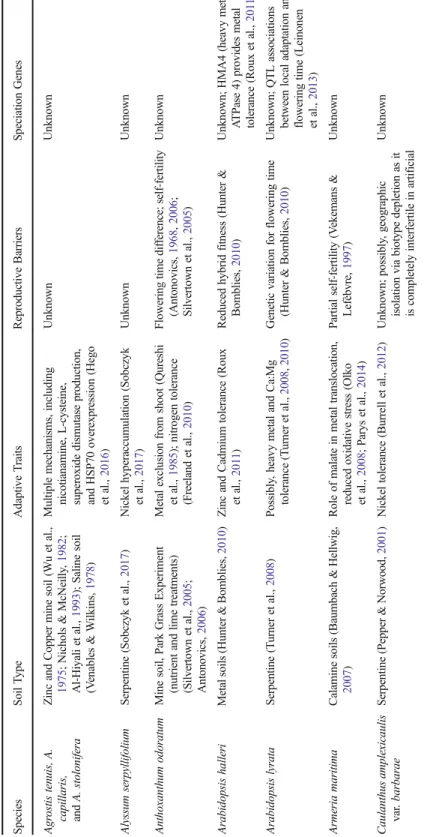
Ta b le 2 (c onti nue d) Species S oil T ype Adaptive T raits Repr o d u ct iv e Ba rr ier s S pe ciatio n G en es Cea noth u s rode ric ki i Ce ra st iu m a lp in u m Colli nsia sparsi flor a Deschamps ia cespit o sa Geonoma macr os tachys Helianthemum spp. Helianthus exil is He lian thu s p a rad ox us Ga bb ro (Bur ge & M anos , 20 11 ) S er p en ti ne (Ny b erg B er g lun d et al., 2 004 ) Ser p en ti ne (M oyle et al. , 20 12 ) Metal soils (Hayward et al., 201 3 ) W ell -d ra ine d v s po orly-drained soil (B o rc h se ni us et al. , 20 16 ) Gy psu m (M oo re et al ., 201 4 ) Serpenti ne (Sambatti & R ice, 2 007 ) S al t (L exe r et al ., 2 003 ) L o w nu tri ent an d C a: Mg tolerance (B ur ge & M anos, 20 11 ) Ma gn es iu m an d nic k el to le ra nc e (N yb er g B er gl und et al ., 200 4 ) Po ss ibly , C a:Mg tole ran ce (M o y le et al ., 2 012 ) Inc re as ed nic ot ian am ine an d p hyt oc hel ati n sy n th es is (H ay war d et al ., 2 013 )
Unknown Accu
Strauss, 2014; Ferris et al., 2014; Schneider et al., 2016). In contrast, ancient paleoendemics may have evolved via gradual speciation through biotype depletion, including via allopatric (vicariant) speciation, as has been shown for the Streptanthus glandulosus complex (Mayer & Soltis, 1994), Caulanthus amplexicaulis var. barbarae
(Pepper & Norwood, 2001), and for Minuartia spp. (Moore et al., 2013; Moore & Kadereit, 2013; Table1). There is ample evidence from studies of edaphic specialists that large-scale geographic isolation is not always critical for diversification; total reproductive isolation can be achieved even in the face of gene flow (Antonovics,
2006). In fact, recent phylogenetic investigations suggest that neoendemism may be the norm in cases of edaphic specialization, not the exception (Baldwin, 2014). Peripatric or budding speciation is an especially common mode of speciation among neoendemic edaphic specialists, with high rates of selfing and polyploidization causing immediate reproductive isolation between adjacent yet edaphically distinct populations (Gottlieb, 2004). Strong directional and disruptive selection that often occurs across edaphic boundaries, combined with parallel changes contributing to reproductive isola-tion between divergent populaisola-tions, can lead to rapid and local speciaisola-tion (Levin, 1993; Crawford, 2010). In peripatric speciation, the progenitor species is initially paraphyletic; however, lineage sorting and extinction will eventually result in monophyly (Crawford,
2010). Case studies of edaphic differentiation in which there are phylogenetic or population genetic data to support relatedness between edaphically divergent taxa are listed in Table 2along with additional evidence for edaphic divergence via ecological, physiological, reproductive, or genetic studies (when available).
How Does Adaptation Contribute to Reproductive Isolation?
Establishing a direct or indirect link between traits that confer edaphic adaptation and traits that contribute to reproductive isolation is strong evidence for the role of edaphic factors in the divergence of species (Hopkins, 2013; Wright et al., 2013). Classic studies of plants on mine tailings in Europe (Antonovics, 2006 and references therein) clearly demonstrated that rapid and repeated evolution of metal tolerance is often associated with the evolution of prezygotic isolating mechanisms, including the evolution of both self-compatibility (Mousset et al., 2016 and references therein) and earlier flowering in metal-tolerant populations (Antonovics, 2006 and references therein). Both of these traits significantly limit gene flow between divergent popula-tions, aiding in the evolution of independent gene pools under strong edaphic selection. Flowering time shifts inAnthoxanthum odoratumin the Park Grass Experiment, at the boundaries between plots vastly varying in soil pH, have resulted in reduced gene flow (Silvertown et al., 2005). Adjacent populations that had a common origin at the start of the experiment in 1856 have now diverged at neutral marker loci, suggesting that reinforcement (i.e., selection against maladaptive hybridization) has been key to com-pleting speciation. Establishing a direct link between pH tolerance and flowering time is necessary to confirm the role of such reinforcement in speciation. Interestingly, there was no indication of reinforcement at the boundaries of plots with smaller pH differ-entials, suggesting a link between pH preference and flowering time. Earlier flowering times have often been documented for serpentine-associated taxa, including those in the
2007), Mimulus spp. (Macnair & Gardner, 1998; Selby et al., 2014), Gilia capitata
(Kruckeberg, 1951), and Leptosiphon spp. (Kay et al., 2011). Near complete reproduc-tive isolation between coastal and inland populations of Mimulus guttatus has been achieved by selection against immigrants and flowering time differences (Lowry et al.,
2008). The annual, inland populations exposed to more summer drought flower early compared to the perennial populations along the coast on more moist soils. Diversification within the stone plant genus Argyroderma of the Western Cape Province in South Africa also appears to have occurred through allopatric adaptive speciation, under strong edaphic-mediated divergent selection along with reproductive isolation achieved through divergence in flowering times (Ellis et al., 2006). In the well documented case of sympatric speciation in Howea, the shift in flowering phenology between species on volcanic and calcareous soils dramatically reduced interspecific gene flow (Hipperson et al., 2016; Fig. 1a). There also appears to be a pleiotropy between flowering time and adaptation to drought, salinity, and pH, driving speciation (Dunning et al., 2016). Temporal isolation is a key factor in facilitating plant speciation; however, flowering time differences between close relatives can arise as a flexible response to divergent edaphic conditions (Levin, 2009) or through direct or pleiotropic genetic effects of edaphic adaptations (Hunter & Bomblies, 2010; Selby et al., 2014). Soil constituents, such as heavy metals, are directly implicated in causing reproduc-tive isolation between close relareproduc-tives. Copper tolerance in Mimulus guttatus is expressed in the sporophyte as well as in the pistil (Searcy & MacNair, 1993). Copper in the pistils acts as a selective agent since seed production is reduced when pollen donors are maladapted to copper-rich soils (Searcy & Mulcahy, 1985; Searcy & MacNair, 1990). Metal accumulation in reproductive organs generates a strong prezygotic isolating mechanism by decreasing reproductive output in crosses between edaphically divergent parents. Therefore, edaphic factors directly act as reproductive barriers, favoring reproduction between plants growing under similar edaphic condi-tions and minimizing gene flow between edaphically divergent taxa.
Serpentine tolerant Brassicaceae endemics can limit nickel uptake into the shoot, particularly into reproductive organs, while non-endemics accumulate significantly more nickel into reproductive organs relative to shoots (Meindl et al., 2014). In the selenium hyperaccumulating Stanleya pinnata, selenium is preferentially allocated to flowers, while the non-accumulating relative Brassica juncea has higher selenium concentrations in leaves relative to flowers (Quinn et al., 2011a). Selenium had no effect on pollen germination in the hyperaccumulator, but it impaired pollen germina-tion in the relative, showing a possible evolugermina-tionary cost for selenium accumulagermina-tion through decreased pollen germination in the non-accumulating taxon.
Pollinators can distinguish between ‘clean’ nectar and that contaminated with metals, and avoid nectar enriched with metal because of toxicity (Meindl & Ashman,
2013). Pollinator preference of nectar, therefore, can potentially limit gene flow between close relatives found on distinct substrates. Additional trait differences be-tween edaphically divergent taxa can also act as reproductive barriers, including flower size differences leading to differential pollinator preferences (Gardner & Macnair,
2000) and pollen-stigma incompatibilities leading to reduced potential for fertilization (Rajakaruna & Whitton, 2004).
complex, there is evidence for inviability in hybrids between metaltolerant and -intolerant parents (Gardner & MacNair, 2000), although such post-zygotic isolation is not a factor between coastal and inland ecotypes of the same taxon (Lowry et al., 2008). Work on copper tolerance in M. guttatus (Macnair & Christie, 1983; Wright et al.,
2013) has revealed a genetic association between edaphic tolerance and hybrid invia-bility (Fig. 1c). In Collinsia sparsiflora, ecotypic adaptation to serpentine is associated with the expression of hybrid sterility between serpentine and nonserpentine ecotypes, over spatial scales of less than 1 km (Wright & Stanton, 2007; Moyle et al., 2012; Fig. 1d). Further, allozyme (Wright & Stanton, 2011) and microsatellite data (Moyle et al., 2012) suggest there is little genetic differentiation between ecotypes, indicating that hybrid sterility may have recently evolved.
A potentially fascinating example of the relationship between adaptation and repro-ductive isolation yet to be studied lies in the progenitor-derivative species pair of Layia glandulosa subsp. lutea and L. discoidea (Baldwin, 2005). Unlike Mimulus, in which hybrid lethality has been documented between copper-tolerant and -intolerant taxa (Wright et al., 2013), there is complete fertility between artificial crosses of the serpentine-intolerant and serpentine-endemic Layia species; however, spontaneous hybrids are not found in nature, suggesting that partially or completely reduced hybrid fitness in one or both parental habitats may be responsible for the diversification. Additionally, it is unknown whether the flower shape (discoid- vs. ray-flowered) plays a role in pollinator preferences or whether potential differences in flowering time, especially when populations occur along contact zones, contribute to pre-zygotic isolation. Similarly, factors contributing to reproductive isolation between the guano-endemic Lasthenia maritima and its close relative, the coastal bluff-specialist L. minor, are little-known (Rajakaruna, 2004). There is evidence for greater self-compatibility within the guano-endemic (Crawford et al., 1985), resembling the trends shown for some metal-tolerant species (Mousset et al., 2016 and references therein); however, it is unclear whether other isolation barriers, such as differences in pollinators or flowering times, or hybrid lethality and reduced fitness of hybrids in parental habitats, also contribute to preserving isolation. Further, the physiological bases for guano adaptation are also unknown. Whether the high nutrient content (nitrogen, phosphorus), low pH (due to uric and other acids), or some other chemical or physical factor of guano drives selection on these substrates needs further investigation. For both Layia and Lasthenia
case studies, QTL-based comparative genome mapping and transcript profiling ap-proaches (Sun & Schliekelman, 2011) can be used to determine whether any traits conferring adaptation to substrate have effects on traits contributing to reproductive isolation between the divergent taxa.
Are Edaphic Endemics Evolutionary Dead-Ends?
& Kadereit, 2015), and gypsophiles (Bresowar & McGlaughlin, 2015) have demon-strated that tolerance to edaphic conditions has been gained numerous times within various groups of angiosperms and has even been lost in some groups, suggesting that traits conferring edaphic tolerance are evolutionarily labile. Further, differences in the evolutionary dynamics (i.e., gains vs. losses) of edaphic tolerance documented among different lineages may result from association of edaphic tolerance traits with other ecophysiological traits related to tolerance of environmental stresses, with edaphic tolerance being more easily gained in preadapted lineages (Saslis-Lagoudakis et al.,
2014; Selby et al., 2014). The direction of serpentine endemism among genera with serpentine-tolerant species in California is mostly from non-tolerant and -tolerant species to endemic species, with a few reversals from the tolerant or endemic state to the non-tolerant state (Anacker et al., 2011). This suggests that the evolution of edaphic endemism may represent an evolutionary dead-end. This may not always be the case, however, as endemics are often able to influence adjacent populations by repeated episodes of introgression and polyploidization. In the diploid-tetraploid complex of
Knautia arvensis, recurrent polyploidization within serpentine populations followed by hybridization with the neighboring non-serpentine tetraploid populations, has allowed serpentine tetraploids to escape from their serpentine refuge and spread further into non-serpentine habitats (Kolářet al., 2012). Similarly, endemic Streptanthus clades are often quite diverse, with endemism having evolved numerous times and having been lost at least once (Cacho et al., 2014). In Arabidopsis, there is also evidence for serpentine-tolerant loci being introgressed from one serpentine-endemic to another (Arnold et al., 2016) and for hybridization between two sympatric and diploid lime-stone endemics, giving rise to a tetraploid siliceous soil endemic (Schmickl & Koch,
2011). These findings suggest that edaphic endemism does not always represent an evolutionary dead-end and that endemics have the potential to further diversify within (Cacho et al., 2014) or across substrates (Schmickl & Koch, 2011).
How Does Tolerance to Edaphic Extremes Influence Competitiveness
in
‘
Normal
’
Soils?
Edaphic islands have long been considered a refuge from competition (Kruckeberg,
1954), suggesting that tolerance to edaphic extremes has a cost. However, the idea of a trade-off of competitive ability for tolerance (i.e., trade-off hypothesis) needs close scrutiny via experimentation (Harper et al., 1997a). Edaphic specialists, compared to non-specialists, often appear to be less competitive (Milla et al., 2011; Moore et al.,
2013; Anacker, 2014; Bastida et al., 2014) and more susceptible to herbivory when found on ‘normal’ soils (Dechamps et al., 2008; Kay et al., 2011; Strauss & Boyd,
experimentally demonstrate that the traits are genetically correlated (Partridge & Sibly,
1991). Experimental studies on copper tolerance in Mimulus guttatus (Harper et al.,
1997a), however, provide no clear evidence in support of a trade-off hypothesis. Additionally, low fitness of metal tolerant plants in ‘normal’ environments can also result from an increased metabolic requirement for the metal (i.e., metal requirement hypothesis). Studies conducted on M. guttatus, however, show no such increased requirement for copper (Harper et al., 1997b, 1998), suggesting that neither the trade-off hypothesis nor the metal requirement hypothesis can fully explain the cost of copper tolerance in M. guttatus. Additional experimentation will likely reveal that it is not one trait but a suite of adaptive traits (i.e., genes, their modifiers, and the interactions between them; see Smith & Macnair, 1998) that has a cost in a ‘normal’ habitat. Similarly, there is little evidence of a cost for tolerance to either low soil calcium to magnesium ratios or high concentrations of heavy metals, two key selective pressures experienced by plants growing on serpentine soils (Brady et al., 2005; Kay et al.,2011). Serpentine endemics, however, are typically slow-growing and stress-tolerant, rather than fast-growing and what is typically considered as competitively superior (Anacker & Harrison, 2012; Fernandez-Going et al.,2012), consistent with the notion of a trade-off between competitive ability and tolerance to serpentine. Indigenous resistant plants on serpentine soil have less competition from invasive species when growing on serpentine soil (Harrison, 1999; Gram et al., 2004; Going et al., 2009), but are poor competitors on high-nutrient soils (Rice, 1989; Jurjavcic et al., 2002; Vallano et al.,
2012). Regardless, the evidence that competition is reduced on serpentine soils (Moore & Elmendorf, 2011) and that edaphic endemics are competitively inferior is not substantial (Powell & Knight, 2009; Fernandez-Going & Harrison, 2013). Furthermore, these hypotheses of a cost of tolerance have not been tested in numerous lineages, nor have they been examined across distinct substrate types.
Comparing pairs of sister taxa could help reveal the evolutionary costs of habitat specialization relative to broad tolerance and address why some species become edaphic specialists whereas others maintain general-purpose genotypes (sensu Baker,
1965) that can tolerate wide-ranging habitat conditions. A widely-distributed Aquilegia
subspecies has greater adaptive phenotypic plasticity and higher competitive ability than a related taxon that is a narrow endemic (Bastida et al., 2014). This suggests that adaptive plasticity, competitive ability, and lineage history all contribute to phenotypic divergence, edaphic niche specialization, and range distribution.
and allies (Armbruster, 2014). Whether such preadaptation to bare habitats is a precursor for adaptation to other rock outcrop plant communities can be tested via similar approaches, using a combination of molecular phylogenetic and ecological data (Cacho & Strauss, 2014).
Does Parallel Evolution Occur Frequently in Edaphic Specialists?
Parallel (or repeated) evolution provides strong evidence for the role of ecology in driving divergence (Nosil, 2012). Parallel edaphic adaptation may be achieved via the evolution of novel alleles contributing to specialization or via parallel increases in the frequency of alleles (Faria et al., 2014). Repeated evolution of traits may not be unusual in clades that have undergone ecological radiation, particularly in those taxa adapted to environments imposing strong divergent selection such as harsh edaphic environments (Levin, 2001; Mengoni et al., 2003a, b). When changes in edaphic tolerance are associated with changes in reproductive compatibility, a case for parallel ecological speciation can be made (Rajakaruna & Whitton, 2004). Contrary to these findings, there are only a limited number of studies showing the repeated evolution of traits conferring adaptation and reproductive isolation in plants, i.e., parallel ecological speciation (Ostevik et al., 2012). Interestingly, of the 23 potential cases for parallel ecological speciation cited by Ostevik et al. (2012), 10 are from plants adapted to harsh edaphic conditions (see Table 1 in Ostevik et al., 2012). The prevalence of cases of edaphic adaptation among the limited number of studies of parallel ecological specia-tion suggests that parallel evoluspecia-tion appears to occur more often in, or is better known from, edaphic specialists relative to other species. Genomic methods can play an important role in determining whether parallel (via independent evolution of the same or different genes; Nichols & McNeilly, 1982; Levin, 2001; Rajakaruna et al.,
2003c) or horizontal gene flow of clustered genes (via introgression; Arnold et al.,
2016) are responsible for the parallel evolution of edaphic tolerance.
Do Interactions with Herbivores or Microbes Drive the Evolution
of Edaphic Specialization?
Plant interactions with other organisms, including those that are mutualistic and antagonistic, appear to have a role in edaphic specialization (Strauss & Boyd, 2011; Van Nuland, 2016). Harsh soils, which are often nutrient-poor, water-stressed, trace-element rich, and found in barren and open landscapes, may increase physiological costs associated with herbivore damage as well as make plants more conspicuous to herbivores (Strauss & Boyd, 2011). Edaphic specialists may be more susceptible to herbivory than their non-specialist relatives and plant-herbivore interactions can some-times be central to edaphic specialization (Fine et al., 2004; Van Zandt,2007; Lau et al.,
(Kruckeberg, 1992; Springer, 2007) suggests that plants will experience lower disease pressure on serpentine and other edaphically harsh environments, either through reduced disease transmission rates in sparsely populated serpentine plant communities (Thrall et al., 2007) or through lowered disease-associated damage, as has been shown for serpentine-adapted Hesperolinon (Springer, 2009). Serpentine specialists within
Hesperolinon are less susceptible to fungal infection, perhaps due to their ability to selectively uptake calcium, which is required to initiate an effective immune response. Less specialized species appear to be more susceptible to fungal disease on serpentine soil (Springer, 2007, 2009). Such a pathogen-refuge effect might also reinforce edaphic associations among plants and promote greater edaphic specialization. In parapatric coastal populations of Senecio lautus, herbivores have a central role in preventing gene flow in the field via differential seedling predation of both migrants and hybrids, whereas soil elemental content contributes to divergent selection on populations both locally and on a geographic scale (Melo et al., 2014).
Specialization in plant host-symbiont-soil interactions may also facilitate plant adaptation to edaphic stress and subsequent specialization (see Table 2 in Van Nuland, 2016). Arbuscular mycorrhizal fungi (AMF) are common root symbionts that can increase a plant hosts' establishment and growth in edaphically-stressful environ-ments (Palacio et al., 2012; Schechter & Branco,2014; Southworth et al.,2014). There are plant and microbial symbionts that enhance plant adaptation to edaphic stress (Thrall et al., 2007), showing that co-adapted interactions may play a role in edaphic specialization. For example, arsenic-tolerant AMF suppress high-affinity arsenate/ phosphate transport in the roots and decreases arsenic uptake by the arsenic-tolerant grass, Holcus lanatus, showing that arsenic-tolerant AMF may contribute to enhanced arsenic-tolerance in the metal-tolerant populations of the grass (Gonzalez-Chavez et al.,
2002). However, salt-tolerant Acacia species from a high-salinity environment are less dependent on Rhizobium bacteria than salt-sensitive hosts from less stressful environ-ments, suggesting plant–rhizobial mutualisms may be less important in plant adaptation to salinity (Thrall et al., 2008). Arbuscular mycorrhizal fungal assemblages associated with serpentine and non-serpentine ecotypes of Collinsia sparsiflora showed that plant ecotypes are associated with distinct AMF assemblages (Schechter & Bruns, 2008); however, a common garden test of host-symbiont specificity provided no evidence of adapted host ecotype-AMF specificity, suggesting that soil type, not microbial speci-ficity, is key to determining AMF assemblage structure in C. sparsiflora(Schechter & Bruns, 2013). Findings on plant host-microbial symbiont specificity and the role of AMF on edaphic stress tolerance in higher plants are variable (Thrall et al., 2008; Glassmand & Casper, 2012); some AMF, however, have the capacity to confer metal tolerance in some plant host species either via sequestration or by contributing to growth enhancement via increased nutrient acquisition (Schechter & Branco, 2014). Such mutualistic interactions are clearly beneficial for some plant species, allowing them to colonize harsh soils and thus setting the stage for potential divergence.
specialized niche for metal-tolerant herbivores, pollinators, microbes, and neighboring plants. For example, high levels of metal in plant tissues reduce herbivory (Quinn et al.,
2010) and pathogen infection (Fones et al., 2010) and result in increased litter decom-position by specialized microbes (Quinn et al., 2011b), causing an elemental allelo-pathic effect on metal-intolerant neighbors (El Mehdawi et al., 2011); all these effects can influence the fitness of plants accumulating the metal, thereby contributing to edaphic specialization. Plant-microbe interactions may also influence gene flow be-tween divergent populations due to microbe-assisted edaphic differentiation. A study of an Artemisia hybrid zone in central Utah showed that the microbial community influenced the performance of parental and hybrid plants in native and nonnative soils, segregating the distinct populations and likely contributing to their edaphic divergence (Miglia, 2007).
Metal-hyperaccumulator plants found on serpentine and other metal-rich environ-ments are hosts to insects that appear to have co-evolved with them (Boyd, 2014). Some of these insects do accumulate heavy metals to toxic levels (Boyd, 2007) and may use them as defense against natural enemies (i.e. elemental defense hypothesis; Boyd, 2007). Although only one study supports this hypothesis (Boyd & Wall, 2001), little research regarding this hypothesis has been conducted to date. There is also no overwhelming evidence for a cost of hyperaccumulation in terms of reproductive functions or pollinator visitation. For example, pollinators of Stanleya pinnata, a Se-hyperaccumulator, showed no visitation preference between high- and low-Se plants, suggesting greater tolerance to the metalloid (Quinn et al., 2011a). Whether the presence of aluminum and nickel in nectar of Impatiens capensis alters foraging behavior by bumblebees has also been investigated (Meindl & Ashman, 2013). The presence of aluminum in nectar did not influence foraging patterns; however, flowers containing nickel-laden nectar solutions had shorter visits relative to controls, and even resulted in reduced visitation of nearby nickel-contaminated flowers. Reduced visita-tion by native pollinators has also been documented for Streptanthus polygaloides
(Meindl & Ashman, 2014) which accumulates nickel in pollinator rewards such as nectar and anthers. Although heavy metal effects on plant-pollinator interactions are clearly context-dependent, edaphic features, such as heavy metal concentrations, have the capacity to influence gene flow and reproductive isolation between close relatives through pollinator selection.
Are Edaphic Specialists More or Less Sensitive to Climate Change?
Species can respond to climate-associated stressors via both phenotypic plasticity and local adaptation (Valladares et al., 2014). Edaphic specialists, many of which display largely disjunct but widespread distributions, are ideal models for exploring how climate interacts with edaphic factors to influence plant distribution (Damschen et al.,
may be extirpated, whereas serpentine populations, already preadapted to aridity, could survive and become endemic due to the extinction of the more widespread nonserpentine populations (Moore et al., 2013; but see Anacker, 2014). Pronounced climatic oscillations of the Quaternary period appear to have forced populations of
Sempervivum, Jovibarba, and Adenostyles to respond via latitudinal or altitudinal shifts into edaphically unsuitable but relatively competition-free habitats (Klein & Kadereit,
2015). This set the stage for the divergence of edaphically specialized species via allopatric speciation. A similar scenario is presented for the evolution of the edaphically specialized Lilium pyrophilum(Douglas et al., 2011).
There is increasing evidence that climatic and edaphic factors interact to control local adaptation and substrate endemism (Fernandez-Going, 2014). Serpentine ende-mism peaks in wet regions both in California and some other parts of the world (Anacker, 2011; Fernandez-Going, 2014), likely due to increased competition on
‘normal’ substrates under more productive climates. At the community level, there is also more species, functional, and phylogenetic turnover across edaphic boundaries in mesic relative to arid regions of California (Anacker & Harrison, 2012). Furthermore, serpentine endemics in California generally occupy wetter regions than even their closest relatives (Fernandez-Going, 2014), but this is only true in the case of neoendemics arising from serpentine-intolerant ancestors; more productive climates may have been more suitable for the persistence of small neoendemic taxa with novel adaptations during and after speciation. Paleoendemics, on the other hand, occupy similar climates to those of their closest relatives, suggesting that range contractions leading to biotype depletion may have been similar in arid and mesic regions (Anacker,
2014). It is as of yet unclear whether climate can alter soil-specific competitiveness in edaphic endemics (see Fernandez-Going & Harrison, 2013) and whether paleoendemics and neoendemics differ in their sensitivities to competition.
Climate change will clearly have differential effects on the ranges of edaphic specialists. In California, future climate conditions may extend the potential range of many endemics (Loarie et al., 2008); however, whether edaphic endemics can naturally disperse to suitable habitat is questionable (Damschen et al., 2012; Spasojevic et al.,
2014). Preadaptations to dry conditions may allow edaphic specialists to expand their current range (Fernandez-Going et al., 2012; Fernandez-Going, 2014) and even be more competitive with non-specialists off of their special edaphic niche (Moore et al.,
2013). Tolerance of edaphic stress appears to go hand-in-hand with tolerance of climatic stress for plants growing on serpentine soils, linking soil infertility to a stress-tolerant functional trait syndrome that confers unusually high resistance to climate change upon plant species and communities (Harrison et al., 2015). Therefore, in the absence of nutrient deposition, stress-tolerant invasive species, and habitat loss, edaphic specialists may perform better under future warmer/drier climates relative to plants adapted to more fertile soils. With possible range expansions onto
serpentine outcrops, are model habitats for exploring such questions and for testing the roles of patch size, shape, type (soil), and isolation in ecological and evolutionary processes (Gil-López et al., 2014).
What is the Genetic Basis of Edaphic Specialization and Speciation?
In the era of genomics, there are many tools (e.g., Bratteler et al., 2006a, b; von Wettberg & Wright,2011; Selby et al.,2014) at our disposal to explore the genetic basis of adaptation to harsh environments, including the nature of adaptation to dissimilar habitats with similar abiotic stressors (e.g., arid and saline habitats contributing to water stress, saline and serpentine soils contributing to ionic stress, or serpentine and carbon-ate soils contributing to high pH). Phylogenetic analyses show that there is a significant association between halophytes and metal hyperaccumulators, although within each group there is low phylogenetic clustering (Moray et al., 2016), suggesting that salinity and metal tolerance can vary among close relatives. In Asteraceae, Amaranthaceae, Fabaceae, and Poaceae, halophytes and hyperaccumulators are more closely related than would be expected if the two traits had evolved independently, suggesting a strong genetic association between the abilities to tolerate salt and heavy metals. Studies of evolutionary ecology now routinely use high-throughput sequencing and other geno-mic approaches to examine the genetic basis of speciation (Tiffin & Ross-Ibarra, 2014) and these methods have clearly promoted the study of edaphic adaptation (Turner et al.,
2010; Porter et al.,2017).
Genomic polymorphisms that are differentiated between edaphically contrasting populations can reveal candidate loci for edaphic adaptation. Gene pool sequencing of serpentine and granitic populations of Arabidopsis lyrata from the USA shows that the polymorphisms that are most strongly associated with soil type are loci for heavy-metal detoxification and calcium and magnesium transport, providing several candidate loci for serpentine adaptation (Turner et al., 2010), including CAX7, which appears to be responsible for adaptation to low calcium to magnesium ratios characteristic of serpentine soils (Turner et al., 2008). Moreover, the same associ-ations between individual loci and serpentine tolerance were observed in the European subspecies of A. lyrata, further implicating edaphic selection. The se-quencing of three candidate loci in the European subspecies indicated parallel differentiation of the same polymorphism at one locus, confirming edaphic special-ization, and different polymorphisms at two other loci, suggesting convergent evolution. Whether these loci also contribute to reproductive isolation between progenitor-derivative taxon pairs is unknown.
Adaptation to low soil calcium to magnesium ratios has often been suggested as key to serpentine tolerance (Palm & Van Volkenburgh, 2014). In serpentine-intolerant
Arabidopsis thaliana, an induced loss of function mutation in the Ca2+-H+ antiporter,
CAX1, enhances survival on soils with a low calcium to magnesium ratio (Bradshaw,
Additional candidate genes have recently been identified for serpentine adaptation in autotetraploid Arabidopsis arenosa, providing evidence that some selected alleles were introgressed from the diploid serpentine-endemic A. lyrata, whereas others were independently involved in separate adaptation events in the two species (Arnold et al., 2016). The research by Arnold et al. (2016) shows strong evidence for selection on genes that control specific ion homeostasis-related traits, as well as drought adap-tation. Although several alleles under selection appear to have been introgressed from
A. lyrata, others have been independently selected following serpentine colonization in both species. The significant overlap between selected genes in serpentine-endemic
A. arenosa and A. lyrata suggests that adaptations to serpentine are not qualitatively different between diploid and tetraploid species. The work described above on
Arabidopsis (Turner et al., 2008,2010; Arnold et al.,2016) advances our understanding of the polygenic basis of multi-trait adaptation to serpentine soils and its repeatability across species. Further, the work suggests that edaphic divergence can occur even in the presence of high levels of inter- and intraspecific gene flow. Serpentine-tolerant
Arabidopsis taxa, along with their close relatives, can provide a useful system for investigating the genetics of speciation under the serpentine influence.
The genetic tools at our disposal (Sun & Schliekelman, 2011; von Wettberg & Wright, 2011; Tiffin & Ross-Ibarra, 2014) can reveal the genetic architecture of adaptive traits that confer reproductive isolation (i.e., speciation genes; Nosil & Schluter, 2011) and whether the same alleles or different alleles contribute to parallel evolution (Ostevik et al., 2012), revealing new insights into the mechanisms by which natural selection can bring about adaptation, reproductive isolation, and speciation. Mechanisms resulting in reproductive isolation may be incidental byproducts of natural selection on linked loci or on loci with pleiotropic effects. For example, plant popula-tions on serpentine and other harsh edaphic settings often flower early (O’Dell & Rajakaruna, 2011). Such phenological isolation could be a byproduct of adaptation to harsh soils or a result of an independent set of genetic changes that were favored by natural selection (Baack et al., 2015). A detailed genetic analysis of the alleles responsible for reproductive barriers can separate these hypotheses, particularly when traits are correlated and contribute to reproductive isolation. In Mimulus, differences in flowering time are often associated with differences in soil water availability (Wu et al.,
2010; Friedman & Willis,2013). In wet coastal and dry inland populations of Mimulus guttatus (Lowry et al., 2008), an inversion polymorphism appears to be a major quantitative trait locus (QTL) for flowering time and growth-related traits, explaining 20–30% of the variation observed between populations (Lowry & Willis, 2010). Reciprocal transplant experiments have demonstrated strong local adaptation in traits that map to the inversion and differ between the coastal and inland ecotypes (Lowry et al., 2008; Hall et al., 2010).
bases for hybrid lethality between edaphically divergent ecotypes of serpentine tolerant species such as Collinsia sparsiflora (Moyle et al., 2012; Fig. 1d) remains to be seen. Current model systems are not representative of all life history strategies and are mostly restricted to herbs, and we need to continue to add new model systems to allow comparative approaches for exploring the intricacies of adaptive evolution (Selby et al.,
2014; von Wettberg et al., 2014). In this regard, the extensive work on the genetics of metal tolerance (Verbruggen et al., 2009) in metalaccumulating and -hyperaccumulating plants used in phytoremediation (Rascio & Navari-Izzo, 2011), and work on the genetics of abiotic stress tolerance and phenology in crops (Roy et al., 2011), are important for examining the genetic bases for edaphic adaptation and species divergence.
Conclusions and Future Directions
Edaphic specialists are key players in the study of local adaptation and ecological speciation (Crawford et al., 2014). Ecological, physiological, phylogenetic, and popu-lation genomic studies of plants growing on serpentine, saline, and metal-contaminated soils continue to shed light on factors and mechanisms driving ecological speciation (Table 2). Studies such as those on Mimulus on copper-enriched soil (Macnair & Christie, 1983; Macnair et al., 1993; Wright et al., 2013; Fig. 1c], Collinsia and
Arabidopsis on serpentine soil (Moyle et al., 2012; Turner et al., 2010; Fig. 1d),
Helianthus on saline soils (Edelist et al., 2009; Fig. 1b], and Senecio on sand dunes and rocky headland soils (Melo et al., 2014), are key to establishing a direct link between adaptation, reproductive isolation, and subsequent speciation. Ongoing re-search on Mimulus, Helianthus, and Arabidopsis (and others; Tables 1 and 2) will continue to unravel how edaphic conditions can directly or indirectly contribute to species divergence.
Lessons on Evolution
There are several key lessons on evolutionary processes from the study of edaphic specialization:
a. Both adaptive phenotypic plasticity and local adaptation contribute to edaphic divergence. Edaphic specialization is key to diversification in some groups; how-ever, in others, there appears to be lack of variation for adaptation to harsh soils. Although edaphic specialization is important in the diversification of flowering plants and ferns, there is little evidence for its significance in other plant groups such as gymnosperms and bryophytes or in lichens, soil algae, and cyanoprokaryotes. b. Although edaphic specialists can evolve under allopatric, parapatric, and sympatric
modes of speciation, there is strong evidence pointing to budding or peripatric speciation being central to the origin of neoendemic species (Anacker & Strauss,
c. Edaphic adaptations have direct or indirect effects on reproductive isolation; adaptive and reproductively isolating traits can evolve rapidly and repeatedly in some lineages, making edaphic specialists key to studying parallel speciation. d. There is mixed evidence for a physiological cost of edaphic tolerance driving
habitat specialization, although both reduced competitive ability and greater sus-ceptibility to herbivory have been documented among some edaphic specialists when grown in ‘normal’ soils.
e. Mutualistic and antagonistic interactions with other organisms can mediate edaphic specialization either by directly enhancing tolerance to edaphic extremes via the action of microbes or by reducing gene flow between divergent populations via the action of pollinators, herbivores, and pathogens.
f. Climate and soils can interact to influence edaphic specialization. Future climates may further restrict the distribution of edaphic specialists due to increased compe-tition from invasive species. However, edaphic specialists could also expand their ranges, even outside their edaphic niche, if their preadaptations to drought make them more competitive than non-specialists under a drying climate.
g. QTL mapping studies, population genomic approaches, and high-throughput phe-notyping assays, when combined with reciprocal transplant studies using hybrid mapping populations (including, F2, backcross, near isogenic lines, and recombi-nant inbred lines), can identify major loci contributing to edaphic adaptation to serpentine, saline, and heavy metal-rich soils (Selby et al., 2014). These loci often have direct or indirect effects on loci that contribute to reproductive isolation (Table 2).
Information Gaps and Future Directions
There are several information gaps that need to be addressed to better develop current model systems as well as to incorporate additional taxa for the study of edaphic specialization. The following are key areas for future research:
a. The identification of specific soil factors that are central to edaphic specialization is important for demonstrating the role of adaptation in speciation. Although most studies state only the general soil type (e.g., serpentine versus non-serpentine, saline versus non-saline, gypsum versus non-gypsum, etc.) being investigated, a handful of studies have attempted to examine the exact soil chemical or physical factor contributing to the specialization and/or divergence (Rajakaruna et al.,
2003a,b; Bradshaw, 2005; Bratteler et al., 2006,b; Palacio et al., 2007; Edelist et al., 2009; Selby et al., 2014). Identifying the key soil variable or variables is more effective when comparing sister populations found across substrates that differ in a distinct way (e.g., with or without a heavy metal as in the case of copper tolerance in Mimulus). Plant ionomic approaches can also be used to investigate ecological functions of ionomic alleles in the adaptation to distinct soils (Lowry et al., 2012; Huang & Salt, 2016).