Cal Poly Basic Needs Task Force Report 1
THE CAL POLY BASIC NEEDS
TASK FORCE REPORT
EXECUTIVE SUMMARY
College students must be properly fed and housed if they are to succeed academically. According to the CSU Basic Needs Initiative report (2018), 27% of Cal Poly students experience food insecurity and 12% experience homelessness. Cal Poly students who experience food and housing insecurity report worse physical health, mental health, and lower GPA than students who do not. Established research has also confirmed that hunger and homelessness among young people impairs cognition, memory, academic
performance, mental health, and social wellbeing.
Cal Poly Basic Needs Task Force Report 2018 3
their academic performance and path to graduation, not to mention their physical and mental wellbeing.
As college tuition and living expenses continue to increase, together with socio-demographic diversity at Cal Poly, food and housing insecurity issues are likely to become more pronounced. In the interest of achieving CSU Graduation Initiative targets and fostering a positive, inclusive campus climate, Cal Poly must take concerted action to ensure that all students have regular and sufficient access to proper food and housing.
The chronic and devastating nature of hunger and homelessness on our campus underscores the need for an integrated basic needs infrastructure at Cal Poly. The Cal Poly Basic Needs Task Force recommends the following actions:
1) Acknowledge the problem and scale of basic needs
insecurity on our campus
2) Create a student-centered dedicated, central physical space
for basic needs-related issues
3) Normalize and destigmatize the issues associated with food
and housing insecurity and poverty
4) Focus on equity, providing students with the type of help
that is right for them
5) Capitalize on partnerships across sectors
6) Build a stronger evidence base by encouraging and
supporting research
7) Advocate for basic needs efforts at the campus, CSU, state,
and national levels
KEY TERMS
BASIC NEEDS
Necessary resources for survival. The fundamental, minimum requirements necessary for a decent standard of life and physical, mental, and social well-being. In the context of this report, we refer primarily to food and housing, but basic needs may also include issues such as safety and security, sanitation, access to clean water, and clothing.
CALFRESH
The name of the federal Supplemental Nutrition Assistance Program (SNAP) in California. CalFresh offers eligible individuals and families money in the form of an Electronic Benefits Transfer (EBT) card, similar to a debit card, which can be used for the purchase of fresh food. The average college student CalFresh participant receives $150/month to spend on groceries.
FOOD INSECURITY
The state of being without reliable access to a sufficient quantity of affordable, nutritious food. “Low” and “very low” food security levels are
defined as “food insecure” by the USDA, and “marginal” and “high” food security levels are considered “food secure”. The word ‘hunger’ is
Cal Poly Basic Needs Task Force Report 2018 5
FOOD PANTRY
Charitable effort that distributes food to those who have difficulty accessing enough food to avoid hunger or food insecurity. At Cal Poly, the food pantry is located at the Student Health and Wellness Center and may be utilized by any registered student.
HOUSING INSTABILITY OR INSECURITY,
HOMELESSNESS
Variably defined as having difficulty paying rent,having frequent moves, living in overcrowded conditions, or doubling up with friends and relatives. In the college context, instability may take the form of frequent moving of residence due to lack of resources or eviction, or temporary or chronic couch surfing. Homelessness refers to lack of a fixed, regular, and adequate nighttime residence, characterized by living in motels, hotels, or camping grounds due to lack of alternative adequate accommodations or living in a car or other location not designed for being a residence.
MEAL VOUCHERS
Cal Poly program designed to alleviate food insecurity by providing electronic dining credits redeemable for meals at participating food outlets on campus.
MUSTANG MEAL SHARE
OBJECTIVE
The Cal Poly Basic Needs Task Force inaugurated in 2016 as a working group and currently meets monthly during the academic year. It is co-chaired by Joy Pedersen, Associate Dean of Students, and Aydin Nazmi, Associate Professor in the Department of Food Science and Nutrition. Members of the Task Force represent Alumni Relations, ASI, Athletics, Cal Poly Corporation, Campus Dining, Campus Health & Wellbeing, Career Counseling and Education, Counseling Services, Dean of Students and Student Affairs, Educational Opportunity Program (EOP), Facilities, Financial Aid, Green Campus Program, Office of the President, University Housing and Residential Life, and community members and organizations.
The goal of the Task Force, and that of this
report is to
examine
and
contextualize
the
problem of basic needs insecurity at Cal
Poly and to
offer solutions
to address this
ongoing problem.
Cal Poly Basic Needs Task Force Report 7
College students must be properly fed and housed if they are to succeed academically. Sadly, thousands of Cal Poly students lack the basic needs of food and housing, according to the CSU Basic Needs Initiative Report (2018)1.
The notion that college students are protected from basic needs insecurity, that is, difficulty accessing proper and consistent food and housing, is incorrect. In fact, college students are at
substantially increased risk for experiencing these problems compared to non-student populations. Cost of tuition, housing, books, and gaps in financial
aid contribute to college students’ vulnerability to
these issues2. This is a national problem that not
only compromises academic success, but also longer-term professional and economic mobility. Worse, these problems are often hidden due to stigma and shame.
The prevalence of food insecurity in US colleges and universities is at least 40%3, in line with CSU1
and UC4 data showing 42% food insecurity among
students. To put this into perspective, national data shows US households average 12-16% food
insecurity, suggesting college students are affected three times as much non-student households (USDA Economic Research Service). As with community-based populations, there are significant disparities between college student groups. At the CSU level, for example, substantially increased risk of food insecurity exists among first-generation college students (49%), Pell Grant recipients (51%), former foster youth (63%), EOP students (58%), students who speak English as a second language
1 Crutchfield and Maguire. California State University Basic Needs Initiative Report. CSU Chancellor’s Office. 2018.
https://www2.calstate.edu/impact-of-the-csu/student-success/basic-needs-initiative. Report data and narratives (red boxes) cited throughout.
2 Goldrick-Rab. Paying the Price: College Costs, Financial Aid, and the Betrayal of the American Dream. University of Chicago Press. 2016. 3 Nazmi, Martinez, Byrd et al. Food insecurity among US higher education students: A systematic review. Journal of Hunger and Environmental
Nutrition 2018. DOI: 10.1080/19320248.2018.1484316.
4 Martinez, Web, Frongillo et al. Food insecurity in California’s public university system: What are the risk factors?Journal of Hunger and
(49%), Dreamers (47%), and DACA students (45%). Latino/Hispanic, Black/African-American, Native Hawaiian/Other Pacific Islander, and Other
race/ethnicity students experienced food insecurity at higher rates compared to Non-Hispanic White and Asian students.
Homelessness among students averages about 13%5
but has been reported as high as 20% in the Los Angeles Community College District6. The CSU
average for homelessness was 11% in 2017, but higher rates were evident for transfer students, Pell Grant recipients, EOP students, and students who speak English as a second language (all 13%), international students (16%), and former foster youth (25%), Black/African-American students also experienced homelessness at far higher rates (18%).
Unsurprisingly, lack of proper food and housing makes everything worse. The evidence is
unambiguous that food and housing insecurity lead to poor physical, mental, cognitive, academic, social
outcomes7. Moreover, these problems
disproportionately impact students of color, low-income students, and first-generation students, suggesting the needs for equity-based approaches targeting those experiencing highest risk.
CAL POLY DATA
5 Goldrick-Rab, Richardson, Hernandez. Hungry and homeless in college. 2017.
http://www.wihopelab.com/publications/Hungry-and-Homeless-in-College-Report.pdf
6 Los Angeles County Community College District. 2017.
http://www.wihopelab.com/publications/Wisconsin-HOPE-Lab-LA-CC-District-Report-Survey-Student-Needs.pdf
Cal Poly Basic Needs Task Force Report 2018 9
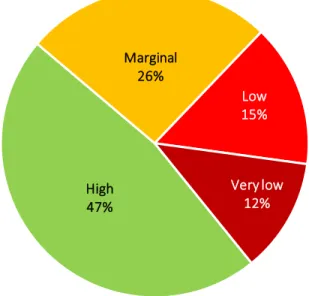
According to the CSU data from 2018, 27% of Cal Poly students experience food insecurity (Figure 1). Of these, there was an approximately equal distribution of
food insecurity (defined as ‘low’ and ‘very low’ food security, in red). An additional
26% experienced ‘marginal’ food security, which refers to problems of food access
and consistent anxiety over food acquisition. This translates to approximately 6,000 students without regular access to proper food and another 6,000 on the brink.
Figure 1. Food security status among Cal Poly students showing 27% food insecurity (15% low and 12% very low food security) and 73% food security (47% high and 26% marginal food security). Data from the 2018 CSU study.
Students struggling with food insecurity have worse physical and mental health indicators (Figure 2), and lower GPA (Figure 3).
High 47%
Marginal 26%
Low 15%
Very low 12%
Figure 2. Health and academic outcomes by level of food security in the previous 30 days. Data from the 2018 CSU study.
Figure 3. GPA by level of food security among Cal Poly students. Data from the 2018 CSU study.
0 2 4 6 8 10 12 14
Poor physical health days Poor mental health days
D
ay
s i
n t
he pa
st
mont
h
Worse physical and mental health among students experiencing food insecurity
High food security Marginal Low Very low food security
3.34
3.23
3.16
3.02
2.8 2.9 3.0 3.1 3.2 3.3 3.4
High Marginal Low Very low
G
PA
Food security status
Cal Poly Basic Needs Task Force Report 2018 11 Figure 4. Nearly 1 in every 8 Cal Poly students experienced homelessness in 2017. Data from the 2018 CSU study.
The proportion of students that reported being homeless in the previous year (2017) was 12%, nearly one in every eight Cal Poly students (Figure 4).
These students have worse physical health, mental health, and academic concerns compared to those who were properly and consistently housed (Figure 5). Students who had not experienced homelessness had comparable GPAs to those who had been homeless, 3.24 and 3.23, respectively. It has been hypothesized that the academic performance of homeless students is boosted by spending so much time on campus, as they seek to capitalize on the shelter and resources offered by libraries and other common areas8.
Figure 5. Health and academic outcomes by homelessness status. Data from the 2018 CSU study.
8 Hungry and homeless in college. Wisconsin Hope Lab. 2017. www.wihopelab.com/publications/Hungry-and-Homeless-in-College-Report.pdf
0 2 4 6 8 10
Poor physical health days Poor mental health days
D
ay
s i
n t
he pa
st
mont
h
Worse physical & mental health with homelessness
Cal Poly Basic Needs Task Force Report 2018 13
BASIC NEEDS & THE GRADUATION INITIATIVE
The CSU Graduation Initiative 2025 aims to
“increase graduation rates for all CSU
students while eliminating opportunity and achievement gaps9.” Key metrics for the
Initiative suggest a focus on students of color, low-income students, and first-generation students. As such, academic preparation, academic support, and reducing achievement gaps are highlighted as major targets.
However, the more fundamental drivers of academic performance and cognition such as food and housing are not sufficiently
addressed. Only three campuses of 23 (Channel Islands, East Bay, and Fresno) included housing and food security issues as part of their short- or long-term Graduation Initiative plans.
Cal Poly’s Graduation Initiative Student Success Plan10 features 14 focus areas,
primarily focusing on academic strategies
9 California State University Graduation Initiative 2025. https://www2.calstate.edu/csu-system/why-the-csu-matters/graduation-initiative-2025 10 California State University Graduation Initiative 2025 CSU System and Campus Completion Goals and Plans, Draft Report. 2016.
https://www.calstate.edu/bot/agendas/sep16/ED-POL-2-ADDENDUM-GI-2025.pdf
11 http://www.sanluisobispo.com/news/local/article86153657.html
such as advising, block scheduling, and
tutoring. Housing instability is not mentioned, even though San Luis Obispo County has been ranked as the sixth least affordable place to live in the US11. Food insecurity is also not
mentioned, even as 6,000 Cal Poly students are not able to meet their basic food requirements. Addressing basic needs is currently absent from the Cal Poly goals.
Cal Poly Basic Needs Task Force Report 14
RESOURCES @ CAL POLY
Cal Poly is fortunate to have a number of resources to directly address student hunger and homelessness (Table 1), along with an emerging social awareness of the issues surrounding basic needs insecurity. Most of these basic needs
programs began as grassroots responses by Cal Poly students, faculty and staff to a palpable need on campus. The fact that today, these services are in higher demand than ever speaks to the ongoing and widespread nature of the basic needs problem on our campus.
In addition to the resources listed, Cal Poly was recently awarded a one-time
grant from CSU Chancellor’s Office (from Senate Bill 85, $130,000) designating
Cal Poly a “Hunger Free Campus”. Funds from this grant will be dedicated to
improving food distribution programs, meal sharing programs, CalFresh
outreach efforts, developing partnerships, creating a stronger online presence, and creating a “Cal Poly Food Hub” that includes a community garden and
kitchen, education, research and evaluation, and an accompanying mobile app. In addition, beginning in Fall 2018, Cal Poly will be hosting two full-time
AmeriCorps CSU STEM VISTA Basic Needs Coordinator for at least one year, who will help plan and coordinate Hunger Free Campus and other basic needs
initiatives across campus. These key resources will help build momentum for Cal Poly as our needs grow and evolve.
Cal Poly Basic Needs Task Force Report 2018 15
Resource Coordination Description Funding
CalFresh Outreach Food Science & Nutrition Dept.
Multi-CSU effort to enroll eligible students in CalFresh program
CA Dept. Social Services
Cal Poly Cares Dean of Students Emergency grants of up to $2000 for basic and other
acute needs
Private donors, Graduation Initiative
Emergency housing University Housing Temporary emergency housing in residence halls,
partner to Cal Poly Cares
Private donors, Univ. Housing
Food Pantry Campus Health &
Wellbeing
Venue with free food and basic need items, “free supermarket”
Private donors
Meal Vouchers Dean of Students,
Campus Dining
Originally hardcopy tickets (until Spring 2018) redeemable for one meal at campus eateries, now
electronic on students’ PolyCard: Peer-to-peer mechanism to donate meals to other students
Student donors via Mustang Meal Share Professional Clothing Closet
Career Services Free high quality donated professional attire Private,
community donors
CALFRESH OUTREACH
(2016-current)This program is part of an 11-CSU effort to identify and help eligible students apply to CalFresh. CalFresh Outreach staff conduct extensive campus-wide outreach and hold drop-in hours, coordinate private appointments, increase awareness at events, and promote visibility through conventional and social media platforms. Since its inception in 2016, this program has helped more than 300 students apply for CalFresh, and about half of those were approved for benefits. At Cal Poly, CalFresh utilization among eligible students is estimated to be much lower than the estimated 17% eligibility, representing a major opportunity. This program is funded by the California Department of Social Services via CSU Chico, and Cal Poly’s 2016-2018 budget totaled $361,599. A proposal has recently been approved to continue funding 2019-2021 in conjunction with dozens of other CSU, UC, and California Community College campuses.
CAL POLY CARES
(2015-current)Cal Poly Cares awards emergency grants of up to $2,000 to students with acute financial need. From July 2015 to April 2016, this program awarded grants to 163 students for a total of $288,753, about half of which was for basic needs such as
housing and meals. From July 2016 to June 2017, 183 students were served with a total of $232,767.
EMERGENCY HOUSING
(2016-current)Housing from other units. Inaugurated in 2016, the program hosted 22 students for an average of approximately two weeks to one quarter each in its first academic year of operation. In AY 2017-2018, 15 students were hosted. Funding comes from Cal Poly Cares and University Housing and totaled $83,000 in its first year.
CAL POLY FOOD PANTRY
(2014-current)Students visiting the Cal Poly Food Pantry typically get a grocery bag full of food, including fresh produce. A Student ID is required to check in and no questions are asked. In academic year 2015-2016, the Pantry served 313 students a total of 559 times. In its second year, almost twice as many students utilized the Pantry and the total number of encounters tripled. In AY 2017-201, it is showed further growth, even though data suggest that less than 9% of students have utilized it, and only 15% of students have heard about it. The Pantry has been supported by philanthropic funding and has recently partnered with the Food Bank Coalition of San Luis Obispo, granting access to wholesale pricing. The annual cost to maintain the pantry is approximately $35,000-45,000.
PROFESSIONAL CLOTHING CLOSET
(2015-current)Cal Poly Basic Needs Task Force Report 2018 17
MEAL VOUCHERS
(2014-current)Available through the Dean of Students, meal vouchers (originally hardcopy tickets) are redeemable for meals at campus eateries electronically via PolyCard. The transition to an electronic mechanism (Mustang Meal Share, introduced 2017) has contributed significantly to streamlining the program, as well as decreasing the stigma associated with using a different means of purchasing food compared to other
students in line. Mustang Meal Share allows freshmen on a meal plan to donate up to 10 meals per year to their peers. Donors submit a form with the number of meals they want to donate and Cal Poly Dining creates an electronic voucher for each meal
donated. To Spring 2018, 100 students have donated 786 meals through Mustang Meal Share. Students requesting vouchers meet with Dean of Students staff to discuss their situation and are also referred to the Food Pantry and the CalFresh Outreach team. Since its inaugural academic year, about 10,000 vouchers have been distributed to roughly 1,200 students per academic year. The majority of recipients receive 26-50 vouchers per year, and nearly half of all recipients receive at least 51 vouchers. Demand has recently increased; in Spring quarter 2018 alone, more than 2,000
SUSTAINING GROWING NEEDS
Food and housing insecurity among Cal Poly students should be considered chronic problems. Indeed, they are likely to become more prevalent in coming years for two main reasons. First, as student socio-demographic diversity increases, Cal
Poly’s student body will have more students of color, first generation students, and
other historically underrepresented groups who are at increased risk for basic needs insecurity12. Second, as housing and tuition costs continue to increase, more and
more college students, even those from middle class backgrounds, will struggle for
basic needs such as food and housing13. As these problems become more
pronounced on campus, and impact more students, it will be important to identify and employ the most effective interventions, apply financially sustainable models, and prioritize prevention.
Cal Poly Basic Needs Task Force Report 2018 19
The most effective interventions will be identified through rigorous longitudinal research into the causes of basic needs
insecurity and how best to meet students’
needs. Utilizing financially sustainable models is also key. The Meal Voucher program, for example, was funded by a single donor since its inception but recently discontinued support, which left a considerable gap. The Basic Needs Task Force at Cal Poly creatively responded to this need by helping create the Mustang Meal Share program, which allows students on meal plans to donate their surplus meals to their peers. Current activities in outreach, promotion, and assisting students with enrollment in CalFresh are externally funded, but represent a high return on investment, because once students are enrolled, they receive an average of $150/month for groceries with little further
input from Cal Poly. This directly addresses food insecurity and generates $1.80 in the local community for every $1 spent with these funds. Efforts of Cal Poly’s CalFresh
Outreach program in 2016-2018 resulted in more than $40,000 per month being
generated in the local region. For other services and programs, finding ways to decrease costs is critical, and may be simple. For example, the Food Pantry recently
partnered with the Food Bank Coalition of San Luis Obispo, which resulted in a savings of 75% on food. Finally, prevention must be prioritized through a number of means, including early identification of at-risk students, rapid deployment of resources to alleviate acute food or housing insecurity, and advocacy at all levels, from grassroots movements to
RECOMMENDATIONS
The chronic and potentially devastating nature of basic needs insecurity
underscores the need for an integrated basic needs infrastructure at Cal Poly. To that end, the Cal Poly Basic Needs Task Force recommends a series the following actions suitable to an array of inter-sectoral partnerships.
1.
Acknowledge the problem and scale of basic needs
insecurity
among Cal Poly students. Unambiguously commit to efforts designed to alleviate, prevent, and study food and housing insecurity. Define food and housing security as a fundamental right for all Cal Poly students.2.
Create a dedicated student-centered physical space
explicitly for basic needs infrastructure and support.
a. Accessing help must be quick and painless. Creating an integratedBasic Needs Hub for basic needs services and resources would streamline access to resources, refer students more quickly and effectively to the proper channels, and decrease misconceptions about which services are available and to whom. This model would also contribute to sustainability, as programs may evolve over time, but a central nucleus would remain a one-stop shop. To improve access and contribute to normalization of the issues, a highly visible physical space (e.g. in the UU) would house the Hub and be coupled with intensive marketing. A dedicated, specially trained full-time staff member plus part-time student staff and interns would serve to run the facility, offering Learn by Doing opportunities for student staff/interns. For the 2018-2019 academic year, the Cal Poly Basic Needs Task Force in
conjunction with Campus Health and Wellbeing have secured two full-time AmeriCorps Volunteers in an effort to begin coordination of basic needs-related efforts, but a longer-term plan is needed.
Cal Poly Basic Needs Task Force Report 2018 21
b. Develop a strong Cal Poly Basic Needs online presence, including a
centralized website with information about resources, plus links to various programs, resources, and key contacts. Create an opt-in mailopt-ing list whereby students can receive basic needs
information on an ongoing basis. Coordinating with existing resources such as diverse Cal Poly social networks and the Cal Poly mobile app is also recommended to make this information easier to access. For the 2018-2019 academic year, the Cal Poly Basic Needs Task Force has secured funds, albeit limited and short-term, from the CSU Chancellor’s Office (Hunger-Free Campus grant) that will serve to initiate some of these efforts.
3.
Normalize and destigmatize
, create a positive and inclusive climate for all students.a. Increasing visibility of the issues and decreasing the associated shame, fear, and stigma is a matter of campus culture. As such, core programs such as WOW, SLO Days, and other student orientation and transition programs offer valuable opportunities for introducing and normalizing the food and housing issues to promote dialogue and visibility in the student population. These issues are relevant to all students and will become major
hurdles to many over the course of their time at Cal Poly.
Ongoing large-scale programs such as academic support centers should also be trained on how to identify students with
potential basic needs problems. Venues such as campus residence halls, recreation centers, and libraries are also high-density areas useful for promotion and marketing efforts. b. Breaking taboos. Financial aid is typically not a taboo subject,
but food insecurity and homelessness remain extremely
sensitive topics, even among friends. Several thousand Cal Poly students experience basic needs insecurity, and studies show that their social and mental health suffers. They feel
4.
Focus on equity
. Some groups experience significantly higher rates of basic needs insecurity. Creating an inclusive campus means ensuring that all people get the type of help that is right for them. Groups at higher risk need more support. While campus-level marketing approaches may be useful for visibility and awareness-building, targeted approaches are warranted for known at-risk groups such as first-generation students, students of color, Pell Grants recipients, former foster youth, EOP students, DACA students, and Dreamers. By tapping into existing on campus networks and mechanisms to offer support, high-risk students may more effectively and quickly access needed resources.5.
Capitalize on partnerships
to unify existing efforts and create new ones.a. Tap into the power and efforts of student groups. Learning about what students need, how they utilize resources, and how they prefer to utilize them will ensure that new efforts are well-suited to needs. Partnerships with ASI, student clubs, Greek life, and internal and external student advocacy groups would benefit planning, strategy, and marketing efforts.
b. The Cal Poly Food Pantry was founded by students and is one of
the most successful basic needs programs on campus. It, and other fruitful student-led efforts, must be highlighted and nurtured into new phases of growth. Students and student government should feel empowered and supported to initiate change and pilot new programs.
c. Faculty and staff are excellent resources and advocates for students. Mechanisms for engaging them represent a great opportunity for basic needs efforts. For example, faculty members across the country have incorporated basic needs language and resources into course syllabi. Basic needs trainings for faculty/staff should be offered and promoted on campus.
d. Expand existing successful programs, develop new ones.
i. Mustang Meal Share allows students with meal plans to
donate up to 10 meals for food insecurity programming. This program should be aggressively marketed to
Cal Poly Basic Needs Task Force Report 2018 23
ii. CalFresh Outreach reaches thousands of students and
enrolls hundreds for benefits. However, there is no location on campus where these dollars can be used. Relatively simple efforts, such as accepting CalFresh EBT cards at the two campus market locations, would be an important step towards improving food accessibility for many students.
iii. Students utilizing Emergency Housing should be
provided with basic home needs such as towels, sheets, utensils, and basic cooking tools to facilitate transition.
iv. Other CSU campuses have initiated food recovery
programs, through which extra food from campus dining and events are made available to students, providing a useful resource and simultaneously reducing food waste. e. Leverage local connections. The Cal Poly partnership with the
Food Bank Coalition of SLO County has saved the Food Pantry 50% on food. Monthly, public food bank food distributions began in April 2018 (23 distributions at first event), with the Cal Poly Food Pantry staff assisting and the CalFresh Outreach team present to answer questions about enrollment. Another
collaboration that is currently under development is a concept for public events that would include free food coupled with high-impact marketing to increase awareness of food and housing insecurity issues and resources. The richness of Cal
Poly’s food and agricultural resources and programs (e.g. Cal
Poly farms, foods, and the College of Agriculture, Food, and Environmental Sciences) could be leveraged for material support and to increase visibility of partnerships.
6.
Build a stronger evidence base
by evaluating programs and undertaking new research. College basic needs insecurity is not well researched, and existing programs at Cal Poly are not thoroughly evaluated. Without data, we in the dark about which programs are most effective, among whom, and how to improve our efforts. Current efforts must be evaluated. Research is urgently needed in the following areas: Basic needs security and resource utilization; academic success and degree completion associated with basic needs; how to normalize and destigmatize the issues among students; and how state andnational policies impact basic needs. Data is needed to move forward in an evidence-based manner. Nascent but promising research
collaborations should be supported by the University and the CSU
Chancellor’s office in the form of funding and facilitating collaborations.
7.
Advocate
for our students.a. The power of Cal Poly and CSU is significant in Sacramento and
Washington, DC, and must be harnessed to lobby on behalf of
students’ basic needs. From grassroots student groups to
campus and CSU leadership, we should be consistently pushing for improvements in policy related to basic needs.
b. Effective policies to help students succeed ensure a healthy work force and vibrant economy. Decades ago, this thinking led to the National School Lunch Program for elementary and secondary education. Higher education students and their basic needs, however, are not effectively supported. There is an urgent need for better policies to this end.
i. Example: As a full-time college student, it is exceedingly difficult to qualify for SNAP/CalFresh and one of the
more common ‘student exemptions’ is working 20 hours
per week, which is not feasible for most students. Changing policy to count ‘credit or unit-hours’ as ‘work
hours’ would effectively qualify most students in need,
making an immediate and significant positive impact on food insecurity among college students.
Cal Poly Basic Needs Task Force Report 2018 25
8.
Fundraise
. Giving to Basic needs efforts should be highlighted as an opportunity for donors who may wish to supporting Cal Poly students towards academic success. Fundraising efforts for student basic needs is an exceptional opportunity for fundraising.The Cal Poly Basic Task Force pledges to take concerted action towards
eliminating basic needs insecurity on campus by focusing on the above issues, as well as communicating our efforts, sharing resources, and engaging partners.
In spite of considerable challenges, the CSU system and Cal Poly are among the national leaders when it comes to examining and addressing basic needs initiatives14. However, there is still much to be learned about the causes and
consequences of food and housing insecurity, and how to appropriately, equitably, and sustainably address these problems on our campus and throughout the nation.