Original Contribution
Economic and Microbiologic Evaluation of Single-Dose Vial
Extension for Hazardous Drugs
By Erinn C. Rowe, MS, PharmD, Scott W. Savage, MS, PharmD, William A. Rutala, MPH, PhD,
David J. Weber, MPH, MD, Maria Gergen-Teague, MT (ASCP),
and Stephen F. Eckel, MHA, BCPS, PharmD
University of North Carolina (UNC) Health Care; UNC Eshelman School of Pharmacy; and UNC School of Medicine, Chapel Hill, NC
Abstract
Purpose: The update of US Pharmacopeia Chapter⬍797⬎in 2008 included guidelines stating that single-dose vials (SDVs) opened and maintained in an International Organization for Stan-dardization Class 5 environment can be used for up to 6 hours after initial puncture. A study was conducted to evaluate the cost of discarding vials after 6 hours and to further test sterility of vials beyond this time point, subsequently defined as the beyond-use date (BUD).
Methods: Financial determination of SDV waste included 2 months of retrospective review of all doses prescribed. Addition-ally, actual waste log data were collected. Active and control vials (prepared using sterilized trypticase soy broth) were recovered, instead of discarded, at the defined 6-hour BUD.
Results: The institution-specific waste of 19 selected SDV med-ications discarded at 6 hours was calculated at $766,000 annually, and tracking waste logs for these same medications was recorded at $770,000 annually. Microbiologic testing of vial extension beyond 6 hours showed that 11 (1.86%) of 592 samples had one colony-forming unit on one of two plates. Positive plates were negative at subsequent time points, and all positives were single isolates most likely introduced during the plating process.
Conclusion: The cost of discarding vials at 6 hours was signifi-cant for hazardous medications in a large academic medical center. On the basis of microbiologic data, vial BUD extension demon-strated a contamination frequency of 1.86%, which likely repre-sented exogenous contamination; vial BUD extension for the tested drugs showed no growth at subsequent time points and could provide an annual cost savings of more than $600,000.
Introduction
The future of health care is a topic of ongoing debate in the US government. Because medication costs constitute a large por-tion of the budgets of health care organizapor-tions, and with con-tinued development of new molecular entities, there is a need for all institutions to evaluate operations to identify opportuni-ties for cost reduction in pharmaceuticals.
Another growing issue gaining significant media attention is the impact of drug shortages. Although these have always oc-curred, the number and frequency are worse than in previous years.1Chemotherapy drug shortages have been most signifi-cant with regard to patient impact.2Patients have had therapies delayed or have used second-line regimens, because preferred medications were unavailable for use. Methodologies to con-serve medications are needed to treat as many patients as safely as possible.
US Pharmacopeia (USP) Chapter⬍797⬎, first released in 2004, established federally enforceable practices for preparation of compounded sterile preparations (CSPs). Many in the phar-macy community were not compliant with these regulations when developed. A survey conducted after the release of USP ⬍797⬎ demonstrated that only 35% of respondents had a compliant cleanroom.3In addition to organizations planning a new cleanroom, there were other recurring costs that required budgeting, including the personal protective equipment re-quired for daily wear by individuals preparing CSPs and the
equipment used for environmental monitoring. Over 75% of hospitals reported increasing their pharmacy budget to accommodate new purchases.
is because 640 CFUs per milliliter is greater than a 0.5-log10 unit increase from the previously measured value. In this sce-nario, first penetration of the vial, leading to microorganism entry, would not demonstrate any microbial growth if a 6-hour BUD were adhered to and these assumptions were observed.6 This standard was used to define growth or no growth in this study. If one CFU was identified during plating, but subse-quent sampling showed no CFUs, there was no growth in the vial, suggesting the colony was introduced during the plating process.
The SDV 6-hour BUD was based on a standard microbial growth curve.7However, whether systems or different condi-tions can prevent microbiologic contamination of the contents of a vial or if all medications allow this standard growth has not been evaluated. Additionally, the cost of the remaining medi-cation has not been estimated and could be substantial. This is particularly of note with regard to chemotherapy, in which medication dosing is a factor of weight or body-surface area and usually does not align with manufactured vial sizes. A prior study conducted in Belgium assessed three scenarios for dis-carding hazardous drug vials: disdis-carding the vial after one CSP, using the vial until the end of the day, and using the vial until chemical expiration date or stability of the drug.8 Although none of these scenarios were directly applicable to the proce-dures recommended in USP⬍797⬎, the results demonstrated the economics associated with drugs remaining in the vials. Theoretic change in practice from the third to the second sce-nario resulted in a drug cost increase of 6%, and change from the third to the first scenario resulted in an increase of 13%. If a process could be found supporting the safe extension of the vial BUD without an increased risk to the patient, drug cost savings could be realized.
Closed-system transfer devices (CSTDs) are used to prevent employee exposure to chemotherapy. Studies have demon-strated that settings in which chemotherapy is prepared and administered have documented environmental contamina-tion.9The implementation of CSTDs can lead to lower em-ployee uptake and exposure to chemotherapy.10De Prijck et al11tested the concept of potential for microbiologic ingress in vials during simulated manipulations with contamination arti-ficially placed on the stopper. After the testing of five different devices or methods used in chemotherapy preparation, one pro-cess (PhaSeal; Carmel Pharma, Columbus, OH) introduced the lowest amount of microorganisms into the vial and was statis-tically better than all other processes.11It is important to note that contamination was detected in the vial using a CSTD and increased with a larger number of couplings.
At the University of North Carolina (UNC) Hospitals and Clinics, approximately 125 hazardous CSPs are prepared daily, which is associated with a $20 million annual expense. It is imperative to manage and control the costs associated with drug preparation through managing contract, improving drug utili-zation, and streamlining the steps involved in preparation.
The objectives of this study were first to determine the cost of medications discarded at 6 hours and what savings could be potentially achieved if the BUD were extended to 24, 36, 48,
and 72 hours. In addition, the study also sampled and cultured the contents of the vials of both active drugs and controls at 6, 24, 48, and 72 hours and 7 and 14 days to determine the presence of microbiologic contamination and speciation, if found.
Methods
The study design included three phases: a theoretic cost model, projecting annual drug waste calculated from 2 months of dis-pensing history; using actual waste log data for 6 months to calculate and forecast annual drug waste and compare this with the projected theoretic cost model; and testing microbial con-tamination of vials by conducting aliquot sampling after anti-neoplastic CSP preparation of active drug or simulated CSP preparation with trypticase soy broth (TSB).
Theoretic Model
Data from a pharmacy information system were retrieved for March and April 2009. These data included all hazardous CSPs, comprising doses that were prepared with MDVs and SDVs. Hazardous medications were defined based on approved manufacturer package inserts specifying handling requirements and at least one of two qualifications: classified on the National Institute for Occupational Safety and Health list or pharmacol-ogy consistent with drugs that may be carcinogenic or muta-genic. Nineteen drugs were selected for analysis based on two criteria: SDV packaging and number and frequency of CSPs. Drugs were excluded if they were MDVs based on 28-day ac-ceptable usage or if⬍10 CSPs in a 2-month period were pre-pared. The 2009 acquisition price of each drug was used to determine cost savings with vial extension. Each CSP contained the drug name, dose prescribed, and label print time, which was assumed to be the drug preparation time. Vial sizes were iden-tified that would leave the smallest amount of medication re-maining, and the theoretic amount of drug left over (in mg or units) could be determined after each CSP preparation. Know-ing the label print time of the followKnow-ing CSP determined if the residual drug could be used in the next CSP. If the label print time were⬎6 hours, the remaining drug would be discarded. The investigators used the combination of vials that provided the least amount of residual waste, even if that required more vials for preparation than might be chosen in actual practice. This model was carried through all CSPs made for a 2-month period.
Actual Model
One practice implemented in the UNC Department of Phar-macy was a daily log of all hazardous vials and CSP waste that was discarded. The theoretic model was evaluated 2 months before this practice. This allowed assessment of vial waste with-out the use of a theoretic model. At the end of the day, the evening technician would log all remaining medication in SDVs that were beyond 6 hours. Six months of data were col-lected from June through December 2009 (excluding August because of the opening of new facility), and the same costs from the theoretic model were used.
Microbiologic Phase
Before the microbiologic phase, the investigator was trained in agar plating by a certified medical technologist from the UNC Department of Epidemiology. Ten control vials were plated at each time point during this training. All standard operating procedures were followed in preparing hazardous CSPs. Com-pounding occurred in an ISO Class 5 biologic safety cabinet within an ISO Class 7 facility.
After the 6-hour BUD, antineoplastic drug vials that had at least 6 mL of drug remaining were sequestered for nonpatient care use instead of being discarded. Six hours was considered time zero for this study, because vial extension would only occur after this time point. Additionally, culturing before compound-ing was not performed, because it was unknown at that time whether waste would occur. At times 6, 24, 48, and 72 hours and 7 and 14 days, antineoplastic drug preparation was simu-lated by removing 1 mL of active drug. The simusimu-lated prepara-tion occurred under all hazardous medicaprepara-tion preparaprepara-tion procedures as required for compliance with USP⬍797⬎. In addition, a closed-system transfer device (PhaSeal; Carmel Pharma) was used in each of these simulated preparations. This is the standard process for all chemotherapy preparations. From the 1 mL aliquot, 0.5 mL was transferred to sheep blood agar and 0.5 mL to trypticase soy agar and then incubated for 48 hours in the epidemiology laboratory of the hospital. Each plate was evaluated for microbiologic growth, and if de-tected, further speciation occurred. Control vials of sterilized TSB (known to allow bacterial growth) were used in addi-tion to active drug. Technicians within the oncology satellite simulated the preparation of CSPs from the control vials, and the investigator collected the remaining vials at 6 hours. All vials were kept at room temperature.
Results
Theoretic Model
The total cost of drugs wasted (using 2009 prices) during the 2-month study period at 6 hours was $127,784, or $766,709 annually. Discarding the vials immediately after use, as opposed to after 6 hours, would result in an increase of $133,054 over 2 months. If regulations allowed BUD extension of SDV use to 24, 36, 48, or 72 hours, the corresponding 2-month total cal-culated dollars discarded would be $51,195, $36,130, $32,044, and $21,638, respectively. The respective percentages of waste
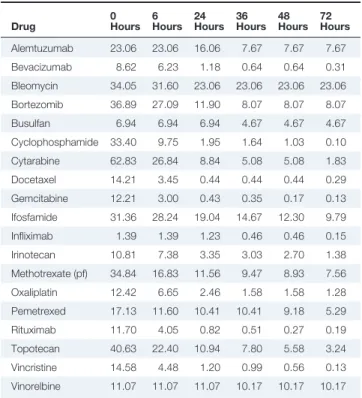
to overall drug spending would be 2.5%, 1.8%, 1.6%, and 1.1%. The annualized savings based on the overall expenses for these medications at each of these time points would be 3.8%, 4.5%, 4.7%, and 5.3%, respectively. With regard to the pro-jected reduction in overall amount of waste, the percentage of milligrams or units reduced for the modeled time periods was also calculated (Table 1).
Actual Model
Six months of waste log data for these 19 hazardous drugs revealed a calculated cost of $385,444, or annual cost of $770,888. The extrapolated actual cost wasted was similar to the annualized cost of waste for the theoretic model of 19 drugs.
Microbiologic Phase
A total of 101 vials were plated across different time periods: 6, 24, 48, and 72 hours and 7 and 14 days. This included 56 active drug vials and 45 TSB controls. The total number of microbi-ologic samples was 606. Twelve were discarded because of in-appropriate handling, and two were discarded at time 14 days because of no remaining medication. Of the remaining 592 samples, 11 were found to have microbial growth or one CFU on one of two plates. This provided an overall plate contami-nation rate of 1.86%. Table 2 lists the different time points and the detection of positive samples.
Positive bacterial cultures were speciated; a summary of the organism and number of colonies is found in Table 3. All pos-itive samples were single isolates, and all of the identified organ-isms are considered environmental contaminants. Zero follow-up samples were positive for either active drug or
con-Table 1.Percent Change of Recovered Drug Associated With
Theoretic Waste Model (mg or units)
Drug
0 Hours
6 Hours
24 Hours
36 Hours
48 Hours
72 Hours
trols. In addition, positive samples were found in drugs dem-onstrated to inhibit microbiologic growth.12,13
Discussion
The results demonstrate that adherence to a 6-hour BUD for SDVs has significant economic implications for the drug bud-get of this hospital. Expanding those costs to similar organiza-tions demonstrates that there could be significant cost savings if the BUD could be safely extended beyond 6 hours. These cost savings were consistent across both the theoretic and actual drug models.
A plate contamination rate of 1.86% was noted for the var-ious tested scenarios. Although this number could be concern-ing, it is important to critically analyze the reported data and recognize that this is a surrogate end point and not the final CSP.
Each of the detected speciated organisms is associated with exogenous contamination (eg, air, skin). Importantly, the pro-cess of transferring the aliquot in the syringe to the agar plate (surrogate end point) required opening of the CSTD and could have lead to introduction of contamination. These steps are not consistent with the usual process of preparing a CSP, in which a closed system is used throughout the whole process. However, the investigators wanted to measure the contamination in the vial, and this was determined to be the best method for this. Further evaluation of the data demonstrated that there were no subsequent positives in any samples. If a growth medium were truly inoculated, one would expect microbial growth over time and the following aliquot to be positive.
One study analyzing the contamination rate of pharmacy CSPs documented a contamination rate of 0.3% when sterile
gloves were used with repeated disinfection.14As opposed to plating an aliquot on an agar plate, this study used Valiteq Aseptic Technique Validation System (Lab Safety Corporation, Des Moines, IL). A positive sample (failed test) is a cloudy or turbid growth medium. Interpretation of results requires visual examination of the sample, which requires hundreds to thou-sands of colonies. In our study, all samples were single isolates and would not have been detected as a contaminated CSP using the mentioned methodology.
One study that tested the contamination of the material for wrapping sterile items further supports the idea that contami-nation could have been introduced through the plating process. From a known sterile item, the investigators detected a plate contamination rate of 1.7%.15The assumption is that exposing a microbiologic plate to the atmosphere and swabbing an item could introduce contamination to the plate.
The study conditions included USP⬍797⬎ recommenda-tions including an ISO Class 5 environment, physical controls (eg, biologic safety cabinets), and employee training in the preparation of CSPs. In addition, a CSTD was used for all preparations (PhaSeal; Carmel Pharma). Until more studies are conducted, the authors do not feel comfortable using BUD extension with a different physical environment or CSTDs. In addition, it is important to note that the vials tested were SDVs and were approved by the US Food and Drug Administration and labeled in that manner, and the patient population receiv-ing those preparations was immunocompromised. Although the cost savings is substantial, and the numerous drug shortages that would somewhat be relieved if all medication in the vial could be used for patient care, USP⬍797⬎is the standard by which all CSPs should prepared. However, all guidelines need to be evidence based, and we are aware of no known studies that document the adverse effects of extended BUDs in a controlled environment.
Medicare does allow for billing of the discarded remainder drug. This is only allowed for drugs and biologics covered by Medicare Part B when the patient is located in physician offices, hospital outpatient clinics, and other covered outpatient set-tings.16Challenges do exist when following this regulation, in-cluding exclusion of inpatient usage (if medications for both types of patients are prepared in the same location) and the need for proper record keeping for audit purposes. Although al-lowable, this process still transfers costs back to the federal government, because the discarded medication is not used for patient care.
There are potential limitations to this type of study. When calculating the theoretic drug costs, it was assumed that the medications were compounded at the label print time and that
Table 3.Microbiologic Speciation of Positive Samples
Vial No. Drug
Time Point Positive
No. of
Colonies Organism
15 Oxaliplatin 6 hours 1 Micrococcus sp
20 Ifosfamide 6 hours 1 Bacillus sp
20 Ifosfamide 48 hours 1 Moraxella
21 Cyclophosphamide 24 hours 1 Bacillus sp
30 Doxorubicin 24 hours 1 Bacillus sp
37 Control vial 72 hours 1 Bacillus sp
62 Control vial 7 days 1 Bacillus sp
66 Control vial 72 hours 1 Bacillus sp
86 Control vial 72 hours 1 Bacillus sp
86 Control vial 14 days 1 Micrococcus sp
110 Cidofovir 7 days 1 Micrococcus sp Table 2.Positive Samples Per Time Period
Sample 6 Hours 24 Hours 48 Hours 72 Hours 7 Days 14 Days Total Overall Rate (%)
Active drug (n⫽322) 2 2 1 0 1 0 6 1.86
TSB control (n⫽270) 0 0 0 3 1 1 5 1.85
Total (n⫽592) 2 2 1 3 2 1 11 1.86
the vial selection for compounding was selected with the aim of using the least amount of waste. It was also essential that the opened vials were used first. Finally, the waste log data relied on the process of a technician usually inspecting the vial to deter-mine the amount remaining as opposed to drawing the volume up in a syringe.
In conclusion, waste associated with implementation of the USP⬍797⬎SDV 6-hour BUD recommendation is substan-tial. Our theoretic analysis demonstrated that more than $766,000 is being discarded annually, and our waste log reiter-ates this with an annual cost of $770,888. The evaluation of extending vial life beyond 6 hours was demonstrated with a microbiologic study. A plate contamination rate of 1.86% was detected, with all positive samples having a single isolate. The speciated organisms were all consistent with exogenous con-tamination, and subsequent sampling of positive vials yielded no growth.
Accepted for publication on February 8, 2012.
Acknowledgment
Closed-system transfer devices for this study were provided by Carmel Pharma. Presented at the Annual Conference of the Hematology On-cology Pharmacy Association, New Orleans, LA, March 24-27, 2010; Summer Meeting of the American Society of Health-System Pharma-cists (ASHP), Tampa, FL, June 6-9, 2010; and Midyear Clinical Meeting of the ASHP, Anaheim, CA, December 5-9, 2010.
Authors’ Disclosures of Potential Conflicts of Interest
Although all authors completed the disclosure declaration, the following author(s) and/or an author’s immediate family member(s) indicated a financial or other interest that is relevant to the subject matter under consideration in this article. Certain relationships marked with a “U” are
those for which no compensation was received; those relationships marked with a “C” were compensated. For a detailed description of the disclosure categories, or for more information about ASCO’s conflict of interest policy, please refer to the Author Disclosure Declaration and the Disclosures of Potential Conflicts of Interest section in Information for Contributors.
Employment or Leadership Position:NoneConsultant or Advi-sory Role:William A. Rutala, Johnson and Johnson (C), Clorox (C); David J. Weber, Johnson and Johnson (C); Stephen F. Eckel, Carmel Pharma (C)Stock Ownership:NoneHonoraria:Erinn C. Rowe, Car-mel Pharma; Scott W. Savage, CarCar-mel Pharma; William A. Rutala, Johnson and Johnson, Clorox; Stephen F. Eckel, Carmel Pharma Research Funding: Stephen F. Eckel, Carmel Pharma Expert Testimony:NoneOther Remuneration:None
Author Contributions
Conception and design:Erinn C. Rowe, Scott W. Savage, William A. Rutala, David J. Weber, Stephen F. Eckel
Financial support:Scott W. Savage, William A. Rutala
Administrative support:Erinn C. Rowe, Scott W. Savage, William A. Rutala, David J. Weber, Stephen F. Eckel
Provision of study materials or patients:William A. Rutala, David J. Weber, Maria Gergen-Teague
Collection and assembly of data:Erinn C. Rowe, Scott W. Savage, William A. Rutala, David J. Weber, Maria Gergen-Teague
Data analysis and interpretation:All authors Manuscript writing:All authors
Final approval of manuscript:All authors
Corresponding author: Erinn C. Rowe, PharmD, MS, 101 Manning Dr CB 7600, Chapel Hill, NC 27514; e-mail: [email protected].
DOI: 10.1200/JOP.2011.000488; published online ahead of print at jop.ascopubs.org June 12, 2012.
References
1. Gehrett BK: A prescription for drug shortages. JAMA 307:153-154, 2012
2. Rabin RC: Drug scarcity’s dire cost, and some ways to cope. www.nytimes.com/ 2011/12/13/health/policy/the-personal-price-paid-for-shortages-of-doxil-and-other-drugs.html?pagewanted⫽all
3. Candy TA, Schneider PJ, Pederson CA: Impact of United States Pharmaco-peia Chapter 797: Results of a national survey. Am J Health Syst Pharm 63:1336-1343, 2006
4. US Pharmacopeial Convention: USP 31/NF 26: Pharmaceutical compounding— Sterile preparations: USP General Chapter⬍797⬎. www.usp.org/usp-nf
5. US Pharmacopeial Convention: USP 34/NF 29: Antimicrobial effectiveness testing—USP General Chapter⬍51⬎. www.usp.org/usp-nf
6. Metcalfe J: Microbiological quality of drug products after penetration of the container system for dose preparation prior to patient administration. http://clean-roomcloseout.com/Micro_quality.asp
7. Cundell A: Review of the media selection and incubation conditions for the compendial sterility and microbial limit tests. Pharm Forum 28:2034-2041, 2002
8. Vandenbroucke J, Robays H: Economic impact of the preparation scenario for cytotoxic drugs: An observational study. EJHP Pract 14:37-42, 2008
9. Connor TH, Anderson RW, Sessink PJ, et al: Surface contamination with antineoplastic agents in six cancer treatment centers in Canada and the United States. Am J Health Syst Pharm 56:1427-1432, 1999
10. Wick C, Slawson M, Jorgenson J, et al: Using a closed-system protective device to reduce personnel exposure to antineoplastic agents. Am J Health Syst Pharm 60:2314-2320, 2003
11. De Prijck K, D’Haese E, Vandenbroucke J, et al: Microbiological challenge of four protective devices for the reconstitution of cytotoxic agents. Lett Appl Micro-biol 47:543-548, 2008
12. Favier B, Latour JC, Fuhnmann C: Viability of microorganisms in bags of cytotoxic drugs J Oncol Pharm Pract 6:167-171, 2001
13. Rowe E, Eckel S: Evaluating microbial growth in various antineoplastics and monoclonal antibodies. Presented at the 45th Midyear Clinical Meeting of the American Society of Health-System Pharmacists, Anaheim, CA, December 5-9, 2010
14. Trissel L, Gentempo J, Saenz L, et al: Effect of two work practice changes on the microbial contamination rates of pharmacy: Compounded sterile prepara-tions. Am J Health Syst Pharm 64:837-841, 2007
15. Webster J, Radke E, George N, et al: Barrier properties and cost implications of a single versus a double wrap for storing instrument packs. Am J Infect Control 33:348-352, 2004