BEYOND NASTY WOMEN & DEPLORABLES:
BRIDGING POLITICAL DIVIDES BY FOCUSING ON SHARED MORAL VALUES
Chelsea Schein
A dissertation submitted to the faculty at the University of North Carolina at Chapel Hill in partial fulfillment of the requirements for the degree of Doctor of Philosophy in the Department
of Psychology and Neuroscience in the School of Arts and Sciences.
Chapel Hill 2018
ABSTRACT
Chelsea Schein Beyond Nasty Women & Deplorables: Bridging Political Divides by Focusing on Shared Moral Values
(Under the direction of Kurt Gray)
TABLE OF CONTENTS
LIST OF FIGURES………... vi
CHAPTER 1: INTRODUCTION………1
Political Polarization………2
Moralization of Political Disagreements……….3
Explaining Moral Diversity………...4
A Common Denomination of Morality………...7
Counteracting Political Animosity………...9
Current Research………11
CHAPTER 2: STUDY 1………12
Method………...12
Participants..………... ………...12
Procedures...………... ………...13
Results………...……….14
Discussion………..19
CHAPTER 3: STUDY 2………20
Method………...21
Participants..………... ………...21
Procedures...………... ………...22
CHAPTER 4: STUDY 3………24
Method………...24
Participants..………... ………...24
Procedures...………... ………...25
Results………...……….26
Discussion………..27
CHAPTER 5: STUDY 4………28
Method………...28
Participants..………... ………...28
Procedures...………... ………...28
Results………29
Discussion………..31
CHAPTER 6: STUDY 5………33
Method………...33
Participants..………... ………...33
Procedures...………... ………...34
Results………36
Discussion………..39
CHAPTER 7: STUDY 6A……….40
Method………...40
Participants..………... ………...40
Procedures...………... ………...40
Discussion………..43
CHAPTER 8: STUDY 6B……….45
Method………...45
Participants..………... ………...45
Procedures...………... ………...46
Results ………..……….46
Discussion……….………….47
CHAPTER 9: STUDY 7………49
Method………...49
Participants..………... ………...49
Procedures...………... ………...50
Results ………..……….50
Discussion……….………….53
CHAPTER 10: STUDY 8………..54
Method………...54
Participants..………... ………...54
Procedures...………... ………...55
Results ………..……….55
Discussion……….………….57
CHAPTER 11: GENERAL DISCUSSION………...59
Open Questions & Future Directions……….60
LIST OF FIGURES
Figure 1 - Correlation between moral similarity and willingness to listen………...15 Figure 2 - Interest in hearing a political opponent discuss various political topics…………...16 Figure 3 – Mediation of harmfulness to relationship on similar values and listening…………...18 Figure 4 – Dehumanization mediation harm attributions relation with
willingness to engage in dialogue………..31 Figure 5 – Number of words used in dialogue with political opponent
CHAPTER 1: INRODUCTION
Fill-in the blanks:
Widespread gun ownership in the United States is a ______ (moral right/national
epidemic). If ______ (more/fewer) people owned guns, thousands of innocent lives could
be saved. The devastating shooting at Sandy Hook Elementary School and similar
tragedies would not have occurred if guns were ______ (allowed/prohibited) in schools.
If you were a card carrying member of the National Rifle Association (NRA), you would undoubtedly circle the first set of answers. Owning a gun is a moral right, if not a patriotic duty and bleeding-heart liberals are morally weak, and pathetic for failing to protect their families. In contrast, members of Mothers Demand Action for Gun Sense in America, a nationwide
organization founded in the wake of the Sandy Hook shooting, would immediately circle the latter choices. Widespread gun ownership is a moral failure of the United States. If conservative NRA members are not moved by the slaughter of innocent kindergartners, they are heartless and callous.
same underlying harm-based moral mind (Schein & Gray, 2015, 2017). Appeals to a common moral denominator might provide a way to lessen the demonization of opponents in this highly polarized time.
This dissertation addresses a putatively simple, yet potentially intractable question: how can we reduce political animosity? Applying insights from the Theory of Dyadic Morality, I propose that highlighting shared moral values should decrease the dehumanization of ideological opponents, and increase our willingness to engage in contentious dialogue.
Political Polarization
Ideological polarization is a prevalent and increasingly salient challenge in the United States (Iyengar & Westwood, 2015; Lord, Ross, & Lepper, 1979; Sunstein, 2002). Partisans on both sides of the political aisle cloister themselves into moral echo-chambers (Frimer, Skitka, & Motyl, 2017; Motyl, 2016). Our towns, friendships, and online social networks are politically segregated (Motyl, Iyer, Oishi, Trawalter, & Nosek, 2014; Poteat, Mereish, Liu, & Nam, 2011; Barberá, Jost, Nagler, Tucker, & Bonneau, 2015).
From our isolated bubbles, we demonize ideological opponents (Brandt et al., 2016; Motyl, 2016; Keltner & Robinson, 1996). In the 2016 election, liberals were cast as “nasty women” and “bad hombres;” conservatives were “deplorables.” Although this political trash talk is nothing new (Geer, 2006), nationally representative samples have found that political
Moralization of Political Disagreements
People disagree about a lot of issues: UNC or Duke, Coke or Pepsi, creamy or crunchy peanut butter. Few issues evoke such persistent polarization and out-group villainizing and dehumanizing as ideological disagreements (Crawford, Modri, & Motyl, 2013; Skitka, Bauman, & Sargis, 2005). One reason why political differences might be so entrenched is because many political issues are moralized (Ryan, 2014). Just think of all the issues that divide our country: abortion rights, physician-assisted suicide, gay marriage, gun rights, trans-bathroom use, immigration. When we debate issues such as abortion or gay marriage, we do not debate their economics or their feasibility. We frequently debate their morality.
Unlike other attitudes, moralized attitudes are viewed as objective (Goodwin & Darley, 2008, 2012; Nichols & Folds-Bennett, 2003), universal (Wainryb, Shaw, Langley, Cottam, & Lewis, 2004), and authority independent (Turiel, Killen, & Helwig, 1987; Wisneski, Lytle, & Skitka, 2009). Moralizing attitudes is a double-edged sword (Skitka & Morgan, 2009). Moral convictions motivate political engagement like voting and activism (Ryan, 2014; Skitka & Bauman, 2008; Skitka & Wisneski, 2011; van Zomeren, Postmes, & Spears, 2012). However, moral convictions are also more resistant to compromise and tradeoffs (Ginges, Atran, Medin, & Shikaki, 2007; Tetlock, Kristel, Beth, Green, & Lerner, 2000), often leading to greater
intolerance (Brandt et al., 2016; Skitka et al., 2005). There is no compromising with moralized attitudes. Those who disagree with us are misguided, lazy, ignorant, immoral or driven by
If our political divides are also moral divides, then it might help to take the time to understand moral diversity before trying to tackle political animosity. Why is it that liberals and conservatives are split by morality? Do liberals and conservative have fundamentally different moral values, or is there something that unites them?
Explaining Moral Diversity
Liberals and conservatives often seem like they are from different planets. This is especially true when it comes to cultural war issues such as gay marriage, abortion, the death penalty and stem-cell research. Why do liberals and conservatives differ so starkly? There are several psychological models that explain moral diversity (Haidt, 2012; Janoff-Bulman & Carnes, 2013; Rai & Fiske, 2011). Each of these model starts with the premise that liberals and conservatives disagree about deeply held moral issues. The models differ on the question of what causes this moral pluralism, whether there is anything unifying morality, and what to do to bridge the moral divide.
on social order and rally around closing borders and enforcing obedience. Social justice and social order pull against each other which is why political debates are so acrimonoius. We all value our community’s well-being, but distinct moral motives lead to the endorsement of opposing policies. The MMM sugggestion for solving political divides is to recognize that both social order and social justice are neccessary for a successful free society. Social justice is
needed for cooperation; social order is needed for coordination (Carnes & Janoff-Bulman, 2016). Therefore, people across the moral aisle should try to work together to balance each others moral concerns (Carnes & Janoff-Bulman, 2016).
Rai & Fiske’s relational model theory (Rai & Fiske, 2011) argues that moral diversity exists because morality is situated within different types of relations. Anthropolgical research suggests that there are generally four types of relationships: communal sharing, authority ranking, equality matching, and market pricing (Fiske, 1991). Rai & Fiske (2011) propose that four different moral motives maintain these relationships: unity, hierarchy, equality, and
proportionality (Rai & Fiske, 2011). Moral disagreements result from competing groups relying on different relational models. For example, perspectives on health care depend on whether you view society in terms of a communal sharing or market pricing relationship. In the first, we have a collective responsibility to ensure the welfare of each member of our community. In the latter, proportionality motives dictate that benefits correspond to input or contributions. Moral
compromise is off the table as the moral motives of unity and proportionality are
incommesurable in this situation. To understand political opponents requires understanding the relational lens through which they are viewing a moral act.
five (or six; Iyer, Koleva, Graham, Ditto, & Haidt, 2012) innate, yet culturally shaped moral foundation of “intuitive ethics” (Haidt, 2012). According to MFT, liberals and conservatives rely on fundamentally different moral foundations (Graham & Haidt, 2012; Haidt, 2012). Liberals have a developed moral sense for harm and fairness (Graham, Haidt, & Nosek, 2009). These are the “individualizing” foundations and they are focused on concerns regarding personal
autonomy, and protecting individual rights. Conservatives have an expanded moral repertoire, valuing loyalty, obedience, and purity in addition to harm and fairness (Graham et al., 2013). These “binding” foundations concern social order and deference to the natural order of the world. Importantly, binding concerns are claimed to be moralized independent of their perceived harmfulness (Haidt, 2001; Horberg, Oveis, Keltner, & Cohen, 2009). Conservatives moralization of same-sex marriage is driven by concerns for the sanctity of marriage, and what is natural. It is therefore immune to considerations of harm (Scott, Inbar, & Rozin, 2016).
left with the conclusion that conservatives are callous, if not outright villains (Haidt, 2012). Liberals are exhibiting a “moral empathy gap” (Ditto & Koleva, 2011). By not sharing the same moral values, they are unable to understand opponents’ perspectives. The key for solving
American cultural wars is for liberals to work harder to understand conservative’s expanded moral compass. Political animosity will persist until liberals can recognize moral values other than harm.
A Common Denominator of Morality?
People hold a plethora of values: rationality, punctuality, respect, honesty, humility, etc…(Schwartz & Bilsky, 1987). Some of these values (e.g., honesty, fairness) are moralized; others are not (e.g., industriousness). The Theory of Dyadic Morality (TDM) argues that what moralizes certain values is their association with harm (Schein & Gray, 2017). Liberals and conservatives might agree that patriotism is good, but the reason only conservatives believe flag burning is a morally reprehensible act of treason is because they value social order (Janoff-Bulman & Carnes, 2013). They see dissent as harmful to society and the soldiers protecting it (Gray, Schein, & Ward, 2014). Moral diversity emerges because perceptions of harm are shaped by one’s worldview (Shweder, 2012), informational assumptions (Turiel, Hildebrandt, Wainryb, & Saltzstein, 1991), motivations (Janoff-Bulman & Carnes, 2013), and relationship context (Rai & Fiske, 2011). People have different values, but the values that are moralized all share one common feature: harm.
salience, we proposed that harm is at the heart of the moral template (Schein & Gray, 2015). This harm-based moral template is formed by the combination of three features: an intentional agent, a causal act, and a damaged patient, or in other words, Agent+Cause+Patient = HARM. Each element of this equation can be filled with a multitude of entities. Agents are often adults, but God (Gray & Wegner, 2010) and corporations (Rai & Diermeier, 2015) can also fill this role. Causal acts can involve hitting, insulting, or even defiling. Children are the most protypic victims (Schein, Goranson, & Gray, 2015), but souls and social order can also be damaged. A cacophony of moral diversity can emerge simply from different combinations of the same basic building blocks.
Several of our studies suggest that harm is a common denominator unifying moral pluralism (Gray et al., 2014; Schein & Gray, 2015). In one study, we asked participants to rate which of two acts were more immoral (e.g. is it more immoral to eat a dead dog, or burn an American flag). After making their decision, participants then rated which act was more harmful, unfair, disloyal, disobedient, and gross. For both liberals and conservatives, harm was the best predictor of which act was seen as more immoral. If there was no common denominator of morality, then harm concerns and purity concerns should be incommensurable (Goodwin, 2017). There would be no metric to make a comparison. However, people are able to make
control for both negative valence, and word length). The fact that harm can organize relative immorality suggests that harm is common feature throughout these actions.
A more direct way of assessing whether harm is active across moral concerns is to just ask participants if they believe an act causes victims. When asked, participants report seeing victims in harmless violations, such as burning an American flag, eating a dead dog, and homosexuality (DeScioli, Gilbert, & Kurzban, 2012). These victims include the self, other people, and society in general (Gray et al., 2014). One concern is that people are acting like lawyers, creating victims merely to justify their views (Haidt, 2001). To counteract this concern, we placed some participants under cognitive load while they were rating the harmfulness of different acts. We expected that load would have no impact. Instead, we found that participants under load were more likely to report victims. This suggests that people automatically perceive victims in even harmless violations. In another study (Gray et al., 2014), we paired pictures of children with descriptions of a variety of harmful (e.g. kick a dog), impure (e.g. rub feces on Bible, defile a corpse), and neutral acts (e.g. ride a bus). Participants rated the children as sadder (a proxy of suffering) after both the harmful and impure acts, but not after the neutral acts. Even putatively harmless violations such as watching animals copulate, led participants to
automatically perceive greater suffering in the world. Whether liberal or conservative, people intuitively see harm when they believe an act is immoral, even if that act lacks objective harm.
Counteracting Political Animosity: Appealing to Common Moral Values
phobia (Ditto & Koleva, 2011). She insists that you pay for a costly fence to prevent your dog from ever attacking her. Not sharing this fear, you view her insistence as malicious and
completely irrational. Only when you appreciate her fear does her insistence on paying for a wall make any sense. To counteract this gap, both theories encourage individuals to try to understand what drives opponents’ views. For MFT, this requires accepting that liberals and conservatives have fundamentally different moralities. For TDM, this requires recognizing that opponents genuinely perceive harm, just in different locations. Appeals to both MFT and TDM could be at least partially effective in reducing political animosity as both views directly challenge our naïve realism (Ross & Ward, 1997) that opponents are devoid of moral reasons.
solved by diverting the discussion. Directly challenging the source of our political conflict should lead to more lasting changes.
Current Research
This paper proposes that an appeal to moral similarity can decrease dehumanization and increase willingness to engage in political discourse. Replicating and extending previous work that finds a link between perceived value differences and political prejudice (Brandt, Reyna, Chambers, Crawford, & Wetherell, 2014) Studies 1-3 examine whether perceived differences in morality correlate with people’s unwillingness to engage in dialogue with political opponents. I predict that perceived moral dissimilarity will correspond with greater unwillingness to engage in political dialogue with opponents (Studies 1 & 2). However, a belief that liberals and
conservative are both motivated by perceptions of harm should correspond with decreased dehumanization, and an increase openness to engage in dialogue even when controlling for general optimism (Study 3).
Studies 4 examines how people perceive political opponents’ moral reasons. I predict that participants will perceive attitudinally similar others as motivated by genuine internal moral reasons, but will be less likely to perceive this motivation in opponents. I further predict that this downplaying of opponents’ moral reasons will correspond with increased dehumanization of opponents, and decreased willingness to engage in dialogue.
Finally, Studies 5-8 test whether a moral similarity intervention can decrease
CHAPTER 2: STUDY 2
People avoid listening to political opponents even when this avoidance comes at
monetary costs (Frimer et al., 2017). However, not all issues are equally divisive. We might not want to talk with our disagreeing friend about abortion, but maybe we are open to chatting about education issues, a topic where the moral divide is less stark. In this first study, I tested what factors correspond with a greater willingness to discuss specific political topics. I predicted that the more we see someone’s particular view as reflecting fundamentally different moral values, the less likely we are to want to listen to that view.
Method
Participants
Procedure
After indicating their political leanings (liberal/conservative), participants read a
statement about Jeff, a political opponent who holds strong party-line views. They then saw a list of 22 political issues (abortion, same sex marriage, gun control, marijuana legalization, tax policy, immigration, climate change, Improving Education, Health Care, Women’s Rights, Free Speech, Fossil Fuels, Nuclear Energy, Recycling Genetically Engineered Foods, Internet Neutrality, Stem Cell Research, School Prayer, Veterans Benefits, Student Loans, Affirmative Action, Teachers Pay). On a -100 to 100 scale, participants rated their interest in listening to the topics: “how interested are you in hearing Jeff discuss the following topics?” (Frimer et al., 2017). To provide an anchor for the interest in listening question, we also asked people interests for performing a range of acts (taking out the trash, having a tooth pulled, reading a really boring newspaper article; standing in a line-up for 20 minutes, and finding a $10 bill. On a -100 to 100 scale, participants also rated view similarity: “how similar are your views to Jeff’s on the following topics;” moral value similarity: “To what extent does Jeff's view on the following topics reflect fundamentally different or fundamentally similar moral values than you;” and moral conviction: “To what extent are your beliefs about the following issues a moral stance?”
As a replication of previous research (Frimer et al., 2017), we also included a question about relationship harm, “Imagine that Jeff is an acquaintance. How would hearing about Jeff's
Results
Collapsed. Collapsing ratings on each item resulted in significant correlations between
interest in listening and similarity of moral values r = .77, p <.001, 95%CI [.51, .90], view similarity r = .78, p < .001, 95%CI [.53, .90], relationship harm, r = .80, p < .001, 95%CI [.56, .91], and emotions, r = .81, p < .001, 95% CI [.58, .92] and a trending correlation with moral conviction, r = -.38, p = .08, 95%CI [-.69, .05]. These correlations suggest that perceived similarity, including similarity of moral values, strongly predicts increased willingness to listen to political opponents discuss a political issues. On average, people are much more likely to listen to a political opponent discuss an issue like education, where moral values are not see as too dissimilar, than gay marriage, where the moral divide is seen as much greater.
Abortion Gay Marriage Guns Marijuana Taxes Immigration Climate Change Education Health Care Women's Rights Free Speech Fossil Fuels Nuclear Energy Recycling GMOs Net Neutrality Stem Cell Research School Prayer Veterans Benefits Student Loans Affirmative Action Teachers Pay -40 -30 -20 -10 0 10
-60 -50 -40 -30 -20 -10 0
In
te
re
st
Figure 1. There is a strong correlation between perceived value similarity on a particular topic, and interest in listening to a political opponent discuss that topic (top). The correlation with moral conviction is weaker (bottom). The ratings on free speech can illustrate why there’s a weaker correlation with moral conviction. Relative to other topics, people on average hold a moral conviction about free speech, but the topic is not hugely divisive, and people are still willing to discuss free speech.
It is worth noting from the start that although people on average were uninterested in listening to political opponents, this disinterest was relatively moderate. Discussing abortion, the issue that held least interest M = -33.34, SD = 66.34, was still rated on average as significantly less uninteresting than reading a particularly boring newspaper article, M = -58.35, SD = 40.98, t(189) =-4.82, p < .001,cohen’s d = -.35, 95% CI of mean diff [-35.2, 14.8]. See Figure 2.
Abortion Same-Sex Marriage Gun Control Marijuana Tax Policy Immigration Climate Change Improving Education Health Care Women's Rights Free Speech Fossil Fuels Nuclear Energy Recycling GMOs Net Neutrality
Stem Cell Research
School Prayer Veterans Benefits Student Loans Affirmative Action Teachers Pay -40 -30 -20 -10 0 10
-10 0 10 20 30 40 50
In
te
re
st
Figure 2. Interest in hearing a political opponent discuss various political topics. The violin plot reflects the density of topics at each interest level. On average most people were only mildly disinterested in listening to political opponents discuss different topics, and even discussing abortion was seen as more interesting than reading a really boring article.
Multi-Level Modeling. A multilevel model with value similarity, person mean centered and grand mean centered entered as fixed factors predicting willingness to listen showed that within an individual, value similarity significantly predicted willingness to listen, B = .23, SE = .02, t(3989) = 13.71, p < .001, 95%CI [.19, .26], suggesting that within an individual, each 10 point increase in moral similarity on average corresponds to a roughly 2 point increase in willingness to listen to a political opponent. To detangle between-person effects and within-person effects of perceived value similarity on interest in listening, I also looked at value
An important question is whether within an individual value similarity predicts
willingness to listen above general similarity. Therefore, value similarity, and view similarity, person mean centered, were entered as fixed effects in a random intercept multi-level model predicting interest in listening to a political opponent. Both value similarity, B = .12, SE = .02, t(3988) = 5.48, p < .001, 95% CI [.08, .16], and view similarity B = .17, SE = .02, t(3988) = 7.91,
p < .001, 95% CI [.13, .21], significantly predicted interest in listening, suggesting that value
similarity is a significant predictor of willingness to listen above just general similarity. These parameters should be interpreted with caution, however, as the fixed effects between value similarity, and general similarity correlated highly at -.64. These effects remain similar when moral conviction, B = .06, SE = .01, t(3987) = 4.71, p < .001, 95%CI [.04, .09] was entered into the model.
Political Differences? Although I had no a priori prediction about politics,
conservativism, grand mean centered, significantly predicted interest in listening, with more conservative corresponding with more willingness to listen B = 3.70, SE = 1.89, t(188) = 1.96, p = .05, 95%C [-.03, 7.43]. While this data did suggest an asymmetry in political aversion, I am hesitant to over-interpret this finding as indicating a larger psychological reality about liberals or conservatives. It is possible that this is a relic of the issues selected (a concern I tried to mitigate by selecting 22 political topics).This analysis was also exploratory, and the sample size is relatively small. Finally, even if there are differences, this data was collected in the first few months of the Trump administration, and it is possible that in the age of Trump, liberals are less willing to listen to discussions on any topics
would hurt their relationship (Frimer et al., 2017). It is possible that discussing moral
dissimilarities would harm the relationship more than discussing less morally divisive issues. Therefore, as an additional, exploratory analysis, I tested whether value dissimilarity
corresponded to a greater perceived risk of harming a friendship relationship, and whether this risk to relationship mediates the connection between value dissimilarity and interest in listening to political opponents. To conduct this analysis, I ran a multi-level mediation model using the Sobel method, following the guidelines of Bauer & Curran (2013). The previously mentioned within person total effect of value similarity on listening was partially mediated by relationship harm, indirect effect, B = .06, SE < .001, z = 582.87, p < .001, proportion mediated effect = .49, though there remained a significant direct effect of value similarity, B = .12, SE = .02, t(3988) = 6.10, p < .001, 95%CI [.08, .15]. At the between-subject level, there was a full mediation with the indirect effect, B = .36, SE < .001, z = 107.23, p < .001, PME = .70 and direct effect B = .15, SE = .11, t(187) = 1.36, p = .18, 95%CI [-.07, .38]. Full mediation pathway at both the within
subject and between subject data can be found in Figure 3.
within-Discussion
CHAPTER 3: STUDY 2
In January 2018, the New York Times editorial team asked Trump supporters to make their best case for Trump, and on January 18th, the New York Times devoted their entire letter-to-the-editor section to 16 letters from Trump supporters
(https://www.nytimes.com/2018/01/17/opinion/trump-voters-supporters.html). In the
introduction to these letters, the editorial team noted that the reason they were publishing these letters was to help “readers who agree with us better understand the views of those who don’t.”
The New York Times’ decision to publish these letters was met with harsh criticism. On the following day, the paper published a series of responses under the title “Furor Over a Forum” (https://www.nytimes.com/2018/01/18/opinion/trump-voters.html). Respondents noted,
sarcastically “perhaps The Times should devote an entire editorial page to flat earthers;” the New York Times should “start talking to people who have their heads in reality, who understand the problems of the world, who understand the harm an inept administration can do” and should not “waste vital newspaper space, in these perilous times, to people who aid and abet a president, and his congressional lackeys, who are destroying all that is noble and just about America.” Most succinctly, one respondent noted “Please don’t ever do that again.”
opponents “as among the ‘deplorables’ — people who are racist and xenophobic.” Another potential reason that people might be uninterested in engaging with political opponents is factual dissimilarity. A repeated theme in the responses is that Trump supporters are living in a different reality. For example, one respondent noted, “educated supporters don’t seem to see the
primordial muck on which everything Trumpian is based.” This failure to establish a shared reality likely hinders successful conversation (Van Bavel & Pereira, 2018), which could also predict a disinterest in engaging in dialogue.
Inspired by these sets of letters, in the second study we presented liberal participants with the New York Time’s pro-Trump op-eds, and looked at predictors of willingness to engage in dialogue with the letter writers. We tested three predictors: the extent to which the letter writer had shared moral values, had a shared factual reality, and relatedly was intelligent. In addition to having theoretical importance, (Van Bavel, & Pereira, 2018), the inclusion of shared factual reality also served as a control for general similarity. Intelligence was included as a general control for global positive assessment of the letter writer. We predicted that greater perceptions of moral overlap would predict willingness to engage in political discourse over and above perceptions of factual overlap and even when controlling for a more general positivity assessment.
Method
Participants
participants who said that they were liberal on the first page of the survey could complete the study. Six participants failed the informational attention check, leaving 94 participants (Mage = 34.70, SD = 10.26, 44.7%female).
Procedure
Participants were randomly shown 6 of the 16 New York Times pro-Trump letters published on January 18, 2108. After reading each letter, participants answered five questions. Participants saw a series of seven increasingly overlapping circles with the words self and other, and were asked to select which circle alignment best represents the overlap in general moral values, and the overlap of factual understanding of the world, with 7 indicating highest overlap. They also answered “how intelligent is this individual,” as well as “how willing would you be to have a discussion with this individual” and “how persuasive is this op-ed,” all on a 1 (not at all) to 7 (very) scale. Persuasiveness was included for exploratory reasons to test if willingness to listen has different predictors than persuasiveness. Finally, participants answered demographics questions.
Results
A multilevel model with moral overlap, factual overlap, and intelligence, all person mean centered and entered as a fixed factor predicting willingness to engage in dialogue showed that moral overlap significantly predicted willingness to engage in dialogue, B = .38, SE = .06, t(463) = 6.15, p < .001, 95% CI [.26, .51] in addition to factual overlap B = .14, SE = .06, t(463) = 2.53, p = .01, 95% CI [.03, .25], and intelligence, B = .37, SE = .04, t(463) = 8.76, p < .001, 95% CI
intelligence. Moral overlap still significantly predicted willingness to engage in dialogue, B = .52, SE = .07, t(464) = 7.91, p < .001, 95%CI [.39, .65], as did factual overlap, B = .29, SE = .06, t(464) = 5.06, p < .001, 95%CI [.18, .40]. Persuasiveness showed a similar pattern with moral overlap, B = .28, SE = .06, t(463) = 4.66, p < .001, 95%CI [.16, .39], factual overlap B = .26, SE = .05, t(463) = 4.88, p < .001, 95%CI [.15, .36], and intelligence, B = .32, SE = .04, t(463) = 7.80, p < .001, 95%CI [ .24, .40], all significantly predicting perceived persuasiveness of the letter.
Discussion
Listening to political opponents is challenging. This study found that the more liberals saw a pro-Trump individual as holding overlapping moral values, the more likely they were to have a conversation with that person, even when controlling for similarity in factual
understanding of the world, and the perceived intelligence of the other person. Of note – since this study relied on a nested design, we are not just finding that people who are generally more likely to view political opponents in a more positive light are more likely to engage in dialogue. Rather, this data suggests that within individuals, greater moral and factual overlap each
CHAPTER 4: STUDY 3
The next study directly examined the relationship between different meta-beliefs about the nature of moral disagreements and people’s attitudes toward political opponents, and their willingness to engage in political discourse. I predict that the belief that all people share the same underlying moral values, consistent with predictions from the Theory of Dyadic Morality, will correlate strongly with decreases in dehumanization of political opponents and will correlate with a greater willingness to engage in political dialogue. Importantly, I predict that these correlations should remain significant even when controlling for general positivity, as measured by optimism in other people and in the world, and faith in other people.
Method
Participants
Two hundred and three students completed the study through mTurk on February 24, 2018.1 Eight participants failed an informational manipulation check, leaving 195 participants (Mage = 39.05, SD = 11.66, 47.2% female, 48.7% liberal).
Procedure
Participants first rated their agreement with two statements, presented in random order, on a 1 (Strongly Disagree) to 7 (Strongly Agree) scale. One statement reflected an approach to moral diversity and highlighted how liberals and conservatives have fundamentally different moral values:
1
Liberals and Conservatives have different moral opinions because they have fundamentally different moral minds. The foundations of their moral beliefs are different, with liberals motivated by one set of core values, and conservatives motivated by another.
The other statement reflected a TDM approach to moral diversity, highlighting shared moral values.
Liberals and Conservatives have different moral opinions, but fundamentally share the same moral mind. Liberals and conservatives both care about
preventing harm and protecting others, but they see harm in different locations. Participants then rated a series of questions about political opponents in random order. These questions included two measures of dehumanization, Bastian eight item
clear, I also included two questions that were restatements of the meta-ethical beliefs “My political opponents have fundamentally different moral values than me,” and “My political opponents have different opinions, but fundamentally share the same underlying moral values.”
To control for general optimism, participants then rated their agreement on three statements (= .82): “I believe that other people are fundamentally good;” “I believe that the world is a fundamentally good place;” and “I believe that other people are
fundamentally selfish (reverse scored).” Finally, participants reported demographics as in study 1.
Results
A within subject t-test showed that on average participants endorsed the different moral minds perspective (M = 4.94, SD = 1.44) more than the similar moral minds perspective (M = 4.28, SD = 1.63), t(194) = 3.58, p < .001, 95% CI [.30, 1.03].
The belief that liberals and conservatives have similar moral minds correlated with a greater willingness wo engage in dialogue, r(194) = .26, p < .001, less dehumanization, r(194) = -.40, p <.001 and a view of a more evolved political opponent, r(194) = .25, p < .001. Even when partialing out general optimism, believing that liberals and conservatives both value harm had a positive correlation with willingness to engage in dialogue rp(192) = .16, p = .02, a negative
correlation with dehumanization, rp (192) = -.29, p < .001, though the evolution of man scale no
longer reached significance, rp(192) = .12, p = .09.
p = .40,2 though it did correlate with greater dehumanization, r(194) = .31, p < .001, and the evolution of man dehumanization measure, r(194) = -.29, p <.001, correlations that remained significant even when partialing out general optimism, dehumanization: rp (192) = .24, p < .001,
and evolution of man: rp (192) = -.22, p < .002.
Political Differences? Politics did not significantly correlate with either dehumanization
measure, either meta-ethical positions, willingness to engage in politics, or general optimism, all rs < |.14|.
Discussion
This study suggests that the claim made by Moral Foundations Theory, that liberals and conservatives have fundamentally different moral minds, is generally more intuitive, but the belief that liberals and conservative share the same moral mind, though see harm different, corresponds with more positive attitudes toward opponents, as measured by decreased dehumanization, and a greater willingness to engage in dialogue, a correlation that remains significant, though smaller, even when partialing out general optimism. Politics did not correlate with any of the key dependent variable.
2
CHAPTER 5: STUDY 4
The Theory of Dyadic Morality predicts that political animosity occurs in part because liberals and conservatives fail to recognize the legitimate perceptions of harm held by moral opponents. This study directly tests a potential asymmetry in how people attribute the political views of political opponents and political allies. I predict that participants will perceive those sharing their political view as motivated by perceptions internal moral reasons, including harm, but will view moral opponents as motivated by ignorance, stupidity, or malice (Ward & Ross, 1997). Recognizing that an opponent genuinely believes that they are helping society should predict decreased dehumanization, and increased willingness to engage in dialogue.
Method
Participants
In April 2017, 575 participants completed the study though 67 failed the attention check, leaving 508 participants (48.5% liberal, 53% female, Mage = 37.60, SD = 12.10).
Procedure
Participants first selected which of this time three political issues they felt most strongly about, from abortion, same-sex marriage, and the death penalty, and then answered questions regarding moral conviction (Skitka et al., 2005), and the permissibility of the issue. Next, participants were randomly assigned to the agreement or disagreement condition. Since some of our predictions specifically focus on correlations within the disagreement condition, we collected more participants in the disagreement condition, at a 2:1 rate. Participants then read the
Jeff is a 35-year-old male, who strongly believes that ____ is morally
im/permissible. On the weekends he volunteers with an organization that does community outreach and helps spread awareness about why is wrong/acceptable. Following this vignette, participants answered a series of questions gauging why they believed Jeff held this view on a 1 (strongly disagree) to 7 (strongly agree) scale. Questions included four harm reasons, : “Jeff genuinely believes that ____is morally permissible because
prohibiting/allowing for ____would result in better outcomes,” “Jeff believes that by opposing/supporting ____he is legitimately helping others,” “Jeff genuinely believes that forbidding/allowing____would be harmful to society,” and “Jeff genuinely believes that forbidding/allowing ____would be harmful to individuals.” Other reasons were derived from Ward & Ross’s (1997), naïve realism research and included idiocy (unintelligent, uninformed) , immorality (internal moral compass, immoral), and external reasons (upbringing, biased by political ideology). Participants then answered an eight item dehumanization scale (Bastian & Haslam, 2010), and then three questions gauging interest in engaging in dialogue: “I would be willing to listen to Jeff discuss his perspective on this topic;” “I would be willing to learn the reasons why Jeff hold his perspective on this topic;” and “I would NOT be interested in listening to Jeff talk about this topic” (reversed scored). Participants completed demographics information at the end of the study.
Results
Moral Reasons. Consistent with predictions, political opponents’ views were seen as less
biased), were combined into a single Naïve Realism measure, = .81. Political opponents views were ascribed to more reasons consistent with naïve realism M = 4.00, SD = 1.15, than
attitudinally similar views, M = 2.27, SD = .80, t(506) = -17.85, p < .001, 95%CI [-1.91, -1.53]. Dehumanization. Moral opponents were dehumanized ( = .92) to a greater degree, M = 3.95, SD = 1.13, than attitudinally similar individual, M = 2.22, SD = .84, t(506) = -17.85, p < .001, 95%CI [-1.92, -1.54].
Dialogue. People were much less willing to engage in dialogue ( = .92) with someone different than themselves, M = 4.32, SD = 1.81 than someone similar, M = 5.64, SD = 1.51, t(506) = 8.25, p < .001, 95%CI [.99, 1.62].
Moral Reasons and Dialogue. It is not really that surprising that we are less willing to
engage in a dialogue with someone different from ourselves. The key question is whether recognition of opponents’ perceptions of harm corresponds with a greater willingness to engage in dialogue. Within perceptions of opponents, there was a small, but significant correlation between dialogue and harm reasons N330 r(328) = .17, p = .003, naïve realism r(328) = -.28, and dehumanization, r(228) = -.50. To explore potential mechanisms of the correlation between attributions of moral reasons and dialogue, I ran a mediation analysis within the opponent
condition. There was a significant total effect, total effect = .22, SE = .07, t(328) = 3.03, p = .003, 95%CI [.07, .36], though this effect was fully mediated by dehumanization, direct effect = .06, SE = .06, t(327) = .94, p = .35, 95%CI [-.07, .19], indirect effect = .16, Boot SE = .04, 95%CI
Political differences? Within perceptions of political opponents, politics did not
significantly correlate with attribution to harm reason, r(328) = .06, p = .32 or interest in dialogue, r(328) = .08, p = .13, though there was a significant correlation with dehumanization r(328) = -.18, p = .001. This correlation with dehumanization suggests that greater
conservativism has a small correspondence with decreased dehumanization of political opponents.
Figure 4. Attributing opponent political views to moral reasons, such as harm-based reasons, corresponds with a, increase in willingness to engage in dialogue, a relationship fully mediated by dehumanization of political opponents. Attribution to moral reasons corresponds to a decrease in dehumanization, and decreases in dehumanization corresponds with an increase in willingness to engage in dialogue. *p< .01.
Discussion
This study found that people see political opponents as having less internal moral reasons including harm-based reasons, for their political attitudes than attitudinally-similar others.
All the studies reported thus far are limited by the correlational nature of the data. Since all the studies are correlational, it is possible that we are just capturing general negativity. People who are more pessimistic are less likely to attribute genuine reasons for opponent
perspectives. Manipulating perceptions of opponents having moral reasons should increase willingness to engage in dialogue.
In the following set of studies, I tested whether appeals to moral similarity can decrease dehumanization and increase people’s willingness to engage with political opponents. Across X studies, I test whether appeals to moral similarity decrease dehumanization and increase
CHAPTER 6: STUDY 5
If perceived differences in values is a strong negative predictor of interest in listening, perhaps perceptions of shared moral values centered in harm/care will decrease political animosity, and increase willingness to engage in dialogue. In the following study, participants were told that they would engage in political dialogue with a political opponent, who they learned was either highly similar in moral values, most especially the value placed on harm and care, or highly dissimilar in moral values, especially as it relates to loyalty, authority, and purity. We predicted that perceptions of moral similarity would decrease dehumanization, and increase interest and actual engagement in political discourse.
Method
Participants
101 mTurk participants completed the study on January 10, 2018.Twenty-three
participants were removed from analysis for failing either the informational attention check, or the recall on similarity/dissimilarity or correctly recalling the political party of the fake mTurker, leaving a total of 78 participants (Mage = 36.29, SD = 10.82, 71.8% liberal as measured by binary
scale, 61.5% on continual, 53.8% female). Method
and a food preference survey under the cover story that they were waiting to match the
participant with another mTurker. After completing the surveys, they learned that they will be paired with Jeff who is described as a Conservative/Liberal (always the opposing political party) and then learned that Jeff had 87% (Dis)Similarity in general moral values. Participants in the similarity condition read,
Based on the results from The Moral Foundations Questionnaire-Short Form, a scientific measure of moral values, you have a HIGH SIMILARITY (87%) in General Moral Values with Jeff. You agree on the value placed on protecting others from harm, and both of you care deeply about the well-being of your communities.
Participants in the dissimilarity condition read,
Based on the results from The Moral Foundations Questionnaire-Short Form, a scientific measure of moral values, you have a HIGH DISSIMILARITY (87%) in General Moral Values with Jeff. You disagree on the importance placed on loyalty, respect for authority and the importance of purity.”
To reinforce the main manipulation, participants also saw a pie chart labeled “87%
(Dis)Similarity in Moral Values.” The language in the moral (dis)similarity intervention was specifically designed to be consistent with Moral Foundations Theory, as it claimed that liberals and conservatives overlap in their concern about harm and care, but are divided on issues such as purity, authority, and loyalty.
0 (Not at All) to 100 (Very Much) scale. As a manipulation check, they then completed a series of questions gauging similarity between themselves and others. Adopting the Inclusion of Other in Self Scale (Aron, Aron, & Smollan, 1992), participants saw a series of overlapping circles, and were asked to select which one represented overlap in personality, political ideology, and general moral values. They were also asked to rate how much they liked Jeff.
They then completed the “dialogue” with Jeff. Participants were told that in the first round, they were going to discuss opinions on abortion. Knowing that Jeff would see their response, they were told to describe their view and why they hold this view. After “waiting” for Jeff’s response, participants then saw Jeff’s answer.
Conservatives were told that Jeff wrote,
I am very much in favor of individual rights. A woman should have a right to control her body. Allowing anyone else to dictate what happens to her is wrong. I believe a woman should have total control over her own body, no matter what. Liberals were told that Jeff wrote,
A human (even fetus) life shouldn't be extinguished just because it's inconvenient. You make a choice, accept the consequences. There are so many couples out there that would LOVE to take your baby and raise it as their own.
As a secondary measure of engagement, participants were then asked to write any comments they have for Jeff. They were specifically told to write each comment or question on their own line, and to write at least one comment.
Finally, as a further measure of political engagement, participants were asked whether they wanted to engage in another round of dialogue to be entered into a drawing for $2. If they selected yes, they moved on to the following screen indicating that Jeff turned down the offer, but they would still be entered into a drawing for $2.
At the end of the study, participants completed demographics information, manipulation checks, and had the opportunity to provide feedback on the study. We had some initial concern about the believability of the chat paradigm, so gave participants a space at the end of the study to write their comments. No participants mentioned concern over the existence of Jeff, though a few participants questioned whether there was actually a dialogue, since they did not have the chance to actively debate Jeff.
Results
Dehumanization. The eight dehumanization questions were averaged (α = .94) into a
single dehumanization score, with higher scores indicating greater dehumanization. Perceptions of moral similarity significantly decreased dehumanization of the political opponent, M = 34.01, SD = 19.44, relative to the dissimilar condition M = 60.30, SD = 18.88, t(76) = 6.05, p < .001, 95%CI of diff [17.64, 34.94], cohen’s d = 1.37.
Political Engagement. This study included 4 different operationalizations of political
Jeff’s position, and 4) their binary response regarding whether they wanted to engage in another round of dialogue with Jeff.
With regard to the interest DV, interest in listening to each topic was averaged into an overall interest score. Interest in listening to Jeff did not differ significantly by condition, similar: M = -2.86, SD = 52.68, dissimilar: M = -5.33, SD = 46.21, t(76) = -.22, p = .83.
One objective measure of engagement of dialogue is the number of words people used when conveying their view of abortion to Jeff. An independent sample t-test found that significantly more words were used on average by participants in the similar condition, M = 57.95, SD = 42.26, than in the dissimilar condition, M = 39.08, SD = 25.64, t(76) = 2.37, p = .02, 95% CI of diff [3.01, 34.74], d = .54. Number of words is a metric susceptible to outliers, so we cut the outliers in each condition, and the analysis remained significant, with participants in the moral similar case on average using more words, M = 53.74, SD = 33.27, than those in the dissimilar condition, M = 36.76, SD = 21.56, t(74) = 2.63, p = .01, 95%CI mean diff [4.097, 29.87], d = .60.
Another measure of political engagement is the total number of comments and total number of words in those comments participants used in response to Jeff’s answer. Here there was no significant difference in the number of comments left with similar, M = 2.98, SD = .2.24, not differing significantly from dissimilar, M = 2.37, SD = 1.22, t(76) = 1.48, p = .14, 95% CI [-.21, 1.43]. While these measures did not meet significance, it is possible that they will with a larger sample size.
condition opting in, and 58% opting in in the dissimilar case, MannWhitney U = 738.00, Z = -.26, p = .80.
Figure 5. Number of words used in initial comment on abortion to political opponent by similarity condition. Error bars indicate 95% CI. p = .02.
Similarity. Independent samples t-test suggests that the manipulation of similarity
increased perception of moral overlap (a question that was essentially a manipulation check) similar: M = 4.50, SD = 1.73, dissimilar; M = 2.34, SD = 1.34, t(76) = 6.15, p < .001, 95%CI [1.46, 2.85] d = 1.40. Similarity had a trending impact on perceived political overlap, M = 2.30, SD = 1.57, dissimilar: M = 1.66, SD = 1.30, t(76) = 1.96, p = .05, 95%CI[.01, 1.30] d = .44.
Relationship between Dehumanization and Engagement. One question is whether
reduced dehumanization corresponds with an increase in willingness to engage in political discourse. Therefore, we first looked at the correlation between dehumanization and each of the engagement measures. Dehumanization had a negative correlation with overall interest in
listening to the topics, r(76) = -.29, p = .009, but did not correlate with any of the other measures of engagements, rs between -.08 and .005, ps > .56. This lack of correlation suggests perhaps
0 15 30 45 60 75
Dissimilar Similar
N
u
m
b
e
r
Wor
d
Discussions
This study suggests that the questionnaire manipulation of moral similarity was an effective manipulation of perceived moral similarity, and manipulating moral similarity is
effective at reducing the dehumanization of political opponents. There was some mixed evidence that the similarity manipulation also increases willingness to engage in dialogue. There are several limitations to this initial intervention study. First, there was no real control condition in the study. It is therefore unclear if similarity decreased dehumanization, or dissimilarity
CHAPTER SEVEN: STUDY 6a
The following study was a replication and extension of Study 5, that tested whether increasing perceived moral similarity increase people’s willingness to engage in dialogue and dissimilarity decreases willingness relative to a control condition.
Method
Participants
On January 17, 2018, 299 participants completed the study through mTurk, of which, 32 failed an attention check (informational or manipulation check), leaving a total of 267
participants (Mage = 35.69, SD = 10.69, 64.4% liberal as measured by binary scale, 55.4% on
continual, 52.9% female). Procedure
time with this individual. This time, the willingness to engage questions were all answered on a 6 point scale from Very Unwilling to Very Willing.
Results
Dehumanization. As before, the eight dehumanization questions, now measured on a
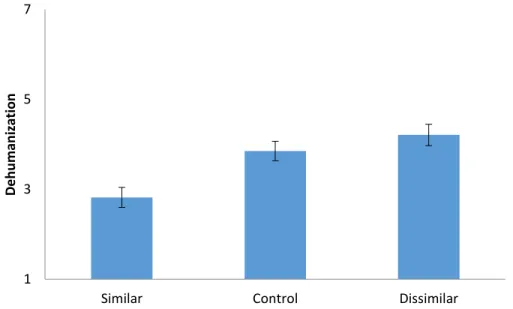
7-point scale, were averaged (α = .89) into a single dehumanization score, with higher scores indicating increased dehumanization. A between subject ANOVA revealed a significant effect of similarity, F(2,264) = 37.52, p < .001, ηp2 = .22. Post-hoc analysis showed that the morally similar condition significantly decreased dehumanization, M = 2.82, SD = 1.07, relative to the control condition, M = 3.85, SD = 1.11, p < .001, Mean Diff = 1.04, SE diff = .17, 95%CI of diff [.71, 1.37], and relative to the dissimilar condition M = 4.21, SD = 1.14, p < .001, Mean Diff = 1.39, SE diff = .17, 95%CI [1.06, 1.72]. Dissimilarity significantly increased dehumanization relative to the control, Mean Diff = .36, SE = .17, p = .03, 95%CI [.03, .68].
Figure 6. Similarity significantly reduced the dehumanization of a political opponent relative to a neutral no information control condition, whereas dehumanization increased dehumanization. Error bars indicate 95% CI. Study 6a.
1 3 5 7
Similar Control Dissimilar
D
e
h
u
m
an
Political Engagement. The four self-report political engagement questions were averaged
to form a political engagement self-report measure (α = .90). A between subject ANOVA revealed a significant effect of similarity, F(2,264) = 3.87, p = .02, ηp2 = .03. Post-hoc analysis revealed that similarity increased self-report interest in engaging in political dialogue, M = 4.70, SD = 1.04, relative to the control condition, M = 4.31, SD = 1.15, p = .03, Mean Diff = -.39, SE =
.17, 95%CI of Diff [-.72, -.05], and relative to the dissimilar condition, M = 4.27, SD = 1.20, p = .01, Mean Diff = -.43, SE = .17, 95%CI [-.77, -.10]. The dissimilar and control conditions did not differ significantly, Mean Diff = -.05, SE = .17, p = .79, 95%CI [-.38, .29].
As a behavioral measure of engagement, I next examined the total number of words used in the initial abortion writing task, the number of words used in the response to Jeff, as well as the number of comments left, and whether the participant wanted to engage in another round of dialogue. Failing to replicate the previous study, the number of words used in the initial writing task did not differ significantly by condition, F(2,264) = .50, p = .61, ηp2 = .004, nor did the number of words used in response to Jeff’s comment, F(2,264) = .64, p = .53, ηp2 = .005, or the number of comments left in response to Jeff, F(2, 264) = .17, p = .84, ηp2 = .001. The more dialogue question also did not vary significantly by condition, chi-square (2, 267 participants) = 2.25, p = .33.
Similarity Manipulation Check. Affirming the effectiveness of my manipulation, there
Dehumanization and Engagement. Dehumanization inversely correlated with self-report
political engagement, r(269) = -.42, p < .001. Dehumanization also fully mediated the effect of the moral similarity condition vs. control and dissimilar on increase willingness to engage in dialogue. While similarity condition (0 = control, dissimilar; 1 = similar * though effect remains significant comparing to just control) did predict increase in willingness to listen, total effect = .41, SE = .15, t(265) = 2.77, p = .006, 05%CI[.12, .70], this was fully mediated by
dehumanization, direct effect = -.09, SE = .15, t(264) = -.57, p = .57, 95%CI [-.39, .21], indirect effect = .50, Boot SE = .10, 95%CI [.32, .71]. Similarity decreased dehumanization, B =-1.22, SE = .15, t(265) = -8.33, p < .001, 95%CI[-1.50, -.93], and this lower dehumanization in turn
increased willingness to engage in dialogue, B = -.41, SE = .06, t(264) = -7.16, p < .001, 95%CI [-.53, -.30].
Figure 7. Mediation path model showing that dehumanization fully mediated the link between moral similarity and an increase willingness to engage in dialogue. For similarity, 1 = similar; 0 = control, dissimilar. * p < .01.
Discussion
task itself. In this study, I manipulated perceived moral similarity, and then ask general questions about willingness to engage in dialogue. However, when participants get to the behavioral
political engagement section, the manipulation of similarity might be overshadowed by the focus on abortion, an issue that is highly divisive in the United States. The shift in focus to abortion might have wiped away the entire similarity manipulation. As an additional test of the
CHAPTER 8: STUDY 6b
Moral Similarity and General Notes to Opponents
This study was a replication of the previous study with a new behavioral dependent variable. Instead of a dialogue on abortion, participants wrote general opening notes to a political opponent. I once again predict that moral similarity will decrease dehumanization, and increase willingness to engage in a dialogue relative to a control and a dissimilar condition.
Method
Participants
On January 25, 2018, 301 participants completed the study through mTurk. Twenty-eight participants were removed for failing an attention check, leaving 273 participants (Mage = 35.89,
SD = 10.52, 59.7% liberal as measured by binary scale, 53.1% on continual, 48.4% female).
Procedure
Results
Dehumanization. As before, the eight dehumanization questions, now measured on a
7-point scale, were averaged (α = .90) into a single dehumanization score, with higher scores indicating increased dehumanization. A between subject ANOVA revealed a significant effect of similarity, F(2,270) = 42.58, p < .001, ηp2 = .24. Post-hoc analysis showed that moral similarity, M = 2.83, SD = 1.09, significantly decreased dehumanization relative to the control, M = 3.85,
SD = 1.07, Mean Diff = -1.02, SE = .16, p < .001, 95%CI of diff[-1.33, -.71], and relative to the
dissimilar condition, M = 4.26, SD = 1.06, Mean Diff = -1.44, SE = .16, p < .001, 95%CI [ -1.33, -.71]. Dissimilarity significantly increased dehumanization relative to the control, Mean Diff = .41, SE= .16, p = .01, 95%CI [.09, .73].
Political Engagement. Similarity condition did not have a significant overall-effect on
self-report political engagement, F(2,270) = 2.46, p = .09, ηp2 = .02. Despite the lack of overall effect, I still conducted a post-hoc analysis, which suggested that Similarity, M = 4.46, SD = 1.17, significantly increased willingness to engage in dialogue relative to dissimilar, M = 4.06, SD = 1.32, Mean Diff = .40, SE = .18, p = .03, 95%CI [.04, .75]. The control condition, M =
4.31, SD = 1.15, did not differ significantly from the other two conditions. The number of words used in the political notes did not differ significantly by condition, F(2,270) = .46, p = .63, ηp2 = .003.
Similarity. The manipulation check of perceived moral overlap showed a significant
dissimilar condition had significantly less perceived moral overlap than the control, Mean Diff = -.55, SE = .22, p = .01, 95%CI [-.97, -.12].
Dehumanization and Political Engagement. Dehumanization inversely correlated with
self-report political engagement, r(271) = -.47, p < .001. Mediation analysis showed a significant indirect effect of .65, Boot SE = .08, 95%CI[.45, .89], with similarity (0 = control, dissimilar, 1 = similar) decreasing dehumanization, B =1.21, SE = .14, t(271) = 8.79, p < .001, 95%CI[1.48, .94], which in turn decreased willingness to engage in dialogue, B = .53, SE = .06, t(270) = -8.87, p < .001, 95%CI [-.65, -.41]. The mediation was run despite a lack of total effect (recall that the significant difference in self-report political engagement was between similar and dissimilar), total effect = .27, SE = .15, t(271) = 1.74, p = .08, 95%CI [-.04, .57], and the direct effect of similarity on engagement, once controlling for dehumanization, was negative, at -.38, SE = .15, t(270) = -2.44, p = .02, 95%CI [-.68, -.07].
Discussion
This replications suggests that manipulations of perceived moral similarity decreased dehumanization relative to a control, and manipulations of moral dissimilarity increased dehumanization. Furthermore, dehumanization negatively predicted self-report willingness to engage in political dialogue. In contrast to the pattern found in Study 5, both Studies 6a and 6b failed to find a significant difference in the length of political dialogue. Null findings are
One limitation of the last three studies is that it is unclear whether it is moral similarity per se that is decreasing dehumanization and increasing self-report willingness to engage in dialogue, or similarity in general that is the cause of the effect. Therefore, in the next two studies, I compared moral similarity with other forms of similarity to examine relative impact of
CHAPTER 9: STUDY 7
From the previous studies, it is unclear whether moral similarity uniquely reduces political animosity, or similarity itself is sufficient to reduce dehumanization (McDonald et al., 2017). It is possible that any minute form of similarity can decrease political animosity, consistent with decades of research in prejudice research, and sociological research on
homophily (McPherson, Smith-Lovin, & Cook, 2001; Wynn, 2016). Any manipulation that shifts thinking from “us vs them” to “us” should be effective in increasing respect (Byrne et al., 1971). To test the relative impact of moral similarity, we rerun the moral similarity intervention study with the addition of two other non-moral similarity conditions. We predicted that moral
similarity would decrease dehumanization relative to a control condition to a larger extent than a trivial similarity (shared food preferences), and stronger than even a central form of similarity (personality).
Method
Participants
On January 19, 2018, 399 participants completed the study on mTurk, though 45 failed the informational or manipulations check, leaving 354 participants (Mage = 37.37, SD = 11.67,
61.6% liberal as measured by binary scale, 51.4% on continual, 54.3% female). Procedure
pragmatic reasons, I shortened the study and eliminated the dialogue component. Participants knew they were paired with Jeff, but were not told anything about engaging in any sort of dialogue with Jeff. I also only looked at the difference between the similarity conditions and the control, dropping the dissimilar condition.
At the start of the study, participants reported the name they’d like to use for the study, and the completed a shortened BFI and the first section of the MFQ-S, as well as a 8 item food preference questionnaire. Participants then learned that Jeff was a Liberal/Conservative (always the opposing political party), and that they had an 87% similarity in general moral values, personality, or food preferences. Participants in the control condition only learned about Jeff’s political party. Participants then completed the 8-item dehumanization scale, and the self-report political engagement questions, the perceived similarity questions, and demographics.
Results
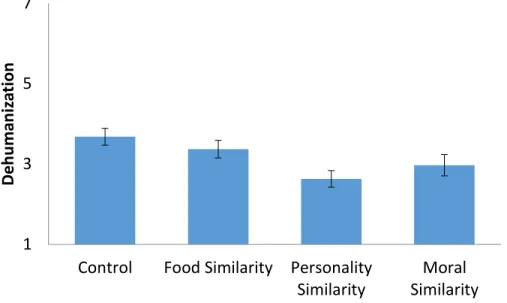
Dehumanization. As before, the eight dehumanization questions, now measured on a
multiple comparisons. Moral similarity’s effect was marginally stronger than the food similarity, p = .08, Mean Diff = -.41, SE = .16, 95%CI of diff [-.84, .03], and did not differ from the
personality similarity condition, p = .25, Mean Diff = .33, SE = .16, 95%CI of diff [-.10, .77] (note: both of these contrast is significant with the LSD adjustment).
Figure 8. Dehumanization rates based on similarity intervention. Personality and moral similarity both reduced dehumanization relative to control at p <.001, and food similarity reducing dehumanization at p = .06.
Political Engagement. The four political engagement questions were averaged into a
single political engagement variable (α =.89). There was a significant effect of condition, F(3,350) = 3.64, p = .01, ηp2 = .03. Planned contrasts with the control condition, M =4.34, SD = 1.16 as the referent showed that only the personality manipulation, M = 4.80, SD = .90, p = .008, Mean Diff = .46, SE =.17, 95%CI[.12, .80], significantly increased willingness to engage in dialogue. Moral similarity, M = 4.49, SD = 1.28, p = .37, Mean Diff = .16, SE = .15, 95%CI [-.18, .49], and food similarity, M = 4.28, SD = 1.19, p = .72, Mean Diff = -.06, SE = .17, 95%CI of diff [-.40, .27], both did not differ significantly from the control condition.
1 3 5 7
Control Food Similarity Personality Similarity
Moral Similarity
De
h
u
m
an
iz
ati
Similarity. It is possible that the stronger effect of personality occurs in part because
personality is a global signal of similarity, including moral similarity. To test for this possibility, we can see if moral overlap shifts with the personality similarity manipulation to the same degree as the morality manipulation. There was an overall effect of condition on moral overlap,
F(3,350) = 19.15, p < .001, ηp2 = .14 . Post-hoc comparisons, bonferoni adjusted suggest that relative to the control condition, both the moral similarity, M = 4.48, SD = 1.61, p< .001, Mean Diff = -1.32, SE = .23, 95%Ci of diff [-1.93, -.71], and personality similarity conditions, M = 4.28, SD = 1.52, p<.001, Mean Diff = -1.12, SE = .23, 95%CI of diff [-1.73, -.50], both
significantly increased perceptions of moral overlap relative to the control condition, M = 3.16, SD = 1.57, with the moral overlap not significantly stronger in the moral similarity condition
than the personality condition, p = 1.00, Mean Diff = .20, SE = .24, 95%CI [-.42, .83]. Food similarity, M = 3.12, SD = 1.48 did not increase perceived moral overlap relative to control, p = 1.0, Mean Diff = .04, SE= .23, 95%CI of diff [-.57, .65]. This finding suggests that the
personality manipulation also functioned as a moral similarity manipulation.
Dehumanization and Engagement. Dehumanization once again negatively correlated with
Discussion