Edinburgh Research Explorer
Government policies to enhance access to credit for
infrastructure-based PPPs
Citation for published version:
Hellowell, M, Vecchi, V, della Croce, R & Gatti, S 2017, 'Government policies to enhance access to credit for infrastructure-based PPPs: an approach to classification and appraisal' Public Money & Management, vol 37, no. 2, pp. 133-140. DOI: 10.1080/09540962.2016.1266173
Digital Object Identifier (DOI): 10.1080/09540962.2016.1266173 Link:
Link to publication record in Edinburgh Research Explorer Document Version:
Peer reviewed version
Published In:
Public Money & Management
Publisher Rights Statement:
This is the accepted manuscript version of : Veronica Vecchi, Mark Hellowell, Raffaele della Croce & Stefano Gatti (2017) Government policies to enhance access to credit for infrastructure-based PPPs: an approach to classification and appraisal, Public Money & Management, 37:2, 133-140 published in full at
10.1080/09540962.2016.1266173
General rights
Copyright for the publications made accessible via the Edinburgh Research Explorer is retained by the author(s) and / or other copyright owners and it is a condition of accessing these publications that users recognise and abide by the legal requirements associated with these rights.
Take down policy
The University of Edinburgh has made every reasonable effort to ensure that Edinburgh Research Explorer content complies with UK legislation. If you believe that the public display of this file breaches copyright please contact [email protected] providing details, and we will remove access to the work immediately and investigate your claim.
GOVERNMENT POLICIES TO ENHANCE ACCESS TO CREDIT FOR
INFRASTRUCTURE-BASED PPPS: AN APPROACH TO CLASSIFICATION AND APPRAISAL1
Veronica Vecchi, Bocconi University School of Management Mark Hellowell, University of Edinburgh
Raffaele della Croce, OECD Stefano Gatti, Bocconi University
Abstract
Several governments across the world have introduced a variety of instruments to enhance investor appetite for public private partnership (PPP) projects. This paper provides a comprehensive categorization of these instruments, the risks they target and their effects, at project and system level, to support policy makers to design the most appropriate instruments to attract private capital into infrastructure development.
Keywords: PPP; guarantees; credit enhancement; infrastructure asset class; risk
Box – Impact:
The use of financial instruments to attract investors into PPP projects may have significant fiscal and economic implications. Therefore, it is crucial for policy makers and public managers, working for local, national or supranational public organizations, to understand the options available, the mechanisms through which these instruments reduce investor risk, and the possible unintended effects. The paper, grounded in the analysis of the main trends in capital markets, offers a threefold categorization of PPP risks, which is a useful scheme to identify the risks that may be addressed with the policy instruments to sustain the PPP bankability.
1. Introduction
Historically, a substantial proportion of infrastructure has been owned by public authorities and financed through taxation and/or public debt. Over the last 30 years, however, successive waves of privatization have reduced the role of the public sector in the infrastructure sector. In addition, tight control of public expenditure in both industrialised and emerging economies has stimulated the development of public private partnerships (hereafter PPPs) in which private finance is used to support capital formation across many areas
1Acknowledgment: The paper has been developed as part of a research project delivered to OECD by Vecchi, Hellowell
of public sector. In addition to fiscal considerations, related to the deferred impact of such investment on public sector budgets and the recognition of related liabilities in headline measures of government indebtedness, the PPP model is regarded as an efficient alternative to traditional public procurement approaches as, in principle, it allows the transfer of the management of construction, life cycle and performance risks to the private sector and may therefore by give rise to better investment decisions and project delivery performance (Iossa and Martimort 2015).
In addition, PPPs have strong interest group support, especially among private investment institutions, including new long term investors, such as pension funds, life insurance companies and sovereign wealth funds (Gatti 2014), attracted to the long maturities and stable returns associated with infrastructure-related financial securities (World Economic Forum 2013). Since the global financial crisis, the institutional investment community has been engaged in a ‘search for yield’ – i.e. for higher returns than accrue to traditional asset classes such as government bonds – and infrastructure have been cited as a potentially desirable ‘alternative asset class’ (Gatti and Della Croce 2015).
To sustain the attraction of private finance into the infrastructure sector, especially in the aftermath of the global financial crisis, many governments have introduced policies and financial instruments to mitigate the financial risks associated with infrastructure development, and thereby enhance the availability and/or reduce the cost, of private capital (Hellowell, Vecchi, and Caselli 2015). However, as the traditional debt funding seems to be no longer available for infrastructure financing, as a consequence of the new international regulatory framework for banks (Basel III), these policy instruments remain an indispensable element to attract alternative long term investors in the infrastructure sector. Furthermore, a number of countries are still experiencing economic stagnation and financial sector instability, which may be also exacerbated by the Brexit, at least in Europe, thus increasing the appeal of risk-mitigation instruments. The recently created Investment and Infrastructure Working Group within the G20 summits2 has also raised the issue as a salient
ingredient for closing the infrastructure gap (OECD 2015). In Europe, the Junker Plan, launched in 2014 and aimed at mobilizing more than €315 bn, leveraging €21 bn of public resources allocated in the European Funds for Strategic Investments and those raised by the European Investment Bank, has confirmed the political commitment of the European Union to use public – private hybrid financial instruments to develop infrastructure.
Leveraging the findings of the existing scientific and grey literature (Hellowell, Vecchi, and Caselli 2015; Matsukawa and Habeck 2007; EPEC 2009; EPEC 2011), the scope of this paper is to provide a framework to categorise the main policy actions recently put in place by governments across the world to attract additional private capital into the infrastructure sector, with a focus on forms of PPPs such as DBFM/O (design, build, finance, maintenance and/or operate) and BOT (build, operate and transfer) schemes. A comprehensive framework is needed in order to allow policy makers to take stock of the state of the practice and appraise the costs and benefits of different instruments to take more informed decisions regarding the most appropriate instruments to be introduced. A PPP can generate positive benefits for government authorities when risks allocated between the public and the private sectors are balanced (Forrer et al. 2010). On the contrary, if the risks transferred to the private counterparty are limited or inappropriate, the probability of adverse selection (Vecchi et al. 2016; Saussier 2013) and moral hazard (Engel, Fischer, and Galetovic 2009; Hellowell, Vecchi, and Caselli 2015) increases, which may give rise to deleterious consequences (a forced renegotiation of the contract, bailout of the private operator or even a termination of the contract are examples).
In this context, it seems useful (and urgent), for policy makers and International Institutions, working closely to Governments, and scholars approaching this field of research, to understand the features and the effects
2 The IIWG was created in 2014 under the Australian presidency and it is one of main working groups of G20 under
the Cooperative Framework among Ministers of Finance and Bank Central Governors of G20 assigned to formulate and recommend the cooperative principles and policies in global infrastructure investment. It was established in
of the main public instruments to increase the attraction of private investors in the PPP filed, in the framework of principle-agent theory and PPP risk-sharing principles. Especially in the European Union context, with the recent introduction of new tighter rules by Eurostat (March 2016) for the off-balance sheet treatment of the PPP transactions, understanding the effect of such policies on the project risk allocation is mandatory. After a discussion of the main trends in infrastructure private financing (section 2), the paper proposes (in section 3) a threefold categorization of PPP risks, based on a revision of the traditional risks matrix presented by the dominant PPP literature, in order to identify the risks that may be addressed with the policy instruments to sustain the PPP bankability. Drawing on an extensive desk online research, section 4 presents a menu of policies, classified on the basis of risks addressed and cash flow impact. Finally, in section 5, the paper provides a preliminary discussion of possible measures to assess the effects and impacts of these policy actions on the performance of the infrastructure sector and draws some first conclusions.
2. Forms and trend in private infrastructure financing
For many years, the traditional capital structure used for private financing of infrastructure has been project finance, based on a simple combination of multiple tranche syndicated bank loans and equity provided by corporate sponsors and developers (Yescombe 2011). However, the practice of project finance has undergone remarkable changes in the past two decades.
In the mid-2000s, an increased risk appetite developed among institutional investors in the context of low interest rates, leading to an increase in their interest in the infrastructure sector (in addition to greater interest among the commercial banks and industrial sponsors that had dominated supply hitherto). Institutional investors have traditionally invested in infrastructure through listed companies and fixed income instruments. It is only in the last two decades that investors have started to recognize infrastructure as a distinct asset class. Since listed infrastructure tends to move in line with broader market trends, it is a commonly held view that investing in unlisted infrastructure - although illiquid - can be beneficial for ensuring proper diversification. In principle, the long-term investment horizon of pension funds and other institutional investors, such as insurance firms and wealth funds, should make them natural investors in less liquid, long-term assets such as infrastructure (Gatti and Della Croce 2015).
The global financial crisis and the resulting Eurozone sovereign debt crisis reduced the availability of low-cost debt financing. The banks that were more active in providing project finance loans progressively withdrew from the market in response to balance sheets problems and to the need to increase their capital base as required by the more stringent Basel III and European Banking Authority requirements that emerged in response to the crisis. The new market context was one in which lower credit availability, higher spreads and shorter maturities became the norm. Bond financing almost disappeared after 2008 due to a series of downgrades suffered by the US-based ‘monoline’ insurers that, before the demise of Lehman Brothers, provided credit insurance to these capital markets debt instruments. Actually, project bonds have some contractual features that make them more attractive to institutional investors other than banks (Gatti and Della Croce 2015). However, existing evidence on the asset allocation strategies of institutional investors indicates that infrastructure are not completely suitable for project bonds investment. Gatti (2014) indicates three relevant factors for this paper: 1) investors seems more interested to project bonds only if construction risk is over (i.e. brownfield investments); 2) the bullet repayment3 structure triggers a refinancing risk; 3)
investors find it hard to assess the degree of risk of complex infrastructure ventures and rely on the rating issued by external rating agencies.
Similar to the market of infrastructure debt, the equity market has gone through a process of significant transformation in the past decade. Before mid-2000s, almost all infrastructure projects received equity financing by industrial sponsors, typically the off-taker, the EPC contractor, the suppliers and/or the company responsible for the operation and maintenance of the infrastructure to be delivered. Starting from mid-2000s, data reported by Preqin, a provider of data on infrastructure investments and private equity, indicate a clear upward trend in global infrastructure fundraising for private equity investments: aggregate funds under management have risen from $1.1 billion in 2004 to $317.5 billion at the end of 2014 (BlackRock 2015), thanks to the diversification strategies put in place by institutional investors.
3. PPP Risks classification and the mitigation policy actions to attract private capital
As written in the introduction, the policy instruments aimed at increasing the PPP bankability influence the risks allocation between the public and the private sector within PPP transactions. Therefore, to understand their effects it is useful to reclassify the main PPP risks analysed by the literature so far (among others Grimsey and Lewis 2002; Li et al. 2005; Ng and Loosemore 2007; Ke, Wang, and Chan 2010; Lam et al. 2007) on the basis of their nature: political and regulatory; market or external; technical.
Political and regulatory risks depend on the activities of the state at various levels of governance. Often, political risk relates to the government at the central or regional levels. In some cases, this risk emerges from the behaviour of the contracting authority itself.
Macroeconomic and market risks arise from the possibility that the market and/or economic environment is subject to variation.
Technical risks are determined by the knowhow of the operators and the features of the project and technology.
This classification helps to distinguish between policies that are generally necessary to create a conducive ‘ecosystem’ for PPPs (Vecchi, Airoldi, and Caselli 2015), which is a precondition for attracting private investors at all, and those that are introduced to address specific circumstances and market failures, which may hamper the attraction of infrastructure transactions from the point of view of such investors. Further, it clearly insulates those risks that must be transferred under the private responsibility, in order to safeguard the microeconomic benefits of PPP.
Table 1 shows the re-classification of the main project risks, grouped according to the project development phases, according to three categories conceived.
Table 1 - Risks Classification
Risks Political and regulatory Macroeconomic and market Technical Development phase
Project feasibility and inclusion in investments plan
x
Longer bidding phase and consequent change of market conditions x Construction phase Land availability x x Social acceptance x Archaeological x Environmental x
Technology availability and
consistency x
Reliability of forecasts for construction costs and delivery time
x Operation phase
Change in service tariff, defined
by the regulator/authority x
Volatility of demand x
Changes in tariff regulation x Underperformance of the
infrastructure, which may cause increase of life cycle costs or further investments
x
Authority doesn’t comply with
payment obligations x Funding Availability of affordable funding x Refinancing risk x
Other risks, across the whole life cycle
Inflation x
Exchange rate fluctuation x
Force majeure x
Change in taxation x
Change in law x
Stability of business and legal
environment x x
Default of operators/SPV x
Termination value different
from expected x x
In order to attract larger volumes of private capital into infrastructure projects, governments can influence the magnitude of these risks and/or reduce the probability of their occurrence.
First, governments can influence political and regulatory risks (Hwang, Zhao, and Gay 2013; Chan et al. 2010) by creating a more conducive institutional environment, including making credible commitments to honor the terms of the agreement, and develop clear and reliable estimates on development and construction costs, tariff and demand definition and trends. This may entail:
a stable long term plan for infrastructure development: enhanced certainty and social acceptance regarding novel approaches to infrastructure development (e.g. PPP, privatization or pure private development); enhanced transparency and accuracy of the infrastructure pipeline; reliability of feasibility studies; credible commitment to provide necessary authorizations;
certainty of rules about, inter alia, public procurement, permits, expropriation, taxation, litigation, tariff definition.
According to Verhoest et al. (2014), three elements are useful to define governments’ support to PPP and therefore create the suitable institutional environment: 1) a clear PPP policy; 2) an appropriate legal and regulatory framework for infrastructure investments; 3) dedicated supporting institutions. Actually, many international institutions have provided guidance about the policy actions and instruments that may serve to create a conducive environment for private sector infrastructure financing and development.
Technical risks are best mitigated by specialized operators and should, therefore, be shifted to the private sector in order to generate an incentive for effective project delivery (Engel, Fischer, and Galetovic 2014). Private concessionaires, then, shift those risks to other specialized subcontractors through separate EPC (engineering, procurement and construction) and O&M (Operation & Maintenance) contracts. However, some of these risks could be retained, even partially, by the public sector without compromising performance where these are external to private sector control and/or their impact on the economic case for the project are particularly severe (Ke, Wang, and Chan 2010). This is the case for archeological and environmental risks, especially in PPP or similar concession-based projects, when the authority should be aware about the condition of the designated land for the investment.
Private players should also, where possible, manage market risks (Li et al. 2005). However, in some circumstances, governments may introduce specific instruments, even with a temporary validity or for a specified range of assets, to make infrastructure investments more appealing and financially viable. These instruments, which will be analyzed in section 4, could specifically act on revenues, operational and capital expenditure, cost and availability of debt and equity, with the final aim to increase the expected revenues of a project and/or reduce the volatility of forecast returns.
Table 2 shows the main mitigation tools that a government can use, both to reduce the political and regulatory risks and to address some of the macroeconomic and market risks. The policy instruments used in the latter case are analysed in the section 4. The table does not report the mitigation instruments for the technical risks, as they are best managed by the private sector and therefore they should be transferred by the contracting through enforced contracts (Engel, Fischer, and Galetovic 2014). It is noteworthy that traditionally Multilateral Development Banks and Export Credit Agency can issue guarantees and other risk enhancement instruments to cover political, macroeconomic and commercial risks (Schwartz, Ruiz-Nuñez, and Chelsky 2014; Matsukawa 2014). As private investors can access these instruments on a commercial basis, to protect the project from, inter alia, inflation and currency risks and the risk that the authority fails to comply with payment obligations, they are not considered here.
Table 2 - The main risks in infrastructure development and the policy actions to mitigate them
Risks Political and regulatory Macroeconomic and market
Full responsibility of the public sector In some cases government can mitigate these risks – below some possible policy actions, described in
section 4 Project feasibility and
inclusion in investments plan* Dedicated institutions (i.e., PPP task force), clear procedures, guide lines and standardized appraisal tools Quality of project development
Longer bidding phase and change of market conditions*
Land availability Enforced expropriation procedures and binding contract
Social acceptance Approved pipeline of investments Government stability
Archaeological Environmental
Technology availability and consistency
Reliability of forecasts for construction costs and delivery time
Change in service tariff, defined by the
regulator/authority
Stable and certain regulatory framework
Tariff update mechanisms defined by biding contracts
Volatility of demand Availability based contract; Minimum
payment; Revenue grant Changes in tariff regulation Stable and certain regulatory
framework Underperformance of the
infrastructure, which may cause increase of life cycle costs or further investments Authority doesn’t comply with payment obligations
Availability of affordable
funding Lump sum capital grant; Grant on interests; Guarantee on debt and minimum payment; Provision of capital (subordinated, equity, debt); Favourable taxation scheme for SPV and equity investors
Refinancing risk Guarantee in case of soft/hard mini
perm4
Inflation Inflation linked tariff Exchange rate fluctuation
Force majeure Contractual provisions, generally it is a shared risk Change in taxation Stable and certain legal framework
Change in law Stable and certain legal framework Currency risk
Stability of business and legal
environment Stable and certain legal framework Default of operators/SPV
Termination value different from expected
Contracts based on straight-line amortization
4. A classification of policy tools for attracting private capital
In this section, we analyse the specific policy actions and tools that governments, at different institutional levels, can offer for mitigating the market risks and attracting capital into this industry, as briefly introduced in section 3.
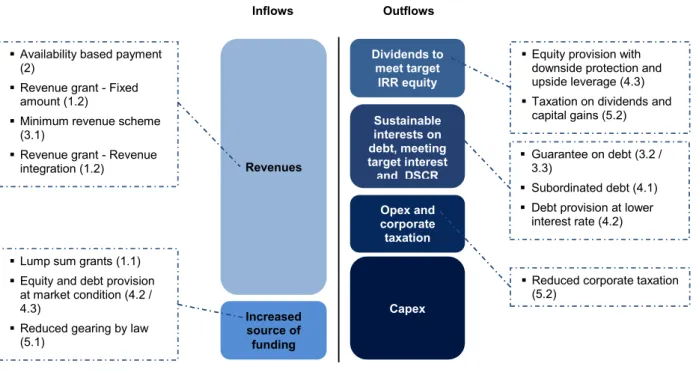
Drawing on the broad classification provided by Hellowell, Vecchi, and Caselli (2015), referred to the post-global financial crisis period, we have conducted an extensive desk online research in September 2014, based on an information-oriented selection approach (Flyvbjerg 2006), to source the main policy actions put in place across the world to sustain the PPP bankability. The desk research was also supplemented by information raised within the G20 IIWG meetings hold in 2014 and 2015 and the evidences generated by scholars in the filed of PPP contract renegotiation. Based on the features and the effects generated on the PPP cash flows (revenues, capital costs, operating costs and corporate taxation, interest on debt and dividends), shown in figure 15, we have defined five categories, which represent a comprehensive
representation of the policy tools used so far in the infrastructure sector.
Hereafter, we explain the five categories and for each of them we indicate features, applications, advantages and drawbacks and the effects of project’s cash flow (Figure 1).
1. Grant/subsidies reduces the capital requirements of the project or integrates its revenues; it is generally delivered by contracting authority, even if some dedicated fund at national level may exists. A grant can be of three types.
1.1. Lump sum capital grant reduces the need of private capital and therefore the revenues (either tools or availability charge) necessary to remunerate the investment; it may delivered at the contract signature or during the implementation of the works; in the latter case, a performance bond may be required to avoid moral hazard during the construction phase. It is a recommended approach to mix the European Union structural funds and private capitals (EU Regulation 1303/2013, art. 62); it foreseen in Korea (Act on private participation in infrastructure, art. 53) and it has been applied in India within the Viability Gap Funding scheme (Singh and Kalidindi 2006) and now within the Hybrid Annuity Model launched by Modi Government6.
1. 2. Revenue grant increases the revenue volume and stability when the risk of demand is retained by the private player and tariffs are set at social value; it is generally defined at the contract signature and it can be paid by the authority as a periodic fixed amount (with a stronger effect on the mitigation of demand risk) or as revenue integration (it leaves the demand risk on the concessionaire, thus also the incentive to manage efficiently the service). Though less used than capital grant, it has been applied in some European countries, such as in Spain in the motorway sector (Vassallo 2006).
2. Availability based PPP with payments made by the authority for the availability of the infrastructure. Though the availability based mechanism is typical of social infrastructure, where the main user is the public authority (such as in the case of hospitals), increasingly it has been used also for economic infrastructure, such as in the transport sector in Canada7and in the United States after the failure of five out of twelve PPP
5 To facilitate the understanding of the picture, each tool is reported with the same number used in the description
provided in this section.
6
http://articles.economictimes.indiatimes.com/2016-01-27/news/70120430_1_annuity-payments-highway-projects-model
projects8. Here, the availability payment neutralizes the demand risk, while leaving on the private
concessionaire the performance risk and thus the incentive to efficiently build and manage the project. Therefore, it is a mechanism that allows transferring only the technical risks to the private sector, with a positive effect on the project bankability, thanks to lower interest rate on debt and more comfortable covenants.
3. Credit-enhancement tools, realised directly by a government or by its own controlled agency or development bank. This can assume three forms:
3.1. Minimum payment guarantee reduces the demand risk, which is partially retained by the contracting authority, which is committed to guarantee a certain level of revenues, generally those necessary to cover the debt service at some level of the DSCR (debt service cover ratio) or to reach a minimum return. It has been extensively used in emerging markets, such as in Chile (Vassallo 2006), Korea (Asian Development Bank 2011) and Colombia (Irwin 2003), Brazil and Mexico (World Bank 2012). A study of the World Bank focused on PPP in Latin America reports that the debt service cover ratio (DSCR, a ratio normally used to assess the bankability of a PPP project) requested by banks ascends to about 1.70x without revenues guarantees, while with a minimum guarantee it ranges from 1.1 to 1.20x. Even though minimum revenue is considered a way to minimize the negative impact of contract renegotiation due to exogenous risks it may cause adverse selection and moral hazard, forcing the authority to activate the payment (Estache, Iimi, and Ruzzier 2009).
3.2. Guarantee in case of default pays the debt principal and interest in the case of concessionaire’s default. It is a widespread approach in both emerging and mature economies, also to mitigate the refinancing risks. Examples includes the TIFIA (Transportation Infrastructure Finance and Innovation Act)9 managed by the US Federal Government; the UK Guarantees scheme created in 2012 to avoid
delays to investment in UK infrastructure projects that may have stalled because of adverse credit conditions10; the Indonesia Infrastructure Guarantee Fund/IIGF created in 2009 to (inter alia) encourage
the participation of private sector in infrastructure projects and minimize exposure from contingent liabilities and sudden shock to the state budgets (OECD 2012). The distortionary effect of such guarantees is enormous, as they reduce or cancel the incentives for investors to monitor the efficient execution of the project (Hellowell, Vecchi, and Caselli 2015).
4. Direct provision of debt and equity capital, realised directly by a government of by its own controlled agency or development bank, can take three main forms.
4.1. Subordinated (junior) debt aimed at enhancing the credit quality of the senior debt in order to attract investment from insurance companies and pension funds. One of the main relevant application is the Project Bond Initiative of the European Investment Bank (EIB), which has enhanced by, on average, 3 notches the rating of the bonds issued by 10 projects across Europe, thanks to a subordinated debt not exceeding the 20% of the capital invested (Vecchi, Casalini, and Gatti 2015).
4.2. Debt, provided at market rates and on market terms, to cope just with the liquidity shortage, or at lower interest rate to help the project to meet the expectation of debt capital investors, in term of interest rate, cover ratios and maturity. According to Hellowell, Vecchi, and Caselli (2015) this is the less distortionary measure to support the attraction of capital, provided it is delivered at market conditions,
8 http://www.fhwa.dot.gov/ipd/p3/defined/design_build_finance_operate.aspx 9 http://www.dot.gov/tifia/overview#sthash.YMHtZNGi.dpuf
https://www.gov.uk/government/publications/uk-guarantees-scheme-prequalified-projects/uk-guarantees-scheme-as it happens for the US Federal Government TIFIA loan used in some PPPs in Florida (the Port of Miami and the I-595 Corridor Roadway Improvements project11) or for the loans of the European
Investment Bank.
4.3. Equity, provided at market conditions or on more advantageous conditions, to fill an equity gap and/or to reduce financial gearing, therefore reducing the exposure to credit risk and to offer downside protection or upside leverage to private equity holders. Examples include the UK PF2 facility, where the Treasury is committed to is to act as a minority equity co-investor in PF2 projects, providing share capital and loans equal to 25-49% of the total equity quantum (Hellowell, Vecchi, and Caselli 2015); and other public – private infrastructure funds jointly or individually set up by European national promotional banks, such as the pan – European Marguerite fund focused on the energy sector12 and the
Inframed fund13 focused on the infrastructure in the Mediterranean area.
Figure 1 – The effect of policy instrument on project cash flows and ratios
Source: Authors
5. Discussion and conclusion
Infrastructure still remains at the centre of the policy agenda, both in mature and emerging markets, and its role for supporting economic development is unquestioned (Moszoro et al. 2015). Due to public budget constraints and privatization policies, private capital will continue to play an important role in the delivery
11 http://www.dot.gov/tifia/projects-financed 12 http://www.marguerite.com/about-us/core-sponsors/ 13 http://inframed.com/genesis/ Revenues Capex Sustainable interests on debt, meeting target interest and DSCR Dividends to meet target IRR equity
Availability based payment (2)
Revenue grant - Fixed amount (1.2)
Minimum revenue scheme (3.1)
Revenue grant - Revenue integration (1.2)
Guarantee on debt (3.2 / 3.3)
Subordinated debt (4.1)
Debt provision at lower interest rate (4.2)
Equity provision with downside protection and upside leverage (4.3)
Taxation on dividends and capital gains (5.2)
Lump sum grants (1.1)
Equity and debt provision at market condition (4.2 / 4.3)
Reduced gearing by law (5.1) Increased source of funding Opex and corporate taxation
Reduced corporate taxation (5.2)
of new infrastructure. Moreover infrastructures are attracting interest from a new range of investors, like pension funds or sovereign wealth funds for their stable return (Gatti 2014; World Economic Forum 2013). Rooted in a framework drawn by Hellowell, Vecchi, and Caselli (2015), this paper provides a framework for the identification and appraisal of instruments used by governments around the world to sustain the supply of private finance for infrastructure development. As the use of such instruments may have significant fiscal and economic implications, understanding the options available among those mainly used across the world, the mechanisms through which they reduce investor risk, and the possible unintended effects, is a priority for the governments and international institutions, that select and appraising them.
In addition, this paper opens also the way to future research aimed at understanding and assessing the effects of these measures and in particular their capacity to attract private capital without generating or increasing moral hazard and adverse selection phenomena, thus safeguarding the microeconomic benefits produced by the involvement of private capital and competencies without compromising governments’ fiscal position (Vecchi et al. 2016).
So far, studies on the impact of public guarantees have been mainly developed with reference to the access to credit by small and medium enterprises (SMEs), focusing on two dimensions, of which the latter is the main relevant for the policy maker (Levitsky 1997): (i) financial additionality, which refers to the increased availability of financial resources in the system or at their better conditions (e.g. interest rates) for the same level of risk; and (ii) economic additionality, which refers to the capacity of a company to use these resources for financing projects able to generate an increase in revenues, in the return on investments and possibly also in the employment.
If the concept of financial additionality is appropriate also for infrastructure policy, on the contrary, economic additionality seems less appropriate here. The decision to proceed with a given infrastructure project rests on an economic appraisal generally undertaken by a competent authority. In principle, this appraisal is independent of any assessment of a project’s desirability – or ‘bankability’ – from the investor’s perspective. In an ideal world, infrastructure projects that offer the largest net benefits to society are those that are prioritised by government, and then a procurement route analysis is undertaken to identify the best value for money approach to fund and develop it. The literature and the practice suggest that the procurement route analysis may be a useful approach to understand the suitability of a PPP scheme (Siemiatycki and Farooqi 2012). If PPP is assessed to be the best and more suitable option, however, a bankability issue may still arise. Therefore, in the infrastructure context, economic desirability, rather than additionality, is the central concern. .
If other policies are used, Vecchi et al. (2016), based on the evidences of a multi-agent simulation, suggest to improve the public sector competence in the procurement phase to offset the opportunistic behaviours and therefore the adverse selection caused by the public guarantee.
Even if the economic desirability and performance of these measures still remain a relevant priority to be addressed for institutions and scholars, these first considerations allow us to recommend that governments to design carefully their “guarantee packages”, as one size fits all approaches are unlikely to be optimal. Indeed, institutional ecosystems and the projects pipeline’s features must be taken into consideration for the most appropriate system to be designed. Governments should also consider the efficiency of the “guarantee package” management system. A trade off should be found between the rigour of project assessment and the delivery time. The risk is that to reduce moral hazard effects, government authorities may not be able to provide the right support when it is needed.
Future research is needed to analyse the effects generated by these different policies, both at project level (in term of attraction of private capital and financial efficiency) and at government level (in term of value for money, affordability and accounting treatment of the contingent liabilities generated).
References
Asian Development Bank. 2011. Public-Private Partnership Infrastructure Projects: Case Studies from the Republic of Korea. Vol. 1. http://www.adb.org/sites/default/files/publication/29032/ppp-kor-v1.pdf. BlackRock. 2015. “Infrastructure Raising. An Asset Class Taking Shape.”
https://www.blackrock.com/investing/literature/whitepaper/infrastructure-rising-an-asset-class-takes-shape.pdf.
Chan, Albert P C, Patrick T I Lam, Daniel W M Chan, Esther Cheung, and Yongjian Ke. 2010. “Critical Success Factors for PPPs in Infrastructure Developments: Chinese Perspective.” Journal of Construction Engineering and Management 136 (5). American Society of Civil Engineers: 484–94. Engel, Eduardo, Ronald D Fischer, and Alexander Galetovic. 2014. The Economics of Public-Private
Partnerships: A Basic Guide. Cambridge University Press.
Engel, Eduardo, Ronald Fischer, and Alexander Galetovic. 2009. “Soft Budgets and Renegotiations in Public-Private Partnerships.” National Bureau of Economic Research.
EPEC. 2009. “The Financial Crisis and the PPP Market. Potential Remedial Action.”
———. 2011. “State Guarantees in PPPs.” http://www.eib.org/epec/resources/epec-state-guarantees-in-ppps-public.pdf.
Estache, Antonio, Atsushi Iimi, and Christian A Ruzzier. 2009. “Procurement in Infrastructure: What Does Theory Tell Us?” World Bank Policy Research Working Paper Series, Vol.
Flyvbjerg, Bent. 2006. “Five Misunderstandings about Case-Study Research.” Qualitative Inquiry 12 (2). Sage publications: 219–45.
Forrer, John, James Edwin Kee, Kathryn E Newcomer, and Eric Boyer. 2010. “Public–private Partnerships and the Public Accountability Question.” Public Administration Review 70 (3). Wiley Online Library: 475–84.
Gatti, Stefano. 2014. “Government and Market Based Instruments and Incentives to Stimulate Long-Term Investment Finance in Infrastructure.” OECD Working Paper.
Gatti, Stefano, and Raffaele Della Croce. 2015. “International Trends in Infrastructure Finance.” In Public Private Partnership for Infrastructure and Business Development, edited by Stefano Caselli, Guido Corbetta, and Veronica Vecchi. New York: Palgrave Macmillan.
Grimsey, Darrin, and Mervyn K Lewis. 2002. “Evaluating the Risks of Public Private Partnerships for Infrastructure Projects.” International Journal of Project Management 20 (2). Elsevier: 107–18. Hellowell, Mark, Veronica Vecchi, and Stefano Caselli. 2015. “Return of the State? An Appraisal of Policies
to Enhance Access to Credit for Infrastructure-Based PPPs.” Public Money & Management 35 (1). Taylor & Francis: 71–78.
Hwang, Bon-Gang, Xianbo Zhao, and Mindy Jiang Shu Gay. 2013. “Public Private Partnership Projects in Singapore: Factors, Critical Risks and Preferred Risk Allocation from the Perspective of Contractors.” International Journal of Project Management 31 (3). Elsevier: 424–33.
Iossa, Elisabetta, and David Martimort. 2015. “The Simple Microeconomics of Public‐ Private Partnerships.” Journal of Public Economic Theory 17 (1). Wiley Online Library: 4–48.
Irwin, Timothy. 2003. Public Money for Private Infrastructure: Deciding When to Offer Guarantees, Output-Based Subsidies, and Other Fiscal Support. World Bank Publications.
Ke, Yongjian, ShouQing Wang, and Albert P C Chan. 2010. “Risk Allocation in Public-Private Partnership Infrastructure Projects: Comparative Study.” Journal of Infrastructure Systems 16 (4). American Society of Civil Engineers: 343–51.
Lam, Ka Chi, Dan Wang, Patricia T K Lee, and Yick Tat Tsang. 2007. “Modelling Risk Allocation Decision in Construction Contracts.” International Journal of Project Management 25 (5). Elsevier: 485–93. Levitsky, Jacob. 1997. “Credit Guarantee Schemes for SMEs–an International Review.” Small Enterprise
Development 8 (2). Practical Action Publishing: 4–17.
Li, Bing, Akintola Akintoye, Peter J Edwards, and Cliff Hardcastle. 2005. “Critical Success Factors for PPP/PFI Projects in the UK Construction Industry.” Construction Management and Economics 23 (5).
Matsukawa, Tomoko. 2014. “Risk Mitigation Instruments for Infrastructure Financing.”
Matsukawa, Tomoko, and Odo Habeck. 2007. “Review of Risk Mitigation Instruments for Infrastructure Financing and Recent Trends and Developments.” Vol. 4. World Bank Publications.
Moszoro, M., G. Araya, F. Ruiz-Nuñez, and J. Schwartz. 2015. “What Drives Private Participation in Infrastructure in Developing Countries?” In Public Private Partnerships for Infrastructure and Enterprise Funding. Principles, Practices and Perspectives, edited by Stefano Caselli, Guido Corbetta, and Veronica Vecchi. New York: Palgrave Macmillan.
Ng, A, and Martin Loosemore. 2007. “Risk Allocation in the Private Provision of Public Infrastructure.” International Journal of Project Management 25 (1). Elsevier: 66–76.
OECD. 2012. “Indonesia. Public-Private Partnership Governance: Policy, Process and Structure.” ———. 2015. “Mapping of Instruments and Incentives for Infrastructure Financing: A Taxonomy.” Saussier, Stéphane. 2013. “An Economic Analysis of the Closure of Markets and Other Dysfunctions in the
Awarding of Concession Contracts.” 2013/08. EUI RSCAS. http://hdl.handle.net/1814/26058.
Schwartz, Jordan Z, Fernanda Ruiz-Nuñez, and Jeff Chelsky. 2014. “Closing the Infrastructure Finance Gap: Addressing Risk.” Financial Flows Infrastructure Financing, 141.
Siemiatycki, Matti, and Naeem Farooqi. 2012. “Value for Money and Risk in Public–private Partnerships: Evaluating the Evidence.” Journal of the American Planning Association 78 (3). Taylor & Francis: 286–99.
Singh, L Boeing, and Satyanarayana N Kalidindi. 2006. “Traffic Revenue Risk Management through Annuity Model of PPP Road Projects in India.” International Journal of Project Management 24 (7). Elsevier: 605–13.
Vassallo, Jose M. 2006. “Traffic Risk Mitigation in Highway Concession Projects: The Experience of Chile.” Journal of Transport Economics and Policy (JTEP) 40 (3). Journal of Transport Economics and Policy: 359–81.
Vecchi, Veronica, Marco Airoldi, and Stefano Caselli. 2015. “Closing Public-Private Partnerships’ Gaps in Italy: From Legal Microsurgery to Managerial Flow.” In Managerial Flow, edited by Veronica Vecchi, Rodney Farr-Wharton, Ben Farr-Wharton, and Manuela Brusoni, 206–19. New York: Routledge. Vecchi, Veronica, Emanuele Borgonovo, Stefania Amadio, Niccolò Cusumano, and Stefano Gatti. 2016.
“Do Public Guarantees to Infrastructure Investments Engender Moral Hazard of Private Bidders? A Multiple Agents Based Simulation.” Paper Laboratorio ASPI – Bocconi.
Vecchi, Veronica, Francesca Casalini, and Stefano Gatti. 2015. “Attracting Private Investors: The EU Project Bond Initiative and the Case of A11 Motorway.” In Public Private Partnerships for Infrastructure and Business Development, edited by Stefano Caselli, Guido Corbetta, and Veronica Vecchi, Palgrave. New York: Palgrave Macmillan.
Verhoest, Koen, Ole Helby Petersen, Walter Scherrer, and Raden Murwantara Soecipto. 2014. “Policy Commitment, Legal and Regulatory Framework, and Institutional Support for PPP in International Comparison: Indexing Countries’ Readiness for Taking up PPP.” PPP Conference 2013, Universiteit Antwerpen: University of Salzburg.
World Bank. 2012. “Best Practices in Public-Private Partnerships Financing in Latin America: The Role of Guarantees.”
https://einstitute.worldbank.org/ei/sites/default/files/Upload_Files/BestPracticesPPPFinancingLatinA mericaguarantees.pdf.
World Economic Forum. 2013. “Strategic Infrastructure. Steps to Prepare and Accelerate Public-Private Partnerships.”
http://www3.weforum.org/docs/AF13/WEF_AF13_Strategic_Infrastructure_Initiative.pdf.
Yescombe, Edward R. 2011. Public-Private Partnerships: Principles of Policy and Finance. Butterworth-Heinemann.