Environmental Protection Act 1986 Page 2 of 6 Works Approval: W5763/2014/1
File No: DER2014/002289 IRLB_TI0674 v2.8
Works Approval Conditions
1 General
1.1 Interpretation
1.1.1 In the Works Approval, definitions from the Environmental Protection Act 1986 apply unless the contrary intention appears.
1.1.2 In the Works Approval, unless the contrary intention appears: ‘Act’ means the Environmental Protection Act 1986;
‘AS/NZS 5667.1’ means the Australian Standard AS/NZS 5667.1 Water Quality – Sampling – Guidance of the Design of sampling programs, sampling techniques and the preservation and handling of samples;
‘AS/NZS 5667.10’ means the Australian Standard AS/NZS 5667.10 Water Quality – Sampling – Guidance on sampling of waste waters;
‘annual period’ means the inclusive period from 1 April until 31 March in the following year; ‘CEO’ means Chief Executive Officer of the Department of Environment Regulation;
‘CEO’ for the purpose of correspondence means: Manager Licensing (Waste North)
Department of Environment Regulation Locked Bag 33 Cloisters Square PERTH WA 6850
Telephone: (08) 9333 7510 Facsimile: (08) 9333 7550
Email: [email protected];
‘code of practice for the storage and handling of dangerous goods’ means document titled “Storage and handling of dangerous goods: Code of Practice“ published by the Department of Mines and Petroleum, as amended from time to time;
‘Commissioning’ means the process of operation and testing that verifies the works and all relevant systems, plant, machinery and equipment have been installed and are performing in accordance with the design specification set out in the works approval application;
‘dangerous goods’ has the meaning defined in the Dangerous Goods Safety (Storage and Handling of Non-explosives) Regulations 2007;
‘environmentally hazardous material’ means material (either solid or liquid raw materials, materials in the process of manufacture, manufactured products, products used in the
manufacturing process, by-products and waste) which if discharged into the environment from or within the premises may cause pollution or environmental harm. Note: Environmentally hazardous materials include dangerous goods where they are stored in quantities below placard quantities. The storage of dangerous goods above placard quantities is regulated by the Department of Mines and Petroleum;
Environmental Protection Act 1986 Page 3 of 6 Works Approval: W5763/2014/1
File No: DER2014/002289 IRLB_TI0674 v2.8
‘NATA accredited’ means in relation to the analysis of a sample that the laboratory is NATA accredited for the specified analysis at the time of the analysis;
‘Premises’ means the area defined in the Premises Map in Schedule 1 and listed as the Premises address on page 1 of the Works Approval;
‘Schedule 1’ means Schedule 1 of this Works Approval unless otherwise stated;
‘Works Approval’ means this Works Approval numbered W5763/2014/1 and issued under the Act; and
‘Works Approval Holder’ means the person or organisation named as the Works Approval Holder on page 1 of the Works Approval.
1.1.3 Any reference to an Australian or other standard in the Works Approval means the relevant parts of the standard in force from time to time during the term of this Works Approval.
1.1.4 Any reference to a guideline or code of practice in the Works Approval means the current version of the guideline or code of practice in force from time to time, and shall include any amendments or replacements to that guidelines or code of practice made during the term of this Works Approval.
1.2 General conditions
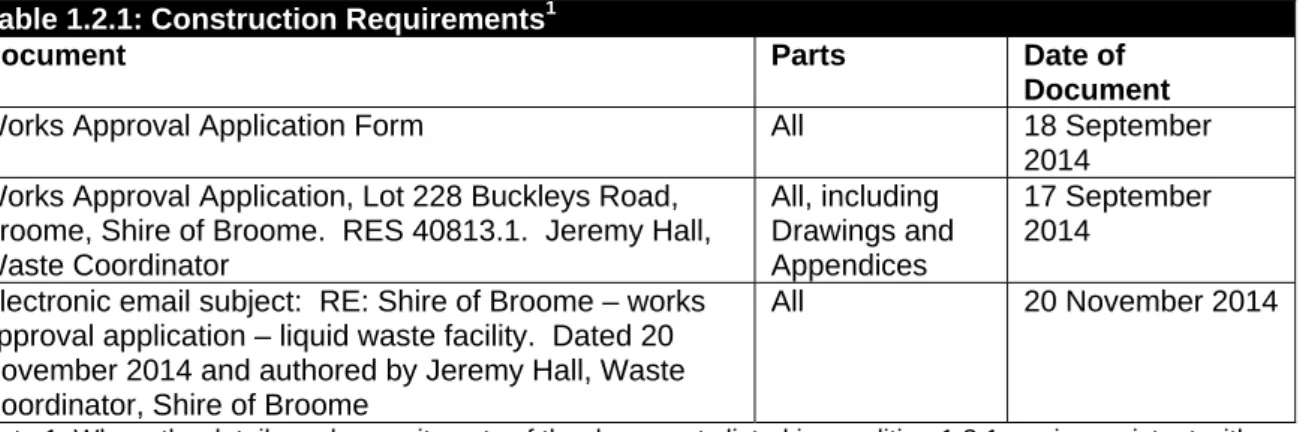
1.2.1 The Works Approval Holder shall construct the works in accordance with the documentation detailed in Table 1.2.1:
Table 1.2.1: Construction Requirements1
Document Parts Date of
Document
Works Approval Application Form All 18 September
2014 Works Approval Application, Lot 228 Buckleys Road,
Broome, Shire of Broome. RES 40813.1. Jeremy Hall, Waste Coordinator All, including Drawings and Appendices 17 September 2014
Electronic email subject: RE: Shire of Broome – works approval application – liquid waste facility. Dated 20 November 2014 and authored by Jeremy Hall, Waste Coordinator, Shire of Broome
All 20 November 2014
Note 1: Where the details and commitments of the documents listed in condition 1.2.1 are inconsistent with any other condition of this works approval, the conditions of this works approval shall prevail.
1.2.2 The Works Approval Holder, except where storage is prescribed in section 1.3, shall ensure that environmentally hazardous materials are stored in accordance with the Code of Practice for the Storage and handling of dangerous goods.
1.2.3 The Works Approval Holder shall undertake commissioning in accordance with the commissioning plan titled “Commissioning Plan – Liquid Waste Facility – Lot 228 Buckleys Road”.
1.2.4 The Works Approval Holder shall commission the Liquid Waste Facility for a period not exceeding 4 months.
1.3 Premises operation
Environmental Protection Act 1986 Page 4 of 6 Works Approval: W5763/2014/1
File No: DER2014/002289 IRLB_TI0674 v2.8
2 Emissions
There are no specified conditions relating to emissions in this section.
3 Monitoring
3.1.1 The Works Approval Holder shall ensure that:
(a) all wastewater sampling is conducted in accordance with AS/NZS 5667.1 and AS/NZS 5667.10; and
(b) all laboratory samples are submitted to and tested by a laboratory with current NATA accreditation for the parameters being measured.
4 Improvements
There are no specified conditions relating to improvements in this section.
5 Information
5.1 Reporting
5.1.1 The Works Approval Holder shall submit a compliance document to the CEO, following the construction of the works and prior to commissioning of the same.
5.1.2 The compliance document shall:
(a) certify that the works were constructed in accordance with the conditions of the Works Approval; and
(b) be signed by a person authorised to represent the Works Approval Holder and contain the printed name and position of that person within the company. 5.1.3 The Works Approval Holder shall submit a commissioning report for the Liquid Waste
Facility to the CEO within 4 weeks of the completion of commissioning. 5.1.4 The Works Approval Holder shall ensure the commissioning report includes;
(a) a list of any original monitoring reports submitted to the Works Approval Holder from third parties for the commissioning period;
(b) a summary of the environmental performance of the Liquid Waste Facility as installed, against the design specification set out in the works approval application;
(c) a review of performance against the works approval conditions; and (d) where they have not been met, measures proposed to meet the design
specification and/or works approval conditions, together with timescales for implementing the proposed measures.
Environmental Protection Act 1986 Page 5 of 6 Works Approval: W5763/2014/1
File No: DER2014/002289 IRLB_TI0674 v2.8
5.2 Notification
5.2.1 The Works Approval Holder shall ensure that the parameters listed in Table 5.2.1 are notified to the CEO in accordance with the notification requirements of the table.
Table 5.2.1: Notification requirements Condition
or table (if relevant)
Parameter Notification requirement Format
or form 1.2.4 Commencement of commissioning 7 days prior to start None
specified Completion of commissioning 7 days after completion
Environmental Protection Act 1986 Page 6 of 6 Works Approval: W5763/2014/1
File No: DER2014/002289 IRLB_TI0674 v2.8
Schedule 1: Maps
Premises map
Environmental Protection Act 1986 Page 1 of 18 Decision Document: W5763/2014/1
File Number: DER2014/002289 IRLB_TI0669 v2.6
Decision Document
Environmental Protection Act 1986, Part V
Proponent:
Shire of Broome
Works Approval: W5763/2014/1
Registered office: 27 Weld Street BROOME WA 6725
Premises address: Shire of Broome Liquid Waste Facility Reserve 40813
Lot 228 Buckleys Road WATERBANK WA 6725 Being Lot 228 on Plan 216500 Issue date: Thursday, 26 February 2015 Commencement date: Monday, 2 March 2015 Expiry date: Sunday, 1 March 2020
Decision
Based on the assessment detailed in this document the Department of Environment Regulation (DER), has decided to issue a Works Approval. DER considers that in reaching this decision, it has taken into account all relevant considerations and legal requirements and that the Works Approval and its conditions will ensure that an appropriate level of environmental protection is provided.
Decision Document prepared by: Carmen Standring Licensing Officer
Decision Document authorised by: Steve Checker Manager Licensing
Environmental Protection Act 1986 Page 2 of 18 Decision Document: W5763/2014/1
File Number: DER2014/002289 IRLB_TI0669 v2.6
Contents
Contents 2
1 Purpose of this Document 2
2 Administrative summary 3
3 Executive summary of proposal and assessment 4
4 Decision table 6
5 Advertisement and consultation table 15
6 Risk Assessment 16
Appendix A 17
1
Purpose of this Document
This decision document explains how DER has assessed and determined the application and provides a record of DER’s decision-making process and how relevant factors have been taken into account. Stakeholders should note that this document is limited to DER’s assessment and decision making under Part V of the Environmental Protection Act 1986. Other approvals may be required for the proposal, and it is the proponent’s responsibility to ensure they have all relevant approvals for their Premises.
Works approval and licence conditions
DER has three types of conditions that may be imposed on works approvals and licences. They are as follows;
Standard conditions (SC)
DER has standard conditions that are imposed on all works approvals and licences regardless of the activities undertaken on the Premises and the information provided in the application. These are included as the following conditions on works approvals and licences:
Works approval conditions: 1.1.1-1.1.4, 1.2.1, 1.2.2, 5.1.1 and 5.1.2. Licence conditions: 1.1.1-1.1.4, 1.2.1-1.2.4, 5.1.1-5.1.4 and 5.2.1. For such conditions, justification within the Decision Document is not provided. Optional standard conditions (OSC)
In the interests of regulatory consistency DER has a set of optional standard conditions that can be imposed on works approvals and licences. DER will include optional standard conditions as
necessary, and are likely to constitute the majority of conditions in any licence. The inclusion of any optional standard conditions is justified in Section 4 of this document.
Non standard conditions (NSC)
Where the proposed activities require conditions outside the standard conditions suite DER will impose one or more non-standard conditions. These include both premises and sector specific conditions, and are likely to occur within few licences. Where used, justification for the application of these conditions will be included in Section 4.
Environmental Protection Act 1986 Page 3 of 18 Decision Document: W5763/2014/1
File Number: DER2014/002289 IRLB_TI0669 v2.6
2 Administrative
summary
Administrative details Application type Works Approval New Licence Licence amendmentWorks Approval amendment Activities that cause the premises to become
prescribed premises
Category number(s) Assessed design capacity
61 2,500 tonnes per annum Application verified
Application fee paid
Date: 21/11/2014 Date: 11/12/2014 Works Approval has been complied with
Compliance Certificate received
Yes No N/A
Yes No N/A
Commercial-in-confidence claim Yes No Commercial-in-confidence claim outcome
N/A
Is the proposal a Major Resource Project? Yes No Was the proposal referred to the Environmental
Protection Authority (EPA) under Part IV of the
Environmental Protection Act 1986?
Yes No
Referral decision No: N/A Managed under Part V Assessed under Part IV
Is the proposal subject to Ministerial Conditions? Yes No
Ministerial statement No: N/A EPA Report No: N/A
Does the proposal involve a discharge of waste into a designated area (as defined in section 57 of the Environmental Protection Act 1986)?
Yes No
Department of Water consulted Yes No Is the Premises within an Environmental Protection Policy (EPP) Area Yes No
If Yes include details of which EPP(s) here.
Is the Premises subject to any EPP requirements? Yes No
Environmental Protection Act 1986 Page 4 of 18 Decision Document: W5763/2014/1
File Number: DER2014/002289 IRLB_TI0669 v2.6
3
Executive summary of proposal and assessment
The Shire of Broome has applied to DER for a works approval to construct a category 61 Liquid Waste Facility (LWF) at the Shire of Broome Waste Management Facility (WMF) at Lot 228 Buckleys Road, Broome.
The LWF is required to treat grease-trap waste generated within the Shire of Broome. The WMF is a licenced Class II putrescible landfill that has two existing grease-trap waste ponds onsite. However, the WMF is approaching the end of its operational life, and closure of these ponds is required to allow the Shire to fully utilise available void space at the WMF. The Shire is therefore seeking approval to construct a new three tank Bioreactor LWF on the premises. Closure of the old ponds will involve transferring all liquid waste to the new Bioreactor LWF (once commissioned and approved to operate by DER) and conducting sampling and analysis of remnant sludge and pond construction materials (such as embankment walls) to determine appropriate disposal.
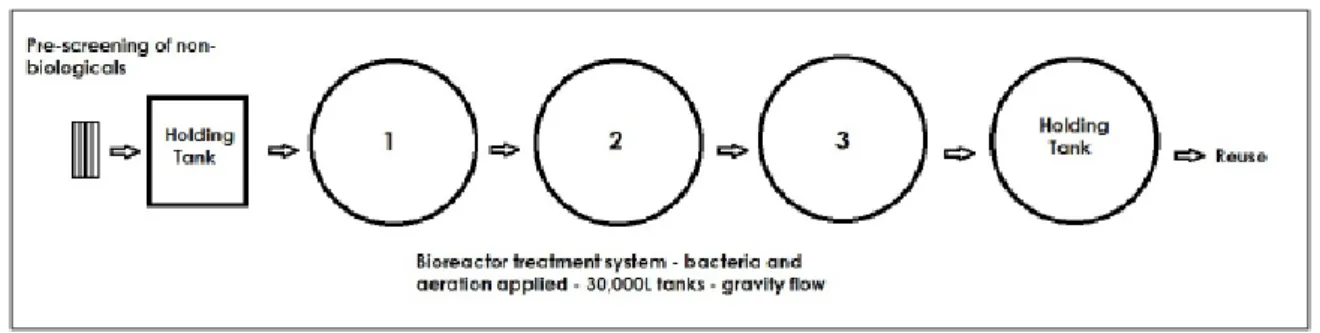
The Bioreactor system involves three tanks in series that are aerated and automatically dosed with bacteria. Figure 1 shows the layout of the three tank Bioreactor system. The tanks contain
anoxic/anaerobic zones and aerobic zones to ensure biological nutrient removal. Each tank acts as a baffle to prevent short circuiting of inflows and retain solids for treatment.
Figure 1: Typical layout schematic of the proposed three tank Bioreactor
Automated bacteria dosing is applied to tanks 1, 2 and 3. Each tank will contain three industrial micro bubble diffusers set at a sub-surface level approximately 1.3m above the bottom of the tanks. Ambient air supply to all diffusers is via a 3.0kW Side Channel Blower that will supply 3,300L of air per minute to the diffusers in all three tanks.
The bacteria product is automatically dosed at programmed times to tanks 1 to 3. The nitrogen cycle bacteria facilitate sufficient levels of aerobic and facultative bacteria in the Bioreactor to process the fats, oils and greases in the wastewater. These bacteria also reduce sludge volumes produced as part of the process.
Treated water from the LWF will be used for dust suppression and irrigation onsite. The Shire of Broome is currently conducting rehabilitation trials on the landfill embankments, and it is envisaged that treated water will be suitable for irrigation of revegetated areas.
The proposal to construct and operate a three tank Bioreactor LWF at the Shire of Broome WMF has been assessed as presenting a low risk to the environment. Emissions and discharges associated with the proposal have been identified as stormwater, dust, odour and discharges to land. The risk of these emissions, and the proponent’s commitments to mitigate such risks, are discussed further in the Decision table below.
Environmental Protection Act 1986 Page 5 of 18 Decision Document: W5763/2014/1
File Number: DER2014/002289 IRLB_TI0669 v2.6
Upon construction of the LWF, the Shire of Broome will be required to submit a construction
compliance document and may then commence commissioning of the LWF. A Commissioning Plan has been submitted that details what steps will be taken to ensure the LWF is operating effectively. Commissioning is expected to take four to six weeks and includes:
testing automatic dosing and blower systems;
introducing liquid waste to the system (to achieve normal operating conditions) and allowing it to be processed through the bioreactor tanks;
sampling and analysis of treated wastewater by a NATA certified laboratory; and
providing documentary evidence of treated water quality to DER.
There will be no discharges of treated wastewater during commissioning; all wastewater will be discharged to the existing grease-trap waste ponds onsite.
Once commissioning has demonstrated that the LWF is treating the liquid waste to an acceptable standard, DER will then process an amendment to the Shire of Broome WMF operating licence (L6912/1997/11) to incorporate conditions as recommended in the Decision table and Appendix A below. The amendment will involve conversion of L6912/1997/11 to the new REFIRE format to incorporate existing licence conditions and new conditions relating to operation of the LWF.
Environmental Protection Act 1986 Page 6 of 18 Decision Document: W5763/2014/1
File Number: DER2014/002289 IRLB_TI0669 v2.6
4 Decision
table
All applications are assessed in line with the Environmental Protection Act 1986, the Environmental Protection Regulations 1987, DER’s Policy Statement -
Limits and targets for prescribed premises (2006), and DER’s Operational Procedure on Assessing Emissions and Discharges from Prescribed Premises. Where other references have been used in making the decision they are detailed in the decision document.
Note: This licence is a non-REFIRE licence. Where applicable, references have been made to the non-REFIRE licence conditions. DECISION TABLE Works Approval / Licence section Condition number W = Works Approval L= Licence OSC or NSC
Justification (including risk description & decision methodology where relevant) Reference documents General conditions OSC 1.2.3 and 1.2.4 Existing licence conditions W1(a) – W1(c) OSC Construction
OSC 1.2.3 has been included in the works approval requiring the Shire of Broome to commission the LWF in accordance with the Commissioning Plan submitted and OSC 1.2.4 has been included to limit the commissioning period of the LWF to four months.
Operation
Emission Description
Emission: Stormwater potentially contaminated from spills or leaks of
grease-trap waste from the facility. Spills or leaks may occur during transfers, or from rupture / overflow of treatment tanks.
Impact: Contamination of surrounding land and surface water drainage systems.
Potential impacts on ecology of soils and surface water from the addition of grease and oils.
Controls: Stormwater will be directed away from the LWF via contours to reduce
the risk of stormwater becoming contaminated during operations. Transfers of liquid waste from truck to tank will not occur during rainy periods. Waste transfers will take place over a hardstand area graded to a drain to capture any spills or leaks during transfers. The drain will comprise a blind sump with grate that will be pumped out prior to and after rain events. The LWF will be fenced off to prevent damage to tanks from vehicles on-site.
General provisions of the Environmental Protection Act 1986 Application supporting documentation
Environmental Protection Act 1986 Page 7 of 18 Decision Document: W5763/2014/1
File Number: DER2014/002289 IRLB_TI0669 v2.6
DECISION TABLE Works Approval / Licence section Condition number W = Works Approval L= Licence OSC or NSC
Justification (including risk description & decision methodology where relevant) Reference documents Risk Assessment Consequence: Minor Likelihood: Rare
Risk Rating: Low
Regulatory Controls
Existing licence conditions W1(a) to W1(c) are in place on the Shire of Broome WMF operating licence to manage stormwater on the premises.
Residual Risk
Consequence: Minor
Likelihood: Rare
Risk Rating: Low
Emissions general
W2
L1.3.1 (REFIRE condition)
OSC Descriptive targets and / or limits will be set through the licence, via a licence
amendment, to manage odour emissions as well as treated water quality from the LWF, and therefore an OSC regarding recording and investigation of exceedances of limits or targets will be included on the amended licence.
N/A
Point source emissions to air including monitoring
W2 and W3 N/A Construction and Operation
No significant point source air emissions are expected from the construction or operation of the LWF. No specified conditions relating to point source emissions to air or the monitoring of these emissions are required to be added to the works approval or licence. General provisions of the Environmental Protection Act 1986 Point source emissions to surface water including
W2 and W3 N/A Construction and Operation
No significant point source emissions to surface water are expected from the construction and operation of the LWF. No specified conditions relating to point source emissions to surface water or the monitoring of these emissions are
General
provisions of the Environmental Protection Act
Environmental Protection Act 1986 Page 8 of 18 Decision Document: W5763/2014/1
File Number: DER2014/002289 IRLB_TI0669 v2.6
DECISION TABLE Works Approval / Licence section Condition number W = Works Approval L= Licence OSC or NSC
Justification (including risk description & decision methodology where relevant)
Reference documents
monitoring required to be added to the works approval or licence. 1986
Environmental Protection (Unauthorised Discharges) Regulations 2004 Point source emissions to groundwater including monitoring
W2 and W3 N/A Construction and Operation
There are no point source emissions to groundwater from the construction or operation of the LWF. No specified conditions relating to point source emissions to groundwater or the monitoring of these emissions are required to be added to the works approval or licence.
General provisions of the Environmental Protection Act 1986 Environmental Protection (Unauthorised Discharges) Regulations 2004 Emissions to land including monitoring
W2 and W3 N/A Construction
There will be no emissions to land during construction of the LWF. All treated wastewater produced during the commissioning period will be discharged to the existing liquid waste ponds, not to land. Monitoring of the discharge will be undertaken in accordance with the submitted Commissioning Plan and discharge to land will only commence once analysis of treated wastewater
shows that treatment levels are compliant with National Water quality
Management Strategy, Australian Guidelines for Sewerage Systems – Effluent
Management and once the WMF operating licence has been amended to allow
discharges under licence conditions. No specified conditions relating to
General provisions of the Environmental Protection Act 1986 Environmental Protection (Unauthorised Discharges)
Environmental Protection Act 1986 Page 9 of 18 Decision Document: W5763/2014/1
File Number: DER2014/002289 IRLB_TI0669 v2.6
DECISION TABLE Works Approval / Licence section Condition number W = Works Approval L= Licence OSC or NSC
Justification (including risk description & decision methodology where relevant)
Reference documents
OSC
emissions to land or the monitoring of such emissions are required to be added to the works approval.
Operation
DER’s assessment and decision making for discharges to land during operation of the LWF are detailed in Appendix A.
Regulations 2004 Application supporting documentation Fugitive emissions
W2 and W3 N/A Construction
Emission Description
Emission: There is potential for dust emissions during construction of the LWF
from minor earthworks and vehicle movements. This is expected to be minimal as the area is already cleared and compacted. Construction involves
assembling footings, tanks / screens, pipework, dosing systems and blowers.
Impact: Dust emissions can be harmful to human health and the environment.
Elevated total suspended particulates (TSP) can impact ambient environmental quality resulting in amenity impacts and can smother vegetation. Particulate matter that is less than 10 (PM10) or 2.5 (PM2.5) micrometres in diameter can be drawn deep into the lungs causing human health impacts.. Nearest sensitive receptor is located 800m west of the premises.
Controls: Water carts will be used to minimise dust during construction.
Construction phase will be visually monitored by the site supervisor and dust management measures (water cart) will be implemented should visible dust cross the premises boundary. The construction period is expected to be around one month.
Risk assessment
Consequence: Insignificant
Likelihood: Possible
Risk rating: Low
General provisions of the Environmental Protection Act 1986 Environmental Protection (Unauthorised Discharges) Regulations 2004 Application supporting documentation
Environmental Protection Act 1986 Page 10 of 18 Decision Document: W5763/2014/1
File Number: DER2014/002289 IRLB_TI0669 v2.6
DECISION TABLE Works Approval / Licence section Condition number W = Works Approval L= Licence OSC or NSC
Justification (including risk description & decision methodology where relevant)
Reference documents
Licence condition A1
Regulatory Controls
No conditions will be required on the works approval to manage dust. Licence condition A1 exists on operating licence to require the management of fugitive dust emissions from activities on the premises.
Residual risk
Consequence: Insignificant
Likelihood: Unlikely Risk rating: Low Operation
There will be no dust emissions during operation of the LWF. Treated waste water from the LWF will be used for dust suppression as part of the landfill operations, and to irrigate rehabilitated sections of the landfill. The existing licence has conditions requiring monitoring and management of dust emissions from other activities at the site.
Odour W2 L2.7.1 (REFIRE condition) N/A OSC Construction
There will be no odour emissions during construction of the LWF. No specified conditions relating to odour emissions are required to be added to the works approval.
Operation
Emission Description
Emission: Odour emissions generated from the breakdown of organic matter
(grease-trap waste) during processing and when performing waste transfers from truck to tanks.
Impact: Nuisance odour emissions may interfere with the amenity, comfort and
welfare of people in the local area. Nearest sensitive receptor is located 800m west of the premises.
General provisions of the Environmental Protection Act 1986 Application supporting documentation
Environmental Protection Act 1986 Page 11 of 18 Decision Document: W5763/2014/1
File Number: DER2014/002289 IRLB_TI0669 v2.6
DECISION TABLE Works Approval / Licence section Condition number W = Works Approval L= Licence OSC or NSC
Justification (including risk description & decision methodology where relevant)
Reference documents
Controls: Bioreactor tanks will be enclosed. Proponent will monitor Bioreactor
tanks daily to ensure the system is operating effectively. Tanks will be cleaned out annually to remove built up sand and grit, however, it is not anticipated de-sludging will be required due to the nature of the waste stream being processed (grease-trap waste).
Risk assessment
Consequence: Minor
Likelihood: Unlikely Risk rating: Low Regulatory Controls
An amendment to Licence L6912/1997/11 will be processed to add OSC 2.7.1 for the management of odour emissions on the premises.
Residual risk
Consequence: Minor
Likelihood: Unlikely Risk rating: Low
Noise W2 N/A Construction and Operation
There will be no additional noise emissions generated during construction and operation of the LWF. No specified conditions relating to noise emissions are required to be added to the works approval or the licence.
Environmental Protection (Noise) Regulations 1997 Application supporting documentation
Environmental Protection Act 1986 Page 12 of 18 Decision Document: W5763/2014/1
File Number: DER2014/002289 IRLB_TI0669 v2.6
DECISION TABLE Works Approval / Licence section Condition number W = Works Approval L= Licence OSC or NSC
Justification (including risk description & decision methodology where relevant) Reference documents Monitoring general W3.1.1 L3.1.1 and 3.1.2 OSC Construction
During commissioning of the LWF, the Shire of Broome will inspect the facility daily to check automatic dosing and bubble diffusers to ensure the facility is operating correctly. Laboratory analysis of the treated wastewater will be performed once wastewater levels are sufficient and normal operating conditions are reached. This is estimated to be once the facility achieves the capacity of the bioreactor tanks (45,000L). Parameters to be analysed include Biochemical Oxygen Demand (BOD), pH, Oil and Grease, Total Suspended Solids, Total Dissolved Solids, Total Nitrogen, Total Phosphorus, Sulfate. OSC 3.1.1 has been included in the works approval to require wastewater sampling to be conducted in accordance with AS/NZS 5667.10 and all laboratory samples to be tested by a laboratory with current NATA accreditation.
Operation
During operation of the LWF, the Shire of Broome will be required to analyse the treated wastewater on a quarterly basis to ensure the treatment levels are effective and suitable for discharge to land. OSC 3.1.1 will be included on the amended licence to require wastewater sampling to be conducted in accordance with AS/NZS 5667.10 and all laboratory samples to be tested by a laboratory with current NATA accreditation. OSC 3.1.2 will also be included to require quarterly samples be taken at least 45 days apart.
N/A
Monitoring of inputs and outputs
L3.5.1 N/A Operation
The Shire of Broome will be required to record and report volumes of liquid waste received at the LWF as well as volumes discharged (irrigated) to land. An OSC will be added to the operating licence requiring the monitoring of inputs at the LWF.
Environmental Protection Act 1986 Page 13 of 18 Decision Document: W5763/2014/1
File Number: DER2014/002289 IRLB_TI0669 v2.6
DECISION TABLE Works Approval / Licence section Condition number W = Works Approval L= Licence OSC or NSC
Justification (including risk description & decision methodology where relevant)
Reference documents
Process monitoring
W3 N/A Construction and Operation
No specified conditions relating to process monitoring are required to be added to the licence. N/A Ambient quality monitoring Licence condition W3(a)
OSC Construction and Operation
The existing Licence has conditions requiring the monitoring of groundwater below the landfill to detect any seepage. There are currently four monitoring locations around the landfill. Bores are sampled and analysed regularly for pH, EC, sulphate and a range of metals. The existing monitoring programme is considered sufficient to cover the monitoring of potential groundwater impacts from the LWF. There are no additional ambient quality monitoring conditions required to be added to the licence as a result of the operation of the LWF.
General provisions of the Environmental Protection Act 1986 Meteorological monitoring
W3 N/A Construction and Operation
No specified conditions relating to meteorological monitoring are required to be added to the licence.
N/A
Improvements W4 N/A The proposal to construct a LWF at the Shire of Broome Waste Management
Facility is for new infrastructure. As such, there is no requirement for Improvements to be included on the works approval or licence.
N/A Information W5.1.1 – W5.1.4 Licence condition G9(a) and (b) OSC OSC Construction
Standard conditions 5.1.1 and 5.1.2 will require the submission of the
compliance document prior to commissioning. OSC 5.1.3 has been included in the works approval for the submission of a commissioning report 4 weeks post commissioning. OSC 5.1.4 outlines information that must be included in the commissioning report.
Operation
The existing licence requires submission of an Annual Environmental Report
Environmental Protection Act 1986 Page 14 of 18 Decision Document: W5763/2014/1
File Number: DER2014/002289 IRLB_TI0669 v2.6
DECISION TABLE Works Approval / Licence section Condition number W = Works Approval L= Licence OSC or NSC
Justification (including risk description & decision methodology where relevant)
Reference documents
which must include the reporting of any monitoring results required by the licence, assessment of groundwater quality and a summary of complaints. Reporting requirements also include submission of an Annual Audit Compliance Report.
A licence amendment will be processed to require reporting of volumes of treated effluent discharged to land as well as the results of analysis of treated effluent from the LWF.
Licence Duration
N/A N/A The proposed works have been assessed as presenting a low risk to the
environment. The works approval will be issued for a period of five years. There are no issues that warrant the limiting of the works approval period.
Environmental Protection Act 1986 Page 15 of 18 Decision Document: W5763/2014/1
File Number: DER2014/002289 IRLB_TI0669 v2.6
5
Advertisement and consultation table
Date Event Comments received/Notes How comments were taken into
consideration 22/12/2014 Application advertised in West
Australian (or other relevant newspaper)
No comments received N/A
9/2/2015 Proponent sent a copy of draft instrument
Environmental Protection Act 1986 Page 16 of 18 Decision Document: W5763/2014/1
File Number: DER2014/002289 IRLB_TI0669 v2.6
6 Risk
Assessment
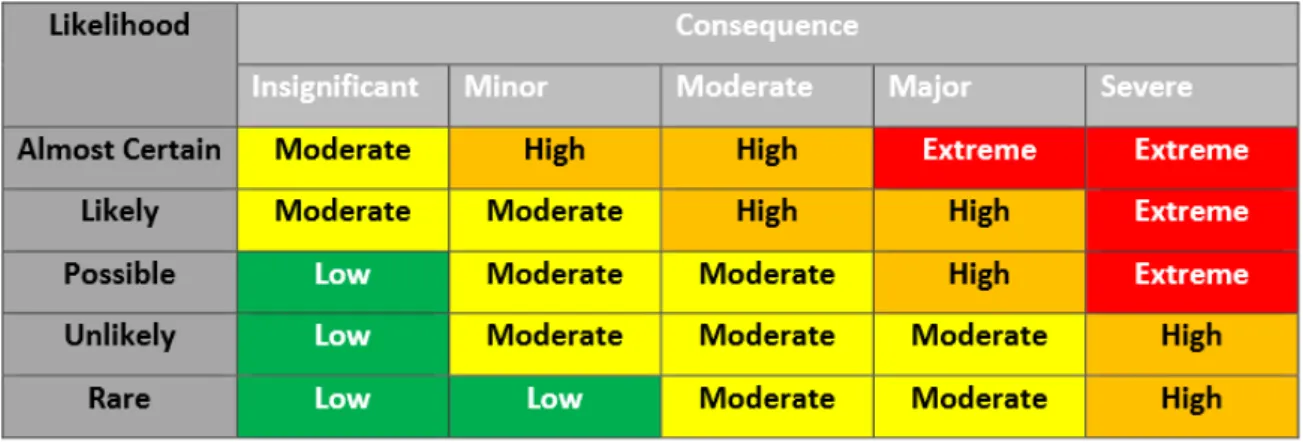
Note: This matrix is taken from the DER Corporate Policy Statement No. 07 - Operational Risk Management
Environmental Protection Act 1986 Page 17 of 18 Decision Document: W5763/2014/1
File Number: DER2014/002289 IRLB_TI0669 v2.6
Appendix A
Emissions to land OperationsA Bioreactor treatment system with the capacity to treat up to 2,500 tonnes per year will be
constructed to treat grease-trap waste received at the Broome WMF. The treated wastewater will be used for dust suppression and irrigated to land as part of rehabilitation activities. Wastewater will be applied by water cart along main roads (unsealed) within the landfill and also on the capped,
rehabilitated embankment faces of the landfill.
Depth to groundwater has been measured to be from 7.25 to 12.4m below ground level from the five monitoring bores on the premises (in November 2013). The nearest surface water body is a wetland approximately 320m to the north of the WMF. The Shire will discharge treated wastewater to haul roads, stockpiles and faces of the landfill. The effluent discharge quality is anticipated to be consistent with National Water quality Management Strategy, Australian Guidelines for Sewerage Systems – Effluent Management (Table 1).
Table 1: Treated effluent quality
Description Value (mg/L) Australian
Guidelines* (mg/L)
% of Guideline Biochemical Oxygen Demand (BOD) 30 30 100%
Total Suspended Solids (TSS) 40 40 100%
Total Dissolved Solids 960 N/A N/A
Total Nitrogen (TN) 50 50 100%
Total Phosphorus (TP) 12 12 100%
Oil and Grease <10 10 100%
*Australian Guidelines for Sewerage Systems – Effluent Management ANZECC 1997.
The entire area of the landfill is around 12ha, and it is estimated that the Shire will discharge treated effluent relatively evenly to at least half of this area throughout the year (6ha). However it should be noted that during the dry season other areas of the landfill may also be irrigated.
Soils at the Broome WMF, known as “Pindan” sands, have been assessed as Risk Category D as per Department of Water’s Water Quality Protection Note 22 “Irrigation with nutrient-rich wastewater” (WQPN 22). Nutrient loading rate calculations show that the Shire will easily comply with annual nutrient loading rates recommended in WQPN 22 when irrigating 2,500 tonnes to land over an area of 6ha on the premises. Table 2 gives the estimated nutrient loading rates for irrigation of treated wastewater from the proposed LWF over a 6ha area.
Table 2: Nutrient loading for 6 ha irrigation area
Parameter Nitrogen Phosphorus
WWTP 2,500 kL / year
Irrigation area 6 ha
Effluent quality 50 mg/L (worst case) 12 mg/L Nutrient Loading – Total 20.8 kg/ha/year 5 kg/ha/year Guideline* 480 kg/ha/year 120 kg/ha/year
*WQPN 22 – Irrigation with nutrient-rich wastewater (DoW 2008). These guidelines refer to Risk Category D.
Emission description
Emission: Treated effluent discharged to the landfill and irrigation areas (rehabilitation sites).
Impact: Water quality not meeting guidelines. Possible nutrient overloading to irrigation areas, or oily water impacting soils in the area.
Environmental Protection Act 1986 Page 18 of 18 Decision Document: W5763/2014/1
File Number: DER2014/002289 IRLB_TI0669 v2.6
Controls: Quarterly monitoring of quality of treated wastewater to ensure compliance with Australian Guidelines. Regular inspections of the LWF to detect / repair any leaks or blockages and annual clean out of sand and grit build up in tanks. Recording areas irrigated and volumes applied to ensure recommended nutrient loading rates (as per WQPN 22) are met.
Risk assessment
Consequence: Minor
Likelihood: Rare
Risk rating: Low Regulatory controls
A licence amendment will be processed upon receipt of the construction compliance document to allow discharges to land from the LWF under L6912/1997/11. Quarterly sampling and analysis of treated wastewater will be required under licence conditions. Wastewater treatment target levels and nutrient loading rate limits (based on WQPN 22) will also be included on the amended licence. The Shire of Broome will be required to record and report discharge volumes and the results of quarterly analysis of treated wastewater in the Annual Environmental Report.
Residual risk
Consequence: Insignificant
Likelihood: Rare