Original Research Article
Prospective study to assess maternal knowledge, attitude and practices
regarding childhood diarrhoea
Naresh Kumar, Supriya Malik*
INTRODUCTION
Diarrhoea is one of the major and most frequently encounter problem by the paediatrician. Diarrhoeal disease is the second leading cause of death n children under 5 yrs and is responsible for killing around 5,25,000
children every year. Diarrhoeal diseases are both preventable and treatable. Globally, there are nearly 1.7 billion cases of childhood diarrhoeal disease every year. Diarrhoea is a leading cause of malnutrition among children under five years of age.1 Introduction of rota
virus vaccine into national immunization program of India may help to further reduce under 5 mortality and Department of Paediatrics, Sri Guru Ram Das University of Medical Sciences and Research Institute, Sri Amritsar, Punjab, India
Received: 17 March 2018
Accepted: 24 March 2018
*Correspondence:
Dr. Supriya Malik,
E-mail: [email protected]
Copyright: © the author(s), publisher and licensee Medip Academy. This is an open-access article distributed under the terms of the Creative Commons Attribution Non-Commercial License, which permits unrestricted non-commercial use, distribution, and reproduction in any medium, provided the original work is properly cited.
ABSTRACT
Background: Diarrhoea is one of the major and most frequently encounter problem by the paediatrician. Diarrhoeal
disease is the second leading cause of death n children under 5 yrs and is responsible for killing around 5,25,000 children every year. In low income counties, children under three years old, experience on an average three episodes of diarrhoea every year. Each episode deprives the child of the nutrition necessary for growth. Current study was conducted to assess maternal knowledge, attitude over practice regarding diarrhoeal disease.
Methods: The present study is a prospective study, carried out at department of paediatrics, at Sri Guru Ram Das University of Medical Sciences and Research Amritsar from Jan 2016—Jan 2018 over period of 2 years. Total 25-0 mothers were intervened to assess their knowledge, attitude and practices during episodes of diarrhoea on basis of educational qualification of mothers, data were divided into three categories: Illiterate, moderately educated including mothers having qualification up to graduation, highly educated-mothers who did post-graduation or some professional education.
Results: Total 250 mothers were included in the study with prior informed consent and question were asked as per preformed questionnaire and vernacular language and English too. In present study, it was observed that maximum number of diarrhoea causes 77.76% were seen in first year of life and there was higher incidence (74.4%) among male children. Incidence of diarrhoea was 67.6% among children of illiterate mother in contrast to 12% among a mother of having higher qualification.
Conclusions: Finding of present study indicated low proportion of maternal knowledge and practice about etiologies and management of diarrhoeal disease among children under 5 years of age. Programme should focus on provided awareness to patients and education of mother should focus on symptoms of dehydration, knowledge on ORS, hoe to prepare an ORS, prevention on danger sign and diseases. rural population.
Keywords: Attitude, Diarrhoea, Knowledge, Mother, ORS
morbidity.2 Diarrhoeal disease is a leading cause of child
mortality and morbidity in the world and most commonly caused by contaminated food and water sources. Worldwide 780 million individual lack access to improved drinking water and 2.5 billion lack improved sanitation.
Diarrhoea due to infection is widespread throughout developing countries. In low income counties, children under three years old, experience on an average three episodes of diarrhoea every year. Each episode deprives the child of the nutrition necessary for growth.
Diarrhoea is defined as passage of three or more loose/liquid stools per day, or more frequent passage than in normal for the individual. Diarrhoea is a symptom of an infection in intestinal tract, which can be caused by variety of bacterial, viral or parasitic organisms.
Various preventives methods are reported in literatures including exclusive breastfeeding, hygiene, safe drinking water and diet, medications, hand washing and supplements like ORS and zinc.
Simple remedies can prevent and reduce the number of mortality. Fluid therapy with ORS, exclusive breastfeeding are typical treatments. Since 1970’s ORS has been the cornerstone of management in order to prevent life threatening dehydration associated with diarrohoea. Nevertheless, only less than 40 % of children with diarrhoea in developing nations receive recommended treatment and there has been a little progress toward the trend in last decades.3,4
Global report indicated that in 2008 despite of recommended about the success of ORS, only 38% of children less than five years old received ORT (oral rehydration therapy) and continued food intake during diarrhoeal episode. Current study was conducted to assess maternal knowledge, attitude over practice regarding diarrhoeal disease.
METHODS
The present study is a prospective study, carried out at department of paediatrics, at Sri Guru Ram Das University of Medical Sciences and Research Amritsar from Jan 2016 Jan 2018 over period of 2 years.
Total 250 mothers were interviewed, and data was collected as per pre-formed questionnaire prepared in vernacular language (Punjabi) English and hindi too.
Study was conducted on mothers who bought their child less than 5 years of age to opd of department of paediatrics, SGRD Medical college to assess their knowledge, attitude and practices during episodes of diarrhoea. On basis of educational qualification of mothers, data were divided into three categories:
• Illiterate
• Moderately educated-including mothers having qualification upto grauation.
• Highly educated-mothers who did post-graduation or some professional education.
Questionnaire consisted of various questions related to maternal knowledge and attitude regarding diaarhoel episode. Knowledge of the mothers of diarroheal children was assessed as per following in questionare which included questions like what is diarrhoes, causes of diarrhoea, seriousness of disease, impact of diarroea childs health, hygiene practices, diet during diarrhoea and homemade remedies.
Attitude was assessed by asking following question:
• Whether mother consider diarrhea is a serious disease or a usual childhood illness.
• Attitude of mother the sex of child
Practices during diarrhoea were observed from following facts:
• Breastfeeding
• Weaning practices
• Hygiene practices
• Homemade remedies
• Additional fluid during diarrhea.
Data analysis was done using SPSS 22 and MS Excel. Descriptive analysis was done to describe the characteristics of the study population.
RESULTS
Sample description
The sample of present study comprised of mothers of children aged upto 5 years having diarroheal episode. Total 250 mothers were enrolled.
Table 1:Distribution of diarroheal children according to age and sex of child.
Age in months
Male Female Total
No % No % No %
0-1 - - - - - - 1-6 46 18.4 13 5.2 59 23.6 6-12 97 38.8 38 15.2 135 54 12-24 22 10.8 8 3.2 35 14 24-60 16 6.4 5 2.0 21 8.4 Total 186 74.4 64 25.6 250 100%
Table 2:Distribution of diarrhoeal children according to literacy states of mother.
Age in months
Illiterate Moderately educated
Highly
educated Total
No % No % No %
0-1 - - - - - 1-6 32 32.8 12 6.8 10 59 23.6 6-12 112 44.8 14 5.6 9 135 54.0 12-24 15 6.0 16 6.4 4 35 14.6 24-60 10 4.0 4 1.6 7 21 8.4 Total 169 67.6 51 20.4 30 250 100
In present study, out of 250 mothers intervened 169 (67.6%) were illiterate whereas (20.4%) and 30 (12%)
belonged to moderately and highly educated groups respectively. Maximum number of diarrheal disease were seen in illiterate mothers and minimum in literate mothers as shown in Table 2.
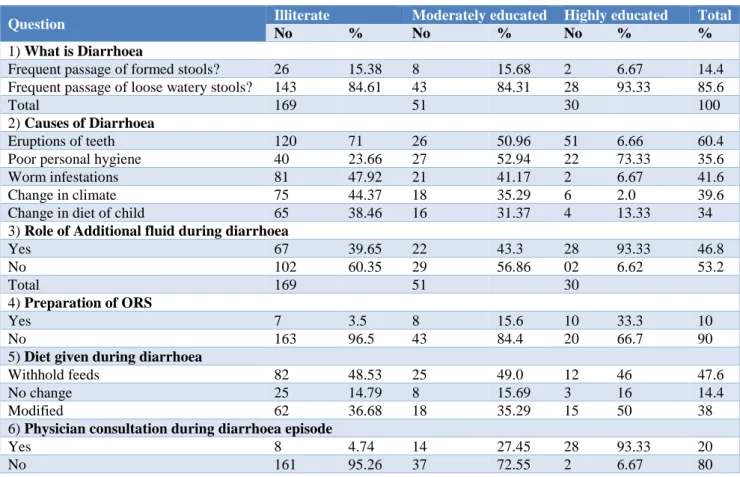
Out of 250, mothers intervened 214 (85.6%) were of opinion that frequent passage of loose s watery stools in diarrhoea whereas only 36 (14.4%)considered frequent passage of formed stools diarrhoea.
Knowledge regarding causes of diarrhoea out of 250 mothers-151 (60.4%) considered emphasis of teeth on a cause of diarrhoea, 35.6% considered poor personal hygiene, 39.6% change in weather and 34% considered change in diet as causes of diarrhoea.
Table 3:Questionnaire to assess knowledge of mother on various aspects of diarrhoea.
Question Illiterate Moderately educated Highly educated Total
No % No % No % %
1) What is Diarrhoea
Frequent passage of formed stools? 26 15.38 8 15.68 2 6.67 14.4 Frequent passage of loose watery stools? 143 84.61 43 84.31 28 93.33 85.6
Total 169 51 30 100
2) Causes of Diarrhoea
Eruptions of teeth 120 71 26 50.96 51 6.66 60.4 Poor personal hygiene 40 23.66 27 52.94 22 73.33 35.6 Worm infestations 81 47.92 21 41.17 2 6.67 41.6 Change in climate 75 44.37 18 35.29 6 2.0 39.6 Change in diet of child 65 38.46 16 31.37 4 13.33 34
3) Role of Additional fluid during diarrhoea
Yes 67 39.65 22 43.3 28 93.33 46.8
No 102 60.35 29 56.86 02 6.62 53.2
Total 169 51 30
4) Preparation of ORS
Yes 7 3.5 8 15.6 10 33.3 10
No 163 96.5 43 84.4 20 66.7 90
5) Diet given during diarrhoea
Withhold feeds 82 48.53 25 49.0 12 46 47.6
No change 25 14.79 8 15.69 3 16 14.4
Modified 62 36.68 18 35.29 15 50 38
6) Physician consultation during diarrhoea episode
Yes 8 4.74 14 27.45 28 93.33 20
No 161 95.26 37 72.55 2 6.67 80
Among total 250 mothers 46.8%agree to fact that there is role of additional fluid during episode of diarrhoea and only 10% mothers know how to prepare ORS, whereas 90% were unaware, 20% mothers considered visiting to physician was required during episode of diarrhoea.
Attitude of mother was assessed regarding seriousness of diarrhoea illness in child a prevalence of sex distribution, if any as shown in Table 4.
Out of 250 mothers ,186 (74.4%) were mothers of male children and 64 (25.6%) were of female children with not much difference as per sex wise distribution.
In present study, children who are exclusively breastfeed are of illiterate mothers. It can be seen that mothers had
firm belief that no diet to be given during diarroheal episodes.
Table 4:Attitude of mothers towards childhood diarrhoea.
Seriousness of disease Illiterate Moderately Literate Highly Educated Total %
No % No % No %
Serious illness 18 10.65 20 39.2 22 73.33 24 Usual childhood illness 26 15.38 19 37.25 8 26.67 21.2 Minor illness 125 73.96 12 23.53 0 0 54.8
Table 5:Various practices of mothers of diarrhoeal diseases.
General practices Illiterate
Moderately educated mother
Highly educated
mother Total
No % No % No %
Feeding habits
Exclusive breastfeed 52 33.55 4 18.18 3 7.64 30.41 Bottle feeding 103 64.45 18 81.82 14 82.36 69.59
Diet changes during diarrhoea
No change 5 2.9 8 15.68 6 20 7.6
Modified (like khichdi, curd, banana) 62 36.68 8 15.68 15 5 34
DISCUSSION
Diarrhoea is a major cause of under 5 childhood mortality and morbidity in developing nations. Overall, the steady decline in under five mortalities is laudable in developing nations however innovations are still required at various levels.5 Diarrhoea is multifactorial in origin. As mother is
a key figure responsible for child care during illness, this study was conducted therefore on maternal knowledge, attitude and practices among mothers of children of diarrhoea under five years of age. Total 250 mothers were included in the study with prior informed consent and question were asked as per preformed questionnaire and vernacular language and English too.
In present study, it was observed that maximum number of diarrhoea causes 77.76% were seen in first year of life and there was higher incidence (74.4%) among male children.
Incidence of diarrhoea was 67.6% among children of illiterate mother in contrast to 12% among a mother of having higher qualification.
Similar findings observed in a study conducted in ethiopion in their study it was observed that maternal education and literacy levels were directly proportionate to level of maternal awareness.6 In another study, done in
Tanzania similar results were achieved.7
In present study only 10% mother had knowledge about proper preparation of oral rehydration solution (ORS). In similar study done in India 18% of subjects had adequate
awareness of ORS.8 These studies suggest a profound
lack on ORS and its utilisation. Oral Rehydration therapy (ORT) with Oral Rehydration solution ORS remains the cornerstone of appropriate case management of diarrhoeal dehydration, but it was observed that in India there is a big gap between knowledge and practise as reflected by poor ORS usage rates (43%).9 Therefore
consistent efforts should be made to emphasize on ORS and its importance.
In present study, 34% mother considered change in diet as main cause of diarrhoea followed by 60.4% as teething. Similar study done in Nigeria revealed than 35% mothers were aware of contaminated food and water as etiological agent and 39% in teething.10
In present, 30.41% of children were given exclusive breastfeeding whereas 69.59% were bottle fed. 58.4% withhold feeding during episode of diarrhoea whereas 7.6% gave diet with no change.
In a study done in India, it was observed that 88% of mothers restricted children diet during diarrhoea, whereas in study by kolahi et al. 60% of mothers discontinue breast and top feeding both during diarrhoeal episode.
CONCLUSION
focus on symptoms of dehydration, knowledge on ORS, hoe to prepare an ORS, prevention on danger sign and diseases.
Funding: No funding sources Conflict of interest: None declared
Ethical approval: The study was approved by the Institutional Ethics Committee
REFERENCES
1. Bassani DG, Kumar R, Awasthi S, Morris SK. Causes of neonatal and child mortality in India. A Nationally representative mortality survey. Lancet. 2010;376:1853-60.
2. Lodha R, Shah D. Prevention of rotavirus diarrhoea:is vaccination the only strategy. Indian Pediatr.2012;49(6):441-3.
3. Pahwa S, Kumar GT, Toteja GS. Performance of community-based health and nutrition education intervention in management of diarrhoea in a slum of Delhi, India. J Health Popul Nutr.2010.28 (6);553-9.
4. Alkizim F, Matheka D, Murithi A. Childhood diarrhoea, failing conventional measures, What’s next? Pan Afr Med J 2011;8(1):47.
5. Bhan MK. Accelerated progress to reduce under-5 mortality in India. Lancet Glob Health. 2013;1(4):e172-3.
6. Kersela T, ASFAW M, Belachew C. Knowledge and practice of mother/ caretakers towards diarrhoea and its treatment in rural communities in Ethiopia. Ethiop Med J.1991;29(4):213-4.
7. Mwambete KD, Joseph R. Knowledge and perception of mother and childhood diarrhoea and its management in Temeke Municipality; Tanazania. Tanzan J Health Res.2010;12(1):47-54
8. Rishi RK, Bodakhe SH, Tailang M. Patterns of use of oral rehydration therapy in Srinagar (Garhwal), Uttaranchal, India. Tropical Doc. 2003 Jul;33(3):143-5.
9. Mumbai: IIPS;2007. International Institute for Population Sciences and Macro International. National Family Health Survey (NFHS-3)2005-6: India.
10. Adimora GN Ikepena AN, Ilechukwu G. Home management of childhood diarrhoea need t, identify campaign. Niger J Clin Pract. 2011;14(2):237-41.