JOURNAL OF LANGUAGE AND LINGUISTIC STUDIES
ISSN: 1305-578XJournal of Language and Linguistic Studies, 13(1), 10-26; 2017
Effects of morphological awareness on second language vocabulary knowledge
Fatma Demiray Akbuluta*
aAbant Izzet Baysal University, Bolu, Turkey
APA Citation:
Akbulut, D. F. (2017).Effects of Morphological Awareness on Second Language Vocabulary Knowledge.Journal of Language and Linguistic Studies, 13(1), 10-26.
Submission Date:22/02/2016 Acceptance Date:11/11/2016
Abstract
This research has analysed the impact of morphological treatment in English morphological awareness task. The main aim of this study is to understand the relationship between morphological awareness and vocabulary knowledge of university preparatory class students. In second language learning environment, fifty-two preparatory class students have participated in this study. The participants have been divided into two groups as experimental and control group. Experimental group was conducted three hours of morphological guideline and morpheme teaching treatment during twelve weeks whereas control group was exposed to traditional vocabulary teaching. To explore the effects of morphological treatment on English vocabulary acknowledgement, all participants completed Nation’s Vocabulary Size Test (2001), language history questionnaire and Morphological Awareness Test (Part A and B). The relationship between the pre-tests and post-tests results has shown that experimental group acquired higher score on vocabulary recognition than control group after thirty-six-hours treatment. These findings indicate that the participants who obtained morphological treatment took in consideration the morphemes and vocabulary items better than the others who took traditional vocabulary teaching procedure.
© 2017JLLS and the Authors - Published by JLLS.
Keywords:Morphological awareness; vocabulary teaching; morphology
1.
Introduction
Vocabulary knowledge is the basis for any language teaching program as well as first language acquisition. In fact, its knowledge plays a very significant role in academic development, literature, second language learning and also daily life. As Nation (2001) proposed, there are four general goals which are important in a language classroom and second language education. These are language, ideas, skills and discourse. Respectively, the first goal, language includes vocabulary and lexical access which have revealed the significance of an adequate number of words to be able to use productively in the target language (Nation, 2001; Read, 2004; Tschirner, 2004; Zimmerman, 2005). The stronger oral vocabulary size means more successful readers because it affects reading and understanding ability (Biemiller and Slonim, 2001).
From this point of views, measuring an individual's vocabulary size may appear to be straightforward, yet it is extremely hard to precisely survey vocabulary information. There have been
numerous appraisals of vocabulary size for distinctive ages, and the sums differ immensely. Vocabulary learning strategies, lexical access models and different methods and techniques to develop vocabulary size and teaching vocabulary items effectively are still interest of lots of scholars or linguists. Recent years, there have been suggestions about using morphological cues to infer the word’s meaning in L2 acquisition (Chang, Wagner, Muse, Chow, and Shu, 2005; Morin, 2003; Schiff and Calif, 2007). As Venezky (1999) proposed English is called as a morphophonemic language because of special relationship between phonology and morphology. Besides phonology, there is also strong relationship among morphology, sentence building, reading and comprehension. As long as individuals who are learning English as a second language realize morphemes in complex words, they may learn and acquire vocabulary items easily.
1.1. Theoretical background
1.1.1.Vocabulary Knowledge and Learning Strategies
All languages have a set of words which is the basis to understand and make sentences (Miller, 1991). Therefore, vocabulary gives us the opportunity to obtain the knowledge, to produce and comprehend the language (Anglin, 1993; Laufer and Nation, 1999). Vocabulary learning is subjectively requesting, consolidating the capacity to guide implications and realistic structures, the capacity to insert words into sentential and talk structures, and the capacity to apply words to this present reality.
This is on the grounds that lexicology in native language or second language convey the fundamental data and furthermore, the learners should understand that knowing more vocabulary will directly affect their capacity to utilize L2 learning capacity. Along these lines, vocabulary can lead the learners to be more decided about utilizing the dialect. Words are the essential bearers of importance, and it is broadly perceived that there is a solid relationship between the individual's vocabulary size and his/her general dialect capability. In this part, word learning mechanisms and strategies are not innate but emergent mechanism (Smith, 1999). Correspondingly, Samuelson and Smith (1998) clarified samples of word learning through memory and consideration and they declared that particular aptitudes for words are unjustified. There are different techniques to learn vocabulary and keep them in long-term memory such as Memory Strategies (MEM), Social Strategies (SOC), Cognitive Strategies (COG), Metacognitive Strategies (MET) and Determination Strategies (DET) (Chang, Wagner, Muse, Chow, and Shu; 2005; Morin, 2003; Schmitt, 1997; Schiff and Calif, 2007) and also various ways such as Experiential learning (Armbruster, Lehr, and Osborn, 2001), memorizing (Levin, Levin, Glasman and Nordwall, 1992), using words repeatedly (Long and Rule, 2004). Besides, direct teaching techniques of vocabulary, learning vocabulary from the context, understanding morphological knowledge to implicit the vocabulary meaning (McKeown, Beck, Omalson, and Perfetti, 1983; Miller, 1991; Nagy and Anderson, 1984; Wysocki and Jenkins, 1987; Zimmerman, 2005) are the ways to teach and learn vocabulary. Thus, morphological vocabulary teaching approach can be seen as a beneficial tool which can help L2 learners to gain unknown lexical items knowledge.
totally comprehended from one experience, but rather a sensible estimate of significance may be picked up by parsing a mind boggling word into its parts.
1.1.2.Morphology
Morphology has vital impact on the development and perception of English words. Morphemes, which incorporate roots, stems, prefixes, and suffixes, are the smallest parts of words that convey significance. Having the capacity to use this moderate level of dialect is integral to building an overwhelming vocabulary and grasping English content. Morphology alludes to the utilization of or the investigation of morphemes, the parts of words that pass on significance. The exact part of morphology differs with every dialect, contingent upon the word arrangement forms utilized as a part of every dialect. It is not in any case sure that there is an all-inclusive part of morphology that applies to all dialects (Libben&Jarema, 2004). In terms of English, morphemes supply the crude materials for making new words, and the dexterity of morphemes gives some portion of the generative force of the English dialect. Numerous new words are promptly reasonable on the grounds that they are made out of well-known morphemes. Kuo and Anderson (2006) recommended that morphological mindfulness is interlaced with different parts of metalinguistic mindfulness and etymological capability, particularly phonological mindfulness, syntactic mindfulness, and vocabulary information. They also added that morphological awareness in English becomes an increasingly important predictor of reading ability. Anglin (1993) suggested that readers can take part in morphological investigation to break down new words into constituent morphemes and in this way build their vocabulary items. In fact, both morphological mindfulness and vocabulary information have as of late risen as imperative indicators (Fracasso et al., 2014 ; Hall et al., 2014 ; Mellard& Fall, 2012 ; Mellard et al., 2010 ; Taylor et al., 2012 ;Tighe and Binder, 2013, To, Tighe and Binder, 2014 ).
The interest of the present study is to decide whether EFL learners in Turkey obtain the parts of morphological information to understand any reading text and comprehend or guess the meaning of the vocabulary knowledge. Pressley et al. (2007) reported that there was some proof that giving information about morphemes can enhance learner’s capacity to gather the implications of words.
1.1.3.Measuring Morphology Skill
Usage-based methodology would represent the movement of morphology learning, on the grounds that development in morphology information can be seen to parallel the recurrence of the morphemes. More elevated amounts of morphological information have been connected to better perusing capacity in the early evaluations (Carlisle, 2003; Fowler&Liberman, 1995; Nagy et al., 2003; Singson, Mahony, and Mann, 2000).
Morphological comprehension in a worldwide sense is analysed with more exact separation of sorts of morphology ability showing up in later studies. Recent studies specifically concentrated on the acquisition of specific grammatical forms emphasizing morphology.
Morin (2003) proposed the technique of utilizing morphological information to construe word implications, and with it, the need to create morphological mindfulness in the L2. She describes morphological awareness as the capacity to control morphemes and word development rules in a language. In another study, Anglin (1993) found that the learners could investigate the morphological structure of complex words which they have not really learned before to make sense of the implications.
Five different morphological word types in English are identified by Anglin (1993) as root words such as short, closet; inflected words such as smoking, reports; derived words such as shortish, treelet; literal compounds such as sunburn, birthday; and idioms such as pink lady=coctail. In this study, root words and derived words have been used to examine morphological awareness of learners.
1.1.4.Morphological Awareness
Maag (2007) identifies words in two categories such as monomorphemic and multimorphemic words. Monomorphemic words, (e.g, window, elephant) are additionally called as root words. Multimorphemic words, (e.g, suspicious, worthiness), are made out of linked morphemes. The term complex word is regularly utilized as a part of vocabulary studies for multimorphemic word. The researcher adds giving examples like in the words talking, talkative, backtalk, and double-talk, the root word talk is a common morpheme that connects the words semantically. Root words and stems are adjusted by inflectional and derivational morphemes that pass on syntactic and semantic subtle elements. Inflectional changes reflect linguistic elements of words, with changes of tense, person, and number. Word’s class or part of speech do not change according to inflections; for example, chair /chairs, talk /talks /talked /talking. Changes in derivational morphology permit a root word or stem to involve different word classes, as in obvious (adjective), obviousness (noun), obviously (adverb). It incorporates information of derivational morphology, for example, prefixes (e.g., the dis-in disorganized to demonstrate the antonym of the first, organized), additions (e.g., the –er in seller to show a person who sells), and compounding (e.g., airplane to produce one word combining two words; air and plane). Then again, learning of inflectional morphology concentrates essentially on showing linguistic changes in words such as talk and talked. It was supposed that if a learner knows one word form, he/she can understand the other part of speech meanings (Nurhemida, 2007).
1.2. Research Questions
Morphological awareness alludes to the attention to and access to the importance and structure of morphemes that are a piece of or identified with the word. In this study, the relationship between morphological awareness and vocabulary knowledge will be investigated for Turkish participants by emphasizing the focus on vocabulary teaching in the classroom. In this study, two sets of research questions were addressed:
1. Does morphological awareness contribute to vocabulary teaching and learning process in the classroom?
2. Does teaching vocabulary with morphological awareness strategy help learners to enlarge their vocabulary knowledge?
2.
Method
In line with the theoretical framework presented beforehand, this study aims to investigate the role of morphological awareness in teaching vocabulary effectively. In this part, after participants have been presented, the pilot study and the instruments used in this study, the treatment which has been applied in the classroom and the results of the study will be contributed.
2.1. Sample / Participants
This study is supposed to analyse morphological awareness while learning vocabulary on undergraduate students of preparatory school in a state university in Turkey. They were originally 55 participants; however 3 people were dropped from the study because of missing data.
Students were enrolled in two different classes on the same level. Their level of English language was tested at the beginning of the semester by “Proficiency and Placement Test” applied by School of Foreign Languages Department. They were regular intermediate level English learners without learning disabilities. They had 5 hours of English language class every day, including listening, speaking, reading, writing, and Use of English classes. They had vocabulary practices inside Listening and Reading classes during 3 hours each week. Furthermore, with regard to Oxford Quick Placement Test, level of proficiency of the participants is intermediate level (M=44.75 out of 60). Participants from two classes were divided into an experimental group and a control group. The experimental group (N=29) was provided with morphology and vocabulary based teaching as a treatment. They were instructed prefixes, suffixes and root knowledge. Furthermore, they were given vocabulary teaching activities with collocations, synonyms and morphological analysis of words. On the other hand, control group (N=23) took traditional vocabulary teaching on the basis of note-taking, memorizing Turkish equivalents of English words, showing pictures, and using dictionary. Unlike control group, experimental group had to spend more time on learning and memorizing vocabulary items with different activities and exercises.
Table1. Descriptive statistics of participants
N Minimum Maximum Mean Sd
Age 52 17.00 25.0 19.00 1.7601
Age-of-acq 52 1.00 25.0 9.98 4.1135
Highschool-l2 52 .00 4.0 3.17 1.3243
College-l2 52 2.00 4.0 2.09 .3575
Reading 52 1.00 9.0 6.44 1.7310
Writing 52 1.00 9.0 6.13 1.5969
Speaking 52 1.00 8.0 4.55 1.4199
Speech-comp 52 1.00 9.0 5.40 1.4315
Express-yourself 52 1.00 10.0 5.55 2.0428
Vocabulary-knowledge 52 2.00 3.0 2.57 .4988
Reading-ability 52 1.00 3.0 2.23 .6749
Hours-of-reading 52 1.00 4.0 1.59 .7735
OxfordQuickPlacement Test (out of 60)
52 42 57 44.75 .3467
valid n (listwise) 52
2.2. Pilot Study
In this research, pilot study with 22 participants were applied to see the instruments’ reliability and validity measuring. For internal validity testing, “equivalence between pre- and post-tests” factor was analysed to see the frequency level of two lists (pre and post) of vocabulary items (each list consists of 38 words). Similarly, for measuring instrument reliability of questionnaire, and pre-post-tests “equivalence of forms of a test” was used. After this study, correlation coefficient was calculated and after some changes in the vocabulary lists, the last design has been used in the study. For this purpose, exploratory and confirmatory factor analysis was performed by statistics experts and internal consistency by Cronbach alpha coefficient was calculated. According to the results, internal consistency coefficient for Morphological awareness† pre-test (.87) and post-test (.79) respectively. The obtained data from the participants was analysed and instruments were used after bringing them their final shapes as applicable.
2.3. Instruments
This study is based on experimental research and the data have been observed quantatively. Control group design has been applied and pre-test/post-test design has been used to measure the effect of treatment. Both groups have taken the same pre-test and post-test but they haven’t had the same treatment between these tests. In this research, all participants have been given a pre-test (Nation’s Vocabulary Level Test and Morphological Awareness Test- Part 1) to be sure of comparability of both groups before their treatment and a post-test (Nation’s Vocabulary Level Test –another version and Morphological Awareness Test- Part 2) to measure the effects of this treatment. Since this study is based on vocabulary knowledge and morphological awareness, to avoid any constraint to measure the real effect, immediate effect of treatment has been evaluated.
†
2.3.1.Nation’s Vocabulary Level Pre-test (2001)
The vocabulary level test was taken from Nation’s Vocabulary Level Test and used in this research to decide participants’ level of vocabulary size before and after treatment. The pre-test is divided into 3 as 2.000, 3.000, 5.000 word level. In each section, there are 10 different parts in which 6 different vocabulary items and 3 different meaning or synonyms. The participants are supposed to choose the correct item and write the number of each as in the example.
e.g.
1. business
2. clock _6_part of a house 3. horse _3_animals with four legs 4. pencil _4_something used for writing 5. shoe
6. wall
For each participant groups, there were no significant differences between vocabulary sizes of the participants. Experimental group received the score of 40.22; while control group received 41.17 (t = .21, p = .79).
Table 2. Paired Samples Statistics of Experimental Group and Control Group (Nation’s Vocabulary Level Pre-Test)
Paired Samples Statistics
N Mean sd t p
Pair 1
EG 29 40.22 7.42
3.44 0.79
CG 23 41.17 6.14
EG: Experimental Group CG: Control Group
2.3.2. Morphological Awareness Pre-test, Part 1 (A and B)
Morphological Awareness Test, Part 1 was presented to the participants. In this task, there are 38 high and low frequency vocabulary items and they would decide whether they know the meaning of these words and write Yes or No on the sheet. After answering Part A, they would switch to Part B and in this part; participants were instructed to find the root of each vocabulary items given with prefixes, suffixes or both. For instance, as the word “international”, they have been expected to find the right answer as b.nation as root of the word.
e.g. International a. inter b. nation c. national,
2.3.3.Treatment
Table 3. Paired Samples Statistics of Experimental Group and Control Group (Morphological Awareness Test)
Paired Samples Statistics
N Mean sd t df p
Pair 1
Pre-test EG-correct 38 18,815 6,268
2.143 37 0.039 Pre-test CG-correct 38 18,000 5,457
Pre-test EG-correct: Correct answers of Experimental Group for Pre-test Pre-test CG-correct: Correct answers of Control Group for Pre-test
Vocabulary teaching was performed during 12 weeks for both groups. Experimental group was instructed 3 hours of morphology (prefix, suffix and root) knowledge each week and in total, they took 36 hours of morphological instruction. Moreover, they were given vocabulary teaching activities including word parts (nouns, adjectives, adverbs etc...), collocations, synonyms, antonyms, and practices about morphological analysis of words. On the other hand, control group took traditional vocabulary teaching activities including dictionary (English-English, English-Turkish) usage for unknown words, memorizing Turkish equivalents of English words, basic note-taking activities, showing pictures etc...In total, they were given vocabulary instruction 3 hours each week and in total 36 hours during 12 weeks, similarly to experimental group. Immediately after the instruction period, both groups were conducted the Vocabulary Level Test and Morphological Awareness Tests (see also 2.3.4, 2.3.5). Finally, after the data were collected, the results were analysed by the help of paired-samples t-test in SPSS-17.
2.3.4.Nation’s Vocabulary Level Post-test (2001)
Nation’s Vocabulary Level Post-test has been used to measure the comparison of pre-test applied prior to treatment. This test contains 140 vocabulary items and requires to find the closest meaning of the key words given in the multiple choice questions as in the example.
e.g. RESTORE: It has been restored. a. said again
b. given to a different person c. given a lower price d. made like new again
The participants would be expected to answer the choice of “d” in this example.
2.3.5.Morphological Awareness Post-test, Part 2 (A and B)
After the treatment, Morphological Awareness Test Part 2 (A and B) was presented to all participants. In part A, they would decide whether they know the meaning of the words but this time they will see distinct 38 vocabulary items. These words were in high and low frequency mixture as in pre-test but different. In Part B, similarly to Pre-test Part B, participants were demanded to find the root of each vocabulary items given with prefixes, suffixes or both again.
the types of instructions to be provided to respondents who were asked to complete a survey. This section should also contain a realistic timetable for the different phases of the study.
3.
Results and Discussion
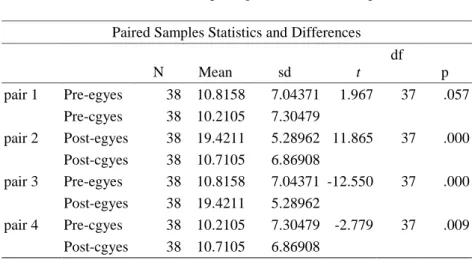
This study was used to test the hypothesis whether increasing morphological awareness of second language learners leads to larger vocabulary knowledge or not. Teaching vocabulary items in terms of prefixes, suffixes or roots helps learners to keep their vocabulary knowledge in long-term memory. The results were based on vocabulary pre-and post-test items including morpheme categories such as prefixes and suffixes. Experimental and control group took these two tests. The findings obtained from pre-tests-part A for both groups showed that there were significant differences between both groups (Experimental Group -Eg afterword-): M= 10.81, SD= 7.04; Control Group -Cg, afterword-): M= 10.21, SD= 7.30) ((t (37) = 1.96, p =0.057, r=0.96). Similarly, Part B results for both groups showed no significant differences between them (Eg: M= 18.81, SD= 6.26; Cg: M= 18.00, SD= 5.45) ((t (37) = 2.14, p =0.039, r=0.92). Prior to treatment, these results show that the vocabulary performance of both groups were similar to each other (see also Table 4 and 5).
Table 4. Results of morphological awareness test-part A
Paired Samples Statistics and Differences
N Mean sd t
df p pair 1 Pre-egyes 38 10.8158 7.04371 1.967 37 .057
Pre-cgyes 38 10.2105 7.30479
pair 2 Post-egyes 38 19.4211 5.28962 11.865 37 .000 Post-cgyes 38 10.7105 6.86908
pair 3 Pre-egyes 38 10.8158 7.04371 -12.550 37 .000 Post-egyes 38 19.4211 5.28962
pair 4 Pre-cgyes 38 10.2105 7.30479 -2.779 37 .009 Post-cgyes 38 10.7105 6.86908
Table 5. Results of morphological awareness test-part B
Paired Samples Statistics and Differences
N Mean sd t
df p pair 1 Pre-egcorrect 38 18.8158 6.26813 2.143 37 .039
Pre-cgcorrect 38 18.0000 5.45745
pair 2 Post-egcorrect 38 24.2895 3.63101 8.116 37 .000 Post-cgcorrect 38 17.4737 5.18697
pair 3 Pre-egcorrect 38 18.8158 6.26813 -6.769 37 .000 Post-egcorrect 38 24.2895 3.63101
pair 4 Pre-cgcorrect 38 18.0000 5.45745 .394 37 .696 Post-cgcorrect 38 17.4737 5.18697
=0.000, r=0.75) (Part B; Eg: M=24.28; SD= 3.63; Cg: M= 17.47, SD= 5.18) ((t (37) = 8.11, p =0.000, r=0.75). As seen from the results, experimental group had higher scores after treatment than control group who took traditional vocabulary teaching.
As for the paired samples group analysis, both groups have been identified in terms of pre-test and post-test comparison to see in their own groups. According to the statistics, while experimental group had a significant difference between test and post-test for Part A and B instruments (PART A, pre-test: M= 10.81, SD= 7.04; post-pre-test: M= 19.42, SD=5,28) ((t (37) = -12.5514, p =0.000, r=0.80), (PART B, pre-test: M= 18.81, SD=6.26, post-test: M=24.28, SD=3.63) ((t (37) = -6.76, p =0.000, r=0.60) control group showed no significant differences between these tests before or after treatment (PART A, pre-test: M=10.21, SD=7.30; post-test: 10.71, SD=6.86) ((t (37) = -2.77, p =0.009, r=0.99), (PART B, pre-test: M=18.00, SD=5.45, post-test: M= 17.47, SD= 5.18) ((t (37) = 0.39, p =0.696, r=-.19) (see also Table 4 and 5).
These results show that morphological instruction and teaching morphemes increased second language learners’ vocabulary comprehension and made them recognize vocabulary items intentionally and incidentally.
According to the results, there has been a significant relationship between vocabulary size and morphological awareness. Students in experimental group, performed significantly better in the Morphological Structure measure. One possible reason is that the vocabulary treatment during 12 weeks was sufficient for their general English proficiency. Students in control group didn’t show any significant differences between before and after treatment. There is an improvement in their general vocabulary size; however, possible reason for this development is that their general English proficiency with other skills improved during 12 weeks, one semester. Another reason may relate to the nature of students’ exposure to English with native speaker instructors and authentic English environment in Preparatory School. This background knowledge and improvement may help them to increase morphological structure knowledge. Supporting the results of the correlational analysis, the improvement of learners in morphology motivated them to learn more vocabulary items and this improvement made the learners realize that learning English vocabulary and morphology was interesting.
4. Conclusion
The current study investigated the vocabulary size of preparatory school students in Turkey, the nature of their morphological awareness and vocabulary size relationship.
The basic contribution of this research is the procurement of morphological approach in vocabulary teaching, and it explains the advantages of it by using short-period treatment. Morphological guideline for vocabulary learning in second language learners has shown that almost no development in remembering and identifying vocabulary items for participants who took traditional vocabulary instruction was observed. In particular, morpheme teaching based learning environment modifies word knowledge and recognition process. The outcomes suggest that morphological guideline alters the vocabulary acknowledgment process; along these lines, it is capable of affecting vocabulary learning.
Utilizing a morphological technique helps the arrangement of a precise mental model and is not only useful for vocabulary acknowledgment but also helpful to improve reading ability, comprehension competency, writing development (by finding needed vocabulary items) and understanding speech production.
To sum up, the findings revealed that the learners had better performance at the Nation’s Vocabulary Level Test at the end of the treatment. However, experimental group had better performance at the same test than control group. The results of the learners in experimental group were significantly better than the learners in control group who did not take any morphological vocabulary teaching treatment. In addition, the current study also found that there was a significant relationship between morphological awareness and vocabulary size.
The findings of this research emphasized a must to give the needed attention to the development of vocabulary size for better understanding in target language in Turkey. The results on the Nation’s Vocabulary Level Test and Morphological Awareness Test revealed the aspects of vocabulary teaching and learning methods and techniques. According to the results, it can be concluded that morphological awareness tasks may contribute to vocabulary teaching and can be placed in English language teaching pedagogy and curriculum. In the classroom environment, the instructors may give explicit instruction and then learners can build their own morphological knowledge so that they can analyse the morphological structure of a new vocabulary item automatically.
This research revealed some considerable findings for the development of English vocabulary knowledge in Turkey. On the other hand, there are some weaknesses and limitations that should be considered for future research. The main problem was that this study is limited to only one state university. The performance scores gathered from the students may be different in another preparatory school in Turkey. The curriculum may be different in another university and the results may also differ from other students in a different environment and city because it could be difficult to access English in their surroundings. Another problem was that the treatment was limited to 12 weeks and this period may not be efficient for preparatory class learners. The instruments were also limited to only two tests (Nation’s Vocabulary Level Test and Morphological Awareness Test) to measure vocabulary size. There should be other instruments that can be used during treatment (12 weeks) for each 4 weeks and the improvement should be observed step by step, until the semester finishes. Finally, future studies should focus on background vocabulary knowledge of learners more effectively with other instruments, ensuring that the test results depend upon morphological awareness. Besides, it is necessary to consider the treatment period more systematicallyand effectively, for example by clarifying the four-week-periods with different measurements. This analysis and separation will help researchers to see whether participants may perform differently or equally in each time limit and section.
References
Anglin,J. M. (1993). Vocabulary development: A morphological analysis. Monographs of the Society for Research in Child Development, Serial No. 238, 58(10).
Apel, K., Diehm , E., & Apel, L. (2013). Using multiple measures of morphological awareness to assess its relation to reading.Topics in Language Disorders,33 ( 1 ), 42 – 56.
Biemiller A., &Slonim, N. (2001). Estimating root word vocabulary growth in normative and advantaged populations: Evidence for a common sequence of vocabulary acquisition. Journal of Educational Psychology, 93(3), 498–520.
Carlisle, J. F. (2003). Morphology matters in learning to read: A commentary. ReadingPsychology, 24, 291–322.
Chang, C. M., Wagner, R. K., Muse, A., W.-Y., B., & Chow, H. S. (2005).The role of morphological awareness in children’s vocabulary acquisition in English.AppliedPsycholinguistics, 26, 415–435. Deacon, S.H., & Kirby, J.R. (2004). Morphological awareness: Just “more phonological?” The roles
of morphological and phonological awareness in reading development.Applied Psycholinguistics, 25, 223–238.
Fowler, A. E., &Liberman, I. Y. (1995).The role of phonology and orthography in morphological awareness.In L. B. Feldman (Ed.) Morphological aspects of languageprocessing (pp. 157– 188).Hillsdale, NJ: Erlbaum.
Fracasso , L.E. , Bangs , K. , & Binder , K.S . (2014). The contributions of phonological and morphological awareness to literacy skills in the Adult Basic Education population. Journal of Learning Disabilities.Advance online publication.
Hall, R., Greenberg , D., Laures-Gore, J. , &Pae, H.K. ( 2014 ). The relationship between expressive vocabulary knowledge and reading skills for adult struggling readers.Journal of Research in Reading,37 (S1), S87 – S100.
Herman , J. , Gilbert Cote , N. , Reilly , L. , & Binder , K.S. ( 2013 ). Literacy skill differences between adult native English and native Spanish speakers. Journal of Research and Practice for AdultLiteracy, Secondary, and Basic Education,2 (3), 147 – 155.
Kirby, J., & Bowers, P. (2012). Morphology works. Research Monograph 41. Retrieved from
http://www.edu.gov.on.ca/eng/literacynumeracy/inspire/research/ww_morphology.pdf
Kuo, L. & Anderson, R. C. (2006). Morphological awareness and learning to read: A cross language perspective. Educational Psychologist, 41, 161–180.
Laufer, B., & Nation, P. (1999).A vocabulary-size test of controlled productive ability.Language Testing, 16, 33 - 51.
Levin, J. R., Levin, M. E., Glasman, L. D., & .Nordwall, M. B. (1992). Mnemonic vocabulary instruction: Additional effectiveness evidence. ContemporaryEducational Psychology, 17, 156-174.
Libben, G., &Jarema, G. (2004).Conceptions and questions concerning morphological processing.Brain and Language, 90, 2–8.
Long, D., & Rule, A. C. (2004).Learning vocabulary through morpheme word family object boxes.Journal of Authentic Learning, 1, 40-50.
Maag , L. K . (2007). Measuring morphological awareness in adult readers: Implications for vocabulary development (Unpublisheddoctoral dissertation) .University of Florida, Gainesville.
McKeown, M. G., Beck, I., Omanson, R. C., &Perfetti, C. A. (1983). The effects of long-term vocabulary instruction on reading comprehension: A replication. Journal of Reading Behaviour, 15, 3–18.
Mellard, D. F., &Fall, E. (2012). Component model of reading comprehension for adult education participants.Learning DisabilityQuarterly,35 (1 ), 10 – 23.
Mellard , D.F. , Fall , E. , & Woods , K.L. ( 2010 ). A path analysis of reading comprehension for adults with low literacy.Journal of Learning Disabilities,43 ( 2 ), 154 – 165.
Muse , A.E . (2005). The nature of morphological knowledge (Unpublished doctoral dissertation) . Florida State University, Tallahassee.
Miller, G. A. (1991). The Science of Words.New York: Scientific American Library.
Morin, R. (2003). Derivational morphological analysis as a strategy for vocabulary acquisition in Spanish.The Modern Language Journal, 87, 200-221.
Nagy, W. E., & Anderson, R. C. (1984). How many words are there in printed school English? Reading Research Quarterly, 19, 304–330.
Nagy, W., Berninger, V., Abbott, R., Vaughan, K., &Vermeulen, K. (2003).Relationship of
morphology and other language skills to literacy skills in at-risk second-grade readers and at-risk fourth-grade writers.Journal of Educational Psychology, 95, 730–742.
Nagy, W., Berninger, V. W., & Abbot, R. D. (2006).Contributions of morphology beyond phonology to literacy outcomes in upper-elementary and middle-school students.Journalof Educational Psychology, 98, 134–147.
Nation, I. S. P. (2001).Learning vocabulary in another language.Cambridge: Cambridge University Press.
Nurhemida,(2007). The relationship between morphological awareness and English vocabulary knowledge of Indonesian senior high school students.Unpublished master’s thesis, University of Queensland, St Lucia, Australia.
Pressley, M., Disney, L., & Anderson, K. (2007).Landmark vocabulary instructional research and the vocabulary instructional research that makes sense now. In R. K. Wagner, A. E. Muse, & K. R. Tannenbaum (Eds.), Vocabulary acquisition: Implications for reading comprehension (pp. 205– 232). New York: Guilford Press.
Read, J. (2004). Research in Teaching Vocabulary.Annual Review of Applied Linguistics, 24, 146-161. Samuelson, L. K., & Smith, L. B. (1998). Memory and attention make smart word learning: An
alternative account of Akhtar, Carpenter and Tomasello. Child Development, 69, 94–104. Schiff, R., &Calif, S. (2007). Role of phonological and morphological awareness in L2 oral word
reading.Language Learning, 57(2), 271–298.
Schmitt, N., & McCarty, M. (1997).Vocabulary Description, Acquisition and Pedagogy. Cambridge: Cambridge University Press.
Smith, L. B. (1999). Children's noun learning: How general learning processes make specialized learning mechanisms. In B. MacWhinney (Ed.),The emergence of language, (pp. 277– 303). Mahwah, NJ: Erlbaum.
Taylor , N.A. , Greenberg , D. , Laures-Gore , J. , & Wise , J. ( 2012 ). Exploring the syntactic skills of struggling adult readers.Readingand Writing,25 (6), 1385 – 1402.
Tighe , E.L. , & Binder , K.S. ( 2013 ). An investigation of morphological awareness and processing in adults with low literacy.AppliedPsycholinguistics: Advance online publication.
To , N.L. , Tighe , E.L. , & Binder , K.S . (2014). Investigating morphological
awareness and the processing of transparent and opaque words in adults with low literacy skills and in skilled readers . Journal of Research in Reading.Advance online publication.
Tong , X. , Deacon , S.H. , Kirby , J.R. , Cain , K. , &Parrila , R. ( 2011 ).
Morphological awareness: A key to understanding poor reading comprehension in English. Journal of Educational Psychology,103 (3), 523 – 534.
Tschirner, E. (2004). Breadth of vocabulary and advanced English study: An empirical investigation. Electronic Journal of Foreign Language Teaching, 1 (1), 27-39.
Venezky, R. (1999). The American way of spelling. New York: Guilford Press. Wysocki, K., & Jenkins, J. R. (1987).Deriving word meanings through morphological
generalization.Reading Research Quarterly, 22, 66–81.
Zimmerman, K. (2005). Newly placed versus continuing students: comparing vocabulary size.TESL Reporter, 38(1), 52 - 60.
Appendix A. Morphological awareness test (pre-test, part A and B)
Part A. Do you know the meaning of the word?
E.g. interesting __√__Yes _____ No intervention _____Yes ___√_ No
yes no yes no
1. apparently 20. dependable
2. international 21. discovery
3. neighbourhood 22. enduring
4. commendable 23. unhealthy
5. passionately 24. unemployment
6. reserved 25. renewable
7. discredited 26. composition
8. explanatory 27. publication
9. generosity 28. indecision
10. politely 29. bravery
11. frustrating 30. mysterious
12. stimulation 31. inspiration
13. satisfactorily 32. protestation
15. fascinated 34. operationalize
16. distraction 35. responsibility
17. irrelevantly 36. irritating
18. expensively 37. entertainment
19. incomparable 38. commercial
Part B.
In each line, the word in
bold
font was formed from one of the words on the right. Select the
letter of the word on the right which is the basis for the
bold
word.
Examples:
__
c
__ teacher
a. tea b. each c. teach
__a__
undamaged
a. damage b. dam c. aged
a
b
c
1. apparently parent rent appear
2. international inter nation national
3. neighbourhood neighbour hood neigh
4. commendable commend mend mendable
5. passionately pass passion passionate
6. reserved reserve reservation serve
7. discredited disc credit edited
8. explanatory explain plane planetary
9. generousity genre gender generous
10. politely politic polite politics
11. frustrating rating frustrate rate
12. stimulation stimulate emulate emulations
13. satisfactorily satisfy factor factory
14. smelly smell melt smelling
15. fascinated fascine fascinate fascination
16. distraction distract ration action
17. irrelevantly irrelevant relevant relevantly
18. expensively expend pensive pens
19. incomparable compare comp comparable
20. dependable depen depend able
21. discovery disco cover discover
22. enduring ring during endure
23. unhealthy unhealth healthy health
24. unemployment employ employer employment
25. renewable newable renew new
26. composition position compose sition
27. publication publicity public publicy
28. indecision incision decide indecent
29. bravery raver very brave
30. mysterious myster mysteri mystery
31. inspiration spirited inspire ration
32.protestation station testate protest
33.attractive tract attract attraction
35.responsibility response responsible sibilate
36.irritating irritate ritate irritation
37.entertainment enter entertain attainment
38.commercial comm mercial commerce
Appendix B. Morphological awareness test (post-test, part A and B)
Part A.
yes no yes no
1. prescription 20. inventory
2. indigestion 21. industrial
3. multicultural 22. recycling
4. freedom 23. adjustment
5. participatory 24. provocation
6. knowledgeable 25. civilisation
7. miserable 26. uncomfortable
8. dishonesty 27. investigate
9. disorganised 28. robbery
10. imagination 29. suspicious
11. immaturity 30. obviousness
12. nationality 31. endangered
13. addressing 32. enjoyment
14. encourageously 33. impossibility
15. independent 34. intercontinental
16. compensation 35. objectionable
17. prestigious 36. truthfully
18. commentator 37. undoubtedly
19. liberation 38. incompetitively
Part B.
a b c
1. prescription prescribe scribe scription
2. indigestion digestion digest indigest
3. multicultural culture multi cultural
4. freedom freed freely free
5. participatory participate party participation
6. knowledgeable knowledge ledge know
7. miserable misery able serable
8. dishonesty dishonest honest honesty
9. disorganised organisation disorganize organise
10. imagination imaginary aginate imagine
11. immaturity immature mature maturity
12. nationality rational nation national
13. addressing dress address dressing
14. encourageously courage encourage courageous
15. independent depend dependent pen
16. compensation comp compensate sensation
17. prestigious prestige pretty restigious
18. commentator commend comment mentator
20. inventory invent ventory inven
21. industrial industry dust rial
22. recycling recyc cycle cycling
23. adjustment just adjust justment
24. provocation prove vocation provoke
25. civilisation civil lisation civilisa
26. uncomfortable comfort fortable table
27. investigate invent vestigate invest
28. robbery rob robber bery
29. suspicious suspicy suspect picious
30. obviousness obvious viousness viously
31. endangered danger endanger dangerous
32. enjoyment joy joyful enjoyable
33. impossibility possible imposs sibility
34. intercontinental inter continent continental
35. objectionable reject jection object
36. truthfully true truth full
37. undoubtedly undoubt doubt doubted
38. incompetitively competition competitive compete
İkinci dil sözcük bilgisinde biçim birimsel farkındalığın etkileri
Öz
Bu çalışma İngilizce biçimbirimsel farkındalık görevi kapsamında biçimbirimsel yaklaşımın etkilerini analiz etmektedir. Çalışmanın asıl amacı üniversite hazırlık sınıfı öğrencilerinin biçimbirimsel farkındalık ve sözcük bilgileri arasındaki ilişkiyi anlamaktır. İkinci dil öğrenme ortamında, elli iki hazırlık sınıfı öğrencisi çalışmada yerini almaktadır. Katılımcılar deney grubu ve kontrol grubu olmak üzere iki gruba ayrılmışlardır. Kontrol grubunda geleneksel sözcük öğretim yöntemi uygulanırken, deney grubunda on iki hafta boyunca, haftada üç saat, biçimbirimsel ilkeler ve biçimbirim öğretim çalışmaları temel alınmıştır. İngilizce sözcük bilgisindeki biçimbirimsel yaklaşımın etkilerini araştırmak amacıyla tüm katılımcılar, Nation’ın Sözcük Bilgisi Testi (2001), dil geçmişi sormacası ve biçimbirimsel farkındalık testini (Bölüm A ve B) tamamlamışlardır. Ön test ve son test sonuçları arasındaki ilişki, deney grubunun otuz altı saat boyunca maruz kaldığı yaklaşımın ardından kontrol grubuna göre sözcük tanıma ve bilgi düzeyinde daha yüksek sonuçlar elde ettiklerini göstermektedir. Bu bulgular, biçimbirimsel açıdan sözcük öğretimi yapılan katılımcıların biçimbirimleri ve sözcükleri geleneksel sözcük öğretim sürecine maruz kalan katılımcılardan daha iyi bir şekilde edindiklerini göstermektedir.
Anahtar Sözcükler:Biçimbirimsel farkındalık; sözcük öğretimi; biçimbirim
AUTHOR BIODATA