S H O R T R E P O R T
Open Access
A comparison of the responsible drinking
dimensions among underage and legal drinkers:
examining differences in beliefs, motives,
self-efficacy, barriers and intentions
Adam E Barry
1*, Michael L Stellefson
1and Conrad L Woolsey
2Abstract
Background:To date, scholarly discourse over the Amethyst Initiative has primarily debated the relative effectiveness of the 21 year-old Minimum Legal Drinking Age (MLDA). Unfortunately, this discourse has failed to account for the Amethyst Initiative’s central tenet/mission:facilitating responsible drinking among college students. This investigation seeks to help fill this gap by quantitatively determining whether a random sample of underage (n= 158) and legal (n= 298) drinkers differed with regard to their alcohol-related behaviors, responsible drinking behaviors, and responsible drinking beliefs.
Findings:Compared to legal drinkers, underage drinkers reported: (a) significantly less confidence to perform responsible drinking behaviors during their next drinking episode [t(446) =−2.97,p< .003;d=−0.297], (b) significantly more perceived barriers to responsible drinking [t(388) = 3.44,p< .001;d= .368], and (c) significantly lower behavioral intentions to perform responsible drinking behaviors the next time they consumed alcohol [t(437) =−3.45,p< .001; d=−0.350]. Each of these differences remained statistically significant, even after controlling for sex and race, in three separate multiple linear regression models.
Conclusion:While college students both above and below the 21 year-old MLDA have similar beliefs regarding what constitutes responsible drinking, students below the current MLDA have less intention to drink responsibly regardless of their behavioral beliefs and/or motives. College/university administrators should consider the negative repercussions that are possible if underage students who are less confident in their ability to drink responsibly are given the legal right to drink on campus.
Keywords:Alcohol, Underage drinking, Responsible drinking, College, Amethyst initiative, Minimum legal drinking age
Debate over the United States’ minimum legal drinking age (MLDA) has recently erupted [1-4]. Despite epi-demiological data linking the current MLDA of 21 with reduced alcohol-related mortality, morbidity, and traffic crashes [5-8], a substantial number of university chancel-lors and presidents have signed a public statement seeking informed, dispassionate discourse over the 21 year-old MLDA [9]. Referred to as the Amethyst Initiative, this proposal supports a series of educational and policy level
efforts to enable 18–20 year old adults to purchase, possess, and consume alcoholic beverages at their own discretion.
To date, discourse over the Amethyst Initiative has primarily revolved around the relative effectiveness of the 21 year-old MLDA. This focus seems counterpro-ductive for several reasons. First, it is difficult to dispute the efficacy of the MLDA [8]. Second, focusing on the policy’s effectiveness fails to spotlight the Amethyst Ini-tiative’s core mission: facilitating responsible drinking among college students. There is a dearth of literature investigating differences in how underage and legal drinkers practice and/or conceptualize responsible
* Correspondence:[email protected] 1
Department of Health Education & Behavior, University of Florida, P.O. Box 118210, Gainesville, FL 32611, USA
Full list of author information is available at the end of the article
drinking behavior(s) specifically, yet studies have ex-plored other aspects of responsible drinking among col-lege students [10-12]. Consequently, this investigation seeks to quantitatively determine whether underage and legal drinkers differ on their alcohol-related behav-iors, and responsible drinking beliefs, motives, self-efficacy, barriers and intentions.
Methods
A random sample of college students attending a large, Southwestern, four-year public university were asked to voluntarily complete a web-based survey in an uncon-trolled setting (e.g., on a respondent’s home computer). Respondents were selected from a master list obtained from the university registrar that contained contact information (name and e-mail) for all enrolled under-graduate students. The survey took approximately 20 minutes to complete. Respondents were made aware that they would be entered into a lottery drawing for an MP3 player to incentivize participation. All procedures were vetted and approved by the university’s Institu-tional Review Board (protocol #2006-0428).
Measures
Alcohol-related behaviors
Most Recent Drinking Episode assessed how many alco-holic drinks were consumed the last time in a social set-ting with alcohol. Respondents typed in the number of drinks they consumed during this event. Binge Drinking assessed how many times respondents consumed five or more alcoholic drinks at a sitting within the past two weeks. Nine possible response options ranged from‘0’to ‘9 or above’.
Responsible drinking
The Characteristics of Responsible Drinking Survey (CHORDS) [13] assessed several responsible drinking di-mensions, including one’s behavioral beliefs, motivations, self-efficacy, barriers, and behavioral intentions regard-ing the responsible consumption of alcohol (see Barry & Goodson [13] for more detailed psychometric informa-tion and item wording).
Behavioral Beliefs(α= .82) were assessed using 8 items that measured behaviors ranging from drinking and driving, to maintaining a blood alcohol concentration (BAC) below the legal limit (0.08%). Response options includednever: not important to do when drinking any alcohol (0);seldom: would be nice to do but not neces-sary (1); some of the time: only when it is possible (2); most of the time: should try to do this (3); or always: must do this every time he/she drinks any alcohol, no matter what (4).
Motivations (α= .86) were determined using 21 items assessing the extent to which various intrapersonal (e.g.,
religious convictions), interpersonal (e.g., desire not to upset significant others or parents), and other context-ual factors (e.g., having to drive home, work- and school-related obligations) facilitate responsible drinking. Response options included (0) never, (1) seldom, (2) some of the time, (3) most of the time, or (4) always.
The 8-item Self-efficacy scale (α= .87) assessed per-ceived confidence in performing each of the actions outlined in the Behavioral Beliefs scale described above. Self-efficacy was measured using a scale from 0% (having no confidence) to 100% (extremely confident), with respondents given the option to select their level of confidence for each alcohol behavior in 10% incre-ments (i.e., (1) 10% confident, (2) 20% confident, (3) 30% confident, etc.).
The Barriers scale (α= .91) encompasses 16 items which examine circumstances (e.g., felt depressed or stressed) and contextual factors (e.g., recently broken-up with a significant other, an attractive person wanted to buy you a drink) that could impede someone from drinking responsibly. Respondents indicated whether each item would be an obstacle to drinking responsibly (0) never, (1) seldom, (2) some of the time, (3) most of the time, or (4) always.
The 8-item Behavioral Intentions scale (α= .84) assessed the likelihood of performing the actions out-lined in the Behavioral Beliefscale. Specifically, respon-dents indicated whether they were (0) not likely at all, (1) seldom likely, (2) somewhat likely, (3) likely, or (4) extremely likely, to perform responsible drinking behav-iors, the next time they chose to drink.
Handling missing data
Only a small percentage of respondents had missing data on any of the subscales (2.0% ofBehavioral Beliefs, 5.0% of Motivations, 1.3% of Self-Efficacy, 6.8% of Barriers, and 3.5% of Behavioral Intentions). Respondents with incomplete data did not differ from those with fully completed surveys with regards to: sex [t(457) = .194, p= .846], age [t(454) =−.797, p= .426], Greek (fraternity/ sorority) status [t(453) =−.807, p= .420], full-time stu-dent status [t(456) =−.445, p= .656], binge drinking status [t(455) = .172, p= .864], or the number of days in which alcohol was consumed in the past 30 days [t(457) = .900,p= .369]. Consequently, incomplete sur-veys were retained for analysis.
Data analysis
significant were further explored in multiple linear re-gression models, controlling for sex and race/ethnicity.
Results
459 self-identified underage (n= 158; 35%) and legal (n= 298; 65%) drinkers completed the web-based sur-vey. Participants were primarily full-time students (93%) who were Caucasian (79.3%) and female (54.5%), with a mean age of 22 years (SD = 5.47 years). Approxi-mately 11% of respondents were members of a fraternity or sorority, and the majority (78%) resided in off-campus housing or an on-campus residence hall (18%). There was an equal representation (~ 18% per each year in school) across all student classifications (e.g., freshmen, sopho-more). Both gender and ethnic distributions of those surveyed were comparable to the institutional popula-tion from which the sample was drawn (47% female, 73% Caucasian, 11% Hispanic, 4% Asian, and 3% Black). Table 1 reports mean differences in alcohol consump-tion and responsible drinking beliefs and behaviors among underage and legal drinkers. Underage drinkers (M= 4.44, SD = 2.95) and legal drinkers (M= 4.10, SD = 3.29) con-sumed similar amounts of alcohol the last time they were in a social situation [t(450) = 1.09, p= .277]. Likewise, underage drinkers (M= 1.44, SD = 1.73) and legal drinkers (M= 1.26, SD = 1.88) reported comparable rates of binge drinking [t(452) = 1.02, p= .310]. Compared to legal drinkers (M= 7.18, SD = 2.06), however, underage drinkers (M= 6.58, SD = 1.96) reported significantly less
self-efficacy to perform responsible drinking behaviors during their next drinking episode. The magnitude of difference (i.e., effect size) in self-efficacy (mean difference =−.60; 95% CI: -.99 to -.20) was relatively small, however (Cohen’s d=−0.297). Underage drinkers (M= 1.57, SD = .79) also reported significantly more perceived barriers to re-sponsible drinking compared to their of-age counter-parts (M= 1.27, SD = .80). The magnitude of difference in barrier means between groups (mean difference = .29, 95% CI: .13 to .46) was medium (Cohen’sd= .368). Moreover, compared to legal drinkers (M= 2.57, SD = .83), underage drinkers (M= 2.29, SD = .78) also reported significantly lower behavioral intentions to perform responsible drinking behaviors the next time they consumed alcohol
Table 1 Differences in alcohol consumption and responsible drinking beliefs and behaviors among underage and legal drinkers
Constructs Underage
drinker Legal drinker
t df p-value Cohen’sd
Alcohol-Related Behaviors
Most Recent Drinking Episode
4.44 4.10 1.09 450 .277 – (2.95) (3.29)
Binge Drinking 1.44 1.26 1.02 452 .310 – (1.73) (1.88)
Responsible Drinking Beliefs & Behaviors
Behavioral Beliefs
2.68 2.75 −1.10 445 .272 – (.68) (.68)
Motivations 2.06 2.07 -.10 411 .924 – (.63) (.62)
Self-Efficacy 6.58 7.18 −2.97 446 .003 -.297 (1.96) (2.06)
Barriers 1.57 1.27 3.44 388 .001 .368 (.79) (.80)
Behavioral Intentions
2.29 2.57 −3.45 437 .001 −0.350 (.78) (.83)
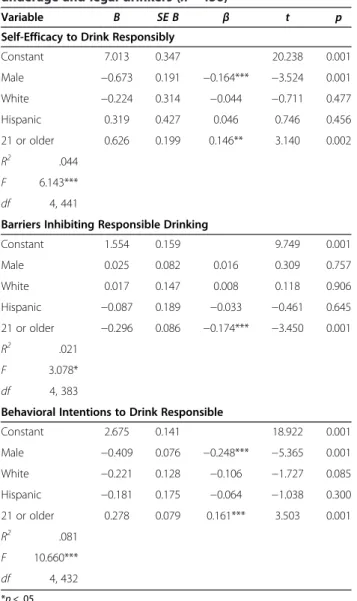
Table 2 Multiple linear regression analyses predicting responsible drinking self-efficacy, barriers & intentions in underage and legal drinkers (n= 456)
Variable B SE B β t p
Self-Efficacy to Drink Responsibly
Constant 7.013 0.347 20.238 0.001 Male −0.673 0.191 −0.164*** −3.524 0.001 White −0.224 0.314 −0.044 −0.711 0.477 Hispanic 0.319 0.427 0.046 0.746 0.456 21 or older 0.626 0.199 0.146** 3.140 0.002
R2 .044
F 6.143***
df 4, 441
Barriers Inhibiting Responsible Drinking
Constant 1.554 0.159 9.749 0.001 Male 0.025 0.082 0.016 0.309 0.757 White 0.017 0.147 0.008 0.118 0.906 Hispanic −0.087 0.189 −0.033 −0.461 0.645 21 or older −0.296 0.086 −0.174*** −3.450 0.001
R2 .021
F 3.078*
df 4, 383
Behavioral Intentions to Drink Responsible
Constant 2.675 0.141 18.922 0.001 Male −0.409 0.076 −0.248*** −5.365 0.001 White −0.221 0.128 −0.106 −1.727 0.085 Hispanic −0.181 0.175 −0.064 −1.038 0.300 21 or older 0.278 0.079 0.161*** 3.503 0.001
R2 .081
F 10.660***
df 4, 432
(mean difference =−.28, 95% CI: -.44 to -.12, Cohen’s d=−0.350). No statistically significant differences were reported between groups on responsible drinking be-havioral beliefs or motivations.
Table 2 presents findings from three separate multiple linear regression models, each of which examined the re-lationship between legal drinking status and the three statistically significant responsible drinking dimensions in Table 1 (i.e., self-efficacy, barriers, intentions). In all three models, legal drinking status predicted each re-sponsible drinking dimension to a statistically significant degree, above and beyond sex and race/ethnicity. In regards to barriers to responsible drinking, only legal drinking status (β=−.17) was statistically significant, such that the number of factors inhibiting responsible drinking decreased with a one unit increase in the inde-pendent variable (i.e., moving from underage to over the MLDA). For both responsible drinking self-efficacy (β= .15) and behavioral intentions (β= .16), going from underage to over the MLDA resulted in greater confi-dence and increased intention to demonstrate respon-sible drinking behavioral beliefs.
Discussion
Despite a lack of empirical evidence suggesting that lower-ing the MLDA will curb blower-inge drinklower-ing among college stu-dents, [14] the Amethyst Initiative continues to attract supporters and attention [15]. Underage drinkers in our sample reported a significantly greater number of factors that would inhibit their ability to drink responsibly as com-pared to students over the MLDA. Underage students also reported significantly less self-efficacy and lower intentions to engage in responsible drinking behaviors the next time they consumed alcohol. While college students both above and below the MLDA have similar beliefs regarding what constitutes responsible drinking, those below the current MLDA have less intention to drink responsibly regardless of their behavioral beliefs and/or motives. While we cannot make definitive claims about potential changes in drinking behaviors, or responsible drinking beliefs and behaviors, of 18–20 year olds if the MLDA were lowered, our findings do illustrate noteworthy differences in responsible drinking dimensions among illegal and legal college student drinkers. Other research suggests that college students who endorse a personal responsibility to obey the current MLDA of 21 are in the minority [16], and heavier and riskier drinkers are more likely to contend the MLDA should be lower than their lighter drinking peers [17]. Future research therefore, should further explore potential causal effects of the pro-posed MLDA reduction among college students.
Conclusion
Current evidence suggests that age-based restrictions on access to alcohol have substantial impact on alcohol
consumption, such that the MLDA clearly reduces alco-hol consumption and its associated harms [18]. Granting increased access to alcohol by lowering the MLDA could lead to increased rates of drinking and subsequent alcohol-related consequences [19]. For example, after New Zealand lowered its MLDA from 20 to 18, there were substantial increases in alcohol-related hospitaliza-tions [20]. Recent system models simulating lowered MLDA changes also suggest“pessimistic”outcomes result-ing from theAmethyst Initiative, including an increased so-cial availability of alcohol (campus wetness) that will likely overshadow any anticipated benefits stemming from allow-ing those 18 and older to consume alcohol legally [21]. Therefore, university chancellors and presidents should strongly consider Fitzpatrick et al.’s [21] warning that, “lowering the current MLDA represents an enormous so-cial experiment with potentially major consequences”(p2).
Competing interests
The authors declare that they have no competing interests.
Authors’contributions
AEB conceptualized the manuscript and prepared the first draft of the manuscript. MLS and CW contributed to the introduction and review of literature. MLS consulted on the statistical analysis. AEB, MLS and CW contributed to the conceptual development of the discussion and conclusion section. Both MLS and CW reviewed the study design, statistical approaches, and each successive draft of the manuscript. All authors contributed to the overall construction of this manuscript, read, edited, and approved the final draft of the manuscript. AEB takes responsibility for the paper as a whole.
Authors’information
The findings reported herein build upon AEB’s previous work, which examined how college students interpret and practice“responsible drinking”. As readers will note, the responsible drinking dimensions reported herein, and elsewhere, echo those of previous investigations focusing on protective behavioral strategies (PBS) drinkers employ to stay safe while drinking. Thus, this manuscript contributes to both the scant literature base focused on responsible drinking, as well as the larger burgeoning literature base focused on harm reduction strategies.
Financial support
This work was supported, in part, by the NIH (NCATS) CTSA awards to the University of Florida UL1TR000064 and KL2TR000065.
Author details 1
Department of Health Education & Behavior, University of Florida, P.O. Box 118210, Gainesville, FL 32611, USA.2Nutrition and Human Performance,
Logan University, Chesterfield, MO 63017, USA.
Received: 18 October 2013 Accepted: 6 January 2014 Published: 22 January 2014
References
1. Babor T:Amethyst initiative vs. animal house: What college presidents can learn from research on the Mediterranean drinking style.San Diego, CA: Presented at the annual meeting and expo of the American Public Health Association; 2008.
2. Muhlenfeld E:Seeking a drinking age debate.University Business 2008:53–54.
4. Wechsler H, Nelson TF:Will increasing alcohol availability by lowering the minimum legal drinking age decrease drinking and related
consequences among youths?Am J Public Health2010,100(6):986–992. 5. McCartt AT, Hellinga LA, Kirley BB:The effects of minimum legal drinking
age 21 laws on alcohol-related driving in the United States.J Safety Res 2010,41:173–181.
6. O’Malley PM, Wagenaar AC:Effects of minimum drinking age laws on alcohol use, related behaviors and traffic crash involvement among American youth: 1976–1987.J Stud Alcohol Drugs1991,52(5):478–491. 7. Voas RB, Tippetts AS, Fell JC:Assessing the effectiveness of minimum legal drinking age and zero tolerance laws in the United States.Accid Anal Prev2003,35(4):579–587.
8. Wagenaar AC, Toomey TL:Effects of minimum drinking age laws: Review and analyses of the literature from 1960–2000.J Stud Alcohol2002, 14:206–225.
9. Amethyst Initiative.Accessed June 12, 2012. Available at: http://www. theamethystinitiative.org/.
10. Barry AE, Howell SM, Dennis M:Evaluating impaired drivers confidence and intention to“(Please) drink responsibly”.J Safety Res2011, 42:137–142.
11. Barry AE, Goodson P:How college student conceptualize and practice responsible drinking.J Am Coll Health2011,59(4):304–312.
12. Barry AE, Goodson P:Contextual and intrapersonal factors influencing college students’decision to drink responsibly.Subst Use Misuse2012, 47:1172–1184.
13. Barry AE, Goodson P:Developing and testing the CHORDS: Characteristics of responsible drinking survey.Am J Health Promot2011,25(6):e11–e21. 14. Rasul JW, Rommel RG, Jacquez GM, Fitzpatrick BG, Ackleh AS, Simonsen N,
Scriber RA:Heavy episodic drinking on college campuses: Does changing the legal drinking age make a difference?J Stud Alcohol Drugs2011, 72(1):15–23.
15. Hambleton L:Experts debate merit of making drinking age 21. The Washington Post2010.
16. Reyna VF, Croom K, Lesser ML, Lewis D, Frank J:Endrosement of a personal responsibility to adhere to the minimum drinking age law predicts consumption, risky behaviors, and alcohol-related harms. Psychol Public Policy Law2013,19(3):380–394.
17. Martinez JA, Munoz Garcia MA, Sher KJ:A new minimum legal drinking age (MLDA)? Some finding to inform the debate.Addict Behav2009, 24:407–410.
18. Carpenter C, Dobkin C:The minimum legal drinking age and public health.J Econ Perspect2011,25(2):133–156.
19. Subbaraman MS, Kerr WC:State panel estimate of the effects of the minimum legal drinking age on alcohol consumption from 1950 to 2002.Alcohol Clin Exp Res2013,37(Suppl 1):e291–296.
20. Conover E, Scrimgeour D:Health consequences of easier access to alcohol: New Zealand evidence.J Health Econ2013,32(3):570–585. 21. Fitzpatrick BG, Scribner R, Ackleh AS, Rasul J, Jacquez G, Simonsen N,
Rommel R:Forecasting the effect of the amethyst initiative on college drinking.Alcohol Clin Exp Res2012,36(9):1608–1613.
doi:10.1186/1747-597X-9-5
Cite this article as:Barryet al.:A comparison of the responsible drinking dimensions among underage and legal drinkers: examining differences in beliefs, motives, self-efficacy, barriers and intentions.Substance Abuse Treatment, Prevention, and Policy20149:5.
Submit your next manuscript to BioMed Central and take full advantage of:
• Convenient online submission
• Thorough peer review
• No space constraints or color figure charges
• Immediate publication on acceptance
• Inclusion in PubMed, CAS, Scopus and Google Scholar
• Research which is freely available for redistribution