Spain
GROWTH
WITH JOBS
StudieS ON
StudieS on Growth with equity
SPAin
StudieS on Growth with equity
SPAin
Growth with JoBS
Copyright © International Labour Organization 2014 First published 2014
Publications of the International Labour Office enjoy copyright under Protocol 2 of the Universal Copyright Convention. Nevertheless, short excerpts from them may be reproduced without authorization, on condition that the source is indicated. For rights of reproduction or translation, application should be made to ILO Publications (Rights and Permissions), International Labour Office, CH-1211 Geneva 22, Switzerland, or by email: [email protected]. The International Labour Office welcomes such applications.
Libraries, institutions and other users registered with reproduction rights organizations may make copies in accordance with the licences issued to them for this purpose. Visit www.ifrro.org to find the reproduction rights organization in your country.
Spain: Growth with jobs/ International Labour Office – Geneva: ILO, 2014 978-92-2-129098-8 (print)
978-92-2-129099-5 (web pdf) International Labour Office
Spain / crisis / employment / unemployment / productivity / competitiveness / labour market policies/ social dialogue / collective bargaining
First published in 2014
Also available in Spanish: España: Crecimiento con empleo (ISBN 978-92-2-329098-6), Geneva, 2014.
ILO Cataloguing in Publication Data
The designations employed in ILO publications, which are in conformity with United Nations prac-tice, and the presentation of material therein do not imply the expression of any opinion whatsoever on the part of the International Labour Office concerning the legal status of any country, area or territory or of its authorities, or concerning the delimitation of its frontiers.
The responsibility for opinions expressed in signed articles, studies and other contributions rests solely with their authors, and publication does not constitute an endorsement by the International Labour Office of the opinions expressed in them.
Reference to names of firms and commercial products and processes does not imply their endorse-ment by the International Labour Office, and any failure to endorse-mention a particular firm, commercial product or process is not a sign of disapproval.
ILO publications and electronic products can be obtained through major booksellers or ILO local offices in many countries, or direct from ILO Publications, International Labour Office, CH-1211 Geneva 22, Switzerland. Catalogues or lists of new publications are available free of charge from the above address, or by email: [email protected]
Visit our website: www.ilo.org/publns
This publication was produced by the Document and Publications Production, Printing and Distribution Branch (PRODOC) of the ILO.
Graphic and typographic design, layout and composition, printing, electronic publishing and distribution.
PRODOC endeavours to use paper sourced from forests managed in an environmentally sustainable and socially responsible manner.
Foreword
In order to achieve a real and sustainable recovery, macroeconomic and employment goals need to be pursued in parallel. This was highlighted by 51 European Governments, Employers’ and Workers’ representatives in the Oslo Declaration adopted by the ILO’s 9th European Regional Conference in April 2013, which stated that “…structural reform and competitiveness, on the one hand, and stimulus packages, investment in the real economy, quality jobs, increased credit for enterprises, on the other, should not be competing paradigms. It is in our common interest to elaborate sustainable approaches in order to promote jobs, growth and social justice”. To that end, the ILO has been analysing the situation in a number of crisis-hit European countries since spring 2013 with a view to investigating and presenting policy options for a sustainable and job-rich recovery.
In different international meetings, including the G20, the ILO has suppor-ted and encouraged a comprehensive approach to the social and economic challenges stemming from the current crisis. The general objective is clear: to combine the pursuit of sound macroeconomic goals with the creation and protection of decent jobs and addressing the needs of the most vulnerable. These issues go to the very centre of the conditions needed to achieve a sus-tainable European currency.
This new ILO report investigates the specific challenges facing Spain in the aftermath of the crisis. The report emphasises that Spain is in the early stages of the recovery process, and that a number of additional measures could be considered to solidify its gains. In order to achieve the objective of “Growth with Jobs”, I hope the report, its findings and the discussions and debate it stimulates will provide useful inputs to the national and European debate on employment and social issues.
Guy Ryder
ACKnowLedGeMentS
Authors of the report
This report has been prepared by Verónica Escudero, Santo Milasi, Clemente Pignatti and Johanna Silvander of the ILO Research Department. The authors are grateful for research assistance provided by Cecilia Heuser, Yi Qu, Phoebe Sam and Rachael Singer. Elva López Mourelo, with assistance from Alberto Gamboa Gamboa, provided timely inputs and verified the translation of the report into Spanish. The team of researchers are also thankful to Miguel Ángel Malo of the Universidad de Salamanca, Spain, and Sameer Khatiwada of the ILO Research Department for impor-tant contributions during the project’s initial phase.
The study has been coordinated by Steven Tobin under the supervision of the Director of the ILO Research Department, Raymond Torres and with guidance from James Howard, Senior Advisor to the ILO Director-General.
A preliminary draft of the report was shared with the Ministry of Employment and Social Security of Spain and with social partners, namely Confederación Española de la Pequeña y Mediana Empresa (Cepyme), Confederación Española de Organizaciones Empresariales (CEOE), Confederación Sindical de Comisiones Obreras (CCOO) and Unión General de Trabajadores (UGT).
The report would not have been possible without the support of the ILO Office for Spain, in particular Joaquín Nieto Sainz, Director of the office in Madrid, and Judith Carreras, Counsellor. Judy Rafferty provided support in relation to the production process of the report.
This final report also takes into consideration many of the comments and feedback on earlier versions received from the ILO Regional Office for Europe and Central Asia, the INWORK Branch of ILO as well as from a number of ILO colleagues. This includes Duncan Campbell, Marva Corley, Carlos André da Silva Gama Nogueira, Natan Elkin, Ekkehard Ernst, Colin Fenwick, Maria Laura Fino, Youcef Ghellab, Susan Hayter, Juan Ramón Iglesias, Sebastian Künzel, Stefan Kühn, Massimiliano La Marca, Wolfgang Lutterbach, Alberto Odero de Dios, Rafael Peels, Giorgio Presidente, Uma Rani Amara, Catherine Saget, Daniel Samaan, Daniel Vaughan-Whitehead, Maria-Luz Vega, and Christian Viegelahn.
tABLe oF ContentS
page
FOREWORD V
ACKNOWLEDGEMENTS VII
TABLE OF CONTENTS IX
LIST OF FIGURES XI
LIST OF TABLES XII
LIST OF BOXES XIII
LIST OF ABBREVIATIONS XIV
EXECUTIVE SUMMARY AND POLICY RECOMMENDATIONS 1
ChAPter 1
economic and labour market performance:
Signs of recovery 15
Introduction 15
A. Macroeconomic trends: A rebound in economic activity 16
B. Labour market performance 24
C. Concluding remarks 36
References 37
ChAPter 2
Productivity and competitiveness:
trends, determinants and possible ways forward 39
Introduction 39
A. Factors underlying the trends in productivity and competitiveness 40 B. Tight credit markets: Effects on investments and employment 50 C. Firms’ demography and business environment 55
D. Policy considerations 62
X
SPAin: Growth with JoBS
ChAPter 3
re-orienting labour market policies
for improved employment and social outcomes 85
Introduction 85
A. Job quality, poverty and labour market polarization: A growing concern 86 B. The role of labour market policies and public employment services in promoting recovery 101
C. Policy considerations 109
Appendix 1: Summary of key reforms in Spain 130
References 140
ChAPter 4
Building recovery through social dialogue and collective bargaining 147
Introduction 147
A. Reviving social dialogue as an enabler of recovery 148 B. Collective bargaining: Recent reform process and preliminary impacts 153
C. Policy considerations 174
References 186
ChAPter 5
towards an employment and social strategy for Spain:
Building consensus, complementarities and the role of the iLo 191
Introduction 191
A. Building an employment and social strategy: Common areas of action 193 B. Implementing an employment and social strategy: The role of social partners and the ILO 198
LiSt oF FiGureS
page Figure 1.1 Real GDP growth, Q1 2007 to Q1 2014 (quarterly year-on-year growth rates, percentage) 17 Figure 1.2 Contribution to GDP growth by main component (year-on-year quarterly growth rate, percentage) 18 Figure 1.3 Share of exports to euro area and non-euro area countries (percentage of total exports) 19 Figure 1.4 Contribution to export growth by type of product in 2013 (annual growth rate, percentage) 20 Figure 1.5 Change in gross fixed capital formation as a percentage of GDP (percentage points) 21 Figure 1.6 Public deficit/surplus and debt as a share of GDP (percentage) 23 Figure 1.7 GDP and employment growth in selected countries
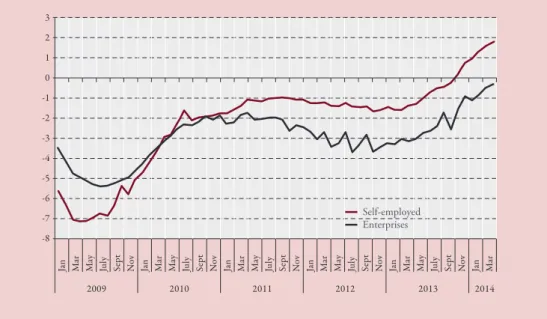
(growth rate over the period 2008–2013, percentage) 25 Figure 1.8 Employment losses by sector (year-on-year change, thousands) 26 Figure 1.9 Dependent employment losses by type of contract (year-on-year change, thousands) 27 Figure 1.10 Share of long-term unemployment in total unemployment (percentage) 30 Figure 1.11 Percentage change in the total number of operating enterprises and self-employed workers
(monthly year-on-year change, percentage) 33 Figure 1.12 Growth rate of employment by industry activity in 2013 (percentage) 34 Figure 2.1 Decomposition of changes in REER between 1999 and 2009 (percentage) 44 Figure 2.2 GDP growth by factor, 2007–2011 (percentage) 45 Figure 2.3 Growth rates of nominal wages in selected countries (year-on-year quarterly growth, per cent) 46 Figure 2.4 Average growth rate of real wages by economic sector (percentage) 48 Figure 2.5 ULC-based REER in selected countries, 2000–2014
(quarterly year-on-year change: Q1 2000 = 100) 49 Figure 2.6 Change in bank credit to non-financial corporations as a percentage of GDP
in selected EU countries, 2003–2013 (percentage points) 51 Figure 2.7 Interest rates on loans to non-financial corporations up to €0.25 million (percentage) 52 Figure 2.8 Access to finance and employment in SMEs, 2009–2011 (percentage points and percentage) 53
Figure 2.9 Enterprise creation 56
Figure 2.10 Survival rates at one and five years after firms’ creation, 2009 and 2011 (percentage) 57 Figure 2.11 Employment growth in newly constituted enterprises, 2011 (percentage) 58 Figure 2.12 Labour market effects of a decrease in bank loan interest rates
Xii
SPAin: Growth with JoBS
Figure 3.1 Number of self-employed, with and without employees, Q1 2008–Q1 2014* (thousands) 92 Figure 3.2 Expenditure in unemployment-related social protection as a share of GDP (percentages) 96 Figure 3.3 At-risk-of-poverty rate by status in 2013 (percentage) 100 Figure 3.4 Expenditure on ALMPs in Spain and selected countries, 2004–2011 102 Figure 3.5 Share of the expenditure by type of ALMP in total ALMP
expenditure in 2004 and 2010 and in the change between 2004 and 2011 (percentage) 105 Figure 3.6 Ratio of active to passive labour market policy expenditure, selected countries, 2004 and 2011 107 Figure 3.7 Relationship between PES staff servicing clients directly and the unemployment rate, 2011 128 Figure 4.1 Duration of ultra-actividad in collective bargaining agreements
(February 2012−April 2014), as a percentage of collective agreements 166
LiSt oF tABLeS
page Table 1.1 Labour market performance in Q2 2014 32 Table 2.1 Comparative performances between firms with and without PE and VC financing 65 Table 2.2 Policy response to improve SMEs’ access to finance across the OECD countries 70 Table 3.1 Incidence of involuntary workers (aged 15−64) in temporary and part-time employment
in selected countries (percentages) 91 Table 3.2 Social protection beneficiaries 99 Table 3.3 Estimated costs of implementing youth guarantee programmes in Europe (millions of euros) 126 Table 4.1 Achievements in tripartite social dialogue in Spain – historical overview 149 Table 4.2 Variation of GDP, inflation and wage increases through collective agreements (percentages) 171 Table 4.3 Evolution of the minimum wage in Spain, 2009–2013 172
LiSt oF BoXeS
page
Box 1.1 Poverty and inequality in Spain 31 Box 2.1 Unit labour cost (ULC) and real effective exchange rate (REER):
Definitions and shortcomings 42
Box 2.2 The regulation of retail trade 59 Box 2.3 The Spanish electricity sector 60 Box 2.4 Starting a business: Spanish regulation in comparative perspective 63 Box 2.5 The role of PE and VC in determining companies’ performances 65 Box 3.1 The 2012 labour market reform in Spain 87 Box 3.2 “Economically dependent self-employed”: a growing phenomenon in Spain 94 Box 3.3 Re-orienting Spain’s suite of labour market programmes:
Guiding principles for consideration 114 Box 3.4 Efficient implementation of youth guarantee programmes 125 Box 4.1 Collective bargaining during the crisis 150 Box 4.2 Spanish social partners’ views on reforms in collective bargaining 169 Box 4.3 Trends in wages negotiated through collective agreements 171 Box 4.4 ILO supervisory mechanisms on collective bargaining 180 Box 5.1 The case for a national employment strategy: The Irish experience 194
XiV
SPAin: Growth with JoBS
LiSt oF ABBreViAtionS
ASCRI Spanish Venture Capital Association (abbreviated in Spanish) ACT Authority for Working Conditions (abbreviated in Spanish)
AENC Bipartite Inter-Confederal Agreement on Employment and Collective Bargaining (abbreviated in Spanish) ALMPs Active Labour Market Policies
CBA Collective Bargaining Agreement
CCOO Confederación Sindical de Comisiones Obreras (Trade Union Confederation of Workers’ Commissions) CEACR Committee of Experts on the Application of Conventions and Recommendations
CEOE Confederación Española de Organizaciones Empresariales (Confederation of Employers and Industries of Spain) CEPYME Confederación Española de la Pequeña y la Mediana Empresa
(Spanish Confederation of Small and Medium-sized Enterprises) CIG Confederación Intersindical Galega (Galician Unions’ Confederation) CPI Consumer Price Index
EFBWW European Federation of Building and Woodworkers EMU Economic and Monetary Union
EPA Spanish Labour Force Survey (abbreviated in Spanish) EPL Employment Protection Legislation
EU European Union
EU-17 European Union of 17 member states EU-28 European Union of 28 member states FOGASA Wage Guarantee Fund (abbreviated in Spanish)
FSC-CCOO Federación de Servicios a la Ciudadanía de CCOO (Citizens’ Service Federation of CCOO) GDP Gross Domestic Product
ICO Instituto de Crédito Oficial
ICT Information and Communications Technology IILS International Institute for Labour Studies ILC International Labour Conference ILO International Labour Organization IMF International Monetary Fund INE Instituto Nacional de Estadística
INSEE Institut National de la Statistique et des Études Économiques IPREM Multi-Purpose Public Income Index
ISCED International Standard Classification of Education ISTAT Istituto Nazionale di Statistica Italiano IT Information Technology
MARF Mercado Alternativo de Renta Fija
MEYSS Ministerio de Empleo y Seguridad Social (Ministry of Employment and Social Security) NEET Not in employment, education or training
OECD Organisation for Economic Co-operation and Development PE Private Equity
PES Public Employment Services PLMP Passive Labour Market Policies REER Real Effective Exchange Rate
REGCON Registro y depósito de Convenios y acuerdos colectivos de trabajo RETA Special System for Self-employed (abbreviated in Spanish) R&D Research and Development
SCF Supply Chain Finance
SEPE Servicio Público de Empleo Estatal (Public State Employment Service) SMEs Small and Medium-sized Enterprises
SMI Inter-occupational minimum wage (abbreviated in Spanish) TFP Total Factor Productivity
TRADE Economically dependent self-employed (abbreviated in Spanish) UGT Unión General de Trabajadores (General Union of Workers) UK United Kingdom
ULC Unit Labour Cost
UPTA Unión de Profesionales y Trabajadores Autónomos (Union of Professionals and Self-Employed Workers) VC Venture Capital
eXeCutiVe SuMMAry And PoLiCy reCoMMendAtionS
The Spanish economy has started to recover from the crisis,
driven mainly by strong export growth ...
The Spanish economy is recovering from both the global financial crisis of 2008 and the sovereign debt crisis that affected the country in 2011. Following ten consecutive quarters of contraction, the economy started to rebound at the end of 2013 and is expected to grow by around 1.5 per cent in 2014. Importantly, the economic recovery has been accompanied by employment gains, with over 200,000 net new jobs created during the first half of 2014.
The economic recovery can be mainly attributed to gains in exports. Indeed, after contracting in 2008 and 2009, exports began to grow in 2010 and with more dynamism in later years. Interestingly, there have been strong gains in exports to non-euro area countries and some emerging countries. For example, in 2013 exports to China and Latin America grew by more than 7 per cent and 13 per cent, respectively.
... but the economic, employment and social repercussions
from the crisis remain significant.
Despite these encouraging developments, the recovery remains bothincom-plete and fragile. Today, the Spanish economy is smaller in size than in 2007 and the average income of Spanish people is 8 per cent lower than in 2007. Moreover, productive investment, at less than 18 per cent of GDP, remains insufficient to sustain future prosperity gains.
Beyond these economic gaps, high unemployment remains the main legacy of the unprecedented recession. Over 4.5 million jobs were lost to the twin crises, or almost one in six of all jobs available in 2007. The unemployment rate, at over 24 per cent, continues to exceed earlier historical peaks. The youth unemployment rate exceeds 50 per cent and ranks the second highest
Executive Summary and Policy Recommendations 2
SPAin: Growth with JoBS
in the European Union, following Greece. Over 60 per cent of jobseekers have been unemployed for more than a year and 42 per cent for more than two years. In early 2014, there were more than 1.8 million jobless house-holds in Spain, one million of which had no income support.
There is therefore a significant risk that many jobseekers will drop out of the labour market. The longer people remain detached from the labour market, the more difficult and costly it is to reintegrate them into employ-ment. This is particularly relevant given that the recovery is being driven by new growth sectors, which requires a shift in skill requirements vis-à-vis pre-crises growth patterns. Also, the twin crises have been accompanied by a significant increase in the risk of poverty, with nearly 20 per cent of the population at risk of poverty in 2013.
Even if the high rate of job creation witnessed in the second quarter of 2014 were to continue, it would still take until 2023 to restore employment to 2007 levels. A complete recovery would take even longer, as more than 200,000 people are expected to enter the workforce over this period. Therefore, while the report welcomes the recent reductions in unemploy-ment, it also highlights the importance of taking further action to ensure there are sustainable improvements in employment and social conditions. In view of the size of the challenge, a comprehensive employment and social strategy may be called for.
A range of measures could be introduced
to help consolidate the jobs recovery. First, actions to nurture
enterprise growth and economic diversification.
These could include, first and foremost, enhanced efforts to establish new foundations for growth, in order to avoid the unbalanced patterns that characterized the pre-crises period. In this regard, the tight bank credit conditions that still prevail represent a major obstacle to the expansion of small businesses, which in turn is constraining productivity gains and the creation of high-quality jobs. Addressing these obstacles is therefore
central to laying the ground for sustainable growth which will allow the labour market to recover. The following measures could be considered in this respect:
• Enhance the functioning of the credit market, especially for small and
medium-sized enterprises (SMEs): The Government has made
consider-able effort to restore access to credit for Spanish enterprises. However, credit conditions remain overly tight, thereby delaying the job recovery as employment-intensive SMEs mainly rely on bank credit for their opera-tions. Beyond the tight credit conditions that presently prevail, there is scope for improving the links between Spanish banks and SMEs. This would facilitate the transition from very small businesses (which are over-represented in Spain) to enterprises of medium size – which in Spain is the main untapped source of productivity gains and high-quality jobs. As the experiences of Germany and Switzerland show, the achievement of a solid network of medium-sized enterprises depends heavily on the abil-ity of banks to develop long-term partnerships and links with innovative entrepreneurs. The constraints that the current banking system represent can only be partly compensated by non-bank financing – which in any case is still underdeveloped in Spain. Improving supply chain finance is also a key area of intervention, as only two out of every ten Spanish firms that sell goods receive their due payments within a month, which makes it difficult for firms to survive. This would go a long way in helping Spanish firms to grow. The UK Government has recently invested £15 million in improving supply chain finance and signed an agreement with some large companies that are committed to improving the information flow between customers and suppliers.
• Ease the administrative and tax burdens on starting and growing a firm: While the rate of creation of new firms in Spain is on par with the rates in other European countries, the conditions and regulations for start-ing a business could nevertheless be improved. For instance, the burden of having to deal with all three levels of government adds unnecessary complexity to start-ups. The legislative requirements for starting a busi-ness could be streamlined to support the emergence of entrepreneurial activities during a time when the macroeconomic outlook is improving.
Executive Summary and Policy Recommendations 4
SPAin: Growth with JoBS
Recently, in France, legislation (Loi de modernisation de l’économie) was eased on a number of fronts for self-employed persons, including by making registration with the national authority easier and introducing tax exemptions for the first three years of operation. It is equally impor-tant that administrative barriers to the growth of small businesses are tackled. In this regard, there is room for smoothing tax thresholds by firm size. If these thresholds are too abrupt the growth of viable small enterprises can be impeded. Likewise, in Spain, advice and assistance for entrepreneurs tends to be front-loaded. What is needed is a support mechanism that enables entrepreneurs to acquire the operational mana-gerial skills required to run and expand a business. Training programmes implemented in other European countries – such as Germany and Italy – have proven particularly effective in this regard.
• Promote productive investment and broaden the industrial base: Stimulating investment is a necessity for supporting economic diversification and productive employment. Given the relatively low levels of investment in technologically intensive industries, the Government could consider introducing tax exemptions on investments in new technology. Similarly, tax exemptions conditional on employment creation or the adoption of green technologies could be introduced. Finally, and as endorsed in the G20 meeting in September 2013, the Government could promote policy interventions to foster finance in order to promote long-term investment by institutional investors – including pension funds and insurers. These have long duration liabilities and can consequently invest in assets with a more distant pay-off horizon. In this regard, financial support from long-term lending institutions, such as the European Investment Bank (EIB), could be further leveraged. This entails strengthening the mechanism of co-funding between EIB’s funds and public resources. For instance, financial support from EIB – which usually covers up to one-third of total financing needs – could be combined with government credit guar-antees with a view to encouraging the participation of private investors in long-term productive investment projects. More fundamentally, the EIB still invests much more resources in low-unemployment countries (even outside the EU) than in crisis-hit areas of the EU. This is an anomaly that needs to be changed urgently. Meanwhile, it would be important to
work closely with the Directorate-General for Employment, Social Affairs and Inclusion (DG EMPL) of the European Commission in an effort to enhance the synergies between European Structural and Investment Funds 2014-2020 and national investment programmes. In this regard, adjusting the front-loading of EU funds may optimize the impact and the effective-ness of public support to investment projects.
Second, a coherent set of measures
to help jobseekers remain in the labour market,
acquire new skills and obtain employment ...
Important as it is, economic recovery alone will not be sufficient to prevent a major drop in labour market participation rates or the emigration of talented people. It is therefore crucial to support participation and upgrade the skills of jobseekers. The Government has undertaken a number of initiatives in this respect, but sustaining these efforts and tailoring them to meet the evolving needs will be central to recovery efforts. Consideration could therefore be given to the launch of a coherent employment policy, which would include the following elements:
• Well-designed active labour market policies: As the economic recovery is still in its nascent phase, it is critical to ensure that workers remain attached to the labour market and retain (and where necessary improve) their skills. This requires improvements in the design of active labour market policies, including better targeting and more frequent contacts with the public employment service and the provision of adequate income support to all jobseekers. Such an approach would provide critical support during periods of structural transformation.
• Targeted hiring subsidies based on skills needs or duration of unemployment: The central measures of the 2012 reform included employment incen-tives targeted towards certain groups (e.g. youth, older workers, women and the long-term unemployed), but the impact of these measures on employment creation has been limited. Efforts are needed to improve the targeting of hiring subsidies. In Belgium, for example, employers who hire workers who have been registered as unemployed for at least a year
Executive Summary and Policy Recommendations 6
SPAin: Growth with JoBS
benefit from reductions in social security contributions. The measure is applied differently for workers in different age groups. For example, by employing a young person aged 27 years or less who does not have a higher secondary diploma, an employer may benefit from up to €1,500 in social security contribution reductions per quarter. In addition, if the young person has been receiving unemployment benefits, the public employment service covers a portion of the worker’s pay.
• Improvements in the design and delivery of training programmes: Training programmes are essential to the recovery process in Spain. Current pro-grammes have enormous potential, but some improvements, guided by international experiences, could improve their effectiveness. In particu-lar, measures to avoid abuse of the system and address the specific needs of unskilled and long-term unemployed are of the upmost importance. As such, training programmes need to be accompanied by a customized provision of services, which matches the skills of the unemployed to the needs of companies. The recent announcement of a comprehensive plan to reform vocational training practices is a welcome initiative in so far as it would enable effective preparation of workers for reintroduction to the labour market. However, more can be done to include the social partners, notably employers, in the design and delivery of training programmes to ensure the measures meet the demands of the economy – as has been done in other countries. Sweden, for example, developed an information technology training programme that actively involved employers, who selected relevant training programmes and also provided work experi-ence opportunities for programme participants. The employment rate of participants in this tailored programme was 20 per cent higher than that of participants in regular training. This high comparative success rate indicates that training tailored to the needs of employers results in a higher chance of the unemployed finding work, because there is more certainty that their skills will be relevant. Similarly, in 2013 the Canadian Government announced the Canada Job Grant, which will enable participants to receive the vocational training necessary for avail-able jobs by putting training decisions into the hands of employers. The Government will contribute up to 10,000 Canadian dollars, while employers are required to contribute one-third of the total costs. Grants
will be for short-duration training provided via eligible third parties, such as community colleges or private trainers. The programme also includes flexible arrangements, such as the potential for small businesses to count a portion of wages towards the employer contribution, so that businesses of any size may participate.
... notably for youth and jobless households ...
Youth have been particularly affected by the crisis, both in Spain and elsewhere in Europe. In this respect, the innovative proposal for a youth guarantee – and other measures to tackle youth unemployment in Europe – by the European Commission and, in particular, DG EMPL in 2012 was a welcome one. In the case of Spain, the announcement of the imple-mentation plan for the youth guarantee scheme is an important milestone. Importantly, the scheme offers a combination of both education and trai-ning opportunities, which is one of the key factors for the success of this type of programme. Implementation could benefit from available knowledge on “what works” in this area – much of which has also been highlighted by DG EMPL – including the following:
• Ensure effective implementation of the youth guarantee scheme: During the implementation phase, Spain could bear in mind the lessons learned from other similar programmes, notably by ensuring: (i) a good balance between active and passive policies, combined with personalized public employment services; (ii) greater resources are made available for public employment services, so they are in a position to operationalize the youth guarantee; and (iii) coherence between programmes, through effective collaboration with social partners.
• Promote the development of apprenticeship programmes: Considerable efforts have been made to reform the apprenticeship system so that the skills acquired in these programmes are aligned with those needed in the labour market. Yet, the incidence of apprenticeships in Spain is less than half the EU average and the issue of skills mismatch persists. To address future skills needs, the Government could consider working together with employers, trade unions and educational institutions to
Executive Summary and Policy Recommendations 8
SPAin: Growth with JoBS
foster greater use of apprenticeships. Finland provides a valuable example in this respect, as the national apprenticeship programme allows students to complete national vocational qualifications through apprenticeship training. On-the-job training constitutes around 70–80 per cent of the programme and it is complemented with classroom teaching. Key ele-ments of success include the use of individual study plans and the exten-sive involvement of the social partners in the definition of the training content. As a result, 71 per cent of the participants in the programme are reported as being employed one year after completion. In Estonia, the content of the training to be provided is specified in the employment contract. Apprenticeships are complemented by other active labour mar-ket interventions and the quality of the training provided by companies is monitored. An assessment of the programme revealed that 50 per cent of the participants were employed after completion and that 70 per cent of these remained in the company where they completed their apprentice-ship.
The high incidence of jobless households should attract more policy atten-tion. Consideration could be given to a special work and income scheme for this group. As in the case of the youth guarantee, this would depend heavily on the availability of an effective public employment service.
... aided by a major overhaul of the public employment service (PES).
Despite various reforms, the PES remains the Achilles heel of labour marketpolicies in Spain. The system is simply not up to the task of providing adequa-te services to jobseekers. A number of sadequa-teps could be considered, notably: • Reinforce PES by raising the number of qualified counsellors: To ensure
that the most vulnerable people (long-term unemployed, youth and con-struction workers) receive support, PES staff need to provide individual counselling through customer segmentation and profiling systems and to become coordinators of personalized career plans. To achieve this, the PES should be better resourced so that staff-to-client ratios can be improved. Germany provides a good example of a well-resourced PES capable of
providing effective service delivery. In 2011, Germany approved measures that allowed the PES to hire additional case workers. This resulted in a law that mandated a staff-to-client ratio of 1:75 for long-term unem-ployed under the age of 25, and 1:150 for persons older than 25. • Modernize PES methods: To improve the performance and reach of PES,
countries in the EU region have modernized the methods used by PES offices. They have automated processes and implemented IT networks to make services more accessible through social media. This allows a link to be created between PES and other organizations, and also between national and regional PES offices, thus enhancing coordination. It also increases accessibility in hard-to-reach areas. Sweden, for example, has used ICT quite successfully to provide kiosks with video links to PES centres to allow face-to-face counselling in rural areas.
• Improve PES accountability and transparency in autonomous communities: Regional PES offices lack incentives to implement activation methods proactively, because that would require an increase in the proportion of the community’s budget allocated to employment services. Some coun-tries in Europe have addressed this issue by increasing the transparency of the actions (or the lack thereof) taken by individual offices, which has the potential to increase regional accountability. For example, in Denmark, a national IT system tracks regional PES progress towards annual goals and minimum activation requirements. The results are then published on the PES website, providing incentives for local poli-ticians and managers to be concerned with the performance of their PES offices.
Third, balanced reforms that facilitate
hiring and boost job quality ...
Labour market polarization has persisted in Spain and despite a recent series of reforms the incidence of temporary employment remains stubbornly high. Moreover, the crises have changed the nature of temporary and part-time employment. Indeed, the number of people in temporary employment because they cannot find a permanent job has tended to increase, and
invo-Executive Summary and Policy Recommendations 10
SPAin: Growth with JoBS
luntary part-time employment is also on the rise, especially among women. Moving forward, it will be important to ensure that the right set of labour market institutions and policies are in place to help workers move from declining to growing sectors and to assist others in reintegrating into the job market – all while being mindful of the need to encourage hiring, pro-mote quality job creation and ensure adequate protection of workers. Improving the protection of temporary workers and making the dismissal system more predictable to both employers and workers would be important in this respect. The Austrian severance pay system provides an interesting case in point in this respect.
This is an area where regular monitoring and evaluation of the various reforms already made is critical for tackling emerging gaps – notably the high incidence of temporary and involuntary part-time work – and for devising new measures.
... increase the coverage of collective agreements ...
Preliminary estimates suggest that the proportion of workers covered by collective agreements has declined. There has also been increased recourse to clauses that allow opting out from collective agreements. At the same time, there are indications that companies use a variety of internal and external flexibility options, notably to substantially modify working conditions at the plant level. The limitation of ultra-actividad seems to have had little effect so far – particularly because the social partners have found solutions to address the issue. Nevertheless, some important gaps in collective bargai-ning regulation have emerged after the limitation of ultra-actividad, notably when the bipartite partners have not been able to renegotiate the agreements that expired. To improve the coverage of collective agreements and facilitate economic adjustment and the creation of high-quality jobs, the following approaches could be considered:
• Improve coverage of workers through quality sectoral agreements and
of industry-level agreements could help to avoid erosion of coverage and ensure transparency of working conditions in the labour market – the manner in which this is achieved should be decided among social part-ners. For instance, in Italy, the recently concluded Pact on Productivity stipulates that sectoral agreements shall guarantee homogenous economic and normative conditions for all industry workers and introduce clear rules for delegation to second-level bargaining as concerns topics that can enhance productivity. Sectoral agreements were also tasked with the duty to ensure that the economic effects are coherent with the general trends in the economy and labour market and with international competition and sectoral developments.
• Monitor derogations to allow for necessary responses to emerging problems: The bipartite partners could develop bargaining modalities to ensure that gaps in collective bargaining regulation do not emerge and that effects of deroga-tions are balanced. In analysing how best to avoid gaps and fragmentation of collective bargaining, the bipartite partners could, for example, consider agreeing on coordination of issues between different bargaining levels and monitoring of derogations and modifications in working conditions, for example by sector. In Germany’s metalworking industry, monitoring of non-application of collective bargaining clauses and internal coordination guidelines were established in 2004. This has reportedly led to bargaining procedures becoming more professional and more transparent, moderating disputes and stimulating substantive discussions.
• Ensure effective representation of bargaining parties: It is important to pay particular attention to appropriate representation in the bargaining proc-ess, through employers or employer organizations on one hand, and trade unions on the other. In this sense, as a long-term objective, social partners should consider ways to improve bargaining capacities at the local level.
... and achieve more balanced
income distribution and avoid further wage cuts.
On average, wages have fallen in nominal terms since 2012, indicating anExecutive Summary and Policy Recommendations 12
SPAin: Growth with JoBS
increased marginally during the first years of the recession – have remained stable since then, implying there has been a reduction in purchasing power. More workers find themselves working at the minimum wage or less, going from an overall 8.9 per cent in 2008 to 11.3 per cent in 2011. This has had a particular impact on women, whose share in this category in 2011 was 16.4 per cent. Furthermore, public sector wages have also been cut.
There are no clear economic grounds for justifying further reductions in labour incomes. Indeed, cost competitiveness has been broadly restored. Further wage cuts would undermine domestic demand, outweighing any possible benefits that could arise in terms of higher exports. With this in mind, the following options could be considered:
• Wage increases as much as productivity gains permit: For effective labour market governance, tripartite monitoring of wage and price develop-ments could help wages to connect with companies’ productivity curves in the long run and allow for sectoral wage coordination. Monitoring of other key issues, such as changes in working conditions and implemen-tation of collective agreements, could allow for appropriate responses through the bipartite or tripartite partners if any undesired phenomena emerge. In addition, EU-level coordination on wage issues could help to provide a basis for a sustainable competitiveness strategy for the whole union.
• Improve data availability and monitor wage and price developments in a
tripartite setting: To ensure that wage negotiations are conducted on the
basis of facts, it is important that there is more comprehensive gather-ing of wage-related data and data on the coverage of workers by collec-tive agreements, taking into account non-application of salary clauses in collective agreements. Further, in addition to data on derogation from collective agreements, which are already being collected, information on substantial modifications of working conditions as carried out by com-panies would be important to capture a more comprehensive picture of the labour market.
Fourth, ensure adequate social protection ...
The Government has recently taken important steps to address income assistance for vulnerable individuals, notably by extending PREPARA Plan indefinitely (having first introduced it in February 2011 as a temporary measure). There is also the Renta Activa de Inserción, which provides a minimum income for long-term unemployed workers aged over 45 who have exhausted their unemployment benefits or unemployment assistance. However, in light of the fact that the employment recovery will take time, the Government could consider bolstering these efforts to ensure there is adequate social protection for the most vulnerable, notably by: (i) raising benefits of these programmes to attenuate the risks of poverty, especially among jobless households; (ii) considering expanding the eligibility criteria of the Renta Activa de Inserción; and (iii) ensuring there are no gaps in coverage, especially for the disadvantaged.
More fundamentally, social protection – notably pensions and the health-care system – has helped to attenuate the social impacts of the crises. It has also played an automatic stabilizer role. And while some aspects of social protec-tion may require reform, notably to reduce any waste and ensure adequate coverage, there are grounds to maintain the main founding principles of social protection, notably its universality, high coverage and affordability.
... and finally, a macroeconomic policy
which accommodates the employment and social strategy.
In some instances, the proposed measures will have fiscal implications.However, a number of recommendations can be accommodated with limi-ted expenditure, simply by shifting resources and changing priorities, e.g. away from subsidies and towards increased emphasis on training. Moreover, spending on labour market policies, e.g. improving PES, can have positive spillover effects on future growth and government resources if they contri-bute to improved employment outcomes. In this respect, spending of this nature cannot be analysed in isolation.
Executive Summary and Policy Recommendations 14
SPAin: Growth with JoBS
If need be, new funding could be secured by closing tax loopholes – facilita-ted by administrative reforms – including addressing undeclared work; and possibly through front-loading resources available from the European Social Fund. More generally, a more medium-term approach to stabilizing public finances that safeguards – and reinforces where necessary – employment and social measures is the best means through which to achieve growth with jobs. Reaching a consensus of this nature will rely heavily on effective social dialogue.
Tripartite social dialogue
is key to this transformation strategy.
Reforms achieved through social dialogue can be both fair and comprehen-sive. Such an approach can increase coherence between economic, employ-ment and social objectives. If Spain is to succeed in the transition to an economy that is more balanced and characterized by quality job growth, effective social dialogue will need to continue to play a prominent role. Some initiatives could be part of this strategy, including:
• Consider the development of a tripartite employment and social monitoring
body: Careful consideration could be given to creating a clearly
man-dated tripartite body to lead the process of strategy development, with a view to ascertaining a comprehensive and balanced approach. With the involvement of key parties in the planning stage, implementation can be expected to be more efficient, and commonly agreed results are more likely to be achieved. Further, once the strategy has been launched, the body could assume a monitoring role (e.g. wage and productivity developments) and give further guidelines for strategy implementation, as necessary. In Ireland, an employment strategy was launched in 2012, after a tripartite drafting process. This strategy is already producing clear results.
• Strengthen the role of the ILO in supporting job-rich recovery: The ILO could provide Spain with its technical expertise and social dialogue sup-port. It could also provide international comparisons of relevance to the work of an employment and social monitoring body, in cooperation with the European Commission as appropriate.
ChAPter 1
eConoMiC And LABour MArKet PerForMAnCe:
SiGnS oF reCoVery
introduCtion
There have been some signs that the Spanish economy is recovering from the financial and economic crisis that first hit the country in 2008. Indeed, GDP growth – while remaining negative – improved throughout 2013 and exports grew faster than in most European countries. Meanwhile, labour market conditions have stabilized since the first quarter of 2013. In particular, job destruction slowed considerably and employment started growing again in a number of industries. Nevertheless, the macroeconomic and labour market situations remained tenuous: strong export performance only partially offset the drop in internal demand and investment, while unemployment, especial-ly among youth, remained among the highest in the advanced economies. Moving forward, efforts are needed to address these issues, otherwise there is a risk that individuals will become permanently detached from the labour market, leading to skills erosion and social exclusion.
This chapter aims to describe the recent developments in macroeconomic and labour market indicators. In particular, section A reviews the trends in aggregate demand and section B presents an analysis of the labour market performance. Finally, section C introduces the rest of the report.
Chapter 1 Economic and labour market performance: Signs of recovery SPAin: Growth with JoBS
16
A
MACroeConoMiC trendS:
A reBound in eConoMiC ACtiVity
GDP growth slowly began to recover in 2013 ...
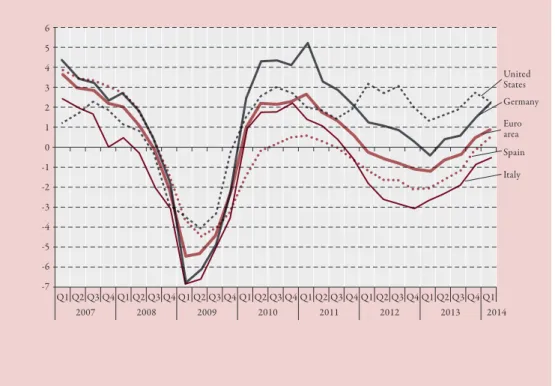
Following the steep contraction of GDP in 2008 – on par with that in other advanced economies – the economic rebound in 2010 and 2011 was much weaker in Spain than in other countries. For instance, while euro area coun-tries grew on average by 1.8 per cent between 2010 and 2011, the rebound in economic activity in Spain was of limited duration and intensity, i.e. GDP grew on average by 0.4 per cent between the third quarters of 2010 and 2011. This left the Spanish economy in a rather vulnerable position when the second recessionary period hit Europe in late 2011. As a result, GDP fell by 2 per cent in 2012 (figure 1.1).
However, the recession slowed considerably during 2013 and reached posi-tive territory at the beginning of 2014. Indeed, the annual GDP growth rate went from –2 per cent in the last quarter of 2012 to 0.5 per cent in the first quarter of 2014. This represents a growth rate just slightly below the euro area average of 0.9 per cent. A number of sectors actually showed some signs of recovery and positive growth, including wholesale and retail trade as well as information and communication activities.
... mainly driven
by positive export performances ...
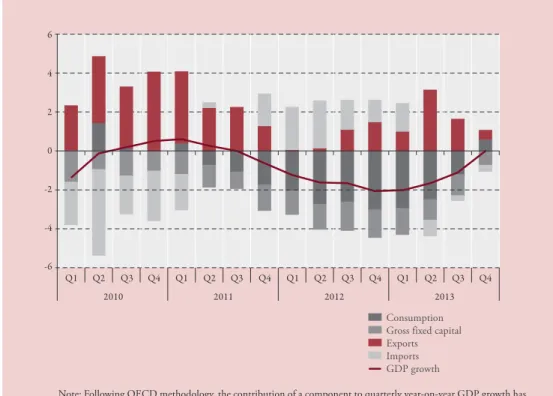
The improvement in GDP growth during 2013 can be mainly attributed to gains in exports, which had already shown a certain degree of resilience during the first phases of the crisis. Indeed, after contracting in 2008 and 2009, export growth has mitigated the negative effect of falling domestic demand and investment (figure 1.2). In particular, exports have recovered more rapidly than in the rest of the euro area, bolstered by external demand from partner countries – notably in the European Union. In particular, the
Source: ILO Research Department, based on OECD statistics.
Figure 1.1 real GdP growth, q1 2007 to q1 2014
(quarterly year-on-year growth rates, percentage)
6 5 4 3 2 1 0 -1 -2 -3 -4 -5 -6 -7
2007 2008 2009 2010 2011 2012 2013 2014
Q1Q2Q3Q4Q1Q2Q3Q4Q1Q2Q3Q4Q1Q2Q3Q4Q1Q2Q3Q4Q1Q2Q3Q4Q1Q2Q3Q4Q1 United States Germany Euro area Spain Italy
volume of exports of goods and services grew by around 5 per cent in 2013, accounting for 1.5 percentage points of the overall GDP growth in that year. As a result, exports increased from 26.9 per cent of GDP in 2007 to 34.1 per cent in 2013, while imports as a share of GDP slightly declined over the same period. This led to the emergence of a positive external bal-ance in 2012 for the first time since the beginning of the 2000s.
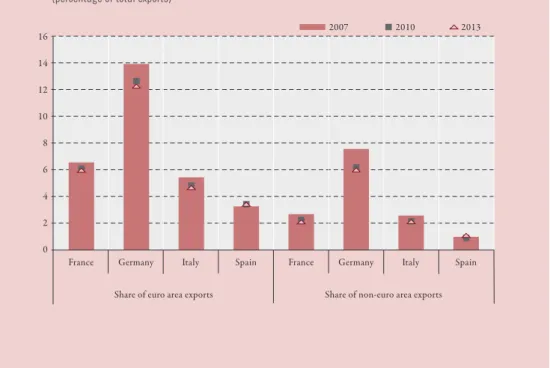
Moreover, Spain has experienced a better performance of its global market share for exports than have other countries, such as France, Germany and Italy. This is true when exports to euro area countries are considered sepa-rately from exports to the rest of the world. Indeed, the share of exports that stay within the euro area has slightly increased in nominal terms, from
Figure 1.2 Contribution to GdP growth by main component
(year-on-year quarterly growth rate, percentage)
Note: Following OECD methodology, the contribution of a component to quarterly year-on-year GDP growth has been calculated as the real growth rate of this component weighted by the share of this component in GDP in the same quarter of the previous year.
Source: ILO Research Department, based on Eurostat.
6 4 2 0 -2 -4 -6
Q1 Q2 Q3 Q4 Q1 Q2 Q3 Q4 Q1 Q2 Q3 Q4 Q1 Q2 Q3 Q4
2010 2011 2012 2013
Consumption Gross fixed capital Exports Imports GDP growth
Chapter 1 Economic and labour market performance: Signs of recovery SPAin: Growth with JoBS
18
3.5 per cent in 2007 to 3.6 per cent in 2013. During the same period, the share of exports to the euro area decreased in Germany, from 14.1 per cent to 12.3 per cent, in France, from 6.9 per cent to 6.2 per cent, and in Italy, from 5.6 per cent to 4.7 per cent. Similarly, the share of exports to non-euro area countries has remained stable in Spain during the recession, while it has decreased for all the main European international partners (figure 1.3). Moreover, very recent trends suggest that Spanish exports to non-EU countries have further increased and consolidated in emerging markets. In particular, exports to Asian and African countries increased by 4.1 per cent and 12.3 per cent, respectively, in 2013. This has been driven by large increases in exports to fast-growing emerging countries, such as China (+7.7%), Israel (+18.7%), Saudi Arabia (+13.4%), South Africa (+28.9%) and Turkey (+5.4%).
Source: ILO Research Department, based IMF Direction of Trade Statistics.
Figure 1.3 Share of exports to euro area and non-euro area countries
(percentage of total exports)
16 14 12 10 8 6 4 2 0
France Germany Italy Spain France Germany Italy Spain
Share of euro area exports Share of non-euro area exports
2007 2010 2013
... concentrated in a number of industries.
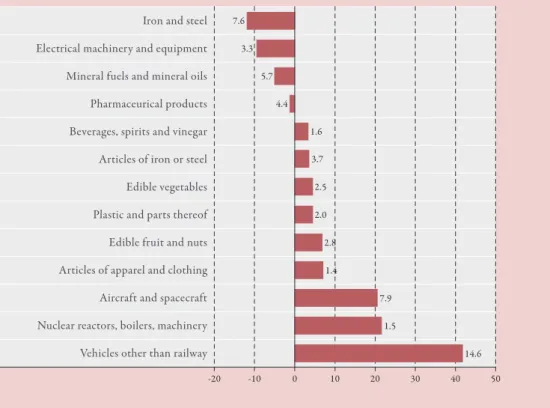
The growth of exports in technology-intensive industries accounted foraround 80 per cent of total export growth in 2013. In particular, industries producing vehicles, nuclear reactors and other machinery – which together accounted for more than 20 per cent of total exports – contributed to more than 60 per cent of total export growth during 2013. Production of aircraft – although representing around 1.5 per cent of total exports – accounted for another 20 per cent (figure 1.4). These data suggest that Spain has been relatively successful in redirecting its export performance towards relatively high-valued-added products, for which competitiveness from emerging countries is lower. However, the pattern of export growth – being mainly focused on a few technology-intensive sectors – has contributed little, at least for the time being, to the recovery in the overall level of employment (see also figure 1.12 in section B of this chapter).
Iron and steel Electrical machinery and equipment Mineral fuels and mineral oils Pharmaceurical products Beverages, spirits and vinegar Articles of iron or steel Edible vegetables Plastic and parts thereof Edible fruit and nuts Articles of apparel and clothing Aircraft and spacecraft Nuclear reactors, boilers, machinery Vehicles other than railway
50
0 10 20 30 40
-20 -10
Figure 1.4 Contribution to export growth by type of product in 2013
(annual growth rate, percentage)
Note: Figures next to the bars represent the share of each product in total exports in 2012.
Source: ILO Research Department, based on the Taric Database of the Spanish Ministry of Industry, Energy and Tourism.
3.3 5.7 7.6
4.4 1.6
2.5 2.0 3.7
2.8 1.4
1.5 7.9
14.6
Chapter 1 Economic and labour market performance: Signs of recovery SPAin: Growth with JoBS
20
Furthermore, among labour-intensive sectors, export performance has been positive in a number of food-related industries. However, the recent improvements in exports have been partially offset by some reductions, especially in certain capital-intensive export sectors, such as those produc-ing mineral fuels, electrical equipment and iron and steel. Also, industries such as pharmaceuticals and the extractives negatively contributed to export growth in 2013 – although they remain an important component of exports in Spain.1
1 Together these sectors accounted for around 10 per cent of total exports in 2013 and between 2008 and 2012 represented almost 20 per cent of total export growth.
Note: Data are seasonally adjusted.
Source: ILO Research Department, based on Eurostat.
Figure 1.5 Change in gross fixed capital formation as a percentage of GdP
(percentage points) 4 2 0 -2 -4 -6 -8 -10 Sp ai n U ni te d S ta tes EU -17 Po rt ug al Ja pan It al y Fr an ce G er m an y Po rt ug al Sp ai n It al y EU -17 Fr an ce Ge rm an y U ni te d S ta tes Ja pan
2007 – 2010 2010 – 2013
However, investment and consumption remain weak ...
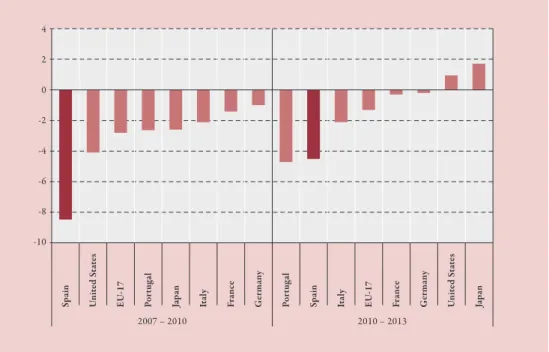
Despite the recent improvements in the economic outlook, gross fixed capital formation as a percentage of GDP declined from 30.7 per cent to 17.7 per cent between 2007 and 2013.2 Most of this reduction took place between 2007 and 2010, when gross fixed capital formation as a share of GDP decreased by 8.5 percentage points (figure 1.5). This represents one of the largest falls in investment among developed countries during this period. For instance, among all EU-17 countries investment declined by less than 3 percentage points of GDP. Moreover, since 2010, investment in Spain has fallen by an additional 4.5 percentage points of GDP, compared with a modest decline of 1.3 percentage points in the EU-17 and strong increases in the case of Japan and the United States (1.7 and 0.9 percentage points, respectively, since 2010).
Chapter 1 Economic and labour market performance: Signs of recovery SPAin: Growth with JoBS
22
Furthermore, household consumption has decreased considerably over the period of the crisis. In fact, average annual household consumption fell by 3.3 per cent, from €18,300 to €17,700 per person (current prices), between 2008 and 2013. This represents one of the highest drops among euro area countries. For instance, in Germany and France, by contrast, household consumption increased over the same period, by 14.3 per cent and 6 per cent, respectively.
... and public finances are under strain,
although fiscal deficits have been declining.
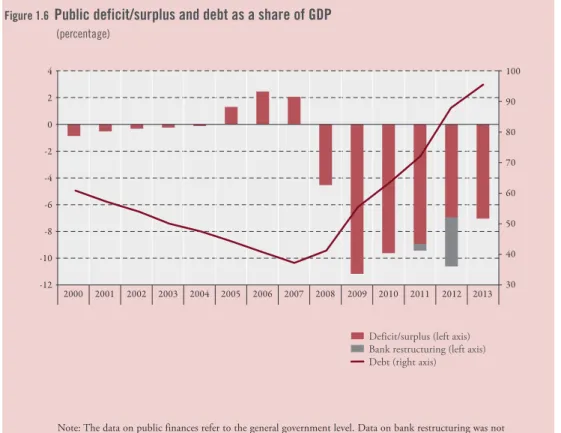
Not surprisingly, public finances have also deteriorated during the crisis,mainly due to the combined effect of increased government spending and reduced government revenues. Indeed, government expenditure increased from 41.4 per cent to 47.8 per cent of GDP between 2008 and 2012. This was mainly due to an increase in expenditure in social protection, which went up from 20.8 per cent of GDP in 2007 to 26.1 per cent in 2011 – see Chapter 3 for additional information. At the same time, government rev-enues decreased sharply in the first phase of the crisis – from 41.1 per cent of GDP in 2007 to 35.1 per cent in 2009 – and, subsequently, increased slightly to reach 37.2 per cent in 2012. This led to an increase in the budget deficit, as well as a steep rise in public debt, also aggravated by the measures implemented for restructuring the banking system as part of the financial assistance programme (figure 1.6).3
3 Information on the share of public deficit expenses directly attributable to the restructuring of the bank-ing sector was provided by the Ministry of Economy and Competitiveness.
Figure 1.6 Public deficit/surplus and debt as a share of GdP
(percentage)
4 2 0 -2 -4 -6 -8 -10 -12
100 90 80 70 60 50 40 30
2000 2001 2002 2003 2004 2005 2006 2007 2008 2009 2010 2011 2012 2013
Deficit/surplus (left axis) Bank restructuring (left axis) Debt (right axis)
However, the fiscal deficit has steadily reduced since 2010 and long-term interest rates on Spanish sovereign bonds have significantly fallen, especially in late 2013. In particular, the fiscal deficit – excluding financial sector costs – fell from 11 per cent of GDP in 2009 to 7.1 per cent in 2013. These measures have also helped to restore confidence in the financial markets, as the long-term interest rate on 10-year government bonds decreased from 5.05 per cent to 3.79 per cent between January 2013 and January 2014.
Chapter 1 Economic and labour market performance: Signs of recovery SPAin: Growth with JoBS
24
B
LABour MArKet PerForMAnCe
The fall in Spanish employment
was one of the steepest across European countries ...
The level of employment in Spain increased steadily during the 1990s and the first half of the 2000s. As a result, the unemployment rate was 8 per cent in 2007, the lowest since 1980. In the aftermath of the 2008 finan-cial crisis, however, Spain experienced one of the sharpest contractions in employment among European countries. In fact, between 2008 and 2013, while employment across the EU-27 decreased on average by 2.9 per cent, the fall in Spain was much steeper, falling 8.9 per cent between 2009 and 2010 and a further 7.4 per cent between 2011 and 2013.
Moreover, the contraction in employment significantly outpaced the fall in GDP. Between 2008 and 2013, GDP dropped by 6.8 per cent, while the fall in employment was almost three times as large – one of the steepest among the major economies. In fact, although several countries experienced a similar GDP contraction after 2008, their drop in employment was con-siderably more contained than that in Spain (figure 1.7).
... due in part to the overreliance
of the economy on the construction sector ...
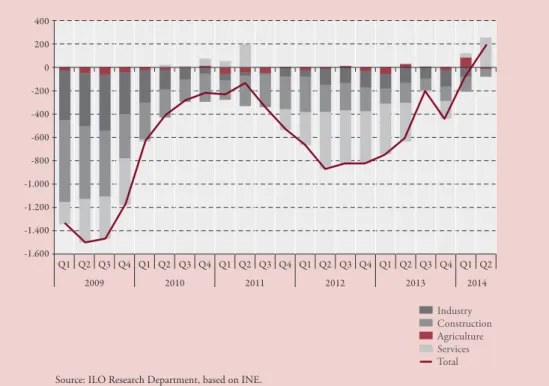
The disproportionate impact of the recession on the Spanish labour market can largely be attributed to the pre-crisis pattern of employment creation, which was focused narrowly on the construction sector.4 In fact, as the crisis erupted – linked at least initially to a housing bubble and the subsequent financial fallout – the construction sector accounted for the bulk of job destruction: between 2009 and 2011, more than 60 per cent of job losses were in this sector (figure 1.8). In contrast, job losses in the agricultural and service sectors were relatively moderate.
4 Between 2000 and 2007, employment in the construction industry grew by 7.4 per cent per year in Spain, against an average of 2 per cent in the EU-17.
Figure 1.7 GdP and employment growth in selected countries
(growth rate over the period 2008–2013, percentage)
GdP growth rate (%)
15
-30 -25 -20 -15 -10 -5 0 5 10
15 10 5 0 -5 -10 -15 -20 -25
Source: ILO Research Department, based on IMF. employment growth rate (%) eSP
AUS
SWE
JPN FRA GBR
CAN
FIN NLD
IRL PRT ITA
DNK
GRC
NOR DEU AUT
USA
... with individuals in temporary employment
bearing the brunt of these losses.
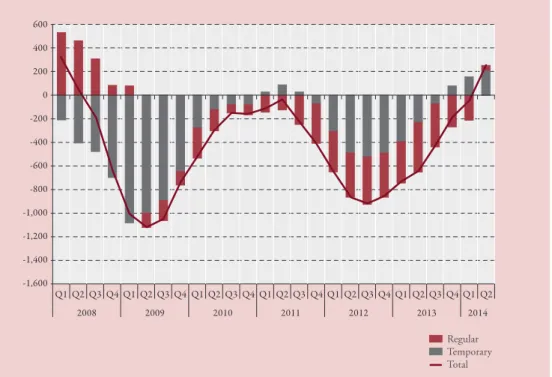
Spanish firms, especially those operating in the construction sector, swiftlyadjusted their workforces by reducing temporary employment.5 In fact, between 2008 and 2011, around 90 per cent of total job losses were among temporary workers – although they represented less than one-third of total jobs. Job losses among temporary workers slowed down considerably after 2012, and temporary employment started growing again since the last quar-ter of 2013. In contrast, the incidence of job destruction among open-end-ed employment increasopen-end-ed considerably in the second part of the recession.
Figure 1.8 employment losses by sector
(year-on-year change, thousands)
Source: ILO Research Department, based on INE.
400 200 0 -200 -400 -600 -800 -1.000 -1.200 -1.400 -1.600
Q1 Q2 Q3 Q4 Q1 Q2 Q3 Q4 Q1 Q2 Q3 Q4 Q1 Q2 Q3 Q4 Q1 Q2 Q3 Q4 Q1 Q2
2009 2010 2011 2012 2013 2014
Industry Construction Agriculture Services Total
Chapter 1 Economic and labour market performance: Signs of recovery SPAin: Growth with JoBS
26
In fact, around three million workers with an open-ended contract lost their job between the first quarter of 2012 and the second quarter of 2014, representing around 60 per cent of the overall contraction in employment over this period (figure 1.9).
The result was a significant rise in unemployment,
especially among youth and low-educated individuals ...
Between the first quarter of 2008 and the same quarter of 2011, the unem-ployment rate increased by 11.5 percentage points to reach 21.2 per cent. It then peaked at 27.1 per cent in the first quarter of 2013.6 Subsequently, the unemployment rate has slowly declined, reaching 26 per cent in the
Figure 1.9 dependent employment losses by type of contract
(year-on-year change, thousands)
Source: ILO Research Department, based on INE.
600 400 200 0 -200 -400 -600 -800 -1,000 -1,200 -1,400 -1,600
Q1Q2Q3Q4Q1Q2Q3Q4Q1Q2Q3Q4Q1Q2Q3Q4Q1Q2Q3Q4Q1Q2Q3Q4 Q1 Q2
2008 2009 2010 2011 2012 2013 2014
Regular Temporary Total
first quarter of 2014. In line with the overall trend, the unemployment rate among women was 26.7 per cent in the first quarter of 2014, up from 11.9 per cent in the same quarter of 2008. During the same period, the male unemployment rate also increased, from 8 per cent to 25.5 per cent. Meanwhile, between the first quarter of 2008 and the same quarter of 2014, the unemployment rate for low-educated individuals (i.e. those with pre-primary, primary and lower secondary education attainment) increased by more than 20 percentage points, reaching 35.6 per cent in the first quarter of 2014. The unemployment rate among people with middle and high levels of education also increased, but at a slower pace – by 16.8 and 10.1 percentage points, respectively, over the same period. The increase
Chapter 1 Economic and labour market performance: Signs of recovery SPAin: Growth with JoBS
28
in unemployment among low-educated individuals has been considerably more pronounced in Spain than in most other EU member states – for instance the unemployment rate for low-educated individuals has increased by 10 percentage points, from 11.4 to 21.4 per cent, in the EU-17 as a whole. This trend is again partially related to the high reliance on employ-ment in the construction sector, where many low-educated individuals were employed in the pre-crisis period.7
The unemployment rate among youths (aged 16–24) has more than dou-bled since the start of the crisis, surging by 34.4 percentage points – from 21.1 per cent in the first quarter of 2008 to 55.5 per cent in the same quar-ter of 2014.8 Only Greece had a higher youth unemployment rate – at 56.7 per cent in the first quarter of 2014 – while the EU-17 average was much lower, at 24.5 per cent. First, in the case of Spain, youth were vulnerable to employment losses given their disproportionate share in temporary employ-ment. In 2008, around 60 per cent of workers below the age of 25 had temporary contracts. Second, many of the Spanish youth were employed in the construction and manufacturing sectors.9 As the crisis erupted, tem-porary employment accounted for the bulk of job destruction, especially in those sectors where youth employment was comparatively more relevant. As a result, the youth unemployment rate doubled by the end of 2010.10 Finally, skills mismatch seems to be more pronounced in Spain than in other European countries. This has posed additional obstacles to youths attempting to enter the labour market during the recession.11
7 Indeed, the number of craft workers in the construction sector – an occupation which is often associated with low levels of educational attainment – dropped by 64.8 per cent between the first quarter of 2008 and the same period of 2014.
8 The particularly negative labour market conditions are not limited to youths below the age of 25. Indeed, regardless of the level of education attained, the unemployment rate for workers aged 15 to 39 is consist-ently higher than the relevant rate for people aged 40 and over.
9 The share of early leavers from education among youth increased from 29 per cent to 31 per cent between 2000 and 2008.
10 Dolado et al. (2013). 11 Garcia (2011).
Despite this, the ratio between youth (aged 16–24) and adult (aged 25 and over) unemployment rates has remained quite stable at around 2.3 since the onset of the crisis. However, this masks the fact that an increasing number of youth have left the labour market since late 2007, regardless of their level of educational attainment. In contrast, the participation rate among adults has remained rather stable, and has even increased among those with the lower levels of education.
... leading to a significant increase
in long-term unemployment.
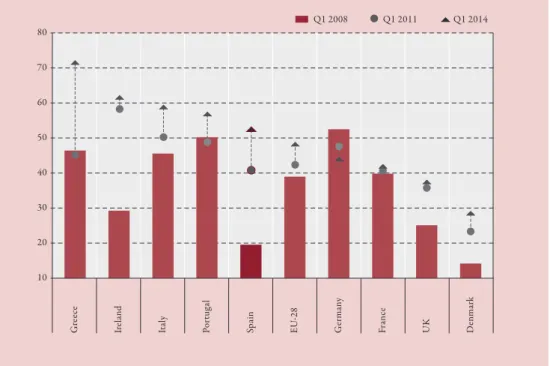
As a consequence of the prolonged economic downturn, the share oflong-term unemployed – those unemployed for one year and over – out of total unemployed increased from 19.1 per cent in the first quarter of 2008 to 52.3 per cent in the same quarter of 2014. Most of this increase took place during the first two years of the crisis; the long-term unemployment rate was indeed already close to 40.5 per cent at the beginning of 2011. The incidence of long-term unemployment in total unemployment in Spain is currently one of the highest among the developed economies. For instance, the long-term unemployment rate is on average 48.7 per cent in the EU-28, 44.1 per cent in Germany and 41.5 per cent in France. However, despite the steep increase observed in recent years, it is still lower in Spain than in other comparable countries, such as Greece (71.4 per cent), Ireland (61.4 per cent), Italy (59.1 per cent) and Portugal (57 per cent) (figure 1.10).