The Entrepreneurial Legacy for e-Learning
Misha HebelCass Business School, London, UK [email protected]
http://www.simfonec.co.uk/about/index.html Rob Wirszycz
Progressive Capital Partners Ltd, London, UK [email protected]
http://www.progressivepartners.com
Abstract: At last years ECEL conference e-Learning in practice was often concluded to be more e-Teaching in that it focused on delivery and technology, with relatively little attention paid to the context of learning or the long-term consequences. This paper uses the example of a highly entrepreneurial company, who have adapted their business model, previously developed to deliver content to a consumer audience, to an e-Learning context. The paper posits a need to return to a more creative and entrepreneurial mindset in the understanding of the use and deployment of e-Learning within an organisation.
Keywords: e-Learning, entrepreneur, emergence, human values, Skinkers
1. Introduction
e-Learning, Virtual learning Environments (VLEs) and ‘blended learning’, supported by their ancestors, Distance Learning, Computer Mediated Communication (CMC) and Computer Based Training (CBT) are now well established in large businesses, public sector and academic institutions. Computers are an everyday part of life and using them to support learning via an established technical architecture of Intranets and Extranets is relatively simple using, for example, FirstClass, Blackboard or eRooms. Take-up may not be all that is wished yet but the potential is clear and the there appears to be a relentless shift towards Internet learning via multimedia content, flexible desktop agents and secure communication platforms. Doing so goes a considerable way towards addressing the old issues of poor delivery, costly maintenance and low take-up (Grani et al (2002); Hebel & Mathiesen, 2002a).
But is it good enough and are we moving fast enough to warrant the attention lavished on the subject? It may be that we the practitioners are guilty of being cast in the role of vicars angrily delivering a sermon from the pulpit shouting, “Why are there so few of you here?”. Indeed if e-Learning is the answer, what is the question posed?
An answer may lie in returning to the roots of business innovation, entrepreneurship. This paradigm of creating and forcing solutions to problems within tight and unreasonable constraints of budget, time and resource can produce some unexpected results. An example
of this is provided by Skinkers Ltd1 who have developed a very innovative e-Learning system without realising they were doing so. The Skinkers products are delivered as services and allow timed ‘digital data and information parcels’ to be delivered at exact times set by the system manager. Interestingly, users can be profiled in such a way that they do not have to part with personal information. In addition, the designers have given considerable thought to how information is received and more importantly welcomed by the user. Information goes directly to people’s computers in front of all other applications and without them search for the information for themselves. A desktop agent called a ‘Skinker’, which usually takes the form of an animated figure and a pop-up mini-screen, does this with figure and box existing in any form. Humour, colour, design and succinct information, often in the form of questions and answers, makes this product fun, interesting as well as informative. This offers two main things - sales benefits derived from appropriate content distribution and learning benefits based on a relevance association with the ‘figure’ and the small size and therefore digestibility of the information ‘parcels’ received.
Skinkers started life as a consumer advertising proposition being used to deliver affinity messages to audiences such as Harry Potter lovers (a ‘desktop owl’) through to Arsenal FC fans (the ‘desktop Wenger’). At no point did the company believe they had a product suitable for e-Learning until they chanced to describe
the product to an acquaintance in charge of e-Learning at Vodafone. He was looking for a way to be more effective and reduce the substantial bill for training call centre operatives about the latest mobile devices. The results that resulted from that entrepreneurial insight have been very strong indeed.
This paper further describes the Skinker product, the learning delivery tests with Vodafone and reflects on the long-term consequences for eLearning in terms of values when it comes as a result of such entrepreneurial activity.
2. Case
study
Skinkers is a small, privately funded, technology company that has developed an innovative communication platform. This new technology enables companies to communicate with their customers while at a PC through an additional channel to those already provided by the Web and Email (Skinkers Ltd, 2002).
Skinkers’ offers content owners and distributors a facility to deliver content directly to customers’ desktops without "getting lost"
within the already cluttered email channel (Skinkers, 2003). Due to the personal nature of a Skinker, the downloadable desktop application installed by the user, marketers and trainers are able to cement a far stronger relationship with their customers. They can also engage with them far more frequently and effectively than through traditional methods such as advertisements, emails and posting. The technology behind Skinkers combines the interruption capability of TV advertising with the entertainment value of animated characters and the timeliness of mobile phone text messaging. The software is original enough in its construction to warrant application for patents and simple enough to be used by most people.
As mentioned the word “Skinker” is also used to refer to the desktop agents that are used in conjunction with the Skinkers Communication Platform to deliver messages on people’s computers. An example is the Skinker created for the UK TV comedian Graham Norton which was used to alert users about interesting content available on the sponsors web site (Virgin Mobile). This Skinker was developed for Channel 4.
Figure 1: Example of Skinker and information box After launching with Sky Sports for the West Indies cricket tour in April 2002 the company experienced considerable success and has around 30 clients including Halifax, Vodafone, Arsenal football team, Channel 4, Centrica, Warner Village and The Independent newspaper. The clients can deliver information on products or remind people of upcoming events; they can deliver training packages in manageable chunks or gather information on user preferences and feedback. The user can
request alerts, reminders, trailers, music, competitions, gossip, offers etc
Unbeknown to the company they were in possession of a device that offered huge e-Learning potential. It was only when this application was explained to someone just given the task of reducing the training budget for Vodafone did the overt connection exist between the product and the learning requirement.
Misha Hebel & Rob Wirszycz
99
This resulted in a trial of a learning delivery package with Vodafone in the early part of 2003. The trial was conducted in conjunction with Vodafone’s Learning & Development department to test delivery of information on 3G technology. The objectives were to:
Determine the effectiveness of the Skinkers Communication Platform in delivering learning information
Contrast the effectiveness of the delivery by running a parallel email delivery
Assess effectiveness using the following criteria ° ° ° ° Receiving information/content Receiving content on time
Consuming the delivery of content Learning/internalising content.
Information was delivered using five ‘nuggets’ delivered over five days to two distinct groups of users. Twenty email users with the information contained as an attachment and twenty Skinkers users receiving Flash presentations of a friendly scientist and information box similar in style to the one shown in figure 1. Three days after the last ‘nugget’ was delivered all participants received a questionnaire to assess level of participation and uptake.
The results show that the Skinkers Users had a much higher level of involvement and a much higher response to the information. The lowest level of participation of Skinkers Users equated to the highest level of Email Users. However the most striking result was the high level of achieved learning. In some ways, this is not surprising due to the higher level of participation but even so information was retained more accurately by the Skinkers Users who returned with almost three times as many correct answers.
It is recognised that this was a small sample and over a short space of time, however this is a trial that can be repeated and most importantly - given the concern at last years ECEL conference – it includes some assessment of learning and not just successful delivery. The next section gives a brief overview of the theory behind eLearning and entrepreneurship in order to put the Skinkers trial into context.
3. e-Learning,
Entrepreneurship
and emergence
e-Learning is characterized by a blended mixture of delivery via technology and some change in the learning state. The takup of
e-learning is enormously diverse and dependent on context whilst not always cognisant of the consequences (Flynn, 2002; Massy, 2002). Complaints include information overload, difficulties accessing the web, conflicting technologies, too few contributors and too many lurkers (observing but not participating), reluctance to commit an opinion in writing, insufficient time, difficulties getting senior people involved (in this context) or the directory structure isn’t intuitive.
The pedagogical issues to be considered include size of group being assessed, previous student experience, means of delivery, use of technology, plagiarism, co-ordination with other learning programmes and feedback as well as student and teacher experience (Flynn, 2002; Hart & Haslem, 2002; Hebel, 2000a).
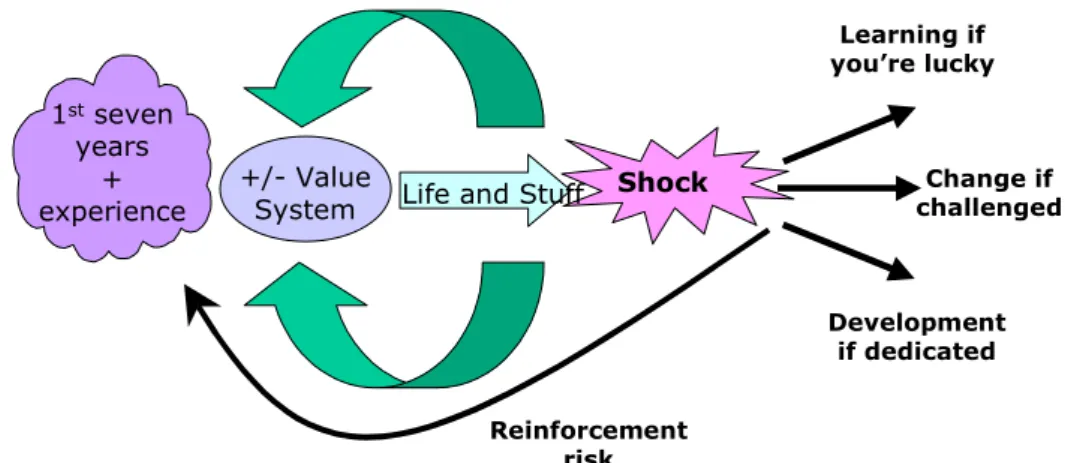
In a previous paper for ECEL (Hebel & Mathiesen, 2002b) a model was presented to show the transformation process of building a human value system (Hebel 1998a & b), which provides a filter for all information and subsequent behaviour. This model can be extended to model the growth of an organisation where all new learning and change is always coloured by our previous knowledge.
The model in figure 2 builds on the systems thinking concept of interconnectedness and the notion that humans form their value systems based on reinforcing what they’ve learnt of life. So the ‘natural’ state of affairs is for reinforcement of value systems, thus learning occurs but mostly, only when it supports existing knowledge (Steinberg, 2003). Because humans are very good at doing things tacitly rather than explicitly they can express only a fraction of it in words. So learning, behaviour or cognitive dissonance can seem natural but unexplainable (Hebel & Mathiesen, 2002).
This values comparison is integral and ongoing if new people and new situations are sought. However it can be argued that the reinforcing nature of value systems means that we will seek or prefer to accept situations we are comfortable with e.g. passive or confrontational. Ultimately it seems that we are unlikely to change very much as individuals, although the occasional shock can cause an occasional readjustment of values priorities and in some cases surprising, emergent properties.
+/- Value
System Life and Stuff Shock
1stseven
years + experience
Learning if you’re lucky
Development if dedicated Reinforcement
risk
Change if challenged
Figure 2: Personal values transformation model It is this shock or surprise element that is considered most relevant to this paper. This is because while there might be an organisational imperative to ensure all ‘frontline’ staff are trained, the contextual gap between what is needed and what is delivered is often such to render whatever is attempted, redundant at best. Skinkers, by the nature of their apparently random intervention of alert and data, create a surprise and a welcome at the same time. This in turn has presented a surprise emergence of additional uses.
Skinkers, by their own route of experiential learning, marketing and web design have come to similar conclusions and offer a practical solution. They recognise that although different industry areas have their own unique characteristics they often share the difficulties posed by plural sites, multiple cultures and amalgams of technology and processes. They recognise that organisational and individual learning shares roots with marketing and capitalises on both of their best qualities, maintaining their creativity and momentum.
This quite personal approach is typical of entrepreneurial activity. Entrepreneurs are often people who appear ambitious and innovative (Kirby, 2003). Some like to put their success down to luck although this may really be attributed to willingness to see and react positively to opportunity or challenge. Entrepreneurs who are often characterised by their risk taking and long hours of hard work within very tight limits of budgets and time. They can also be identified as having novel ideas and being different, undisciplined and unconventional (Birley & Muzyka, 2000) implying the likelihood that conventional
business practices will be difficult for them to follow and that organisationally they are going to need other skills to support them (Kirby, 2003).
4. Conclusion
It appears that the secret to successful eLearning – and probably all learning – is surprise and reinforcement both at the design stage and the learning point. The values of both need to be spoken to and challenged in an entrepreneurial fashion by being novel, positive and with an element of risk.
References
Birley, S. & Muzyka, D. (2000) Mastering Entrepreneurship, FT Prentice Hall Flynn, M. (2002) Achieving Success with
Blended Learning, ECEL2002 proceedings http://www.academic- conferences.org/ecel2004/2-proceedings-ecel2002.htm
Grani, H., Hebel, M, Mathiesen, B., Hustvedt Mathiesen, C., Nomme, R. (2001) Når samspill må prøves på nytt,
presentation to Internet World Norway 2 October 2001
http://www.internetworld.com/events/in ternational_events.php
Hart, M. & Haslam, P. (2002) The reconfiguration of the Higher Education experience and its implications for work-based learning (WBL), ECEL2002 proceedings
http://www.academic- conferences.org/ecel2004/2-proceedings-ecel2002.htm
Hebel, M. & Mathiesen, B. (2002a). E-Learning in OD Consultancy & Global
Misha Hebel & Rob Wirszycz
101
e-Learning (ECEL2002) 4-5 November 2002, pp115--125 proceedings
http://www.academic- conferences.org/ecel2004/2-proceedings-ecel2002.htm
Hebel, M. & Mathiesen, B. (2002b) A Human Value System Based Methodology for an Organisational Development Consultancy, Systems Theory and Practice in the Knowledge Age, UKSS proceedings (eds Ragsdell, West & Wilby), KA/PP, New York pp. 139-146, ISBN 0-306-47247-3
http://ukss.org.uk/
Hebel, M. (2000) Human Values and the Management of Technological Change, Cognition, Technology & Work, Vol. 2:106-115
http://www.springerlink.com/app/home/ contribution.asp?wasp=dfdq68f8dv0qt m5f64r6&referrer=parent&backto=issu
e,6,6;journal,16,21;linkingpublicationre sults,id:103534,1
Kirby, D.A. (2003) Entrepreneurship, McGraw-Hill
Massy, J. (2002) Asking the right stuff, e.learning age Sept 02 issue, Bizmedia Ltd
http://www.elearningage.co.uk/Sep02. html
Skinkers Ltd (2002) Confidential Information Pack, Skinkers Ltd, internal
communication
Skinkers Ltd (2003) Vodafone trial – results from the learning & development trial, Skinkers Ltd, (2004) Internal
Communication
http://www.skinkers.com/elearning.htm l (12/1/04))
Steinberg, A. (2003) The re-definition of expert knowledge, LSE paper