New Academic Program Approval Packet
August 2013
- These guidelines and forms are used for the approval of proposed new degrees, certificates, concentrations, cooperative degrees, closed site programs, and substantive changes to those, and for proposals to offer existing programs off-campus.
- For the approval of proposed new tracks or minors, go to
www.umbc.edu/ugc/forms.html for undergraduate programs, or call the Graduate School at x53659 for graduate programs.
For questions, contact:
Antonio Moreira, Vice Provost for Academic Affairs,
[email protected]
, x56576
or
Table of Contents
Page
New Program Submission and Review Procedures 3
Appendix A:
Responsibilities in the Review Process for New Program Proposals 7 Appendix B:
MHEC/USM Program Categories, Definitions, and Relevant Approval Processes 8 Appendix C:
New Program Submission and Review Procedures
These procedures concern new academic programs, including undergraduate majors, upper-division certificates, post-baccalaureate certificates, masters and doctoral degree programs. Also included are new concentrations, off-campus delivery of existing programs, cooperative degree programs, closed site
programs, and substantive changes to any of the preceding.
(1) Department, Program, or Interdisciplinary Team Initiates Program Concept
Preliminary discussion of a new program may begin within a single academic department or program, with an interdisciplinary team involving two or more departments/programs, or with cooperation between an academic department/program and another campus unit, such as the Division of Professional Education and Training. The Department chair(s) should discuss the program with the appropriate dean(s) prior to proceeding to the next step. Programs that involve other campuses of the University System of Maryland or other colleges and universities outside the USM will necessarily involve additional steps and some modifications to the procedures described here.
Program Concept
Program Concept Group: A Committee of the Provost, Vice Provost for Academic Affairs, Vice Provost for Professional Education, Deans, APB Chair, and Faculty Senate President discusses and makes recommendations on the program concept.
Each new program concept is reviewed and evaluated by this committee. A decision is made
whether to proceed with proposal development. This committee meets at least twice per semester. Contact Beth Wells at [email protected] or x58907 for the meeting schedule.
Guidelines for Submissions to the Program Concept Group
• Describe the program concept in no more than one to two pages, including brief descriptions of the following elements:
o Proposed name of program o Sponsoring department(s)
o Description of the need for the program and educational objectives o Description of the target audience and market demand
o Proposed curriculum o Resources needed o Faculty oversight
• One a third page, document the anticipated enrollments and resource needs as shown below. At this stage, what is being developed and reviewed is a program concept. Faculty are asked to provide the best available estimates in the following categories for review by the Program Concept Group. It is understood that only after a program concept is approved for development into a full program proposal will faculty and staff invest more time in market research and detailed budget preparation.
o Enrollments
Conservatively estimate enrollments based on currently-available information.
Year 1: ___ students: (___ new + ___ current students changing to this major) Year 2: ___ students: (___ new + ___ current students changing to this major) Year 3: ___ students: (___ new + ___ current students changing to this major) Year 4: ___ students: (___ new + ___ current students changing to this major) Year 5: ___students: (___ new)
o Resource Needs
Estimate resource needs based on currently-available information.
• $__________ (salary plus benefits) for faculty in year (s) __________
• $___________ for _____ part-time instructors in year (s) __________
• $__________ (salary plus benefits) for staff in year (s) ___________
• Operating budget: $_________/year, including: Library/Media Budget: $________/year
$ __________ for marketing in year (s) __________
Other: $_________ for _______________ in year(s) ___________ o Totals:
Recurring costs = $__________/yr. One-time costs = $_________
• Send the three-page concept paper, including narrative and resource needs, to Beth Wells at least one week in advance of the Program Concept Group meeting
• The sponsoring chair or dean presents the concept to the Program Concept Group
• Feedback on the concept is conveyed to the sponsoring department
When a program concept has been approved for development, the Provost’s Office sends to the lead faculty or staff a “Routing Sheet for Review and Approval” which shows the level and kind of proposal and review that will be needed for this new program. If you are developing a new proposal and have not received this sheet, be sure to contact Beth Wells at x 58907 or [email protected] to discuss what you need before proceeding.
Program Development
The format and contents of a program proposal depend on what kind of program is being proposed. These guidelines cover most proposal types, but some requirements can also vary on a case-by-case basis. It is very important for program developers to seek consultation in the event of any questions. See Appendix B for definitions of the various types of proposals and their required components.
Timeline for Approval
It is also very important for program developers to have accurate information about: (a) how often and when the required UMBC faculty review committees meet to consider proposals; (b) schedules for USM/MHEC review; and (c) how long it may take each body to deliberate and respond. Program developers should contact Beth Wells, x 58907 [email protected] to receive important information, advice, and assistance in the following areas before embarking on proposal development:
• confirmation on what components are required in the proposal
• the current schedule of meetings for all UMBC faculty committees that will sequentially review the proposal
• the current review schedules for the Maryland Higher Education Commission (MHEC), including the limited MHEC “windows” for submission
• development of a realistic timeline for faculty completion of the proposal and completion of campus and off-campus review relative to the desired first offering of the program
• advice on developing the proposal itself, including narrative and budget (informal review and feedback while developing).
(2) The proposal is developed and sent for informal review
Informal Review
All program proposals (including budgets) that will be submitted through the formal campus review process must first be reviewed informally by the Assistant Vice Provost for Academic Affairs. The purpose of this informal review is to give feedback to program developers about compliance with UMBC, USM, and MHEC guidelines for narrative and budget portions of proposals and to offer advice on how the proposal might be enhanced for clarity, comprehensiveness, etc. Please submit the proposal for informal review at least two weeks in advance of the proposed date for starting it through the on-campus review process (see “Routing Sheet for Review and Approval”), to allow time for suggested revisions.
Proposal Submission & Review
When the proposed program involves collaboration (courses, etc.) with departments in addition to the one(s) making the proposal, letters of support from the collaborating departments are required. (3) The proposal is submitted to the Vice President for Administration and Finance for budget review
(4) The proposal is sent to appropriate Dean(s), according to the instructions on the “Routing Sheet for Review and Approval”
(5) Proposal is submitted formally to the Vice Provost for Academic Affairs
Once it has been reviewed and approved by chairs and deans, the proposal and all supporting materials are sent to the Office of the Provost, to the attention of the Vice Provost for Academic Affairs. The Provost’s Office formally reviews the proposal for sufficiency and clarity of presentation (not for final approval) and transmits it to appropriate faculty committees for review.
(6) Provost’s Office submits Proposal to Academic Planning and Budget Committee; to the Undergraduate or Graduate Council; and to the Faculty Senate.
(8) Provost’s Office Notifies USM
The Provost’s Office sends the Notification of New Program under Development form (or Letter of Intent) to the Vice Chancellor for Academic Affairs at USM
(9) Faculty Senate receives Committee recommendations and forwards Proposal
The Faculty Senate President receives reports from the APB and the Undergraduate Council or the Graduate Council. Once recommendations from all relevant committees have been received, the Senate President brings the proposal to the Senate for approval. The Faculty Senate President then signs the Routing Sheet and sends it to the Vice Provost for Academic Affairs.
(10) Provost Recommends approval of Proposal to President
Upon receipt of the Routing Sheet with notification of approval by the Faculty Senate, the Provost transmits the proposal and all supporting materials to the President.
(11) President transmits Proposal for review and approval to USM and MHEC (12) Program is implemented
Following approval of the Proposal by USM and MHEC, the Provost’s Office initiates the program implementation process by which SA and all necessary UMBC data systems add the program so students can register for it and the department can market the program to prospective students.
Appendix A
Responsibilities in the Review Process for New Program Proposals Responsibilities of faculty:
• To submit, through Deans, a concept document sufficient to requirements of Program Concept Group (PCG)1 found in this document
• If concept is approved, to prepare the full proposal in compliance with: o These guidelines and requirements
o Program stipulations made by the PCG
o Requirements for consultation with the co-sponsoring or affected Dean(s) indicated
• To submit the draft proposal to the Vice Provost for Academic Affairs for informal review and to make suggested revisions to comply with guidelines for narrative and budget
• To submit the formal proposal to the Vice President for Administration and Finance for budget review
• To submit to Dean(s) a proposal that meet requirements of guidelines and stipulations Responsibilities of Deans:
• To play a critical academic role in shaping the program concept and examining potential costs
• To play an active role throughout the process
• To present concepts for new programs from their Colleges at PCG
• To review proposals for sufficiency and full compliance with these guidelines and all stipulations (for program content and for consultation) made by PCG
• To return to the faculty with feedback on any proposal that does not meet guidelines
• To review proposals from other Colleges for which they are co-sponsor, which affect them, or in which their courses are included Responsibilities of Vice President for Administration and Finance:
• To review the budgets of new program proposals Responsibilities of the Office of the Provost:
Responsibilities of Vice Provost for Academic Affairs:
• To informally review all proposals
• To consult on program proposals with the Provost
• To send program proposals to the shared governance groups after they have been approved by administrators Responsibilities of Assistant Vice Provost for Academic Affairs:
• To serve as primary contact in the Provost’s Office for consultation on new program proposal requirements
• To staff the PCG and circulate record of decisions and stipulations
• To update, as needed, the following:
o requirements for submission to PCG and dates of meetings
o information about approval process for different kinds of programs and contact information for those needing advice or consultation
o requirements for proposals for new programs
• To provide advice and consultation on internal and external approval process and timing
• To develop routing/approval sheets for new program proposals
• To submit Letters of Intent to USM
• To submit new program proposals to USM/MHEC
• To monitor proposal submissions to USM/MHEC Responsibilities of Provost:
• To Chair the PCG
• To present concepts for new programs from Erickson School at PCG
• To review proposals from Erickson & DPET for sufficiency, sending forward through the approval process only those that meet all requirements of PCG and guidelines posted on the website
• To review all proposals at the end of the campus review process
• To notify the Budget Committee of new programs approved
1 The responsibility of the Program Concept Group is preliminary review of the proposed concept for any proposed new program, in the form of a brief concept
paper. Approval of the program concept by PCG is required before faculty may develop a full proposal for a new program. Stipulations on the development of the new program may be made. Members of the PCG are: The Provost, the Collegiate Deans, Dean of the Graduate School, Dean of Undergraduate Education, Vice Provost for Academic Affairs, Vice Provost for Continuing and Professional Studies., Chair of Academic Planning and Budget, and President of Faculty Senate.
Appendix B
MHEC PROGRAM CATEGORIES AND DEFINITIONS AND RELEVANT MHEC AND BOR APPROVAL PROCESSES
(Questions about the categories, definitions, or processes should be directed to Beth Wells at x58907 or [email protected])
PROGRAM
CATEGORY PROGRAM DEFINITIONS USM/BOR PROCESS MHEC PROCESS Type A: New Programs, Degrees, and Stand-Alone Certificates (regardless of delivery method) 1. An instructional program leading to a formal award in subject area in which award is not presently
authorized. 2. An instructional program in subject area in which formal award is offered at a different degree level.
3. A new major created by combining course work offered in two or more existing degree programs.
4. An award of a different type in a subject matter in which another formal award at the same level is already offered (e.g., MS in Management & MBA).
Early in planning process, submit to USM/OAA notification letter for distribution to AAAC. Within or slightly before USM program submission window2, submit proposal,
including budget forms, to USM/OAA for review and preparation of summary for consideration by BOR Committee on Education Policy.
USM/BOR is responsible under statute for assuring that proposed new programs are consistent with institutional mission, can be offered within existing resources, and meet standards of quality for academic programs, including demonstrable quality of the faculty; adequacy of facilities and library resources; and adequacy of curriculum design and related learning outcomes, including technology fluency.
EPC review must occur after 30-day period for objections. BOR approval must occur within 60 days of submission.
Submit complete proposal, including the fee, to MHEC within USM program submission window. Within 10 days of receipt, MHEC will review and determine if the proposal is complete. If complete, it will be distributed to other segments.
MHEC’s and other institutions' reviews of new USM proposals are limited in statute to filing objections (within 30 days of
submission) based upon:
(1) Inconsistency of the proposed program with the institution's approved mission; (2) Unreasonable program duplication which would cause demonstrable harm to another institution; or
(3) Violation of the State's equal educational opportunity obligations under State and federal law.
Absent objection, MHEC will approve the program within 31 to 35 days and is limited to a decision within 60 days of submission. MHEC and BOR review and approval occur concurrently, but are independent.
2 The USM “window” is the period of time in which a program proposal should be submitted to MHEC so that its transmittal from MHEC to
segments will permit the proposal to be out for comment for 30 days prior to the meeting of the BOR Education Policy Committee while not exceeding the 60-day review period prior to its formal approval at the next scheduled meeting of the full Board.
PROGRAM
CATEGORY PROGRAM DEFINITIONS USM/BOR PROCESS MHEC PROCESS Type B: Substantial Expansion or Modification of Existing Program 1. A change of more than 33 percent of an existing programs course work; 2. Conversion of more than 50 percent of a program previously approved for offering in a distance education format to a classroom or site-based learning format, or conversion of more than 50 percent of a program previously approved for offering in a classroom or site-based learning format to a distance education format;
3. A new program title
within an approved program. 4. A new area of concentration within an existing program: Area of concentration = a sequential arrangement of courses within a program which at the
Undergraduate level at least 24 semester credit hours
Master's level at least 12 semester hours; and Doctoral level at least 18 semester hours.
Submit to USM/OAA one-page notification of change, description, and rationale, requesting Chancellor’s approval.
Submit proposal for substantial modification to MHEC (see Type C on next page.). Within 10 days of receipt, MHEC will review and determine if the proposal is complete. If complete, it will be distributed to other segments.
MHEC’s and other institutions' reviews of new USM proposals are limited in statute to filing objections (within 30 days of
submission) based upon:
(1) Inconsistency of the proposed program with the institution's approved mission; (2) Unreasonable program duplication which would cause demonstrable harm to another institution; or
(3) Violation of the State's equal educational opportunity obligations under State and federal law.
Absent objection, MHEC will approve the program within 31 to 35 days and is limited to a decision within 60 days of submission.
PROGRAM
CATEGORY PROGRAM DEFINITIONS USM/BOR PROCESS MHEC PROCESS Type C: Off-Campus Delivery of Existing Program (live instruction only, or partially offered electronically) 1. An existing degree or certificate program that offers more than 1/3 of required course work for the major or certificate at non-campus site during any 12-month period; or 2. An existing degree or certificate program for which an institution advertises that course work at an off-campus site will lead to award of certificate or degree, regardless of portion of program offered at off-campus site.
Submit to USM/OAA for information copy of materials submitted to MHEC.
Submit a proposal for substantial modification to MHEC requesting approval of off-campus program. The proposal shall contain the following information regarding need and demand for extending the program and the impact the program may have on similar programs that may exist in the region:
1. The title of the program and the degree
or certificate to be awarded;
2. The resource requirements for the
program and the source of funds to support the program for the first 2 years of program implementation;
3. The need and demand for the program
in terms of:
a. Specific local, regional and State need for graduates;
b. Job opportunities available to those who complete the program; and c. Evidence of market demand
through supporting data, including results of surveys that have recently been conducted;
4. A description of the following, if a similar
program is offered within the same geographical region of the State: a. Similarities or differences in the
degree to be awarded; b. Area of specialization; and c. Specific academic content of the
program;
5. A description of the method of
instructional delivery, including distance education, on-site faculty, and the mix of full-time and part-time instructors; 6. A brief description of the academic
oversight, quality control, and student services to be provided.
7. Provision for adequate and appropriate library resources within reasonable distance of the instructional site or through institution-sponsored electronic collections and databases.
PROGRAM
CATEGORY PROGRAM DEFINITIONS USM/BOR PROCESS MHEC PROCESS Type D: Certificate Program at Undergrad/Grad Level Exclusively Within Existing Degree Program Lower-Division Certificate = 12 or more credit hours at the freshman or sophomore level, or both.
Upper-Division
Certificate = 12 or more credit hours at junior or senior level, or both. Post-Baccalaureate Certificate = 12 or more credits of college-level work, the majority of which are at the master's level. Post-Master’s Certificate = 12 credits beyond the master’s degree.
Certificate of Advanced Study = 30 credits beyond the master’s degree.
Professional Certificate = the number of courses required by the appropriate National association.
No approval required; notify USM/OAA concurrently with MHEC.
Submit a program proposal for a new certificate in an existing degree program may be made in a brief, one-page document that:
(a) Explains the centrality of the proposed certificate program to the mission of the institution;
(b) Provides evidence of the market demand for the proposed certificate program;
(c) Sets out the curriculum design; and (d) Shows that adequate faculty resources
exist for the proposed certificate program.
If the proposed program requires new resources, submit Finance data to include Tables 1 (Resources) and 2 (Expenditures) along with a narrative discussing the resource requirements and sources of funds to support the program.
PROGRAM
CATEGORY PROGRAM DEFINITIONS USM/BOR PROCESS MHEC PROCESS Type E: Directed Technology Certificate Certificate for completion of a specialized learning program developed by the institution specifically for employer training needs at a closed site. A directed technology certificate is designed as a sequence of courses that meets specific training objectives. Its purpose is to dramatically shorten the start-up time for credit training programs and to provide a useful credentialing function for those desiring a formal award. The certificate may be awarded for
successfully earning at least 12 semester credit hours, but no more than 24 semester credit hours.
No approval required; notify USM/OAA concurrently with MHEC.
Submit a copy of the curriculum and a letter from the president of the institution that responds to the following:
• The curriculum for the certificate has been developed in consultation with a specific employer or employers to meet specific training needs;
• The curriculum has been reviewed by the appropriate curriculum approval bodies at the institution;
• A content specialist will be assigned to ensure high standards and maintain written documentation about the curriculum; and
Financial resources are adequate to support the curriculum.
Type F: Cooperative Degree Program 1. Joint Degree Program = students receive single diploma that bears names and seals of both
institutions. Planning and delivery of course work by representatives of all institutions. 2. Primary Degree Program = Diploma granted by primary institution, which offers at least 2/3 of course work and plans program in consultation with partners.
Follow process for new programs. Include with proposal submission copy of MOU among
participating institutions. For Joint Degree Programs, submit single proposal with appropriate signatures from all participants.
Follow process for new programs. Include with proposal submission copy of MOU among participating institutions. For Joint Degree Programs, MHEC requires one proposal be submitted with appropriate signatures from all participants.
PROGRAM
CATEGORY PROGRAM DEFINITIONS USM/BOR PROCESS MHEC PROCESS Type G:
Closed Site Program
A previously approved program offered at the request of a sponsoring agent at a business, industry or
governmental site solely for its own employees. (If program is open to general public, institution must follow off-campus approval process.)
Notification not required. Submit a letter of notification to MHEC describing the program and affirm that there is access to library and faculty resources consistent with the scope and nature of the offerings. Include documentation of sponsoring agent request.
Type H: Bachelor of Technical Studies, Bachelor Professional Studies An articulated program in a related, specialized area of concentration at a four-year institution for students with an AAS degree. MOU between community college and institution identifies admissions, registration, advising, student services, financial aid, tuition, faculty resources, and programmatic and degree requirements. Program includes minimum 3-credit internship. The BTPS program structure has been coordinated collaboratively across relevant segments.
Submit MOU and budget tables to USM/OAA for review and action by the Chancellor.
Submit MOU to MHEC for administrative approval. MHEC will not distribute the proposal for comment. Budget tables are not required. Type I: Program Suspension Temporary suspension of program to examine future direction; time not to exceed two years. No new students admitted during suspension, but currently enrolled students must be given opportunity to satisfy degree requirements.
Notify USM/OAA of suspension with brief rationale.
Notify MHEC of suspension with brief rationale.
PROGRAM
CATEGORY PROGRAM DEFINITIONS USM/BOR PROCESS MHEC PROCESS Type J:
Program Discontinuance
Termination of
program. See USM Policy on the Review and Abolition of Existing Academic Programs (III-7.02). Submit required documentation to USM/OAA for review and approval by the
Chancellor.
Submit documentation in support of program discontinuance to MHEC for approval.
Type K: Reactivate Program
Reactivate a program within three years of suspension.
Notify USM/OAA of intent
to reactivate. Notify MHEC of intent to reactivate.
Type L: Title Change of an Approved Program
Title change of program with no revision of curricular content.
Submit a brief letter of request for title change indicating the existing and proposed titles and a justification for the change to USM/OAA for review and approval by the Chancellor.
Submit a brief letter of request for title change indicating the existing and proposed titles and a justification for the change to MHEC for review and administrative approval. This will not be disseminated for review and comment.
Type M: Articulation Agreement with Maryland Secondary Schools and Non-Degree Institutions
Proposal for articulation of transfer credit of specific courses or programs offered by Maryland Secondary Schools and Non-Degree Institutions. No approval required; notify USM/OAA concurrently with submission of proposal to MHEC.
Submit to MHEC a written proposal for articulation or transfer of credit of specific courses or programs shall be submitted by the chief executive officer of the school system or the non-degree granting institution to the chief executive officer of the degree granting institution. The proposal shall include, but is not limited to, a complete description of course/program content, instructional/experimental learning hours, expected competencies, and assessment measures used. The proposal shall also indicate whether the intention is for transfer of credit for courses within an articulated program or for transfer of credit for individual courses. Agreements must be approved by the Maryland Higher Education Commission. Agreements must be signed by the chief executive officers of the two institutions entering into the agreement to be valid and considered by the Commission.
Appendix C
Instructions for Completing Proposal Types A, B, C, and F
UNIVERSITY SYSTEM OF MARYLAND INSTITUTION PROPOSAL FOR
New Instructional Program
Substantial Expansion/Major Modification Cooperative Degree Program
Institution Submitting Proposal
Title of Proposed Program
Degree to be Awarded Projected Implementation Date
Proposed HEGIS Code Proposed CIP Code
Department in which program will be
located Department Contact
Contact Phone Number Contact E-Mail Address
Signature of President or Designee Date
Body of Proposal: Not to exceed 10 pages. Please be sure to number your pages.
Include in the proposal every lettered section below, using the same letters and the same headings as shown.
A. Centrality to institutional mission statement and planning priorities:
Provide a description of the program, including each area of concentration (if
applicable), and how it relates to the institution’s approved mission. Explain how the proposed program supports the institution’s strategic goals and provide evidence that affirms it is an institutional priority.
Include and cite quote(s) from the UMBC mission statement.
http://www.umbc.edu/aboutumbc/mission.php
Include and cite quote(s) from UMBC strategic planning documents.
http://www.umbc.edu/provost/PDFs/frameworkfinal.pdf
B. Adequacy of curriculum design and delivery to related learning outcomes:
1. Provide a list of courses with title, semester credit hours and course descriptions, along with a description of program requirements. (Use form included in this packet.)
2. Describe the educational objectives and intended student learning outcomes. 3. Discuss how general education requirements will be met, if applicable.
4. Identify any specialized accreditation or graduate certification requirements for this program and its students.
5. If contracting with another institution or non-collegiate organization regarding delivery of the academic program, include a copy of the MOU or contract. C. Critical and compelling regional or Statewide need as identified in the
State Plan:
1. Demonstrate demand and need for the program in terms of meeting present and future needs of the region and the State in general based on one or more of the following:
o The need for the advancement and evolution of knowledge;
o Societal needs, including expanding educational opportunities and choices
for minority and educationally disadvantaged students at institutions of higher education;
o The need to strengthen and expand the capacity of historically black
o institutions to provide high quality and unique educational programs.
2. Provide evidence that the perceived need is consistent with the Maryland State Plan for Postsecondary Education and the USM Strategic Plan.
Include and cite quote(s) from the Maryland State Plan for Postsecondary Education.
http://mhec.maryland.gov/highered/about/meetings/commissionmeetings/6-17-09/2009draftmdstateplanforpostsecondaryeducationais+memo.pdf
Include and cite quote(s) from the 2010-2020 USM Strategic Plan.
http://www.usmd.edu/usm/chancellor/specialdocs/
D. Quantifiable & reliable evidence and documentation of market supply & demand in the region and State:
1. Present data and analysis projecting market demand and the availability of openings in a job market to be served by the new program.
2. Discuss and provide evidence of market surveys that clearly provide quantifiable and reliable data on the educational and training needs and the anticipated number of vacancies expected over the next 5 years.
3. Data showing the current and projected supply of prospective graduates. Provide and cite data from the Bureau of Labor Statistics for the following, with greatest emphasis on the Baltimore region and State of Maryland:
Baltimore area http://www.bls.gov/ro3/cesqbalt.htm Maryland http://www.dllr.state.md.us/lmi/iandoprojshort/ U.S. http://www.bls.gov/ooh/ 18
E. Reasonableness of program duplication:
1. Specifically and by name of institution identify any similar programs in the State and/or same geographical area. Discuss similarities and differences between the proposed program and others.
2. Provide justification for the proposed program.
F. Relevance to Historically Black Institutions (HBIs)
1. Discuss the program’s potential impact on the implementation or maintenance of high-demand programs at HBI’s.
2. Discuss the program’s potential impact on the uniqueness and institutional identities and missions of HBIs.
Specifically identify programs at Morgan State University, Bowie State University, Coppin State University, and University of Maryland Eastern Shore (UMES) that can be perceived as potentially impacted by the proposed new program. Make the case for why no adverse impact will occur, and, if possible, for how the new program will support the mission and success of the program at the HBI.
G. If proposing a distance education program, please provide evidence of the Principles of Good Practice (as outlined in COMAR 13B.02.03.22C).
If no distance learning is included, state this.
H. Adequacy of faculty resources (as outlined in COMAR 13B.02.03.11).
Provide a brief narrative demonstrating the quality of program faculty. Include a summary list of faculty with appointment type, terminal degree title and field, academic title/rank, status (full-time, part-time, adjunct) and the course(s) each faulty member will teach.
I. Adequacy of library resources (as outlined in COMAR 13B.02.03.12).
Describe the library resources available and/or the measures to be taken to ensure resources are adequate to support the proposed program. If the program is to be
implemented within existing institutional resources, include a supportive
statement by the President for library resources to meet the program’s needs. Contact Director of the Albin O. Kuhn Library and Gallery, Larry Wilt, for his
consultation on what, if any, additional resources are needed in the library for the proposed new program.
Include this statement:
“The President assures that appropriate library resources are available to support the needs of this program.”
J. Adequacy of physical facilities, infrastructure and instructional equipment (as outlined in COMAR 13B.02.03.13)
Provide an assurance that physical facilities, infrastructure and instruction equipment are adequate to initiate the program, particularly as related to spaces for
classrooms, staff and faculty offices, and laboratories for studies in the technologies and sciences. If the program is to be implemented within existing institutional resources, include a supportive statement by the President for adequate equipment and facilities to meet the program’s needs.
Include this statement:
“The President assures that appropriate physical facilities, infrastructure, and instructional equipment are available to support the needs of this program.” K. Adequacy of financial resources with documentation (as outlined in
COMAR 13B.02.03.14)
Commitment is to requiring no new general funds from the State, but grants,
partnerships, and reallocated Institutional funds used to support the program should be explained in narrative form in this section. Confirmation of grants and
partnerships via letters or memorandums of understanding helps to support the case for non-tuition revenue sources. Additionally, any special equipment, library, or facilities identified in the expense table might be addressed here as opposed to briefer footnoting in Tables 1 and 2 (included in this packet).
Include this statement in the narrative:
“The President assures that no new general funds from the State are required.” Institutions have significant leeway in deciding how to complete this section and Tables 1 and 2, but the extent to which assumptions and decisions affecting
resources and expenditures are explicitly delineated is the extent to which questions and concerns are avoided.
Note:
1. Tables 1 and 2 included in this packet are required by USM and MHEC and must be prepared and included in advance of the proposal’s being sent for off-campus review (after the on-campus review and approval).
2. UMBC requirements for review of proposals include completion of a different set of budget tables which can be found here. These must be completed when the proposal is first developed. Contact Tony Moreira for questions or assistance regarding completion of these tables. [email protected]
See “UMBC New Program Budget Template” at http://www.umbc.edu/provost/policies.html
L. Resources and Expenditures
Institutions typically can provide the departments developing programs with references to sources both on and off campus to help in completing the resource and expenditure tables. There are campus-specific definitions of full- and part-time students for research and comprehensive institutions, for example, as well as different projections for how many in-state and out-of-state students and full-time and part-time students might be expected to enroll in a particular new program. Consult with the Dean, Institutional Research Director, or Provost as to the best source of data at the Institution.
Explanatory footnotes for assumptions made in projecting student and faculty FTE and for any special resource or expenditure data noted are encouraged to add clarity and understanding to the proposal.
M. Adequacy of provisions for evaluation of program (as outlined in COMAR 13B.02.03.15).
Discuss procedures for evaluating courses, faculty and student learning outcomes. Include information here from the department’s program for assessment of student learning outcomes.
N. Consistency with the State’s minority student achievement goals (as
outlined in COMAR 13B.02.03.05 and in the State Plan for Postsecondary Education). Discuss how the proposed program addresses minority student access & success, and the institution’s cultural diversity goals and initiatives.
As appropriate, use and cite quote(s) from UMBC’s Diversity Plan.
http://www.umbc.edu/provost/PDFs/UMBC_Diversity_Plan_030409.pdfrt and Strategic
As appropriate, use and cite data from UMBC’s annual report on diversity.
http://www.umbc.edu/provost/PDFs/DiversityReport22412.pdf
If there are diversity data on enrollments in the department’s programs, quote and cite them.
http://www.umbc.edu/oir/DB/Student%20Term%20Enrollments/StudentTermEnrl.htm
O. Relationship to low productivity programs identified by the Commission:
If the proposed program is directly related to an identified low productivity program, discuss how the fiscal resources (including faculty, administration, library resources and general operating expenses) may be redistributed to this program.
If there is no relationship to a low productivity program, state this.
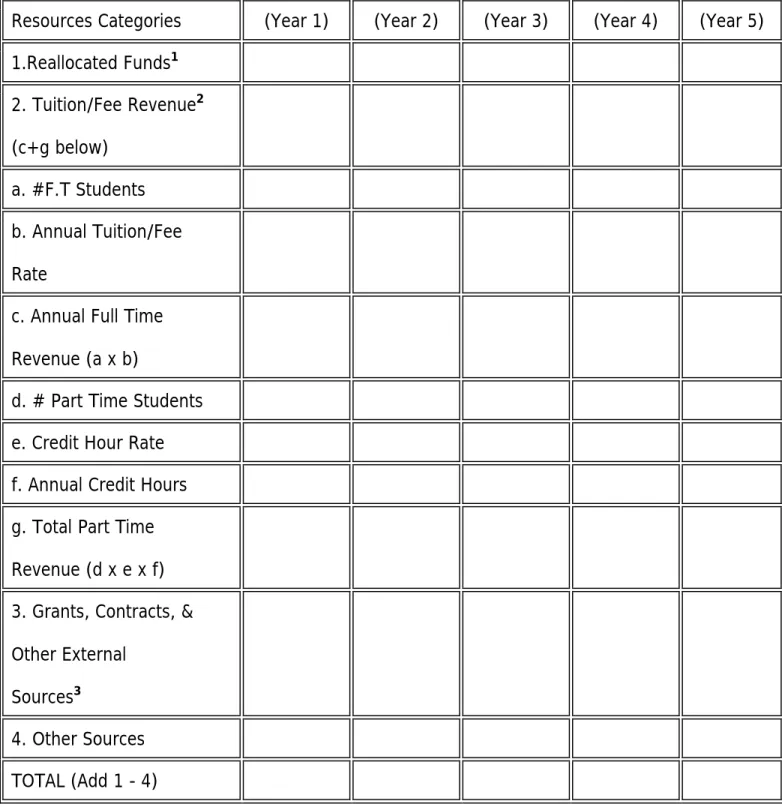
TABLE 1: RESOURCES
Resources Categories (Year 1) (Year 2) (Year 3) (Year 4) (Year 5)
1.Reallocated Funds1 2. Tuition/Fee Revenue2 (c+g below) a. #F.T Students b. Annual Tuition/Fee Rate
c. Annual Full Time Revenue (a x b)
d. # Part Time Students
e. Credit Hour Rate
f. Annual Credit Hours
g. Total Part Time Revenue (d x e x f)
3. Grants, Contracts, & Other External Sources3 4. Other Sources TOTAL (Add 1 - 4) ________________________________
1 Whenever reallocated funds are included among the resources available to new programs, the following information must be provided in a footnote: origin(s) of reallocated funds, impact of the reallocation on the existing academic program(s), and manner in which the reallocation is consistent with the institution's strategic plan.
2 This figure should be a realistic percentage of tuition and fees which will be used to support the new program. Factors such as indirect costs linked to new students and the impact of enrolling continuing students in the new program should be considered when determining the percentage.
3 Whenever external funds are included among the resources, the following information must be provided in a footnote: source of the funding and alternative methods of funding the program after the cessation of external funding.
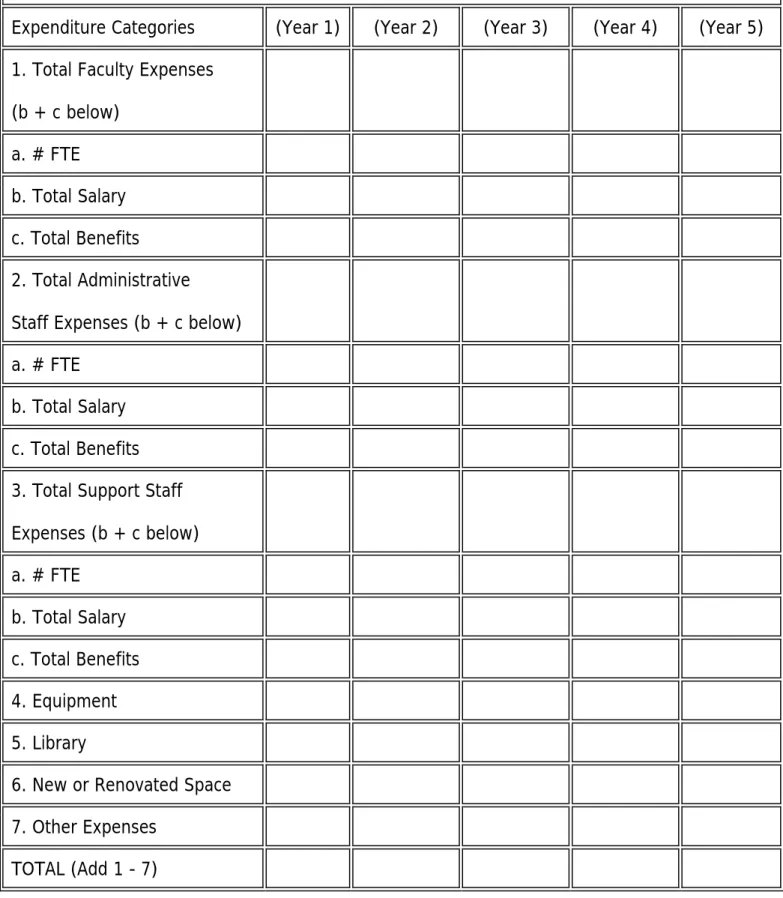
TABLE 2: EXPENDITURES
Expenditure Categories (Year 1) (Year 2) (Year 3) (Year 4) (Year 5) 1. Total Faculty Expenses
(b + c below) a. # FTE b. Total Salary c. Total Benefits 2. Total Administrative
Staff Expenses (b + c below)
a. # FTE
b. Total Salary
c. Total Benefits
3. Total Support Staff Expenses (b + c below) a. # FTE b. Total Salary c. Total Benefits 4. Equipment 5. Library
6. New or Renovated Space
7. Other Expenses
TOTAL (Add 1 - 7)
Courses in the Program
List the courses and credits in the proposed new program and brief course descriptions. Degree Requirements: 120 semester hours
Major Requirements Total credits
MAJR 101 Introduction to the Major I MAJR 102 Introduction to the Major II MAJR 301 Intermediate Major I
MAJR 302 Intermediate Major I – Special Topics MAJR 303 Intermediate Major II
MAJR 304 Intermediate Major III MAJR 401 Advanced Major I MAJR 402 Advanced Major II MAJR 401 Advanced Major III MAJR 401 Advanced Major IV
Supporting Courses:
ACCTG 101 Principles of Accounting I ACCTG102 Principles of Accounting II
Concentration:
CONC 301 Intermediate Concentration I CONC 302 Intermediate Concentration II CONC 303 Intermediate Concentration III CONC 401 Advanced Concentration I CONC 301 Advanced Concentration II CONC 301 Advanced Concentration III
General Education Requirements:
ENGL 101 Principles of English Composition MATH 101 College Algebra
Arts & Humanities Social Sciences Sciences + Lab Electives