ibm.com/redbooks
Master Data Management
for SaaS Applications
Whei-Jen Chen
Bhavani Eshwar
Ramya Rajendiran
Shettigar Srinivas
Manjunath B Subramanian
Bharathi Venkatasubramanian
InfoSphere MDM and SaaS applications
integration guidance
WebSphere Cast Iron Cloud
integration as middleware
Cloud application
integration scenarios
Master Data Management for SaaS Applications
October 2014
International Technical Support Organization
First Edition (October 2014)
This edition applies to IBM InfoSphere Master Data Management Version 11.3, IBM InfoSphere Server Version 11.3, WebSphere Cast Iron Cloud Integration Version 7.0.
Note: Before using this information and the product it supports, read the information in “Notices” on page vii.
© Copyright IBM Corp. 2014. All rights reserved. iii
Contents
Notices . . . vii Trademarks . . . viii Preface . . . ix Authors . . . x Acknowledgement . . . xiiiNow you can become a published author, too! . . . xiii
Comments welcome . . . xiii
Stay connected to IBM Redbooks publications . . . xiv
Chapter 1. Introduction . . . 1
1.1 Master data management and SaaS applications. . . 2
1.2 The evolution of SaaS applications . . . 2
1.2.1 Business and technical impact . . . 3
1.2.2 Other considerations for SaaS applications in the context of master data management . . . 4
1.3 SaaS applications require data mastering and governance similar to on-premises applications . . . 5
1.3.1 Managing duplicate records . . . 5
1.3.2 Adherence to data quality standards and governance policies . . . 7
1.4 Challenges in overcoming business and operational issues from within the SaaS applications using a native MDM or internal MDM . . . 8
1.4.1 Incomplete information . . . 8
1.4.2 Consistent de-duplication strategy and results . . . 9
1.4.3 Data augmentation through business hierarchies . . . 10
1.4.4 Redundant enforcement mechanisms that hinder enterprise-wide governance initiatives . . . 10
1.5 Other integration challenges . . . 11
1.5.1 Cross border . . . 11
1.5.2 Data integration . . . 12
1.5.3 Security . . . 13
1.5.4 Business process integration . . . 13
1.6 Setting the stage for MDM integration with SaaS applications . . . 14
1.6.1 High-level solution construct and logical architecture . . . 15
1.6.2 IBM InfoSphere MDM . . . 16
1.6.3 WebSphere Cast Iron Cloud Integration . . . 17
1.6.4 Logical architecture of the InfoSphere MDM and WebSphere Cast Iron Cloud Integration . . . 18
Chapter 2. MDM solution readiness to participate in integrations with SaaS
applications . . . 21
2.1 Integration strategies employed regularly by on-premises applications . . 22
2.1.1 Role of open standards . . . 24
2.1.2 Integration strategies for consumers and services providers outside the enterprise firewall . . . 28
2.2 Integrations with IBM InfoSphere Master Data Management solutions . . 30
2.2.1 Integrations with source systems . . . 30
2.2.2 Integrations with business applications . . . 31
2.2.3 Integrations with warehouses and other analytical environments . . . 31
2.3 General requirements for integrations of on-premises MDM solutions with SaaS applications . . . 32
2.3.1 Integrations with SaaS applications acting as a source . . . 33
2.3.2 SaaS applications consuming MDM services and MDM callouts to SaaS applications . . . 34
2.3.3 Bulk data operations between MDM solutions and SaaS applications . . . 34
2.3.4 Preparations required for MDM solutions to integrate with SaaS applications . . . 35
2.4 Aspects of solution definition. . . 38
2.4.1 High-level requirements . . . 38
2.4.2 Security requirements . . . 40
2.4.3 Different solution approaches . . . 41
Chapter 3. Middleware considerations for integration . . . 43
3.1 Data integration between on-premises MDM systems and SaaS applications . . . 44
3.1.1 Introduction to WebSphere Cast Iron Cloud Integration capabilities. 44 3.1.2 Deployment options in WebSphere Cast Iron Cloud Integration. . . . 48
3.1.3 IBM Information Server . . . 51
3.2 Access integration between on-premises MDM systems and SaaS application . . . 52
3.2.1 Security . . . 52
3.2.2 WebSphere Cast Iron Cloud Integration connectors. . . 54
3.3 Process integration between on-premises MDM systems and SaaS applications . . . 58
3.3.1 Data flow orchestration using TIPs . . . 59
3.3.2 BPM based Stewardship . . . 60
Chapter 4. Solution architecture . . . 63
4.1 Integration patterns applicable for integration of MDM systems and SaaS applications. . . 64
Contents v
4.1.2 Access integration patterns . . . 70
4.1.3 Process integration patterns . . . 74
4.2 Solution architecture for integrating MDM systems and SaaS applications . . . 80
4.3 Considerations for bulk load operations . . . 83
4.3.1 IBM InfoSphere Information Server Pack for Salesforce.com. . . 83
4.3.2 IBM InfoSphere DataStage . . . 83
4.3.3 Initial extract, and bulk and incremental load requirements . . . 84
4.3.4 Sample export job . . . 85
Chapter 5. A sample InfoSphere MDM and SaaS application integration scenario . . . 87
5.1 Business issue . . . 88
5.1.1 Solution for the business issues . . . 89
5.1.2 Relevance of the solution to Container Company A . . . 91
5.2 Solution architecture . . . 91
5.2.1 Salesforce.com customization . . . 92
5.2.2 IBM WebSphere Cast Iron Live as the middle ware . . . 92
5.2.3 MDM InfoSphere web services . . . 93
5.2.4 Prerequisite for this solution capability . . . 93
Chapter 6. Putting it all together . . . 95
6.1 Pre-requisites . . . 96
6.1.1 Downloading WebSphere Cast Iron Studio. . . 96
6.1.2 Downloading integration sample . . . 96
6.1.3 Creating and deploying a project in Force.com IDE . . . 97
6.1.4 Setting the Salesforce.com configuration properties. . . 97
6.2 Installing the WebSphere Cast Iron Live Secure Connector . . . 97
6.2.1 Creating a secure connector in WebSphere Cast Iron Live . . . 98
6.2.2 Installing Secure Connector on Windows system . . . 102
6.3 Configuring the project in WebSphere Cast Iron Studio . . . 108
6.3.1 Downloading the Template Integration Process . . . 108
6.3.2 Configuring the project . . . 108
6.4 Loading sample data . . . 112
6.5 Testing the scenario . . . 112
6.5.1 Starting Secure Connector . . . 112
6.5.2 Starting the WebSphere Cast Iron project . . . 113
6.5.3 Running the sample . . . 114
Chapter 7. Handling integrations with other SaaS applications . . . 119
7.1 InfoSphere MDM and Netsuite CRM integration . . . 120
7.1.1 InfoSphere MDM powered search . . . 120
7.1.2 Real-time synchronization of records in Netsuite CRM to InfoSphere MDM. . . 121
7.2 InfoSphere MDM and Workday . . . 122
7.3 IBM Bluemix and services . . . 122
Related publications . . . 125
IBM Redbooks publications . . . 125
Other publications . . . 126
Online resources . . . 126
© Copyright IBM Corp. 2014. All rights reserved. vii
Notices
This information was developed for products and services offered in the U.S.A.
IBM may not offer the products, services, or features discussed in this document in other countries. Consult your local IBM representative for information on the products and services currently available in your area. Any reference to an IBM product, program, or service is not intended to state or imply that only that IBM product, program, or service may be used. Any functionally equivalent product, program, or service that does not infringe any IBM intellectual property right may be used instead. However, it is the user's responsibility to evaluate and verify the operation of any non-IBM product, program, or service.
IBM may have patents or pending patent applications covering subject matter described in this document. The furnishing of this document does not grant you any license to these patents. You can send license inquiries, in writing, to:
IBM Director of Licensing, IBM Corporation, North Castle Drive, Armonk, NY 10504-1785 U.S.A. The following paragraph does not apply to the United Kingdom or any other country where such provisions are inconsistent with local law: INTERNATIONAL BUSINESS MACHINES CORPORATION
PROVIDES THIS PUBLICATION "AS IS" WITHOUT WARRANTY OF ANY KIND, EITHER EXPRESS OR IMPLIED, INCLUDING, BUT NOT LIMITED TO, THE IMPLIED WARRANTIES OF NON-INFRINGEMENT, MERCHANTABILITY OR FITNESS FOR A PARTICULAR PURPOSE. Some states do not allow disclaimer of express or implied warranties in certain transactions, therefore, this statement may not apply to you.
This information could include technical inaccuracies or typographical errors. Changes are periodically made to the information herein; these changes will be incorporated in new editions of the publication. IBM may make
improvements and/or changes in the product(s) and/or the program(s) described in this publication at any time without notice.
Any references in this information to non-IBM websites are provided for convenience only and do not in any manner serve as an endorsement of those websites. The materials at those websites are not part of the materials for this IBM product and use of those websites is at your own risk.
IBM may use or distribute any of the information you supply in any way it believes appropriate without incurring any obligation to you.
Any performance data contained herein was determined in a controlled environment. Therefore, the results obtained in other operating environments may vary significantly. Some measurements may have been made on development-level systems and there is no guarantee that these measurements will be the same on generally available systems. Furthermore, some measurements may have been estimated through extrapolation. Actual results may vary. Users of this document should verify the applicable data for their specific environment. Information concerning non-IBM products was obtained from the suppliers of those products, their published announcements or other publicly available sources. IBM has not tested those products and cannot confirm the accuracy of performance, compatibility or any other claims related to non-IBM products. Questions on the capabilities of non-IBM products should be addressed to the suppliers of those products.
This information contains examples of data and reports used in daily business operations. To illustrate them as completely as possible, the examples include the names of individuals, companies, brands, and products. All of these names are fictitious and any similarity to the names and addresses used by an actual business enterprise is entirely coincidental.
COPYRIGHT LICENSE:
This information contains sample application programs in source language, which illustrate programming techniques on various operating platforms. You may copy, modify, and distribute these sample programs in any form without payment to IBM, for the purposes of developing, using, marketing or distributing application programs conforming to the application programming interface for the operating platform for which the sample programs are written. These examples have not been thoroughly tested under all conditions. IBM, therefore, cannot guarantee or imply reliability, serviceability, or function of these programs. You may copy, modify, and distribute these sample programs in any form without payment to IBM for the purposes of developing, using, marketing, or distributing application programs conforming to IBM's application programming interfaces.
Trademarks
IBM, the IBM logo, and ibm.com are trademarks or registered trademarks of International Business Machines Corporation in the United States, other countries, or both. These and other IBM trademarked terms are marked on their first occurrence in this information with the appropriate symbol (® or ™), indicating US registered or common law trademarks owned by IBM at the time this information was
published. Such trademarks may also be registered or common law trademarks in other countries. A current list of IBM trademarks is available on the Web at http://www.ibm.com/legal/copytrade.shtml
The following terms are trademarks of the International Business Machines Corporation in the United States, other countries, or both:
BigInsights™ Bluemix™ Cast Iron® Cognos® DataStage® DB2® developerWorks® IBM Watson™ IBM® InfoSphere® QualityStage® Redbooks® Redbooks (logo) ® SPSS® Watson™ WebSphere®
The following terms are trademarks of other companies:
Linux is a trademark of Linus Torvalds in the United States, other countries, or both.
Microsoft, Windows, and the Windows logo are trademarks of Microsoft Corporation in the United States, other countries, or both.
Java, and all Java-based trademarks and logos are trademarks or registered trademarks of Oracle and/or its affiliates.
© Copyright IBM Corp. 2014. All rights reserved. ix
Preface
Enterprises today understand the value of employing a master data management (MDM) solution for managing and governing mission critical information assets. chief data officers and chief information officers drive MDM initiatives with IBM® InfoSphere® Master Data Management to improve business results and
operational efficiencies, which can help to lower costs and to reduce the risk of using untrusted master information in business process. Cloud computing introduces new considerations where enterprise IT architectures are extended beyond the corporate networks into the cloud.
Many enterprises are now adopting turnkey business applications offered as
software as a service
(SaaS) solutions, such as customer relationshipmanagement (CRM), payroll processing, human resource management, and many more. However, in the context of MDM solutions, many organizations perceive risks in having these solutions deployed on the cloud. In some cases, organization are concerned with the legal restrictions of deploying solutions on the cloud, whereas in other cases organizations have policies and strategies in force that limit solution deployment on the cloud.
Immaterial of what all the cases might be, industry trends point to a prediction that many “extended enterprises” will keep MDM solutions on premises and will want its integrations with SaaS applications, specifically customer and asset domains. This trend puts a key focus on an important component in the solution construct, that is, the cloud integration middleware and how it fits with hybrid cloud architectures that span on premises and cloud services. As this trend pans out, the on-premises MDM solution integration with SaaS applications will be the key pain point for the “extended enterprise.”
This IBM Redbooks® publication provides guidance to chief data officers, chief information officers, MDM practitioners, integration architects, and others who are interested in the integration of IBM InfoSphere Master Data Management with SaaS applications. This book lays the background on how mastering and governance needs for SaaS applications is quite similar to what on-premises business applications would need. It draws the perspective for serving the on-premises application and the SaaS application with the same MDM hub. This book describes how IBM WebSphere® Cast Iron® Cloud Integration can serve as the “de-facto” cloud integration middleware to integrate the on-premises InfoSphere Master Data Management systems with any SaaS application by using Saleforce.com integration as an example. This book also covers aspects of handling bulk operations with IBM InfoSphere Information Server.
After reading this book, you will have a good understanding about the
considerations for on-premises InfoSphere Master Data Management integration with SaaS applications in general and Salesforce.com in particular.
The MDM practitioners and integration architects will understand the deployable integrations patterns and, in general, will be able to effectively contribute to delivering strategies that involve building solutions in this area. Additionally, SaaS vendors and customers looking to build or implement SaaS solutions that might require trusted master information will be able to use this compilation to ensure that the right architecture is put together and adhered to as a set of standard integrations patterns with all the core building blocks is essential for the longevity of a solution in this space.
Authors
This book was produced by a team of specialists from around the world working at the International Technical Support Organization, San Jose Center.
Whei-Jen Chen is a Project Leader at the International Technical Support Organization, San Jose Center. She has extensive experience in application development, database design and modeling, and IBM DB2® system administration. Whei-Jen is an IBM Certified Solutions Expert in database administration and application development and an IBM Certified IT Specialist.
Preface xi Bhavani Eshwar is a Senior Technical Staff Member in the R&D Team of IBM InfoSphere Master Data Management. He has worldwide responsibilities for technical oversight on MDM Architecture, MDM Integrations, and MDM Cloud Offerings. He works out of the India Software Labs of IBM India Pvt. Ltd. and has additional
responsibilities for Talent Development, Geo Expansion, University Relations, and Intellectual Property Development as a Senior Technical Leader. He has been working in the area of information integration, data governance, and MDM in IBM Information and Analytics Group for about 10 years. He has around 19 years of IT industry experience. Bhavani is a member of the IBM Academy of Technology and he is also a member of various world wide architecture boards in IBM overseeing the technical developments in Products. He holds a few patents in the technology areas he works in.
Ramya Rajendiran is a Software Developer at IBM India Software Labs in Bangalore, India. She has a Bachelors degree in Computer Science Engineering and Masters degree in Management of Technology. She has close to 8 years of industry experience and has held technical lead roles with IBM WebSphere Commerce, IBM Supply Chain, IBM WebSphere Adapters, and IBM WebSphere Cast Iron Cloud integration. She has also authored with a team WebSphere Commerce
Line-Of-Business Tooling Customization, SG24-7619.
Shettigar Srinivas is an Senior Developer working on Integration Portfolio in IBM InfoSphere Master Data Management in India Software Labs, Bangalore. He is currently working on the
integration between Salesforce.com and InfoSphere Master Data Management. Before Integration Portfolio, Srini worked on traditional Master Data Management development. His areas of expertise are MDM, master data policy
management, and integration around MDM. He holds a bachelor degree in electrical and electronics.
Manjunath B Subramanian works as a Product Manager for IBM InfoSphere Master Data
Management. Manjunath has more than 12 years of experience in the field of MDM and has worked in a variety of client facing roles during this time. In his current capacity, he is responsible for defining the road map and strategy for InfoSphere Master Data Management installation, upgrade,
configuration, and SaaS integration.
Bharathi Venkatasubramanian is a Senior Software Engineer at India Software Labs. She started her career with the WebSphere Adapters team in 2006 where she was responsible for the development and support of adapters like FTP, Enterprise Content Management, and Oracle E-Business Suite. She is now a lead developer for the WebSphere Cast Iron Cloud Integration team, specializing in Cast Iron Connectors and Cast Iron Studio. She has published many articles related to integration on IBM developerWorks®. She holds a Bachelors degree in Computer Science from BITS Pilani India.
Preface xiii
Acknowledgement
Thanks to the following people for their contributions to this project: Rajath Ramesh
Jeffrey I. Dare
Raghunathan Krishnamurthy
Software Group, IBM India Pvt Ltd
Jon Case
Scott Schumacher
Software Group, IBM USA
Joseph Tsang
Software Group, IBM Canada
Now you can become a published author, too!
Here’s an opportunity to spotlight your skills, grow your career, and become a published author—all at the same time! Join an ITSO residency project and help write a book in your area of expertise, while honing your experience using leading-edge technologies. Your efforts will help to increase product acceptance and customer satisfaction, as you expand your network of technical contacts and relationships. Residencies run from two to six weeks in length, and you can participate either in person or as a remote resident working from your home base.
Find out more about the residency program, browse the residency index, and apply online at:
ibm.com/redbooks/residencies.html
Comments welcome
Your comments are important to us!
We want our books to be as helpful as possible. Send us your comments about this book or other IBM Redbooks publications in one of the following ways:
Use the online Contact us review Redbooks form found at:
Send your comments in an email to:
[email protected] Mail your comments to:
IBM Corporation, International Technical Support Organization Dept. HYTD Mail Station P099
2455 South Road
Poughkeepsie, NY 12601-5400
Stay connected to IBM Redbooks publications
Find us on Facebook:
http://www.facebook.com/IBMRedbooks Follow us on Twitter:
http://twitter.com/ibmredbooks Look for us on LinkedIn:
http://www.linkedin.com/groups?home=&gid=2130806
Explore new Redbooks publications, residencies, and workshops with the IBM Redbooks weekly newsletter:
https://www.redbooks.ibm.com/Redbooks.nsf/subscribe?OpenForm Stay current on recent Redbooks publications with RSS Feeds:
© Copyright IBM Corp. 2014. All rights reserved. 1
Chapter 1.
Introduction
This chapter discusses the business drivers for integrating an on-premises IBM InfoSphere Master Data Management (InfoSphere MDM) system with a software as a service (SaaS) application, such as Salesforce.com. The chapter also describes the business challenges and technical challenges that must be overcome, along with the capability considerations that must be enabled for this integration to be successful. It includes the following topics:
Master data management and SaaS applications
The evolution of SaaS applications
SaaS applications require data mastering and governance similar to on-premises applications
Challenges in overcoming business and operational issues from within the SaaS applications using a native MDM or internal MDM
Other integration challenges
Setting the stage for MDM integration with SaaS applications
1.1 Master data management and SaaS applications
With data growing rapidly and the increasing number of ways for managing this data, master data management (MDM) initiatives are continuing to grow in importance to the chief data officer or the chief information officer. Delivering a trusted, accurate, and complete view of critical data assets to business users and applications improves business results and operational efficiencies and also can help to lower costs and reduce risks. Using MDM, information governance can be enforced at an organization level, where business and IT can have aconversation and agree on important topics, such as data quality, which
otherwise might not have been possible. Furthermore, business applications can be shielded from disruptive forces, such as big data and social data, by allowing MDM to build the
golden profile
of the customer and deliver this profile in context and on demand to users and applications.As a general principle, MDM promotes
horizontal thinking
, where users from different line of business (LOBs) think about actions that can create an enterprise level impact, thereby benefitting the overall business. These factors and several other factors have contributed to the rapid growth in the worldwide MDM market. Thus, companies continue to invest in MDM technologies and solutions to create better business results and to improve cross-LOB functions.SaaS applications, such as Salesforce.com, are business applications that are provisioned on the cloud and delivered as a service. These applications are typically hosted by independent software providers (ISP) or application service providers (ASP) and are normally based on a multi-tenant model. Installation and system management of the software is completely transparent to the user, because the provider manages all these aspects. As a result, the initial setup cost and provisioning cost is low. The software licensing is based on a subscription basis where the usage fee is typically charged either monthly or annually.
The industry has seen a rapid growth in the adoption of SaaS applications in the last few years. A leading-industry analyst reported recently that by 2015, more than 50% of organizations will have a SaaS strategy defined as part of their IT roadmap and application providers will support this strategy by enabling a majority of their software solution to be cloud ready.
1.2 The evolution of SaaS applications
The evolution of SaaS applications, and cloud adoption in general, have given birth to the notion of an
extended enterprise
that organizations now have to dealChapter 1. Introduction 3 with. Data and applications can now be
hybrid
because they can originate both inside and outside the enterprise. Business critical data assets that were traditionally created within the enterprise can now originate from upstream SaaS applications, and this can create the need for additional integrations withback-end systems. Though this scenario is not a new use case, and Salesforce customer relationship management (CRM) is a prime example of a SaaS application that companies have integrated with back-end applications. The difference now is the massive growth in the number of applications that are moving into the SaaS space, creating the need for additional integrations with enterprise applications.
Another aspect worth noting is that, by design, SaaS applications are relatively easier to obtain compared to the on-premises applications. SaaS applications can also be provisioned fairly quickly because clients do not have to procure the hardware or software or complete installation and configuration tasks. They can simply pay for the required subscription costs for the SaaS application, and the SaaS environment can be provisioned within minutes. Departmental heads and other LOB users find this model encouraging because it reduces the dependency on IT. They can get started on projects quickly and economically. As a result, organizations are seeing a rapid rise in the growth of SaaS applications and solutions that are sponsored by the business user community. Although this approach brings agility to the business, it also creates additional data silos in the extended part of the enterprise, which then need to be monitored and governed. Hybrid or extended enterprises will become a reality in the near future because of the benefits that they provide to a business. The challenge here is to give business users a seamless experience when accessing applications and data, irrespective of where the applications or data reside. This process is similar to accessing the Internet and intranet sites that we are exposed to today. The only difference is that in the case of SaaS and on-premises applications, there must be a seamless data integration between the Internet site (that is, the SaaS application) and the intranet site (the on-premises application) or vice versa. Additional requirements in terms of application integration and process integration might apply in the form of workflows or business process management modules.
1.2.1 Business and technical impact
Organizations gearing up to embrace the SaaS revolution might experience business and technical impacts in following areas:
Application integration
: SaaS integration with on-premises applications willbecome a key requirement and will open important conversations on data security. Organizations will be required to implement the SaaS integration in such a way that it does not compromise corporate IT security guidelines.
Data integration
: Organization will need to integrate critical data assets, such as master data and reference data, between SaaS applications andon-premises applications. Implementing a seamless governance model to ensure data quality and polices are kept in check will be key.
Process integration
: End-to-end process integration for customer relationshipmanagement, support and service delivery, across all touch points will form a important factor. Business users and data stewards should be able to participate in workflows and other business processes that include data, rules, and processes that span both on-premises applications and SaaS applications.
1.2.2 Other considerations for SaaS applications in the context of
master data management
Master data is the information infrastructure that connects applications, both inside and outside the enterprise (SaaS). So, when organizations employ one or more SaaS applications as part of their business strategy, it is important to understand how master data dependencies and extensions are performed in such situations. Consider the following questions when determining the optimal business outcome in these situations:
How will data be mastered in an extended enterprise when the authoring is distributed? (That is, consider whether creation and maintenance of master data happens both inside and outside the enterprise.)
How will data governance be implemented so that it covers the core enterprise and the extended enterprise (SaaS)? How will workflow and remediation tasks be implemented using the data from on-premises applications and SaaS applications?
What will be the recommended strategy for integrating master data between SaaS applications (such as Salesforce.com) and an on-premises application (such as InfoSphere MDM) so that a 360-degree view of the customer can be provisioned for any or all customer interaction points? How can the cost of integration be optimized when there are multiple SaaS applications (both now and in the future)?
How will risks related to data security be handled when integrating an on-premises MDM with an external SaaS application?
How will a user enrich the master data in the SaaS application by drawing information from other sources (both on-premises and other SaaS
Chapter 1. Introduction 5
How will a user view a consolidated, 360-degree of master data profiled at an organization level?
How will data quality be measured and tracked? How can SaaS applications use the existing knowledge base and assets already built in the on-premises applications (for example, data quality rules)?
1.3 SaaS applications require data mastering and
governance similar to on-premises applications
In the context of CRM applications, such as Salesforce.com, sales and marketing users depend on good quality customer information so that they can search for and enrich that information to support their daily business use requirements. So the key point here is that customer information is continuously added or changed and then searched not just by the users in the CRM application but also from the other business applications. When there are duplicates, they should be
reconciled, merged, or linked with the other records. Business users and IT must have an agreement on the data quality levels that they will maintain to ensure smooth functioning of the business. Whenever these agreements are violated by poor data quality levels, policy violations are automatically triggered, and the appropriate governance body members are notified. Remediation is carried out in a workflow.
In the context of SaaS applications, creating master data, governance challenges, and remediation tasks should be managed properly. Duplicates should be controlled at the source by the implementation of the
“search-before-create” policy, and the search technology should be powerful enough to handle all kinds of variations, thereby preventing duplicate creation at the source.
1.3.1 Managing duplicate records
When authoring is distributed, different users create data on multiple applications. This duplication increases the likelihood of error and poor data quality. Performing a large number of data stewardship and reconciliation tasks can create a negative offset on productivity and is best avoided. Poor data quality affects sales and marketing performance in several ways. In the context of data quality governance, ensuring that business and IT are in alignment with respect to data quality metrics, rules, and policies is critical for keeping the bottom line costs in check and for ensuring high productivity for business users.
In the case of CRM, research has shown that there is direct correlation between good data quality and good CRM performance. CRM users on Salesforce.com
face a common problem with other source applications in the form of duplicate record creation. A big contributor to this problem is limited built-in search capabilities that do not find duplicates when customer records have
typographical errors, misspellings, and variations of name or addresses. Many CRM applications, such as Salesforce.com, imply a simple search and index mechanism that requires fairly deterministic search criteria and that operates only on its own records. Thus, it has no way to bring in other sources of data. For example, if a sales representative needs to enter information about a contact containing the term “Saint,” a search for existing records returns only exact matches to the supplied search terms. The sales representative has to search for all variances of the term (for example, “St,” “St.,” and “Saint”) to find all of the possible matches. This effort would take multiple searches to find the one correct and accurate record, although most users expect the search to be more like a Google search, where all relevant results are returned. As a result, the sales representative finds few or no matches, and the likelihood that the sales representative will create a duplicate record increases. The limited search and index capability also creates a scenario where sales representatives searching records to prepare for a customer meeting or call might view only part of the customer’s account and customer interaction history based on the particular version of the customer name used during the search. As a result, customer expectations might be missed due to a lack of complete information.
This drawback might also cause the sales user to create new records when in fact the record already exists. Duplicate records can frustrate users and can compromise the use of the CRM application where the data is perceived to not be trustworthy. Even if the CRM has good fuzzy search capabilities, there might be instances when the customer record resides in different source applications. So a user would ideally want a capability to do federated search that searches across applications but that still has fuzzy or probabilistic search capabilities that negates variations. Such requirements are seldom met by CRM applications and, thus, control on duplicate records is generally found lacking. CRMs such as Salesforce.com depend on an InfoSphere MDM solution to assist them with such requirements.
This same issue also manifests itself when large data updates are required, such as when the marketing department needs to load the results of a lead generation or marketing campaign. In this case, marketing administrators must manually import the data into Salesforce.com, check as much as possible for duplicates, and try to avoid creating a whole set of new ones. This process is a
time-consuming exercise that significantly delays the time it takes to update data and the ability to gain the potential benefits from the campaign while also using up valuable marketing resources on menial tasks.
This lack of a complete, enriched picture of a contact and their account history has some unfortunate consequences. For example, when a sales representative
Chapter 1. Introduction 7 visits a customer without complete, accurate knowledge about other calls made and the overall account history, the customer is made to feel undervalued. It also creates the perception of a supplier who is not aware of what is going on. This same lack of information might also lead to poor management and governance. Poor quality information can result in failing to meet regulatory requirements in areas such as customer care, and will also reduce management’s ability to manage and control operational activities and performance.
1.3.2 Adherence to data quality standards and governance policies
When authoring remains distributed, it is important that users are guided by the application to capture data to the acceptable standards laid down by the organization. For example, a company might have data quality standards in the way they capture the details of a customer. Name, address, telephone number, phone number, fax, email address, and so on might require certainstandardizations and normalizations as part of the company policy. Therefore, when implementing a SaaS application that serves as a source application for accounts and contacts, such as Salesforce.com, it is imperative that the same data quality rules are followed here for consistency.
In such cases, companies have the following choices for implementation:
Implement the data quality policies (again) in Salesforce.com and replicate or rebuild all the rules.
Use the knowledge base, data quality rules, and standards already
incorporated in the enterprise InfoSphere MDM system, and use these rules during the account creation process in Salesforce.com.
The second option is the better choice, because all policies and rules are enforced by the master data application. In addition, similar to the other applications in the enterprise, Salesforce.com looks up to InfoSphere MDM for guidance on data quality standards and policies. There is no need to replicate these rules in every application (including Salesforce.com), thereby enabling consistency across the board. Those rules that are specific to Salesforce.com can be incorporated in Salesforce.com itself.
The other advantage in following this methodology is that it enables an
organization to measure the data quality metrics and measures and allows the organization to compare these measures with the standard set by InfoSphere MDM. For example, if the data governance committee set benchmarks to capture completeness of records in terms of a percentage and if there are indicators for the lowest acceptable thresholds as part of the company governance policy, allowing source applications such as Salesforce.com to look up InfoSphere MDM for data quality standards enables you to measure, analyze, and report the
deviations or adherence, whichever the case might be, as part of the monthly, quarterly, and annual data governance reporting.
1.4 Challenges in overcoming business and operational
issues from within the SaaS applications using a
native MDM or internal MDM
MDM is more about
managing
the data than the data itself. So the depth of capabilities that help manage the data is important in determining the quality of the information. Industry-leading MDM offerings, such as InfoSphere MDM, have best of breed capabilities natively built in to support such. Some of these key capabilities are of paramount importance in context to SaaS applications, such as Salesforce.com: Real-time probabilistic search and match to drive use cases, such as search before create
Robust business process manage (BPM) and workflow engine for remediation and stewardship
Policy enforcement and monitoring for data governance inside and outside the enterprise
Ability to analyze, measure, and perform data quality procedures
Real-time and near real-time integration to meet transactional requirements and batch integration
Some SaaS applications might not have these capabilities or might lack the required depth to support life cycle management of accounts, contacts, and other critical information.
1.4.1 Incomplete information
To a user on Salesforce or a another SaaS application, getting access to a 360-degree view of customer information that is complete and up to date in all aspects is important. Today, CRM applications are dependent on MDM solutions to help them get access to this 360-degree view. Let us analyze a few use cases and understand why this is the case.
Customers today interact with an organization using several touch points and channels, as opposed to previously when there were only a few dominant channels, such as face to face, email, phone, or fax. In addition, customers expect organizations to have a seamless integration between these touch points
Chapter 1. Introduction 9 so that any update they make on one touch point is reflected on all the others. This expectation is forcing organizations to deliver an omni-channel experience to customers where they channel all client interactions to a single system, usually an MDM solution, and have this system as a point of a reference for all other channels (such as mobile, web, kiosk, and so on).
SaaS applications cannot do this channeling on their own because it requires them to do multi channel integration to gain insight. Add to this challenge disruptive forces, such as social media and mobile apps, and you realize that CRM applications are not designed to handle this level of complexity. And if there is more than one CRM (SaaS or on-premise) implemented within the enterprise, it will require the data to be consolidated, matched, and linked for single-view generation and consumption just within the CRM boundary space.
All these use cases and problem statements can be well handled by MDM, and CRM applications usually rely on an MDM system for information completeness and accuracy.
1.4.2 Consistent de-duplication strategy and results
Duplication of records is a common phenomenon observed in most applications. Applications typically get around this problem by applying
fuzzy logic
orprobabilistic matching, as part of the “search-before-create” implementation. However, just like how all duplicates are not created equal, the accuracy of all de-duplication engines is not the same either. Basically, the following types of problems must be managed:
Match accuracy
: What one application considers a duplicate might not beconsidered as a duplicate in another application.
Probabilistic matching engines show variance in accuracy and results, because they all are coded differently and because they employ different techniques. The accuracy of the results depends on the depth of the matching capability and not all applications have the same depth. So consistency in matching and de-duplication is generally important.
Duplicates at source level versus duplicates at the enterprise level
: A recordnot considered a duplicate in one source application might already be present in another source application.
So, during record creation, the first source application should ideally have the ability to check if the record exists anywhere in the enterprise. If it exists, and if it is determined that both records are referring to the same customer, records should be matched and linked to one entity record or physical record so that lifecycle management can be done at this entity level. This process ensures a 360-degree view of customer information at an enterprise level.
1.4.3 Data augmentation through business hierarchies
Different applications use different hierarchies to classify and categorize
customer information. In most cases, a mapping between hierarchies exists, and these mappings are used by downstream business intelligence applications for aggregations and reporting. For example, one application can classify customers based on geography, and another application can segregate customers based on segmentation. A customer can be mapped to both hierarchies, and it is often useful for the business or a business intelligence (BI) application to determine the catchment concentration of their segmented customers so that they can do targeted marketing, which can be more effective.
It is perfectly normal that, with changing business requirements, these
hierarchies undergo changes where additional nodes and levels are added. This change creates the need for adding and updating the mappings. So lifecycle management of hierarchies and relationship is another important area that must be addressed.
A SaaS application has challenges in maintaining business hierarchies on its own given this complexity, whereas an MDM solution, such as InfoSphere MDM, can help manage the different hierarchies and their mappings in one location. Further, an MDM solution can help manage the lifecycle of customer
classification hierarchies by applying governance frameworks whenever there are changes to these hierarchies and also by ensuring that the updated definitions are synchronized with what downstream systems need.
1.4.4 Redundant enforcement mechanisms that hinder
enterprise-wide governance initiatives
Master information
is a shared entity that is owned at an “organization” levelrather than at an “application” level. The definition, policies, and rules related to how customer information or other master information is to be captured and maintained is defined by an Information Governance Council that is set up at the highest levels of the organization. This committee usually is comprised of the department heads from both business and IT and is usually led the chief data officer or the chief information officer. In addition, the Information Governance Council also ensures that monthly or quarterly data quality standards are met and that business and IT are in agreement and have committed to meeting these standards. Some organizations treat the Information Governance Council so seriously that they incorporate a percentage of the salary pay for committee members depending on how well compliance was achieved in the previous month or quarter.
Chapter 1. Introduction 11 MDM solutions, such as InfoSphere MDM, drive governance in the organization. When the business has to integrate with one or more SaaS applications, it can be a challenge to embed or inject the governance policies and data quality rules in every application. Therefore, each SaaS application should look to MDM solutions, especially InfoSphere MDM, to help understand whether the
information being captured is in-line with the standards and governance policies as agreed by the organization.
1.5 Other integration challenges
This section describes other integration challenges that must be addressed when integrating an on-premises MDM system with an external SaaS application.
1.5.1 Cross border
Cloud vendors typically have several data centers in different countries, and SaaS applications vendors host their applications in one ore more of these data centers. Organizations looking to integrate SaaS applications should carefully analyze information privacy acts, laws, and regulations that apply when personal information about customers are stored, maintained, or managed outside the country where the customer resides.
Certain countries and regions, such as the European Union, have strict
regulations about storing personal data in countries outside the union. There are published laws and regulations that state that citizen information should not be stored or maintained outside the country of residence.Thus, in theory, the transfer of personal information from the European Union to the US is prohibited when equivalent privacy protection is not in place in the US. American
companies that would work with EU data must comply with the Safe Harbour framework.
Even in the US, there are laws about information exchange and privacy. The Health Insurance Portability and Accountability Act (HIPAA) act, for example, talks about patient’s privacy rights when dealing with how and when personal health information can be shared.
Companies that implement SaaS applications, especially those related to CRM and other customer facing initiatives, need to be aware of these regulations and should implement solutions accordingly. One plausible way to handle this challenge is to implement an MDM solution, such as InfoSphere MDM, and use the MDM solution to power the external SaaS application. That is, the data always resides in the “country of residence” MDM solution SaaS application, but it queries for all create, read, update, and delete (CRUD) services. The SaaS
application is implemented on a “no data persistence” model, and it invokes the services from an MDM solution when dealing with use cases that are related to customer data creation, search, and update.
1.5.2 Data integration
Based on what we have discussed so far, we have established the premise that master data integration between on-premises enterprise applications, such as InfoSphere MDM, and external SaaS applications, such as Salesforce.com, is an important capability. You can use the following methods to enable data
integration in an extended enterprise:
Real-time data integration
Near real-time data integration
Bulk data integration
The real-time and near real-time data integration capabilities enable use cases that require real-time transaction services invocation between SaaS applications and an on-premises MDM solution. Examples for such use cases include:
“Search-before-create”
View account details, including contact information, interaction history
Publish account details from SaaS applications to the on-premises MDM system
Create, update, or delete actions
Event notification and auditing
360-degree view of account information, organization hierarchies, and relationships
Capabilities related to bulk data integration and movement support use cases where bulk load of data or mass updates have to be performed. Examples for such use cases include:
Initial load of data that involves extraction of data from an on-premises application, such as InfoSphere MDM, and loading of this data into a SaaS application, such as Salesforce.com
Mass de-duplication of marketing leads generated from a campaign program
Bulk update of data in SaaS application, which must be propagated to on-premises MDM system
Chapter 1. Introduction 13
1.5.3 Security
Security concerns and their associated risks continue to be the biggest inhibitor for companies when it comes to cloud computing. Although security challenges in cloud computing realms can be a vast topic for discussion and can include several sub topics, such as application security, user security, platform security, and so on, we limit the scope of discussion in this book to
data
security.Challenges related to data compromise, data hacking, and data loss can pose a serious security concern whenever data needs to be integrated between
on-premises applications and SaaS applications. For example, a major concern arises when organizations implement point-to-point integrations using web services or Representational State Transfer (REST), which need special inbound access to be allowed in the company’s firewall. This point-to-point integration is done to allow the external SaaS applications to make service calls with the on-premises applications and for integrating data. This type of access exposes a major security flaw that puts the company’s entire IT infrastructure at a wide open compromise and risk. So organizations need to evaluate and implement
integration solutions that offer secure access to their on-premises application layer and data.
The other challenge related to data security is data theft. Due to lack of control on what goes on in the data center where the SaaS applications are hosted, it opens a security concern where someone (in the data center) can easily steal sensitive customer information related to a customer, SSNs, and other critical information. So companies are required to review the security policy of the vendor to ensure that the possibility of data theft occurring is virtually non existent.
Several software vendors today offer specialized software solutions that allow a seamless, secure integration between on-premises applications (such as InfoSphere MDM) and SaaS application (such as Salesforce.com). These solutions have made significant progress in recent years in the area related to data security and have alleviated the security concerns to a large extent. For example, cloud integration solutions, such as IBM WebSphere Cast Iron Cloud Integration, offers a capability that performs SSH tunneling in the firewall for all service interactions. This function ensures that only trusted SaaS applications with valid security tokens and certificates can access the company’s application and data.
1.5.4 Business process integration
Process integration is an integral part of master data creation and maintenance procedures because customer data creation can be on a distributed authoring
topology. For example, there might be several source applications in the
enterprise where customer information is created, but this customer information needs to funnel down to the MDM systems for the ultimate system of record and for the enterprise 360-degree view. With time, whenever these customer records undergo updates or remediation, it is best done in a workflow process that has the required process orchestration, data steward task assignments and notifications, and so on.
When integrating an external SaaS source application, such as Salesforce.com, where customer information or account information is also created, it is important to ensure that the external application can effectively participate in the workflow processes as defined by the business. This requires good service integration between the MDM application, the workflow engine, and the SaaS application to ensure that data in the System of Record is clean and up to date.
The following approaches are effective for implementing business process integration with Salesforce.com using service integration:
Implement a custom point-to-point integration between the MDM system, the workflow engine, and Salesforce.
Use a cloud integration product, such as WebSphere Cast Iron Cloud Integration, for service integration and orchestration.
When integrating, use a cloud integration offering as the extended enterprise connector and enterprise application integration (EAI). This approach is secure and cost efficient (zero coding approach). In addition, it allows you to support future integrations by mapping the MDM services once but by also integrating these services with any SaaS application anytime in the future.
1.6 Setting the stage for MDM integration with SaaS
applications
Cloud computing (including SaaS applications) can bring about significant innovation to both business and IT operations. However, it can also bring disruptive changes that must be addressed well for the innovation to be effective. For example, so far, the bulk of the master data originated from within the enterprise and was fed to the business applications that were also within the enterprise. However, this process is changing rapidly with the emergence of SaaS applications and hybrid topologies, which have given rise to a new generation of integration requirements. Further, we are also seeing a shift in the way that master data is created and integrated when compared to the traditional methods. For example, the bulk of the core master information that typically originated inside the enterprise is now originating from outside the enterprise, in
Chapter 1. Introduction 15 the form of big data, social data, and so on. The majority of the business applications (such as CRM applications, eCommerce applications, and so on) that resided within the enterprise and that either generated or consumed master information, are now residing outside the enterprise in the form of SaaS
applications. This is slowly but surely shifting the integration epicenter from “enterprise only” applications to that of an “extended enterprise” that
encapsulates enterprise applications and SaaS applications in one integrated operating environment.
When contemplating MDM integration with SaaS applications, consider carefully the following technical requirements and solution aspects:
Security
: Anytime a business critical application, such as an MDM solution, iswired to an application that practically resides outside the company’s network, data security automatically becomes an important requirement. The
integration component that facilitates the integration should not require any “hot wiring” that bypasses the fundamental IT security guidelines of the company.
Master Data Governance
(both inside and outside the enterprise): Masterinformation can potentially originate in an SaaS application. A good example of this is Salesforce.com, where customer accounts and contacts get created. The ability for the MDM system to drive and enforce master data governance in these applications assumes an important role. Otherwise, issues related to substandard information can pose serious challenges that can negatively impact the business operations throughout the enterprise.
Integration
: Given the rapid rise in the emergence of SaaS applications,organization must ensure that their integration platform has the capability to quickly “wire and weld” any SaaS application and their on-premises MDM solution. This is critical to stay agile in an ever-changing business
environment and also to meet competitive threats. In addition, it is also important that a multi dimensional integration approach is implemented that facilitates integration of data, application, and processes between the MDM system and SaaS applications.
1.6.1 High-level solution construct and logical architecture
IBM InfoSphere MDM and IBM WebSphere Cast Iron Cloud Integration are well positioned to meet the requirements described in 1.3, “SaaS applications require data mastering and governance similar to on-premises applications” on page 5, 1.4, “Challenges in overcoming business and operational issues from within the SaaS applications using a native MDM or internal MDM” on page 8, and 1.5, “Other integration challenges” on page 11.
1.6.2 IBM InfoSphere MDM
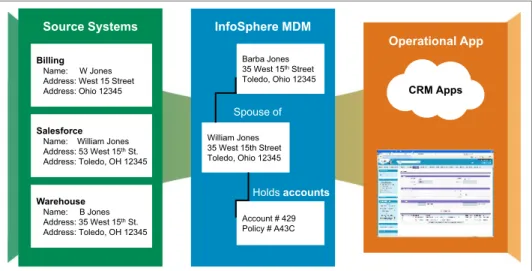
IBM InfoSphere MDM creates trusted views and elevates the effectiveness of your most important business processes and applications. It can help you to improve business results, lower costs, reduce risk, and enable strategic agility. InfoSphere MDM supports multiple MDM styles and domains to work together to provide a comprehensive set of MDM capabilities (as illustrated in Figure 1-1).
Figure 1-1 InfoSphere MDM provisioning a single view of customer Some of the key capabilities of InfoSphere MDM include:
Virtual, physical, or hybrid master repository
Workflow capabilities to implement policies and processes for data stewardship and data governance
Pre-built and extensible data models and business services
Highly accurate probabilistic matching and search
Policy management to author, monitor and enforce data quality
Solutions framework to enable and enhance applications and processes with master data
Data stewardship to inspect and resolve data quality issues
Relationship and hierarchy management to manage household and B2B relationships
Integration with multiple batch and real-time options
Billing
Name: W Jones Address: West 15 Street Address: Ohio 12345
Salesforce
Name: William Jones Address: 53 West 15thSt. Address: Toledo, OH 12345 Warehouse Name: B Jones Address: 35 West 15thSt. Address: Toledo, OH 12345 Barba Jones 35 West 15thStreet Toledo, Ohio 12345 Spouse of William Jones 35 West 15th Street Toledo, Ohio 12345 Account # 429 Policy # A43C Holds accounts
Source Systems InfoSphere MDM
Operational App
Chapter 1. Introduction 17
1.6.3 WebSphere Cast Iron Cloud Integration
IBM WebSphere Cast Iron Cloud Integration products can enable you to help integrate cloud and on-premises applications in days, to help reduce integration costs, and to help optimize resources and productivity in SaaS and cloud models. They provide a graphical configuration approach—rather than custom coding, on-demand tooling, or traditional middleware—to help you integrate applications quickly and simply. They use pre-configured templates based on common integration scenarios to accelerate integration.
WebSphere Cast Iron Cloud Integration products provide several capabilities for near real-time integration, data cleansing and migration, data synchronization and connectivity, and workflow and transformation that enable you to orchestrate integration processes across multiple applications. Mash up capabilities enable you to integrate information from disparate sources and to display it using the native user interface of a cloud application. WebSphere Cast Iron Cloud Integration products also support mobile applications by harnessing data and processes from other parts of the enterprise (as illustrated in Figure 1-2).
Figure 1-2 WebSphere Cast Iron Cloud Integration capabilities
SaaS Applications WebSphere Cast Iron Cloud Integration Secure Connector Web Browser IBM MDM User Customer Firewall SSL Tunnel HTTPS
WebSphere Cast Iron Live
HTTPS
On-Premises Apps
Cast Iron Capabilities
3
2
4
1
Source TargetDesign
Run
Connectivity Transformation Logic Management
Oracle Amazon Microsoft Salesforce.com Google Oracle VMware Cisco NetSuite Taleo SAP ADP DELL Aprimo … DB2 Siebel Sybase CSV CA Technologies SAP Lawson QAD BaaN SQL Server Flat File BMC Remedy
PeopleSoftGreat Plains Epicor
The deployment options include:
WebSphere Cast Iron Express
is cloud-based software that helps you integrateinformation from SaaS applications, such as Salesforce.com, with other data sources.
WebSphere Cast Iron Hypervisor Edition
is a virtual appliance that can beinstalled on existing servers through virtualization technology.
WebSphere Cast Iron Live
is a multi-tenant, cloud-based platform forintegrating cloud and on-premises applications and enterprise systems in a hybrid environment.
1.6.4 Logical architecture of the InfoSphere MDM and WebSphere
Cast Iron Cloud Integration
Figure 1-3 on page 19 shows the logical integration architecture and positioning of InfoSphere MDM and WebSphere Cast Iron Live. InfoSphere MDM, as a mission critical application, is usually set up behind the firewall and in a network that has no inbound or outbound access. WebSphere Cast Iron Live resides outside the firewall and helps broker the calls between the MDM system and external SaaS applications. The WebSphere Cast Iron Cloud Integration Secure Connector ensures that communications between the MDM system and the SaaS applications are secured.
Chapter 1. Introduction 19 Figure 1-3 Logical architecture
Cloud Applications and databases (public/private)
Secure Connector (Production) Cast Iron Secure
Connector (Test)
Project development and unit test in Cast Iron Studio
Applications
(Test) Applications (Production)
Web browser management of project deployment and Cast Iron Live environments
© Copyright IBM Corp. 2014. All rights reserved. 21
Chapter 2.
MDM solution readiness to
participate in integrations
with SaaS applications
This chapter describes various integration strategies, relevant standards, and a other characteristics that on-premises applications generally use. It also describes integrations and master data management (MDM) solutions typically participates in. This chapter discusses the requirements for integrating
on-premises MDM solutions with SaaS applications. It wraps up by outlining different facets of solution definition when it comes to integrating on-premises MDM solutions with SaaS applications.
This chapter includes the following topics:
Integration strategies employed regularly by on-premises applications
Integrations with IBM InfoSphere Master Data Management solutions
General requirements for integrations of on-premises MDM solutions with SaaS applications
Aspects of solution definition
2.1 Integration strategies employed regularly by
on-premises applications
Enterprise applications deployed on premises are integrated for various reasons. The key reason is to draw synergies on the capabilities offered by different applications that have been purchased or built by these enterprises. Historically, point-to-point integration came in being with applications building independent connectors to support inter-application connectivity and processing hand off. Over time, it was seen that complex integration scenarios were not sustainable with this approach had high maintainability and ownership costs.
Point-to-point integration approaches have given way to
enterprise application
integration
(EAI) architectures. EAI architectures predominantly governed howapplications deployed on premises interacted with other, the standards they employed, and other non-functional considerations. Enterprises collaborating with other enterprises also employed integration practices under the umbrella of EAI to enable business-to-business (B2B) integration. EAI architectures helped enterprises enable the integration of people, processes, and information at departmental levels and was easily extended across enterprise boundaries. Early EAI solutions used a sort of
hub and spoke
model to centralize integrations and typically dealt with message brokering from a centrally deployed application. These solutions used to have adapters, data transformation capabilities,orchestration capabilities, stewardship interfaces, and other complex functions to provide a single integration solution for the enterprises. EAI solutions paved the way for better consideration to terms such as loose coupling, made good strides in helping standards around reliable messaging, laid the foundation for connector architecture standards and a few others, however. During this time that EAI was evolving, the B2B integrations saw large companies mandating methods of receiving business information technology with the widespread adoption of electronic data interchange (EDI) standard.
However, given the solution was single point of inter-application messaging and vendor specific nuances were managed in the adapters, this construct fell under its own weight because it was not able to support transactionality and became a single point of failure with no proper standardized failover techniques.
The enterprise service bus (ESB) was an attempt to resolve hub and spoke related issues. ESBs did resolve some of the issues around the EAI solution but also brought to the surface service-oriented architecture (SOA). ESBs served well in real-time asynchronous integrations; however, real-time synchronous integrations needed better capabilities in integration service composability, reliability, transaction processing, and many others.
Chapter 2. MDM solution readiness to participate in integrations with SaaS applications 23 You can find more resource materials about SOA at:
http://www-01.ibm.com/software/solutions/soa/
The following summary provides a roundup of what has been written about SOA by various IBM experts:
SOA provides a disciplined approach to integration that is essential for the enterprise integration architecture. SOA laid down the path for building modular composite applications, laying down high importance on reusable service components using open and available standards. The notion was loosely coupling was taken a step further and component architectures become more powerful as they provided the ability for components to act as service consumers and providers by exposing interfaces in a standard format across a distributed topology.
This improved flexibility of IT systems and provided the following benefits: – SOA based integration approaches used open standards to deliver
integration assets as services, helped reuse of existing assets and avoided proprietary vendor lock-in issues.
– SOA provided a standard to represent and interact with integration components thus providing flexibility to reuse assets and allowing multiple business processes to seamlessly interact with each other.
– SOA shifted the focus of integration solution assemblies rather than implementation details of each function which laid the foundations for Composite applications which ultimately support building a “composable” business.
SOA was partially fueled by the prevalence of the World Wide Web and the HTTP protocol, which in turn helped the creation of remote procedure call (RPC) style and SOAP style web services, Although RPC style web services were more command-oriented, SOAP style was XML-document-oriented. Because of the rigid nature of SOAP-style web services, Representational State Transfer (REST) is an architectural style that can be used as a web service and has gained momentum over the years because it does not have a lock on to the XML payload. Talking about payloads, over time, REST style services with the “schema-less” JSON format has gained prominence. Enterprises continue to use REST style services and web services in the current implementation, and the cloud computing era has brought in web APIs into the landscape of the applications composer.
In summary, enterprises typically use reliable messaging or real-time
asynchronous integrations, services for real-time synchronous integrations, and some ETL solution for bulk data operations.