B-1375
Electrical Stimulation
Purpose, Application and Results
Texas Agricultural Extension Service • The Texas A&M University System • Daniel C. Pfannstiel, Director • College Station, Texas
D.M. Stiffler, J.W. Savell, G.C. Smith, T.R. Dutson and Z.L. Carpenter*
History
The use of electrical stimulation (ES) for increas-ing meat tenderness is not a new idea. Benjamin Franklin remarked in 1749 that, “Killing turkeys elec-trically, with the pleasant side effect that it made them uncommonly tender, was the first practical application that had been found for electricity.” In 1951, more than two centuries after Franklin’s discovery, patents were obtained by Harsham and Deatherage (U.S. Pat-ent No. 2,544,681) and RPat-entschler (U.S. PatPat-ent No. 2,544,724) for their processes of tenderizing car-casses by ES. However, ES was not utilized by the packing industry until recent advancements were made in its technology and new research substantiated its usefulness.
Most of the research on ES has been reported since 1976. Experiments conducted by researchers in New Zealand, Australia, Great Britain and the United States have shown that ES markedly improves meat tenderness. In addition, researchers at the Texas Ag-ricultural Experiment Station observed that this proc-ess enhanced certain quality characteristics such as lean color, lean firmness and visibility of marbling. The packer, retailer, purveyor, restaurateur and con-sumer benefit when ES is used as an integral part of the process of converting live animals to meat and meat products.
Palatability
The search for a postmortem tenderizing method stems from the need to provide the consumer with a uniform, consistent and desirable product relative to palatability (eating satisfaction) attributes. Tenderness is considered the most important palatability charac-teristics of meat. Researchers
*Meat specialist, Texas Agricultural Extension Service; as-sistant professor, professor and associate professor, Texas Agricultural Experiment Station; and head, Department of Animal Science, Texas AM University; The Texas A&M Uni-versity System.
have studied numerous methods to improve meat tenderness which include alternate suspension (Tenderstretch), delayed chilling, high temperature conditioning and cooler aging. These procedures influ-ence tenderness by affecting the muscle contractile proteins, connective tissue or both. During postmor-tem chilling, muscle undergoes a series of biochemi-cal, histological and physical events, collectively termed death stiffening or rigor mortis. Alterations of the events involved in rigor mortis have a pro-found influence on product desirability.
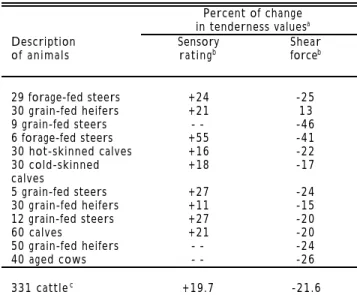
Research at the Texas Agricultural Experiment Station has demonstrated that sizable tenderness im-provements result from ES (Table 1). Although most of the research has involved beef, efforts have also been made to determine the influence of ES on pork, lamb and goat. On the average, tenderness, measured by reduced resistance to shear force, was increased approximately 23, 9, 24 and 29 percent for beef, pork, lamb and goat carcasses, respectively. Sensory panel evaluations indicated that steaks or chops from elec-trically stimulated sides were, on the average, 26, 3, 12 and 32 percent more tender than steaks or chops from untreated sides, for beef, pork, lamb and goats, respectively. ES is of greatest benefit on carcasses that would produce less tender meat if they were not stimulated. Table 2 summarizes the effects of ES on tenderness of cooked steaks from cattle varying ages and from different nutritional management regimes.
Tenderness Mechanisms
There are three theories regarding the mecha-nism or mechamecha-nisms by which ES tenderizes meat. The first involves the fact that in muscle which has not been electrically stimulated, muscle fibers can, and often do, shorten during rigor mortis; such shortening occurs in response to cold and is thus called cold-shortening. Cold-shortened muscle fibers are nor-mally less tender than muscle fibers which have not cold-shortened.
Figure 1 — Beef ribeye muscles from both sides of the same carcass. The side on the left was electrically stimulated while the side on the right was not electri-cally stimulated. The ribeye from the electrielectri-cally stimulated side is brighter colored, firmer, finer textured, has more visible marbling and has no heat-ring com-pared to its unstimulated counterpart.
Cold-shortening occurs most often in carcasses when muscle temperature drops below 50 degrees F within 8 to 12 hours postmortem and when muscle pH (a measure of acidity) remains above 6.1. The lowering of the pH of muscle is caused by conversion of mus-cle sugar (glycogen) to lactic acid. If the musmus-cle pH is lower than 6.1 when the muscle reaches 50 degrees F, cold-shortening seldom occurs. Research indicates that ES of the carcass results in a very rapid drop in muscle pH. Since the pH of muscle in electrically stimulated carcasses is often 5.7 to 5.9 within a few hours after death, cold-shortening is either reduced or prevented. The validity of this concept has been questioned because comparisons of sarcomere length (a measure of the extent of muscle fiber shortening) between muscles from electrically stimulated and not stimulated sides or carcasses do not always differ even though there are almost always differences in tenderness.
The second theory regarding the manner by which ES increases tenderness involves the rapid de-cline in muscle pH while carcass temperatures are still high. Such circumstances are very favorable for the naturally occurring (lysosomal) enzymes to degrade muscle proteins and to cause more rapid tenderiza-tion of meat in a manner referred to as natural aging (storage of meat at refrigerated temperatures for ex-tended periods of time, 7 to 30 days). Studies have shown that the lysosomal enzymes in electrically stimulated carcasses are released sooner and work faster than lysosomal enzymes in carcasses that are not stimulated.
The third possible mechanism by which ES in-creases meat tenderness was hypothesized when light and electron micrographs of muscles from electrically stimulated sides or carcasses revealed structural
dam-age in the muscle fibers. Contracture bands, which may have been caused by localized physical distur-bances from stimulation-induced contractions, are often observed in muscle fibers from electrically stimulated carcasses. The disarray of the protein fila-ments in these contracture bands suggests that such structural damage may be involved in the tenderization response. Also, tenderization may result from the stretching of muscle fibers on either side of the con-tracture band. Stretching results in less muscle fila-ment overlap and less resistance to chewing.
These three mechanisms, singularly or collec-tively, could explain the tenderness improvement as-sociated with ES. The method of stimulation may determine the importance of each mechanism in ten-derizing muscle, since numerous voltages, amperages, cycles and modes of administration of electricity have been used with varying effects on tenderness.
In addition to the reported advantage in tender-ness, sensory panel evaluations of steaks and chops from electrically stimulated sides have revealed in-creases in flavor scores as compared to those for cuts from sides not electrically stimulated. Results indicate improvements of 6, 2 and 6 percent for beef, pork and goat, respectively. Flavor of lamb does not appear to be affected by ES. Although the mechanism by which ES enhances flavor has not been identified, it is known that ES accelerates pH decline and
Figure 2 — Veal ribeye muscles from both sides of the same carcass. The side on the right was electrically stimulated while the side on the left was not electrically stimulated. The ribeye from the electrically stimulated side is much lighter in color and finer in texture than its unstimulated counterpart.
.
enzymatic activities. Since the interactions of pH de-cline and components of muscle are related to long-term natural aging of meat, ES could simply expedite the development of those chemical reactions respon-sible for aged-meat flavor.
Studies also have been conducted to determine the extent to which natural aging negates or comple-ments tenderness differences between electrically stimulated beef and beef that was not electrically stimulated. Research evidence suggests that aging complements the tenderization effect of ES. The use of both ES and aging improved tenderness of loin steaks 44 percent while use of aging alone resulted in a 26 percent improvement in loin steaks tenderness compared to the tenderness of loin steaks removed from carcasses at 2 days postmortem. Another re-search study revealed that loin steaks from electri-cally stimulated carcasses aged for 7 days were about 10 percent more tender than loin steaks from car-casses aged for 21 days that were not stimulated. In this connection, postmortem aging time could be re-duced if ES was used, reducing costs of inventory maintenance, shrinkage and energy use.
Table 1. Summary of effects of electrical stimulation on
tenderness.
Shear force value a Shear force value b
Number of Number of carcasses carcasses or Percentage of Percentage samples improve-ment improve-ment Beef 6 5 6 23% 4 5 2 26% Pork 9 0 9% 1 8 0 3% L a m b 1 3 7 24% 1 0 9 12% Goat 7 3 1 29% 2 2 9 32%
aThe force required to shear a 1/2-inch core of cooked beef,
pork, lamb or goat muscle.
bRatings of comparative tenderness-toughness of cooked
product by an experienced panel of 8 to 10 members.
Table 2. Summary of Electrical stimulation effects on ten-derness.
Percent of change in tenderness valuesa
Description Sensory Shear
of animals ratingb forceb
29 forage-fed steers +24 - 2 5 30 grain-fed heifers +21 1 3 9 grain-fed steers - - - 4 6 6 forage-fed steers +55 - 4 1 30 hot-skinned calves +16 - 2 2 30 cold-skinned calves +18 - 1 7 5 grain-fed steers +27 - 2 4 30 grain-fed heifers +11 - 1 5 12 grain-fed steers +27 - 2 0 60 calves +21 - 2 0 50 grain-fed heifers - - - 2 4 40 aged cows - - - 2 6 331 cattlec +19.7 - 2 1 . 6 aC a l c u l a t e d b y c o m p a r i n g e l e c t r i c a l l y s t i m u l a t e d a n d not
stimulated sides of the same animal.
bAn increase in sensory p a n e l r a t i n g s a n d a decrease in
shear force values indicate more tender meat.
cAverage percentage improvement in meat tenderness.
Quality Characteristics
Although ES was first used to improve tender-ness, its adoption by the meat industry in the United States likely resulted from findings which demon-strated that ES improves lean quality characteristics. Research at the Texas Agricultural Experiment Station has shown that ES reduces the incidence of heat-ring formation, brightens muscle color, increases muscle firmness, expedites the setting-up (development) of marbling and improves retail cut appearance and caselife.
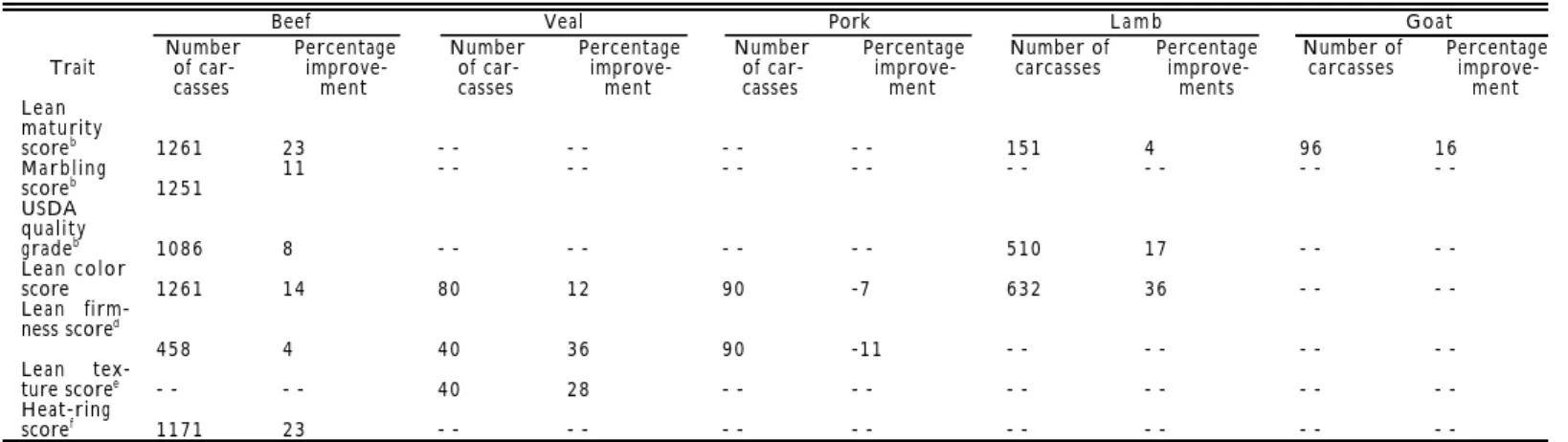
Lean color When beef carcasses are ribbed and evaluated at 18 to 24 hours after slaughter, the lean color of electrically stimulated sides of beef is signifi-cantly brighter than that of sides that were not electri-cally stimulated (Table 3). If lean color would other-wise by dark, ES apparently causes postmortem glyco-lysis (conversion of glucose to lactic acid) to be more nearly complete at the time of carcass ribbing and thus helps to ensure brighter, more youthful lean color than would normally be observed when car-casses are ribbed within 18 to 24 hours after slaugh-ter. If beef might otherwise be only slightly dark cut-ting, ES lessens the problem. However, in a test where selected sides from cattle that were handled in a manner designed to produce moderate to severe dark cutting beef were stimulated, ES did not improve lean color.
Table 3. Summary of effects of electrical stimulation on lean quality characteristics.a
Beef Veal Pork L a m b Goat
Trait Numberof car-casses Percentage improve-ment Number of car-casses Percentage improve-ment Number of car-casses Percentage improve-ment Number of
carcasses Percentage improve-ments
Number of
carcasses Percentage improve-ment L e a n maturity scoreb 1 2 6 1 2 3 - - - 1 5 1 4 9 6 1 6 M a r b l i n g scoreb 1 2 5 1 1 1 - - - -USDA q u a l i t y gradeb 1 0 8 6 8 - - - 5 1 0 1 7 - - -L e a n c o l o r score 1 2 6 1 1 4 8 0 1 2 9 0 -7 6 3 2 3 6 - - -Lean firm-ness scored 4 5 8 4 4 0 3 6 9 0 - 1 1 - - - -Lean tex-ture scoree - - - - 4 0 2 8 - - - -Heat-ring scoref 1 1 7 1 2 3 - - -
-aThe effects of electrical stimulation on lean quality characteristics are reported as percentage improvement.
bBased on USDA beef quality grade standards.
cBased on 8-point scale where 8=very light pink; 1=very dark red or purple.
dBased on 8-point scale where 8=extremely firm; 1=extremely soft.
eBased on 8-point scale where 8=extremely fine; 1=extremely coarse.
fBased on 5-point scale where 5=no heat-ring; 1=extremely severe heat-ring.
For veal and lamb, lean color was also improved (Table 3) by ES. However, ES of pork carcasses seems to have a deleterious effect on lean color. Lean maturity was improved in electrically stimulated veal and goat carcasses (Table 3). Since color, texture and firmness of lean are the most important value-determining characteristics in veal carcasses and cuts, ES greatly improves their quality and value.
Heat-ring prevention A problem not uncommon in the meat industry is heat-ring development in the ribeye muscle of beef carcasses that have not been chilled properly. Heat-ring appears to be caused by the differential chill rate among areas of the ribeye muscle which are believed to cause differing rates of color development and rigor mortis (and consequent differences in extent of muscle fiber shortening) from the exterior to the interior portions. This condition is prevalent in cattle with a thin covering of external fat over the ribeye and results in sunken ribeyes with a two-toned color development.
Prevention of heat-ring is important because carcasses with severe heat-ring may not be eligible for federal meat grading since the grade factors are difficult to evaluate.
Heat-ring is really a misnomer, since this condi-tion apparently results from cold temperature slowing the color and rigor mortis development processes in the portion of the ribeye muscle nearest its outside surface. The proper term for this condition should be cold-ring since the portion of the ribeye that is dark in color, coarse in texture and sunken beneath the plane of the cut-surface is significantly colder, early in the chilling process, than is the inside ribeye portion. Nevertheless, the condition has been termed heat-ring by the meat industry for at least several decades. Research conducted at the Texas Agricultural Experi-ment Station has shown that heat-ring incidence can be significantly reduced or eliminated by ES. Studies on paired sides of carcasses, where one side was electrically stimulated and the other was not, have revealed that heat-ring formation in carcasses ribbed
18 hours after death was substantially reduced in elec-trically stimulated sides.
Marbling Research has shown that marbling scores can be slightly increased by ES when carcasses are ribbed and presented for grading after 12 to 24 hours of chilling. It is common knowledge in the meat in-dustry that sides of beef left to chill longer than their opposite sides usually will exhibit slightly higher mar-bling scores when evaluated. For example, the per-centage of carcasses that grade U.S. Choice on a Monday after 2 or more days of chilling (weekend cattle) is generally higher than the percentage for cat-tle ribbed on other days of the week after only 24 hours of chilling. Apparently, the greater develop-ment of marbling in electrically stimulated carcasses ribbed 1 day after slaughter is similar to that observed in weekend cattle. ES causes the lean to be firmer, finer textured and brighter colored and therefore, probably causes faster setting-up of the fat and greater contrast in appearance of fat and lean in
the ribeye. Differences in marbling between electri-cally stimulated and not electrielectri-cally stimulated sides are minimal or nonexistent if carcasses are chilled for 48 hours or more before ribbing.
Grading Research results at the Texas Agricultural Experiment Station indicate that, on the average, young (A and B maturity groups) beef carcasses that have been subjected to ES and ribbed within 24 hours postmortem will grade 8 percent higher than beef carcasses that have not been stimulated. Such results are highly dependent on the type of cattle being stimulated and the proportions of carcasses falling in the middle of the grade versus those at the extreme ends of the grade. For lambs, USDA grade was im-proved by 17 percent when ES was used.
Retail caselife. When the first electrically stimulated beef was merchandised, retailers were concerned that the retail caselife might be shortened by the ES proc-ess. To study this, Texas Agricultural Experiment Sta-tion scientists conducted retail caselife studies using
both steaks and ground beef. Retail caselife of ground beef was not affected by ES and such product had the same discoloration pattern as ground beef from car-casses that had not been stimulated. Round steaks from electrically stimulated sides, displayed under identical conditions for 4 days, remained brighter for an extra day when compared to round steaks from not stimulated sides. Discoloration of steaks from stimulated carcasses was also less severe. These re-sults indicate that an extra one-half to one full day of retail caselife is possible for steaks from electrically stimulated carcasses.
Safety and Installation
Food Safety and Inspection Service (FSIS), in conjunction with Occupational Safety and Health Ad-ministration (OSHA), has developed safety and sanita-tion standards and requirements for the installasanita-tion and use of ES units or devices, Electrical stimulators may be installed upon approval by the Facilities Group of Meat and Poultry Inspection (MPI) and by the Equipment Group, Facilities Group, Technical Serv-ices, Meat and Poultry Inspection, FSIS, USDA, Washington, DC 20250.
Persons who work near or operate such
equipment must recognize the potential
dan-ger associated with high voltage electrical
stimulators which produce lethal quantities of electricity. Because of this, FSIS requires barriers
at all openings to the stimulator, flashing or rotating lights and audible signals to warn plant personnel that the unit is operating. “Danger — High Voltage” signs must be displayed prominently, and emergency stop buttons to shut off the electrical current must be plainly labeled. The power supply must be locked in the off position when not in use to prevent unauthor-ized personnel from turning on the stimulator. Also, a fail-safe system must be installed around the stimulator to prevent personnel from entering the area while the unit is operative. Low voltage units which are now available to packing plants offer a significant safety ad-vantage compared to high voltage electrical stimula-tors.
Commercial Application
In early electrical stimulation tests, a commer-cially available, B and D “Electro-Sting” Hog Stunner® (440 volt) was used. The stunner was modified for electrically stimulating carcasses or sides by attaching two cables to the separated electrodes in the wand so the probes could be attached to the end of each ca-ble; one pin was placed in the muscles of the round (leg) near the hock and the other pin was placed in
the muscles between the blade bone (scapula) and the vertebrae in the shoulder region. High voltage ES was administered in pulses of .5 to 1 second duration with intervals between pulses of approximately 1 second. Carcasses were stimulated with 25 to 50 pulses of electricity within 1 hour after stunning-sticking and then processed normally.
Later tests (conducted in cooperation with H and H Meat products, Mercedes, Texas) of ES, before in-plant implementation, used a unit (developed in coop-eration with personnel of Agricultural Research, USDA, College Station, Texas) which could generate different voltages, pulse durations and pulse intervals. With this unit, a single electrode was inserted into the neck of the carcass and electricity was administered automatically. Voltage used in these experiments was either 150 or 550; amperage ranged from 0.5 to 5; and up to 20 impulses were administered in a period of 45 to 70 seconds. Response in terms of tenderness in-crease was not closely associated with voltage. How-ever, lean color, freedom from heat-ring and marbling scores appeared to be greatly improved by the use of the higher voltage.
H and H Meat Products was the first firm to use ES. They used a unit patterned after the Texas Agri-cultural Experiment Station test machine. Because of the interest shown by the U.S. meat industry in incor-porating ES into the slaughter-dressing sequence of beef packing plants, several companies: LeFiell Com-pany; Omeco-Boss; Britton Manufacturing, Inc.; and Cervin Company, manufacture equipment to adminis-ter electricity to carcasses. The LeFiell Company was the first commercial firm to install a fully automated high voltage electrical stimulator in a beef packing plant in the U.S. when their electrical stimulator, the Lectro-Tender®, was installed in the Sam Kane Beef Proces-sors plant in Corpus Christi, Texas. Britton Manufac-turing Inc. was the first company to install a manually operated, safety enclosed system in a beef slaughter plant. Their high voltage unit was installed in Freedman Packing Company, Houston, Texas. Electrical stimula-tors are now available for packing plants with kill rates of one to ten head per day, 10 to 40 head per hour or 200 to 300 or more head per hour. Stimulators of all of these capacities are presently in use in the indus-try.
Hand-operated units, both high and low voltage, designed for use by locker plants or small packer op-erators are also available. These stimulators operate over a range of 30 to 700 volts and usually pulse 20 times (2 seconds on, 1 second off) during a 1-minute cycle. A manually inserted probe is placed in the neck or shoulder of the carcass for the high voltage units and a probe or nose clamp is used for the low voltage units. For higher volume slaughter operations, units which consist of single or multiple rub-bars or continuous chainbelt systems are available.
Along with the many ES units available, consider-able variation exists with regard to the location of the ES unit on the slaughter floor. The earliest point in the slaughter-dressing sequence where ES is being commercially applied is the bleeding area. An advan-tage of this location is that additional blood forced from the carcass during stimulation can be readily processed. A surface-contact stimulator is required in this area to prevent contamination of the meat caused by penetration of the hide. Because contact is made only with the hide, no special sanitation of the equipment is necessary. Certain disadvantages are associated with ES in the bleeding area since most plants shackle and suspend cattle by a single leg. Be-cause of this, there can be violent contractions of the free hindleg and subsequent damage to certain mus-cles (for example, the tenderloin). Also, because of the erratic jerking during stimulation some carcasses break the point of contact, causing some arcing of the electrical current and hide damage if a surface contact system, rather than nose clamp system, is used.
Other slaughter plants have positioned ES units after dehiding and before evisceration. Depending on the stage in the slaughter-dressing sequence, there can be problems with urine or fecal contamination if the viscera has not been removed. However, these problems have generally been solved by not rimming or by placing plastic gabs around the bung, tying off the urinary bladder or other practices. Regardless of where stimulation is accomplished it is performed on carcasses after hide removal the contact point must be sterilized between carcasses — before touching the next carcass. ES of the eviscerated, unsplit car-cass best prevents contamination of the carcar-cass by viscera contents. Stimulating sides (after the carcasses are split) is not recommended because it is inefficient, generally does not provide any advantage over stimu-lation of an
unsplit carcass and is associated with violent contrac-tions which can separate the vertebrae (units of the backbone) and pull the meat away from the feather bones.
Low voltage (35 to 70 volts) stimulation units are also commercially available to packing plants in the U.S. These units employ probe attachment in a man-ner that causes the brain and central man-nervous system to elicit muscle contractions. To be effective such stimulation must be conducted in the bleeding area. Low voltages ES will cause muscle contraction only if it is applied within 10 minutes after stunning. The pri-mary advantage of low voltage stimulation is
that it requires minimal safety precautions. Prelimi-nary data suggest that low voltage stimulation initiates a muscle pH decline similar to that associated with the
use of high voltage stimulation. Documented data concerning color development and uniformity, mar-bling set-up and the influence of low voltage stimula-tion on muscle tenderness are limited and inconclu-sive. Some researchers have investigated ES using 100 to 150 volts applied subsequent to bleeding, hide re-moval and evisceration (approximately 45 minutes after slaughter). Data from those studies suggest a more rapid muscle pH drop for electrically stimulated sides than for sides that were not stimulated, but lean quality attributes do not appear to be as favorably affected when ES is applied this way as when high volt-age stimulation is used.
Figure 3 — High voltage commercial rub-bar stimulator. The beef carcass on the left is in a relaxed state while the beef carcass on the right is in the stimulated state. (Notice upward movement of foreshanks in the stimulated carcass.)
Trade names for electrically stimulated meat prod-ucts have evolved as commercial application has in-creased. Sam Kane Beef Processors (Corpus Christi, Texas) call their product ELECTRO-TENDER-aged®. They roller brand carcasses and use that trademark on their boxed beef and portion controlled products. Gooch Packing Company (Abilene, Texas) calls its prod-uct Gooch Good’n Tender Beef® and makes point-of purchase materials, such as gummed labels, posters and signs, and newspaper advertisement inserts available to retailers. Other packers and retailers have initiated
campaigns to promote electrically stimulated products and to inform the public of the availability of meat im-proved by this process.
ES has become a reality in the U.S. because of the efforts of certain progressive beef packers, equipment manufactures and retailers. The amount of electrically stimulated beef in the U.S. beef supply has achieved ma-jor proportions. ES may revolutionize the way cattle are bred, fed, merchandised and marketed; as such, this process could have a tremendous impact on the cattle of the future. A p p r e c i a t i o n i s e x t e n d e d t o t h e K i n g R a n c h , I n c . , K i n g s v i l l e , T e x a s ; t h e T e x a s C a t t l e F e e d e r s A s s o c i a -t i o n , A m a r i l l o , T e x a s ; -t h e L e F i e l l C o m p a n y , I n c . , S a n F r a n c i s c o , C a l i f o r n i a ; t h e B r i t t o n M a n u f a c t u r i n g , I n c . , C o l l e g e S t a t i o n , T e x a s ; a n d t h e O s c a r S c h m i d t M e a t R e s e a r c h D e v e l o p m e n t F u n d f o r s u p p o r t o f t h e e l e c t r i c a l s t i m u l a t i o n s t u d i e s c o n d u c t e d b y t h e T e x a s A g r i c u l t u r a l E x p e r i m e n t S t a t i o n .
The information given herein is for educational purposes only. Reference to commercial products or trade names is made with the understanding that no discrimination is intended and no endorsement by the Cooperative Ex-tension Service is implied.