USING INTERNET SERVICES IN HUMAN RESOURCES MANAGEMENT Olena Oliinychenko
Senior lecturer, Department of «HR management and Labour Economics» National University of Food Technologies, Kyiv, Ukraine
e-mail: lektor.kiev @ gmail.com https://www.linkedin.com/in/lektor
Abstract
The development of Internet services and technologies that are conventionally incorporated in the concepts of «Web 1.0», «Web 2.0» and «Web 3.0» was analyzed. Areas use of technologies and software from the concept Web 1.0 in actions for human resources management (HRM) are set. Areas of use of Web 2.0 services and technologies for key processes in HRM are shown. The potential of the concept of Web 3.0 for HR is now beginning to develop mainly in the «cloud computing» services (particularly in the HR SaaS). Combination of various HRM Systems and Internet services and/or online HR tools for certain HR processes is also actively developing.
Keywords: human resource, personnel management, software, HRMS, Internet services, Web services, HR, HR SaaS, human resource management system, Web, Web 2.0, Web 3.0.
Introduction. The purpose of this research is to determine existing capabilities and ways in using Internet communication technologies and services in human resources management.
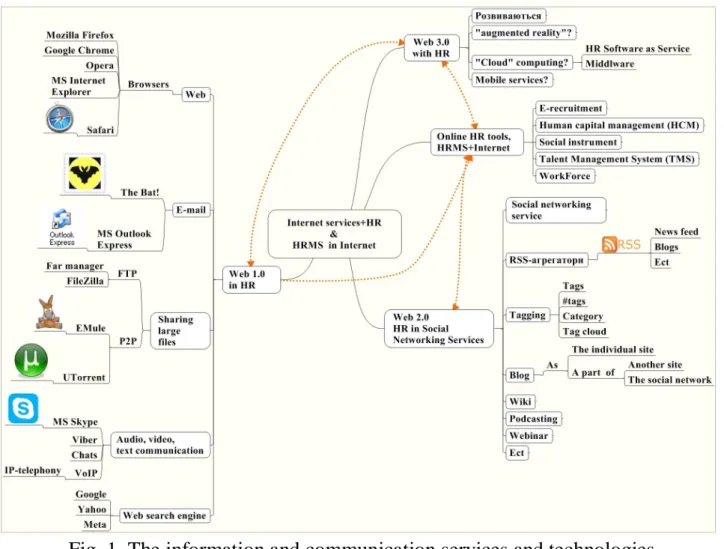
Main text. HR specialists are able to use information and communication services and technologies of the Internet (see Fig. 1). Internet technologies have passed several stages in their development which are conventionally called as the concepts of «Web 1.0», «Web 2.0» and «Web 3.0» [1, 2, 3, 4, 5]..
Each of the concepts is reflected in the form of certain technologies and Internet services, i.e. services provided by the Internet. Specifically, HR-professionals can actively use such technologies and software of concept Web 1.0 which is presented in Table 1.
The appearance of the term «Web 2.0» is associated with the article «What Is Web 2.0» by Tim O'Reilly in 2004 [5]. Furthermore, this concept describes what the perception of the Internet users is actually changing. In times of Web 1.0 open communication in the network occurred mostly anonymously. With the invention of
Fig. 1. The information and communication services and technologies Internet in human resource management
Developed by the author
Web 2.0, users started to add their own personal information about themselves and environment, their preferences, capabilities, goals (so-called «content») and other information. Now there is a need to set some boundaries of confidentiality, which is still not well understood by users.
Table 1 Ways of using Internet services of the concept Web 1.0 in HRM
№ Actions Internet services and software
1 2 3
1
Obtaining professional
information on the Internet, provided by other users, media, digital libraries, etc.
Hypertext. Web browser - program for browsing websites. The most popular are MS Internet Explorer, Google Chrome, Mozilla Firefox, Safari, Opera, ect.
1 2 3
2
Finding relevant information on the websites, FTP sites, news, groups etc.
Web search engine. As a rule browsers are also used for finding information. The most popular search engines are Google, Yandex, Yahoo!, Meta, etc.
3 Sharing large files
Network files sharing or peer-to-peer file sharing (P2P networking). Client programs: uTorrent, eMule.
FTP (file transfer protocol). Client programs: Far manager, FileZilla, etc.
4 Correspondence
E-mail. Mail clients (e.g. The Bat!, MS Outlook, Opera Mail, IBM Notes etc.) or Web-based email services (e.g. mail.yahoo, Gmail, Mail.ru, ukr.net and many others)
5 Audio, video and text communication
Applications that transmit audio, video and text information (e.g. MS Skype, Viber, various chat room)
6 Saving on calls to subscribers of
other cities and countries IP-telephony etc. Source: compiled by the author
Practical implementation Web 2.0 as software and technologies can be considered from 2010. There is no consensus in understanding of examples of practical implementation of the concept of Web 3.0 at the present time.
The concept of Web 3.0 was formulated in 2007 by Jason Calacanis as «the creation of high-quality content and services produced by gifted individuals using Web 2.0 technology as an enabling platform» [4]. The beginning of the practical implementation as software products and technologies can be considered from 2010. There is no consensus in one-valuedness understanding of examples of practical implementation of the concept of Web 3.0 at the present time. That is why different developers of the developers, vendors and users relate to this concept quite various
software and technologies: from the well-known mobile and geolocation services to high-quality video, «cloud computing» technologies, management of computer software «with the power of mind» and 3D-effects (including so-called «augmented reality») [1, 3].
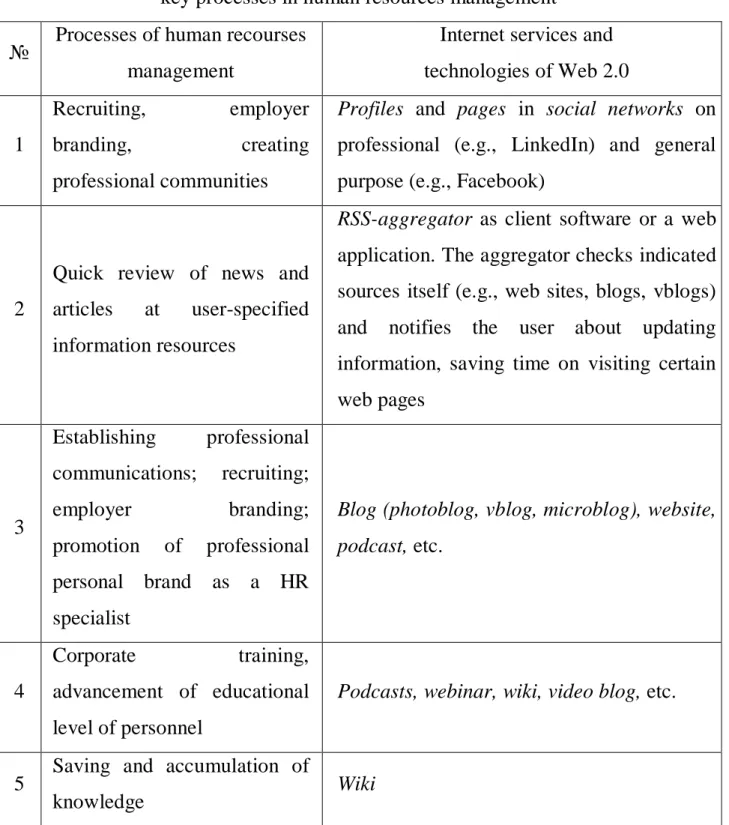
Table 2 Internet services and technologies of the concept Web 2.0, which are involved in the
key processes in human resources management
№ Processes of human recourses management
Internet services and technologies of Web 2.0
1
Recruiting, employer
branding, creating
professional communities
Profiles and pages in social networks on professional (e.g., LinkedIn) and general purpose (e.g., Facebook)
2
Quick review of news and articles at user-specified information resources
RSS-aggregator as client software or a web application. The aggregator checks indicated sources itself (e.g., web sites, blogs, vblogs) and notifies the user about updating information, saving time on visiting certain web pages 3 Establishing professional communications; recruiting; employer branding; promotion of professional personal brand as a HR specialist
Blog (photoblog, vblog, microblog), website, podcast, etc.
4
Corporate training,
advancement of educational level of personnel
Podcasts, webinar, wiki, video blog, etc.
5 Saving and accumulation of
knowledge Wiki
At the present time the limits of terminology between the concepts of Web 2.0 and Web 3.0 cannot be called well-defined. For example, such technologies as «cloud» services or collaboration services (e.g. Google docs) can be attributed both to the concept of Web 2.0 and to the Web 3.0.
Besides, the combination of corporate Human Resource Management Systems (HRMS) (in particular Human capital management, Work Force Management, Talent management system, corporate learning systems, e-recruitment, etc.) with the Internet services is widely used at the present time [2].
Conclusion. So, we found that the possibilities of using Web services 1.0 (Internet technologies and software) in human resources management are limited by specific actions. Resulting of the development and personalization of the concept technologies Web 2.0, active user participation in shaping the content and connections between them, HR-professionals can use Internet services for the key processes in HRM. The potential of Web 3.0 begins to be used in human resources management at the present time. In particular, vendors offer many HR SaaS software. HRMS is actively integrated currently with Internet services or represented as separate online HR tools.
Prospects for further development of the subject are detailed researches of individual types of Internet services and technologies in HR management.
References
1. Christophor Dmitriy. What is Web 3.0. Version and evaluation. / D. Christophe - [E- resource] : - Mode of access : http://therunet.com/articles/1552-chto-takoe-web-3-0-versii-i-otsenki
2. Human Resources System in Russia in 2013 HRM. Short version of the analytical report . [E- resource] : - Mode of access: . http://www.tadviser.ru/index.php/HRM
3. Fedorov A., Martynov D. Windows Azure: the cloud platform Microsoft. / A. Fedorov - [E- resource] : - Mode of access :
http://download.microsoft.com/documents/rus/msdn/Windows_Azure_web.pdf
4. Salacanis Jason. Web 3.0, the "official" definition. / Jason Salacanis - [E-resource] : - Mode of access : http://calacanis.com/2007/10/03/web-3-0-the-official-definition
5. O'Reilly Tim. What Is Web 2.0/Tim O'Reilly - [E-resource] : - Mode of access : http://oreilly.com/web2/archive/what-is-web-20.html