Business Continuity Guide
September 2014
This Guide is primarily intended for use by Government of Alberta Departments, Agencies,
1 | B u s i n e s s C o n t i n u i t y G u i d e
Contents
1 Introduction ... 7
1.1 Executive Summary ... 7
1.2 Introduction to GOA Business Continuity Management (BCM) ... 7
1.3 Authority and Legislation ... 8
1.4 Guiding Principles ... 8
1.5 Business Continuity Standards and Best Practices ... 8
2 Business Continuity Program Creation and Management ... 11
2.1 What is a Business Continuity Program? ... 11
2.2 BCM Program Scope ... 12
3 Business Continuity Plan Development ... 15
3.1 Overview and Plan Development Objectives ... 15
3.2 Planning Steps / Development Process ... 15
3.2.1 Phase 1 - Initial Preparation ... 17
3.2.2 Phase 2 - Interim Plan (optional) ... 17
3.2.3 Phase 3 - Risk Assessment ... 18
3.2.4 Phase 4 - Business Impact Analysis ... 18
3.2.5 Phase 5 - Emergency Response and Contingency Procedures ... 19
3.2.6 Phase 6 - Disaster Recovery and Continuity Strategies ... 19
3.2.7 Phase 7 - Writing ... 19
3.2.8 Phase 8 - Awareness and Training ... 20
3.2.9 Phase 9 – PlanReview, Test, Exercise, Audit and Maintenance ... 20
3.3 Structure and Content of the Business Continuity Plan ... 21
3.3.1 Cover Page, Contents and Layout ... 21
3.3.2 Section 1 – Business Continuity Program ... 21
3.3.3 Section 2 – Plan Activation, Coordination and Communication ... 22
3.3.4 Section 3 – Business Impact Analysis and Risk Assessment ... 23
3.3.5 Section 4 – Business Unit(s) Continuity Procedures ... 23
3.3.6 Section 5 – Review, Maintenance, Training, and Exercises... 23
3.3.7 Section 6 – Supporting Documents ... 24
3.4 Approval and Distribution ... 24
2 | B u s i n e s s C o n t i n u i t y G u i d e
4 Plan Activation and Incident Management ... 27
4.1 Overview ... 27
4.2 Management and Control Responsibilities ... 27
4.2.1 Executive Team ... 27
4.2.2 Management Team ... 27
4.2.3 Operational / Response Team ... 28
4.3 Emergency Operations Centre (EOC) Location ... 28
4.4 Emergency Procedures ... 29
4.4.1 Facility Emergency Response Plan (FERP) and BCP. ... 29
4.4.2 Building Evacuation... 29
4.5 Plan Activation Procedures and Operations ... 29
4.5.1 Level of Response... 29
4.5.2 Escalation and Control ... 29
4.5.3 Escalation Process ... 30
4.5.4 De-escalation Processes ... 30
4.6 Communication Plan ... 30
5 Risk Assessment ... 34
5.1 Key Terms ... 34
5.2 Risk Assessment in Business Continuity Planning - Background ... 35
5.3 Risk Assessment vs Business Impact Analysis... 36
5.4 Objectives of Risk Assessment ... 36
5.5 Risk Assessment Process ... 37
5.5.1 Choosing RA Framework ... 37
5.5.2 Risk Assessment Considerations ... 37
5.5.3 Risk Assessment Walkthrough ... 38
5.5.4 Step 1 – Setting the Context ... 40
5.5.5 Step 2 – Risk Identification ... 40
5.5.6 Step 3 – Risk Analysis ... 41
5.5.7 Step 4 – Risk Evaluation ... 44
5.5.8 Step 5 – Risk Mitigation ... 46
5.6 Summary ... 48
3 | B u s i n e s s C o n t i n u i t y G u i d e
6.1 Key Terms ... 51
6.2 Overview ... 52
6.3 Why Conduct Business Impact Analysis ... 53
6.4 How to Conduct Business Impact Analysis ... 53
6.4.1 Step 1 – Define the Scope ... 54
6.4.2 Step 2 – Preparing the Business Impact Analysis ... 55
6.4.3 Step 3 – Data Collection: Scope and Methods ... 56
6.4.4 Step 4 – After the Interview ... 58
6.4.5 Step 5 – Input of the Data (BIA) ... 58
6.4.6 Step 6 – BIA Data Control ... 60
6.5 Final BIA Report ... 60
6.6 Summary ... 61
6.7 Checklist ... 62
6.8 BIA Worksheets ... 63
7 Business Continuity Strategies ... 68
7.1 Key Terms ... 68
7.2 Overview of Business Continuity Strategies ... 69
7.3 Methods / Sources of Information to Develop Strategies... 71
7.3.1 What BCOs Need to Know When Gathering Information to Develop Continuity Strategies... 71
7.4 Approaches for Business Continuity Strategies ... 71
7.4.1 Disaster Recovery Strategies ... 72
7.4.2 Business Continuity Strategies ... 73
7.5 Strategy Selection Process ... 73
7.5.1 Selection Process ... 73
7.5.2 Strategy Outcomes ... 74
7.5.3 Steps for Strategy Selection Process ... 74
7.5.4 Executive Input, Decision and Implementation ... 75
7.6 Summary ... 75
8 Awareness and Training ... 78
8.1 Awareness and Training Objectives ... 78
4 | B u s i n e s s C o n t i n u i t y G u i d e
8.3 Training ... 78
8.3.1 General Staff Awareness Training ... 78
8.3.2 Business Continuity Team Training ... 79
8.3.3 Executive and Senior Management Training ... 79
8.4 Awareness and Training Frequency ... 79
9 Program Maintenance ... 82
9.1 Overview ... 82
9.2 Review Process ... 83
9.3 Audit Process ... 83
10 Exercising and Testing ... 86
10.1 Overview ... 86
10.2 Exercises Types or Methods ... 87
10.2.1 Walkthrough or Orientation Business Continuity Exercise (BCX) ... 87
10.2.2 Table Top BCX ... 87
10.2.3 Simulation BCX ... 87
11 Lessons Learned ... 91
11.1 Purpose ... 91
11.2 Lesson Learned Activities ... 91
11.2.1 Conducting Lessons Learned Session ... 91
11.2.2 Documenting Lessons Learned Activities ... 92
6 | B u s i n e s s C o n t i n u i t y G u i d e
Business Continuity Management
About this section1. Introduction
1.1. Executive Summary
1.2. Introduction to GOA Business Continuity Management (BCM) 1.3. Authority and Legislation
1.4. Guiding Principles
7 | B u s i n e s s C o n t i n u i t y G u i d e
1 Introduction
1.1 Executive Summary
When a significant event causes disruption to the provision of essential services to Albertans, the Government of Alberta (GOA) will activate the GOA Business Continuity Plan (BCP) in order to recover and return to normal operations. The GOA BCP outlines the framework by which the government manages the continuity of its essential services during business disruptions. Under the coordination of Alberta Emergency
Management Agency (AEMA), individual departments will implement their individual BCPs (as required) to ensure the continuation of critical and vital services that are essential for the health and safety of all Albertans. Under current legislation and in conjunction with industry best practices, AEMA and GOA departments maintain
comprehensive Business Continuity Management programs to address the known and unknown risks that may adversely impact their operations.
This guide is intended to assist Business Continuity Officers (BCOs) and their Business Continuity Teams through the process of business continuity planning and
management. This guide provides an overview of current best practices targeted at GOA departments, and while extensive, may not cover unique departmental
requirements. Users are encouraged to seek additional information beyond the scope of this guide to meet the demands of their departments. Similarly, while many of the lessons and components in this guide may apply to community business continuity, those users should ensure fit and applicability for their specific requirements. Additional information and assistance for GOA departmental Business Continuity Teams is
available from the Business Continuity Planning Section of AEMA.
1.2 Introduction to GOA Business Continuity Management (BCM)
When a disruptive incident occurs, and the initial emergency response has been resolved, departments need to begin the task of addressing business continuity;
specifically, restoring and maintaining essential services. Through a comprehensive BC Program, underpinned by a comprehensive BCP, departments will be better able to assess potential risks, understand their impacts and know how to resume essential services efficiently and effectively, regardless of the mechanism of disruption.
A comprehensive BC Program will:
Ensure provision of essential services to all Albertans;
Ensure and maintain confidence in government;
Minimize potential revenue loss; and
8 | B u s i n e s s C o n t i n u i t y G u i d e
1.3 Authority and Legislation
The current legislative framework for business continuity planning in the GOA is derived from the Emergency Management Act (EMA) and the Government Emergency
Management Regulation (GEMR). These documents assign roles, responsibilities and authorities for business continuity planning in the GOA.
The GEMR assigns AEMA the responsibility for developing, implementing and maintaining the Alberta Emergency Plan (AEP) and the GOA BCP. The GEMR also assigns AEMA the responsibility for requiring each department, in consultation with AEMA, to prepare, implement, and maintain a BCP; accountability for business continuity planning within each department is retained by the Deputy Head of the department (typically a Deputy Minister).
1.4 Guiding Principles
This guide is intended to provide a frame of reference for BCOs to develop, maintain and improve their departmental BC Program. This guide is meant to highlight current industry best practices and provide suggestions or an alternative perspective that will enhance existing BCPs. The Guide is not a prescriptive instruction manual that must be followed to meet GOA BCP requirements. Where templates have been provided, users are encouraged to modify them to meet their needs.
1.5 Business Continuity Standards and Best Practices
Business Continuity continues to gain momentum and recognition within both the national and the global emergency management framework. Currently, the GOA recognizes that in the international BC community, ISO 22301:2012 serves as the comprehensive standard for business continuity professionals to benchmark against in developing and enhancing their BC Programs. AEMA employs ISO 22301:2012 and Canada’s CSA Z1600 in administering the GOA BC Program. The CSA, as a Canadian standard, is viewed by AEMA as the prime standard against which GOA programs are measured. While neither of these standards has been formally adopted by the GOA, these standards have been considered in developing this Guide and will be used on an ongoing basis to inform best practices for the GOA.
10 | B u s i n e s s C o n t i n u i t y G u i d e
Program Creation and Management
About this Section2. Program Creation and Management 2.1. What is a BC Program?
11 | B u s i n e s s C o n t i n u i t y G u i d e
2 Business Continuity Program Creation and Management
2.1 What is a Business Continuity Program?
At its core, BC is focused on minimizing preventable disruptions to the essential
programs and services offered by a government, an industry, or a business, and when preventing service gaps is no longer an option, business continuity describes processes and practices to restore and resume business as efficiently as possible. Within the GOA, BC refers to both the protecting of outward services provided to Albertans as well as to the internal processes that support those services. For example, it is insufficient to say that the GOA prioritizes providing ‘essential service X’ without also committing to maintaining the software, IT systems and staff resources (for example) required to deliver that service.
The central document of a BC Program is the BCP. The BCP is a plan that prioritizes essential services, describes mitigation measures, and coordinates and implements continuity of service strategies when a business disruption occurs. The BCP should be a living document that reflects the values, objectives and framework of its parent department. Like any good plan, especially within government, it is flexible and readily adapted to each departmental reorganization. It cannot be a stagnant document that sits quietly on a shelf without regular review; the BCP must prompt regular discussion and debate around ensuring that the departmental mission, goals and objectives can be achieved regardless of external disruptions. A BCP must outline realistic and
achievable strategies that help departments identify and prioritize their core services; recognize risks and how to mitigate them; and create specific, actionable solutions to continue providing service regardless of disruptive events and emergencies.
The Business Continuity Management (BCM) Program is a cyclical program that delineates and describes all activities concerning business continuity within the department. A typical BCM Program encompasses development of a BCP (as described in this guide); awareness and training for the department on the BCP; activation and execution of the BCP as required; and amendments and improvements to BC matters on a regular basis.
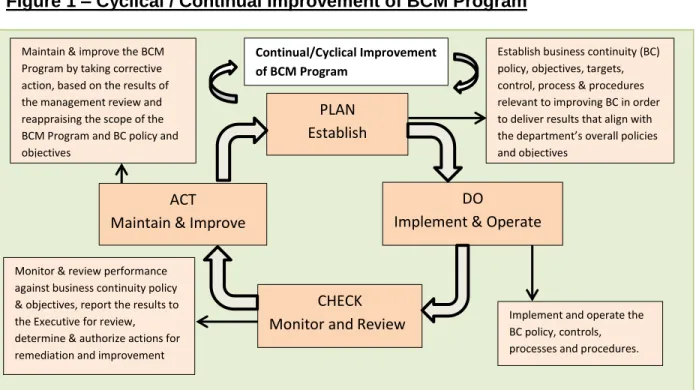
An effective BCM Program will involve participation of various disciplines that need to be coordinated throughout the BCM life cycle. The BCM Program must be managed within an established framework and according to the principles contained in the department’s BCM policy. A BCM Program must reflect the department’s strategy, objectives and culture to ensure that the program is relevant, effective and meets current service delivery goals. The cyclical /continual improvement of a BCM program involves a Plan, Do, Check and Act model as illustrated in Figure 1 below.
12 | B u s i n e s s C o n t i n u i t y G u i d e
Figure 1 – Cyclical / Continual Improvement of BCM Program
2.2 BCM Program Scope
Clearly defining the scope of the BCM Program allows the Business Continuity Team (BCT) to specifically describe what is encompassed by the program, and limits
redundancies caused by external partner plans or programs. The scope of a BCM Program begins with identifying the departmental mission and objectives, and outlining what processes and services support those overarching principles. A clearly articulated scope also helps participants understand the limitations of a BCM Program which can reduce concerns that a BCT will encroach upon or impede existing program authorities or priorities. Finally, by defining what is outside of the scope of the BCM Program, a BCT ensures that the resulting BCP will not be a document that is too large or unwieldy to be accessible to staff.
PLAN Establish
DO
Implement & Operate
CHECK Monitor and Review ACT
Maintain & Improve
Monitor & review performance against business continuity policy & objectives, report the results to the Executive for review, determine & authorize actions for remediation and improvement
Maintain & improve the BCM Program by taking corrective action, based on the results of the management review and reappraising the scope of the BCM Program and BC policy and objectives
Establish business continuity (BC) policy, objectives, targets, control, process & procedures relevant to improving BC in order to deliver results that align with the department’s overall policies and objectives
Implement and operate the BC policy, controls, processes and procedures.
Continual/Cyclical Improvement of BCM Program
14 | B u s i n e s s C o n t i n u i t y G u i d e
Business Continuity Plan Development
About this section3. Business Continuity Plan Development
3.1. Overview and Plan Development Objectives 3.2. Planning Steps / Development Process
3.2.1. Phase 1 – Initial Preparation 3.2.2. Phase 2 – Interim Plan (Optional) 3.2.3. Phase 3 – Risk Assessment
3.2.4. Phase 4 – Business Impact Analysis
3.2.5. Phase 5 – Emergency Response and Contingency Operations 3.2.6. Phase 6 – Disaster Recovery and Continuity Operations 3.2.7. Phase 7 – Plan Development
3.2.8. Phase 8 – Awareness and Training
3.2.9. Phase 9 – Review, Test, Exercise, Audit and Maintenance 3.3. Structure and Content of the BCP
3.3.1. Cover Page, Contents and Layout
3.3.2. Section 1 – Business Continuity Program
3.3.3. Section 2 – Plan Activation, Coordination and Communication 3.3.4. Section 3 – Business Impact Analysis and Risk Assessment 3.3.5. Section 4 – Business Units Continuity Procedures
3.3.6. Section 5 – Review, Maintenance, Training, and Exercises 3.3.7. Section 6 – Supporting Documents
3.4. Approval and Distribution 3.5. Summary
15 | B u s i n e s s C o n t i n u i t y G u i d e
3
Business Continuity Plan Development
3.1 Overview and Plan Development ObjectivesA BCP provides guidance for sustaining essential services during a disruption, and procedures for recovering those functions that are disrupted.
Plan Development Objectives are to:
Understand the purpose and role of supporting plans (i.e. Communication Plan, Crisis Management Plan, Facility Emergency Response Plan, Disaster Recovery Plan), and development of policies and procedures;
Identify the key people involved in implementing the BCP, and clarifying their roles and responsibilities before, during and after a disaster; and
Understand the process, design framework, structure and contents of the BCP.
3.2 Planning Steps / Development Process
Developing a plan is a deliberate process that will engage multiple partners across your department. It is recommended that you work through a progressive development process that will enable to you to build your BCP through collaborative and objective analysis. The successive planning steps / development process described below are intended as suggested guideposts that will facilitate GOA departments in producing an effective BCP. In order to develop a relevant and tailored BCP, each departmental BCO must determine the level of detail required for each step to address their specific departmental needs.
16 | B u s i n e s s C o n t i n u i t y G u i d e
Figure 2 – Phases of BCP Development
PHASE 1 Initial Preparations
PHASE 8 Awareness & Training PHASE 3
Risk Assessment
PHASE 7 Writing
PHASE 6
Continuity & Recovery Strategies PHASE 5
Emergency Response Operations & Contingency Considerations PHASE 4 Business Impact Analysis PHASE 2 Interim Plan (optional) PHASE 9 Exercise / Test Audit / Review Plan Maintenance PHASES 3 & 4 Click Hyperlink to open
17 | B u s i n e s s C o n t i n u i t y G u i d e 3.2.1 Phase 1 - Initial Preparation
As with any major policy, program, or plan development sequence, there are a number of key considerations which must be addressed before commencing a deliberate process to create a BCP. The following list of common considerations is not
exhaustive; individual departments may have unique considerations to address as part of their initial preparation:
Management Engagement
- Identify the right level of management to sponsor the BC Program. In the GOA this decision is the responsibility of each department deputy head;
- Ensure management understands what the BCP will encompass, when it would be used, and what are its intended outcomes; and
- Be open about the resources necessary to support the program and complete the BCP, and confirm that these resources will be available throughout the development of the plan.
Research and consider legislation, industry regulations, and any other directives or policies that guide or impact the department;
Secure team member participation and commitment; and
Define the scope of your BCP.
3.2.2 Phase 2 - Interim Plan (optional)
To develop a comprehensive BCP takes time. Disasters can happen at any time prior to completion of a thorough BCP. If a BCP is being developed for the first time (as
opposed to updating or modernizing an existing plan), departments may want to consider adopting an Interim Plan. An Interim Plan offers limited protection against disruptions and should be prepared when the department doesn’t have an existing BCP or the current BCP is significantly out of date. The Interim Plan should be solely focused
Involve Executive Management in the following:
Assignment of a project sponsor to take ownership for the BCP project. He or she is responsible for ensuring that:
- Support for the planning project from all senior managers is obtained and maintained; - Planning activity is completed on schedule; and
- Department wide awareness of the BCP project and the completed BCP. Objectives and scope for the project are approved
A BCO is formally appointed to:
- Organize and supervise project planning, development and review;
- Organize and supervise the planning process, the creation of the BCP and its testing, training and ongoing maintenance; and
18 | B u s i n e s s C o n t i n u i t y G u i d e
on critical services that are regarded as particularly at risk or vulnerable. An Interim Plan will normally be developed independently by the members of the BCT, whereas the development of the full BCP will require wide stakeholder engagement.
Phase 3 and 4 – Risk Assessment and Business Impact Analysis
3.2.3 Phase 3 - Risk Assessment
Risk Assessment consists of identifying and assessing risks that can potentially disrupt business operations. Upon completion of a Risk Assessment, BCOs should know the most likely and most dangerous threats to departmental operations. The Risk
Assessment then will inform possible actions for risk mitigation. Risk mitigation consists of those actions that can be taken to reduce the likelihood of the occurrence of a
specific risk, or reducing the impact should the risk occur.
3.2.4 Phase 4 - Business Impact Analysis
The BIA begins with identifying the specific business units within the department, and the specific resources required to execute the responsibilities of those units. These resources include (but are not limited to) specific locations, staffing levels, IT
requirements, training requirements, etc. From here, the BCT will then assess the effect on the department should one of the business units be unable to execute their duties.
Key Things to Consider when Devising an Interim Plan are: Notify management about the Interim Plan Structure and Roles; Appointment of a BCT (if not already done) to develop the Interim Plan; Establish a procedure for convening the BCT;
Identify basic recovery requirements and practical recovery strategies; and
Ensure that the Executive Team is fully aware of, and approves the Interim Plan once completed.
Fordetailed information onRisk Assessment, click the hyperlink
There is no clear industry consensus on whether you should conduct your Business Impact Analysis (BIA) or your Risk Assessment first. Each BCO must weigh the needs and vulnerabilities of the department to determine in which order to complete the BIA and the Risk Assessment; they can also be completed concurrently.
19 | B u s i n e s s C o n t i n u i t y G u i d e
This enables the BCT to prioritize the services and resources necessary to maintain (or restore) the essential business units in the event of a disruption.
3.2.5 Phase 5 - Emergency Response and Contingency Procedures This phase consists of reviewing existing emergency response procedures and
assessing their connection to the BCP. Emergency Response Plans (ERPs) often focus on contingency activities for specific types of disruption, plan activations, and
coordination that will need to be generalized to meet with the all-hazard approach of a BC Program.
3.2.6 Phase 6 - Disaster Recovery and Continuity Strategies
Disaster Recovery Strategies are specifically concerned with recovering the information and technology (IT) systems that support the department. Continuity Strategies are those strategies designed to resume departmental operations other than IT systems – for example manual workarounds or staffing reallocation.
3.2.7 Phase 7 - Writing
This phase identifies the key people who will draft, review, and produce the actual BCP. This team determines the structure and contents for the BCP.
REMEMBER - The people who will execute the plan should participate in the development of the plan. This is to ensure that inputs to the plans are provided by the appropriate subject matter experts and that you do not end up with an impractical plan.
For detailed InformationonBusiness Impact Analysis Section, click the
hyperlink.
For detailed information on Business Continuity Strategies, click the
hyperlink.
For detailed information onEmergency Procedures Section,click the
20 | B u s i n e s s C o n t i n u i t y G u i d e 3.2.8 Phase 8 - Awareness and Training
This section details the mechanisms by which the department will be made aware of the BC Program, the BCP, and their roles in supporting departmental BC. It also serves to outline the specific training requirements necessary for executing specific response and recovery activities. A comprehensive Awareness and Training program ensures that all members of the department will be able to work together effectively.
3.2.9 Phase 9 – Plan Review, Test, Exercise, Audit and Maintenance
BCPs are not static; they must evolve as the department changes. Thus, whenever there is a significant change in a department (new staffing levels, new technology, change in organization or organizational responsibilities), the current BCP should be reviewed by the BCT to ensure its relevance and effectiveness. Once complete, the BCP must be tested (preferably through an exercise) to validate the plan and identify any areas that require clarification/improvement. If possible, upon completion of initial validation through an exercise program, the BCP should be audited by an outside agency to ensure clarity and thoroughness by someone who is not intimately familiar with the department. Finally, once the BCP has been validated and reviewed for effectiveness, the BCP will require regular review and maintenance to ensure that it remains relevant until the next formal revision.
For detailed information onAwareness and Trainingclick thehyperlink.
Auditing and review are terms that are sometimes used interchangeably. In this Guide, an audit is conducted by an individual or body that is external to the BCP development, and measures the plan against an empirical standard, typically legislation or formally adopted policies. A review is a less formal assessment which can be conducted internally or by an external partner. For example, the GOA Corporate Internal Audit Services may audit a BCP against current Alberta legislation; whereas a BCO may review their BCP after a
departmental reorganization to ensure communication pathways are still relevant and intact.
For detailed information onExercise and Testing; and Program Maintenance
21 | B u s i n e s s C o n t i n u i t y G u i d e
3.3 Structure and Content of the Business Continuity Plan
A BCP must include sufficient information to enable individuals not intimately familiar with the internal workings of the department to clearly understand how the department will maintain its essential services in the event of a disruption. There is no set template for a BCP; all departments must determine what best addresses their needs. However, there are some commonalities between all effective BCPs.
3.3.1 Cover Page, Contents and Layout Cover page and Executive Foreword
The cover page must clearly display the effective date, confidentiality restrictions (if any), and any legal disclaimers. An Executive Foreword drafted by the senior member of the BCT is also required to signify Executive approval and support of the plan. This Executive Foreword will be signed by the deputy head of the department.
3.3.2 Section 1 – Business Continuity Program Introduction
The introduction outlines the BCM Program of the department, the structure and
purpose of the BCP, conditions for activation of the plan, and who is specifically affected by the plan.
Department Business Continuity Management Program Policy
This section describes the departmental policy underlying the Business Continuity Management (BCM) Program. At a minimum, it will include:
Applicable legislation, regulation, and governance framework;
The department’s specific policy statement regarding Business Continuity;
The specific objective of the BCM Program;
The scope of the department’s BCM Program;
The assumptions underlying the BCM Program; and
22 | B u s i n e s s C o n t i n u i t y G u i d e
Departmental Organizational Structure
This section outlines the overarching structure of the department. It lists the business units of the department, and briefly describes the function of each. This enables a clear understanding of the interdependence of the business units, and the services they provide both internally to the department and the GOA, and externally to Albertans. Departmental Business Continuity Organizational Structure
This section identifies those personnel specifically assigned tasks in the departmental BC Program. This section describes the roles and responsibilities of each member of the BCT and identifies essential and non-essential personnel in the event of a disruption of any type. The Departmental Business Continuity Organizational Structure includes (but is not limited to) the Executive Team, the designated Business Continuity Officer(s), and representatives from each Business Unit.
3.3.3 Section 2 – Plan Activation, Coordination and Communication Activation and Escalation Procedures
This section explains the criteria by which the BCP is activated and the procedures for its implementation. It includes notification procedures, recall of essential personnel procedures, and instructions on activation of Emergency Operations Centres (EOCs) or alternate sites.
Facility Response Procedures (May be included; not specifically part of the BCP) Many business disruptions result from damage or loss of the facility within which the business occurs due to physical damage (fire, flooding, severe weather etc). The departmental BCP may (but is not required to) describe the procedures that will be followed in the event of damage or loss of the facility while it is occupied. If these procedures are included, they should (at a minimum) include the procedures by which evacuation of the facility will be conducted, how staff will be accounted for, and how the emergency at the facility will be mitigated. This detail is required to be described in the Facility Emergency Response Plan (FERP), a separate document that connects to the BCP.
Communications and Coordination
This section outlines the procedures by which all communications, both internally to affected staff and externally to the GOA and Albertans as a whole will be executed. At a minimum this section will include specific identification by position as to who is
23 | B u s i n e s s C o n t i n u i t y G u i d e
will be executed. This section also outlines coordination processes in both routine operations and in the event of a disruption.
Essential Services List
This section lists all essential services provided by the department and identifies the maximum duration they can be disrupted. This enables prioritization of resources and recovery efforts. This list will include those resources that are necessary for performing the essential service. The Essential Services List is the cornerstone upon which the rest of the BCP is built.
Contact Information
This section includes current contact information for those personnel identified as essential within the BCP. At a minimum it must include e-mail addresses and telephone numbers for both working hours and after-working hours. Each person identified on this list must also have a designated alternate who must provide the same contact
information.
3.3.4 Section 3 – Business Impact Analysis and Risk Assessment
While not a specific element of the BCP, the Business Impact Analysis (BIA) and Risk Assessment (RA) should be included. BIAs and RAs are key elements required to build a BCP that is both realistic and effective. While the background documentation from these two activities is not specifically required to be contained in the BCP itself, doing so is highly recommended as a means of aiding understanding of the complete context of the overall Plan.
3.3.5 Section 4 – Business Unit(s) Continuity Procedures
For smaller departments in the GOA that operate from a single location, a single BCP may be sufficient. For larger departments, or departments that operate from multiple locations, it may be necessary for individual business units or geographic regions to prepare a separate BCP. In this case, individual business units or location-based Continuity Plans will be included in the departmental BCP as separate documents or annexes. The departmental BCP will describe how the department as a wholewill recover from a disruption that affects the department generally; the business unit Continuity Plans will describe how each specific business unit will recover from a disruption that affects a business unit individually.
3.3.6 Section 5 – Review, Maintenance, Training, and Exercises
This section describes the means by which the BCP is maintained, trained, tested, and updated. At a minimum it will include identification of who is responsible for review,
24 | B u s i n e s s C o n t i n u i t y G u i d e
maintenance and exercise design (usually the BCO) and the frequency for each of the listed activities.
3.3.7 Section 6 – Supporting Documents
This section includes any supporting plans or documents that help inform, but are not essential to the departmental BCP. These documents are usually in the form of Annexes, Appendices, and Attachments depending upon how critical they are to the understanding of the departmental BCP. For example, a departmental-specific glossary would generally be included as an Annex, while emergency response plans from the municipality in which the department is located could be an attachment.
3.4 Approval and Distribution
Once the BCP is finalized, the BCO will schedule a briefing to the Executive members of the departmental BCT. At this time the BCO will review the plan in detail and seek formal approval of the plan. In the GOA context, approval authority is generally held at the level of Deputy Minister. Once the Executive team (including the deputy head) has approved the plan, it is distributed across the department. Generally it is preferred that only limited numbers of hard copies are provided, as version control becomes
problematic as the plan is updated.
3.5 Summary
BCPs are living documents that require a great deal of time and effort to prepare properly. They must be reviewed, and revised if necessary, every time the
circumstances from which they were prepared materially change.
Preparation of an effective BCP is an art form. The temptation to include every possible detail in a BCP must be resisted; a plan that attempts to provide for every possible eventuality spreads itself so thin that it prepares for none. Instead, BCOs must identify the crucial elements that make their department an effective element of the GOA and prepare plans to minimize the impact of a disruption and recover from a disruption in the shortest time possible. If the BCP provides a clear set of processes, protocols, and procedures adaptable to any disruption, regardless of the actual mechanism of disruption, it will serve its intended purpose.
Executive Team buy-in is paramount to the success of any BCP. Without top-level involvement in the development and implementation of the BC Program, the program risks stagnation or under-prioritization. This will lead to the GOA being ineffective when Albertans need them most.
26 | B u s i n e s s C o n t i n u i t y G u i d e
Plan Activation and Management
About this section4. Plan Activation and Incident Management 4.1. Overview
4.2. Management and Control 4.2.1. Executive Team 4.2.2. Management Team
4.2.3. Operational/Response Team
4.3. Emergency Operations Centre (EOC) Location 4.4. Emergency Procedures
4.4.1. Facility Emergency Response Plan (FERP) and BCP 4.4.2. Building Evacuation
4.5. Plan Activation Procedures and Operations 4.5.1. Level of Response
4.5.2. Escalation and Control 4.5.3. Activation Processes 4.5.4. Escalation Process 4.5.5. De-escalation Processes 4.6. Communication Plan
27 | B u s i n e s s C o n t i n u i t y G u i d e
4 Plan Activation and Incident Management
4.1 OverviewThis section describes the normal process by which a business disruption is identified and communicated, how the initial impact assessment is performed, and how a decision to activate the BCP is made and by whom. This section also describes the
establishment of emergency operations and notification process for recovery teams. Specific procedures are required for:
Incident management and control;
Incident detection and reporting;
Alerting and notification;
BCP activation and deactivation;
Emergency Operations Centre activation;
Impact and damage assessment (coordinated with emergency response plan) and situation analysis; and
Development and approval of an Incident Action Plan (IAP).
4.2 Management and Control Responsibilities
This section provides an overview on incident management span of control. It describes the roles and responsibilities of key players within the BCM program and identifies the delegation of authority and management succession in the BCM program. Within the GOA, this section can also outline departmental liaisons to the BCP.
4.2.1 Executive Team
Executive Team is responsible for decision-making and directing crisis communication for significant business disruption. They retain the authority to activate the BCP, and may, where appropriate, delegate that authority to the BCT in accordance with the department’s BCP. Executive Teams are generally comprised of Executive Directors, Assistant Deputy Ministers, and Deputy Ministers (or their equivalents).
4.2.2 Management Team
The Management Team reports directly to the Executive Team, and has the
responsibility to oversee business recovery and continuity processes being executed by the BCT and the operational staff. The Management Team may receive delegated authority to activate the BCP. They are responsible for communicating recovery status to the Executive Team and making the necessary management decisions to support the recovery efforts, in addition to implementing executive decisions. They oversee the
28 | B u s i n e s s C o n t i n u i t y G u i d e
business disruption from the initial response to the point at which normal business operations are resumed based upon continuity strategies. Management Teams are generally comprised of Managers and Directors (or their equivalents).
Specific responsibilities of the Management team may include:
Assessing preliminary impacts with support from the BCT;
Provision of regular reports to the Executive Team on the current status of the incident (when activated) or status of the program (regular business cycle);
Developing action plans during an activation for Executive approval;
Execution and supervision of Executive Team direction;
Supervision of the execution of the BCP; and
Organization and provision of administrative support to the recovery effort.
4.2.3 Operational / Response Team
The Operational / Response Team is responsible for executing specific recovery processes necessary for continuity or recovery actions of critical business functions at the primary location or alternate locations. The Operational / Response Team reports directly to the Management Team. The Response Teams may be broken into sub-teams, each with their own leader to facilitate the recovery effort.
Specific responsibilities of the Operations / Response team include:
Execution of the business recovery procedures for their area of responsibilities in the order of priority identified in the BCP;
Communication of the status of recovery to the Management Team as needed;
Identification of issues or problems that must escalated to the Management Team for resolution;
Establishment of shifts for Recovery Team members to support the recovery effort;
Establishment of liaison with alternate site personnel if needed; and
Identification of resources needed for recovery operations.
4.3 Emergency Operations Centre (EOC) Location
The EOC is the centre from which overall direction and control, coordination and resource support will be provided to the Management Team to resolve a disruptive incident. EOCs can be activated in response to Consequence Management events as well as to Business Continuity disruptions. When developing an EOC plan,
29 | B u s i n e s s C o n t i n u i t y G u i d e
consideration should be given to communication systems, facility security, and equipment needed during the BCP activation.
4.4 Emergency Procedures
4.4.1 Facility Emergency Response Plan (FERP) and BCP.
The Facility Emergency Response Plan (FERP) is a plan to respond to an emergency event that has impacted a specific facility/building. It focuses on ensuring the health and safety of the building’s occupants, identifies hazards specific to the facility, and outlines the processes for evacuating the facility. To ensure facility events are reported, it is advisable to establish a relationship between the FERP and BCP. Note that this
relationship does not mean that FERP is part of the BCP; it merely means that the two are connected.
4.4.2 Building Evacuation
Emergency response procedures should be detailed in the FERP. All building evacuation or shelter-in-place processes must also be detailed in the FERP.
4.5 Plan Activation Procedures and Operations
4.5.1 Level of Response
Differing levels of impact will require differing levels of response. Determination in advance of level of impact/response will ease decision-making with respect to a business continuity disruption. Level of impact is determined based upon the effect on essential services. For example, if a disruption is considered minor, it may solely require monitoring, but if the disruption is considered major or extreme, activation of the BCP would be required. See activation process flowchart.
4.5.2 Escalation and Control Notification
A BCP must clearly define notification processes for both:
Detection of Potential Disruption – A disruption is likely or predicted to occur; and
Declaration of Disruption – A disruption has occurred and is impacting essential services.
30 | B u s i n e s s C o n t i n u i t y G u i d e 4.5.3 Escalation Process
A BCP must clearly describe:
EOC activation and the methods by which the BCT will be convened;
Executive and Management Team notification procedures;
External Partner notification procedures;
Staff notification procedures;
BCP implementing instructions (roles and responsibilities, locations etc); and
Impact Assessment Criteria, including triggers for escalation.
4.5.4 De-escalation Processes A BCP must clearly describe:
Triggers by which response activities can be reduced;
The process to deactivate the BCP; and
Procedures for demobilization and resumption of normal operations.
4.6 Communication Plan
The communication plan must clearly describe:
Management of internal / external communications;
Lines of responsibility for communications between Executive Team, Management Team, and Operational Response Teams; and
Draft key messages for external partners who may be affected by the disruption.
31 | B u s i n e s s C o n t i n u i t y G u i d e
Figure 3 - Plan Activation Process
Notify: - Executive Team - Management Team / Business Continuity Team - Staff - POC - Stakeholders Disruption Occurs
Assess the Scale, Impact and Duration of the Disruption
Are Critical and Vital Services Disrupted or Impacted Significant Impact? Activation of BCP Not Required Monitor Situation Activate BCP
Take necessary steps / actions to:
- Manage disruption - Maintain / Continue
Critical & Vital Services - Resume and Recover all
Activities
Facility Emergency Response Plan – If disruption requires evacuation of the building or facility YES NO NO YES Activate EOC if Required
C
O
M
M
U
N
I
C
A
T
I
O
N
Deactivate Plan Notify Stakeholders33 | B u s i n e s s C o n t i n u i t y G u i d e
Risk Assessment
About this section5. Risk Assessment (RA) 5.1. Key Terms
5.2. Risk Assessment in Business Continuity Planning – Background 5.3. Risk Assessment verses Business Impact Analysis
5.4. Objectives of Risk Assessment 5.5. Risk Assessment Process
5.5.1. Choosing RA Framework
5.5.2. Risk Assessment Considerations 5.5.3. Risk Assessment Walkthrough 5.5.4. Step 1 – Setting the Context 5.5.5. Step 2 – Risk Identification 5.5.6. Step 3 – Risk Analysis 5.5.7. Step 4 – Risk Evaluation 5.5.8. Step 5 – Risk Mitigation 5.6. Summary
34 | B u s i n e s s C o n t i n u i t y G u i d e
5 Risk Assessment
Merriam-Webster defines risk as “the possibility that something bad or unpleasant (such as an injury or a loss) will happen”. This definition should be kept in mind throughout this section.
5.1 Key Terms
Risk (in the context of BC) – effect of uncertainty on objectives with a resulting effect that is a positive or negative deviation from what is expected.
Risk Assessment – overall process of risk identification, risk analysis and risk evaluation.
Risk Owner – person or entity with the responsibility and authority to manage a risk. Risk Identification– process of finding, recognizing and describing risks.
Risk Analysis – process to comprehend the nature of a specific risk and to determine the level of risk.
Likelihood - chance of something happening.
Asset – anything of value to the department. Assets can be tangible (such as a building) or intangible (such as reputation).
Quantitative Assessment – an assessment method through which statistical values are assigned to specific risks for comparison.
Qualitative Assessment – an assessment method that assigns non-statistical values to risks. This assessment produces narrative, descriptive or comparative information about risks.
Probability – a measure of the chance of an event or incident happening. Frequency – the number of occurrences of an event in a defined period of time.
35 | B u s i n e s s C o n t i n u i t y G u i d e
5.2 Risk Assessment in Business Continuity Planning - Background
Risk in the GOA BC Program may be defined as a situation that leads to a disruption in a department’s ability to deliver essential services. Thus, risk is a factor that must be carefully managed to ensure that the GOA is able to sustain operations and deliver services to Albertans at all times.
In order to properly mitigate risk, it first must be thoroughly assessed against two factors: probability, or the chance that the particular risk will disrupt essential service delivery; and impact, the degree of disruption that would be caused if the risk occurred. An example of the difference between likelihood and impact of a specific risk is that a disruption of essential services due to key staff absenteeism as a result of an influenza pandemic may be classed as likelyduring flu season, but that the impactof staff absenteeism due to influenza may be minor if the department is closed for holidays and would not be providing services anyway.
To prevent disruption and ensure continuity of service, the threats or risks to the
essential services must be identified through a robust Risk Assessment (RA) process. RA and Business Impact Analysis (BIA) are the foundation of effective business
continuity planning, but the two processes are often confused. RA consists of identification and analysis of specific risks that may affect a department’s ability to deliver essential services to Albertans. Conversely, BIA consists of identification and analysis of those business processes / activities (including required resources) that are needed to deliver those essential services, and the effect of disruption upon them.
Which Comes First? Risk Assessment or Business Impact Analysis.
Business continuity practitioners have debated whether Risk Assessment is necessary to complete an effective BIA. Some have argued that Risk Assessment is not necessary to complete a BIA, because business continuity is about minimizing the consequences of a disruption. While this may be true, limitations on resources means that not every risk can be mitigated, and thus within the context of the GOA, a Risk Assessment is necessary in order to focus effort.
36 | B u s i n e s s C o n t i n u i t y G u i d e
5.3 Risk Assessment vs Business Impact Analysis
BIA is discussed in greater detail later in this guide. However, the table below provides some key distinctions between RA and BIA in relation to business continuity.
5.4 Objectives of Risk Assessment
Identify the various threats to departmental delivery of essential services;
Assess departmental vulnerability to each threat and the potential exposure should the risk occur; and
Review controls presently in place to mitigate or reduce risks, and ensure that business unit owners understand those risks and decide to accept, prevent or manage them.
Key Points – RA versus BIA
What RA does
Provides understanding of risks to delivery of departmental essential services
Permits comparison between risks of different types, thereby enabling prioritization of mitigation resources Enables assessment of vulnerability of
essential services to risk
What BIA does
Provides understanding of business processes / activities
Ranks services based upon their criticality to resumption of normal operations
Provides understanding of the impact of disruption, which enables
assignment of recovery objectives and prioritization
The Disaster Recovery Institute and British Continuity Institute have identified the basic competencies needed to successfully complete risk evaluation and control as:
Understand the threats, loss potential, and vulnerability. Evaluate risk analysis tools and techniques.
Define a risk evaluation strategy. Select a process to evaluate risk.
37 | B u s i n e s s C o n t i n u i t y G u i d e
5.5 Risk Assessment Process
5.5.1 Choosing RA Framework
There are a number of methodologies / techniques ranging from simple to complex (CSA Z1600- 2008) that BCOs can employ to complete their departmental RA.
Each BCO must complete their RA with whichever tool is most appropriate for their department, and with which they feel comfortable. While there is no GOA-specifically mandated RA tool, the GOA does require every department to have an ERM process, and has recommended ISO 31000:20091 as a framework for enterprise wide risk management.
5.5.2 Risk Assessment Considerations
The following are some of the key considerations for a successful RA, regardless of the chosen methodology:
An effective RA process is dependent upon having the right people participating in the process;
RA must be conducted with the department’s essential services at the forefront;
Participants must fully understand the chosen RA method so that they can participate in the process;
Unforeseen risks may be identified as a result of the combined knowledge of the RA group. These new risks must be accounted for in the final assessment;
Risks can only be managed once they have been identified and assessed;
Essential services must be identified prior to commencing the RA;
Risks, once identified, may be mitigated, accepted, or ignored. This decision will come from the risk owner;
A written report of the RA must be compiled and approved by the department Executive Team; and
1
GOA Enterprise Risk Management - https://ext.sp.tb.alberta.ca/Planning/Pages/ERM.aspx Some commonly used tools for Enterprise Risk Management (ERM) are:
- ISO 31000 Risk Management Principles and Guidelines.
- Committee of Sponsoring Organizations (COSO) ERM – Integrated Framework. - Australia/New Zealand Standard (ASS/NZS 4360:2004) Risk Management.
When choosing the framework for your RA, it is appropriate to consider the framework that has been adopted by your ERM unit or branch.
38 | B u s i n e s s C o n t i n u i t y G u i d e
RAs will be reviewed annually at a minimum, and will be fully conducted whenever there is a significant change in the department.
5.5.3 Risk Assessment Walkthrough
A sample walkthrough of a RA using ISO 31000 risk management principles and guidelines follows below. The key steps are:
Setting the Risk Context – identify the departmental essential services and describe both the internal and external requirements in their delivery;
Risk Identification – identify the specific risks that could potentially disrupt the department’s delivery of its essential services;
Risk Analysis – determine and describe each risk in terms of its likelihood and impact;
Risk Evaluation – compare the results of the risk analysis against risk criteria in order to determine whether a specific risk will be accepted, mitigated, or ignored. Note that acceptance or ignorance of a risk is a decision to be made by the risk owner, not the BCO; and
Risk Mitigation – identification of specific actions that will be taken to lessen the likelihood of a risk occurring, the impact that the risk would have, or both.
40 | B u s i n e s s C o n t i n u i t y G u i d e 5.5.4 Step 1 – Setting the Context
Risk cannot be assessed in a vacuum. A risk that may be critical to one department may only be incidental to another. Accordingly, the first step of a RA is setting the departmental context. Setting the context requires (but is not limited) to the following inputs and will deliver the following outputs:
Setting the Context - Inputs
Essential Services - Identify departmental services and categorize them as Critical, Vital, Necessary and Desired. It is important to understand these services at all levels of your department;
Scope – Define the scope for the RA. Will the RA cover every Business Unit or will it be limited to a specific Business Unit?;
InformationGathering – Gather all necessary information including (but not limited to) legislation, regulation, policies, and historical data; and
SWOT analysis tool - Evaluate the current Strengths, Weakness, Opportunities and Threats for your department.
Setting the Context - Outputs
The required output from context setting is an understanding of the broad themes of risk that your department faces. These themes include (but are not limited to) risk caused by loss of staff, loss of IT, loss of communications etc. Not every department will face the same risk themes, and not every theme will carry the same weight in each department. 5.5.5 Step 2 – Risk Identification
Risk identification is the process by which specific risks are named and described. It must be noted that naming a risk must be done by generalization based upon the underlying nature of the risk. For example, a risk may be named and defined as a lack of sufficient trained personnel. It is immaterial in terms of BC planning (other than in mitigation strategies) as to whether this lack is caused by absenteeism due to illness or inability to physically access the work location as a result of severe weather. The
underlying problem is that sufficient trained personnel are unavailable to deliver the department’s essential services. Risk identification is performed by the BCT and the risk owners.
Methods to Identify Risk
Methods for risk identification include surveys and questionnaires, interviews, focus groups, workshops, previously approved policy documents, legislation, and historical data.
41 | B u s i n e s s C o n t i n u i t y G u i d e
Risk Identification - Inputs
Risk context developed in the previous step of the process; and
Essential Services List. Risk Identification - Output
Named list of risks for your department; and
Existing mitigation strategies. 5.5.6 Step 3 – Risk Analysis
During this step of the RA process, the named list of risks for your department will be considered in the context of likelihood and impact. This is the step wherein mitigation strategies will be identified / developed, and prioritized in order to ensure resources are best employed. The objective of risk analysis is to understand risk in terms of its
likelihood of the named risk occurring, and its impact on essential services. During this stage the BCO will develop more specific risks (i.e. absenteeism due to illness) from the generalized risks (absenteeism) in order to better determine the likelihood of the risk occurring.
There are many ways by which the likelihood of a risk occurring and its impact are determined, but the two most commonly used methods of analysis are quantitative and
qualitative.
5.5.6.1 Quantitative analysis
Quantitative analysis consists of comparing specific statistical values for risks. In general, this method is most used for comparing the impact of a disruption rather than likelihood, as it is possible to determine quantities from a disruption (dollars lost,
Albertans not served at a data centre, facilities unavailable) whereas it is impossible to place a numeric value on the likelihood of a risk (How many floods will happen? How many pandemics will happen?).
5.5.6.2 Qualitative analysis
Qualitative analysis consists of comparison based upon informed judgment of a
likelihood or an impact. The key requirement for qualitative analysis is that the judgment is informed; guesswork or generalities do not represent qualitative analysis.
Both qualitative and quantitative techniques are useful in determining the likelihood and impact of a risk, but neither method is superior. Quantitative analysis is more specific, but requires detailed, accurate, and consistent information for a comparison to be useful. Qualitative analysis, while less specific than quantitative, is better able to
42 | B u s i n e s s C o n t i n u i t y G u i d e
describe potentialities. Nobody can see the future; one can only estimate the probability and impact of an event. One caveat to a quantitative assessment is the fact that as circumstances change, the value of historical data changes. For example, if a BCO was estimating the likelihood and potential impact of flooding in a specific area, all historical data would become invalid once flood mitigation measures were completed.
5.5.6.3 What is likelihood in the context of Risk Analysis?
Likelihood in the context of Risk Analysis is a statement that describes the chance that a specific event will happen in a specific area. It generally is expressed as a function of time, i.e. there is a 30% chance that this area will flood in the next two years.
Quantitative measures for calculating Likelihood:
Frequency: The number of times a named event occurs over a chosen timeframe in a particular location. An example would be that a building has flooded three times over the past seven years. Probability: An expression of how expected an event can be in the future. Probability is usually
expressed as a percentage. Probabilities are based upon previously recorded frequencies. For example, a 100-year flood has a 1/100 chance of occurring in any given year, or expressed as a probability of 1% or 0.01. An event that is expected to occur 3 times of the next 2 years would have a 1.5 probability each year, or a 150% chance of occurrence.
Qualitative representation of likelihood expresses the chance of occurrence through descriptive words. Each word, or phrase, will have a designated range of possibilities attached to it. A caveat to qualitative representation is that the descriptive word or phrase must be explained in the Risk Analysis. The table below displays some common Probability and Frequency descriptors.
Sample Probability and Frequency Descriptors
P Descriptor Probability (P) definition F Descriptor Frequency (F) definition Certain >99% chance of occurring in a given year (one or
more occurrences per year.)
Frequent Up to once in 2 years or more Likely 50 - 99% chance of occurring in a given year
(one occurrence every one to two years.)
Likely Once in 2 years up to once in 25 years
Possible 5-49% chance of occurring in a given year (one occurrence every 2 to 20 years.)
Possible Once in 25 years up to once in 50 years
Unlikely 2-5% chance of occurring in a given year (one occurrence every twenty to fifty years.)
Unlikely Once in 50 years up to once in 100 years
Rare 1 - 2% chance of occurring in a given year (one occurrence every fifty to one hundred years.)
rare Once in 100 years Extremely
rare
<1% chance of occurring in a given year (one occurrence every one hundred or more years.)
43 | B u s i n e s s C o n t i n u i t y G u i d e
Once this process has been completed for all named risks, the risks can then be ranked from Most Likely to Least Likely.
5.5.6.4 What is Impact in the context of Risk Analysis?
Impact or consequence are used interchangeably; for the purpose of this guide, impact will be used. Impact means the effect on the department should the risk occur. Much as with likelihood, impact can be can be expressed through qualitative expression or quantitative measurement.
Quantitative representation of impact:
One common measure of impact is to determine the damages that may be caused by the occurrence of the risk in terms of dollar amount of the likely loss. This may be estimated through historical data. This dollar value can include second and third-order effects if known.
Qualitative representation of Impact:
Not every potential impact can be quantified, and quantitative measurements may not adequately express the scope of a risk occurrence. To better express the effect of risk occurrence on Albertans, qualitative representation of impact should be incorporated into risk analysis. A loss may cost a great deal of money, but be mostly invisible to daily life; conversely, a relatively minor cost in dollars could have a great impact, such as complete loss of access to electronic records due to a power outage. As with likelihood, qualitative impact descriptors must be described to ensure consistency during the analysis.
AEMA has identified a range of conditions to measure impact and these include manageability of the event, staff health and safety, essential services and records, infrastructure, interdependence, financial costs, and public visibility2.
Below is an example of a qualitative measurement system for fatalities and injuries. You can repeat the same with the rest of measurement criteria you have chosen (such as financial costs, public visibility etc.).
2
GOA BCP 2013:- Cross Government Risk Assessment Annex M, Figure M1
44 | B u s i n e s s C o n t i n u i t y G u i d e
Major Impact Significant and lasting disruption of service to a large number of Albertans over a large area
Moderate Impact Significant disruption of service for a short period to a moderate number of Albertans in a limited area
Minor Impact Minor disruption of service for a short period to a limited number of Albertans in a small area
Negligible Impact No disruption of service to Albertans, but a condition that must be remedied before normal daily operations can resume
5.5.6.5 Key considerations in analyzing risk include (but are not limited to):
Determination of the frequency of the particular risk;
Degree of predictability of the particular risk;
Speed of effect of the mechanism of risk (i.e. fire has a high speed of effect, while pandemics have a low speed);
Duration of period between warning of risk and effect of risk occurrence;
Duration of disruption likely to be caused by the particular risk;
Degree of permanence of the disruption caused by the particular risk (ie a facility destroyed by fire has a high degree of permanence, while staff outages caused by a pandemic has a low degree of permanence);
Existing mitigation strategies; and
Obligations (external and internal).
Risk Analysis Output
List of particular risks expressing both the likelihood and impact of each risk. 5.5.7 Step 4 – Risk Evaluation
In a perfect world, each department would have unlimited resources to mitigate each identified risk. Unfortunately, however, the GOA operates in a resource-constrained environment and must decide which risks must be mitigated and which risks must be accepted. In order to do this, each particular risk identified in the Risk Analysis must be evaluated against each other in order to enable prioritization.
Risk evaluation assists in determining the vulnerability of an organization to the risk events. Risk evaluation is the process of comparing risk levels with established criteria to determine whether a risk is acceptable or tolerable.
This process is done after completing risk analysis; it requires estimation of both impact and likelihood for an entire department through careful and objective consideration.
45 | B u s i n e s s C o n t i n u i t y G u i d e
The risk that is considered to have high impact / likelihood might actually turn out to have low or medium impact after considering the organization’s preparedness, adaptability and mitigation measures already in place. Alternatively, without mitigation, a medium impact risk could actually represent a high impact in the event of risk occurrence.
Therefore, vulnerability refers to the susceptibility of an organization to a risk. When
calculating vulnerability to the threat consider success (how likely the threat is to succeed);
extent (how much damage there is likely to be) and rating (summary of both aspects, value
from the chosen range for vulnerability).
A sample categorization method for risk evaluation is displayed below:
Risk Rating Interpretation DETERMINE
ACCEPTABILITY OF RISK
These risks are very high. Countermeasures recommended to mitigate these risks should be implemented as soon as possible.
These risks are moderate. Countermeasure implementation should be planned in the near future.
These risks are low. Countermeasure implementation will enhance organization’s preparedness. They are of less urgency than the above risks.
Vulnerability to Threat
Impact of Loss Low Moderate High Very High DETERMINE RISK LEVEL FOR EACH TRHEAT Major Moderate Minor Negligible