Building Performance Bulletin
For more information and links to helpful and related information sources, visit the Wood Durability web site at www.durable-wood.com.A downloadable PDF version of this publication is also available from the site.
This publication was produced in collaboration with Forintek Canada Corporation, Canada’s Wood Products Research Institute.
© 2004 Copyright Canadian Wood Council Ottawa, Ontario, Canada 25M-03-04
Design and production by:
Accurate Design & Communication Inc. Printed by:
Introduction and Background
Wood, a long-lasting, economical, and renewable resource, is the building material of choice in North American housing. This is largely due to the proven performance of properly designed and built wood frame buildings that have provided strong and lasting housing for a multitude of people. Although wood can withstand much abuse, it needs to be stored and handled properly to perform according to expectations. Managing moisture in structural wood products is essential in order to control swelling and shrinkage and prevent problems associated with mold or decay.
Wood and Moisture
Wood is a semi-porous material. It absorbs moisture and swells when conditions are wet or humid and releases moisture during dry periods. The amount of water that the wood contains at any time is called Moisture Content, (MC). This value is expressed as a ratio of the weight of water in the wood to the weight of the oven-dry wood. For example, if a board has 25% MC, one fifth of the board’s weight is water.
When wood reaches a balance with the surrounding atmosphere and does not absorb or release moisture, it is said to have reached its Equilibrium Moisture Content.
Wood changes dimensionally with changes in mois-ture content. Lumber shrinkage is much larger across the grain (radial or tangential shrinkage), and is negligible parallel (longitudinal) to the grain, as shown in Figure 1.
The moisture content of freshly sawn lumber is much higher than the equilibrium moisture content wood will reach under normal service conditions. This is why lumber is generally dried before being shipped to users. Drying lumber increases its structural performance, greatly reduces the chances of fungal growth such as mold, stain, or decay, and reduces swelling and shrinkage, which could lead to warping or other problems.
The “S-Dry” label on a North American grade-stamp for construction lumber indicates that the lumber was surfaced at a moisture content of 19% or less.
Figure 1:
Dimensional Changes in Wood
Grading agency Mill designation Species group Moisture content Assigned grade
S-P-F
RS-DRY
1
000
Rule of thumb – for every 4% change in MC, there is approximately 1% change in the radial/tangential direction.
Figure 2: Grade Stamp
Panel products such as plywood or OSB (Oriented Strand Board) are at a low moisture content at the time of manufacturing (see Table 1). Engineered wood products such as I-joists also tend to have moisture content lower than S-Dry lumber, which keeps them very dimensionally stable as long as they are dry.
Table 1: Typical Moisture Content of Wood Products at Time of Manufacture
Product Moisture Content
Lumber – S-Dry 19% or less
Lumber – S-Green Usually over 19% Panel products (OSB, plywood) 4-8%
I-Joists 4-16%
Wood that is Not Kept Dry
Wood that is in contact with water over a long period of time can become discolored for various reasons and may grow fungi, including stains, molds and decay.
Discoloration – Is it due to Moisture?
If wood stays wet, it can take on a darker appear-ance due to the water. This dark appearappear-ance will disappear when the wood dries again, but if it stays wet too long, it may become permanently discolored. Discoloration of the wood may be due to moisture issues or other causes.
Potential causes of discoloration in wood include: • Staining fungi (usually “bluestain” that goes
deep into the wood)
• Weathering (gives wood a grey colour) • Decay fungi (the wood may be weaker) • Mold (may appear in various colours - grey,
red, brown, black, white yellow) • Dirt (will rub off when dry)
• Iron stain (caused by steel straps, machinery from transportation or manufacturing)
• Yeasts (black and slimy to the touch) • Miscellaneous chemical stains (caused by
naturally occurring wood chemicals)
Of these, only decay will affect the structural per-formance of the wood; other forms of discoloration will not weaken the wood. In the case of staining fungi, the staining may have occurred in the tree before the wood was sawn into lumber, although storing wet lumber over a long period of time may also cause staining of the wood.
Decay fungi are different from molds and staining fungi. Molds and stains feed off the free water and the sugars stored inside the wood but don’t affect the wood strength. On the other hand, decay fungi will gradually eat the wood if it remains wet for too long. Although conditions for mold and stain growth are also favorable to decay, the presence of mold or stain does not indicate that there is decay. Still, excess water, as well as moderate to warm tempera-tures that sustain mold growth, could ultimately lead to decay, if the wood is not quickly dried.
Molds are everywhere; therefore, they have the potential to thrive where there is moisture. They have received much public attention after having been identified as a contributor to poor indoor air quality, along with dust, mites and other factors. Molds can grow on many surfaces, including wall-board, paint, shower curtains, ceramic tile and grout, as well as wood. Although there are still many unknown factors regarding molds and their effects on health, one thing is for sure: molds indicate a problem with moisture management in the building. Water can come from various sources and the way to solve the problem is to remove these sources. Ensuring that materials are dry during construction is a good practice to reduce the chances of problems down the road.
Potential causes of water entry in the building include: • Plumbing failure
• Poor thermal performance
• Poor detailing of the envelope (leaks) • Poor ventilation
Wall construction practices have evolved. Air tightness is emphasized and many new materials are available for wall construction. Though there are typically provisions included in the wall design for the building envelope to dry, it is good practice to ensure that building materials are dry (ie. 19% MC or less) at the time of enclosing the wall. Refer to the Canadian Mortgage and Housing Corporation Best Practice Guides for a discussion on the proper designing of wood frame envelopes.
Most building codes require that wood be dried to 19% MC or less. This moisture content is sufficiently low to virtually eliminate the chances of mold growth on wood products as well as minimize dimensional changes in the members.
Moisture and Construction
Wood used in Buildings
In normal applications, wood will undergo changes in moisture content throughout its life in relation to sea-sonal changes in relative humidity and temperature. For example, in more humid regions, wood will have Figure 4: Moisture Content vs. Humidity and the Risk of Mold Growth
0 5 10 15 Moisture Content (%) Humidity (%) EMC at 21°C (70°F) 20 Safe Zone Intermediate Zone Danger Zone 10 25 20 30 40 50 60 70 80 90 100
an average moisture content value that is higher than in drier regions. In fact, wood is a good moisture sink and will help equilibrate the humidity fluctuations in the building. Figure 4 illustrates how wood comes into equilibrium with relative humidity and temperature in a building envelope. The Figure also indicates that • The risk of mold increases with higher moisture
content and relative humidity, particularly when these conditions are sustained for longer time periods;
• Mold can start growing where humidity levels exceed 80%; although growth is slow, it can speed up when humidity is higher.
Furthermore, it is worth noting that
• Wood moisture content level typically has to be high (30% and above) for an extended period, in order for wood to decay;
• Most fungi grow fastest in the 60-80°F (15-25°C) range; around freezing, they grow very slowly or not at all.
The following Table lists some examples of expected long term average MC values for lumber inside the building envelope in various North American regions.
Table 2: Average Yearly MC for Wood in Various North American Regions
Region Average MC Range of Wood (%) Coastal 8-12
Inland 6-10 Drier climates 5-9
All these values are below 19% moisture content, which means that wood will slowly keep drying in service. The time for wood to reach equilibrium with the surroundings is not critical in such cases, as the moisture content levels are below those that will sup-port fungal growth. However, changes in moisture content result in dimensional changes that could lead to serviceability problems if not considered during design and construction. Simple construction details, such as ensuring that materials are compatible and leaving gaps between sheathing, will accomodate shrinkage and swelling.
Engineered wood products are manufactured using dried wood in a controlled environment. As a result, these products are dimensionally stable. Severe wetting could compromise quality and dimensional stability. Panel products and engineered structural wood products should be protected from moisture.
Wood Outside Buildings
Some outdoor applications such as decks and porches are more conducive to decay. In such cases, the wood should be protected by treatment (preservative treated wood). Otherwise, a naturally durable species, such as cedar, should be considered. Regardless of the protection provided, it is good practice to keep wood away from potential water sources. Should that not be possible, the structure should be detailed to ensure that moisture does not accumulate and that wood will re-dry after wetting.
Figure 5: Design to Accommodate Shrinkage and Swelling in Building Products
Site Considerations
Most wood construction products, even those intended for protected interior use, are often left outside for a length of time, where they are subject to picking up moisture from rain, snow, or the ground. Outdoor storage on the building site should be minimized to limit potential damage caused by exposure to moisture. This can often be achieved by careful planning.
Upon Delivery
Do Don’t
Prepare the material storage area. Let water infiltrate through torn wrapper The site should be clean, and well-drained
Examine the state of the wrapper upon delivery Drop the bundles in puddles or allow them to be dumped on the ground
Leave intact specialty wrapping on the bundles Store wood products in basements
Fix or replace damaged wrapper with a good Lift I-joists in ways they are not designed for;
quality tarp lift with the web in the vertical position, how they
are designed to take structural loads
Store materials off the ground Leave the materials in an area that incites theft
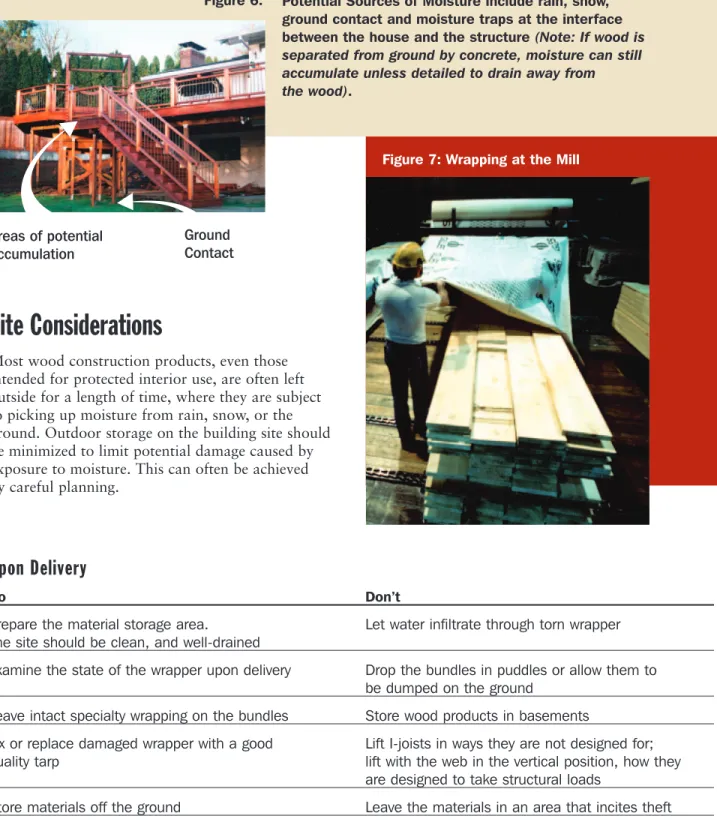
Potential Sources of Moisture include rain, snow, ground contact and moisture traps at the interface between the house and the structure (Note: If wood is separated from ground by concrete, moisture can still accumulate unless detailed to drain away from the wood).
Figure 7: Wrapping at the Mill Figure 6:
Areas of potential accumulation
Ground Contact
Construction Sequence
Storage and Handling Techniques
Storage Area
• Ensure storage area is well-drained and clear of obstacles, debris, and vegetation (Vegetation can harbour insects, prevent good ventilation and keep the air moist).
• If the soil is wet or poorly drained, place a poly-ethylene tarp or a temporary gravel pad on the ground below the supports for the materials.
Storage Off Ground
• Keep packages of lumber, trusses, I-Joists and panels 6 to 8 inches off the ground (dry wood in contact with the ground will quickly take up water).
• Store bundles as level as possible.
Do Don’t
Have the material delivered as close to the Let the materials sit too long. Materials left exposed installation date as possible risk water absorption and deterioration, as well
as theft
Protect the materials after they have been installed Hurry to “close-in” the walls, especially if the by closing the structure quickly (walls/roof) wood is green and/or has been wetted Provide enough time and ventilation for the materials
inside the wall cavities to dry to an acceptable level before installing the vapour barrier, when elevated moisture levels have been detected
Horizontal wood components, however, need more time to dry. Temporary protection
such as tarps may be required.
Figure 8: Drying need of Construction
Vertical wood members can dry relatively quickly after wetting
Figure 10: Storage off-ground
Wrapping
• Keep wrappers on the bundles until they are ready to be used.
• Re-cover using a waterproof tarp if the wrap-ping is damaged. WARNING: Tarps develop holes easily on lumber corners or other points of stress.
• The tarp should not be tucked under the pile or wrapped tightly.
• Make sure the tarp covering extends beyond the bundles.
Beware of polyethylene tarps; though they are efficient at protecting the wood from soil mois-ture, their use as a wrapping material may keep the moisture trapped inside the pile.
If Wood is Re-Wetted
Kiln dried lumber and panels have some innate degree of water repellence and are not easily wetted by a small amount of rain. Wood gets wet and dries from the outside in. In cases of wetness, the wood will dry quickly on the surface and limit mold growth.
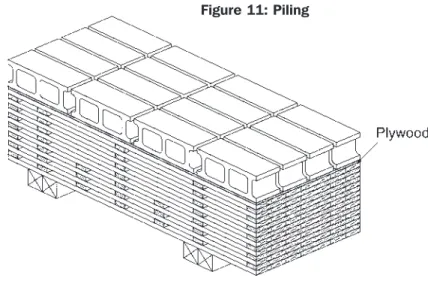
Wood products are most commonly stored in solid piles. With tidy piles of panel products, the top panel can retain the moisture but most of the water runs off and does not readily penetrate into the pile. Piled lumber can be more vulner-able as rainwater or snowmelt percolates in between the lumber pieces and may wet several layers. Such water is held between the boards as a film that wets the surfaces. Wood in this situa-tion could remain wet long enough to develop surface mold or wood-staining fungi. For longer term storage, lumber should be stickered.
High Moisture Content Before Installation
In the event that a user would like to dry lumber before installation, rather than install it green and let it dry in place, the proper procedure involves stacking the lumber with stickers (small sticks of dry wood about 3/4 inch thick by 1/2 inch wide) to provide sufficient air-flow between the layers of boards.
• Place stickers across the pile, no farther than 2 feet apart;
• Align stickers vertically with the ones of the row below so that the weight is transferred directly to the pile below;
• Place first and last stickers as close to the end of the pile as possible to prevent checking in the lumber A makeshift roof made up of longer pieces of wood could be placed on the wood pile to help reduce wetting and to protect the pieces from the hot sun, which could cause checking in the uppermost boards. Otherwise, a sheet of plywood over the pile or a tarp under the top layer will help shed water and prevent the lower tiers from getting wet. Weight should also be placed on top of the pile to prevent the upper pieces of wood from warping as the wood dries.
Wetting After Installation
For surface-wetted material used in framing, getting the roof sheathing and roof membrane on quickly and allow-ing the wood to air dry in place is a common strategy that works. The lumber will dry out naturally so long as
Handling Green Lumber
A water-based formulation containing a low level of an antimicrobial chemical is some-times applied to lumber that will be sold green. This is to prevent the growth of staining fungi or molds on the lumber before it is used. The products used to treat the wood are registered for commercial use by the Pest Management Regulatory Agency in Canada or by the Environment Protection Agency in the USA. Prior to their use, risk assessments determine that the products are safe for use under the conditions given on the pesticide label.
The chemicals used for treatment are mild, such as detergent type chemicals or fungi-cides used on agricultural food products. Their protection time on green lumber is therefore limited. The treatment is meant to give a few months protection against fungi to cover the time between manu-facturing to receiving the wood at the building site. It is not intended to replace preservative-treated wood.
Often, by the time green lumber has been shipped from the sawmill, it is partially air-dried. Manufacturers rarely wrap packages of green lumber. Upon arrival at the building site, green lumber is best stored indoors.
it is well ventilated and the humidity level of the air is not high. The latter, of course, depends on the local weather during the time of construction. In cold weather, space heaters should be used to help with drying. The site manager should make sure the fram-ing is dry when the whole buildfram-ing is closed and sealed, otherwise moisture trapped in the structure may cause problems, given the tight construction methods in use today.
A Few Points to Remember
The versatility and long-term performance of wood products has ensured that traditional and innovative wood materials will continue to be important to the North American construction industry. The trends towards using engineered wood products and the advances in wall construction places a greater emphasis on managing moisture in wood.
As a final reminder, here are a few points to remem-ber when handling wood products to ensure that they remain dry and mold free:
• Examine the wrapper on delivery to make sure that it is fully protecting the wood;
• Minimize outdoor on-site storage;
• Store wood products in a dry, well drained area; • Keep an intact protective cover on the products
until ready to use;
• Allow sufficient time for the materials to dry if they have been wetted;
• Avoid closing in walls that have wet building materials.
Clean Up Material Affected by Mold
Recommendations on remedial procedures for materials damaged by water and mold growth are identified in various publications and articles such as ‘Remedial Procedures for Water Damage in Buildings’ by Public Works and Government Services Canada (T. Nathanson, 2002), or New York City’s Dept, of Health and Mental Hygiene’s “Guidelines on Assessment and Remediation of Fungi in Indoor Environments.” In all cases, the first recommendation is that the source of moisture and the conditions suitable for mold growth should be eliminated before surface mold is cleaned. Clean-up measures depend on the extent of material affected by water and/or fungal attack. In cases involving small amounts of mold, it is generally recommended that molds be removed from solid or semi-porous materials (such as wood) by cleaning with a water/detergent solution or wet vacuuming with a HEPA equipped vacuum cleaner, after which the materials should then be thoroughly dried. Disinfectants or biocides are generally not recommended, since they may contain respiratory irritants and are not always completely effective in destroying mold organisms. Good practice also considers the health of workers in cleaning up affected areas. In order to minimize risk, it is recommended to wear protective equipment such as a N95 particulate half facemask, rubber gloves and eye protection. Larger areas, however, may need professional clean up. On-site professional advice is available should there be doubt on the appropriate course of action.
Canadian Wood Council
99 Bank St., Suite 400 Ottawa, ON K1P 6B9 Tel: 1-800-463-5091 Fax: 1-613-747-6264 e-mail: [email protected]References
Remedial Procedures for Water Damage in Buildings. Tedd Nathanson, Environmental Services, Public Works and Government Services Canada. 2002
www.pwgsc.gc.ca/rps/aes/docs/pdf/iaq_pub_remedial-e.pdf
Guidelines on Assessment and Remediation of Fungi in Indoor Environments. New York City Department of Health and Mental Hygiene. 2002
www.ci.nyc.vs/html/doh/html/epi/moldrpt1.html
Wood Frame Envelopes – Best Practice Guide, Building Technology.