ISSN-L: 2501 - 1235 Available on-line at: www.oapub.org/edu
doi: 10.5281/zenodo.3638119 Volume 6 │ Issue 1 │ 2020
MOBBING AND TURNOVER INTENTION:
A STUDY FROM EMPLOYEES OF THE PROVINCIAL
DIRECTORATE OF YOUTH AND SPORTS IN TURKEY
Urkus Berber1,
Bekir S. Yildiz2i 1M.Sc., Izmir Provincial Directorate of
Youth and Sports, Turkey
2M.Sc., Mugla Provincial Directorate of
Youth and Sports, Turkey
Abstract:
In this study, the relationship between mobbing behavior and employees’ turnover
intention in organizations providing sports services was examined. The data in this study
were obtained from two Provincial Directorate of Youth and Sports’ employees, in
Turkey. As the data collection tool, the mobbing scale developed by Yildiz (2019) and the turnover intention scale developed by Landau and Hammer (1986) were used. As a result of this study, in which hierarchical regression analysis was used, it was found that
mobbing behaviors significantly and positively affected employees’ turnover intentions.
At the end of the study, administrative suggestions were given on the solution of mobbing.
Keywords: mobbing, turnover intention, employee, sport organization
1. Introduction
In terms of human resources approach, the selection, orientation, and training of staff for an organization are really costly. Therefore, an organization that has invested in its employees will be able to maintain its high performance only as long as its successful employees keep it in the organization (Shuck et al., 2014). From another point of view, it is inevitable that in organizations that cannot hold their employees, there will be a lot of turnovers and thus service delivery systems will be disrupted and customer dissatisfaction will result (Ashill, Rod, and Carruthers, 2008).
Recently, employees’ turnover intentions have begun to attract more attention
from the researchers. Researchers believe that stable employees are effective in
organizational success. For this reason, the researchers’ studies include the reasons that
affect the intention of the employees to leave their jobs (Yi, Nataraajan, and Gong, 2011).
There are many issues that affect employees’ turnover intentions, mobbing is one of them.
For the first time, Swedish Scientist Heinz Leymann brought up the concept of mobbing in the workplace. In his researches, Leymann (1996) found that working people (with psychological, social and economic consequences) are exposed to a number of negative behaviors. In his later research, he focused on the stages of mobbing behavior and the psychological, social and economic effects on employees exposed to mobbing. Leymann (1996) classified 45 distinct mobbing behaviors in five groups according to their characteristics: attack on the dignity of the person, attacks on performance, attacks on communication, attacks on social conditions and the threat of physical attack. Any of these behaviors can occur due to certain conditions, one-off and limited. It would not be correct to call it mobbing. In order for mobbing behavior to be in question, as mentioned before, long-term repetition of many behaviors entering the mobbing by considering the target is required (Leymann and Gustafsson, 1996). Mobbing is a concept that expresses that an employee in a workplace is exposed to unethical behavior by bullying by another employee or employees (Leymann, 1996). Turnover intention is defined as the
employee’s turnover intention his job at the workplace (Yildiz, 2013). The separation of
employees has costs to businesses. Activities such as finding, hiring and training new staff includes direct costs (Duffield et al., 2014). The turnover intention affects organizations negatively, both in terms of loss of human resources experienced by leaving good employees and dividing the ongoing workflow (Yildiz, 2018).
Mobbing is a phenomenon that can be seen in all kinds of cultures and organizations, and everyone can be exposed regardless of gender (Zapf, 1999). Some studies in recent years have reported that the phenomenon of mobbing is also seen in sports organizations regardless of gender (Karik and Yildiz, 2015; Yildiz, Kepoglu, and Yildiz, 2018). There are many studies that mobbing has lost the peace of the employees in the workplace (Öntürk, 2019). In this study, in order to contribute to the sports
literature, it is aimed to examine the effect of mobbing on employees’ turnover intentions
in sports organizations in order to make the issue clearer.
2. Method
2.1. Measurement Instruments
In this study, the mobbing scale for academicians, consisting of 10 items and 2 sub-dimensions (vertical/horizontal mobbing, and vertical mobbing) developed by Yildiz (2019), was used to measure the mobbing perceptions of employees. Although this scale was developed for academicians, we consider it can be applied to other service sectors’
employees, 3 items and one-dimensional turnover intentions scale developed by Landau and Hammer (1986), was used. Scale items were measured on a five-point Likert type scale ranging from 1=strongly disagree to 5=strongly agree.
2.2. Sample Size and Procedure
The sample of this study consists of employees of two Provincial Directorate of Youth and Sports (Mugla, and Izmir), in Turkey. The scale forms were distributed to 140 employees with an emphasis on confidentiality and were asked to respond within a week. A total of 110 forms were returned, 7 forms with deficiencies were not considered and a total of 103 forms were found suitable for analysis.
2.3. Statistical Analysis
Descriptive statistics, correlation analysis, and hierarchical regression analysis were used
for the data. Reliability of the scales was determined by Cronbach’s Alpha coefficient.
3. Findings
3.1. Demographic Findings
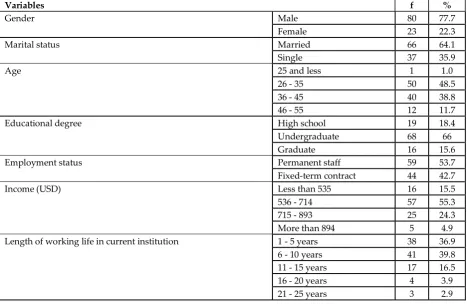
Most of the participants were male (77.7%) and married (64.1%). Almost half were between the ages of 26-35 (48.5%). More than half of the participants were permanent staff (53.7%), had university education level (66%), and income of 236-714 USD (55.3%). Most of the participants worked for 6 to 10 years in their workplace (39.8%), (Table 1).
Table 1: Demographic characteristics
Variables f %
Gender Male 80 77.7
Female 23 22.3
Marital status Married 66 64.1
Single 37 35.9
Age 25 and less 1 1.0
26 - 35 50 48.5
36 - 45 40 38.8
46 - 55 12 11.7
Educational degree High school 19 18.4
Undergraduate 68 66
Graduate 16 15.6
Employment status Permanent staff 59 53.7
Fixed-term contract 44 42.7
Income (USD) Less than 535 16 15.5
536 - 714 57 55.3
715 - 893 25 24.3
More than 894 5 4.9 Length of working life in current institution 1 - 5 years 38 36.9
3.2. Reliability Analysis of the Scales
In reliability analysis conducted to determine the internal consistency of mobbing scale, Cronbach Alpha value was found to be 0.915. Cronbach Alpha value of turnover intention scale was found to be 0.843. The values of both scales were found to be quite high.
3.3. Correlation Analysis
According to the correlation results, there is a significant and positive relationship between mobbing and turnover intention (r = .541; p <0.01). It is noteworthy that the level of this relationship is high. When examined in terms of demographic variables, the level
of exposure to mobbing behavior increases as the education level of the employee’s
increases.
Therefore, it can be said that those who have a high education level are prevented from coming to certain positions with their mobbing behavior. Similarly, as the education
level of the employee’s increases, the level of turnover intention increases.
It can be said that employees with a high level of education cannot tolerate exposure to mobbing behavior, so they may consider leaving work (Table 2).
Table 2: Results of correlation analysis
Variables 1 2 3 4 5 6 7 8
1. Gender 1
2. Marital status -.110 1
3. Age -.135 -.163 1
4. Educational degree .072 .110 -.177 1
5. Employment status -.039 .294** -.306** -.203* 1
6. Income .024 -.077 .248* .492** -.371** 1
7. Length of working life in current institution -.100 -.179 .657** -.162 -.481** .303** 1
8. Mobbing ,103 ,017 -,101 ,267** -,170 ,185 ,047 1
9. Turnover intention -,082 ,081 -,172 ,343** -,059 ,166 -,117 ,541** **p <0.01; *p <0.05
3.4. Hierarchical Regression Analysis
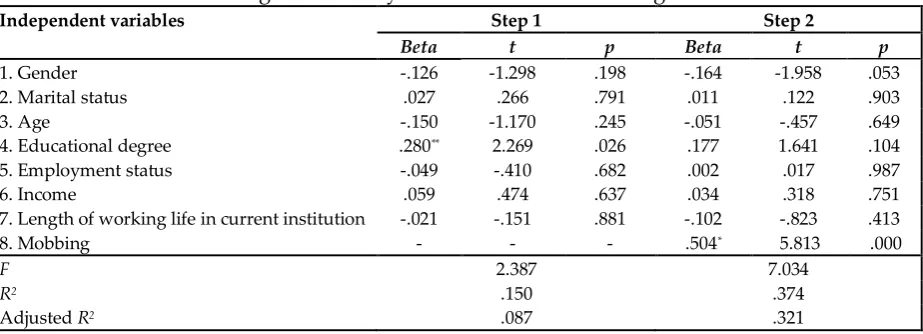
According to the hierarchical regression analysis, mobbing significantly and positively
Table 3: Hierarchical regression analysis on the effect of mobbing on turnover intention
Independent variables Step 1 Step 2
Beta t p Beta t p
1. Gender -.126 -1.298 .198 -.164 -1.958 .053
2. Marital status .027 .266 .791 .011 .122 .903
3. Age -.150 -1.170 .245 -.051 -.457 .649
4. Educational degree .280** 2.269 .026 .177 1.641 .104
5. Employment status -.049 -.410 .682 .002 .017 .987
6. Income .059 .474 .637 .034 .318 .751
7. Length of working life in current institution -.021 -.151 .881 -.102 -.823 .413
8. Mobbing - - - .504* 5.813 .000
F 2.387 7.034
R2 .150 .374
Adjusted R2 .087 .321
Note: Standardized beta values were used. *p <0.001, ** p <0.05.
4. Discussion and Conclusion
This study was carried out to investigate the effect of mobbing behaviors on employees’
turnover intention in sports organizations. The findings of this study showed that
mobbing behaviors significantly and positively affect employees’ turnover intentions.
According to these findings, as the mobbing behaviors increase in the workplace, the turnover intention increases.
It is a fact that mobbing has many negative effects on employees. For example, mobbing leads to low organizational commitment (Bedük and Ata, 2019), low job satisfaction (Irak, 2019), low job performance (Rehman, Yusoff, and Ismail, 2019) and low organizational citizenship behavior (Yildiz, 2016). Turnover intention is also an important phenomenon affected by mobbing.
There are many studies in the literature that deal with the relationship between mobbing and turnover intention. Lee, Lee, and Bernstein (2013) found that mobbing had
a positive effect on nurses’ turnover intentions (β = 0.160; p <0.05). Akar, Anafarta, and Savran’s (2011) research showed that mobbing had a positive effect on the turnover
intention of employees in the agriculture industry (β = 0.223; p <0.05). Razzaghian and
Ghani (2014) found that mobbing had a significant and positive effect on turnover
intention of academic staff at the university (β = 0.734; p <0.001). Akbolat, Yilmazer, and
Tutar (2014) found a significant and positive relationship between mobbing behavior and turnover intention in their research on hotel employees in the tourism sector (r = 0.448; p <0.01). In a study conducted by Yildiz (2018) in an organization providing sports services, it found a significant and positive relationship between mobbing and turnover intention (r = 0.375; p <0.01). All previous research results and our study findings are very similar. As can be seen from the above studies, mobbing behaviors, regardless of sector and profession, are an important factor affecting employees’ turnover intentions. Therefore,
problems (Yildiz, 2018). On the other hand, efforts can be made to improve the quality of leader-member interaction. Thus, instead of negative behaviors such as mobbing, extra-role behaviors such as organizational citizenship behaviors can occur in employees (Yildiz, 2011).
About the Authors
Urkus Berber is a Sport Trainer in Izmir Provincial Directorate of Youth and Sports,
Turkey. She has a master’s degree and her research areas are sports marketing and organizational behavior in sports. She had competed in the Turkish National Team in various sports in the past.
Bekir S. Yildiz is a Sports Facility Director in Mugla Provincial Directorate of Youth and
Sports, Turkey. He has a master’s degree and his research area is organizational behavior in sports. He had played for various amateur and professional football teams.
References
Akar, N. Y., Anafarta, N., and Savran, F. (2011). Causes, dimensions and organizational consequences of mobbing: An empirical study. Ege Academic Review, 11(1), 179-191.
Akbolat, M., Yilmazer, A., and Tutar, H. (2014). The effect of perceptions of mobbing of employee in hospitality businesses on job satisfaction and intention to leave. Manas Journal of Social Studies, 3(3), 1-17.
Ashill, N. J., Rod, M., and Carruthers, J. (2008). The effect of management commitment to
service quality on frontline employees’ job attitudes, turnover intentions and
service recovery performance in a new public management context. Journal of
Strategic Marketing, 16(5), 437-462. DOI:
https://doi.org/10.1080/09652540802480944 .
Bedük, A. and Ata, N. (2019). A research on the relationship between mobbing and organizational commitment: The case of municipal bus drivers. The Journal of International Social Research, 12(62), 1182-1193.
Duffield, C. M., Roche, M. A., Homer, C. and Buchan, J., and Dimitrelis, S. (2014). A comparative review of nurse turnover rates and costs across countries. Leading Global Nursing Research, 70(12), 2703-2712. DOI: https://doi.org/10.1111/jan.12483 Irak, D. U. (2019). Personality and experience of mobbing: Three types of mobbing and
the consequences at the workplace. The Journal of Human and Work, 6(1), 55-66. DOI: https://doi.org/10.18394/iid.457447.
Karik, T. and Yildiz, S. M. (2015). The effect of mobbing behaviors on burnout of women’s
basketball players. International Journal of Human Sciences, 12(2), 430-442. DOI:
Landau, J. and Hammer, T. H. (1986). Clerical employees’ perceptions of intra
organizational career opportunities. Academy of Management Journal, 29(2), 385-404. DOI: https://doi.org/10.5465/256194.
Lee, Y., Lee, M., and Bernstein, K. (2013). Effect of workplace bullying and job stress on turnover intention in hospital nurses. J Korean Acad Psychiatr Ment Health Nurs, 22(2), 77-87. DOI: https://doi.org/10.12934/jkpmhn.2013.22.2.77.
Leymann, H. (1996). The content and development of mobbing at work. European Journal of Work and Organizational Psychology, 5(2), 165-184. DOI:
https://doi.org/10.1080/13594329608414853.
Leymann, H. and Gustafsson, A. (1996). Mobbing at work and the development of post-traumatic stress disorders. European Journal of Work and Organizational Psychology, 5(2), 251-275, DOI: https://doi.org/10.1080/13594329608414858.
Öntürk, Y. (2018). Spor ortamında mobbing. Ankara: Gece Kitaplığı Yayınevi.
Razzaghian, M. and Ghani, U. (2014). Effect of workplace bullying on turnover intention of faculty members: A case of private sector universities of Khyber Pakhtunkhwa, Pakistan. Business & Economic Review, 6(1), 40-51.
Rehman, F., Yusoff, R. M., and Ismail, F. (2019). Tracing the effects of mobbing on the performance of engineers: An evidence of a telecom sector. Journal of Social Transformation and Regional Development, 1(1), 1-11.
Shuck, B., Twyford, D., Reio, T. G., and Shuck, A. (2014). Human resource development practices and employee engagement: Examining the connection with employee turnover intentions. Human Resource Development Quarterly, 25(2), 239-270. DOI: https://doi.org/10.1002/hrdq.21190.
Yi, Y., Nataraajan, R., and Gong, T. (2011). Customer participation and citizenship behavioral influences on employee performance, satisfaction, commitment, and turnover intention. Journal of Business Research, 64(1), 87-95. DOI:
https://doi.org/10.1016/j.jbusres.2009.12.007.
Yildiz, S. M. (2011). The relationship between leader member exchange and organizational citizenship behavior in public organizations providing sports services. Selcuk University Journal of Physical Education and Sport Science, 13(3), 323-329.
Yildiz, S. M. (2013). The effect of quality of work life on employee turnover intention in sports and physical activity organizations. Ege Academic Review, 13(3), 317-324. Yildiz, S. M. (2016). The effect of workplace mobbing behaviors on organizational
citizenship behavior of employees in sport and physical activity organizations. Dokuz Eylul University The Journal of Graduate School of Social Sciences, 18(1), 165-180. DOI: https://doi.org/10.16953/deusbed.80977.
Yildiz, S. M. (2018). An empirical analysis of the leader-member exchange and employee turnover intentions mediated by mobbing: Evidence from sport organizations. Economic Research-Ekonomska Istraživanja 31(1), 480-497. DOI:
Yildiz, B. S., Kepoglu, A., and Yildiz, S.M. (2018). The effect of mobbing behaviors on
amateur footballers’ burnout. CBU Beden Egitimi ve Spor Bilimleri Dergisi, 13(2),
231-246.
Yildiz, S. M. (2019). A new mobbing scale for academicians working in higher educational institutions. 9th International Social Sciences Conference in the Balkans, October 16-27, Kusadasi, Turkey.
Creative Commons licensing terms