Herbarium of Vascular Plants Collection of the
University of Extremadura (Spain)
Marta Espinosa1, Josefa López1
1 Área de Botánica, Facultad de Ciencias, Universidad de Extremadura, Avda. de Elvas s/n, 06006, Badajoz, Spain
Corresponding author:Marta Espinosa Sánchez ([email protected])
Academic editor:V. Chavan | Received 17 April 2013 | Accepted 27 May 2013 | Published 19 June 2013
Citation: Espinosa M, López J (2013) Herbarium of Vascular Plants Collection of the University of Extremadura (Spain). PhytoKeys 25: 1–13. doi: 10.3897/phytokeys.25.5341 Resource ID: GBIF key: http://gbrds.gbif.org/browse/ agent?uuid=835d30de-f762-11e1-a439-00145eb45e9a
Resource citation: University of Extremadura (2013) Herbarium of Vascular Plants Collection of the University of Extremadura, Spain. 36451 data records. Contributors: Espinosa M, López J, Devesa JA, Ortega-Olivencia A, Ruiz T, Tormo R, Rodríguez-Riaño T, Viera MC, Carrasco JP, Muñoz A, Montero I, Vázquez FM, Navarro ML, Valtueña FJ and Malato-Beliz JVC. Online at http://www.gbif.es:8080/ipt/resource.do?r=collectionherbariumextremadura, http:// data.gbif.org/datasets/resource/255 and http://www.eweb.unex.es/eweb/botanica/herbario/, versión 1.0 (Last updated on 2013-05-23), GBIF key: http://gbrds.gbif.org/browse/agent?uuid=835d30de-f762-11e1-a439-00145eb45e9a. Data Paper ID: doi: 10.3897/phytokeys.25.5341
Abstract
The herbarium of University of Extremadura (UNEX Herbarium) is formed by 36451 specimens of vas-cular plants whose main origin is the autonomous region of Extremadura (Spain) and Portugal, although it also contains a smaller number of specimens from different places, including the rest of peninsular Spain, the Baleares Islands, the Macaronesian region (Canary Islands, Madeira and Azores), northwest of Africa (Morocco) and Brazil. 98% of the total records are georeferenced.
It is an active collection in continuous growth. Its data can be accessed through the GBIF data por-tal at http://data.gbif.org/datasets/resource/255 and http://www.eweb.unex.es/eweb/botanica/herbario/. This paper describes the specimen associated data set of the UNEX Herbarium, with an objective to dis-seminate the data contained in a data set with potential users, and promote the multiple uses of the data.
Keywords
Extremadura, herbarium collection, Liliopsida, Magnoliopsida, Spain, Portugal, Baleares islands, Macaro-nesian region, Morocco, Brazil, UNEX Herbarium, vascular plant taxonomy
www.phytokeys.com
Copyright M. Espinosa, J. López. This is an open access article distributed under the terms of the Creative Commons Attribution License 3.0 (CC-BY), which permits unrestricted use, distribution, and reproduction in any medium, provided the original author and source are credited.
Ruiz, curator and current director of the UNEX Herbarium. Significant contribu-tions have also been made by Professor Ana Ortega-Olivencia, Dr. Rafael Tormo, Dr. Josefa López, and Dr. Tomás Rodríguez-Riaño. Other researchers who contributed to the growth of the UNEX Herbarium includes, Mª Carmen Viera, Jacinto Pedro Carrasco, Adolfo Muñoz, Inmaculada Montero, and Francisco Mª Vázquez. In ad-dition, the disinterested work developed throughout time by a lot of students of the University of Extremadura, especially, Mª Luisa Navarro Pérez and Dr. Francisco Javier Valtueña.
The development of different research projects has made it possible to improve the quality of the herbarium. Among them, the numerous compilations carried out by differents members of the Botany Area in order to elaborate the first flora of the Extremadura region (Devesa 1995) or the synthesis of different taxonomic families or genera for Flora Ibérica (http://www.floraiberica.org/). Additionally, 4.5% of the material comes from the purchase of part of the herbarium of Dr. J.V.C. Malato-Beliz.
Limited and unpredictable funding has always pose challenge for ensuring sus-tained growth of the collection facility since its establishment.
General taxonomic coverage description
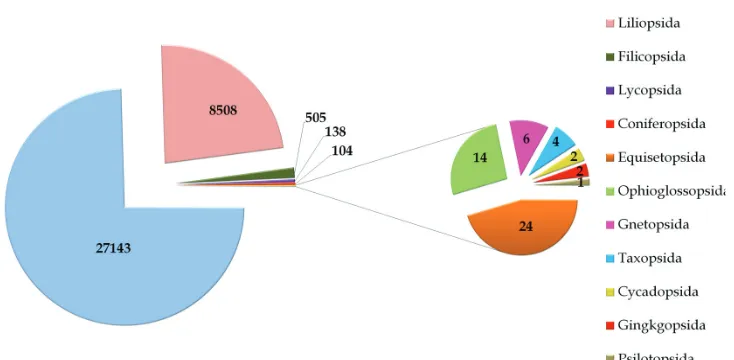
As depicted in Figure 1, majority of the specimens in UNEX Herbarium belong to class Magnoliopsida (27143 specimens) and Liliopsida (8508 specimens). These classes are followed by Filicopsida (505 specimens), Lycopsida (138 specimens), Coniferopsi-da (104 specimens), EquisetopsiConiferopsi-da (24 specimens), OphioglossopsiConiferopsi-da (14 specimens), Gnetopsida (6 specimens), Taxopsida (4 specimens) Cycadopsida and Gingkgopsida (both with 2 specimens), and Psilotopsida (1 specimen).
taxonomic ranks
Kingdom: Plantae
Phylum: Pteridophyta, Spermatophyta
Class: Magnoliopsida, Liliopsida, Filicopsida, Lycopsida, Coniferopsida, Equisetopsida, Ophioglossopsida, Gnetopsida, Taxopsida, Cycadopsida, Gingkgopsida, Psilotopsida. Family: Acanthaceae, Aceraceae, Adiantaceae, Agavaceae, Aizoaceae, Alismataceae,
Figure 2. Taxonomic coverage (as per families) of the UNEX Herbarium.
drangeaceae, Hydrophyllaceae, Hymenophyllaceae, Hypolepidaceae, Iridaceae, Isoetaceae, Juglandaceae, Juncaceae, Juncaginaceae, Lamiaceae, Lauraceae, Lem-naceae, Lentibulariaceae, Liliaceae, LiLem-naceae, Loranthaceae, Lycopodiaceae, Ly-thraceae, Magnoliaceae, Malpighiaceae, Malvaceae, Maranthaceae, Marsileace-ae, MelastomataceMarsileace-ae, MeliaceMarsileace-ae, MelianthaceMarsileace-ae, MimosaceMarsileace-ae, MolluginaceMarsileace-ae, Monimiaceae, Moraceae, Myoporaceae, Myricaceae, Myrsinaceae, Myrtaceae, Najadaceae, Nyctaginaceae, Nymphaeaceae, Oleaceae, Onagraceae, Ophioglos-saceae, Orchidaceae, Orobanchaceae, Osmundaceae, Oxalidaceae, Paeoniaceae, Papaveraceae, Passifloraceae, Phytolaccaceae, Pinaceae, Piperaceae, Pittosporace-ae, PlantaginacePittosporace-ae, PlatanacePittosporace-ae, PlumbaginacePittosporace-ae, PoacePittosporace-ae, PodocarpacePittosporace-ae, Po-lemoniaceae, Polygalaceae, Polygonaceae, Polypodiaceae, Pontederiaceae, Portu-lacaceae, Potamogetonaceae, Primulaceae, Proteaceae, Psilotaceae, Pteridaceae, Punicaceae, Pyrolaceae, Rafflesiaceae, Ranunculaceae, Resedaceae, Rhamnaceae, Rosaceae, Rubiaceae, Ruppiaceae, Rutaceae, Salicaceae, Santalaceae, Sapindace-ae, SaxifragaceSapindace-ae, ScrophulariaceSapindace-ae, SelaginellaceSapindace-ae, SimaroubaceSapindace-ae, Sinopteri-daceae, Solanaceae, Sparganiaceae, Sterculiaceae, Styracaceae, Symplocaceae, Tamaricaceae, Taxaceae, Theaceae, Theligonaceae, Thelypteridaceae, Thymelae-aceae, TiliThymelae-aceae, TropaeolThymelae-aceae, TyphThymelae-aceae, UlmThymelae-aceae, UmbelliferThymelae-aceae, Urti-caceae, Valerianaceae, Verbenaceae, Violaceae, Vitaceae, Zannichelliaceae, Zin-giberaceae, Zygophyllaceae
General spatial coverage
Specimens deposited in the UNEX Herbarium have been collected mainly from Ibe-rian Peninsula (Spain and Portugal) northwest of Africa (Morocco) and Brazil. As indi-cated in Figure 4, maximum number of specimens included in the dataset are collected from Spain (31490) followed by Portugal (3488), Brazil (722) and Morocco (111) respectively. With regards to collections from Spanish provinces, Badajoz contributes 16910 specimens, followed by Cáceres (6855 specimens) and Cádiz (1012 specimens). Other sampling areas include Almería (711 specimens), Jaén (495 specimens), Málaga (411 specimens), Gerona (388 specimens), Huesca (371 specimens), León (308 speci-mens), Oviedo (293 specispeci-mens), Granada (290 specispeci-mens), Huelva (260 specimens) and Lérida (249 specimens).
The specimens better represented in the database correspond to elements of the Mediterranean forest and/or scrubland. These specimens are developed under a sea-sonal climate of mild winters and hot and dry summers, with abundant rainfall in autumn and spring. Frequent in this climate are forest fires, to which the vegetation is adapted. Specimens from Brazil (except one specimen collected in the state of Santa Catarina), are collected in the state of Río Grande do Sul. This state has a humid sub-tropical climate and a hydrography classified into three major regions: Uruguay River Basin, Guaiba River, and Litoral.
temporal coverage
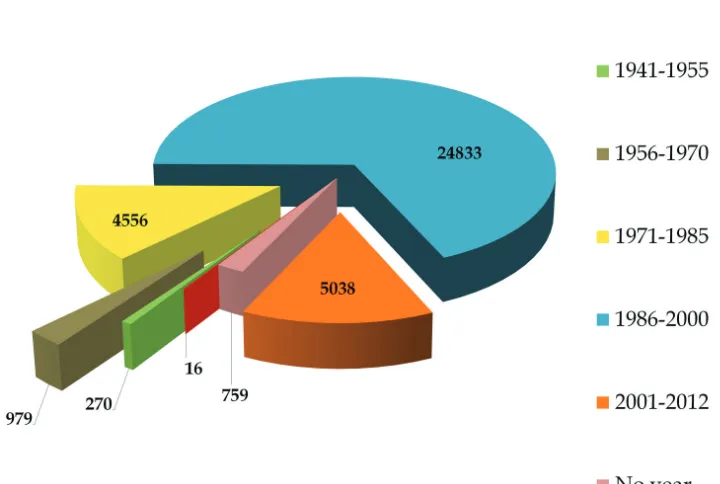
1911 – 2013. As shown in Figure 5, earliest collection event is dated back to 1911. Maxi-mum number of specimens are collected during 1986–2000 (24833), followed by 2001– 2012 (5038), 1971–1985 (4556), 1956–1970 (979), 1941–1955 (270), and 1911–1940 (16). There are 759 specimens for which period of collection cannot be ascertained. Collection name: UNEX Herbarium, University of Extremadura.
Collection identifier: http://data.gbif.org/datasets/resource/255 Formation period: 1986-2013
Specimen preservation method: Dried and pressed Curatorial unit: 36451 with an uncertainty of 0 (Sheets) Curatorial unit: 1253 with an uncertainty of 0 (Genera)
Methods
Method step description
them to a flat surface and remove water from the tissue, thereby preventing their de-generation or attacks by bacteria, fungi or insects that would destroy them.
Assembly of specimens: The dried material is mounted on a holder constituted by an A3 cardboard (42 × 29.7 cm) and a resistant paper (so-called jacket) dimension A2 (42 × 59.4 cm) that perfectly covers the cardboard, thus protecting the specimen. The assembly is made on the cardboard with transparent tape, allowing both that the speci-men be tighten to the holder and that the assembly be aesthetic.
Registration of herbarium specimens: After assembly, specimens are registered and labeled. Registration is done in a database (Microsoft Office Access Database → Dar-winCore 1.2) in which each specimen is assigned a reference number allocated con-secutively. The information contained in the record of each specimen is: institution owner of the herbarium, reference number, scientific name of the family and species, date of collection, georeferencing data (country, province, town), habitat, Legitimavit, and Determinavit. All log data are printed and constitute the sheet label.
Treatment of specimens: Before putting the specimens in the herbarium they are stored in hermetic plastic boxes and kept for 72 hours in cold storage (freezers) at -40°C. In this way the material is decontaminated from possible attacks of pathogens that can destroy them and the rest of material already in the herbarium.
Iberian Peninsula is the most significant geographic zone represented in UNEX Her-barium. Figure 6 depicts the collections from various provinces of Iberian Peninsula. Over 5000 specimens are collected from two provinces (Badajoz and Cáceres). Two provinces (Cádiz and Almería) contributed specimens in the range of 500-1500. The specimens collected from morocco (111 sheets) are representatives for an area greater than 50% of the country (Fig. 7a). Conversely, specimens from Brazil (721 sheets) cover not more than 3% of the area of the country (Fig. 7b).
Sampling description
As evident from the previous section, the specimens deposited in the UNEX Her-barium comes from diverse regions, which is outcome of several research projects de-positing the specimens. As a result, specimens are not collected using a single, uniform protocol. Of the materials from donations or purchases (e.g. herbarium of Dr. J.V.C. Malato-Beliz) the protocol followed for the collection of specimens is unknown. The methodology used in collecting plants by researchers from the Botany Area may change depending on the objectives pursued by the work they are carried out for.
In general, collection takes place following previous available references drawn from scientific works, herbarium material or indications from reliable collectors. The collection campaigns are designed to be more or less exhaustive of different available areas depending on the purpose of the collection (e.g. for taxonomic works, we do ex-haustive inspections of whole territories with expansion of the collection area beyond known indications).
Quality control description
com-prising the taxonomic synthesis of families Adoxaceae, Caprifoliaceae, Dipsacaceae, Ru-biaceae and Valerianaceae, and XVI (under edition, see http://www.floraiberica.org/) in which these experts are responsible for the genera Arctium, Atractylis, Carlina, Crupina, Figure 6. Geographical distribution of specimens in the Iberian Peninsula, Baleares, Canarias, Madeira and Azores.
al. 1997, 2005, Rodríguez-Riaño et al. 1999a, 1999b, 1999c, 2004, 2006, Valtueña et al. 2007, 2008a, 2008b, 2010a, 2010b, 2011, 2012) or the genera Drosophyllum (Ortega-Olivencia et al. 1995, 1998) or Scrophularia (Ortega-Olivencia and Devesa 1993a, 1993b, Ortega-Olivencia et al. 2012, Valtueña et al. 2013). Use of these lit-erature resources and long standing experience of the researchers high degree of confi-dence to the taxonomic identification of the specimens.
The 98% of the records in the collection are georeferenced. A total of 58.38% have MGRS coordinates and the rest geographical coordinates. The MGRS coordinate sys-tem has been transformed into geographical coordinates through a geographic calculator (http://www.asturnatura.com/sinflac/calculadora-conversiones-coordenadas.php), while at the same time maintaining the MGRS coordinates in the database. The accuracy of these coordinates grids varies from 1 km2 to 10 km2. The geographical coordinates have been
taken through the description of localities and search of these localities in Google Earth (http://www.google.com/earth/index.html). The accuracy of geographic coordinate values also varies between 2 and 12 km depending on the number of decimal places contained.
Datasets
Object name: Herbarium of Vascular Plants Collection of the University of Extrema-dura (Spain)
Character encoding: UTF-8
Format name: Darwin Core Archive format Format version: 1.0
Distribution
http://www.gbif.es:8080/ipt/resource.do?r=collectionherbariumextremadura Publication date of data: 2013-05-18
Language: English
Licenses of use: This database “Herbarium of Vascular Plants Collection of the Uni-versity of Extremadura (Spain)”is made available under license Open Data Commons Attribution: http://www.opendatacommons.org/licenses/by/1.0/
(k) locality, (l) individualCount, (m) scientificNameAuthorship , (n) institutionCode (o) decimalLongitude , (p) country, (q) preparations, (r) identifiedBy, (s) stateProv-ince, (t) recordedBy, (u) recordNumber, (v) decimalLatitude, (w) genus, (x) specifi-cEpithet and (y) occurrenceRemarks.
Character encoding: iso-8859-1 Format name: Access
Format version: 1.0
Distribution: http://data.gbif.org/datasets/resource/255 Metadata language: English
Date of metadata creation: 2013-03-20 Hierarchy level: Dataset
Acknowledgements
We wish to thank the Government of Spain for financial support to the UNEX Herbarium through of the projects CGL2005-24206-E and PTA2010-3138-I. Funding was partially obtained from the Economy, Trade, and Innovation Council of Extremadura (CCV004).
References
Devesa JA (1995) Vegetación y Flora de Extremadura. Universitas Editorial. Badajoz, 1–773. Devesa JA (1999) Las Gramíneas de Extremadura. Monografías Botánicas. Universidad de
Extremadura. Badajoz, 1–358.
Devesa J, Gonzalo R, Herrero A (Ed) (2007) Flora ibérica. Vol. 15. Real Jardín Botánico de Madrid, CSIC, Madrid, 1–496.
Devesa JA, López E (2008) Notas taxonómicas sobre el género Centaurea L. (Asteraceae) en la Península Ibérica. I. C. cordubensis Font Quer, C. bethurica E. López & Devesa, sp. nov., y C. schousboei Lange. Anales del Jardín Botánico de Madrid 65(2): 331–341.
Flora iberica: http://www.floraiberica.org/ [accessed 16.05.2013]
Geographic calculator: http://www.asturnatura.com/sinflac/calculadora-conversiones-coorde-nadas.php [accessed 16.05.2013]
Google Earth: http://www.google.com/earth/index.html [accessed 16.05.2013]
López J, Devesa JA, Ruiz T, Ortega-Olivencia A (1998) Seedling morphology in Genisteae (Fabaceae) from South-West Spain. Botanical Journal of the Linnean Society 128(3): 229– 250. doi: 10.1111/j.1095-8339.1998.tb02119.x
López J, Devesa JA, Ruiz T, Ortega-Olivencia A (1999a) Seed germination in Genisteae (Fa-baceae) from South-West Spain. Phyton -Annales Rei Botanicae- 39(1): 107–129. López J, Rodríguez-Riaño T, Ortega-Olivencia A, Devesa JA, Ruiz T (1999b) Pollination
and Evolution 184(3–4): 159–174. doi: 10.1007/BF00937433
Ortega-Olivencia A, Carrasco Claver JP, Devesa JA (1995) Floral and reproductive biology of Drosophyllum lusitanicum (L.) Link (Droseraceae). Botanical Journal of the Linnean Society 118(4): 331–351.
Ortega-Olivencia A, Devesa JA (1997) Seed set and germination in some wild species of Vi-cia from SW Europe (Spain). Nordic Journal of Botany 17(6): 639–648. doi: 10.1111/ j.1756-1051.1997.tb00360.x
Ortega-Olivencia A, Ramos S, Rodríguez T, Devesa JA (1997) Floral biometry, floral rewards and pollen-ovule ratios in some Vicia from Extremadura, Spain. Edinburgh Journal of Botany 54(1): 39–53. doi: 10.1017/S0960428600003851
Ortega-Olivencia A, Devesa JA (1998) Taxonomy and breeding system in a new species of
Scrophularia L. (Scrophulariaceae) from Morocco. Botanical Journal of the Linnean Society 128(2): 185–202. doi: 10.1111/j.1095-8339.1998.tb02115.x
Ortega-Olivencia A, López-Paredes JA, Rodríguez-Riaño T, Devesa JA (1998) Modes of self-pollination and absence of cryptic self-incompatibility in Drosophyllum lusitanicum (Dros-eraceae). Botanica Acta 111(6): 474–480.
Ortega-Olivencia A, Devesa JA (2003) Two new species of Galium (Rubiaceae) from the Iberian Peninsula. Botanical Journal of the Linnean Society 143(2): 177–187. doi: 10.1046/j.1095-8339.2003.00212.x
Ortega-Olivencia A, Devesa JA, Rodríguez-Riaño T (2004) A new Galium species from NW Portugal. Botanica Helvetica 114(1): 1–6.
Ortega-Olivencia A, Rodríguez-Riaño T, Valtueña FJ, López J, Devesa JA (2005) First con-firmation of a native bird-pollinated plant in Europe. Oikos 110(3): 578–590. doi: 10.1111/j.0030-1299.2005.13877.x
Ortega-Olivencia A, Rodríguez-Riaño T, Pérez-Bote JL, López J, Mayo C, Valtueña FJ, Navarro-Pérez M (2012) Insects, birds and lizards as pollinators of the largest-flowered Scrophularia
of Europe and Macaronesia. Annals of Botany 109(1): 153–167. doi: 10.1093/aob/mcr255 Rodríguez-Riaño T, Ortega-Olivencia A, Devesa JA (1999a). Biología floral en Fabaceae. Ruizia
16. Monografías del Real Jardín Botánico de Madrid, CSIC, Madrid, 1–176.
Rodríguez-Riaño T, Ortega-Olivencia A, Devesa JA (1999b) Types of androecium in the Fa-baceae of SW Europe. Annals of Botany 83(2): 109–116. doi: 10.1006/anbo.1998.0808 Rodriguez-Riaño T, Ortega-Olivencia A, Devesa JA (1999c) Reproductive biology in two
Genisteae (Papilionoideae) endemic of the western Mediterranean region: Cytisusstriatus
Rodríguez-Riaño T, Ortega-Olivencia A, Devesa JA (2004) Reproductive biology in Cyti-sus multiflorus (Fabaceae). Annales. Botanici Fennici 41(3): 179–188. doi: 10.3732/ ajb.0800332
Rodríguez-Riaño T, Valtueña FJ, Ortega-Olivencia A (2006) Megasporogenesis, megagame-togenesis and ontogeny of the Aril in Cytisus striatus and C. multiflorus (Leguminosae: Papilionoideae). Annals of Botany 98(4): 777–791. doi: 10.1093/aob/mcl166
Valtueña FJ, Ortega-Olivencia A, Rodríguez-Riaño T (2007) Nectar production in Anagyris foetida (Fabaceae): Two types of concentration in flowers with hanging droplet. Interna-tional Journal of Plant Sciences 168(5): 627–638. doi: 10.1086/513482
Valtueña FJ, Ortega-Olivencia A, Rodríguez-Riaño T (2008a) Germination and seed bank bi-ology in some Iberian populations of Anagyrisfoetida L. (Leguminosae). Plant Systematics and Evolution 275(3–4): 231–243. doi: 10.1007/s00606-008-0067-2
Valtueña FJ, Ortega-Olivencia A, Rodríguez-Riaño T, López J (2008b) Reproductive biol-ogy in Anagyrisfoetida L. (Leguminosae), an autumn-winter flowering and ornithophilous Mediterranean shrub. Botanical Journal of the Linnean Society 157(3): 519–532. doi: 10.1111/boj.2008.157.issue-3
Valtueña FJ, Ortega-Olivencia A, Rodríguez-Riaño T, López J (2010a) Causes of low fruit and seed set in bird-pollinated Anagyrisfoetida (Leguminosae): Pollen limitation and other extrinsic factors. Folia Geobotanica 45(1): 77–94. doi: 10.1007/s12224-009-9054-9 Valtueña FJ, Rodríguez-Riaño T, Espinosa F, Ortega-Olivencia A (2010b) Self-sterility in two
Cytisus species (Leguminosae, Papilionoideae) due to early-acting inbreeding depression. American Journal of Botany 97(1): 123–135. doi: 10.3732/ajb.0800332
Valtueña FJ, Rodríguez-Riaño T, Ortega-Olivencia A (2011) Ephemeral and non-ephemeral structures during seed development in two Cytisus species (Papilionoideae, Leguminosae). Plant Biosystems 145(1): 98–105. doi: 10.1080/11263504.2010.540379
Valtueña FJ, Ortega-Olivencia A, Rodríguez-Riaño T (2012) Regulation of fruit and seed set in
Anagyrisfoetida L. (Fabaceae): The role of intrinsic factors. Plant Biosystems, 146 (SUPPL. 1): 190–200. doi: 10.1080/11263504.2012.679976