Use of Technology in the Teaching of Telugu
Concepts to Create Enthusiastic Learning
Environment—A Case Study among Educators
Elliah Prema
Centre for Innovative Life Learning (CILL), University of Mauritius, Reduit, Mauritius
Bahadur Goonesh Kumar
Centre for Innovative Life Learning (CILL), University of Mauritius, Reduit, Mauritius
Abstract—The purpose of this study was to determine whether the use of digital technology could create a positive impact in teaching of Telugu concepts. Due to little exposure of the Telugu language in Mauritius, learners face difficulties in learning and understanding the language in terms of pronunciation, vocabulary, communication and writing skills. The study focused mainly on how the use of cartoons could cater for all types of learners, how they can be used as a tool to allow a child centred learning and whether they promoted the understanding of concepts easily through the use of technology and brought motivation to learners. A study was conducted with two upper primary schools to find out whether concept cartoons could be advantageous in encouraging them in better understanding concepts. Cartoon Story Maker was used as an educational tool to teach the “Singular- Plural” concept followed by an interactive quiz as assessment to monitor the progress of students. Through both qualitative and quantitative approaches, focus groups, observation, and achievement tests were chosen as convenient methods to collect data. The findings revealed that there has been a slight increase in percentage of scores in class tests and that cartoon concepts have motivated the learners to learn the Telugu concepts and helped to improve their communication skills.
Index Terms—cultural unity, collaboration, types of learners, focus group, assessment
I. INTRODUCTION
Language plays a significant role in the life of a community and it englobes every aspect of social organization. Each linguistic group would like to preserve and cherish its language as a principle element of cultural unity. Language education has been modernized due to the application of technology and how technology is increasing the pace of teaching and learning of teachers and learners is still being surveyed (Motteram, 2013).
However, in Mauritius, despite English being the official language, French and Creole are being used for communication. Ancestors immigrated to Mauritius during the 19th century in 1826, from different parts of India and a small percentage of immigrants came from Tamil Nadu. Today in Mauritius we have around 10% of the population who are Telugus. In order to preserve their culture, children of age 5 years old are being taught Telugu as a foreign language in primary schools. Due to little exposure of the latter, learners face difficulties in learning and understanding the language in terms of pronunciation, vocabulary, communication and writing skills.
There are many ways for educators to bring upon technology in their classroom such as using the interactive whiteboard, mobile phones, tablets or laptops. In short, it can be argued that technology will help to boost the level of language education as well as language learners. Within the Primary Education sector of Mauritius, there are only 97 Telugu educators and a total number of 1241 Telugu students aged from 6 to 11 years old. A Telugu teacher is allocated only 50 minutes per day to teach the language. Lack of space, time, improper infrastructure, unavailability of enough resources are the factors that prevent the use of technological devices by teachers, thus preventing them from moving away from the traditional chalk and talk teaching method to the technological based one. Yet, mobile phones, CDs, whiteboard are the usual tools used to arouse learners’ interest, motivation, and a liking for Telugu Language. Computer illiterate educators, time factor, bulky syllabus, technical problems, lack of technicians are the factors that affect the implementation of technology in their teaching. In this way interaction remains teacher- centred, thus the learners show lack of interest in Telugu subject. According to researchers, technology has removed the distance barrier and has allowed for higher education to effectively teach anyone around the world (Tabatabaei & Ying Gui, 2011). The use of technological devices in foreign language teaching is beneficial in many aspects such as the capacity to control presentation, Novelty and Creativity and Adaptability.
to investigate how technology would influence teaching and learning of Telugu language in a classroom. The learners will then be self- assessed through an interactive Quiz using I-spring Quiz Maker.
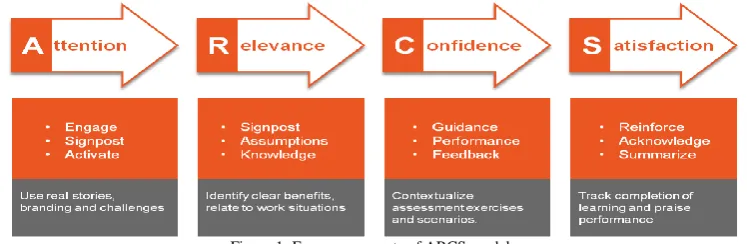
The motivational ARCS design model was used to design the learning content.
Figure 1: Four components of ARCS model
(Source: Word press, 2015. ADDIE –the fundamental model in ISD).
Pappas (2015) cited in his article that this motivational design model has been created by John Keller based on Tolman’s and Lewin’s theories. It consists of four main components namely; Attention, Relevance, Confidence, and Satisfaction which are considered to highly influence human motivation (Malik, 2014 cited Pappas 2015). This learning resource design aims to help the teachers and learners to teach and learn respectively the Telugu concepts in a modern approach. To critically study this context, the following objectives were formulated: (1) To investigate whether concept cartoons will help all types of learners namely; Visual, Auditory, Reading and Kinesthetic to understand the Telugu concepts more easily, (2) to promote the interaction and collaboration skills between teachers and students, (3) to motivate and inspire learners to reach their potential. In line with these objectives, the research questions set are as follows:
• What will be the advantages and disadvantages of implementing the use of technology in Telugu teaching and learning?
• Whether the use of Cartoon Story Maker will help in motivating and entertaining Telugu language educators and learners?
• Can the use of this visual media help all types of learners to better understand the concepts?
II. METHODOLOGY
Focus group discussion was carried out as a survey with 5 Telugu educators from different institutions in order to have their opinions about the availability and the use of technology in their language teaching classrooms. The ‘Plural Concept’ was explained with Grades 4 and 5 learners through the traditional teaching method during 4 classes of 50 minutes each, followed by an achievement test (Test 1) at the end of the week to assess their progress. Furthermore, during the following week, the CSM software was used as a teaching and learning tool in the computer lab with the same grades of learners mentioned above. Participant observation was then carried out during the manipulation of the learning tool and an observation checklist was prepared to assess the learners’ reactions. After the session of concept cartoons, they were assessed through a set of quiz prepared in I-Spring Quiz maker software as a formative assessment. The percentage passes were then calculated to assess their learning progress with using technology (Test 2). The quiz test was supported with video and sound. Yuliani et al. (2015) mentioned that this type of visual media helps teachers in stimulating and encouraging the target language. He claimed that both audio and visual help to create the interactive quiz and brought interest and enthusiasm in learners and thus increased their understanding of other cultures. The development of the learning tool was preceded with the help of ARCS motivational design which consists of the four components that help to develop their cognitive, psychomotor and affective skills.
Attention- Grab attention to create learners’ interest
Inquiry: Set questions in Telugu about numbers and objects around them
Variability: Introducing the new CSM and Quiz maker software downloaded on their PC, allowing the learners to insert various cartoon characters with their own recordings and text bubbles with the drag and drop action helped in increasing their cognitive load and psychomotor skills. Thus, gaining their attention enabled motivation of students to invest time, pay attention and to find out more about the topic.
Relevance – Relate to students’ experiences
The topic ‘Plural’ presented through cartoons were firstly set to the students by the use of projector in the computer lab. Next, the learners had the opportunity to navigate through the slides in CSM on their own PC so as to understand the content at their own pace.
Confidence- Focus on scaffolding of positive expectations of students’ success
Satisfaction- Receiving encouragement, support, and reward from a learning experience. Poulsen et al. (2008), mentioned that learners will be motivated to learn when they obtained good results. So, feedback about the use of those technological learning tools in teaching and learning of Telugu language from the learners were asked and their progresses were discussed.
The implementation of the learning tool has been carried out by 2 Primary Telugu Educators from different institutions referring as School A and B with Grade 4 and 5 learners. The educators act as a facilitator to the learners to use the developed technological tool. But, to investigate whether the use of technology creates an impact in the teaching and learning of Telugu, conventional way of teaching was firstly used. That method of teaching took place in the class with 4 pupils per grade respectively. However, the remaining days went on by explaining the 2 groups the different types of plural forms in Telugu language using the traditional approach. After one week, the same explanations were given through the developed tool with the concept cartoons to the same students but in different learning environment (the computer lab). The teaching and learning by the pupils were carried out for 3 days of 50 minutes. The activity involved self -learning, good interaction with the tool, with their friends as well as with the teacher.
Nevertheless, Students’ Achievement Tests (1& 2) were carried out as data analysis method to collect numerical data. Achievement Test 1: using traditional method
Traditional way of Achievement Test paper was given to the pupils after the students have followed the face to face classes. They were evaluated according to their level of understanding the concept and to what extent they have done it right.
Achievement Test 2 using Technology
After viewing and reviewing of the presentation done on CSM in the computer lab, the pupils had to work out the Quiz as an Achievement Test on their PCs followed by feedbacks. Here is a table presenting the details of the Achievement tests:
TABLE 1:
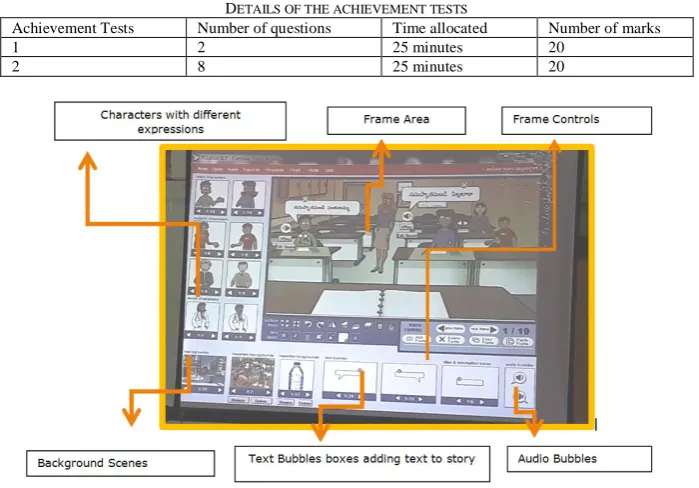
DETAILS OF THE ACHIEVEMENT TESTS
Achievement Tests Number of questions Time allocated Number of marks
1 2 25 minutes 20
2 8 25 minutes 20
Figure 2: Print screen of CSM frame while projecting in computer lab
Figure 4: Screenshots of i-Spring Quiz Maker
III. RESULTS AND ANALYSIS
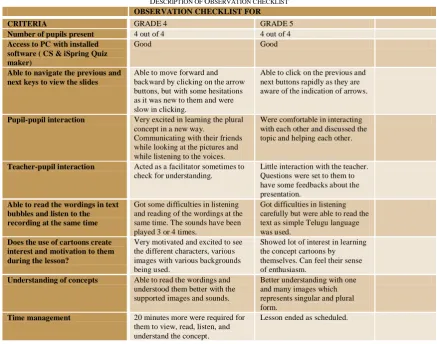
It was noted that the interactive lesson done created interest and encouragement in all learners taking part in the activity. This is so, because it was the first time that cartoons were used for explanation of Telugu concepts. One observation made was that there was a minimum of interaction between teacher- pupils. The finding matches that of Keogh and Naylor’s (2013) who mentioned that learners using concept cartoons automatically acted the role of an adjudicator, i.e. making their own judgments on the task being done. That role of adjudicator helps in empowering the learners’ ability to make judgments about their ideas whether they are right or wrong. In this way, the less confident learners will involve in argumentation and will put forward their ideas readily (Solomon, 1999 cited in Keogh and Naylor’s 2012). The Table below shows the results obtained from the observation checklist.
TABLE 2:
DESCRIPTION OF OBSERVATION CHECKLIST
OBSERVATION CHECKLIST FOR
CRITERIA GRADE 4 GRADE 5
Number of pupils present 4 out of 4 4 out of 4
Access to PC with installed software ( CS & iSpring Quiz maker)
Good Good
Able to navigate the previous and next keys to view the slides
Able to move forward and backward by clicking on the arrow buttons, but with some hesitations as it was new to them and were slow in clicking.
Able to click on the previous and next buttons rapidly as they are aware of the indication of arrows.
Pupil-pupil interaction Very excited in learning the plural concept in a new way.
Communicating with their friends while looking at the pictures and while listening to the voices.
Were comfortable in interacting with each other and discussed the topic and helping each other.
Teacher-pupil interaction Acted as a facilitator sometimes to check for understanding.
Little interaction with the teacher. Questions were set to them to have some feedbacks about the presentation.
Able to read the wordings in text bubbles and listen to the recording at the same time
Got some difficulties in listening and reading of the wordings at the same time. The sounds have been played 3 or 4 times.
Got difficulties in listening carefully but were able to read the text as simple Telugu language was used.
Does the use of cartoons create interest and motivation to them during the lesson?
Very motivated and excited to see the different characters, various images with various backgrounds being used.
Showed lot of interest in learning the concept cartoons by themselves. Can feel their sense of enthusiasm.
Understanding of concepts Able to read the wordings and understood them better with the supported images and sounds.
Better understanding with one and many images which represents singular and plural form.
Time management 20 minutes more were required for them to view, read, listen, and understand the concept.
Lesson ended as scheduled.
the sentences, linguistic learners can read the sentences over and over again so as to understand the concept and kinesthetic learners were manipulating the learning tools to grasp the new concept of learning.
Conventional approach v/s Technological approach
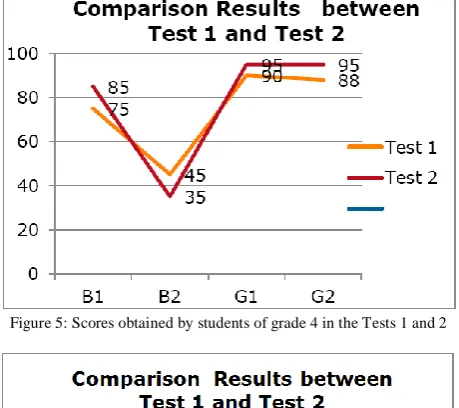
Figure 5: Scores obtained by students of grade 4 in the Tests 1 and 2
Figure 6: Scores obtained by students of grade 5 in the Tests 1 and 2
The same group of Grade 4 and 5 students was taught the ‘Plural’ concept in Telugu by both the conventional way and technological way. From the above charts, it is found that there are no significant differences in the % of marks after carrying out Tests 1 and 2. We note that student B2 from grade 4, who scored 45% of marks in Test 1 managed to get only 35% of marks in Test 2. Although technology was used for teaching, it was noted that one student was classed as low ability students and he was unable to perform better. Besides school, he does not get exposed to Telugu language at all. Homework was rarely completed due to un-responsible and un-educated parents who do not seem to care for their child’s educational life. On the other hand, the two average grade 5 learners who scored 55% in Test 1 as shown in Fig 6, have increased their marks in Test 2 obtaining 75%. For the high achievers, they performed better with the use of technology in teaching and learning the Telugu concept. These results are in line with those of Sidiropoulos (2008 cited Keogh and Naylor’s 2012) who adopted a similar methodological approach in his research study, which involved conventional and the use of new technology, ADLSE- an online platform in the teaching of Macroeconomics. He stated that the results were positive, which means that the use of new technology, ADLSE contributed to an increase in students’ performance.
cartoons for teaching lead to high degree of motivation thus improve the students’ different language skills and hence aid in achieving higher test scores. The pupils acquired a wide range of vocabulary from concept cartoons that they can use in real life. It can be suggested that by watching the cartoons, students can get stimulus to speak the target language. It has been found that exposure to cartoons on language learning improved the students’ communication skills.
IV. CONCLUSION
Language development is based upon the four skills namely; speaking, listening, reading and writing and all of these skills were facilitated by using technologies. Technologies made it possible to teach students using audio and visual materials that can be played, paused and repeated; therefore students can work at their own pace. They also enable the recording and analyzing of one’s speech and that can be used in various scaffolding forms for student learning. However, lack of resources, lack of time, unavailability of proper infrastructure and no permanent technicians provided remained the factors affecting the shift from passive to interactive teaching and learning. The research has been conducted to investigate how the use of technologies can motivate young learners to focus in the discussion of Telugu concept and how the implementation of the designed CSM tool were useful in helping the learners of different levels and learning styles, thus promoting interactions between teacher - students and students - students. The study was carried out with Grade 4 and 5 students. Both conventional and technological approaches have been used. The teacher had used the concept cartoons followed by an interactive quiz (Test 2) using iSpring. No significant differences in the percentage of marks from the two tests were found from using the two methods used, but there was an increase in the performance of low achievers.
REFERENCES
[1] De Lange, J. (2009). Case study, the Use of Concept Cartoons in the Flemish Science Education: Improvement of the Tool and Supporting Learners´ Language Skills through a Design Based Research. Paper presented at the ESERA, Istanbul.
[2] Dimitrios, B., Labros, S., Nikolaos, K., Maria, K., & Anthanasios, K. (2013). Traditional teaching methods vs. Teaching through the application of information and communication technologies in the accounting field. European Scientific Journal,
9(28) ISSN: 1857 – 7881 (Print) e - ISSN 1857- 7431.
[3] Doring, A. (2002). The Use of Cartoons as a Teaching and Learning Strategy with Adult Learners. New Zealand Journal of adult learning, 30(1), pp.56-62.
[4] Farwell, T. (2017). Learning Styles: Visual, Auditory, Kinesthetic. [online] Available from: https://www.familyeducation.com/school/multiple-intelligences/learning-styles-visual-auditory-kinesthetic (accessed 10/10/2017).
[5] Haque, S. (2013). Using cartoons for english language teaching in bangladesh: progress, problems and possibilities. Journal of
the Institute of Modern Languages, [online] Vol. 24 Available from:
http://www.academia.edu/8027144/USING_CARTOONS_FOR_ENGLISH_LANGUAGE_TEACHING_IN_BANGLADESH _PROGRESS_PROBLEMS_AND_POSSIBILITIES (accessed 08/10/17).
[6] Kawulich, B. (2005). Participant Observation as a Data Collection Method. Forum: Qualitative Social Research [online] 6(2) Available from: http://www.qualitative-research.net/index.php/fqs/article/view/466/996 (accessed 15/08/17).
[7] Keller, J., & Suzuki, K. (2004). Learner motivation and e-learning design: A multi-nationally validated process. Journal of Educational Media, 29(3), pp.229-239.
[8] Kenpro, (2012). Focus Group Discussion Method of Data Collection[online] Available from: http://www.kenpro.org/focus-group-discussion-method-of-data-collection-2/ (accessed 22/08/17).
[9] Lewin, K. (1935). A dynamic theory of personality. New York: McGraw-Hill.
[10] Malik, S. (2014). Effectiveness of ARCS Model of Motivational Design to Overcome Non Completion Rate of Students in Distance Education. Turkish Online Journal of Distance Education, 15(2), pp.194-200.
[11] Motteram, G. (2013). The benefits of new technology in language learning. British Council worldwide. Available at: https://www.britishcouncil.org/voices-magazine/the-benefits-new-technology-language-learning (accessed 18/10/17).
[12] Naylor, S., & Keogh, B. (2013). Concept cartoons: What have we learnt? Journal of Turkish Science Education, 10 (1), 3-11. Nicoll, G. (2001). A report of undergraduates bonding misconceptions. International Journal of Science Education, 23 (7), 707- 730.
[13] Pappas, C. (2015). Instructional Design Models and Theories: Keller’s ARCS Model Of Motivation. [Blog] eLearning Industry. Available from: https://elearningindustry.com/arcs-model-of-motivation (accessed 08/08/17).
[14] Poulsen, A., Lam, K., Cisneros, S., & Trust, T. (2008). ARCS model of motivational design. Retrieved March, 21, p.2011. Presented at the ESERA Conference, Istanbul, Turkey. Available at: http://torreytrust.com/images/ITH_Trust.pdf (accessed 02/06/17).
[15] Tabatabaei, M., & Gui, Y. (2011). The impact of technology on teaching and learning languages. Education in a technological world: communicating current and emerging research and technological efforts, 10(2), pp.513-517.
[16] Tolman, E.C. (1949). Purpose behavior in animals and men. Berkeley: University of California, Press, 1949.
[17] Wagner, D., Daswani, C., & Karnati, R. (2010). Technology and Mother-Tongue Literacy in Southern India: Impact Studies among Young Children and Out-of-School Youth. Information Technologies & International Development [online], 6(4). Available from: http://www.literacy.org/sites/literacy.org/files/publications/wagner_ict_lit_india_itid_dec10_bw.pdf (accessed 02/06/17).
[19] Yuliani, S., Khulaifiyah, K., & Idayani, A. (2015). CLIL (Content And Language Integrated Learning) For Achieving Positive Outcomes Of Students College. Proceedings of ISELT FBS Universitas Negeri Padang, 3, pp.443-450.
Prema Elliah has joined service in the Education Sector in Mauritius in 2007. She has been working in Primary schools in the north of the island teaching mainly Telegu Language with Grade 1 to 6 students. She completed her teacher diploma primary wit h the Mauritius Institute of Education (MIE) and her BSc (Hons) Educational and Instructional Technologies at the Centre for Innovative Lifelong Learning (CILL), University of Mauritius.
Goonesh Kumar Bahadur holds an undergraduate degree in Fashion from University of Central Lancashire, UK (2000), a Master degree from University of Mauritius in Computer Mediated Communication Pedagogies (2005) and a PhD in Fibrous Materials, Faculty of Engineering, University of Mauritius (2017). He has been working with the Department of Textile Technol ogy at the University of Mauritius since 2001 and has been involved in teaching students enrolled for the BSc (Hons) Textile and Fashion Design and BSc (Hons) Fashion Technology Programmes. In 2010, he moved to another department within the University of Mauritius, The Centre for Innovative Lifelong Learning (CILL) which specialises in e-learning. He is now the Officer in Charge of that centre. He has been teaching on programmes like, Diploma/ BSc (Hons) in Web and Multimedia Development, BSc (Hons) Educational and Instructional Technologies and on the MSc Educational Technologies.