Abstract—The stress concentration is always the associated problem that is inescapable and difficult to be solved completely in the shape design of pressure vessel. In order to eliminate those problems, this research is presented a numerical method, which is based upon the finite element method combined with simplify conjugated gradient method (S.C.G.M.) to optimize the shape of the pressure vessel. The objective function is used to find the minimization of stress in the pressure vessel. The validated results for the stress concentration are obtained from the comparison between the simulated results and previous study. Finally, this investigation can improve the stress distribution for the thin shell and reduce the stress concentration of the pressure vessel in the optimal process.
Keywords: stress concentration, pressure vessel, F.E.M., S.C.G.M.
I. INTRODUCTION
The pressure vessel is used in the petrochemical, gas storage and pharmaceutical industries, etc. Besides, most of the accidents (about 80%) for pressure vessel are resulted from the stress concentration. The associated stress concen-tration depends on the size, shape and location of the opening. The stress concentration effect the life time of pressure vessel crucially. It is very important to minimize the stress-raising effect at the opening or the discontinuous junction. In addition, the A.S.M.E. Boiler and Pressure Vessel code does not provide about the detailed analysis of stress. It only defines the thickness of wall which depends on the radius, the welding efficiency and the working pressure, etc. Besides, the maximum stress is under the allowable stress. The safety factors and the design rules [1] are assumed to satisfy for the high localized stresses. This code provides a quick design method. Then, a safety procedure will be processed in detail [2].
Manuscript received December 18, 2009.
W. C. Huang was with the Institute of Mechatronic System Engineering, National University of Tainan, Tainan 701, Taiwan, R.O.C. (phone: 886-0958-887-772; e-mail: harry750265@ hotmail.com).
J. C. Li was with the Institute of Mechatronic System Engineering, National University of Tainan, Tainan 701, Taiwan, R.O.C. (phone: 886-0925-289-511; e-mail: hebe75421@ hotmail.com).
David T. W. Lin was with the Institute of Mechatronic System Engineering, National University of Tainan, Tainan 701, Taiwan, R.O.C. (e-mail: [email protected]).
K. Y. Huang was with the Department of Mechatronic Engineering, Huafan University, Taipei 301, Taiwan, R.O.C. (e-mail: [email protected]).
As the design has the constraints, the stress concentration should be not exceeded the maximum of allowable stress in the structure and the connected structure should be not lost during the process of shape change. Those applications of pressure vessel are demanded for more lightweight, high-performance and low-cost. The researches of shape design optimization attest that the shape changes can save the considerable mass and improve the performance of structural [3-6]. Consequently, the shape of dome is one of the important issues in the design of pressure vessel.
Several methods have been used for solving the problem of stress concentration and light weight on the shape of pressure vessel, which are including the analytic methods or the numerical approaches, such as computational simulation [7], finite element method [8], adaptive genetic algorithm [9], metamorphic development [10], and first order method [11]. The optimization has become a significant development area in spite of the structural design and the academic research. In general, the purpose of shape optimization is used for finding the best structure with various constraints. For example, Hinton et al. [12] have reported some studies on the finite element structural shape and thickness optimization of axisymmetric shells. Queau and Trompette [13] investigated the shape optimization of a nozzle on the pressure vessel which was optimized the outside surface configuration. Hsu et al. [14] researched the stressed thickness profile design on the axial-symmetry shell with discontinuities. Li [15] showed the sensitivity analysis for finite element model about shape optimization design of pressure vessel. Ramakrishnan et al. [16] presented the optimal shape of thin pressure vessel with volume as an objective function. In above investigation, it was discussed the thickness optimization of the shell. Liang et al. [17] revealed a method in their study can usable for optimum design of dome contours of pressure vessel. Carlos et al. [18] showed the different optimization method and compared the advantage for each other on gating system. The results clearly show the effectiveness of the proposed approach for finding high quality castings. Xu et al. [19] proposed an adaptive genetic algorithm to design a vessel during optimal process. Sonmez [20] is proposed the research objective, which is to obtain globally optimum shapes for two-dimensional structures subject to quasi-static loads and restraints.
In this paper, a simplified method is used for designing typical pressure vessels include the spherical dome. This simplified method is a numerical method which is based upon the finite element method combines with simplify conjugated gradient method to optimize the shape of pressure vessel. The hoop and equivalent stresses are optimized for smooth in the boundary of vessel [21]. Moreover, it is important to
An Approach Based on S.C.G.M. for the 3D
Shape Optimization of the Pressure Vessel with
Spherical Dome
minimize the raising effect of the stress at the inside of wall. This investigation is to demonstrate how the application of numerical optimal simulation techniques can be used to search for an effective optimization of the pressure vessel design. Even more, the numerical results have been validated with the previous experimental study. On the other hand, the simplified conjugate gradient method is used as the optimization method. The S.C.G.M. method is proposed by Cheng and Chang [22], which is capable of handling the objective functions defined in different forms, and thus it widens the flexibility of the application of the optimization method. In the S.C.G.M. method, design variables are evaluated firstly in the sensitivity of the objective function. And then by giving an appropriate fixed value for the step size, the optimal design can be carried out without overwhelming mathematical derivation. And this approach has faster convergence characteristics than the other gradient based techniques. In the end, the result of the stress concentration in this paper is obtained by comparing the simulation results and another study. Furthermore, this investigation can improve the stress distribution on the thin shell and reduce the stress concentration of pressure vessel in the design process.
It includes four sections in this paper. In the first section, the current development of the optimization algorithm in the stress concentration problems is introduced, more investigation have been researched for shape problems and the characteristics, the process of the proposed method and the numerical model are illustrated in the second section. The computational process is also proposed to be implemented the method in the computer. In the third section, the optimal predictions are employed to demonstrate the usage of the proposed method with various conditions. A discussion of the analyzed results is also presented in this section. At last, the overall contribution and possible applications of this research are concluded in the fourth section. From this study, it can be concluded that the proposed method is an accurate, robust and efficient method to optimal the design problem.
II. SYSTEM DESCRIPTION 2.1 Validated model
[image:2.595.358.490.271.476.2]The model of pressure vessel is designed for the comparison and the analysis with previous study. In this paper [23], it consists of a cylinder, two elliptical heads and nozzle, etc. Fig.1 is the geometry schematic for pressure vessel, which the characteristic of the model is showed in the table 1.
[image:2.595.354.506.598.762.2]Fig.1 The geometry schematic view of model.
Table 1 The parameter of the pressure vessel. Unit: (mm)
Para-meter
Hi d0 Di L1 Hi l L
106 162.5 300 1200 175 600 2400
And the thickness of wall is 6(mm) in the vessel. To follow this investigation process, the comparison of this study is supplied a result which can make a verification for the analysis.
2.2 Optimization model
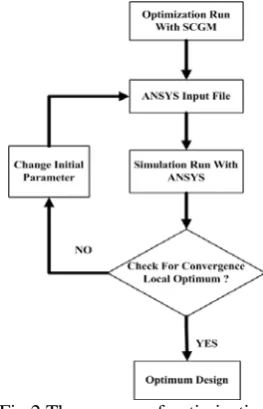
The model of pressure vessel is analyzed by the commercial program ANSYS which is used the three-dimensional solid brick element model. The whole structure is only 90 degree in the simulation, that is analyzed for the whole structure to be analyzed is axis-symmetric. The process of optimization with ANSYS is showed in Fig.2.
Fig.2 The process of optimization.
The following formulation is showed in the presented problem. In this research, a linear elastic material model is used with Poisson’s ratio = 0.3 , ultimate strength =
) (
620 MPa , Young’s modulus = 2.07×10⁵(MPa), and the density = 7.8×10⁻⁶(kg/mm3) . In order to analyze the phenomenon in this process, the schematic of model is expressed in Fig.3.
[image:2.595.101.237.629.747.2]By the ASME chapter UG-32(f) [24], the satisfy definition of the minimum thickness Tr for the spherical
dome as follow:
P PR T all r 2 . 0 2 2 − = η
σ (1)
u s all
n σ
σ = 1 (2)
where Tr is the thickness of dome in the vessel.
P is the working pressure
2
R is the radius of spherical dome in the inwall η is the welding efficiency
s
n is the safety coefficient
u
σ is the ultimate strength
all
σ is the allowable stress of the material.
And then, the cylinder in the pressure vessel is the definition of the minimum thickness Ts as follows:
P PR T all s 2 . 1 2 2 1 − = η
σ (3)
where Ts is the thickness of cylinder, and R1 is the radius of inwall in the cylinder .
The thickness of cylinder is fixed in this investigation. There are 4 variables in the model. X2 is the radius in the spherical dome, X3 and X4 are the angle and the height in the junction of dome with cylinder, respectively. Besides, X1 is the thickness of hemisphere which is changed with X2 in (1) as shown in Fig. 3.
In the optimal design process, the objective function is reduced for the maximum Von Mises stress of the whole model. Furthermore, IA is the iteration number, and J is the objective function of optimization design in this paper.
The minimization of the objective function is accomplished by using the S.C.G.M. method [22]. The method evaluates the gradient functions of the objective function and sets up a new conjugate direction for the updated undetermined coefficients with the help of a direct numerical sensitivity analysis.
We perform the direct numerical sensitivity analysis [22] to determine the gradient functions( J )n,(i 1,2,...,l)
i
= ∂
∂
α . First,
give a perturbation (Δαi) to each of the undetermined coefficients, {αi,i=1,2,...,l}, and then find the change in the objective function (ΔJ) caused by (Δαi) . The gradient function with respect to each of the undetermined coefficients {αi,i=1,2,...,l} can be calculated by the direct numerical differentiation as
i i J J α α Δ Δ = ∂ ∂ (4)
Then, we can calculate the conjugate gradient coefficients, n
i
r , and the search directions, n+1 i
π , for each of the undetermined coefficients {αi,i=1,2,...,l} with
l i J J r n i n i n
i , 1,2,...,
) ( ) ( 2 1 = ⎥ ⎥ ⎥ ⎥ ⎦ ⎤ ⎢ ⎢ ⎢ ⎢ ⎣ ⎡ ∂ ∂ ∂ ∂ = − α α (5) l i r J n i n i n i n
i ( ) , 1,2,...,
1 + =
∂ ∂ =
+ π
α
π (6)
The step sizes {βi,i=1,2,...,l} will be assigned for all the undetermined coefficients {αi,i=1,2,...,l} and leave it unchanged during the iteration. In this study, the fixed value is determined by a trial- and error process, and the value is set to be 1.0×10⁻⁶
typically. The difficulty lies with the fact that how to decide the suitable value of the step size. The undetermined coefficients will be updated.
l i n i i n i n
i , 1,2,..., 1
1= − + =
+ α βπ
α (7)
The procedure for applying the S.C.G.M. method is described briefly in the following:
Step1. Make an initial guess for the shape profile by giv-ing initial values to the set of undetermined coeffi-cients{αi,i=1,2,...,l}. With initialization accomplished, the run itself can begin.
Step2. Use the direct problem solver to predict the stress concentration and stress distribution of the pressure vessel, and calculate the objective function J.
Step3. When the objective function reaches a minimum, the solution process is terminated. Otherwise, proceed to step4.
Step4. Through the (4), to determine the gradient functions, ( J )n,(i 1,2,...,l)
i
= ∂
∂
α .
Step5. Through the (5) and (6), to calculate the conjugate gradient coefficients, n
l
r , and the search directions,
1 + n l
π , for each of the undetermined coefficients, } ,..., 2 , 1 ,
{αi i= l .
Step6. Assign a fixed value to the step sizes } ,..., 2 , 1 ,
{βi i= l for all the undetermined coefficients
} ,..., 2 , 1 ,
{αi i= l and leave it unchanged during the iteration. Step7. According the (7), to update the undetermined coefficients and adjust the shapes of pressure vessel, and go back to step2.
III. NUMERICAL RESULTS AND DISCUSSION
Fig.4 The distribution of stress concentration on the pressure vessel.
This paper assumed a new model to discuss the stress distribution of pressure vessel in the fig.3. In order to approach the actuality, the 3D structure of optimal design model is showed in the fig.5. From this figure, it is clear to realize that the stress distribution of vessel and the phenomenon of stress concentration is improved after the process of optimization by using S.C.G.M..
Fig.5 The optimal design of 3D structure on pressure vessel. In the fig.6, the diagram is showed the convergence of iteration as the relative criteria is equal to 10−6 and the number of times is almost 105 in iteration. There is a specifically advantage in this proposed method, which is only a few time for search the minization of working stress, and it is important to advance by choice a suitable initial value.
Fig.7 presented a profile of the stress distribution f or changing the value of X2 and X4. The variable X2 and X4 are independent and not effective each other. In this part, it is discussed the phenomenon of varying variablies and try to find the minimization of stress. The variable X2 is increased from 1400(mm) to 1650(mm) , the stress is decreased between 1400(mm) and 1500(mm) but it is increased between 1500(mm) to 1650(mm). And the variable X4 is increased from 100(mm) to 500(mm), the stress is reduced fastly. From the result in fig.7, the minimal position is located in (X2,X4)=(1509.68, 158.58) for minimization stress is equal to 152.7(MPa). It can be seen that the model is a non-monotonic function.
Fig.6 The convergence of iteration.
Fig.7 The stress distribution for varying the value of X2 and X4.
In Fig. 8 and Fig. 9 show the stress distribution of inwall and outer wall at Y-axis between initial design and optimization. The interval between 0 and 400 are larger than
) (
155 MPa of safe working stress obviously for the stress concentration of inwall. This is highly probable that it will happened accident or sudden situation in the working environment and reduce the lifetime of the pressure vessel. The variation between the average stress and the peak stress is 79.53(MPa) , and after the optimal procedure, the variation is 14.12 (MPa) in this investigation. The result can be thought as very well and the stress concentration is reduced about 33.35 percent, and the total volume also declines about 0.32 percent. There are the profiles to be constrained after optimization and it is also controlled within the safe working stress in those figures.
Fig.8 The stress distribution of inwall at Y-axis between the initial design and the optimization.
Fig.9 The stress distribution of outer wall at Y-axis between the initial design and the optimization.
IV. CONCLUSION
In general, the shape design is an important problem for the thin shell pressure vessel. In order to obtain good quality, it presents a numerical algorithm for shape design of a pressure vessel in this study. The proposed method which is based on finite element method combines with simplify conjugated gradient method to optimize the shape of pressure vessel. In this research of verification part, one of the results compares with the previous study [23]. The significance of this study shows that the numerical analysis provides for a good result for the shape of pressure vessel. This means that the proposed method can simulate the real size model of pressure vessel effectively.
After the optimal process, the stress concentration reduces about 33.35 percent, and the total volume also decreases about 0.32 percent. The results show that the location and the size of junction are important issue for the design of pressure vessel. The optimum shape is that the minimization Von Mises stress of the whole model is reduced. This is not only a promising investigation, but also a good verification for handling a complex problem efficiently in the optimization techniques and the mechanical application. In addition, it illustrates that the proposed method is an accurate, stable, and efficient method for solving the stress concentration problems.
REFERENCES
[1] J. H. Faupel, ‘‘Yield and bursting characteristics of heavy-wall cylinders,’’ Transactions of ASME, Vol. 78, pp. 1031–1064, 1956.
[2] J. M. Kihiu, G. O. Rading and S. M. Mutuli, ‘‘Universal SCFs and optimal chamfering in cross-bored cylinders,’’ International Journal of Pressure Vessels and Piping, Vol. 84, No. 6, pp. 396–404, 2007. [3] J. Luo, Z. Luo, L. Chen, L. Tong and M. Y. Wang , ‘‘A semi-implicit
level set method for structural shape and topology optimization,’’ Journal of Computational Physics, Vol. 227, Issue 11, pp. 5561–5581, 2008.
[4] D. Peng and R. Jones, ‘‘ An approach based on biological algorithm for three-dimensional shape optimization with fracture strength constrains,’’ Computer Methods in Applied Mechanics and Engineering, Vol. 197, Issues 49–50, pp. 4383–4398, 2008.
[5] A. Canelas, J. Herskovits and J. C. F. Telles, ‘‘Shape optimization using the boundary element method and a SAND interior point algorithm for constrained optimization,’’ Computers & Structures, Vol. 86, Issues 13–14, pp. 1517–1526, 2008.
[6] Z. Wu, ‘‘An efficient approach for shape optimization of components,’’ International Journal of Mechanical Sciences, Vol. 47, Issue 10, pp. 1595–1610, 2005.
[7] A. A. Smerdov, ‘‘A computational study in optimum formulations of optimization problems on laminated cylindrical shells for buckling II. Shells under external pressure,’’ Composites Science Technology, Vol. 60, Issue 11, pp. 2067–2076, 2000.
[8] A. Th. Diamantoudis and G. N. Labeas, ‘‘Stress intensity factors of semi-elliptical surface cracks in pressure vessels by global-local finite element methodology,’’ Engineering Fracture Mechanics, Vol. 72, Issue 9, pp. 1299–1312, 2005.
[9] P. Xu, J. Zheng, H. Chen and P. Liu, “Optimal design of high pressure hydrogen storage vessel using an adaptive genetic algorithm,” International Journal of Hydrogen Energy, Available online, 2009. [10] J. S. Liu, G. T. Parks and P. J. Clarkson “Shape optimization of
axisymmetric cylindrical nozzles in spherical pressure vessels subject to stress constraints,” International Journal of Pressure Vessel and Piping, Vol. 78, Issue 1, pp.1–9, 2001.
[11] L. Zhu and J. T. Boyle, “Optimal shapes for axisymmetric pressure vessels: A brief overview,” Journal of Pressure Vessel Technology, Vol. 122, pp.443–449, 2000.
[12] C. V. Ramakrishnan and A. Francavilla, ‘‘Structural shape optimization using penalty functions,’’ Journal of Structural Mechanics, Vol.3, pp. 403–422, 1975.
[13] J. P. Queau and Ph. Trompette, ‘‘Two-dimensional shape optimal design by finite element method,’’ International Journal Numerical Methods Engineering, Vol.15, pp.1603–1612, 1980.
[14] Y. Li, ‘‘Sensitivity analysis in shape optimization design for a pressure vessel,’’ International Journal Pressure Vessels and Piping, Vol.49, No. 3, pp.387–397, 1992.
[15] E. Hinton, N. V. R. Rao and J. Sienz, ‘‘Finite element structural shape and thickness optimization of axisymmetric shells,’’ Engineering Computations Swansea, Vol.9, No. 5, pp.499–527, 1992.
[16] Y. L. Hsu, C. R. Steele and S. D. Sheppard, ‘‘Fully stressed thickness profile design at discontinuities of axisymmetric shells,’’ Structural Multidisciplinary Optimization, Vol.7, pp.199–205, 1994.
[17] C. C. Liang, H. W. Chen and C. H. Wang, “Optimum design of dome contour for filament-wound composite pressure vessels based on a shape factor ,” Composite Structures, Vol.58, pp.469–482, 2002. [18] C. E. Esparza, M. P. G. Mata and R. Z. R. Mercado, “Optimal design of
gating systems by gradient search methods,” Computational Materials Science, Vol.36, pp.457–467, 2006.
[19] P. Xu, J. Zheng, H. Chen and P. Liu, “Optimal design of high pressure hydrogen storage vessel using an adaptive genetic algorithm” International Journal of Hydrogen Energy, pp.1–7, 2009.
[20] F. O. Sonmez, “Shape optimization of 2D structures using simulated annealing,” Computer Methods Applied Mechanics Engineering, Vol.196, pp.3279–3299, 2007.
[21] H. Darijani, M. H. Kargarnovin and R. Naghdabadi, ‘‘Design of thick-walled cylindrical vessels under internal pressure based on elasto-plastic approach,’’ Materials & Design, Vol.30, No.9, pp.3537–3544, 2009.
[22] C. H. Cheng and M. H. Chang, “A simplified conjugate-gradient method for shape identification based on thermal data,” Numerical Heat Transfer, Part B Vol.43, pp. 489–507, 2003.
[23] Z. F. Sang, L. P. Xue, Y. J. Lin and G. E. O. Widera, “Limit and burst pressures for a cylindrical shell intersection with intermediate diameter ratio” International Journal Pressure Vessels and Piping, Vol.79, pp.341–349, 2002.