BIOLOGICAL ACTIVITY OF SOME NEWLY SYNTHESIZED
HYDRAZONE DERIVATIVES DERIVED FROM
(DICYCLOPROPYLMETHYLENE)HYDRAZONE
Marwa Abdel-Motaal
[a, b]* and Ahmed Nabil
[c]Keywords: Hydrazones; Dicyclopropyl ketone; Anticancer activity; Antibacterial activity.
A series of new hydrazone derivatives were synthesized using dicyclopropyl ketone as starting material. Unexpected reaction of salicylaldehyde with (dicyclopropylmethylene)hydrazine yielded the appropriate bis(salicylaldehyde azine). Treatment of the (dicyclopropylmethylene)hydrazine with the appropriate coupling agents gave the corresponding imides, imidazolones, oxazolones, quinazolinones and triazoles, respectively. The synthesized compounds were characterized using IR, 1H-NMR, 13C-NMR and mass spectral data. These newly formed products were tested for their antibacterial and antifungal activities and most of the compounds showed high activity compared with Ciprofloxacin as positive controls. In addition, the compounds were also, examined for their anticancer activities against breast cancer cell line (MCF7) compared with cisplatin as a positive control. The novel synthesized compounds showed satisfactory activity against (MCF7) with mean IC50values ranging from 21.5 to 100 μM.
* Corresponding Authors
E-Mail: [email protected]
[a] Chemistry Department, Faculty of Science, Qassim University, Qassim, Saudi Arabia.
[b] Department of Chemistry, Faculty of Science, El Mansoura University, Mansoura, Egypt.
[c] Department of Biotechnology, Faculty of Postgraduate Studies for Advanced Sciences, Suef, University, Beni-Suef, Egypt.
Introduction
Hydrazones have diverse interesting biological activities1 including antitumor,2–4 anti-inflammatory,5 antimalarial,6 antimicrobial,7,8 insecticidal,9 antiplatelet,10 antibacterial, antifungal, antimycobacterial, cytotoxic and cytostatic activities.11,12 Cu(II) phenanthroline hydrazone complexes are able to cleave DNA and show cytotoxic activity against cancer cells.13 Aminoguanidine hydrazones (AGH's) have potential important towards developing focused adjuvants for antibiotic drug therapies against bacterial multidrug resistance.14 These compounds also evaluated for their in vitro α-glucosidase inhibitory activity.15 Hydrazones have been used to designmaterials that are used for pH-responsive drug delivery systems and these hydrazones were characterized by different spectral methods. Therefore there is scope to utilize these dendrimers to form hydrazone conjugates with the drugs (anticancer as well as antimicrobial) for more effective and targeted delivery in acidic environments.16 Hydrazones have an attractive therapeutic approach, which is widely applied in the treatment of many diseases. For example, Alzheimer’s disease (AD).17 Moreover, the significance of hydrazones is due to their ability to extensively used as intermediates for the synthesis of heterocyclic compounds of pharmaceutical interests18,19 and as transition metal chelators.20,21 Therefore, and in view of these findings we report here in the utilization of (dicyclopropylmethylene)hydrazone (2) which has previously been prepared by the reaction of dicyclopropyl ketone and hydrazine hydrate 22 as a primitive compoundfor synthesis of novel of a series of new heterocyclic compounds with a biologically active pharmacophore (=NH–N-CH–)
followed by screened for their antibacterial, antifungal and anticancer activities against breast cancer cell line (MCF7).
Experimental
All compounds were used without any purification or treatment. Reagents were used synthesized according to published literature. Thin-layer chromatography (TLC) was used to monitor the reaction and emphasizes the purity of the products. Melting points are recorded in Gallenkamp electric melting point apparatus and are uncorrected. The IR spectra ύ (cm-1) were measured on FT-IR spectrophotometer in potassium bromide (KBr). The 1H-NMR and 13C-NMR spectra were measured were measured in DMSO-d6 as solvent at 500 MHz on a JNM-ECA500II NMR spectrometer using tetramethylsilane (TMS) as an internal reference and
chemical shifts are expressed as δ ppm. The mass spectra (EI)
were recorded on 70 eV with Kratos MS equipment.
Synthesis of (dicyclopropylmethylene)hydrazone (2)
Hydrazine hydrate (1 mmol) was added to an equimolar amount of a solution of dicyclopropyl ketone (1 mmol) in 15 mL of absolute ethanol. The reaction mixture was heated under reflux for 5 h, evaporate the excess ethanol and then left to cool down to 0oc. The solid product was obtained by pouring onto ice-water with stirring, filtered off, dried, the product is sufficiently pure and it didn’t need purification to give 2 as Colorless powder; yield 92 %; m.p. 85o C. IR (KBr,
ν/cm-1): 3425, 3395 (NH
2), 1604 (C=N).1H NMR
(DMSO-d6) δ ppm 0.6-1.07 (m, 8H, 4CH2), 2.25 (m, 4H, 2CH,NH2).
13C-NMR (DMSO-d6): δ ppm 5.6, 7.24, 9.36, 11.45 and 165.8. MS (EI): (m/z, %), 124 (M+-1, 1), 108 (100).
General procedure for the synthesis of 3-10
mmol) in absolute ethanol (30 ml) was refluxed in water bath for 6-8 h. the reaction mixture was left to cool, the resulting precipitate was filtered off and recrystallized from ethanol to give 3-8.
1-(Dicyclopropylmethylene)-2-(4-methoxybenzylidene)-hydrazine (3a)
Yellow needles; yield 78 %; mp 164-6 oC IR (KBr, ν/cm -1): 2967-2840 (CH aliph.), 1659, 1600 (2C=N).1H NMR (DMSO-d6) δ ppm 0.1-1.06 (m, 10H, H-aliph), 3.79 (s, 3H, OCH3) and 7.035-7.8 (m, 4H, H-Ar) 8.6 (s, 1H, CH=N).13 C-NMR (DMSO-d6): δ ppm 5.6, 7.24, 9.36, 11.45 and 165.8. MS (EI): (m/z, %), 241 (M+-1, 9.08), 160 (100).
1-(Dicyclopropylmethylene)-2-(4-nitrobenzylidene)hydrazine (3b)
Yellow crystals; yield 92 %; mp. >250 oC. IR (KBr, ν/cm -1): 2961-2830 (CH aliph.), 1609 (2C=N). 1H NMR
(DMSO-d6) δ ppm 0.12-1.4 (m, 10H, H-aliph), 6.8-7.1 (m, 4H, H-Ar)
and 8.3 (s, 1H, CH=N). MS (EI): (m/z, %), 257 (M+, 23).
1-(Dicyclopropylmethylene)-2-(furan-2-ylmethylene)hydrazine (3c)
Bale yellow needles; yield 81 %; mp 104 oC, IR (KBr, ν/cm -1): 2927-2850 (CH aliph.), 1656-1651 (2C=N).1H NMR (DMSO-d6) δ ppm 0.1-1.6 (m, 10H, H-aliph), 6.5-7.5 (m, 3H, H-Ar) and 8.1 (s, 1H, CH=N). MS (EI): (m/z, %), 202 (M+, 60)
3-((Dicyclopropylmethylene)hydrazono)indolin-2-one (4)
Dark red crystals; yield 88 %; mp >300 oC. the reaction mixture with few drops of acetic acid as catalyst. IR (KBr,
ν/cm-1):3277(NH), 1723, 1613 (C=O, C=N).1H NMR (DMSO-d6) δ ppm 0.9-1.3 (m, 10H, H-aliph), 6.8-7.5 (m, 4H, H-Ar) and 10.9(s, 1H, NH). 13C-NMR (DMSO-d6): δ ppm 7.36, 9.2, 13.13, 110.6, 111.12, 122.05, 127.8, 128.2, 134.4, 144.73, 145.19 and 163.4 MS (EI): (m/z, %), 253 (M+, 100).
Ethyl-3-((dicyclopropylmethylene)hydrazono)butanoate (5)
Yellow crystals; yield 68 %; mp190 oC. IR (KBr, ν/cm -1):1683, 1613 (C=O, C=N).1H NMR (DMSO-d6) δ ppm 0.9 -1.0 (m, 10H, H-aliph), 1.1(t, 3H, CH3), 2.2(S, 3H, CH3), 1.1(t, 3H, CH3), 2.2(S, 2H, CH2)and 4.0(q, 2H, CH2 ester). 13 C-NMR (DMSO-d6): δ ppm 12.8, 14.3, 17.7, 58.7, 103.8, 11.9, 138.6, 149.8, 159.7, and 166.8 MS (EI): (m/z, %), 236 (M+, 2.5).
2,2'-(Hydrazine-1,2-diylidenebis(methanylylidene))-diphenol(10)
Bright yellow crystals ; yield 95 %; mp 205-7 oC
IR (KBr, ν/cm-1):3445(OH), 1622 (2 C=N).1H NMR
(DMSO-d6) δ ppm 6.9-7.6(m, 8H, H-Ar), 8.9(s, 2H, CH=N) and 11.1(s, 2H, OH).MS (EI): (m/z, %), 240 (M+, 17) and 185(100).
General procedure for the synthesis of 7a, 8a
Thiosemicarbazide (1 mmol) was added to an equimolar amounts of solution of 3a (1 mmol) in 25 mL of absolute ethanol and few drops of acetic acid. The reaction mixture was heated under reflux for 12 h then the precipitated crude product was filtered off.
4-((Dicyclopropylmethylene)amino)-5-(4-methoxyphenyl)-4,5-dihydro-1H-1,2,4-triazol-3-amine(7a)
White crystals (from ethanol) 62 %, m.p 160-162°C.IR
(KBr, ν/cm-1): 1793,1725, 1653 (C=O,2 C=N).1H NMR
(DMSO-d6) δ ppm 1.02 1.4 (m, 10H, H-aliph) and 3.8(s, 3H, OCH3), 5.8 (s, 1H, CH), 6.7, 7.8 (m, 4H, H-Ar), 8.6 (s, 2H, NH2) and 9.8 (s, 1H, NH). MS (EI): (m/z, %), 268 (M+-OCH3, 6.6).
5'-Amino-4'-((dicyclopropylmethylene)amino)-2',4'-dihydro-spiro[indoline-3,3'-[1,2,4]triazol]-2-one (8a)
Yellow crystals (from ethanol) 75 %, m.p 238-240 oCIR
(KBr, ν/cm-1): 3419, 3351(2NH), 3259, 3190(NH
2), 1679, 1613 (C=O, C=N).1H NMR (DMSO-d6) δ ppm 1.0-1.055 (m, 10H, H-aliph), 6.8-7.3 (m, 4H, H-Ar), 10.5 (s, 1H, NH), 10.6 ( s, 1H, NH) and 11.1 (s, 2h, NH2) .13C-NMR (DMSO-d6): δ ppm 10-20, 109.9, 111.03, 117.4, 119.98,162.7, 178.66 and 181.13 MS (EI): (m/z, %), 313 (M++2, 8.4).
General procedure for the synthesis of 7b, 8b
A mixture of 4 (1 mmol) and of benzohydrazide (1 mmol) in 20 ml absolute ethanol in the presence of alcoholic potassium hydroxide (1.5 mmol) was refluxed for 22 h. The reaction mixture was cooled, then poured into ice-water, then it was acidified with diluted HCl to pH 6. The formed crude product was filtered off,
1,1-Dicyclopropyl-N-(5-(4-methoxyphenyl)-3-phenyl-1,5-dihydro-4H-1,2,4-triazol-4-yl)methanimine (7b)
Brown crystals (from ethanol) 62 %, m.p >250 oCIR (KBr,
ν/cm-1): 3419, 3351(2NH), 3259, 3190(NH
2), 1679, 1613 (C=O, C=N).1H NMR (DMSO-d6) δ ppm 1.0-1.055 (m, 10H, H-aliph), 6.8-7.3 (m, 4H, H-Ar), 10.5 (s, 1H, NH), 10.6 ( s, 1H, NH) and 11.1 (s, 2h, NH2) .13C-NMR (DMSO-d6): δ ppm 10-20, 109.9, 111.03, 117.4, 119.98,162.7, 178.66 and 181.13 MS (EI): (m/z, %), 313 (M++2, 8.4)
4'-((Dicyclopropylmethylene)amino)-5'-phenyl-2',4'-dihydro-spiro[indoline-3,3'-[1,2,4]triazol]-2-one (8b)
Yellow crystals (from ethanol) 62 %, m.p 262-264 °C.IR
(KBr, ν/cm-1): 3349 (NH), 1685, 1601 (2C=N).1H NMR
(DMSO-d6) δ ppm 0.9-2.1 (m, 10H, H-aliph), 3.8 (s, 3H, CH3) and 7-7.9 (m, 9H, H-Ar) MS (EI): (m/z, %) 360 (M+- 1, 15.1).
Synthesis 2-(3-amino-4-((2-hydroxybenzylidene)amino)-4,5-dihydro-1H-1,2,4- triazol-5-yl)phenol (11a)
ethanol and few drops of acetic acid. The reaction mixture was heated under reflux for16 h, the precipitated of the crude product was filtered and further purified by recrystallization from methanol to give 11a as faint yellow crystals; yield 95 %; mp 226-8 oC. IR (KBr, ν/cm-1):3443, 3320(NH
2),3173, 3137 (2CH=N), 1723, 1613 (C=N).1H NMR (DMSO-d6) δ ppm 6.7-8.0 (m, 8H, H-Ar), 8.3 (s, 1H, CH=N),9.8(s, 1H, NH2)and 11.3(s, 1H, OH). 13C-NMR (DMSO-d6): δ ppm 116, 119.34, 120.37, 126.7, 131.17, 139.7, 156.4 and 177.6 MS (EI): (m/z, %), 297 (M+, 2.5), 195(100).
Synthesis of 2-(4-((2-hydroxybenzylidene)amino)-3-phenyl-4,5-dihydro-1H-1,2,4-triazol-5-yl)phenol(11b)
A mixture of 10 (1mmol) and (1 mmol) of benzohydrazide in 20 ml absolute ethanol in the presence of alcoholic potassium hydroxide (1.5 mmol) was refluxed for 8 h. The reaction mixture was cooled, then poured into ice-water, then it was acidified with dilute HCl to pH 6. The formed crude product was filtered off, dried, and crystallized from methanol to give (55 %) of 11b asyellow crystals; yield 54 %; mp. 198-200 oC.
IR (KBr, ν/cm-1): 1689,1623 (2 C=N).1H NMR
(DMSO-d6) δ ppm 6.5-7.1(m, 8H, H-Ar), 8.5(s, H, CH=N) and 11.1(s,
2H, 2OH).MS (EI): (m/z, %), 356 (M+, 20).
General procedure for the synthesis of 12, 13
A mixture of dicyclopropyl ketone 1 (1 mmol) and cyanoacetic acid hydrazide (1 mmol) in 25 ml absolute ethanol was refluxed for 3 h on a water bath. After leaving the mixture to cool to room temperature, the white precipitate that formed was filtered off to be the crude product of 12. The filtrate was cooled to 0oc the brown pellets that precipitated was filtered off to afford 13.
2-Cyano-N'-(dicyclopropylmethylene)acetohydrazide (12)
White crystals (from ethanol) 65 %, m.p 125-126 oC. IR
(KBr, ν/cm-1):3198 (NH), 2264 (cyano), 1679 (C=N).1H
NMR (DMSO-d6) δ ppm 0.6-2.03 (m, 10H, H-aliph), 3.9 (s, 2H, CH2) and 10.86(s, 1H, NH). 13C-NMR (DMSO-d6): δ ppm 5.92, 6.86, 10.5, 11.03, 24.57, 116.24, 157.92 and 165.03 MS (EI): (m/z, %), 191 (M+, 13), 123(100).
5-Amino-1-(dicyclopropylmethyl)-1,2-dihydro-3H-pyrazol-3-one (13)
Brown pellets (from ethanol) 33 %, m.p 210 °C. IR (KBr,
ν/cm-1):3337(NH), 3166, 3100 (NH
2), 1689, 1654 (C=O, C=N).1H NMR (DMSO-d6) δ ppm 0.8-1.8 (m, 10H, H-aliph), 4.1(s, 1H, CH-N), 5.6 (s, 1H, NH), 5.8 (S, 1H, H-Ar) and 9.8(s, 2H, NH2). 13C-NMR (DMSO-d6): δ ppm 18.6, 36.27, 56.08, 74.23, 157.0, 159.3 and 171.7. MS (EI): (m/z, %), 193 (M+, 1.5), 69(100).
Synthesis of 1-(dicyclopropylmethylene)-3-(2-methyl-4-oxoquinazolin-3(4H)-yl)thiourea (15)
A mixture of equimolar amount of dicyclopropyl ketone (1 mmol) and thiourea derivative 14 (1 mmol) in absolute
ethanol (25 ml) was refluxed in water bath for 12 hr. the reaction mixture was left to cool, the resulting precipitate was Filtered off and recrystallized from ethanol to give 15 as brown needles in 45 % yield, mp 135-2°C. IR (KBr, ν/cm -1):3432 (NH), 1675, 1660 (C=O, C=N).1H NMR (DMSO-d6)
δ ppm 1.1-1.8 (m, 13H, H-aliph, CH3), 6.4-7.3 (m, 4H, H-Ar)
and 8.2 (s, 1H, NH).MS (EI): (m/z, %), 326 (M+, 100).
General procedure for the synthesis of 16-20
To a solution of 2 (5 mmol) and 25 ml of glacial acetic acid, (5 mmol) of phthalic anhydride, maleic anhydride, succinic anhydride, benzylidene-2-methyloxazol-5(4H)-one, 4-benzylidene-phenyloxazol-5(4H)-one or 2-methylbenzoxazinone was added. The reaction mixture was refluxed for 6-24 h. The solution was poured on ice-cold water. The formed precipitate was filtered, washed with water, dried and crystallized from the appropriate solvent.
2-(2-(Dicyclopropylmethylene)hydrazine-1-carbonyl)benzoic acid (16)
White crystals (from acetic acid) 72 %, m.p >250°C. IR
(KBr, ν/cm-1):3459(OH), 1746, 1660, 1605 (2C=O, C=N).1H
NMR (DMSO-d6) δ ppm 0.6-1.8 (m, 10H, H-aliph), 7.8-8.1 (m, 5H, H-Ar,NH) and 11.5(s, 1H, COOH). 13C-NMR (DMSO-d6): δ ppm 18.6-74.23, 124.8, 125.14, 127.16, 128.8, 132.6, 136.2 and 163.44. MS (EI): (m/z, %), 272 (M+, 25).
1-((Dicyclopropylmethylene)amino)-1H-pyrrole-2,5-dione (17)
Brown crystals (from methanol) 55 %, m.p >260 °C. IR
(KBr, ν/cm-1): 1739, 1634 (2C=O, C=N).1H NMR
(DMSO-d6) δ ppm 0.8-2.1 (m, 10H, H-aliph), 6.2 (dd, 2H, H-Ar). 13
C-NMR (DMSO-d6): δ ppm 38.9, 20.4, 20.6, 21.08, 29.04, 131.65, 166.85 and 172.06. MS (EI): (m/z, %), 204 (M+, 56).
1-((Dicyclopropylmethylene)amino)pyrrolidine-2,5-dione (18)
White needles (from DMF) 82 %, m.p 245-8 oC IR (KBr,
ν/cm-1): 1735 (2C=O).1H NMR (DMSO-d6) δ ppm 1.8-3.5 (m, 14H, H-aliph). 13C-NMR (DMSO-d6): δ ppm 26.3, 172.0 and 172.2. MS (EI): (m/z, %), 206 (M+, 62).
5-Benzylidene-3-((dicyclopropylmethylene)amino)-2-methyl-3,5-dihydro-4H-imidazol-4-one(19a)
Brown crystals (from ethanol) 62 %, m.p 152-154 °C. IR
(KBr, ν/cm-1): 1704, 1645, 1602 (C=O, 2C=N).1H NMR
(DMSO-d6) δ ppm 1.9-2.0 (m, 13H, H-aliph, CH3) and 6.9-8.3 (m, 6H, H-Ar). 13C-NMR (DMSO-d6): δ ppm 10.0, 14.04, 20.50, 21.06, 112.2, 130.4, 132.4, 136.9, 141.15, 159.34, 169.12 and 172.03. MS (EI): (m/z, %), 289 (M+- 4, 10.6).
5-Benzylidene-3-((dicyclopropylmethylene)amino)-2-phenyl-3,5-dihydro-4H-imidazol-4-one (19b)
Yellow crystals (from acetic acid) 74 %, m.p 158-160 °C.
IR (KBr, ν/cm-1): 1793,1725, 1653 (C=O,2 C=N).1H NMR
125.1-133.7 Ar-C, 163.06 and 166.9 MS (EI): (m/z, %), 352 (M+, 1.9).
3-((Dicyclopropylmethylene)amino)-2-methylquinazolin-4(3H)-one (20)
Faint yellow needles (from ethanol) 82 %, m.p 230-232 oC
IR (KBr, ν/cm-1): 1675, 1660 (C=O, C=N).1H NMR
(DMSO-d6) δ ppm 1.02-2.1 (m, 13H, H-aliph, CH3) and 7.9-8.2 (m,
4H, H-Ar).MS (EI): (m/z, %), 267 (M+, 3.6).
Synthesis of 2,2-dicyclopropyl-3,4-dihydro-2H-naphtho[2,1-e][1,3,4]oxadiazine-5,6-dione (22)
2,3-Epoxy-1,4-naphthoquinone (5 mmol) was added to a solution of 2 (5 mmol) in absolute ethanol. The reaction mixture was refluxed in water bath for 2 h. The precipitate that formed was filtered off. This solid was dissolved in distilled water then cooled to 0oc and dil. HCl was dropwise added to the solution until reached to PH 6. The crude product was filtered off, washed with water, dried, recrystallized from methanol to give buff crystals of 22 in 89 % yield, mp 185-186 oC.
IR (KBr, ν/cm-1):3450 (2NH), 1687 (2C=O).1H NMR
(DMSO-d6) δ ppm 1.2-1.5 (m, 10H, H-aliph), 6.1(s, 1H, NH) and 7.7-8.01 (m, 1H, H-Ar). 13C-NMR (DMSO-d6): δ ppm 16.6-77, 110.99, 125.3, 125.93, 130.56, 131.87, 134.47, 159.48, 181, 24 and184.73. MS (EI): (m/z, %), 296 (M+, 1.5).
Biological activity
The following materials were used: Dulbecco's modified Eagles medium (DMEM) (Lonza, Belgium), a fetal bovine serum (FBS) (Lonza, Belgium), an antibiotic and antimycotic (penicillin-streptomycin) (Lonza, USA) sample, a Kreps ringer bicarbonate buffer (Sigma Aldrich, USA), a trypsin/EDTA 0.25 % (200 mg/L EDTA, 170,000 U trypsin/L) (Lonza, Belgium), a bovine serum albumin (BSA) (Hyclone, USA). , a phosphate buffer saline 1X (PBS) (Hyclone, USA), Trypan blue 0.4 % (Lonza, USA), an MTT assay kit (Lonza, USA), Ciprofloxacin (Sigma Aldrich, USA), Cisplatin ( Hospira UK Ltd.).
MCF7 and normal cell lines were obtained from VACSERA, EGYPT. Candida Albicans Fungus was obtained from Regional Center of fungi, Al-Azhar University, Egypt. Gram +ve Staphylococcus Aureus and Gram –ve E. Coli were obtained from Department of Biotechnology, Faculty of Post Graduate Studies for Advanced Sciences, Beni-Suef University, Egypt.
Anticancer activity
The cells were cultured in DMEM medium at 37 ° C, 5 % CO2 supplemented with 10 % fetal bovine serum (FBS), 100 U mL-1 penicillin and 100 μg mL-1 streptomycin. Cell viability was estimated using MTT assay Kit which based on the reduction of 3-(4,5-dimethylthiazol-2-yl)-2,5-diphenyltetrazolium bromide (MTT) dye to violet formazan crystals by succinate dehydrogenase inside living cells mitochondria. The cells were seeded into 96-well plate with
a concentration of 6000 cells/well and incubated for 24 h. The medium was discarded and various concentrations of the test compounds dissolved in DMEM were added to wells. After another incubation with the same conditions, the medium was
discarded, and 100 μL MTT (2 mg mL-1) was added and
incubated for 3 h at 37 °C. The produced purple formazan
crystals were dissolved in 50 μL of DMSO. The plate was
then incubated for 15 min at 37 °C and the optical density was read at 570 nm with a reference wavelength 630 nm as using Stat fax Elisa plate reader (Stat fax, USA). Cisplatin (Hospira UK Ltd.) was used as positive control and DMSO was used as the solvent for compounds and its final concentration was less than 0.2%. IC50 and IS50 were calculated. All in vitro tests were performed in triplicates.
Antimicrobial and antifungal activity tests
The studied compounds were diluted with DMSO to conc. 100 mg mL-1 then about 6mm diameter filter paper was
soaked in 75 μl of diluted compounds. Ciprofloxacin (20 μg
mL-1) was used as positive control and DMSO was used as negative control. Nutrient agar plates were inoculated with Gram +ve Staphylococcus Aureus, Gram –ve E. Coli and Candida Albicans by sterile swabs and the tested compound containing discs were placed onto the nutrient agar surface by sterile forceps. Plates were incubated at 37°C/24 h. Inhibition zone was measured in mm. Tests were performed in triplicates.
Result and discussion
The target synthetic products 2–23 were prepared using synthetic procedures are summarized in Schemes 1-4. Condensation of dicyclopropyl ketone 1 with hydrazine hydrate in refluxing ethanol afforded the key hydrazone derivative (2), followed by condensation with appropriate aromatic aldehydes in refluxing ethanol formed the corresponding Schiff bases (3-5) in good yields. Similarly, the hydrazone 2 was condensed with isatin in the presence of a few drops of glacial acetic acid as a catalyst to produce the Schiff base 4 in a rather excellent yield. However, cyclization reaction of the hydrazine derivative 5 was unsuccessful.
The structures of the newly synthesized compounds 2-5
were confirmed on the basis of their spectral data (IR,1 H-NMR, 13C-NMR and MS spectra). The infrared spectra of the formed hydrazones showed the absence of amino group and appearance of imino group at 1613-1659 cm-1. In addition, 1H-NMR spectrum of 3b showed singlet signal at 3.79 ppm due to the methoxy group, while in the spectrum of compound
4 a singlet signal at 10.9 ppm for NH group was appeared. Also, the spectrum of compound 5 showed the presence of -COOCH2CH3 group, two protons appeared as a quartet at 4.0 ppm, three protons as a triplet at 1.22 ppm while, the three protons of the methyl group appeared as a singlet at 2.25 ppm.
Scheme 1. Synthetic route to obtain target hydrazone derivatives 3-5 ((i) NH2NH2.H2O, ethanol, reflux; (ii) ethanol, glacial CH3COOH, reflux) and subsequent formation of triazole derivatives by reaction of the synthesized Schiff bases with thiosemicarbazide and benzohydrazide
The amino protons in the sepctra of compounds 7a and 8a
were appeared in the range of 9.8-12.9 ppm. All the aromatic protons were found in the range of 6.7-8 ppm. IR spectrum for compound 8b ascertained its structure by the appearance of the characteristic bands at 3438 and 1691 cm-1 for the amino and carbonyl groups. Its 1H-NMR spectrum showed singlet signals at 12.4 and 11.0 ppm assigned to 2NH protons. The appearance of aromatic hydrogen signals was confirmed by the multiplet signals in the range of 6.8-7.6 ppm. The 13 C-NMR and mass spectra were in good agreement with the molecular formula. On the other hand, with an unexpected reaction of salicylaldehyde with hydrazone 2 it gave the light yellow crystals of salicylaldehyde azine 10 with 95 % yield which was synthesized previously.28 The proposed mechanism accompanied by degradation of the hydrazone group and reformation of the starting dicyclopropyl ketone then condensation of the resulting salicylaldehyde hydrazone with another mole of salicylaldehyde. Comparison with the reported spectra and melting point data with the synthesized compound gave us absolute confidence to assign it as salicylaldehyde diazine 10.
The spectral data of 10 were in good agreement with the expected structure of the compound. Its IR spectrum showed absorption bands at 3445 and 1622 cm-1 due to 2OH and 2C=N groups and absence of absorption band of NH2 group. 1H-NMR and 13C-NMR revealed the absence of aliphatic protons and carbons of the cyclopropyl rings, respectively. Its mass spectrum exhibited a molecular ion peak at m\z 240 which consistent the molecular formula of the bis-azine 10. We have attempted to prepare the Schiff base derivative 9 by the addition reaction of thiosemicarbazide and benzohydrazide with compound 2. As the unexpected direction of the reaction led the formation of bis azine 10, this compound was reacted with thiosemicarbazide and benzohydrazide to form triazoles 11a and 11b, respectively. Their structures were assigned by their spectral and analytical data. IR spectrum for 11a showed the presence of NH2 bands at 3173 and 3137 cm-1 and the mass and NMR spectra were confirmed the cyclization reaction with thiosemicarbazides. In the same way, the formation of 11b could be confirmed by its spectral data.
Scheme 2. The reaction of hydrazine 2 with salicylaldehyde and subsequent with thiosemicarbazide and benzohydrazide
Compound 1 was reacted with cyanoacetic acid hydrazide in ethanol as a solvent given a mixture of cyanoacetohydrazone and pyrazole derivatives (12 and 13)
which can exist in two tautomeric ketone-enol forms), respectively and these products were separated easily from ethanol by cooling. Treatment of dicyclopropyl ketone with thiourea derivative (14) in boiling ethanol gave the corresponding quinazoline derivative (15).
The structures of the 12 and 13 were elucidated on the basis of their IR, 1H-NMR, 13C-NMR and MS spectra. For example, the IR spectrum of 12 revealed the presence of absorption band at 2264 cm-1 characteristic for cyano group. There were no found any absorption bands at the region of cyano group, but there was found absorption bands at 3166 due to the presence NH2 group in the spectrum of compound 13. NMR spectra also confirmed the structures with appearance of methylene signals at 3.9 ppm and NH2 signal at 10.8 ppm. Further, the structure of compounds 12-15 was established on the basis of analytical and spectral data.
Scheme 3. reaction of dicyclopropyl ketone 1 with cyanoacetic acid hydrazide and thiourea derivative in absolute ethanol
Finally, the hydrazone derivative 2 was reacted with different anhydrides like phthalic, succinic and maleic anhydrides in refluxing acetic acid to give phtalamido (a ring opening of the anhydride was observed and attempts made to cyclize the synthesized product were failed), 1-succinimido and 1-pyrrole analogs 16-18, respectively. The formation of compounds 16-18 could take place through the nucleophilic addition by the nitrogen nucleophile of the hydrazide on the carbonyl group of the anhydride leading to ring opening followed by cyclisation with the elimination of a water
N NH2 O
N N
Ar
CHO
NO2
O CHO CHO
OCH3
N N NH
O
N N EtOOC
N N
O
N N
O N NH R
N H N N NH
N R
OCH3
i
1 2
Ar=
aromatic aldehyde 3a-c
a) b)Ar= c) isatin ii
4
ethyl acetoacetate
5 6
ii
ii
thiosemicarbazide or phCONHNH2
8 thiosemicarbazide
or phCONHNH2 EtOH or AcOH
7 a) R=NH2 b) R=Ph
a) R=NH2 b) R=Ph
N NH2
OH
CHO N
N OH
N N
OH HO
N N
OH
O H
N H
N
R
PhCONHNH2 2
+
9
10
Ethanol
a) R=NH2 b) R= Ph
11
thiosemicarbazide or
N NH
O
CN
N N
N H2
OH H2NHN
O CN
N S
NH N
N O N
H2
S NHN
N O
N N H
N H2
O +
1 12 13
ethanol, reflux
15 ethanol, reflux
molecule. The same methodology was extended to the preparation imidazolone derivatives 19a,b by the reaction of
2 with appropriate oxazolones, respectively. Furthermore, the reaction of 2 with 2-methylbenzoxazinone gave quinazolinone 20 in 54 % yield. 2,2-Dicyclopropyl-3,4-dihydro-2H-naphtho[2,1-e][1,3,4]oxadiazine-5,6-dione (22) was prepared by condensation of (dicyclopropyl-methylene)hydrazone (2) with 2,3-epoxy-1,4-naphtho-quinone in boiling acetonitrile in excellent yield through the formation of intermediate 21 with subsequent cyclization.
Structural characterizations of the synthesized compounds
14-22 were performed by IR, 1H and 13C NMR and mass spectrometry. The IR spectra of compounds 17 showed the absence NH2 absorption band and the presence of characteristic amide -C=O group stretching bands around 1739 cm-1. IR of 16 showed a distinctive band at 1746 cm-1 due to the carbonyl of carboxylic group. Its 1H-NMR spectrum showed the presence of aromatic protons and exhibits a singlet signal at 11.5 ppm due to proton of COOH group. Analysis of the 13C-NMR spectra of the hydrazones
16-17 revealed the presence of a signal for the carbonyl group of amide groups at approximately 172 ppm. The mass spectra of compounds 16-17 revealed the presence of the molecular ion peaks. IR and NMR spectra confirmed the structures of
19a,b and 20 by the disappearance of the NH2 group signals besides appearance of the expected signals. The structure of the synthesized compound 22 was ascertained on the basis of its IR, mass and NMR spectral characteristics. The presence of NH and C=O functional groups was marked by the appearance of stretching bands at 3450 and 1678 cm-1 respectively. Its 1H-NMR spectrum showed two singlet signals at 6.3 and 11.6 ppm characteristic for two NH protons and the carbonyl signals are appeared at 184.73 and 181.24 ppm in the 13C-NMR spectrum.
Scheme 4. Reaction of hydrazone derivative 2 with anhydrides, oxazolone, benzoxazinone and epoxy-1,4-naphthoquinone derivatives
Antimicrobial activity
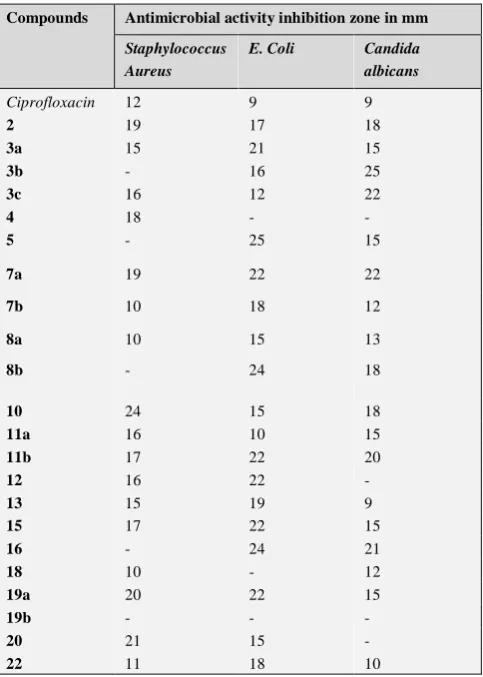
The newly synthesized compounds were evaluated for their antibacterial and antifungal activities against Staphylococcus Aureus, Escherichia coli and Candida Albicans. Ciprofloxacin was used as reference material for the comparison. The results for antimicrobial activity showed that compounds 10, 19a and 20 exhibited higher bioactivity against Staphylococcus than the standard material and compounds 3b, 3c, 4, 11a, 11b, 12,13, 15 and 7a showed moderate activity and compounds 5, 16 and 8b possessed excellent antibacterial activity against E. Coli. Most of the synthesized compounds showed high to good antifungal action against C. albicans growth in comparison with the reference material.Results showed that compounds 3b, 3c, 15
and 7a were more active among all the test compounds followed by compound 9b and 18. The synthesized compounds 4, 12, 19b and 20 did not show any antifungal activity at the studied concentrations against C. albicans growth.
Table 1: Antimicrobial activity of the synthesized compounds
Antimicrobial activity inhibition zone in mm Compounds Candida albicans E. Coli Staphylococcus Aureus 9 9 12 Ciprofloxacin 18 17 19 2 15 21 15 3a 25 16 - 3b 22 12 16 3c - - 18 4 15 25 - 5 22 22 19 7a 12 18 10 7b 13 15 10 8a 18 24 - 8b 18 15 24 10 15 10 16 11a 20 22 17 11b - 22 16 12 9 19 15 13 15 22 17 15 21 24 - 16 12 - 10 18 15 22 20 19a - - - 19b - 15 21 20 10 18 11 22 Anticancer activity
The anticancer activity for the synthesized compounds was evaluated in vitro screening against breast cancer cell line (MCF-7) (Table 2). Cisplatin was used as the reference material. From the results of Table 2, it was found that compound 4 exhibited the most excellent anticancer activity for MCF-7 cell lines, with an IC50 value of 21.5 it proved to be much more active than the reference drug and compared to most of the tested compounds. This is may be due to the presence of indole moiety.
N N O O N N O O N N N R O NN N O
Ac2O, reflux
N NH HOOC O O NH NH O O O O O
CH3CN
O N NH O OH 2 16 17 acetic acid reflux phthalic anhydride maleic anhydride succinic anhydride 20
acetic acid, reflux
Furthermore, compounds 13, 18 and 19a were found to be more active than the reference drugalso with IC50 22.4, 23.6 and 25.5, respectively. The cell killing potency of 13 is high and this may be due to the presence of two active free functional groups OH and NH2 attached to pyrazole moiety. While the presence of imido and imidazolone skeletons and the presence of phenyl groups enhanced their cytotoxic activity of 18 and 19a respectively. On the other hand, the other tested synthesized compounds were exhibited moderate to weak cytotoxic activity.
The selectivity index (SI) for our newly synthesized drugs was calculated by comparison the cytotoxic effect of drugs against cancer cell line with its cytotoxic effect against human lung fibroblast normal cell line MRC-5 and the findings came with high satisfaction, where compounds 4, 13, 18, 19a showed selectivity to cancer cell line higher than cisplatin selectivity, also compound 2 showed the same selectivity in comparison with cisplatin.
Moreover, compounds 3a, 3c, 7a, 7b, 8a, 11b, 12, 19b
showed a satisfactory selectivity index, especially 8a that was closer to cisplatin selectivity index. These results proved that our newly synthesized hydrazone derivatives were selective and specific to hepatocellular carcinoma cell line HEPG2 more than normal human cell line.
Table 2. Cytotoxicity of cisplatin and the new compounds against MCF-7 breast cancer cells and normal cell line
SI MTT assay IC50 24h (μM)
MRC-5 MCF7
Compounds
3.1 90
28.4 Cisplatin
3.1 200
62.8 2
2.4 120
50 3a
- >200
100 3b
2.9 150
50.5 3c
3.4 75
21.5 4
- 150
>100 5
2.2 90
40.8 7a
2.3 120
51.7 7b
3 150
50 8a
1.1 100
84.2 8b
1.6 150
90.6 10
1.06 85.2
80.2 11a
2.2 100
45.2 11b
2.6 150
55.8 12
3.5 80
22.4 13
- >200
48.6 15
- 95
>100 16
1.5 150
100 17
3.2 100
23.6 18
3.3 84.7
25.5 19a
2.3 175
75.4 19b
1.5 75
50 20
- 50
>100 22
IC50: drug concentration that inhibits cell growth by 50%. SI was calculated by dividing IC50 value of lung fibroblast normal cell line for each compound against IC50 of the cancer cell line.
Conclusion
Some new hydrazones based on (dicyclopropylmethylene)hydrazine 2 were synthesized and transformed into a series of heterocyclic products such as imidazolone, quinazolinone, triazole and indole derivatives. The antimicrobial and antitumor activities of the newly synthesized compounds were evaluated. Most of the compounds showed higher activity compared with Ciprofloxacin as positive controls and some of the compounds showed satisfactory activity against a breast cancer cell line (MCF7) compared with cisplatin as a positive control.
References
1Kamur, P., Rai, A., Singh, M., Kumar, D., Sahdev, A. K., Raj, V. Review on the pharmacological activities of hydrazones derivatives. Pharmaceutical Science. 2016, 2(3), 278-306.
2Mohareb, R. M., Mohamed, A. A., The Reaction of
Cyanoacetylhydrazine with ω -Bromo(4-methyl)acetophenone: Synthesis of Heterocyclic Derivatives with Antitumor Activity. Molecules. 2010, 15(5), 3602-3617. doi:10.3390/molecules15053602
3Mandewale, M. C., Patil, U. C., Shedge, S. V., Dappadwad, U. R., Yamgar, R. S., A review on quinoline hydrazone derivatives as a new class of potent antitubercular and anticancer agents.
Beni-Suef Univ. J. Basic Appl. Sci., 2017, 6(4), 354-361
https://doi.org/10.1016/j.bjbas.2017.07.005
4Mohareb, R. M., Samir, E. M., The Reaction of Cyanoacetylhydrazine with Chloroacetone: Synthesis of 1,2,4-Triazine, 1,3,4-Oxadiazine and Their Fused Derivatives with Antitumor Activities. Open J. Med. Chem., 2012, 2(1), 1-9. http://dx.doi.org/10.4236/ojmc.2012.21001
5Phanideepika, A., Padmavathi, B., Sudheerbabu, I., Godavari, W., Pradesh, A., Asian J. Pharm. Anal. and Med. Chem., 2013,
3(1),162-165.
6Melnyk, P., Leroux, V., Sergheraert, C., Grellier, P., Design, synthesis and in vitro antimalarial activity of an acylhydrazone library. Bioorg. Med. Chem. Lett., 2006, 16(1), 31-35. doi:10.1016/j.bmcl.2005.09.058
7Anbazhagan, R., Sankaran, K. R., Design, synthesis, computational calculation and biological evaluation of some novel 2-thiazolyl hydrazones. Spectrochimica Acta - Part A:
Molecular and Biomolecular Spectroscopy. 2015, 135,
984-993. https://doi.org/10.1016/j.saa.2014.06.160
8Uppal, G., Bala, S., Kamboj, S., Saini, M., Therapeutic review exploring antimicrobial potential of hydrazones as promising lead. Der Pharma Chem., 2011, 3(1), 250-268.
9Yang, Z. B., Hu, D. Y., Zeng, S., Song, B. A., Novel hydrazone derivatives containing pyridine amide moiety: Design, synthesis, and insecticidal activity. Bioorg. Med. Chem. Lett.,. 2016, 26(4), 1161-1164. doi:10.1016/j.bmcl.2016.01.047
10Silva, G. A., Costa, L. M. M., Brito, F. C. F., Miranda, A. L. P., Barreiro, E. J., Fraga, C. A. M., New class of potent antinociceptive and antiplatelet 10H-phenothiazine-1- acylhydrazone derivatives. Bioorg. Med. Chem., 2004, 12(12), 3149-3158. doi:10.1016/j.bmc.2004.04.009
11Krátký, M., Bősze, S., Baranyai, Z., Stolaříková, J., Vinšová, J., Synthesis and biological evolution of hydrazones derived from 4-(trifluoromethyl)benzohydrazide. Bioorg. Med. Chem. Lett., 2017, 27(23), 5185-5189. doi:10.1016/j.bmcl.2017.10.050
12Asati, V., Sahu, N. K., Rathore, A., Sahu, S., Kohli, D. V., Synthesis, characterization and antimicrobial evaluation of some 1,3-benzothiazole-2-yl-hydrazone derivatives. Arabian
J. Chem., 2015, 8(4), 495-499.
13Heinrich, J., Stubbe, J., Kulak, N., Cu(II) complexes with hydrazone-functionalized phenanthrolines as self-activating metallonucleases. Inorg. Chim. Acta, 2018, 481, 79-86. doi:10.1016/j.ica.2017.11.015
14Dantas, N., de Aquino, T. M., de Araújo-Júnior, J. X., da Silva-Júnior, E., Gomes E. A., Gomes A. A. S., Siqueira-Silva-Júnior, J. P., Mendonça, Junior F. J. B., Aminoguanidine hydrazones (AGH’s) as modulators of norfloxacin resistance in Staphylococcus aureus that overexpress NorA efflux pump.
Chemico-Biol. Interact.,2018, 280(September 2017), 8-14.
https://doi.org/10.1016/j.cbi.2017.12.009
15Wang, G., Chen, M., Wang, J., Peng, Y., Xie, Z., Denq, B., Chen, S., Li, W., Synthesis, biological evaluation and molecular docking studies of chromone hydrazone derivatives as α -glucosidase inhibitors. Bioorg. Med. Chem. Lett., 2017, 27(13), 2957-2961. https://doi.org/10.1016/j.bmcl.2017.05.007
16Sonawane, S. J., Kalhapure, R. S., Govender, T., Hydrazone linkages in pH responsive drug delivery systems. Eur. J.
Pharm. Sci., 2017, 99, 45-65.
https://doi.org/10.1016/j.ejps.2016.12.011
17Haghighijoo, Z., Firuzi, O., Hemmateenejad B, Emami S, Edraki N, Miri R. Synthesis and biological evaluation of quinazolinone-based hydrazones with potential use in Alzheimer’s disease. Bioorg. Chem., 2017, 74, 126-133. doi:10.1016/j.bioorg.2017.07.014
18Al-Bogami, A. S., Al-Majid, A. M., Al-Saad, M. A., Mousa, A. A., Al-Mazroa, S. A., Alkhathlan, H. Z., Cyclization of hydrazones of 2-acetyl-1-naphthol and 1-Acetyl-2-naphthol with triphosgene. Synthesis of spironaphthoxazine dimers.
Molecules. 2009, 14(6), 2147-2159.
doi:10.3390/molecules14062147
19Wardakhan, W. W., El-Sayed, N. N. E., Mohareb, R. M., Synthesis and anti-tumor evaluation of novel hydrazide and hydrazide-hydrazone derivatives. Acta Pharm., 2013, 63(1), 45-57. doi:10.2478/acph-2013-0004
20Liu, K., Yan, H., Chang, G., Li Z, Niu, M., Hong, M., Organotin(IV) complexes derived from hydrazone Schiff base: Synthesis, crystal structure, in vitro cytotoxicity and DNA/BSA interactions. Inorganica Chimica Acta. 2017, 464, 137-146. doi:10.1016/j.ica.2017.05.017
21Singh, Y. P., Patel, R. N., Singh, Y., Butcher, R. J., Vishakarma, P. K., Singh, R. K. B., Structure and antioxidant superoxide dismutase activity of copper(II) hydrazone complexes.
Polyhedron. 2017, 122(February), 1-15.
doi:10.1016/j.poly.2016.11.013
22Javed, M. I., Brewer, M., Diazo preparation via dehydrogenation of hydrazones with “activated” DMSO. Org. Lett., 2007, 9(9), 1789-1792. doi:10.1021/ol070515w
23Sadeghpour, H., Khabnadideh, S., Zomorodian, K., Pakshir, K., Hoseinpourm K., Javid, N., Faghih-Mirzaei, E., Rezaei, Z., Design, Synthesis, and Biological Activity of New Triazole and Nitro-Triazole Derivatives as Antifungal Agents.
Molecules. 2017, 22(7), 1150.
doi:10.3390/molecules22071150
24Zamani, K., Faghihi, K., Synthesis of Some New Substituted 1 , 2 , 4-Triazole and 1 , 3 , 4-Thiadiazole and Their Derivatives.
Turk. J. Chem.,2003, 27, 119-125.
doi:10.1007/s10593-009-0187-9
25Ghochikyan, T. V., Samvelyan, M. A., Galstyan, A. S., Grigoryan, S. V., Synthesis of some s-derivatives of 1,2,4-triazoles. Chem. Biol., 2016, 2, 8-12..
26Yan, S. J., Liu, Y. J., Chen, Y. L., Liu, L., Lin, J., An efficient one-pot synthesis of heterocycle-fused 1,2,3-triazole derivatives as anti-cancer agents. Bioorg. Med. Chem. Lett.,2010, 20(17), 5225-5228. doi:10.1016/j.bmcl.2010.06.141
27Valverde, I. E., Lecaille, F., Lalmanach, G., Aucagne, V., Delmas, A. F., Synthesis of a biologically active triazole-containing analogue of cystatin A through successive peptidomimetic alkyne-azide ligations. Angew. Chem. - Int. Ed.2012, 51(3), 718-722. doi:10.1002/anie.201107222
28Lugasi, S., New Synthetic Pathways for Thiocarbohydrazide and Salicylaldehyde Azine Compounds. Asian J. Chem. Sci., 2017,
3(1), 1-8. doi:10.9734/AJOCS/2017/35504