ARTIGO ORIGINAL
ABSTRACT
Introduction: Biliary complications occur in 10-30% of liver transplants. The aim of this study was to compare the incidence of these complications in liver transplants when the T-tube was or was not used during the biliary anastomosis.
Material and Methods: Analysis of 2 groups of patients undergoing liver transplantation between 2008 and 2012. Patients were divided considering if the T-tube was used (G1) or if it was not (G2). We sought explanatory models of the occurrence of biliary complications by logistic regression, including the variables identified in the univariate analysis.
Results: We reviewed 506 consecutive patients who underwent a first liver transplant (G1 = 363, G2 = 143). The overall incidence of biliary complications was 24.7% (95% CI 21.1 to 28.6): 27.0% in G1 and 18.9% in G2 (p = 0.057). The incidences of stenosis and biliary fistula tended to be higher in G1: 19.6% (95% CI 15.7 to 23.8) vs 15.4% (95% CI 10.1 to 22.0) (p = 0.275) and 6.6% (95% CI 4.4 to 9.5) vs 2.8% (95% CI 0.9 to 6.6) (p = 0.091). We did not find statistically significant differences in the rates of endoscopic retrograde cholangiopancreatography, reoperation and retransplantation. There were two deaths in G1. There was no association between the occurrence of biliary complications and the diameters of the biliary tract nor the time of cold ischemia. The explanatory model, adjusted to the recipient and the donor age’s and to the initial diagnosis, identifies the use of the T-tube as increasing the possibility of the occurrence of biliary complications (AdjOR 1.71, 95% CI 1.04 to 2.80; p = 0.034).
Discussion and Conclusion: The use of the T-tube should be a decision taken on a case-based intraoperative judgment of experienced surgeons
Keywords: Anastomosis, Surgical; Liver Transplantation/methods
Biliary Anastomosis in Liver Transplantation: With or
Without T-Tube?
Anastomose Biliar no Transplante Hepático: Com ou
Sem Tubo em T?
1. Serviço de Cirurgia Geral. Hospital de Curry Cabral. Centro Hospitalar de Lisboa Central. Lisboa. Portugal.
2. Gabinete de Análise Epidemiológica e Estatística. Centro de Investigação. Centro Hospitalar de Lisboa Central. Lisboa. Portugal.
Autor correspondente: Janine Carmelino. [email protected]
Recebido: 05 de dezembro de 2015 - Aceite: 28 de novembro de 2016 | Copyright © Ordem dos Médicos 2017
Janine CARMELINO1, Susana RODRIGUES1, Hugo Pinto MARQUES1, Vasco RIBEIRO1, Daniel VIRELLA2,
Marta ALVES2, Américo MARTINS1, Eduardo BARROSO1
Acta Med Port 2017 Feb;30(2):122-126 ▪ http://dx.doi.org/10.20344/amp.7287
RESUMO
Introdução: Complicações biliares ocorrem em 10% - 30% dos transplantes hepáticos. O objetivo deste trabalho é comparar as in-cidências dessas complicações nos transplantes hepáticos em que foi ou não utilizado tubo em T na anastomose biliar.
Material e Métodos: Análise de dois grupos de doentes submetidos a transplante hepático entre 2008 e 2012. Consideraram-se os doentes em que o tubo em T foi utilizado (G1) e em que não o foi (G2). Procuraram-se depois modelos explicativos da ocorrência de complicações biliares por regressão logística, incluindo as variáveis identificadas na análise univariável.
Resultados: Estudaram-se 506 doentes consecutivos submetidos a um primeiro transplante hepático (G1 = 363; G2 = 143). A in-cidência global de complicações biliares foi 24,7% (IC 95% 21,1 - 28,6): 27,0% no G1 e 18,9% no G2 (p = 0,057). As incidências de estenose e de fístula biliar foram tendencialmente mais elevadas em G1: 19,6% (IC 95% 15,7-23,8) vs 15,4% (IC 95% 10,1 - 22,0) (p = 0,275) e 6,6% (IC 95% 4,4 - 9,5) vs 2,8% (IC 95% 0,9 - 6,6) (p = 0,091). Não se encontraram diferenças estatisticamente significa-tivas nas taxas de colangiopancreatografia retrógrada endoscópica, reoperação e retransplante. Verificaram-se dois óbitos no G1. Não se encontrou associação entre a ocorrência de complicações biliares e os diâmetros das vias biliares ou o tempo de isquemia fria. O modelo explicativo ajustado à idade do recetor e do dador, e ao diagnóstico de base identifica o uso do tubo em T como aumentando a possibilidade da ocorrência de complicações biliares (AdjOR 1,71; IC 95% 1,04 - 2,80; p = 0,034).
Discussão e Conclusão: A utilização do tubo em T deve ser uma decisão tomada caso a caso e baseada no julgamento intra-oper-atório de cirurgiões experientes.
Palavras-chave: Anastomose Cirúrgica; Transplante de Fígado/métodos
INTRODUCTION
Biliary reconstruction remains the technical ‘Achilles heel’ of liver transplant surgery, responsible for a 10-30%
complication rate.1
Biliary strictures and fistulae are the most frequent complications of deceased donor liver transplantation,
occurring in 9-12% and 5-10% of the patients, respectively.2
The systematic use of the choledocho-choledochostomy with T-tube in liver transplant surgery originated from the experience acquired in biliary surgery. However, its use has been increasingly questioned by different authors over the past few years, mostly regarding the anastomosis with
similar-diameter and well-vascularized bile ducts.1,3,4
End-to-end choledocho-choledochostomy has been the procedure of choice for biliary anastomosis in our transplant centre and the fact that it allows for the preservation of the natural sphincter mechanism and that it provides easy access for future endoscopic interventions are procedure’s
most important advantages.5
ARTIGO ORIGINAL
biliary tract.1
There are however some disadvantages, namely leading to (i) more discomfort for the patient, (ii) to ascending infections, (iii) an additional admission to hospital aimed at its removal and (iv) the risk for the presence of a fistula at the entrance of the tube, with the subsequent risk for bile
peritonitis.1
Different authors have analysed this subject and tried to clarify this controversy, having described different and
conflicting results.1-9
In our centre, the insertion of a biliary drainage catheter or T-tube is determined on a case-by-case basis and is systematically used in biliary reconstruction surgery in which the risk for complications is expectedly higher, such as (i) small diameter bile ducts (<7 mm), (ii) re-transplant and (iii) in marginal grafting or with prolonged cold ischaemic time. This study aimed at the comparison of the incidence
of biliary complications when using vs. not using a biliary
drainage catheter (T-tube) in liver transplantation.
MATERIAL AND METHODS
In total, clinical records of 577 patients who underwent a liver transplant at a single transplant centre between 2008 and 2012 (five years) were analysed.
Transplant recipients less than 18 years of age and patients submitted to re-transplant, small-for-size grafts and biliary reconstruction surgery involving biliodigestive anastomosis were excluded from the study.
Two groups were considered, upon analysis of the clinical records of the remaining 506 patients included in the study: group 1 (G1) including patients in whom a T-tube has been used and group 2 (G2) in whom it was not used. The decision on whether or not using a T-tube depended on surgeon’s intraoperative evaluation.
The following were the variables that were analysed and obtained from patient’s clinical records: main donor and recipient characteristics, underlying liver disease, global postoperative outcomes, biliary complications and therapy used to manage these.
A cholangiography was obtained in G1 patients between postoperative day 7 and day 10 and these patients were discharged from the hospital with a clamped T-tube, which was removed upon new cholangiography obtained six months upon transplant.
The presence of fever and signs of peritoneal irritation
over the first 24 hours upon the cholangiography were considered as symptoms of clinical suspicion of bile leak upon T-tube removal and this was always confirmed with imaging.
The presence of fever and increased levels of inflammatory and cholestasis parameters led to a possible diagnosis of cholangitis.
The presence of biliary stricture was always confirmed with imaging and endoscopy.
A mean (standard deviation) post-transplant follow-up time of 1,174 (32) days was found. Patients were monthly re-assessed over the first six months post-transplant, every three months over the following 18 months and every six thereafter.
Fisher’s exact test or Chi-square were used for the percentage comparison. Incidence rate acuity was given by 95% confidence intervals (95% CI).
Univariate analysis identified those variables that were eligible for explanatory modelling regarding the presence of biliary complications, using logistic regression.
SPSS 22.0 (SPSS for Windows, Rel. 22.0.1, 2013. SPSS Inc., Chicago, Il, USA) software has been used.
RESULTS
Out of the 506 patients in our group, 363 underwent a biliary reconstruction with a T-tube (G1) and 143 with no T-tube (G2).
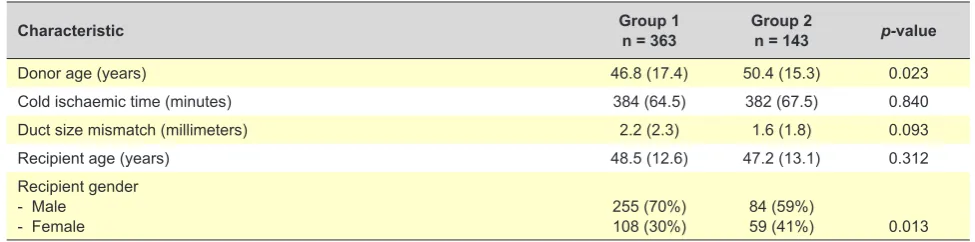
Main characteristics of both groups are shown in Table 1. Only the mean age of the donor (higher in G2 patients) and the gender of the recipient (more male patients in G1) were significantly different between both groups.
Data regarding underlying liver disease leading to liver transplant are shown in Table 2. Some statistically significant differences were found between both groups in bivariate analysis and using Chi-square test. The option on using a T-tube was more frequent in patients who underwent a liver transplant due to non-viral liver disorders with cirrhosis and tumours and less frequent in patients with metabolic disorders.
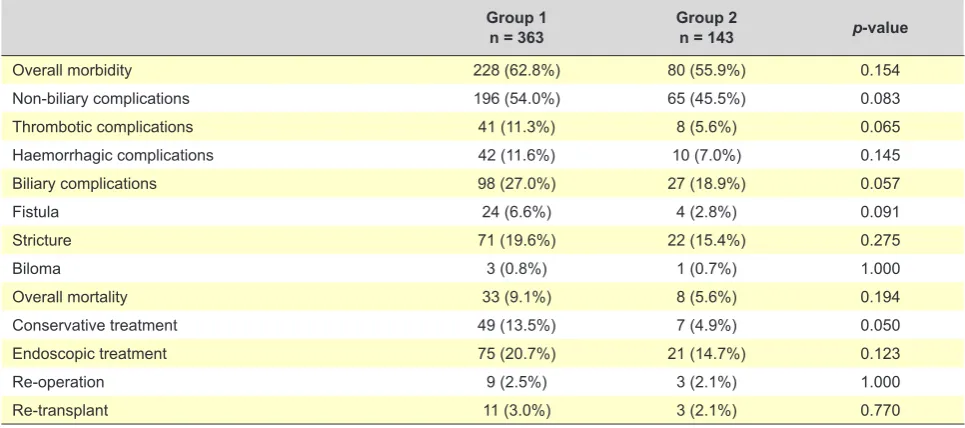
No statistically significant differences were found when global postoperative outcomes were compared between both groups (overall morbidity and mortality due to
non-biliary causes) (p-value = 0.154 and 0.083, respectively)
(Table 3).
In addition, no statistically significant differences Table 1 - Characteristics of our group of patients
Characteristic Group 1n = 363 Group 2n = 143 p-value
Donor age (years) 46.8 (17.4) 50.4 (15.3) 0.023
Cold ischaemic time (minutes) 384 (64.5) 382 (67.5) 0.840
Duct size mismatch (millimeters) 2.2 (2.3) 1.6 (1.8) 0.093
Recipient age (years) 48.5 (12.6) 47.2 (13.1) 0.312
Recipient gender - Male
- Female 255 (70%)108 (30%) 84 (59%)59 (41%) 0.013
ARTIGO ORIGINAL were found regarding the incidence of thrombotic and haemorrhagic complications (p-value = 0.065 and 0.145,
respectively) (Table 3).
A higher rate of biliary complications was found in G1
patients (27% vs. 18.9%; p-value = 0.057). A trend towards
a more frequent presence of the three major types of biliary complication (bile duct stricture, fistula and biloma) in G1 patients was also found (Table 3).
A higher percentage of G1 patients with an indication for admission to hospital for conservative treatment was found
(13.5% vs. 4.9%; p-value = 0.050). No significant differences
were found between both groups as regards the number of endoscopic retrograde cholangiopancreatography imaging
procedures (p-value = 0.123), re-operation (p-value =
1.000) or re-transplant carried out for the treatment of biliary
complications (p-value = 0.770) (Table3).
The two deceased patients in G1 had been referred for liver re-transplant due to recurrent cholangitis and died due to refractory haemorrhagic shock upon re-transplant (Table 3).
Mean time (standard deviation) up to T-tube removal was 9.3 (3.7) months in G1 patients.
Out of the 98 patients presenting with biliary complications, seven (7.1%) occurred over the additional admission to hospital for T-tube removal. The presence
of abdominal pain was found in four of these patients and this extended their stay in the hospital for monitoring and conservative treatment, two presented with bile leak with an indication for endoscopic treatment and one with biliary peritonitis with an indication for urgent re-operation. No correlation between the rate of biliary complications and bile duct diameter nor between this rate and cold ischaemic time was found in univariate analysis.
The use of a biliary drainage seems associated with a 59% increased probability of biliary complication (OR 1.59;
95% CI 0.98-2.56; p = 0.058), according with the logistic
regression analysis.
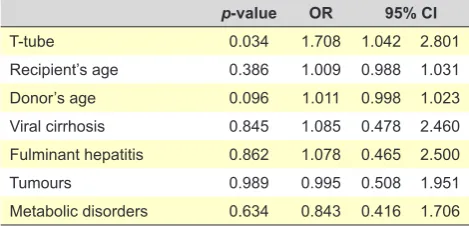
When the explanatory model was adjusted to the age of the recipient and donor and to the underlying liver disease, the use of a T-tube was associated with a 71% increase in the presence of biliary complications (adjOR 1.71; 95% CI
1.04 – 2.80; p = 0.034) (Table 4).
DISCUSSION AND CONCLUSION
A trend towards more frequent biliary complications in patients having been submitted to biliary reconstruction with T-tube has been found in this effectiveness study with 506 patients who underwent liver transplantation.
These results contrast with the conclusions found in different studies published over the past decade.
Table 2 - Distribution of our group of patients by liver underlying disease leading to liver transplant
Liver underlying disease Group 1n = 363 Group 2n = 143 p-value
Viral cirrhosis 30 (8.3%) 16 (11.2%) 0.200
Fulminant hepatitis 32 (8.8%) 7 (4.9%) 0.200
Non-viral liver diseases w/ cirrhosis 100 (27.5%) 38 (26.6%) < 0.001
Tumours 116 (32.0%) 32 (22.4%) < 0.001
Metabolic disorders 85 (23.4%) 50 (35.0%) 0.003
Chi-square test p-value = 0.022
Chi-square test. Group 1: Biliary reconstruction with T-tube; Group 2: Biliary reconstruction without T-tube. Absolute values (percentage).
Table 3 - Global postoperative outcomes and types of treatment of biliary complications
Group 1
n = 363 Group 2n = 143 p-value
Overall morbidity 228 (62.8%) 80 (55.9%) 0.154
Non-biliary complications 196 (54.0%) 65 (45.5%) 0.083
Thrombotic complications 41 (11.3%) 8 (5.6%) 0.065
Haemorrhagic complications 42 (11.6%) 10 (7.0%) 0.145
Biliary complications 98 (27.0%) 27 (18.9%) 0.057
Fistula 24 (6.6%) 4 (2.8%) 0.091
Stricture 71 (19.6%) 22 (15.4%) 0.275
Biloma 3 (0.8%) 1 (0.7%) 1.000
Overall mortality 33 (9.1%) 8 (5.6%) 0.194
Conservative treatment 49 (13.5%) 7 (4.9%) 0.050
Endoscopic treatment 75 (20.7%) 21 (14.7%) 0.123
Re-operation 9 (2.5%) 3 (2.1%) 1.000
Re-transplant 11 (3.0%) 3 (2.1%) 0.770
ARTIGO ORIGINAL
An increased incidence of biliary stricture has been found with the use of a T-tube in a meta-analysis by Huang
et al. involving 1,608 patients, even though the incidence of
biliary complications was not increased.6
Sun et al. have analysed 15 studies and found a
significantly higher incidence of biliary stricture in patients
who underwent the anastomosis without any T-tube (p <
0.001; OR = 0.49; 95% CI: 0.34 – 0.69).7
In a prospective randomized clinical trial involving 187
patients, López-Andújar et al. have found a 12% reduction
(95% CI 4-10) in the absolute risk for the presence of biliary
stricture with the use of a T-tube.1
Benítez Cantero et al. also found that biliary stricture
was more frequent when the T-tube had not been used in a
retrospective analysis of 95 patients.8
In a prospective randomized study by Sascha Weiss
et al. involving 194 patients, the use of a T-tube has been considered as a safe measure and allowed for the reduction
of the number of post-transplant invasive procedures.9
Conflicting conclusions have been found in a
meta-analysis by Paes-Barbosa et al. These authors have
suggested that a choledocho-choledochostomy should only be carried out with a T-tube drainage in case of a
side-to-side and without it in case of an end-to-end anastomosis.5
The results of the meta-analysis by Sotiropoulos et al.
(1,027 patients) are closer to those obtained in this study and have found that the systematic use of a T-tube led to an increased post-operative morbidity, to an increased number of radiological procedures and an increased length of stay
in hospital.2
A systematic use of a T-tube has been contested by the
revision study carried out by Carina Riediger et al. in which
only 17 (2%) out of the 639 patients involved in the meta-analysis took advantage of the use of a T-tube aimed at the prevention of biliary stricture. We share the opinion with these authors that non-invasive monitoring of graft function may be carried out through the determination of the level of
factor V or the plasma clearance rate of indocyanine.3
The dimension of our group of patients and the fact that this was a study carried out within a single transplant centre were the strengths of the study, reducing the usual heterogeneity found in multicentric studies.
The correlations found between the use of a T-tube and
the presence of biliary complications included objective and robust variables. Reliability was reinforced by the fact that those correlations have remained in multivariate analysis upon the adjustment.
We believe however that the generalisation of the results should be undertaken with care, due to the limitations of the study. The decision on whether or not using a T-tube depended on surgeon’s intraoperative assessment, was not randomized and was taken regardless of the research protocol and was based on some variables that are usually not available to an observational and documentary study as this one.
T-tube drainage has been used in order to protect the biliary anastomosis in more difficult patients (with a small-diameter bile duct or submitted to a prolonged cold ischaemic time), leading to an unavoidable selection bias and to the definition of two asymmetrical groups.
Even though we admit that this study does not allow for any unequivocal conclusion on whether the use of a T-tube led to any benefit regarding the prevention of biliary complications, the results of the multivariate analysis adjusted to donor’s and recipient’s age as well as to the underlying liver disease leading to the liver transplant allow to question its systematic use in every biliary anastomosis. The identification of the patients in whom the use of a T-tube does not bring any advantage in terms of prevention of biliary complications and therefore reducing the risk of morbidity associated with its use is crucial, as described by
López-Andújar et al.1
In our group of patients, a trend was found towards the presence of more biliary complications in the group of patients in whom a T-tube had been used.
Nevertheless, considering the limitations of this study, we found that the decision regarding which type of biliary reconstruction in liver transplantation should be used must be taken upon a careful individual analysis. The use of a T-tube may be avoided when the donor and recipient bile ducts are of similar diameter and well vascularized.
We are therefore in agreement with López-Andújar et
al. and we always use the T-tube in case of a significant
duct size mismatch, mainly when one is less than 7 mm in
diameter.1
Intra-operative assessment by experienced surgeons may prevent from the use of a T-tube in patients at a low risk of complications.
HUMAN AND ANIMAL PROTECTION
The authors declare that the followed procedures were according to regulations established by the Ethics and Clinical Research Committee and according to the Helsinki Declaration of the World Medical Association.
DATA CONFIDENTIALITY
The authors declare that they have followed the protocols of their work centre on the publication of patient
data.
Table 4 - Explanatory model of the presence of biliary complica-tions. Logistic regression analysis adjusted to recipient’s and donor’s age, as well as to liver underlying disease
p-value OR 95% CI
T-tube 0.034 1.708 1.042 2.801
Recipient’s age 0.386 1.009 0.988 1.031
Donor’s age 0.096 1.011 0.998 1.023
Viral cirrhosis 0.845 1.085 0.478 2.460 Fulminant hepatitis 0.862 1.078 0.465 2.500
Tumours 0.989 0.995 0.508 1.951
ARTIGO ORIGINAL CONFLICTS OF INTEREST The authors declare that there were no conflicts of
interest in writing this manuscript.
FINANCIAL SUPPORT
The authors declare that there was no financial support in writing this manuscript.
REFERENCES
1. López-Andújar R, Orón EM, Carregnato AF, Suárez FV, Herraiz AM, Rodríguez FS, et al. T-tube or no T-tube in cadaveric orthotopic liver transplantation: the eternal dilemma: results of a prospective and randomized clinical trial. Ann Surg. 2013;258:21-9.
2. Gastaca M. Biliary complications after orthotopic liver transplantation: a review of incidence and risk factors. Transplant Proc. 2012;44:1545-9. 3. Sotiropoulos GC, Sgourakis G, Radtke A, Molmenti EP, Goumas K,
Mylona S, et al. Orthotopic liver transplantation: T-tube or not T-tube? Systematic review and meta-analysis of results. Transplantation. 2009;87:1672-80.
4. Riediger C, Müller MW, Michalski CW, Hüser N, Schuster T, Kleeff J, et al. T-Tube or no T-tube in the reconstruction of the biliary tract during orthotopic liver transplantation: systematic review and meta-analysis. Liver Transpl. 2010;16:705-17.
5. Paes-Barbosa FC, Massarollo PC, Bernardo WM, Ferreira FG, Barbosa FK, Raslan M, et al. Systematic review and meta-analysis of biliary reconstruction techniques in orthotopic deceased donor liver
transplantation. J Hepatobiliary Pancreat Sci. 2011;18:525-36. 6. Huang WD, Jiang JK, Lu YQ. Value of T-tube in biliary tract reconstruction
during orthotopic liver transplantation: a meta-analysis. J Zhejiang Univ Sci B. 2011;12:357-64.
7. Sun N, Zhang J, Li X, Zhang C, Zhou X, Zhang C. Biliary tract reconstruction with or without T-tube in orthotopic liver transplantation: a systematic review and meta-analysis. Expert Rev Gastroenterol Hepatol. 2015;9:529-38.
8. Benítez Cantero JM, Costán Rodero G, Montero Álvarez JL, Ayllón Terán MD, Naveas Polo C, Fraga Rivas E, et al. Biliary complications after liver transplantation using side-to-side Choledochocholedochostomy reconstruction with or without T-tube. Transplant Proc. 2012;44:2098-9. 9. Weiss S, Schmidt SC, Ulrich F, Pascher A, Schumacher G,