An Internet of Things Based System for Home
Automation using Web Services and Cloud
Computing
Anshu Prakash Murdan
Department of Electrical and Electronic Engineering University of Mauritius
Rediut, Mauritius [email protected]
Luckshana Gunness
Department of Electrical and Electronic Engineering University of Mauritius
Rediut, Mauritius
Abstract - A Home automation system makes the operations of various home appliances more convenient and saves energy. It involves automatic control of lighting equipment, air conditioning and heating, audio/video systems, security systems, kitchen appliances and all other equipment typically used in a house. With the advent of Internet of Things (IoT) systems, home devices can even be remotely monitored and controlled via the Internet. Modern systems generally consist of switches and sensors connected to a central hub or gateway from which the system is controlled with a user interface that is interacted either with a wall-mounted terminal, mobile phone software, tablet computer or a web interface, often via Internet cloud services. IoT offers new services for making homes smarter while improving the interaction of people and IoT devices/services with the surrounding environment. However, in many developing countries, the concept of IoT in smart homes has not really been explored, mainly due to high cost of commercial IoT Home automation systems. This paper presents an approach to the design and development of a low cost IoT based, energy efficient system. The monitoring and control of devices is effected in real-time using web services and cloud computing. Also, the user can constantly monitor the amount of electricity his house is consuming via the graphical user interface (GUI) which provides a visual display of energy consumed by the whole house. Only authorized users are given access to sensor data. The solution is based on the Arduino Yun microcontroller and sensors. Data collected by the sensor nodes are transferred in real time over the Internet to the user using the facilities provided by Cloud Computing. A notification system using a web-based service has been implemented to inform the user about the status of any device.
Keywords: Arduino Yun, Cloud Computing, Energy-efficient, Home automation, IoT, Security, Web services.
I. INTRODUCTION
With the advent of broadband connections and widespread Wi-Fi at home, the latter has rapidly evolved into what is commonly known today as the smart home. Vinay and Kusuma (2015), pointed out that wireless systems based on technologies like Wi-Fi and cloud networks could reduce
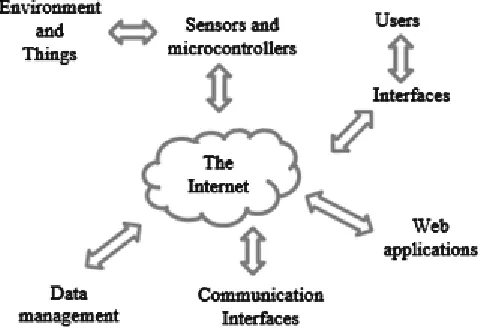
installation costs, and improve system scalability while allowing network extension and contributing to aesthetical benefits [1]. The primary idea behind any IoT technology and its operation is that devices from both real and virtual world of the Internet combine and interact with one another by tracking, sensing and monitoring objects and their environment. To be able to perform these tasks, components with sensing and networking capabilities are programmed and added to the objects. Fig.1 illustrates the different things in an IoT system and their interaction with each other and the Internet.
Fig 1. Interaction between Things in IoT
Cloud computing allows the implementation of flexible applications that further enhance home automation [2]. Three important requirements must be satisfied such that numerous smart homes can access reusable services over the Internet [3]:
Connection among appliances in automated home
Connected devices operate using online services. The proposed solution has been designed to operate both in the manual and autonomous mode. In the manual mode, user can change status of device irrespective of data being fed in database whereas in the automatic mode, system has to take decisions by itself based on data being sensed.
The rest of the paper is structured as follows. Section II highlights the existing solutions and designs proposed so far. Section III presents the system analysis of IoT in home automation using Cloud computing and Web services with an explanation of the approach used in section IV, followed by section V which details the experimental results. Finally, section VI concludes the paper and describes future work.
II. RELATEDWORK
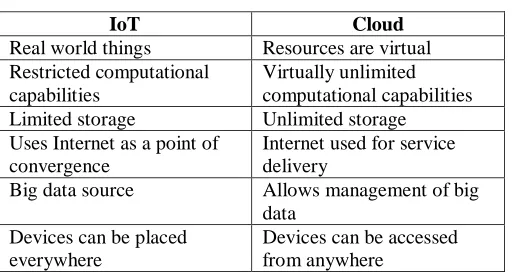
Cloud computing and IoT, which are two distinct technologies, are expected to become an integral part of the Future Internet considering the rate at which they are being adopted and used. In 2014, a detailed analysis of the Cloud-IoT paradigm was carried out whereby the need to merge Cloud and IoT was discussed [4]. The advantages and limitations of both were identified such that during integration each one could compensate for the other. Table 1 summarizes the complementarity of IoT and Cloud.
Table 1 Complementarity between IoT and Cloud
IoT Cloud
Real world things Resources are virtual Restricted computational
capabilities
Virtually unlimited computational capabilities Limited storage Unlimited storage Uses Internet as a point of
convergence
Internet used for service delivery
Big data source Allows management of big data
Devices can be placed everywhere
Devices can be accessed from anywhere
Han et al. [5] proposed a new smart home energy management system (SHEMS) using ZigBee and IEEE 802.15.4 standard. A SHEMS based multi-sensing and light control application was designed to reduce total energy cost. The control application domains included in this initial version are sensing device control, pricing and demand response and load control applications. In order to give the smart home its “home nature” when it is serving its users, Wu et al. (2012) developed two applications namely “Media Follow Me” and “Ubiquitous Skype” to study the relationship between users and services [6]. The authors first analyzed the relationship among services, spaces, and users, and then proposed a framework as well as a corresponding algorithm to model their interaction relationship. Preliminary evaluations showed that the proposed work can enhance the performance of the human-system interaction in a smart home environment.
One of the challenging issues in diverse IoT network is energy efficiency and at present Green-IoT is a promising field of research. Various energy-efficient routing protocols have thus been suggested. The authors in [7] suggested the Pruned Adaptive IoT Routing (PAIR) for heterogeneous IoT. The protocol finds a routing path by considering the energy of the nodes to transmit data in the system. Abedin et al. (2015), proposed an energy-efficient Green-IoT scheme for IoT devices to improve the lifetime of the whole IoT network [8]. Another key challenge in the implementation of IoT in home automation is security. Since the core of IoT is Internet, security issues are bound to arise. Data and privacy protection is among the application challenges of IoT [9].
Qi Jing et al. (2014), focused on the security architecture and issues of IoT and analyzed the security problems at each of the following layers: perception, transportation and application. They also compared security issues between IoT and traditional network. The authors also analyzed the cross-layer heterogeneous integration issues and security issues in detail and discussed the security issues of IoT as a whole [10]. IoT is prone to compatibility issues between various networks since it is made up of different heterogeneous networks. It becomes difficult to establish relationship of trust between nodes since the latter is constantly changing. However, this can be solved by routing protocols and key management schemes [11][12][13].
Sentoso and Vun (2015) presented an approach to incorporate strong security in deploying Internet of Things for smart home system, together with due consideration given to user convenience in operating the system. A wifi gateway was used as the center node of the system to perform initial system configuration. It was also used for authenticating the communication between the IoT devices as well as providing a means for the user to setup, access and control the system through an Android based mobile device running appropriate application program [14].
Fig 2. System Architecture of Smart Home Using ZigBee and Cloud Computing
III. SYSTEMANALYSIS
A. Problem Definition
The principal challenges faced by home automation systems are poor manageability, inflexibility, high cost and low security. The main objectives of this paper are to design and implement an IoT based system for a smart home to monitor, control and automate the appliances of the house through a relatively easy manageable web interface using Web services and Cloud computing while ensuring security of data and access of authorized users only.
B. Proposed System Feature
The proposed approach uses microcontroller enabled sensors and actuators to monitor home conditions and control devices on a real-time basis in the front end. The system can be accessed via any local PC from the web browser or even remotely from any PC or portable device provided it is connected to the Internet. Using web services and Cloud computing, the user can monitor data and control devices from anywhere while being notified of any change in device status.
The system can be accessed using Wi-Fi technology which connects the distributed sensors to the smart home server. The server monitors the different sensors, accepts requests and carry out commands. It can also easily be configured to handle more sensors. The Arduino Yun board with built-in Ethernet and Wi-Fi support was used, for this research work. Wi-Fi technology was selected to be the network infrastructure connecting the sensors to the server; hence improving system mobility and scalability.
IV. SYSTEMDESIGNANDIMPLEMENTATION
A. Proposed Home Automation System
In this section, the hardware prototype of the design and the buildings blocks required to realize same are considered. Fig. 3 shows the proposed model of the IoT based home automation system. The latter consists of the following sensors connected to the Arduino Yun microcontroller board:
DHT22 Temperature and Humidity sensor
PIR Motion sensor with LDR
YHDC-SCT-013-000 Non-Invasive AC Current sensor
Fig 3. Proposed model of home automation system
The microcontroller needs to first establish connection to the Internet through Wi-Fi. Once connection has been established, it can read parameters/data being acquired from the sensors and send them to the server to be stored in the cloud. As such, the data can be read and accessed at any time and from anywhere on a real-time basis.
turn on and the user will be notified about this action taken autonomously by the system.
Similarly, if it is dark and a person enters the room, a Passive Infrared Sensor (PIR) sensor detects human presence and switches on the lights until the room is empty again. A PIR sensor also known as a movement detector, measures the amount of infrared light radiating from objects passing in their view; a change in the measurement exceeding some defined threshold is considered a movement. Dual-element PIR sensors connect two pyroelectric detector elements. The sensor signal is equal to the difference of the elements’ voltages. Combined with Fresnel lenses, focusing infrared light coming from different angels, such sensors allow for the extraction of directional information of moving objects [16]. A counter has been included in the Arduino code to keep track of the number of times the PIR sensor is triggered. In a real set-up, PIR sensors are normally placed near the door, so that each sensor is able to count, on-system and in real-time, the number of people going in each direction, that is, in and out of the room.
Hence light does not turn off until counter is equal to zero which indicates everyone has left the room.
The current sensor unit measures and monitors the amount of current flowing throughout the whole house. It is clipped onto the live wire of the electricity meter. It measures ac current throughout the day and it is continuously fed into the database. Both energy consumption per minute and average energy consumed throughout the entire day is calculated. Assuming the power factor to be equal to unity, the energy consumption is calculated as follows:
(1)
= irms x 230V
Energy (Wh) = Power x time
(2) = irms x 230V x
(3)
= (irms x 230V x
)/1000
When energy consumption of a day exceeds that of another one, a notification is sent to the user on his portable device to alarm him. The proposed model has been designed such that the user will always have an upper hand on the system, that is, he can switch the system to manual mode and change the status of any device at any time irrespective of the data being sensed by the sensors. However, only authorized users can access the system and only the system administrator decides
B. Proposed Home Automation System Functions
The prototype was designed to operate as per the following requirements:
i. Monitoring of the following home conditions:
Temperature and humidity of surroundings
Light intensity and switch on/off lights accordingly whenever someone enters/ leaves the room if it is dark
Power consumption of entire house every day ii. Sensors send data acquired to be stored in an online
online
iii. Based on data acquired, system takes decisions and acts accordingly
iv. System allows visualization of the status of any sensor/device and should be able to manage it anytime from anywhere using Cloud computing v. System must be able to operate in two modes:
manual and automatic.
In manual mode, user should be able to change status of any device irrespective of data being fed to database.
In automatic mode, system should be able to take decisions and change status of device considering data being fed by sensors into database.
vi. Also, passwords must be used such that only authorized people get access to information being fed to database and manipulate status of devices. vii. System consists of an administrator who has the
power to choose who can gain access to the system and can even freeze/deactivate a user from the system.
viii. Finally, whenever the status of a device changes or power being consumed by the house exceeds certain threshold, a notification is sent to authorized users to their portable devices to inform them.
ix.
C. Software Design
Front End Design:
The model was first implemented on a local server to test and debug any error. The local server used was XAMPP which allows the use of the software tool phpMyAdmin written on PHP and that operates with the MySQL database management system. After testing, the system was implemented on the 000Webhost platform, such that it can be accessed from anywhere, anytime.
Cloud Storage
The 000Webhost which provides free web hosting with Control Panel (CPanel) using PHP and MySQL, was used to develop and maintain web applications. The CPanel provides a platform to create, read, update and delete files and folders. Web services were used for URL calls and the following CALL methods were used: GET, POST and DELETE. The web server software used is Apache.
Notification system:
The notification system is a web based service that allows the user to be informed of any change in device status or excess energy consumption of the house provided Internet connection is available. Different notification systems were analyzed namely Twilio, Ipipi and IFTTT. OneSignal tool which provides push notification service was implemented for this prototype as it provides a ubiquitous platform for all mobile and web notification messages and it is free. Unlimited number of devices can be connected to it and it provides unlimited notifications based on real-time analytics.
D. Implementation Setup
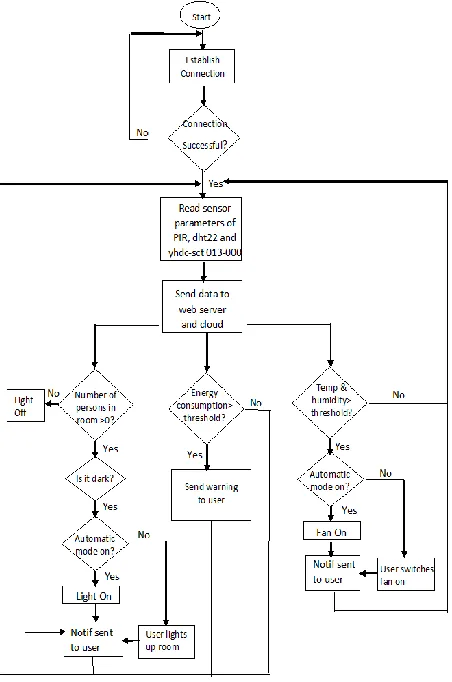
The sequence of activities in this IoT based system for home automation is illustrated in Fig.4. Once Wi-Fi connection has been established, sensors start sending data to the web server which are stored in Cloud and can be visualized and accessed on the IoTAdmin website of the 000Webhost application. However, since the Arduino Yun is used as the microcontroller, the implementation is restricted such that it cannot run the codes for all the three sensors at once but rather performs the action step wise. That is, all the sensors cannot run simultaneously. Only after the Arduino has run the code of a sensor and its data has been sent to the cloud, then it can move to the next sensor. A graphical user interface has been implemented for both the temperature and humidity readings stored and the energy consumption of the house.
V. RESULTS
The overall design solution was tested to evaluate its performance and effectiveness. After successful connection of microcontroller to the server, data from all three sensors are sent to the web server for monitoring and control of the system. The dashboard provides information about the temperature and humidity of the surroundings, fan status, the number of persons in room, light status and finally the energy consumption of the house.
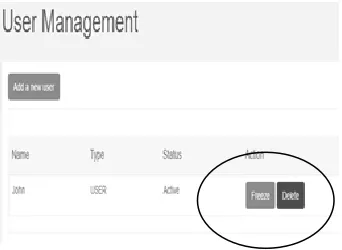
Fig 5 shows the security part of the system. It has been implemented such that only the system administrator or authorized users can gain access into the system via the user management setting implemented. Fig 6 shows the Freeze/ Delete action that can be taken by the administrator to deny a user from accessing the system.
Fig 4. Flowchart showing sequence of activities
Fig 5 User Management setting
Fig 6. Freeze/ Delete action
Fig 7 shows the temperature and humidity panel whereby the values recorded by the DHT22 sensor are stored and displayed using a graphical interface. It can be seen that a temperature value of 28.80 and humidity of 69.2 was recorded.
Fig 7. Temperature and humidity panel
Fig 8 and 9 show the graphical user interface for the energy consumption of the house.
Fig 8. Energy consumption/ min
Figure 9. Energy consumption/ day
Fig 10 shows the notification system whereby the user has to subscribe before getting notifications.
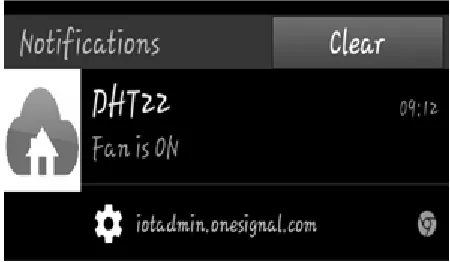
Fig 11. Notification indicating fan ON
Fig 11 shows the notification obtained from OneSignal when fan was switched on.
CONCLUSIONANDFUTUREWORK
The aim of this project was to design and implement a complete Internet of Things based system for an energy efficient home automation while ensuring security of data. The proposed solution provided users a web-enabled interface to monitor their home conditions and also be notified about any change in status of a device via a web based service whilst ensuring security. Also, the monitoring part of the current sensing unit allows the user to be more energy conscious since the latter can compare the amount of energy being consumed to a threshold value and be notified whenever that is exceeded. The project demonstrates a way of using Web services and Cloud computing to build an IoT system for a smart home on a real-time basis. Through this approach, users can have access to the system from anywhere in the world.
Future Work
One limitation encountered during the implementation of this project was that the Arduino board had certain restrictions. Since the board is not a server in itself, it cannot store large amount of data and also it introduces latency into the system. An improvement would be to use a Raspberry Pi instead which is a server in itself. Hence, the problem of latency can be overcome. Also, node.js which uses JavaScript could be introduced into the system such that all requests can be stored in a file and can be pushed from file to server. This would prevent loss of data in case of connection lost.
REFERENCES
[1] S. K. N. Vinay and S. M. Kusuma, "Home Automation Using Internet of Things," International Research Journal of Engineering and Technology (IRJET), vol. 02, no. 03, pp. 1965-1970, 2015.
[2] K. Andreas and P. Andreas, "The Smart home meets the Web of Things," International Journal Ad Hoc and Ubiquitous Computing, vol. 7, pp. 145-154, 2011.
[3] X. Ye and J. Huang, "A framework for cloud based smart home," International Conference in Computer Science and Network Technology, vol. 02, pp. 894-897, 2011.
[4] B. Alessio, P. Valerio, d. D. Walter and P. Antonio, "On the Integration of Cloud Computing and the Internet of Things," International Conference on the Future Internet of Things and Cloud, 2014.
[5] D. m. Han and J. h. Lim, "Smart home energy management system using IEEE 802.15.4 and zigbee," in IEEE Transactions on Consumer Electronics, vol. 56, no. 3, pp. 1403-1410, Aug. 2010.
[6] W. Chao-Lin and F. Li-Chen, "Design and Realization of a Framework for Human System Interaction in smart homes," IEEE TRANSACTIONS ON SYSTEMS, MAN, AND CYBERNETICS, vol. 42, no. 1, 2012.
[7] S. M. A. Oteafy, F. M. Al-Turjman and H. S. Hassanein, "Pruned Adaptive Routing in the heterogeneous Internet of Things," 2012 IEEE Global Communications Conference (GLOBECOM), Anaheim, CA, 2012, pp. 214-219.
[8] S. F. Abedin, M. G. R. Alam, R. Haw and C. S. Hong, "A system model for energy efficient green-IoT network," 2015 International Conference on Information Networking (ICOIN), Cambodia, 2015, pp. 177-182.
[9] T. Chun-Wei and L. Chin-Feng, "Future Internet of Things: open issues and challenges," Springer Journal Wireless Networks, vol. 20, no. 8, pp. 2201-2217, 2014.
[10] J. Qi, V. Athanasios and W. Jiafu, "Security of the Internet of Things: perspectives and challenges," Springer Science and Business Media Wireless Network, 2014.
[11] J. Qi, W. Jiafu, L. Jingwei and Q. Dechao, "Security analysis and security model research on IoT," Computer and Digital Engineering, vol. 40, no. 11, pp. 21-24, 2012.
[12] H. Suo, Z. Liu, J. Wan and K. Zhou, " Security and privacy in mobile cloud computing," In Proceedings of the 9thIEEE international wireless communications and mobile computing conference, pp. 655-659, 2013.
[13] J. Wan, M. Chen and F. Xia, "From machine-to-machine communications towards cyber-physical systems," Computer Science and Information Systems, vol. 10, no. 3, pp. 1105-1128, 2013.
[14] F. K. Santoso and N. C. H. Vun, "Securing IoT for smart home system," 2015 International Symposium on Consumer Electronics (ISCE), Madrid, 2015, pp. 1-2.
[15] Soliman, Moataz & Abiodun, Tobi & Hamouda, Tarek & Zhou, Jiehan & Lung, Chung-Horng. (2013). Smart Home: Integrating Internet of Things with Web Services and Cloud Computing. Proceedings of the International Conference on Cloud Computing Technology and Science, CloudCom. 2. 317-320. 10.1109/CloudCom.2013.155.