ARTIGO ORIGINAL
ABSTRACT
Introduction: Biological and biosimilar medicinal products have specific characteristics that call for a closer monitoring of their safety profile. Since the current legal framework stems from both European and national regulations, some gaps in the operational field may be expected. The goal of this paper is to identify these gaps and propose changes to the current information systems and pharmacovigilance regulations.
Material and Methods: A qualitative analysis of current pharmacovigilance regulatory framework and supporting information system was conducted.
Results: Current pharmacovigilance system does not seem to vouch for the safe use of biologicals and biosimilar drugs. The gaps found in reviewed materials may be attributable to their lack of specificity for biopharmaceuticals.
Discussion: Biologicals therapy presents specific determinants related with the drugs, prescription, and traceability, without replication in any other segment of the pharmaceutical market. They are able to shape their safety profile.
Conclusion: The existing pharmacovigilance’s regulatory framework should be adjusted in order to improve the safety related with biopharmaceutical therapy. Some intervention measures are proposed.
Keywords: Adverse Drug Reaction Reporting Systems; Biological Products; Biosimilar Pharmaceuticals; Drug Monitoring; Pharmacovigilance; Portugal
Biologicals and Biosimilars: Gaps in the Pharmacovigilance
System in Portugal
Medicamentos Biológicos e Biossimilares:
Descontinuidades no Sistema de Farmacovigilância em
Portugal
1. Instituto de Ciências da Saúde. Universidade Católica Portuguesa. Lisboa. Portugal. 2. Acompanhamento Farmacoterapêutico, Lda. Pavia. Portugal.
3. Departamento de Biologia. Escola de Ciências e Tecnologia. Universidade de Évora. Évora. Portugal. 4. Institute of Health Policy & Management. Erasmus University Rotterdam. Rotterdam. The Netherlands. 5. Faculty of Health, Medicine and Life Sciences. Maastricht University. Maastricht. The Netherlands. Autor correspondente: Maria da Conceição Constantino Portela. [email protected] Recebido: 27 de julho de 2016 - Aceite: 22 de dezembro de 2016 | Copyright © Ordem dos Médicos 2017
Maria da Conceição Constantino PORTELA1, Carlos SINOGAS2,3, Fernando Albuquerque de ALMEIDA4,
Ricardo BAPTISTA-LEITE1,5, Alexandre CASTRO-CALDAS1
Acta Med Port 2017 Mar;30(3):205-212 ▪ https://doi.org/10.20344/amp.8079
RESUMO
Introdução: A monitorização da segurança associada aos medicamentos biológicos e biossimilares exige um sistema de informação alinhado com o enquadramento regulamentar. Tendo em conta que podem ocorrer descontinuidades entre a regulamentação euro-peia, nacional e a respetiva tradução operacional, importa pesquisar e identificar essas lacunas.
Material e Métodos: Foi desenvolvida uma análise qualitativa dos suportes legais vigentes em julho de 2016 ao nível europeu e na-cional, com foco na farmacovigilância. Desta análise decorreu a caracterização operacional do sistema em Portugal.
Resultados: Foram identificadas zonas de descontinuidade no âmbito do sistema de farmacovigilância em Portugal, pela ausência de especificidade para os medicamentos biológicos e biossimilares.
Discussão: A segurança associada à terapêutica biológica apresenta determinantes específicos relacionados com os medicamentos, prescrição e traçabilidade, que não encontram replicação nos outros segmentos do mercado farmacêutico.
Conclusão: Com base nas lacunas identificadas, são apresentadas propostas de intervenção com o objetivo de incrementar a segu-rança associada à utilização clínica de medicamentos biológicos e biossimilares.
Palavras-chave: Biossimilares; Farmacovigilância; Medicamentos Biológicos; Monitorização de Fármacos; Portugal; Sistemas de Notificação de Reações Adversas a Medicamentos
INTRODUCTION
Biological and biosimilar medicines are very complex and variable molecules or mixture of molecules affect-ing both their safety and efficacy profile. These factors should also be considered regarding interchangeability and switching. Therefore, benefit to risk ratio monitoring must be ensured, considering that some frontiers of instrumen-tal discontinuity may exist within the alignment between regulatory and operational domains which must be identi-fied and rectiidenti-fied. The specific information on biological and biosimilar medicines may not be adequately addressed by
the pharmacovigilance system, due to its universal nature; this study aimed at the identification and characterisation of such information.
MATERIAL AND METHODS
ARTIGO ORIGINAL the public institutions governed by the Portuguese Ministry of Health and the European Medicines Agency was used
and search was restricted to the current regulation on pharmacovigilance. In a subsequent stage, the content of the latter was analysed and the information specifically regarding biological and biosimilar medicines has been selected. In addition, regulation on converging areas with this domain was considered: counterfeit tracking, traceability and trans-frontier healthcare. An assessment aimed at characterising the operationalisation of regulatory determinations and identifying the information flows and communication systems used for the prescription and dispensing of biological and biosimilar medicines, as well as the Portuguese system of adverse event reporting and record has been subsequently carried out. Information was restricted to the applicable legislation by July 2016, regardless of the year when it was published.
RESULTS
Biological, biotechnology-derived and biosimilar medicines
Biological medicines consist of one or multiple biologically derived active ingredients. Originator biologics approval is based on comprehensive technical and scientific documentation in terms of quality, safety and efficacy. Biosimilar medicines are usually approved upon a brief procedure in which similarity (although not the equivalence) to a pre-existing originator biological medicine is ensured. Therefore, comparability studies provide the evidence needed to support similarity in terms of quality, safety and efficacy, ensuring that biosimilar medicines provide the same efficacy and safety as originator biologics.1
Biotechnology-derived medicines are produced by fermentation of cells usually modified by recombinant DNA technology for the expression of the active substance. Biological medicines can be obtained following a biotechnological pathway or made from living organisms. In the first case, bioreactor production may induce heterogeneities between medicines from different manufacturers or between different lots of the same medicine to which adverse events are related, while in the second case inter-individual rather than intra-individual heterogeneities are anticipated, due to intra-individual homeostatic control. Biologics protein base, in addition to high molecular weight and biologically-based materials used for production may determine for an intrinsic variability leading to changes in the safety and efficacy profile that must be considered and therefore making this segment of medicinal products crucial in terms of pharmacovigilance.2
Models of accessibility to therapy
Medical prescription is the instrument that ensures patient’s access to therapy with biological medicines, which may also assume one of the categories of restricted
medical prescription1 where prescription and/or use are
restricted to certain specialised areas with closer monitoring of their safety profile. Overall, very severe adverse events can be induced by these medicines and the need for special monitoring is required throughout the treatment.3
Pharmacovigilance system and safety assurance Regulatory framework
Pharmacovigilance systems have progressed from an approach oriented towards data collection, analysis and response to suspected adverse event reporting3,4 to a new
approach based on the promotion of risk management. Medicines segments with an increased risk profile associated with some degree of uncertainty and in need for additional monitoring were added.5,6
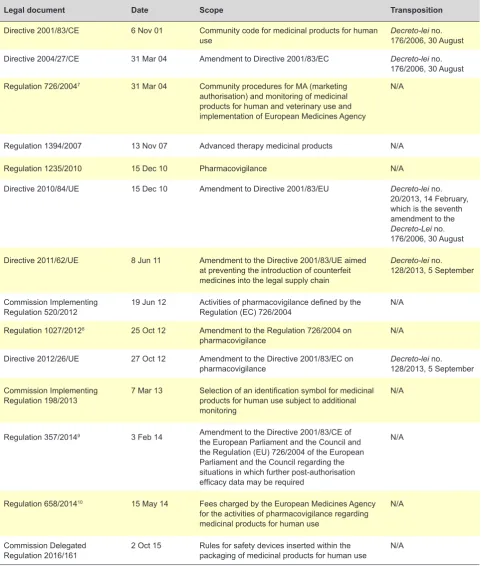
This progression has been underlined by European regulations (Table 1) and subsequent transposition (Table 2), asking for an adaptive dynamics of pharmacovigilance systems “complying with scientific and technical advances” and ensuring the safety of licensed medicines.4
Spontaneous suspected adverse event reporting is crucial in every pharmacovigilance system. Apart from the “harmful and involuntary effects of the licensed use of a medicine in normal dosage, (…) therapeutic errors and the use outside the terms of marketing authorisation, including misuse and abuse”2 should also be considered. Adverse
events include any untoward and unintended response to medicines.13
Prescription, dispensing and use
Mandatory electronic prescription, based on the international non-proprietary name (INN) of the active substance14 and the inclusion of the brand name or the
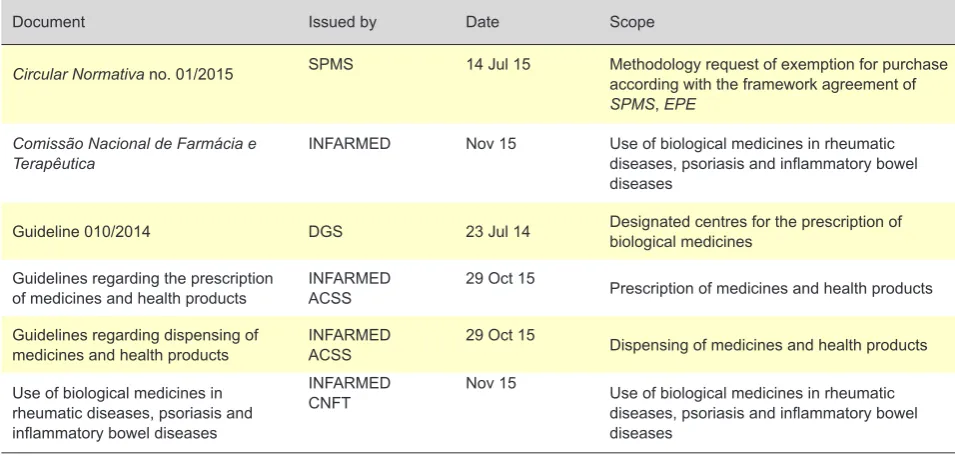
marketing authorisation holder are established by the regulatory framework (Table 3). Substitution of a medicine that has been prescribed by its brand name is not permitted under three situations which are reflected in legisltaion3
even though no specific reference is made regarding biological medicines.
As regards dispensing, these medicines are classified as subject to medical prescription or to restricted medical prescription and the latter are outpatient dispensed by the hospital pharmacy.15 However, “procedures regarding the
period of free supply of medicines, the information provided to the patient, the information record, the conditions regarding pharmacy dispensing or consultation are very different among hospitals, which may lead to differences regarding accessibility and the use of medicines.”16
Prescription is restricted to designated centres where applicable17 and these must provide for a quick response
in case of any adverse event.18 Designated centres for
ARTIGO ORIGINAL
Prescription and dispensing of medicines aimed at the treatment of patients with Crohn’s disease or ulcerative colitis only requires that prescription is made by gastroenterologists. These must be dispensed by the hospital pharmacy at the institution where the medication has been prescribed and the their use are subject to a
monthly based monitoring.19
The orientations of the Comissão Nacional de Farmácia e Terapêutica established that active substances available as biosimilar medicines and less expensive medicines should be selected.20 The use of medicines with the same
brand name should also be guaranteed over the required
Table 1 - Legal framework in the domain of pharmacovigilance
Legal document Date Scope Transposition
Directive 2001/83/CE 6 Nov 01 Community code for medicinal products for human
use Decreto-lei no. 176/2006, 30 August
Directive 2004/27/CE 31 Mar 04 Amendment to Directive 2001/83/EC Decreto-lei no. 176/2006, 30 August Regulation 726/20047 31 Mar 04 Community procedures for MA (marketing
authorisation) and monitoring of medicinal products for human and veterinary use and implementation of European Medicines Agency
N/A
Regulation 1394/2007 13 Nov 07 Advanced therapy medicinal products N/A
Regulation 1235/2010 15 Dec 10 Pharmacovigilance N/A
Directive 2010/84/UE 15 Dec 10 Amendment to Directive 2001/83/EU Decreto-lei no. 20/2013, 14 February, which is the seventh amendment to the Decreto-Lei no. 176/2006, 30 August
Directive 2011/62/UE 8 Jun 11 Amendment to the Directive 2001/83/UE aimed at preventing the introduction of counterfeit medicines into the legal supply chain
Decreto-lei no. 128/2013, 5 September
Commission Implementing
Regulation 520/2012 19 Jun 12 Activities of pharmacovigilance defined by the Regulation (EC) 726/2004 N/A
Regulation 1027/20128 25 Oct 12 Amendment to the Regulation 726/2004 on
pharmacovigilance N/A
Directive 2012/26/UE 27 Oct 12 Amendment to the Directive 2001/83/EC on
pharmacovigilance Decreto-lei no. 128/2013, 5 September
Commission Implementing
Regulation 198/2013 7 Mar 13 Selection of an identification symbol for medicinal products for human use subject to additional monitoring
N/A
Regulation 357/20149 3 Feb 14 Amendment to the Directive 2001/83/CE of the European Parliament and the Council and the Regulation (EU) 726/2004 of the European Parliament and the Council regarding the situations in which further post-authorisation efficacy data may be required
N/A
Regulation 658/201410 15 May 14 Fees charged by the European Medicines Agency for the activities of pharmacovigilance regarding medicinal products for human use
N/A
Commission Delegated
Regulation 2016/161 2 Oct 15 Rules for safety devices inserted within the packaging of medicinal products for human use N/A Source: Compilation made by the authors
ARTIGO ORIGINAL period of time in order to ensure traceability. Whenever alternating takes place, a precautionary principle must
be applied. With the same objective, alternating between biosimilar medicines must comply with a minimum
six-month period of time. Biological medicines are subject to additional monitoring due to their safety profile.21,22
The use of biologics in rheumatic diseases, psoriasis and inflammatory bowel diseases was regulated by the
Table 2 - National framework in the area of pharmacovigilance and other legislation applicable to biological and biosimilar medicines
Legal document Date Scope
Decreto-lei no. 176/2006 30 Aug 06 Medicinal products directive
Decreto-lei no. 20/2013 14 Feb 13 Seventh amendment to the Decreto-lei no. 176/2006 (Medicinal products
directive)
Decreto-lei no. 128/2013 5 Sep 13 Transposition of Directive no. 2011/62/EU and no. 2012/26/EU regarding
counterfeit medicines and pharmacovigilance; first amendment to the Decreto-lei no. 20/2013, which was the seventh amendment to the Decreto-lei no. 176/2006
Despacho no. 9767/2014 21 Jul 14 Definition of the conditions for prescription, dispensing and cost-sharing of
medicines for treatment of patients with Crohn’s disease or ulcerative colitis
Lei no. 51/201411 25 Aug 14 Ninth amendment to the Decreto-lei no. 176/2006
Decreto-lei no. 52/2014 25 Aug 14 Definition of conditions required for access and cooperation regarding
trans-frontier healthcare
Despacho no. 11042-F/2014 29 Aug 14 Definition of the model of medical prescription to be dispensed by a different member state
Portaria no. 48/2016 22 Mar 16 Definition of the conditions for dispensing and use of medicines aimed at
the treatment of patients with rheumatoid arthritis, ankylosing spondylitis, psoriatic arthritis, polyarticular juvenile idiopathic arthritis and plaque psoriasis
Portaria no. 198/201612 20 Jul 16 Amendment to the Appendix I of the Portaria no. 48/2016
Source: Compilation made by the authors.
Table 3 - Normative documents regarding prescription, dispensing and use of biological and biosimilar medicines in Portugal
Document Issued by Date Scope
Circular Normativa no. 01/2015 SPMS 14 Jul 15 Methodology request of exemption for purchase according with the framework agreement of SPMS, EPE
Comissão Nacional de Farmácia e
Terapêutica INFARMED Nov 15 Use of biological medicines in rheumatic diseases, psoriasis and inflammatory bowel diseases
Guideline 010/2014 DGS 23 Jul 14 Designated centres for the prescription of biological medicines
Guidelines regarding the prescription
of medicines and health products INFARMEDACSS 29 Oct 15 Prescription of medicines and health products
Guidelines regarding dispensing of
medicines and health products INFARMEDACSS 29 Oct 15 Dispensing of medicines and health products
Use of biological medicines in rheumatic diseases, psoriasis and inflammatory bowel diseases
INFARMED
CNFT Nov 15 Use of biological medicines in rheumatic diseases, psoriasis and inflammatory bowel diseases
Source: Compilation made by the authors.
ARTIGO ORIGINAL
Comissão Nacional de Farmácia e Terapêutica; clinical recommendations are provided in the guidelines (Normas de Orientação Clínica) of the Direção Geral de Saúde
(DGS) upon scientific societies having been heard.23
Purchase of biological and biosimilar medicines by the institutions of the Portuguese healthcare system (SNS) is subject to the official determinations that binds to the dispositions within framework agreements. An exception system is expected whenever the continuity of therapy must be ensured and when interchangeability has not been proved.24
Information flow within the pharmacovigilance system
Information on safety of medicines is preferably collected through spontaneous suspected adverse event reporting made by healthcare professionals and by patients.25 Specific forms are used by the
INFARMED26 (Table 4) and the information is collected and
sent to the regional centres of pharmacovigilance and to the national authority – INFARMED and centralised by the European Medicines Agency through the EudraVigilance information system.
Traceability
The orientations of the Comissão Nacional de Farmácia e Terapêutica established that traceability of biological and biosimilar medicines must be ensured.14 The Direção Geral
de Saúde is required to keep record of every patient, in order to meet this objective.11 Within a transition stage, until DGS
system becomes operational, information is centralised by the INFARMED.11
As regards advanced therapy medicinal products, risk monitoring must contain a comprehensive connotation, with patient’s total traceability, as well as regarding the product, basic and raw materials, including all those having had contact with cells or tissues that it may contain, for at least a 30-year period beyond the expiration date of the product.27 Impacts of trans-frontier healthcare
Trans-frontier patient mobility leads to healthcare extension to the perimeter of all member states.28 This reality
required for the definition of measures aimed at an easier mutual recognition of medical prescriptions and the model of medical prescription to be used in Portugal and to be dispensed in a different member state has been approved.29
Therefore, prescription of biologics is complemented by trademark clarification.30
As regards financing with liability on the part of the affiliated member state, up to a maximum of three member states can be involved in the use of a medicine (different state members regarding medical prescription, dispensing and financing). Safety monitoring and therapy traceability assurance becomes even more complex within this tripartite framework.
Issues regarding counterfeit
The use of a Community code for medicinal products for human use has been established, aimed at preventing
Table 4 - Comparative analysis of the information within Portuguese adverse event reporting forms for patients and healthcare professionals
Adverse event reporting form
Medicine identification Healthcare professionals Patients
Full name of the medicine – X
Brand name X –
Pharmaceutical form – X
Dosage X X
Lot no. X X
Route of administration X X
Date of treatment onset X X
Date of treatment withdrawal X X
Medicine used for the first time – X
Daily dose X X
Therapeutic indication X X
ARTIGO ORIGINAL from the entrance of counterfeit medicines into the legal market.31 The Portuguese Decreto-lei no. 128/2013 has
established that, for biologics, knowing the brand name and the lot number is crucial and the pharmacovigilance system must be prepared to collect this information (article 167) through healthcare professionals (article 169) and the patients (article 172).6
This framework is on the way of a reconfiguration with the systematic use of safety devices within packaging of prescription medicines.32 Advanced therapy medicinal
products are not covered by this disposition.
DISCUSSION
Regulatory framework of the pharmacovigilance system has a cross-sectional application to every medicine, even though a progression towards adequacy to specific segments such as biological and biosimilar medicines can been observed.
Now is the time to look upstream and downstream of each regulatory intervention for the level of alignment with the remaining legal and operational dispositions. Three levels of discontinuity can be found: (1) in transposition from the European to the Portuguese legislation, (2) in the application of the national legislation into the development of normative documents and (3) in links between these and the operating systems.
Basic and initial framework of the activities of pharmacovigilance is minimalist4 and no specificity as
regards biologics is included. A subsequent legal document defined that biologics are not generic medicines33 and the
transposition of this document defined that adverse event reporting “includes the identification of these medicines by its name and lot number.”3
The importance of pharmacovigilance for this segment of medicines is also described in the European legislation as “every appropriate measures should be taken in order to identify all biological medicines prescribed, distributed or sold within its territory and involved in reporting, considering the name of the medicine, (…) as well as the lot number”2
and subsequently, in the transposition “the notifications of these suspicions regarding biological medicines that were prescribed, distributed or sold in Portugal, will identify these medicines by the name and the lot number.” 7
As regards the fight against the introduction of counterfeit medicines into the legal supply chain, no particular determination has been specified regarding biologics and biosimilars.25 However, we may find in the eighth amendment
to the Decreto-lei no. 176/2006 that, regarding adverse events, “when reporting of these suspicions regarding biological medicines that were prescribed, distributed or sold in Portugal, these are identified by the name and the lot number.”6 In a different regulation, the need for the adoption
of standard and urgent procedures regarding emergent safety issues is reinforced, even though no other specific
reference has been made regarding biological medicines in any of the regulations.5
Therefore, considering the current Portuguese regulatory framework, six domains should be mentioned:
Prescription and outpatient dispensing of prescription medicines
No mention is made regarding any specific prescription and dispensing of biological medicines in the guidelines issued by the INFARMED and the ACSS.12 As regards
prescriptions, the use of the brand name is defined, apart from the use of the INN, even though no specific reference has been made regarding the use of this procedure when using biological medicines. This is an omission in regulation that must be corrected by a text revision. The reference to the lot number or to the marketing authorisation holder of biosimilar medicines is missing from the regulation, as well as the information on whether the prescription regards therapy onset or continuity.
Hospital-based prescription and dispensing of restricted prescription medicines
There is a regulatory framework involving the procedures and the instruments.9,10 However, these are not adapted
to therapy with biological and biosimilar medicines as recorded items do not allow for a complete characterisation and traceability of these medicines. There is a mandatory identification of the INN, dosage, pharmaceutical form, posology and therapy duration. However, any information on the brand name, lot number or reference to therapy onset or continuity is considered. In addition, the specific legal framework regarding the conditions for dispensing and use of biologics in anti-rheumatic therapy,11 as well as in
Crohn’s disease and ulcerative colitis13 does not include any
of the abovementioned information, which would ensure a full knowledge on informative variables regarding the safety profile associated with these medicines.
Limitations to substitution of any prescribed biological medicine by brand name
Three situations have been defined in which substitution of any medicine prescribed by brand name is not possible,3,8
to which we suggest the addition of a different paragraph based on the guidelines issued by the Comissão Nacional de Farmácia e Terapêutica.14 According with this document,
biosimilar medicines must be initially selected as the therapeutic option, even though in our opinion, whenever a prescription has been made by brand name, this should be kept. A precautionary principle is therefore reinforced.14
Adverse event reporting
ARTIGO ORIGINAL Nacional de Farmácia e Terapêutica. Therefore, the
system must be prepared to incorporate any information associated with this domain, apart from the one focused on the medicine and which is already ensured by the Decreto-lei nº 128/2013, 5 September. The clinical experience in this domain gives a crucial contribution to the careful identification of potential adverse events and subsequent reporting to the pharmacovigilance system.
Committee for the analysis of the prescription of biological medicines
A Committee for the Analysis of the Prescription of Biological Medicines must be established12 as it was
defined by the guideline 010/2014 of the DGS. The analysis of prescription of biologics as well as patient’s treatment regimens should be included among the functions of this committee, in order to ensure effectiveness, safety and adherence to therapy.
Addressing of an extended regulatory framework
Finally, reference should be made to chemically synthesized medicines with the same active substances as those biotechnologically obtained before. As these may be considered within the context of interchangeability and switching, these and other medicines – such as advanced
therapy medicinal products - should be covered by the abovementioned dispositions.
CONCLUSION
Safety associated with the use of biological and biosimilar medicines has specific determinants not replicated in any other segment of the pharmaceutical market. Working in perfect tuning and synchrony within the different institutional levels of information is the main challenge to the system. Necessary steps should be taken aimed at the full adjustment and implementation of legal and operational frameworks regarding therapy with biological and biosimilar medicines, allowing for the promotion of internal consistency, in order to improve safety.
HUMAN AND ANIMAL PROTECTION
The authors declare that the followed procedures were according to regulations established by the Ethics and Clinical Research Committee and according to the Helsinki Declaration of the World Medical Association.
FINANCIAL SUPPORT
The authors declare that a grant has been assigned by Roche Farmacêutica Química Lda. in writing this manuscript.
REFERENCES
1. European Medicines Agency. Guideline on similar biological medicinal products. Committee for Medicinal Products for Human Use. London: EMA; 2014.
2. Parlamento Europeu. Diretiva 2010/84/UE do Parlamento Europeu e do Conselho de 15 de dezembro de 2010. Estrasburgo: Parlamento Europeu; 2010.
3. Ministério da Saúde. Decreto-lei nº 176/2006. Lisboa: Imprensa Nacional Casa da Moeda; 2006.
4. Parlamento Europeu. Diretiva 2001/83/CE do Parlamento Europeu e do Conselho de 6 de novembro de 2001. Estrasburgo: Parlamento Europeu; 2001.
5. Parlamento Europeu. Diretiva 2012/26/UE do Parlamento Europeu e do Conselho de 25 de outubro de 2012. Estrasburgo: Parlamento Europeu; 2001.
6. Ministério da Saúde. Decreto-lei nº 128/2013. Lisboa: Ministério da Saúde; 2013.
7. Parlamento Europeu. Regulamento (CE) nº 726/2004 do Parlamento Europeu e do Conselho de 31 de março de 2004. Estrasburgo: Parlamento Europeu; 2004.
8. Comissão Europeia. Regulamento de Execução nº 520/2012 do Parlamento Europeu e do Conselho de 19 de junho de 2012. Bruxelas: Comissão Europeia; 2012.
9. Comissão Europeia. Regulamento Delegado (CE) nº 357/2014 da Comissão de 3 de fevereiro de 2014. Bruxelas: Comissão Europeia; 2014.
10. Parlamento Europeu. Regulamento Delegado (CE) nº 658/2014 do Parlamento Europeu e do Conselho de 15 de maio de 2014. Estrasburgo: Parlamento Europeu; 2014.
11. Assembleia da República. Lei nº 51/2014. Lisboa: Assembleia da República; 2014.
12. Assembleia da República. Portaria 198/2016. Lisboa: Assembleia da República; 2016.
13. Ministério da Saúde. Decreto-lei nº 20/2013. Lisboa: Ministério da Saúde; 2013.
14. Ministério da Saúde. Portaria nº 224/2015. Lisboa: Ministério da Saúde; 2015.
15. Ministério da Saúde. Despacho nº 13382/2012. Lisboa: Ministério da
Saúde; 2012.
16. Infarmed. Procedimentos de cedência de medicamentos no ambulatório hospitalar. Circular Normativa nº01/CD/2012.2012. Lisboa: Infarmed; 2012.
17. Ministério da Saúde. Portaria nº48/2016. Lisboa: Ministério da Saúde; 2016.
18. Direção Geral da Saúde. Centro Prescritor de Agentes Biológicos. Circular Normativa nº 010/2014. Lisboa: DGS; 2014.
19. Ministério da Saúde. Despacho 9767/2014. Lisboa: Ministério da Saúde; 2015.
20. Comissão Nacional de Farmácia e Terapêutica. Orientação. Medicamentos biossimilares. Lisboa: Infarmed; 2016.
21. Comissão Europeia. Regulamento de Execução (UE) nº 198/2013 da Comissão de 7 de março de 2013. Bruxelas: Comissão Europeia; 2013. 22. Parlamento Europeu. Regulamento (UE) nº 1027/2012 do Parlamento
Europeu e do Conselho de 25 de outubro de 2012. Estrasburgo: Parlamento Europeu; 2012.
23. Fonseca JE, Bernardes M, Canhão H, Santos MJ, Quintal A, Malcata A, et al. Portuguese guidelines for the use of biological agents in rheumatoid arthritis-october 2011 update. Acta Reumatol Port. 2011;36:385-8. 24. Serviços Partilhados do Ministério da Saúde. Metodologia para pedido
de dispensa de obrigatoriedade de aquisição ao abrigo dos acordos quadro da SPMS, EPE. Circular Normativa nº 01/2015.Lisboa: Serviços Partilhados do Ministério da Saúde; 2015.
25. Parlamento Europeu. Regulamento (UE) nº 1235/2010 do Parlamento Europeu e do Conselho de 15 de dezembro de 2010. Estrasburgo: Parlamento Europeu; 2010.
26. INFARMED - Autoridade Nacional do Medicamento e Produtos de Saúde. Formulário de notificação de reações adversas para profissionais de saúde. [acedido 2016 out 09]. Disponível em: http://www.infarmed. pt/portal/page/portal/INFARMED/MEDICAMENTOS_USO_HUMANO/ FARMACOVIGILANCIA/NOTIFICACAO_DE_RAM/Ficha%20de%20 notificacao%20PS_setembro%202014.pdf.
ARTIGO ORIGINAL
28. Parlamento Europeu. Diretiva 2011/24/UE do Parlamento Europeu e do Conselho de 9 de março de 2011 relativa ao exercício dos direitos dos doentes em matéria de cuidados de saúde transfronteiriços. Estrasburgo: Parlamento Europeu; 2011.
29. Ministério da Saúde. Despacho nº 11042-F/2014. Lisboa: Ministério da Saúde; 2014.
30. Assembleia da República. Lei nº 52/2014. Lisboa: Assembleia da República; 2014.
31. Parlamento Europeu. Diretiva 2011/62/UE do Parlamento Europeu e do
Conselho de 8 de junho de 2011. Estrasburgo: Parlamento Europeu; 2011.
32. Comissão Europeia. Regulamento Delegado (UE) 2016/161 da Comissão de 2 de outubro de 2015. Bruxelas: Comissão Europeia; 2016.