Available online at:
www.managementjournal.info
RESEARCH ARTICLE
Intellectual Capital as a Source of Sustainable Competitive
Advantage
Madiha Bakhouche
Department of Management Sciences, Faculty of Economic, Commercial and Management Sciences/Laarbi Tebessi University, Algeria.
*Corresponding Author Email:[email protected]
Abstract: The transition to knowledge economy Led to change success requirements in business environment. In this study will be addressed the issue of intellectual capital in terms of the concept and its features and its various components. With the definition of shifts that have taken place to achieve competitive advantage in light of this economy by addressing the importance of intellectual capital as a new and essential source of sustainable competitive advantage introduced cited literature in this area. The study concludes with a number of results.
Keywords: Intellectual capital (IC), Human capital, Structural capital relational capital, sustained competitive advantage.
Article Received: 10 April 2019 Revised: 20 April 2019 Accepted: 25 April. 2019
Introduction
In the knowledge-based economy, firms must compete in a complex and challenging context that is being transformed by many factors from globalization, frequent and uncertain changes to the growing use of information technologies.
Therefore, achieving a competitive advantage is a major pre-occupation of managers in competitive markets, which characterize many businesses today and the sources of sustainable competitive advantage have been
a major concern for scholars and
practitioners for the last two decades because it determinants a firm’s success and growth. From this scientific background we can present the study problem: what is the source of a sustained competitive advantage in knowledge age.
We can Found the Study Importance in the Following Points
The complexity degree in economic markets
over the world needs new sources for survive and succeed.
The knowledge age presents the
importance of intangible assets in the
success of any corporation which called intellectual capital.
The importance derives from the type of competitive advantage topic that is a strategic decision in any field.
The Algerian corporation can benefit from the study results.
The Study Goals Appear in the Following Points
The definition of intellectual capital and of its different parts.
The presentation of the new source of sustained competitive advantage through several researchers’ studies.
Offering a number of results that can benefits interested people from managers or scholars by the topic.
To realize the study goals and answer its question, the study addresses aspects of the
study variables, intellectual capital,
The introduction of the paper should explain the nature of the problem, previous work, purpose, and the contribution of the paper.
The contents of each section may be provided to understand easily about the paper.
Intellectual Capital Concept
The Literature Offers Different Definitions of Intellectual Capital (IC) Such as
"The intellectual material that has been formalized, captured, and leveraged to create wealth by producing a higher-valued asset"[1].
"The groups of knowledge assets that are attributed to an organization and most significantly contribute to an improved competitive position of this organization by adding value to defined stakeholders"[2]. “The difference between adjusted equity
and market value of a firm"[3].
"The combination of an organization’s human, organizational and relational resources and activities. It includes the knowledge, skills, experiences and abilities of the employees, its R&D activities,
organizational routines, procedures,
systems, databases and its Intellectual Property rights, as well as all of the
resources linked to its external
relationships; such as with its customers, suppliers, R&D partners, etc" [4].
The Organization for Economic
Co-operation and Development (OECD, 1999) describes ‘intellectual capital’ as the economic value of two categories of intangible assets of a company: (a) organizational (structural) capital; and (b) human capital.
Authors have defined intellectual capital in several ways. It can be derived that intellectual capital has not a unique definition. All the above definitions consider knowledge and intangible assets as an asset of the company. So we can define intellectual capital as the sum of all intangible assets, including human capital, structural capital, relational capital and organizational capital. Intellectual capital became popular in the early and mid-1990s.
It is an instructive aside to point out that knowledge management has exploded so rapidly.
Intellectual capital represents the awareness that knowledge is a factor of production with land, labor, capital and energy [5].
The term intellectual capital is used as a synonym for intangible or knowledge assets since the work by Stewart (1991). The fact of calling it “capital” makes reference to its economic roots, because it was described in 1969 by Galbraith as a process of value creation and as a bundle of assets at the same time [6].
We can said also that knowledge becomes an important source of survive in any
organization especially in competitive
environment and its role increased in knowledge economy.
In their review A. Lönnquist and P. Mettanen of the Definition of IC Identified the Following Characteristics [7].
It is invisible.
It is closely related to knowledge and experiences of employees as well as
customers and technologies of an
organization,
It offers better opportunities for an organization to succeed in the future.
The Economic Characteristics of IC Include the Following [8]
IC can pose a large risk element for buyers and sellers of knowledge – sellers do not give samples.
It is a debt, rather than an asset item since it is borrowed from people like employees and customers,
Much of it is not owned or controlled by the organization like workers knowledge where the boundaries are hard to define.
The organization investing in IC does not retain full ownership of the assets it has created, such as employees, can rarely be precluded from enjoying some of the benefits of the investments after they switch employers.
There is no neutral unit of measurement corresponding to the monetary unit on a balance sheet.
It is marked by ethical concerns about including human capital on a balance sheet-placing a price on individuals can send a message that employees may be substituted for other forms of capital.
Since there is no one, single methodology or view on what IC is and how to measure it proliferate, the consensus among the different stakeholders is hard to reach.
The natural of other factors of production such as land, capital and labor that knows economists and businessmen makes a difficult in the application of the same rules on IC added its intangible nature is a bar in dealing with different parts of IC.
Classifications of Intellectual Capital Intellectual capital or intangible assets cannot be touched; they can be identified and reasonably classified. Some classifications of intellectual capital are depicted in the next Table:
Table1: Some classifications of intellectual capital
Author Intellectual capital
Human capital Structural capital
Internal capital External capital
Brooking
(1997) Human centered assets Infrastructure assets property assets Intellectual Market assets
Edvinsson
(1997) Human capital Organizational capital Customer capital
Kaplan &Norton
(1996)
Learning and growth perspective
Internal business processes
perspective perspective Customer
Roos et al
(1997) Human capital Organization Renewal and development Relationships
Sveiby
(1998) competence Human Internal structure structure External
Source: Vasilije Vasic, Aleša Saša Sitar, Measuring Intellectual Capital: Lessons Learned from a Practical Implementation, on the web site: www.fm-kp.si, P: 340
From the comparison of these classifications, we realize that they differ in defining structural capital, whereas they all agree that knowledge, as human capital, is a vital component. So the literature presents a great number of classification schemes for intellectual capital. However, a convergent taxonomy emerged, categorizing intellectual capital onto three components: human capital; structural capital and relational capital:
Human capital: is a main component of intellectual capital because employees generate IC through their competence, their attitude and their intellectual agility, competence includes skills and education, while attitude covers the behavioral component of the employees work. Intellectual agility enables one to change practices and to think of innovative solutions to problems. Human capital has been defined on an individual level as: "the
combination of four factors: genetic inheritance; education; experience; and attitudes about life and business"[9].
Structural capital (or organizational
capital): which includes the systems, networks, policies, culture, distribution
channels, and other "organizational
capabilities" developed to meet market requirements as well as intellectual property [10].
Relational (customer) capital: This includes the connections that people outside the organization have with it, their loyalty, the market share, the level of back orders, and similar issues [08].
Competitive Advantage and its New Source
Firstly we will define competitive advantage.
A competitive advantage is: "an advantage
gained over competitors by offering
customers greater value (by lower prices or providing additional benefits and service that justify similar, or possibly higher prices). For growers and producers involved in niche
marketing, finding and nurturing a
competitive advantage can mean increased profit and a venture that is sustainable and successful over the long term" [11].
Building a competitive advantage will involve understanding the needs of the market (customers), and devising a strategy to make use of the resources that are available (or can be obtained) to set the business apart from the competition.
The strategy will need to take into account the target market, the business’ strengths and weaknesses, the business’ goals, the product/service the business has developed, and the strategies of the competition, so
“Building sustainable competitive
advantages revolves around differentiating a product from the competition along attributes that are important and relevant to customers.”[12].
But these facts can be applied in the industrial economy because the knowledge becomes a real source of building a sustained competitive advantage. Jia-Lang Hinese-professor in national Cheng-Chi University in Taiwan- explains the development in advantage sources in her article in Chinese PC Week magazine: "In the past 200 years, economists of neoclassical school think there are merely three key factors of production: labor, capital, and land.
It is different nowadays as information and knowledge are the key production factors and replace the other factors. In order to maintain competitive advantages, companies must develop resources and capabilities to combine market and technology so that they can solve competition issues.
The new economy is ignited and driven by
innovation, entrepreneurship, and
technology"[14]. It appears that the new economy has its key in building competitive advantage which is knowledge and new
technology but we can`t abandoned the other factors. Laurence Prusak in an article published in 1996 stated the following:
“Researchers in the areas of sustainable competitive advantages have come to the conclusion that the only thing that gives an organization a competitive edge, the only thing that is sustainable, is what it knows, how it uses what it knows, and how fast it can know something new”[15].
Viedma Marti says that: "Intellectual Capital refers to the intellectual assets from an strategic and global perspective and knowledge refers to the components of the intellectual assets from a tactical or operational perspective. In fact both concepts (knowledge and IC) overlap, and they perspectives. Concluding, Intellectual Capital is definitely the resource of sustained competitive advantage"[16].
For the relationships between knowledge and its management and intellectual capital, authors found that there is an overlap but IC is the source of any competitive advantage in knowledge economy. Jay Cross supports the same idea: "in a world that competes on knowledge, what a company knows is its competitive advantage. How odd, then, that few companies protect their intellectual capital from decay and degradation. Organizations often leave their knowledge assets scattered around, unprotected, and often impossible to find when needed.
Even more surprising, most leave the fate of their most valuable assets to chance" [15]. (Catherine Gannon et al) speaks about the creation of sustained competitive advantage by the realization of a model that needs the firm to build, integrate, reconfigure and remove knowledge relationships when necessary between human, structural and relational capital. [1] [16].
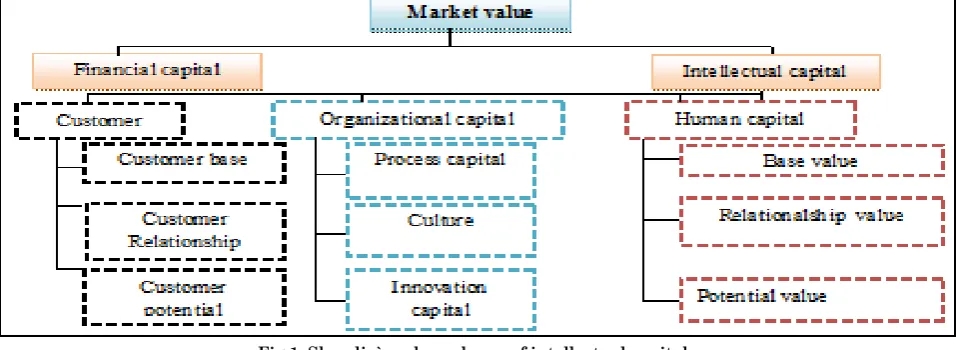
Fig 1: Skandia`s value scheme of intellectual capital
Source:Leif Edvinson, Developing intellectual capital at Skandia, Long Range Planning, Vol30, No: 3, June 1997, PP: 369
From this figure it appears that intellectual capital is the difference between market value and financial capital so it is the source of the difference between market and book value for many corporations over the world like Microsoft. Waterhouse (1999) argues
that intellectual capital assets are
strategically now more important to wealth creation than they ever were in the past. From literature review, we can said that intellectual capital is the resource of
sustained competitive advantage in
knowledge age because is a factor of survive and gaining benefits and creating value.
Conclusion
As the dynamics of economy shift towards a knowledge-based orientation and away from its natural resource roots, the importance and value of intellectual capital increases. It becomes the essential source of sustainable competitive advantage.
From This study we arrived to These Results
There is a continually transformation and development in business world over all the countries. People, governments, especially organizations are affected by these changes.
We leave in new economy which called
knowledge based economy. It depends in new factors of production such as IT.
The degree of competition increased
between corporations over the world that require new competitive arms.
Intellectual capital is an old conception that its importance appears as a result of all above changes in the new economy. There is no universal definition of IC but
we can said that is a combination of human, structural and relational capital. There is many classifications to IC between
it tangible and intangible parts.
Sustained competitive advantage is a
strategic goal of any corporation to gain
benefits and survive in business
environment.
Competitive success now is based less on the strategic allocation of physical and financial resources, and more on the intellectual capital.
Finally, in knowledge economy intellectual capital is the source of sustained competitive advantage and an important factor in value creation. So this important result needs to be emphasized by presenting international experiences of leading companies that have invested in knowledge capital as a mechanism to sustain their competitive advantage.
References
1. Stewart T (1997) intellectual capital: the new
wealth of organizations (Nicholas Brealey publishing, business Digest, New York).
2. Sudarsanan S, Sorwar G, Marr B (2003)
Valuation of intellectual capital and real option models’, paper presented to PMA Intellectual
Capital Symposium, 01-02 October 2003 at Cranfield University.
3. Edvinsson L, MaloneMS (1997) intellectual
4. Tich IT (2008) intellectual capital reporting, agricultural economics, Czech, 54(2):57-63.
5. Michael E, Koenig D (1998) from intellectual
capital to knowledge management: what are they talking about? Paper presented at a workshop of the section on management and marketing at the 64th IFLA general conference in Amsterdam.
6. Pedro López Sáez, José Emilio Navas López,
Gregorio Martín de Castro (2007) intellectual capital in knowledge-intensive firms: exploring the concept and main components in Boston’s Route, 128.
7. Amir Fazlagic measuring the intellectual
capital of a university, conference on trends in the management of human resources in higher education on the web site:www.oecd.org.
8. IBID.
9. Nick Bontis(1998) intellectual capital: an
exploratory study that develops measures and models, management decision, university Press, 36-2.
10. Andrew Kok (2007) intellectual capital
management as part of knowledge management initiatives at institutions of higher learning, the electronic journal of knowledge management, 5(2):185-195.
11. MS Cole Ehmke strategies for competitive
advantage, on the web site:
http://ag.arizona.edu.
12. Jia-Lang Hinese intellectual capital and
competitive, PC Week magazine Seng
Advantages, on the web site: www.irma-international.org.
13. Prusak Laurence (1996) the knowledge
advantage, Strategy & Leadership, 24(2):183-195.
14. Josep María Viedma Marti ICBS Intellectual
Capital Benchmarking System, journal of technology management, on the web site: intellectualcapitalmanagementsystems.com.
15. Jay Cross, converting intellectual capital into
competitive advantage, on the web site: http://www.internettime.com.
16. Catherine Gannon, Denis Harrington, Patrick
Lynch, managing intellectual capital for a sustained competitive advantage in the Irish
tourism industry, on the web site:
http://rikon.ie/images/publications.
17. Liselotth Arkblad, Carolina Mibberg (2006)
accounting for intangible assets: relevance lost?, school of business economics and law, Goteborg thesis, Sweedan.