ISSN-L: 2501 - 1235 Available on-line at: www.oapub.org/edu
Copyright © The Author(s). All Rights Reserved.
doi: 10.5281/zenodo.1445874 Volume 4 │ Issue 11 │ 2018
A CORRELATIONAL STUDY OF BALANCE
WITH FUNCTIONAL INDEPENDENCE AND COGNITION
IN GERIATRIC POPULATION
Mohammad Anamul Haque1i, Prabhpreet Bachittar Singh2, Nilofar Rasheed3
1Dr., Physiotherapist,
Prince Sultan Military Medical City, Riyadh, Kingdom of Saudi Arabia
2Dr., Assistant Professor,
Faculty of Physiotherapy, SGT University, Gurugram, India
3Dr., Assistant Professor,
School of Nursing and Health Sciences, NIU University, Noida, India
Abstract:
Background and objective of the study: The presence of balance disturbances need to be examined in old age home-dwelling elderly because many studies have been done on community-dwelling elderly. Hence, there is a need of examining the balance disturbances in old age home-dwelling elderly depending on their physical function, cognitive function, and functional independence. Therefore, the objective of this study is to assess the correlation of balance with cognitive functions and with functional independence. Methodology: This was a correlation study design in which 60 elderly (age>65 years) were recruited from SGT Hospital Gurugram, India. The Tinetti Test (TT) was utilized to assess patients' capacity to walk and maintain balance. The TT enables the division of patients into three groups depending on the level of their dependence and the risk of falls. The group at the highest risk obtains the lowest scores (≤18). The group at moderate risk consists of people with scores of 19–23 points, which reflects moderate dependence and fall risk. The group at minimal risk is the one with scores of ≥24 points. For TT, there were components where the elderly individual was asked to sit, stand and walk where the quality of these movements were observed accordingly. Results and discussion: At baseline, data was found to be non-significant. After the analysis of the data, it was found that there was a fair correlation between balance and
functional independence. Although there was no correlation found between balance and cognitive functions.
Keywords: elderly, Tinetti test, cognitive functions and balance
1. Introduction
According to WHO, from 2015 to 2050, the proportion of world’s population will nearly be double from 12% to 22% over 60 years of age. Geriatric population in India is projected to increase about 12.4 percent and may increase from 76.6 million to 173.1 million in 20261.The capability for sustaining the disturbances of centre of mass with in
feasible limits of BOS like in stunting, sitting and during ambulation is referred to as balance. The distance between the mark of meeting the body with other surface, also includes the mark of meeting aids. The estimation of balance can be done either with static or dynamic BOS. Hazard of falling may also be caused by diminished ability to sustain balance2. Counterbalance is a complex and programmed joining of few
frameworks such as mobility plan, mental functions and biomechanical pressure. As the age advances the above mentioned frameworks may not be able incorporate as rapidly in order to sustain balance and avert falling. Diminished resilience, failure of malleable power and increased rigor in connective tissues of supportive system are the resultant of progression of age3. Balance is directly proportional to fall as if a person loses balance
the individual results in falling. According to Laurence, disrupted balance is one of the dominant element of fall, also there are more elements of fall for example accidents, gait disorders, dizziness/vertigo, occurrence of sudden fall without loss of alertness, disorientation, orthostatic hypotension, disorders related to vision and syncope4. Falling
is a common event, experienced by everyone regardless of the age, but in elderly, it is more frequent, serious and constitutes to a major cause of mortality and morbidity. Fall refers to an event in which there is un-intensional disturbance of body to a lower level form starting position5. The outcomes of fall related injuries incorporate loss of
self-governance and inability to move in people more than 65 years or more. Old age home dwelling elderly face activities like fall more than community-dwelling elderly6.Many
factors like depression, cognitive functions, sight misfortune, reduced physical functions etc leads to disturbed balance. Older people’s useful independence is a vital marker of their wellbeing status. In elderly people, the loss of independence is one of most noteworthy concerns. For these residence, wellbeing is straightforwardly identified with independence and the ability to do exercises of day by day living, regardless of the possibility that the individual presents persistent illness. Hence, the independence to perform assignments like walk, sit and stand turns into a crucial component of legitimate improvement in seniority7. Execution of preventive activities
aim of this study is to analyze the correlation of balance with functional independence and cognition in the old age home-dwelling elderly depending on their symptoms of cognitive status and physical function. The presence of balance disturbances need to be examined in old age home-dwelling elderly because many studies have been done on community-dwelling elderly. Hence, there is a need of examining the balance disturbances in old age home-dwelling elderly depending on their physical function, cognitive function and functional independence.
2. Methodology
This was a correlation study design in which 60 elderly (age>65 years) were recruited from SGT Hospital Gurugram, India. The subjects included in the study must be not having any orthopedic condition that may hamper with the functional testing of the patient; they must not dependent on any kind of assistance aid to move. Patients those who are long term bed ridden or with any deformity or prior injury were excluded from the study.
3. Procedure
3.1 Data analysis
The data was checked as far as its fulfillment, unwavering quality, and the rightness of its accumulation. The collected data was entered in the Excel in Microsoft office Software. Then this data was transferred to Statistics Package for Social Sciences (SPSS) version 21.5, IBM Inc. for analysis. Descriptive statistics was analyzed by Shapiro wilk test. Summarized data was presented using Tables and Graphs. The level of significance was set at p<0.05.
4. Results
Frequency distribution is depicted in Table No. 1. There were total 60 elderly involved in the study, out of which 22 (36.7%) were males and 38 were (63.3%) females. Mean ± standard deviation values for age, weight, height and also body mass index is depicted in Table no. 1.
Table 1: Frequency Distribution
Gender N Percentage (%)
Males 22 36.7
Females 38 63.3
Total 60 100.0
Table 2: Descriptive Statistics of the participants at baseline
Variable N Minimum Maximum Mean SD
Age (years) 60 40.00 94.00 76.02 8.92
Weight (kg) 60 40.00 79.00 56.27 9.63
Height (meters) 60 1.48 1.79 1.60 0.08
BMI 60 16.70 28.50 22.53 3.04
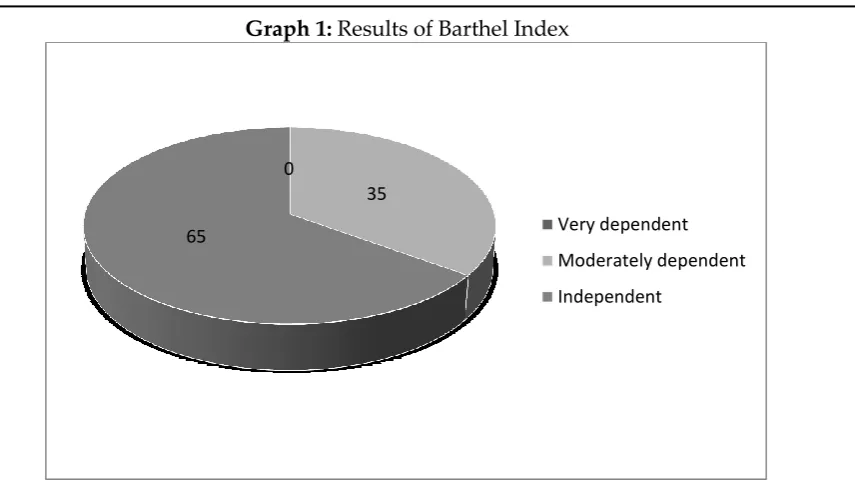
There were total 60 elderly involved in the study, out of which 39 (65%) elderly were independent,21 (35%) were moderately independent and 0 were very dependent depicted in Table no. 3.
Table 3: Distribution of study population according to Barthel Index (BI)
BI N Percentage (%)
Very dependent 0 0
Moderately dependent 21 35.0
Graph 1: Results of Barthel Index
There were total 60 elderly involved in the study, out of which 7 (11.7%) elderly were seriously disturbed cognitive function,7 (11.7%) were moderate disability and 46 (76.7%) were normal mental efficiency depicted in Table no. 4.
Table 4: Distribution of study population according to Abbreviated Mental Test Score (AMTS)
AMTS N Percentage (%)
Seriously disturbed cognitive function 7 11.7
Moderate disability 7 11.7
Normal mental efficiency 46 76.7
Graph 2: Results of AMTS 0
35
65 Very dependent
Moderately dependent
Independent
11.7 11.7
76.7
seriously disturbed cognitive function
Moderate disability
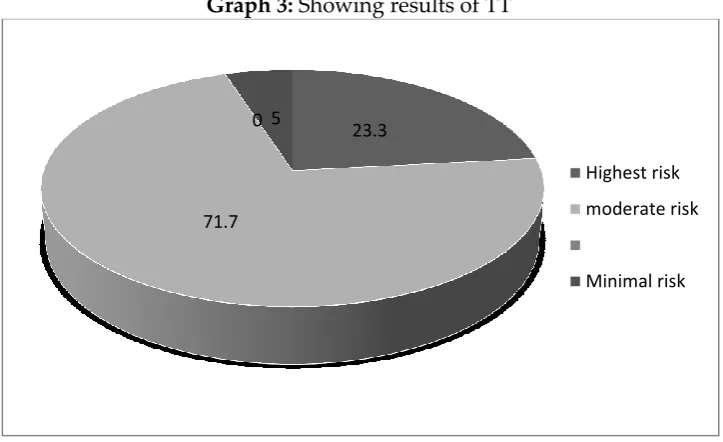
Table 5: Distribution of study population according to Tinetti Test (TT)
TT N Percentage (%)
Highest risk 14 23.3
Moderate risk 43 71.7
Minimal risk 3 5.0
There were total 60 elderly involved in the study, out of which 14 (23.3%) elderly were at highest risk, 43 (71.7%) were moderate risk and 3 (5%) were normal minimal risk depicted in Table no. 6.
Graph 3: Showing results of TT
It was found that there is correlation between balance and functional independence and the results according to analysis was found significant (p<0.002).
Table 6: Correlation of TMT with AMTS, and Barthel Index
AMTS Barthel Index
TMT rho 0.188 0.391
Pa value 0.149, NS 0.002**
aSpearman Correlation test (p<0.05)
23.3
71.7 0 5
Highest risk
moderate risk
Graph 4: Showing correlation between TT and AMTS
Graph 5: Showing correlation between BI and AMTS
5. Discussion
The aim of the study was to find correlation of balance with functional independence and cognitive functions in old age home dwelling elderly. The present study concluded that there is fair correlation between balance and functional independence. There was no correlation found between balances with cognitive functions. Researchers have proposed that both poor physical wellness condition and high level of physical motions are expanding the danger of falls. As the age progresses there is also reduction in balance and capability of performing activities of daily living. These situations are responsible for fear of falling, falls, depending on others and at last death. The need for assistance in order to perform activities of daily living for example walking, bathing etc is correlated with bad health which can lead the elderly towards health towards
0 2 4 6 8 10 12
0 5 10 15 20 25 30
AMTS
0 10 20 30 40 50 60 70 80 90 100
0 5 10 15 20 25 30
hospitalization, costs for treatment taken, reduced life quality and at last death12.
Researchers have also evaluated the most commonly feared consequences of falling motivated the elderly to avoid activity which further caused functional disability and loss of independence. Damage to identity was also a consequence of fall fear8.In the
present study the elderly presented with good scores of Barthel Index (87.83 ± 3.38) due to which a fairly significant correlation was found between balance and functional independence. Impairment in cognitive function, mobility skills and balance contributes as the risk factors of fall. All these parameters form a vicious circle and if this vicious circle is not broken the risk of fall increases9.
There are studies which have found that there is relation between physical functions and cognitive functions but relations found were independent of demographic characteristics, how much an individual weighs and health conditions of involved elderly10. The elderly with disrupted cognitive functions were prone to losing
balance as compared to elderly with normal cognitive functions. In the present study it was found that as the age progresses, the elderly complained of increased fall as compared to elderly who just entered the age group of above 65 years. Researchers like Vasallo et al confirmed that patients with impaired cognitive functions are prone to experience unfortunate outcomes. Subjects with impaired cognition had more risk of falls, falls which were recurrent in nature and injurious in nature. Also, the elderly with normal cognitive functions were involved less with injuries and falls11. In the present
study, elderly showed normal mental efficiency (cognitive functions) as per the mean score of AMTS (7.98 ± 3.15). There are researches done which confirms that cognitive problems may lead to disturbed gait and balance which further increase the risk of falls22. Whereas, some researchers emphasize on the association between physical
fitness, the risk of falls, and cognitive disturbances12.
The ability for maintaining the body in an upright position in a stable state is critical to prevent falls in elderly. This ability requires the integration of visual feedback, the vestibular system, proprioception, reaction times and muscular responses. However, these mechanisms are negatively affected by aging, and the adaptive reflexes that respond to disturbances of balance are damaged. Therefore, the elderly become more prone to falls13.
The functional benefit of exercise may be highest in older adults. There have been several studies regarding the effects of physical activity on the neuromuscular system of this population. Strength training protocols can be utilized to improve muscle strength in elderly14. There are also other types of training have shown to establish
strength, power and balance in older adults. Resistance training, power training also ballistic strength training may be effective for improving explosive force production and functional performance in old age15. In this study, it comprises of relatively small
old-age homes by improving their balance through exercises and thereby reducing risk of fall and injuries related to fall in elderly people.
References
Kumar A, Srivastava DK, Verma A et al, The problems of fall risk factors and their management among geriatric population in India, Indian Journal of community health, 2013; Vol. 25, No. 2.
El-Khoury, F., Cassou, B., Charles, M. A., & Dargent-Molina, P. (2013). The effect of fall prevention exercise programmes on fall induced injuries in community dwelling older adults: systematic review and meta-analysis of randomised controlled trials. BMj, 347, f6234.
Dhebar, F. (2014). Interventions for increasing balance and confidence in older adults: a review. International journal of physiotherapy and research, 2(4), 631-36.
Rubenstein, L. Z. (2006). Falls in older people: epidemiology, risk factors and strategies
for prevention. Age and ageing, 35(suppl_2), ii37-ii41.
Vanessa Vieira Pereira, Roberto Alcantara Maia et al, The functional assessment of Berg Balance Scale is better capable of estimating fall risk in elderly than posturographic Balance Stability system, 2013;71(1):5-10.
Magdalena Sylwia Kaminska, Jacek Brodowski and Beata Karakiewicz, Fall risk factors in community-dwelling elderly depending on their physical function, cognitive status and symptoms of depression, International Journal of Environmental Research and Public Health, 12, 3406-3416(March 2014).
Prata, M. G., & Scheicher, M. E. (2012). Correlation between balance and the level of
functional independence among elderly people. Sao Paulo Medical Journal, 130(2),
97-101.
Lucy Yardley, PhD, and Helen Smith, DM; A Prospective Study of the Relationship between Feared Consequences of Falling and Avoidance of Activity in Community-Living Older People; 2002; Vol. 42, No. 1.
Nezire Kose, Sevli Cuvalci; The risk factors of fall and their correlation with balance, depression, cognitive impairment and mobility skills in elderly nursing home residents; Saudi medical journal; 2005; 26(6):978-81.
Caterina Rosano, Tamara B Harris, Association between physical and cognitive function in healthy elderly: The health, ageing and body composition study, Neuroepidemiology, 2005, 24(1-2):8-14.
Vassallo M, Mallela SK et al; Fall risk factors in elderly patients with cognitive impairment on rehabilitation wards; GeriatrGerontol Int. 2009;9(1):41-6.
Zanocchi, M.; Pilon, S.; Speme, S.; Nicola, E.; Corsinovi, L.; Ponte, E.; Cerrato, F.; Luppino, A.; Martinelli, E.; Margolicci, A.; Molaschi, M. Falls in hospitalized elderly
Abreu SSE & Caldas CP. Velocidade de marcha, equilíbrio e idade: um estudo correlacional entre idosaspraticantes e idosasnãopraticantes de um programa de exercícios terapêuticos. Rev Bra. Fisioter 2008; 12(4): 324-330.
Tinetti M. (2003) Preventing falls in elderly persons. N. Eng. J. Med. Vol. 348(1), pp.42-49.
Creative Commons licensing terms