ISSN-L: 2501 - 1235 Available on-line at: www.oapub.org/edu
Copyright © The Author(s). All Rights Reserved.
doi: 10.5281/zenodo.1463936 Volume 4 │ Issue 12 │ 2018
THE EFFECT OF PROPRIOCEPTION TRAINING
ON SOME OF THE MOTOR CHARACTERICSTICS OF
WRESTLERS IN THE JUNIORS CATEGORY
iKubilay Akbaş1,
Murat Sarikabak2ii
1Ministry of Youth and Sports, Bartın Youth Services and Provincial Directorate of Sports,
Specialist Coach 2School of Physical Education and Sport,
Bartin University, Turkey
Abstract:
This study has been performed to determine the effect of proprioception training on some of the motor characteristics of wrestlers ın the juniors’ category. The study has been carried out with 20 volunteer wrestlers born between 2004 & 2006 and chosen with purposeful sampling method. 10 volunteers selected randomly have been grouped together to form a test group and the remaining 10 to form a control group. Each group has been tested based on balance, durability, power, flexibility and quickness and first and last test results have been determined. The test results have been analyzed in the software program SPSS 22. “Mann-Whitney U Test has been used to determine the differences between independent groups whereas “Wilcoxon Analysis” has been utilized in volunteers’ repetitive measurement tests with a p≤0,05 significance level. As a result, when the results of first and last tests based on balance, durability, power, flexibility and quickness performed on the wrestler group who have been through proprioception training for 8 weeks is compared to the test results of the wrestler group who have not been through proprioception training, it has been observed that there exists statistically significant differences (p<0,05).
Keywords: proprioception, training, wrestler.
1. Introduction
Sports education can be defined as performing a variety of sports that are culturally inherited or improvement of social and scholastic quality of individuals (Armstrong, 1990, p. 55). Sports education is a keystone occupation providing individuals to move comfortably both in daily life and sports life while assuring a healthy life throughout their lives. Sports education has lots of benefits to people who have headed towards a branch of sports in their childhood or adulthood and still continuing to do sports. While learning the basic skills, the athlete will also have attained the game rules, mutual respect, fair-play, tactical skills and physical awareness (Erdil, 2016). It is very important to be able to perform the movements required for daily life and sports activities correctly. Performing these movements correctly is related with the person’s proprioception senses. Proprioception can basically be defined as the person’s motor control and management of motor skills (Hillier, Immink and Thewlis, 2015, p. 933). Proprioception sense, different than person’s five senses, provides perception of spatial information of the body. For this reason, it has been named as the sixth sense (Gijn, 2011, p. 1189). Spatial awareness of the person forms the basis of movement being performed. Therefore, reflexes, reactions and planned movements are based on the information gained by proprioception sense (Kerr, 1955, p. 160). Proprioceptive system brings the qualification required for the person’s accordance with environment and providing adaptation. It is the sense that assures understanding the position of the joints when one closes his eyes. By virtue of this information, people busy with sports need to improve the proprioception sense in order to reduce their mistakes, prevent injuries and increase their success (Liberum Montessori Akademia, 2017).
A person’s proprioception sense can be improved with proprioceptive exercises. Proprioceptive exercise supports athletes yet in the developmental ages in gaining body awareness, keeping their balance, harmonizing power and movement, executing the movement correctly, defeating the opponent by developing the correct defense and counter-attacks (Fizyoo, 2017).
determined that positional sense, postural oscillation and muscle reactions have greatly improved as a result of station training programme consisting of 45 seconds of training composed of various exercises and 30 seconds of resting (Lattanzio and Petrella, 1998, p. 465).
2. Method
The research group has been made up from 20 licensed male wrestling athletes in the junior category born between 2004 and 2006. The athletes have randomly been divided into control and test groups.
The body composition (height, weight) and motor characteristics (back strength, sit and reach flexibility test, flamingo balance test, shuttle test, holding with twisted arm) have been traced by applying an 8 week proprioception training schedule on the test group. Within the 8 week time span, basic static proprioceptive exercises and basic dynamic proprioceptive exercises have been applied. The control group on the other hand has continued their regular wrestle training in training days within those 8 weeks. The proprioception trainings have started with 10 minutes warm up period, then continued for the next 30 minutes with eyes open and eyes closed exercises on wrestling pad, branch based work-out and a set of movements performed with equipment’s such as trampoline, bosu ball, rubber, balance board and ended with 5 minutes cool down exercises.
3. Findings
This research has been carried out in order to investigate the effects of proprioception trainings on motor characteristics of junior wrestlers such as balance, power, quickness, flexibility and durability. Some tests and measurements have been applied on 20 junior wrestlers in scope of this research. The results have been statistically analysed and documented in the relevant tables.
Table 1: Firs and Last Test Result, Balance, Comparison Analysis
N Row
average
Rows
total Z p
T
est
Balance (Last) –
Balance (First)
Negative rows 8 4,50 36,00
-2,549 0,111
Positive rows 0 ,00 ,00
Equivalence 2
Cont
rol Balance (Last) –
Balance (First)
Negative rows 1 1,50 1,50
,000 1,000 Positive rows 1 1,50 1,50
Equivalence 8
It has been observed that there exists statistically significant difference (p<0,05) between the results of test group which has been depicted in Table 1 derived to compare the first and last balance test results of control and test groups. However, when the change in first and last balance test results of control group are analyzed, no statistically significant difference (p>0,05) has been observed between first and last test results.
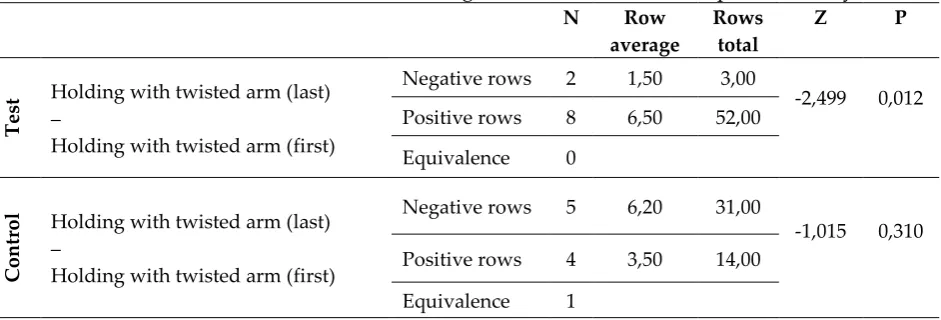
Table 2: First and Last Test Results, Holding with Twisted Arm, Comparison Analysis
N Row
average
Rows total
Z P
T
est
Holding with twisted arm (last) –
Holding with twisted arm (first)
Negative rows 2 1,50 3,00
-2,499 0,012 Positive rows 8 6,50 52,00
Equivalence 0
Cont
rol Holding with twisted arm (last) –
Holding with twisted arm (first)
Negative rows 5 6,20 31,00
-1,015 0,310 Positive rows 4 3,50 14,00
Equivalence 1
Table 3: Firs and Last Test Results, Shuttle, Comparison Analysis
N Row
average
Rows total
Z P
T
est
Shuttle (last) –
Shuttle (first)
Negative rows 0 ,00 ,00
-2,414 0,016 Positive rows 7 4,00 28,00
Equivalence 3
Cont
rol Shuttle (last) –
Shuttle (first)
Negative rows 4 4,75 19,00
-,144 0,886 Positive rows 4 4,25 17,00
Equivalence 2
It has been observed in Table 3 that there exists statistically significant difference (p<0,05) between the shuttle test results of test group. However, when the change in first and last shuttle test results of control group are analyzed, no statistically significant difference (p>0,05) has been observed between first and last test results. With respect to this analysis, an improvement has been observed in the test results of athletes after proprioception training.
Table 4: Firs and Last Test Results, Sit and Reach, Comparison Analysis
N Row
average
Rows total
Z P
T
est
Sit and Reach (last) –
Sit and Reach (first)
Negative rows 0 ,00 ,00
-2,684 0,007 Positive rows 9 5,00 45,00
Equivalence 1
Cont
rol Sit and Reach (last) –
Sit and Reach (first)
Negative rows 3 6,17 18,50
-,073 0,942 Positive rows 5 3,5 17,50
Equivalence 2
After Sit and Reach analysis examining the flexibility of volunteers, it has been observed in Table 4 that there exists statistically significant difference (p<0,05) between the Sit and Reach test results of test group. However, when the change in first and last Sit and Reach test results of control group are analyzed, no statistically significant difference (p>0,05) has been observed between first and last test results.
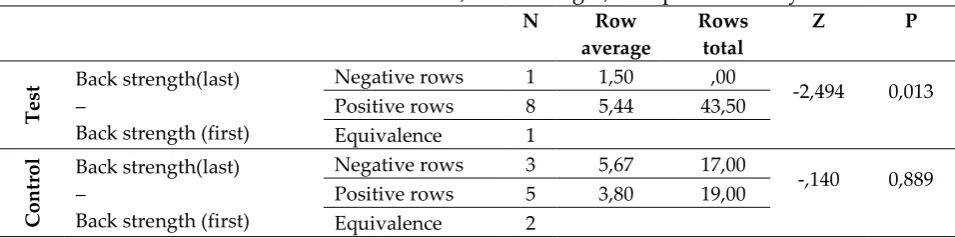
Table 5: Firs and Last Test Results, Back strength, Comparison Analysis
N Row
average
Rows total
Z P
T
est
Back strength(last) –
Back strength (first)
Negative rows 1 1,50 ,00
-2,494 0,013 Positive rows 8 5,44 43,50
Equivalence 1
Cont
rol Back strength(last) –
Back strength (first)
Negative rows 3 5,67 17,00
-,140 0,889 Positive rows 5 3,80 19,00
It has been observed in Table 5 that there exists statistically significant difference (p<0,05) between the back strength test results of test group. The findings reveal that there has been an increase in the power ratings of the volunteers in the test group. However, when the change in first and last back strength test results of control group are analyzed, no statistically significant difference (p>0,05) has been observed between first and last test results.
4. Conclusion
This research has been carried out in order to investigate the effects of an 8 week proprioception training on some of the motor characteristics of junior wrestlers. When first and last test results of test and control groups formed for that purpose are compared; statistically significant difference (p<0,05) has been observed between first and last results of balance test, holding with twisted arm test, shuttle test, sit and reach test and back strength test in the test group. However, no statistically significant difference (p>0,05) has been observed between first and last test results in the control group.
Pojskic and Levıc (2015) has observed the effect of basketball trainings on leg proprioception in his study and observed an improvement in the balance skill of both the dominant and non-dominant leg. A study carried out on sprinters with bosu ball for
6 weeks by Romero-Franco and Jiménez-Reyes (2015) revealed that proprioceptive
education can improve postural stability. Also, a research by Gertenbach in 2002 has led to the conclusion that proprioceptive education is an effective method to improve the functional balance of adults and the elders. The information gained during this research agrees with the balance test results of this study. In the study of Dehghan and his colleagues (2013), in order to prevent ankle sprains in young soccer players, 400 soccer players has been selected randomly to apply proprioceptive training. At the end, it has been observed that the best way to reduce injuries is the proprioceptive studies. Our study, like the Dehghan and his colleagues has shown the mistakes are kept to a minimum and the injuries are reduced with proprioceptive training. In the study of Baltacı and Kohl in 2003, the postural stability in gymnasts and dancers, undergoing proprioceptive education program has been monitored and an increase in the muscle power, knee kinesthesia and muscle tone has been proven. The ratings of the wrestlers involved in this study shows similarity with other studies in the literature.
on the evolution of some of the motor characteristics. It can be stated that, the results of this study agree with the literature on that subject.
References
Armstrong, N. (1990). New Directions in Physical Education. UK: Human Kinetics
Publishers LTD.
Ashton-Miller J., W. E.-W. (2015, Ekim 8). Can Proprioception Really Be İmproved By
Exercises? Ekim 25, 2017 tarihinde http://www1.udel.edu:
http://www1.udel.edu/PT/PT%20Clinical%20Services adresinden alındı.
Baltacı, G., & Kohl, H. W. (2003). Does Proprioceptive Training During Knee and Ankle
Rehabilitation Improve Outcome? Physical Therapy Reviews, 8, 5-16.
Dehghan, M., Eydivandi, K., & Jaafarzadeh, G. (2013). The Effect of Proprioceptive Training Associated With The Mental İmagery Exercise Programs on The
Prevention of Ankle Sprains İn Young Soccer Players. European Journal of
Experimental Biology, 3 (2), 576-579.
Erdil, G. (2016). Farklılıkla Öğrenme Motor Becerilerin Öğrenimine Farklı Bir Bakış.
Marmara Üniversitesi Spor Bilimleri Dergisi, 1(1), 39-50.
Erdoğan, C. S., Er, F., İpekoğlu, G., Çolakoğlu, T., Zorba, E., & Çolakoğlu, F. F. (2017). Farklı Denge Egzersizlerinin Voleybolcularda Statik ve Dinamik Denge
Performansı Üzerine Etkileri. Spor ve Performans Araştırmaları Dergisi, 8 (1),
11-18.
Fizyoo (2017). Propriyosepsiyon Duyusu ve Egzersizleri. Mart 8, 2018 tarihinde
fizyoo.com: http://fizyoo.com/propriyosepsiyon-duyusu-egzersizleri/
adresinden alındı.
Gertenbach, H. J. (2002). The Influence of Proprioceptive Training on the Functional
Balance of Older Adults. University of Stellenbosch, Master Thesis.
Gijn, J. V. (2011). Charles Bell (1774-1842). Journal of Neurology, 258 (6), 1189-1190.
Gioftsidou, A., Malliou, P., Sofokleous, P., Pafis, G., Beneka, A., & Godolias, G. (2012).
The Effects of Balance Traınıng on Balance Abılıty in Handball Players. Exercise
and Quality of Life, 4 (2), 15-22.
Gökhan, İ., Aktaş, Y., & Aysan, H. A. (2015). Amatör Futbolcuların Bacak Kuvveti ile
Sürat Değerleri Arasındaki İlişkinin İncelenmesi. International Journal of Science
Culture and Sport (IntJSCS), 47-54.
Hewett, T., Pasque, C., Heyl, R., & Wroble, R. (2005). Wrestling İnjuries. Med Sport
Science, 152-178.
Hillier, S., Immink, M., & Thewlis, D. (2015). Assessing Proprioception: A Systematic
Review of Possibilities. Neurorehabil Neural Repair , 29 (10), 933-949.
Karakaş, S., Yıldız, Y., Köse, H., Temoçin, S., & Kızılkaya, K. (2011). Profesyonel ve Amatör Futbolcularda Takım, Mevki ve Fiziksel Yapı Faktörlerinin Vücut
Kompozisyon Üzerine Etkileri. ADÜ Tıp Fakültesi Dergisi , 12 (1), 63-69.
Lattanzio, P., & Petrella, R. J. (1998). Knee Proprioception: A Review Of Mechanisms,
Measurements, And İmplications Of Muscular Fatigue. Orthopedics , 463–471.
Liberum Montessori Akademia. (2017, Ocak 8). Proprioseptif (Derin Duyu). Mayıs 26, 2018 tarihinde http://www.montessoriakademia.com/2017/01/08/proprioseptif-derin-duyu/ adresinden alındı.
Pojskic, H. & Levic, E. (2015). Proprıoceptıon Traınıng: Before or After Regular Basketball Traınıng Sessıon? 20th Annual Congress of the European College of Sport Science, 24th - 27th June 2015, Malmö – Sweden Book of Abstracts.
Romero-Franco, N., & Jiménez-Reyes, P. (2015). Unipedal postural balance and countermovement jumps after a warm-up and plyometric training session: A
randomized controlled trial. The Journal of Strength & Conditioning
Research, 29(11), 3216-3222.
Ruiz, R., & Richardson, M. (2005). Functional Balance Training Using A Domed
Device-BOSU. National Strength And Conditioning Association , 27 (1), 50-55.
Şahiner, İ., & Balcı, Ş. S. (2010). Çocuklara Uygulanan Farklı Otur-Uzan Esneklik
Testlerinin Karşılaştırılması. Niğde Üniversitesi Beden Eğitimi ve Spor Bilimleri
Dergisi, 4 (1).
Strickler, T., Malone, T., & Garrett, W. E. (1990). The Effects Of Passive Warming On
Muscle İnjury. Am J Sports Med , 141-145.
Tamer, S. (2013). Kas Kısalığının Diz Eklemi Proprioseptif Duyusuna Etkisi. Hacettepe
Üniversitesi, Sağlık Bilimleri Enstitüsü, Fizik Tedavi ve Rehabilitasyon Programı, Yüksek Lisans Tezi.
Creative Commons licensing terms