ISSN-L: 2501 - 1235 Available on-line at: www.oapub.org/edu
doi: 10.5281/zenodo.1467964 Volume 4 │ Issue 11 │ 2018
THERAPIES OVER MEDICATION: COMPARING THE EFFECT OF
TENS AND CUPPING THERAPY TO ENHANCE THE PERFORMANCE
IN FEMALE COLLEGE GOING STUDENTS
Manisha Sharma1,
Mohd Asif2i,
Richa Herendra Rai2,
Zaheed Akhtar3,
Md. Sajid Hussain4
1Clinical Physiotherapist, Noida, India 2Assistant Professor, BCIP, IP University, Delhi, India 3Assistant Professor, RPIIT, Haryana, India 4Senior Physiotherapist, Apollo Hospital, Delhi, India
Abstract:
Introduction: Education is about teaching, learning skills and knowledge. And if we talk about college and universities, they have different kind of furniture which is not fit for all students few and very short and very long for that so, everyone cannot fit in same. The leading technologies lead to impact on student’s posture and posture impairment causes impact on the back and that result in pain. And pain causes, impact on performance. That pain and their effects on student’s performance related to back activity. Performance is the completion of a task with application of knowledge, skills and abilities. Methodology: Study was observational; a total number of sixty samples was selected from Noida and G. Noida. Simple random sampling was used, upon evaluation the inclusion criteria were (1). Female students (2).Age: 18to 25yrs (3). BMI: 19.5 - 24.9 kg/m2. (4) Sitting duration 4hrs/day (5). Chronic back pain for three months. Exclusion criteria were (1). Low and high BP (2). Any pathological condition. (3). Neurological deficits (4). Menstrual irregularities. After that, all subjects were randomly assigned to one of the four groups. Group 1 has given the Tens and Group 2 has given the Cupping therapy. Both the groups have further divided according to the treatment duration 5min and 10min. Treatment description: Tens and Cupping were performed for all the groups the electrodes and cups were placed over the area of most severe pain. The treatment was administered for the specific duration of each group. Result & Conclusion: In our study, we have found that the cupping therapy is equally effective as compared to Tens when the treatment were given for 5min Tens comes out more effective and Cupping is more effective when the therapy time duration is 10min. So,
Cupping therapy can be used as an alternative method of back pain therapy depends upon the situation.
Keywords: leading technologies; performance; postural impairment; Cupping therapy
1. Introduction
Education is about teaching, learning skills and knowledge. It is important for all people of all ages. For students education helps them to learn, to build their opinion and to develop point of views on things. And if we talk about college and universities, they have different kind of furniture which is not fit for all students few and very short and very long for that so that everyone cannot fit in same. And the leading technologies lead to impact on their posture and posture impairments causes impact on the back and that results in pain. And pain causes, impact on performance. That pain and their effects on students’ performance related to back activities. Performance is the completion of a task with application of knowledge, skills and abilities.[1]
According to the research, the low back pain is common among the adults and Prevalence of that depends upon or varies according to their work. Patients with low back pain are a heterogeneous group and differ in several dimensions such as pain experience, severity of disease, impairment factor and functional limitations. Patients with LBP often suffer from severe limitations in activities of daily living. National and international guidelines recommend multimodal treatment approaches for persisting nonspecific back pain that includes the restoration of normal function as an important treatment component.[2,3]
Effect of LBP on performance: pain captures the attention, displace the current concerns and priorities escape and repair. It reduces the ability of a person to perform any task. It has found that the person without pain could perform better. Performance are poorer in those with higher intensity compared with that those have the lesser intensity of pain.[4] Although pain can protect us by forcing us to rest an injury to stop doing something. Research shows that uncontrolled pain has an adverse effect in our body immune system; continuous pain also appears to lower our body’s ability to respond to stressful situations and limits our activities of daily living.
and stretching exercises. Many research shows Tens is more effective in controlling pain and cupping therapy is nowadays is most used treatment for enhancing performance of the person. So as we know that the Tens and cupping therapy, both are effective in pain reduction so in our study, we want to check which is more significant in back pain patients to improve their performance by reducing pain. Tens is widely used in the management of chronic pain.[5] Tens pad electrodes applied over the acupuncture site. Cupping is a therapeutic method, involving the application of suction, it creates the vacuum on the skin with the ensuring negative pressure resulting in capillary rupture this method in dry/retained cupping.[6] To get rid of pain, people go for medicines or other treatments which may have some adverse effects. So, according to many researches Tens and Cupping therapy is effective for relieving pain. Many researches have done over Tens and Cupping to check their effectiveness upon pain, but in era of Cupping and Tens there are very few or less researches have done. These two have their best effect on relieving pain so our study is about finding the best out of them to reduce pain and regain their ability to perform.
2. Methods
A total number of sixty samples were selected from Noida and G. Noida. Simple random sampling was used, after screening the subject on the basis of inclusion and exclusion criteria of the research; they were included in the study. Upon evaluation, the inclusion criteria were (1) Female students[8] (2) Age 18to 25yrs[8] (3) BMI :19.5 - 24.9 kg/m2. (4) Sitting duration 4hrs/day[9] (5) Chronic back pain since three months.[21]. Exclusion criteria were (1) Any pathological condition (eg: Pott's spine, A.S, PIVD, etc)[13] as per mentioned by subject (2) Neurological deficits as per mentioned by subject[20] (3)Blood disorders[16](4) Skin irritation or allergy[13](5) High blood pressure[16]Allocation was concealed. Informed consent was obtained from all subjects before enrollment, and all rights of the subject were protected.
2.1 Tools and Measuring Methods
We used two performance test measure included
1. Stair climbing[23] - walking up and down 20 steps in a standard staircase as fast as possible
2. Lift test[23]- 5 repetition of lifting a 5kg of box and put on a standard size table and put it back to the floor.
Tools: Tens machine, Cupping Therapy set, 5kg box, standard size table, standard size stairs, stop watch.
2.2 Procedure
given the Tens and Group 2 has given the Cupping Therapy. Both the groups have further divided according to the treatment duration 5min and 10min
Group 1 is divided into Group 1a and Group 1b. Group 1a has given the TENS for 5 minutes (n -15). Group 1b has given the Tens for 10 minutes (n -15). Group 2 is divided into Group 2a and Group 2b. Group 2a has given the Cupping Therapy for 5 minutes(n -15). Group 2b has given the Cupping Therapy for 10 (n -15) minutes. Random assignment was performed in blocks of four to ensure approximately equal numbers in the treatment groups. The assignment was drawn from the chits and by means of a table of random number.
Test Procedure description: After recruiting the sample, we checked their activity through two tests - stair climbing test and box lifting test.
For stair climbing, we have taken the standard size stairs and used a stopwatch to calculate time. We told them to climb the 20 stairs as fast as they can and recorded the time for both pre and posttest.
For the box lifting test we took the 5kg box and a standard size table after that we told samples to lift the box from the floor and place it on the table and repeat it 5 times as fast as they can do and calculated time.
Treatment description: Tens and Cupping were performed to all the groups, 4pole Tens were used and electrodes were placed on the area of most severe pain. Same as Tens for cupping cups were placed over the area of most severe pain. The treatment was administered for the specific duration of each group.
After that we have compared the both intergroup effect and intra group effect to check either, which is more beneficial among them Tens and Cupping Therapy at intra group and at what time both is beneficial either 5minutes or 10minutes.
2.3 Data Analysis
Data was analyzed by using SPSS 21.0, IBM software. Pearson’s Coefficient of Correlation formula was applied. Demographic data, descriptive statics were obtained using Student’s t-test. All Predictor variables were compared with the application of Pearson Correlation. The formula was applied at 95% Confidence Interval and significant p-values set at 0.05. The results were taken to be significant at p≤0.05.
3. Results
3.1 Between the Group Comparison of Cupping and Tens for 5 Min. 3.1.1 Test 1
The result shows that when done for Test 1 (stair climbing) the effect of cupping and Tens for 5min has a statistically no significance with p-value = 0.153, Cupping (mean = 5.811, SD = 0.628) Tens (mean = 5.509, SD = 0.488) As per the result it is not significantly correlated though Tens is more effective than cupping but we could apply any of one as convenient to patient. (Table 2)
3.1.2 Test 2
For Test 2 (lift up test) with p value is 0.064 (for cupping mean = 17.869, SD = 1.456 for Tens mean = 16.779, SD =1.637). Though it is not statistically significantly correlated, but the result is near about p=0.05. So when comparing Test 1 and Test 2 for 5min Test 2 and Tens comes out more significant. There could be an error due to sample sizes, gender, so changes or modifications in future result may lead to varying results.(Table 3)
3.2 Between the Group Comparison of Cupping and Tens for 10min 3.2.1 Test 1
Results shows that for test 1 (stair climbing) has a statistically not significant with a p value of 0.620 (for cupping Mean = 5.779, Standard deviation = 0.678 and for Tens Mean = 5.927, standard deviation = 0.918) as per the result, it is not significantly correlated, but while comparing tens and cupping for 10min in Test 1, we found that cupping comes out more effective than that of tens. (Table 4)
3.2.2 Test 2
For Test 2 (lift up test) with p value is 0.507 (for Cupping mean = 17.411, SD = 1.931 for Tens mean = 16.865, SD = 2.480). The result for condition 2 also not significantly correlated, but between the comparison of Cupping and Tens, cupping comes out more effectively. (Table 5)
4. Discussion
The purpose of the study was to compare the effect of Tens and Cupping therapy to enhance back performance.
test by taking consideration towards previous researches and their positive effect of reducing back pain by both techniques.
The study was concerned with predictable variables; age, gender, duration of sitting hours and back pain and to find out the impact of pain on performance by two most reliable test measures was used; first is stair climbing and another is lift up test[17]
According to a study made by Michael P. Fingsten, Susanne Luederet et. al regarding the significance of physical performance tests for patients with low back pain and their obtained performance data for mobility-related activities in patients with low back pain (LBP) [17], the stair climbing is more reliable performance test then that of lift up-test. But in our study, lift up test is having values more nearer to significance that could be due to small sample size, or we have selected only females that may be also a reason for the variation. So changes in inclusion criteria or sample size may bring variation in further researches.
Hanan, S. A. and Eman, S. E. Egypt has done their research on "Cupping Therapy (Al-Hijama): It's Impact on Persistent Non-Specific Lower Back Pain and Client Disability" and concluded that no adverse effects were reported from subjects after the treatment. There are highly statistical significant for pain and disability for client between pre and post cupping therapy. It is recommended that using cupping therapy for enhance disability and decrease pain of lower back pain. Cupping has also been found to affect the body up to four inches into the tissues, causing tissues to release toxins, activate the lymphatic system, clear colon blockages, help activate and clear the veins, arteries and capillaries, activate the skin, clear stretch marks and improve varicose veins. Cupping is the best deep tissue massage available. Cupping, the technique, is very useful and very safe.[14]
Cupping works on the acupuncture principles so the research has done by David Magnus Winchester Margaret which supports our result they have done their research on A randomized comparative trail of acupuncture vs Tens for chronic back pain in the elderly shows in their research that both the acupuncture and Tens are almost equally effective.[11] in our research we have also found that they both have about to equally effective and somehow Tens is more effective in 5min procedure. As per the research done by Jong-In-Kim, Myeong Soo Lee et. al[15] conducted their study on topic Cupping for treating pain A systematic review shown that the objective of the study was to assess the evidence for or against the effectiveness of cupping as a treatment option for pain found that the significant reduction in low back pain through cupping in 10 min procedure supports our result of cupping outcome which is effective in 10 min.
Linda S. Chester Tona Nadine E. Foster a Christine C. W. Right B. G. David Baxter C. Panos Barla showed that this study evaluated the effects of varying frequency, intensity and stimulation site, of transcutaneous electrical nerve stimulation (tens) in an experimental model of pain. Shows in their research that the effectiveness of tens for pain relief took the treatment duration of 30-45 min thrice in a day and found that the effective diminishing of pain through Tens.[18] statement given by them supports our tens outcome.
Siti Nur Hasina has done their research on topic “The Effects of Cupping Therapy on Level of Dysmenorrhea in Adolescent in Rw. 06 Wonoayu Gempol Pasuruan“ and stated that dysmenorrhea is one of the gynecological problems that interfere with daily life and the most common problems experienced by women, especially adolescent. Was concluded that the cupping therapy can reduce the rate of adolescents dysmenorrhea and intervention especially could be used in dysmenorrhea helps females to decrease pain and spasm during menstruation.[19]
According to the previous researches we have took time parameters of 5 min and 10 min for both techniques (Tens and Cupping Therapy ) to find out the accurate or more effective time duration for back pain relief to enhance performance. So at last as per our study comparing effect of TENS and cupping therapy to reduce pain and enhance performance. As analysis has done and result shows that cupping therapy are more effective in 10 min and Tens in 5 min and overall comparison shows that the effect of Tens in reducing pain to enhance performance is better than that of cupping therapy, but it varies according to time. So our experimental hypothesis is rejected. There could be an error due to less sample size and lack of duration for research so if in future another research will done with large sample size then there could be a variation in results. Another reason for error could be because of study design or shorter duration of therapy time, the chances if continuous treatment will be given or modifications done in study design that may lead to different results. We have only included females so change in sampling could also be a reason for variations. As per research and results Tens comes out more effective, but in situations where patients facing religious boundations and limitations and to those who refused to take electrical treatment or patient can't afford expensive treatment, cupping therapy is cheaper and non-invasive method.[12] and in case of electro-phobic patients or presence of electrical implants instead of Tens we can choose an alternative treatment method through cupping therapy that will show effective result in reduction of pain.
4.1 Clinical Implications
4.2 Limitations
Only female students of NCR were included in the study. A small sample size was considered. Age group above 25 years was not included in the study. Students who have back pain more than three months. Videography was not carried out. Only two tests were taken for performance assessment: stair climbing and box lifting.
4.3 Future studies
Other region and male students or both gender students can be included, large sample size will be taken, age group above 30 years should be included in the study, videography can be carried out, other tools and test can be used, treatment time variation can also be done instead of 5min and 10 min, and we can increase that also.
5. Conclusion
In our study, we found that the cupping therapy is equally effective as compared to Tens. When the treatment was given for 5min Tens comes out more effective and Cupping is more effective when the therapy time duration is 10min. So cupping therapy can be used as an alternative method of therapy depends upon the situation.
References
A. K. Hadilkar, S. Milne et al. transcutaneous electrical nerve stimulation for the treatment of chronic low back pain: A systemic review, Wells Cochrane Database Syst Rev 3, CD 003008, Spine 30(23), 2657-2666, 2005.
Arntz A, Hopmans M. et al. Under predicted pain disrupts more than correctly predicted pain, but does not hurt more. Beh Res Ther 1998;36:1121–9. [PubMed] A. Khadilkar, S Milne et al. Transcutaneous electrical nerve stimulation (TENS) for
chronic low‐back pain, Cochrane Database of Systematic Reviews, 2005
David Jonathan Grant, Jane Bishop-Miller et al. A randomized comparative trial of acupuncture versus transcutaneous electrical nerve stimulation for chronic back pain in the elderly Received 16 November 1998, Revised 13 January 1999, Accepted 15 January 1999, Available online 18 June 1999.
Debra Sullivan, et al. cupping-therapy uses, benefits and side effects, published at health line web on 14 April 2016.
Fiona M. Blyth, Lyn M. March et al. Chronic pain, work performance and litigation. University of Sydney Pain Management and Research Centre, PAIN 103 (1-2), 41-47, 2003, Australia.
Jong-In Kim, 1, 2, Myeong Soo Lee, 1, 3,* et al. Evid Based Complement Alternat Med. 2011; 2011: 467014. Published online 2011 Jun 23. doi:10.1093/ecam/nep 035 PMCID: PMC 3136528 PMID:
Jong-In Kim, Tae-Hun Kim et al. Evaluation of wet-cupping therapy for persistent non-specific low back pain: a randomised, waiting-list controlled, open-label, parallel-group pilot trial, 12 (1), 146, 2011.
Jong-In Kim, Myeong Soo Lee et al. Cupping for treating pain: a systematic review Evidence-Based Complementary and Alternative Medicine 2011.
Jong-In Kim, Myeong Soo Lee, Cupping for Treating Pain: A Systematic Review [...], and Edzard Ernst, Evidence-Based Complementary and Alternative Medicine 2011.
Karen Grimmer, Marie Williams, et al. Vertical anthropometric measures and low back pain in adolescents, Centre for Allied Health Research, City East Campus, University of South Australia, North Tce, Adelaide 5000, Australia, Physiotherapy Research International 6 (2),94-105,2001.
Løyland B., Miaskowski C. et al. Prevalence and characteristics of chronic pain among long–terms social assistance recipients compared to the general population in Norway. Clin J Pain 2010, 26:624–630.
Linda S. Chesterton Nadine E. Foster et al. Effects of Tens frequency, intensity and stimulations its parameter manipulation non pressure pain thresholds in healthy human subjects, PAIN 106 (1-2) 73-80, 2003.
Michael Pfingsten, Susanne Lueder et al. Significance of physical performance tests for patients with low back pain Pain Medicine 15 (7), 1211-1221, 2014
Paula T. Hakala Arja H. Rimpelä et al. Frequent computer related activities increase the risk of neck-shoulder and low back pain in adolescents. The European Journal of Public Health, Volume 16, Issue 5, 1 October 536-541, 2006.
Sarah Milne, Vivian A Welch et al., Transcutaneous electrical nerve stimulation (TENS) for chronic low‐back pain, Cochrane Database of Systematic Reviews, 2000. S. Hanan, S. E. Man et al. Cupping therapy (al-hijama): It’s impact on persistent
non-specific lower back pain and client disability, Life Sci J 10 (4), 631-642, 2013
Siti Nur Hasina et al. The Effects of Cupping Therapy on Level of Dysmenorrhea in Adolescent, proceeding Surabaya international health conference (1), 2017.
Sunann Schuster, Side effect of overusing a TENS machine 14 August, 2017
Todd L. Olsen, Robyn L. Anderson, et al. The epidemiology of low back pain in an adolescent population, American journal of public health 82 (4), 606-608, 1992. World Medical Association: WMA Resolution on the Access to Adequate Pain
Appendix
A. Tables
Table 1: Descriptive statistics of participants (Demographic data)
N Age BMI
Mean+SD 60 19+1.5 20+0.5
N=number of participants; BMI= body mass index; SD= standard deviation.
Table 2: Test 1 Pre-test (between the group comparison of cupping and tens for 5 min)
Mean SD P-Value
Cupping 5.811 0.628 0.153
Tens 5.509 0.488
Table 3: Test 2 Post-test (between the group comparison of cupping and tens for 5 min)
Mean SD P-Value
Cupping 17.869 1.456 0.064
Tens 16.779 1.637
Table 4: Test 1 Pre-test (between the group comparison of cupping and tens for 10 min)
Mean SD P-Value
Cupping 5.779 0.678 0.620
Tens 5.927 0.918
Table 5: Test 2 Post-test (between the group comparison of cupping and tens for 10 min)
Mean SD P-Value
Cupping 17.411 1.931 0.507
Tens 16.865 2.480
B. Graphics
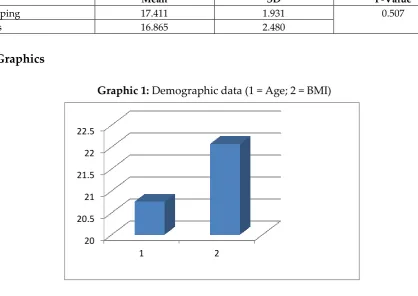
Graphic 1: Demographic data (1 = Age; 2 = BMI)
20 20.5 21 21.5 22 22.5
Graph 2: Comparison effect of TENS & Cupping for 5 min treatment time
Graphic 3: Comparison effect of TENS & Cupping for 10 min treatment time
Graph 4: Comparison effect of TENS for 5 min & 10 min treatment time
y = 0.0308x + 16.213 R² = 0.0013
0 2 4 6 8 10 12 14 16 18 20
0 5 10 15 20 25 30
Cu p p in g 5 m in .
Tens 5 min.
y = 1.1294x - 2.7984 R² = 0.7737
0 5 10 15 20 25 30
0 5 10 15 20 25 30
Cu p p in g 10 m in .
Tens 10 min.
y = 0.6892x + 5.3003 R² = 0.207
0 5 10 15 20 25
0 5 10 15 20 25 30
Ten
s 5
m
in
.
Creative Commons licensing terms