Innovative Smart Dustbin with an Android
Applications using IOT
Mamatha S
1, Vishwas P L
2, Kola Koushika Vaishnavi
3, Swathi V
4, Vittal S
51, 2, 3, 4, 5Department of CSE,VTU University, Belagavi – 590018
Abstract: Waste collection and transportation, is the most costly stage in a waste management program. An IoT based methodology has been proposed as a new solution .Waste management are the activities and actions required to manage waste from its inception to its final disposal. Smart Street Bin describes the scope of work of “Smart Bins” in managing the waste collection system for an entire city. It provide the Smart Dustbin which uses Wireless Sensor Networks(WSN’s) and Mobile applications towards the betterment of Smart Cities. Smart dustbin provides Environment friendly smart dustbins and is a Client-Server model. The proposed system enhancing the project by including two different android applications, one is BBMP app and other one is User app. Smart bin measures waste level ,temperature level, humidity and harmful gases level and all are get updating in a user applications and notification with map send to BBMP application.
Keywords: Internet of Things; Solid Waste Management; Sensing; Automation; ultrasonic Sensors, android apps, Firebase cloud
I. INTRODUCTION
The Internet of things (IOT) is the extension of Internet connectivity into physical devices and everyday objects. Embedded with electronics, Internet connectivity, and other forms of hardware (such as sensors), these devices can communicate and interact with others over the Internet, and they can be remotely monitored and controlled. This includes the collection, transport, treatment and disposal of waste, together with monitoring and regulation of the waste management process.
Waste management (or waste disposal) are the activities and actions required to manage waste from its inception to its final disposal. This includes the collection, transport, treatment and disposal of waste, together with monitoring and regulation of the waste management process. Waste can be solid, liquid, or gaseous and each type has different methods of disposal and management. Waste management deals with all types of waste, including industrial, biological and household. Sensor Based Waste Collection Binsis used to identify status of waste bins if it is empty or filled so as to customize the waste collection schedule accordingly and also save the cost), and others all contribute to enabling the Internet of things.
In the consumer market, IoT technology is most synonymous with products pertaining to the concept of the "smart home", covering devices and appliances (such as lighting fixtures, thermostats, home security systems and cameras, and other home appliances) that support one or more common ecosystems, and can be controlled via devices associated with that ecosystem, such as smart phones and smart speakers.
Real time waste management system by using smart dustbins to check the fill level of dustbins whether the dustbins are full or not, through this system the information of all smart dustbins can be accessed from anywhere and anytime by the concern person. It will inform the status of each and every dustbin in real time so that concerned authority can send the garbage collection vehicle only when the dustbin is full. By implementing this system resource optimization, cost reduction, effective usage of smart dustbins can be done.
II. EXISTING SYSTEM
The methodology proposes use of Infrared sensors to gather real time data from the waste bins and that of Raspberry Pi2Development Board to communicate this information to the waste managers. The waste managers can effectively use this information to optimize the scheduling and routing of collection process.
A. Advantages Of The Existing System
1) Raise Public Awareness Of Utilizing Renewable Energy
2) Improve Street Sanitation
3) Encourage Recycling
4) Collect And Analyse Area-Specific Data On Waste Volumes For Better Planning
5) Increase Wi-Fi Coverage With Their Function As A Free Public Wi-Fi Hotspot
B. Disadvantages Of The Existing System
1) Time consuming and less effective: trucks go and empty containers whether they are full or not.
2) High costs.
3) Unhygienic Environment and look of the city.
4) Bad smell spreads and may cause illness to human beings.
5) More traffic and Noise
Fig:1 Smart dustbin using IR sensors
III. PROPOSED SYSTEM
Considering the need of modern technology the smart garbage bin can expensive but considering the amount of dustbin needed in India, expensive garbage bin would not be a prior experiment that is why need to use less expensive sensors to reduce its cost and also make it efficient in applications.
Technology always helps mankind in making life easier. Now presenting an innovative way which revolutionizes the trash management system through this taking a step towards clean India. Present scenario in the public places where proper disposal is not being done because of which come across overflow dustbins. Even the private areas which are clean enough failed to utilize the resources efficiently.
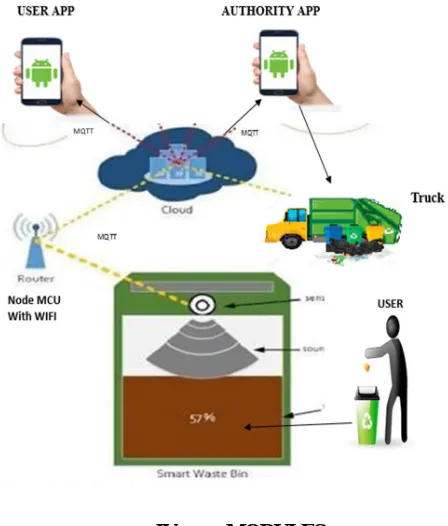
At the same time, the level of garbage also will display on user app to allow user to know the level of garbage in the dustbin without open it. The ultrasonic sensors connect to microcontroller to detect the level of garbage of each bin based on the depth of the bin. At the same, the ultrasonic sensors connect to ESP8266 Wi-Fi module to make sure the data transfer and display on user app.
The LCD is interfaces with microcontroller will display the percentage of the garbage for each bins. The system will try to monitor the depth of the garbage based on garbage type. The domestic waste does not to wait the bin to be 100% full as the longer it will be in the bin; the longer the domestic waste will be rotten and create unpleasant environment.
A. Applications 1) Domestic
2) Hotels
3) Malls
4) Railway Station
5) Bus Stop
6) Gardens
7) Colleges
B. Advantages Of The Proposed System
1) Real time information on the fill level of the dustbin.
2) Deployment of dustbin based on the actual needs.
3) Cost Reduction and resource optimization.
4) Improves Environment quality.
a) Fewer smells
b) Cleaner cities
5) Intelligent management of the services in the city.
[image:3.595.187.411.242.505.2]6) Effective usage of dustbins
Fig 2: Smart Bin with Ultrasonic Sensor
IV. MODULES
A. Object Distance Measurement
The Ultrasonic sensors are used to detect the object, to measure the distance of the object and have many applications. The Ultrasonic sensor provides the easiest method of object detection and gives the perfect measurement between stationary or moving objects. The sensor measures the time required for the sound echo to return and send the same to the microcontroller as variable width pulse. An ultrasonic transducer consists of a transmitter and a receiver. The transmitter produces 40 KHz sound wave while the receiver detects the 40 KHz sound wave and converts it to electrical signals which are fed to microcontroller.
[image:3.595.132.455.599.734.2]B. Object Detect and Level Calculation
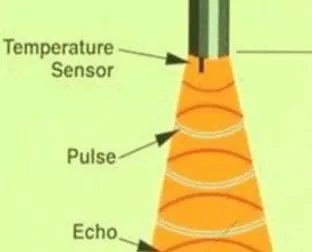
[image:4.595.202.399.179.311.2]Ultrasonic sound vibrates at a frequency above the range of human hearing. Transducers are the microphones used to receive and send the ultrasonic sound. Our ultrasonic sensors, like many others, use a single transducer to send a pulse and to receive the echo. The sensor determines the distance to a target by measuring time lapses between the sending and receiving of the ultrasonic pulse.
Fig 4: Level Calculation
C. GAS Detection
[image:4.595.228.369.425.509.2]The MQ-135 gas sensor senses the gases like ammonia nitrogen, oxygen, alcohols, aromatic compounds, sulphide and smoke. The boost converter of the chip MQ-3 gas sensor is PT1301. The operating voltage of this gas sensor is from 2.5V to 5.0V. The MQ-3 gas sensor has a lower conductivity to clean the air as a gas sensing material. In the atmosphere one can find polluting gases, but the conductivity of gas sensor increases as the concentration of polluting gas increases. MQ-135 gas sensor can be implementation to detect the smoke, benzene, steam and other harmful gases. It has potential to detect different harmful gases. The MQ-135 gas sensor is low cost to purchase.
Fig 5:Gas Detection
D. Temperature and Humidity Calculation
The humidity sensing component of the DHT11 is a moisture holding substrate with the electrodes applied to the surface. When
water vapour is absorbed by the substrate, ions are released by the substrate which increases the conductivity between the
electrodes. The DHT11 is a basic, ultra-low-cost digital temperature and humidity sensor. It uses a capacitive humidity sensor
and a thermistor to measure the surrounding air, and spits out a digital signal on the data pin (no analog input pins needed). It’s fairly simple to use, but requires careful timing to grab data. The only real downside of this sensor is you can only get new data from it once every 2 seconds, so when using our library, sensor readings can be up to 2 seconds old.
[image:4.595.221.377.610.736.2]E. Opening and Closing of Cover
A servo motor is a rotary actuator or a motor that allows for a precise control in terms of the angular position, acceleration, and velocity. Basically it has certain capabilities that a regular motor does not have. Consequently it makes use of a regular motor and pairs it with a sensor for position feedback. Servo motor works on the PWM (Pulse Width Modulation) principle, which means its angle of rotation, is controlled by the duration of pulse applied to its control PIN. Basically servo motor is made up of DC motor which is controlled by a variable resistor (potentiometer) and some gears.
F. Controlling of servomotors:
Usually a servomotor turns 90 degree in either direction hence maximum movement can be 180 degree. However a normal servo motor cannot rotate any further to a build in mechanical stop.
We take three wires are out of a servo: positive, ground and control wire. A servo motor is control by sending a pulse width modulated (PWM) signal through the control wire. A pulse is sent every 20 milliseconds. Width of the pulses determines the position of the shaft.
Fig 7: Servo Motor controlling the lid
V. CONCLUSION
The solution to the optimization of waste collection process lies in generation of real time data about the filling up of waste bins placed at different distant locations. This real time information will help the waste managers to effectively route and schedule the movement of collection machinery. The overflowing of waste bins will also be avoided. The proposed IoT based methodology can easily provide this information. The proposed hardware can serve the purpose for all type of bins. The technology is robust, cheaper and easy to use due to the low cost of the sensors used. Advancements in technology in various sectors of life has created avenues of sophisticated service delivery. With the increasing population and changes in the lifestyle, waste management is another sector where current technological repertoire can be applied in a more operative way. Different environmental entities and stakeholders are involved in the waste management process. It is very important to have a robust way of managing the waste, so that not only the whole process becomes efficient, but also, the disposal of waste is done in a productive way. Besides, food industry, healthcare, tourism, and other such departments can take benefit from the available resources related with waste management.
REFERENCES
[1] P.Suresh1J. Vijay Daniel2, Dr.V.Parthasarathy4 “A state of the art review on the Internet of Things (IoT)” International Conference on Science, Engineering and Management Research (ICSEMR 2014)
[2] ArkadyZaslavsky, DimitriosGeorgakopoulos” Internet of Things: Challenges and State-of-the-art solutions in Internet-scale Sensor Information Management and Mobile Analytics” 2015 16th IEEE International Conference on Mobile Data Management
[3] Theodoros.Anagnostopoulos1,Arkady.Zaslavsky2,1, Alexey Medvedev1, Sergei Khoruzhnicov1” Top–k Query based Dynamic Scheduling for IoT-enabled Smart City Waste Collection” 2015 16th IEEE International Conference on Mobile Data Management.
[4] “City Garbage collection indicator using RF (Zigbee) and GSM technology”
[5] Vikrant Bhor, Pankaj Morajkar, Maheshwar Gurav, Dishant Pandya4 “Smart Garbage Management System” International Journal of Engineering Research & Technology (IJERT) ISSN: 2278-0181 IJERTV4IS031175 Vol. 4 Issue 03, March-2015
[6] Insung Hong, Sunghoi Park, Beomseok Lee, Jaekeun Lee, DaebeomJeong, and Sehyun Park, “IoT-Based Smart Garbage System for Efficient Food Waste Management”, The Scientific World Journal Volume 2014 (2014), Article ID 646953
[7] Marian Look, “Trash Plant: India”, earth911B.