Available online throug
ISSN 2229 – 5046
CHEMICAL REACTION EFFECTS ON MHD FREE CONVECTIVE OSCILLATORY
FLOW PAST A POROUS PLATE EMBEDDED IN A POROUS MEDIUM
IN THE PRESENCE OF HEAT SOURCE
K. Sreelatha
1*, B. Rami Reddy
2and J. Girish Kumar
31
Dept. of Science and Humanities, Satya Institute of Tech and Management,
Gajularega, Vizianagaram, A.P., India
2
Dept of Mathematics, Hindu College, Guntur, A.P., India
3
Dept. of Mathematics, Govt. Degree College, Jammalamadugu, Kadapa (Dt.), A.P., India
(Received on: 20-12-12; Revised & Accepted on: 28-01-13)
ABSTRACT
A
n attempt has been made to study the two-dimensional MHD free convective oscillatory flow of an electricallyconducting incompressible viscous fluid past an infinite vertical porous plate embedded in a porous medium, through which suction occurs with constant velocity and chemical reaction in the presence of a heat source. A uniform magnetic field is assumed to be applied transversely to the direction of the free stream taking into account of induced magnetic field. The governing equations involved in the present analysis are solved by using the perturbation method. The velocity, temperature and concentration fields are studied for different parameters such as Grashof number (Gr), modified Grashof number (Gc), Magnetic field parameter (M), Permeability parameter (k), Schmidt number (Sc), Prandtl number (Pr), heat source parameter (Q) and Chemical reaction parameter (Kr), Eckert number (Ec) etc.
Key words: MHD, Chemical reaction, Heat Source, Porous medium etc.
INTRODUCTION:
The influence of magnetic field on viscous incompressible flow of an electrically conducting fluid has its importance in many applications such as extrusion of plastics in the manufacture of rayon and nylon, purification of crude oil, pulp, paper industry, textile industry and in different geophysical cases etc. In many process industries, the cooling of threads or sheets of some polymer materials is of importance in the production line. The rate of cooling can be controlled effectively to achieve final products of desired characteristics by drawing threads, etc. in the presence of an electrically conducting fluid subject to a magnetic field.
MHD plays an important role in agriculture, petroleum industries, geophysics and in astrophysics. Important applications are in the study of geological formations, in exploration and thermal recovery of oil, and in the assessment of aquifers, geothermal reservoirs and underground nuclear waste storage sites. MHD flow has application in metrology, solar physics and in motion of earth’s core. Also it has applications in the field of stellar and planetary magnetospheres, aeronautics, chemical engineering and electronics. In the field of power generation, MHD is receiving considerable attention due to the possibilities it offers for much higher thermal efficiencies in power plants.
Jonah Philliph et al. (16) studied the effects of thermal radiation and MHD on the unsteady free convection and mass transform flow past an exponentially accelerated vertical plate with variable temperature. Gireesh Kumar et al. (12) discussed the effects of chemical reaction on transient MHD convection flow past a vertical surface embedded in a porous medium with oscillating temperature. Hemanth Poonia and Chaudhary (14) analyzed the MHD free convection and mass transfer flow over an infinite vertical porous plate with viscous dissipation. Girish Kumar et al. (13) examined the mass transfer effects on MHD flows exponentially accelerated vertical plate in the presence of chemical reaction through porous media.
The study of convective fluid flow with mass transfer along a vertical porous plate in the presence of magnetic field and internal heat generation receiving considerable attention due to its useful applications in different branches of science and technology such as cosmical and geophysical science, fire engineering, combustion modeling etc. Vajravelu (24) studied natural convection flow along a heated semi-infinite vertical plate with internal heat generation.
Corresponding author:K. Sreelatha1*
Cookey et al. (8) analyzed influence of viscous dissipation and radiation on unsteady MHD free convective flow past an infinite heated vertical plate in a porous medium with time dependent suction. Chamkha (6) discussed unsteady MHD convective heat and mass transfer past a semi-infinite vertical permeable moving plate with heat generation. Ahmed (2) looked the effects of unsteady free convective MHD flow through a porous medium bounded by an infinite vertical porous plate. Sharma and Singh (21) discussed the unsteady MHD free convective flow and heat transfer along a vertical porous plate with variable suction and internal heat generation. Sharma et al. (20) analyzed the heat and mass transfer effects on unsteady MHD free convective flow along a vertical porous plate with internal heat generation and variable suction. Soundalgekar (22) investigated the unsteady free convection flow along vertical porous plate with different boundary conditions and viscous dissipation effect.
Convection in porous medium has important applications in many areas including thermal energy storage, flow through filtering devices, utilization of geothermal energy, oil extraction, high performance insulation for buildings, paper industry etc. Hence combined study may give some vital information which will surely be helpful in developing other relevant areas. Kishore et al. (17) analyzed the effects of thermal radiation and viscous dissipation on MHD heat and mass diffusion flow past an oscillating vertical plate embedded in a porous medium with variable surface conditions. Israel – Cookey et al. (15) studied the influence of viscous dissipation and radiation on unsteady MHD free convection flow past an infinite heated vertical plate in a porous medium with time dependent suction.
Chaudhary and Arpita Jain (7) discussed the MHD heat and mass diffusion flow by natural convection past a surface
embedded in a porous medium. Seethamahalakshmi et al. (19) examined the effects of the chemical reaction and
radiation absorption on an unsteady MHD convective heat and mass transfer flow fast a semi-infinite vertical moving in a porous medium with heat source and suction. Abdel-Nasser Osman et al. (1) investigated the analytical solution of thermal radiation and chemical reaction effects on unsteady MHD convection through porous medium with heat source/sink. Chamkha and Khaled (5) looked the effects of hydromagnetic combined heat and mass transfer by natural convection from a permeable surface embedded in fluid saturated porous medium.
Mass diffusion rates can changed tremendously with chemical reactions. In majority cases, a chemical reaction depends on the concentration the concentration of the species itself. A reaction is said to be first order, if the rate of reaction is directly proportional to the concentration itself (Cussler (9)). A few representative areas of interest in which heat and mass transfer combined along with chemical reaction play an important role in chemical industries like in food processing and polymer production.
Chambre and Young (4) have analyzed a first order chemical reaction in the neighborhood of a horizontal plate. Das et al. (10, 11) have studied the effect of homogeneous first order chemical reaction on the flow past an impulsively started vertical plate with uniform heat flux and mass transfer. Again, they are also discussed the mass transfer effects on moving isothermal infinite vertical plate in the presence of chemical reaction. The dimensionless governing equations were solved by the usual Laplace Transform technique. Sudheer Babu et al. (23) have examined the radiation and chemical reaction effects on an unsteady MHD convection flow past a vertical moving porous plate embedded in a porous medium with viscous dissipation. Muthucumaraswamy and Kulaivel (18) looked the chemical reaction effects on moving infinite vertical plate with uniform heat flux and variable mass diffusion
The main objective of the present analysis is to study the unsteady two-dimensional MHD free convective oscillatory flow of an electrically conducting incompressible viscous fluid past an infinite vertical porous plate embedded in a porous medium, in which suction occurs with constant velocity and chemical reaction in the presence of a heat source. The equations of continuity, momentum, energy and diffusion which govern the flow field are solved to the best possible solution.
Nomenclature
C - dimensionless concentration, [-]
𝐶𝐶′ - concentration, [mol𝑚𝑚−3]
𝐶𝐶𝑤𝑤′ - species concentration at the plate, [mol𝑚𝑚−3]
𝐶𝐶∞′ - species concentration far away from the plate, [mol𝑚𝑚−3]
𝑐𝑐𝑝𝑝 - specific heat at constant pressure, [Jkg-1K-1]
D - chemical diffusivity, [m2s-1]
Ec - Eckert number, [-]
𝑔𝑔𝑥𝑥′ - acceleration due to gravity, [ms-2]
Gc - modified Grashof number, [-]
Gr - Grashof number, [-]
𝐵𝐵0 - applied magnetic field, [-]
𝑘𝑘′ - permeability parameter, [-]
𝜅𝜅 - thermal conductivity, [Wm-1K-1]
𝑝𝑝′ - pressure, [kgm-1s-2]
𝑞𝑞′ - heat flux at the plate, [Wm-2 ]
𝑄𝑄′ - heat source, [-]
Sc - Schmidt number, [-]
𝐾𝐾𝑟𝑟′ - chemical reaction, [-]
T - dimensionless fluid temperature, [-]
𝑇𝑇′ - fluid temperature, [K]
𝑇𝑇∞′ - temperature of the fluid far away from the plate, [K]
t - dimensionless time, [-]
𝑡𝑡′ - the time, [s]
𝑈𝑈0 - mean free stream velocity, [ms-1]
u - dimensionless velocity of the fluid at the 𝑥𝑥′- direction, [-]
𝑢𝑢′ - velocity of the fluid at the 𝑥𝑥′- direction, [ms-1]
𝑣𝑣′ - velocity of the fluid at the 𝑦𝑦′- direction, [-] 𝑣𝑣0 - suction velocity, [ms-1]
𝑥𝑥′ - co-ordinate axis along the plate, [-] 𝑦𝑦′ - co-ordinate axis normal to the plate, [-]
Greek symbols
𝛼𝛼 - absorption coefficient, [m-1]
𝛽𝛽 - coefficient of thermal expansion, [K-1]
𝛽𝛽∗ - coefficient of concentration expansion, [(molm-3)-1]
𝑣𝑣 - kinematic viscosity, [m2s-1]
𝜌𝜌 - fluid density, [kgm-3]
𝜎𝜎∗ - Stefan – Boltzman constant, [Wm-2K-4]
𝜔𝜔 - dimensionless frequency of vibration of the fluid, [-]
𝜔𝜔′ - frequency of vibration of the fluid, [rads-1]
FORMULATION OF THE PROBLEM:
We consider the unsteady two-dimensional MHD free convective oscillatory flow of an electrically conducting incompressible viscous fluid past an infinite vertical porous plate embedded in a porous medium, through which suction occurs with constant velocity and chemical reaction in the presence of a heat source. The 𝑥𝑥′ - axis is along the plate in the upward direction and the 𝑦𝑦′ - axis is normal to it. A uniform magnetic field is applied in the direction perpendicular to the plate. Reynolds number is much less than unity and the induced magnetic field is negligible in comparison with the applied magnetic field. It is also assumed that all the fluid properties are constant except that of the influence of the density variation with temperature and concentration in the body force term (Boussinesq’s approximation). There is a chemical reaction between the diffusing species and the fluid. The foreign mass present in the flow is assumed to be a low level and hence Soret and Dufour effects are negligible. Under these assumptions, the governing equations of the flow field are:
Continuity equation
𝜕𝜕𝑣𝑣′
𝜕𝜕𝑦𝑦′ = 0 (1)
Momentum equation
𝜌𝜌 �𝜕𝜕𝑢𝑢𝜕𝜕𝑡𝑡′′+ 𝑣𝑣′ 𝜕𝜕𝑢𝑢 ′
𝜕𝜕𝑦𝑦′�= −
𝜕𝜕𝑝𝑝′
𝜕𝜕𝑥𝑥′ − 𝜌𝜌𝑔𝑔𝑥𝑥′ + 𝑣𝑣𝜌𝜌𝜕𝜕
2𝑢𝑢′
𝜕𝜕𝑦𝑦′2− �𝜎𝜎𝐵𝐵02+ 𝜌𝜌𝑣𝑣 ′
𝑘𝑘′�(𝑢𝑢′) (2)
Energy equation
𝜕𝜕𝑇𝑇′ 𝜕𝜕𝑡𝑡′ +𝑣𝑣′ 𝜕𝜕𝑇𝑇
′
𝜕𝜕𝑦𝑦′ = 𝜌𝜌𝐶𝐶𝜅𝜅𝑝𝑝𝜕𝜕
2𝑇𝑇′
𝜕𝜕𝑦𝑦′2+
𝑣𝑣 𝐶𝐶𝑝𝑝�
𝜕𝜕𝑢𝑢′ 𝜕𝜕𝑦𝑦′�
2
+𝜌𝜌𝐶𝐶𝑄𝑄′
𝑝𝑝(𝑇𝑇
′− 𝑇𝑇
∞′) (3)
Diffusion equation
𝜕𝜕𝐶𝐶′
𝜕𝜕𝑡𝑡′ + 𝑣𝑣′ 𝜕𝜕𝐶𝐶 ′
𝜕𝜕𝑦𝑦′ =𝐷𝐷𝜕𝜕
2𝐶𝐶′
𝜕𝜕𝑦𝑦′2− 𝐾𝐾𝑟𝑟′(𝐶𝐶′− 𝐶𝐶∞′) (4)
The boundary conditions are:
𝑢𝑢′ = 0,𝑣𝑣′= −𝑣𝑣
0,𝜕𝜕𝑇𝑇 ′
𝜕𝜕𝑦𝑦′ = −𝑞𝑞 ′
𝜅𝜅 ,𝐶𝐶′ = 𝐶𝐶𝑤𝑤′ 𝑎𝑎𝑡𝑡 𝑦𝑦′ = 0 𝑢𝑢′ → 𝑈𝑈′ = 𝑈𝑈
0�1 +𝜀𝜀𝑒𝑒𝑖𝑖𝑤𝑤′𝑡𝑡′�,𝑇𝑇′→ 𝑇𝑇∞′,𝐶𝐶′→ 𝐶𝐶∞′ 𝑎𝑎𝑎𝑎 𝑦𝑦′ → ∞
� (5)
Where 𝑣𝑣0 is the constant suction velocity and the negative sign indicates that it is towards the plate, 𝑞𝑞′ - the constant heat flux, 𝑇𝑇∞′ - the fluid temperature far away from the plate, 𝐶𝐶𝑤𝑤′ - the species concentration at the plate, 𝐶𝐶∞′ - the species concentration far away from the plate, 𝑈𝑈0 - the mean free stream velocity, 𝜔𝜔′ - the frequency of vibration of the fluid, and 𝜀𝜀 (𝜀𝜀< 1) - a constant quantity.
For the free stream, equation (2) becomes:
𝜌𝜌𝑑𝑑𝑈𝑈𝑑𝑑𝑡𝑡′′ = −
𝜕𝜕𝑝𝑝′
𝜕𝜕𝑥𝑥′ − 𝜌𝜌∞𝑔𝑔𝑥𝑥′ − 𝜎𝜎𝐵𝐵02𝑈𝑈′− 𝜌𝜌𝑣𝑣 ′
𝑘𝑘′𝑈𝑈′ (6)
On eliminating 𝜕𝜕𝑝𝑝′
𝜕𝜕𝑥𝑥′ between (2) and (6) we get:
𝜌𝜌 �𝜕𝜕𝑢𝑢𝜕𝜕𝑡𝑡′′+ 𝑣𝑣′ 𝜕𝜕𝑢𝑢 ′
𝜕𝜕𝑦𝑦′�= 𝜌𝜌
𝑑𝑑𝑈𝑈′
𝑑𝑑𝑡𝑡′ +𝑔𝑔𝑥𝑥′(𝜌𝜌∞− 𝜌𝜌) + 𝑣𝑣𝜌𝜌𝜕𝜕
2𝑢𝑢′
𝜕𝜕𝑦𝑦′2− �𝜎𝜎𝐵𝐵02+ 𝜌𝜌
𝑣𝑣′
𝑘𝑘′� �𝑢𝑢′− 𝑈𝑈′(𝑡𝑡′)� (7)
The state equation is
𝑔𝑔𝑥𝑥′(𝜌𝜌∞− 𝜌𝜌) = 𝑔𝑔𝑥𝑥′𝜌𝜌𝛽𝛽(𝑇𝑇′− 𝑇𝑇∞′) +𝑔𝑔𝑥𝑥′𝜌𝜌𝛽𝛽∗(𝐶𝐶′− 𝐶𝐶∞′ ) (8)
Where 𝛽𝛽 is the coefficient of thermal expansion and 𝛽𝛽∗ is the coefficient of concentration expansion
From (7) and (8) we have
𝜕𝜕𝑢𝑢′
𝜕𝜕𝑡𝑡′ +𝑣𝑣′ 𝜕𝜕𝑢𝑢 ′
𝜕𝜕𝑦𝑦′ =
𝑑𝑑𝑈𝑈′
𝑑𝑑𝑡𝑡′ +𝑔𝑔𝑥𝑥′𝛽𝛽(𝑇𝑇′− 𝑇𝑇∞′) +𝑔𝑔𝑥𝑥′𝛽𝛽∗(𝐶𝐶′− 𝐶𝐶∞′ ) +𝑣𝑣𝜕𝜕
2𝑢𝑢′
𝜕𝜕𝑦𝑦′2− �
𝜎𝜎𝐵𝐵02
𝜌𝜌 + 𝑣𝑣′
𝑘𝑘′� �𝑢𝑢′− 𝑈𝑈′(𝑡𝑡′)�
(9) Equation (1) gives:
𝑣𝑣′ = −𝑣𝑣
0(𝑣𝑣0> 0) (10)
On substituting equation (10), in equations (10), (3) and (4) we take:
𝜕𝜕𝑢𝑢′
𝜕𝜕𝑡𝑡′ − 𝑣𝑣0
𝜕𝜕𝑢𝑢′
𝜕𝜕𝑦𝑦′ =
𝑑𝑑𝑈𝑈′
𝑑𝑑𝑡𝑡′ +𝑔𝑔𝑥𝑥′𝛽𝛽(𝑇𝑇′− 𝑇𝑇∞′) +𝑔𝑔𝑥𝑥′𝛽𝛽∗(𝐶𝐶′− 𝐶𝐶∞′ ) +𝑣𝑣𝜕𝜕
2𝑢𝑢′
𝜕𝜕𝑦𝑦′2− �
𝜎𝜎𝐵𝐵02
𝜌𝜌 + 𝑣𝑣′
𝑘𝑘′� �𝑢𝑢′− 𝑈𝑈′(𝑡𝑡′)�
(11)
𝜕𝜕𝑇𝑇′
𝜕𝜕𝑡𝑡′ − 𝑣𝑣0
𝜕𝜕𝑇𝑇′
𝜕𝜕𝑦𝑦′ =
𝜅𝜅 𝜌𝜌𝐶𝐶𝑝𝑝
𝜕𝜕2𝑇𝑇′
𝜕𝜕𝑦𝑦′2+
𝑣𝑣 𝐶𝐶𝑝𝑝�
𝜕𝜕𝑢𝑢′
𝜕𝜕𝑦𝑦′� 2
+𝜌𝜌𝐶𝐶𝑄𝑄′
𝑝𝑝(𝑇𝑇
′− 𝑇𝑇
∞′) (12)
𝜕𝜕𝐶𝐶′
𝜕𝜕𝑡𝑡′ − 𝑣𝑣0𝜕𝜕𝐶𝐶 ′
𝜕𝜕𝑦𝑦′ =𝐷𝐷𝜕𝜕
2𝐶𝐶′
𝜕𝜕𝑦𝑦′2− 𝐾𝐾𝑟𝑟′(𝐶𝐶′− 𝐶𝐶∞′) (13)
Using the transformations:
𝑦𝑦= 𝑦𝑦′𝑣𝑣0
𝑣𝑣 ,𝑡𝑡= 𝑡𝑡′𝑣𝑣02
4𝑣𝑣 ,𝑢𝑢= 𝑢𝑢′ 𝑈𝑈0,𝑈𝑈=
𝑈𝑈′ 𝑈𝑈0,𝜔𝜔=
4𝑣𝑣𝜔𝜔′ 𝑣𝑣02 𝑇𝑇=
𝑇𝑇′−𝑇𝑇∞′ 𝑣𝑣𝑞𝑞′ 𝑘𝑘𝑣𝑣0
𝐶𝐶= 𝐶𝐶′−𝐶𝐶∞′
𝐶𝐶𝑤𝑤′−𝐶𝐶∞′ ,𝐺𝐺𝑟𝑟=
𝑔𝑔𝑥𝑥′𝛽𝛽𝑣𝑣2𝑞𝑞′ 𝑘𝑘𝑈𝑈0𝑣𝑣03 ,𝐺𝐺𝑐𝑐=
𝑣𝑣𝑔𝑔𝑥𝑥′𝛽𝛽∗�𝐶𝐶𝑤𝑤′−𝐶𝐶∞′ �
𝑈𝑈0𝑣𝑣02 , Pr =
𝜌𝜌𝑣𝑣𝐶𝐶𝑝𝑝
𝑘𝑘 , 𝐸𝐸𝑐𝑐=𝑘𝑘𝑈𝑈02𝑣𝑣0
𝐶𝐶𝑝𝑝𝑣𝑣𝑞𝑞′ ,𝑀𝑀=
𝜎𝜎𝐵𝐵02𝑣𝑣 𝜌𝜌𝑣𝑣02 ,𝑄𝑄=
𝑣𝑣2𝑄𝑄′
𝜅𝜅𝑣𝑣02 ,𝐾𝐾𝑟𝑟=
𝐾𝐾𝑟𝑟′𝑣𝑣
𝑣𝑣02 ,𝑆𝑆𝑐𝑐=
𝑣𝑣 𝐷𝐷, 𝑘𝑘=
𝑘𝑘′𝑣𝑣2
𝑣𝑣02 ⎭
⎪ ⎬ ⎪ ⎫
(14)
With the help of the non-dimensional quantities (14), equations (11)-(13) reduce to:
1 4 𝜕𝜕𝑢𝑢 𝜕𝜕𝑡𝑡− 𝜕𝜕𝑢𝑢 𝜕𝜕𝑦𝑦= 1 4 𝑑𝑑𝑈𝑈
𝑑𝑑𝑡𝑡 +𝐺𝐺𝑟𝑟𝑇𝑇+𝐺𝐺𝑐𝑐𝐶𝐶+ 𝜕𝜕2𝑢𝑢
𝜕𝜕𝑦𝑦2− �𝑀𝑀+1𝑘𝑘�(𝑢𝑢 − 𝑈𝑈) (15)
𝑃𝑃𝑟𝑟 �14𝜕𝜕𝑇𝑇𝜕𝜕𝑡𝑡− 𝜕𝜕𝑇𝑇𝜕𝜕𝑦𝑦�= 𝜕𝜕𝜕𝜕𝑦𝑦2𝑇𝑇2+ 𝑃𝑃𝑟𝑟𝐸𝐸𝑐𝑐 �𝜕𝜕𝑢𝑢𝜕𝜕𝑦𝑦�
2
+𝑄𝑄𝑇𝑇 (16)
𝑆𝑆𝑐𝑐 �14𝜕𝜕𝐶𝐶𝜕𝜕𝑡𝑡 − 𝜕𝜕𝐶𝐶𝜕𝜕𝑦𝑦�= 𝜕𝜕𝜕𝜕𝑦𝑦2𝐶𝐶2− 𝐾𝐾𝑟𝑟𝑆𝑆𝑐𝑐𝐶𝐶 (17)
With the boundary conditions:
𝑢𝑢= 0, 𝜕𝜕𝑇𝑇𝜕𝜕𝑦𝑦 = −1, 𝐶𝐶= 1 𝑎𝑎𝑡𝑡 𝑦𝑦= 0
SOLUTION OF THE PROBLEM:
Equations (15) – (17) are coupled, non-linear partial differential equations and these cannot be solved in closed form. However, these equations can be reduced to a set of ordinary differential equations, which can be solved analytically. This can be done by representing the velocity, temperature and concentration of the fluid in the neighbourhood of the plate as:
𝑢𝑢(𝑦𝑦,𝑡𝑡) = 𝑢𝑢0(𝑦𝑦) +𝜀𝜀𝑒𝑒𝑖𝑖𝜔𝜔𝑡𝑡𝑢𝑢1(𝑦𝑦) +⋯ (19)
𝑇𝑇(𝑦𝑦,𝑡𝑡) = 𝑇𝑇0(𝑦𝑦) +𝜀𝜀𝑒𝑒𝑖𝑖𝜔𝜔𝑡𝑡𝑇𝑇1(𝑦𝑦) +⋯ (20)
𝐶𝐶(𝑦𝑦,𝑡𝑡) = 𝐶𝐶0(𝑦𝑦) +𝜀𝜀𝑒𝑒𝑖𝑖𝜔𝜔𝑡𝑡𝐶𝐶1(𝑦𝑦) +⋯ (21)
On substituting equations (19)-(21) in equations (15)-(17) we get the following system of differential equations:
𝑑𝑑2𝑢𝑢0
𝑑𝑑𝑦𝑦2 +𝑑𝑑𝑢𝑢𝑑𝑑𝑦𝑦0− �𝑀𝑀+1𝑘𝑘� 𝑢𝑢0=− �𝐺𝐺𝑟𝑟𝑇𝑇0+𝐺𝐺𝑐𝑐𝐶𝐶0+�𝑀𝑀+1𝑘𝑘�� (22)
𝑑𝑑2𝑢𝑢1
𝑑𝑑𝑦𝑦2 +𝑑𝑑𝑢𝑢𝑑𝑑𝑦𝑦1− �𝑖𝑖𝜔𝜔4 − 𝑀𝑀 −𝑘𝑘1� 𝑢𝑢1=− �𝐺𝐺𝑟𝑟𝑇𝑇1+𝐺𝐺𝑐𝑐𝐶𝐶1+�𝑖𝑖𝜔𝜔4 +𝑀𝑀+1𝑘𝑘�� ` (23)
𝑑𝑑2𝑇𝑇0
𝑑𝑑𝑦𝑦2 +𝑃𝑃𝑟𝑟𝑑𝑑𝑇𝑇𝑑𝑑𝑦𝑦0+ 𝑄𝑄𝑇𝑇0=−𝑃𝑃𝑟𝑟𝐸𝐸𝑐𝑐 �𝑑𝑑𝑢𝑢𝑑𝑑𝑦𝑦0� 2
(24)
𝑑𝑑2𝑇𝑇1
𝑑𝑑𝑦𝑦2 +𝑃𝑃𝑟𝑟𝑑𝑑𝑇𝑇𝑑𝑑𝑦𝑦1−𝑖𝑖𝜔𝜔4 𝑃𝑃𝑟𝑟𝑇𝑇1+ 𝑄𝑄𝑇𝑇1=−2𝑃𝑃𝑟𝑟𝐸𝐸𝑐𝑐 �𝑑𝑑𝑢𝑢𝑑𝑑𝑦𝑦0� �𝑑𝑑𝑢𝑢𝑑𝑑𝑦𝑦1� (25)
𝑑𝑑2𝐶𝐶0
𝑑𝑑𝑦𝑦2 +𝑆𝑆𝑐𝑐𝑑𝑑𝐶𝐶𝑑𝑑𝑦𝑦0− 𝐾𝐾𝑟𝑟𝑆𝑆𝑐𝑐𝐶𝐶0= 0 (26)
𝑑𝑑2𝐶𝐶1
𝑑𝑑𝑦𝑦2 +𝑆𝑆𝑐𝑐𝑑𝑑𝐶𝐶𝑑𝑑𝑦𝑦1− 𝑆𝑆𝑐𝑐 �𝑖𝑖𝜔𝜔4 − 𝐾𝐾𝑟𝑟� 𝐶𝐶1= 0 (27)
The corresponding boundary conditions (18) are:
𝑢𝑢0= 0,𝑢𝑢1= 0,𝑑𝑑𝑇𝑇𝑑𝑑𝑦𝑦0=−1,𝑑𝑑𝑇𝑇𝑑𝑑𝑦𝑦1= 0,𝐶𝐶0= 1,𝐶𝐶1= 0 𝑎𝑎𝑡𝑡 𝑦𝑦= 0
𝑢𝑢0→1,𝑢𝑢1→1,𝑇𝑇0→0,𝑇𝑇1→0,𝐶𝐶0→0,𝐶𝐶1→0 𝑎𝑎𝑎𝑎 𝑦𝑦 → ∞
� (28)
In order to solve the system of the differential equations (22)-(27) we put:
𝑢𝑢0(𝑦𝑦) = 𝑢𝑢01(𝑦𝑦) + 𝐸𝐸𝑐𝑐𝑢𝑢02(𝑦𝑦)
𝑇𝑇0(𝑦𝑦) = 𝑇𝑇01(𝑦𝑦) + 𝐸𝐸𝑐𝑐𝑇𝑇02(𝑦𝑦)� (29)
and
𝑢𝑢1(𝑦𝑦) = 𝑢𝑢11(𝑦𝑦) + 𝐸𝐸𝑐𝑐𝑢𝑢12(𝑦𝑦)
𝑇𝑇1(𝑦𝑦) = 𝑇𝑇11(𝑦𝑦) + 𝐸𝐸𝑐𝑐𝑇𝑇12(𝑦𝑦)� (30)
In this system, equating the coefficients of 𝐸𝐸𝑐𝑐0 and 𝐸𝐸𝑐𝑐1 we get:
𝑑𝑑2𝑢𝑢01
𝑑𝑑𝑦𝑦2 +
𝑑𝑑𝑢𝑢01
𝑑𝑑𝑦𝑦 − �𝑀𝑀+
1
𝑘𝑘� 𝑢𝑢01= − �𝐺𝐺𝑟𝑟𝑇𝑇01+ 𝐺𝐺𝑐𝑐𝐶𝐶01+ �𝑀𝑀+
1
𝑘𝑘�� (31)
𝑑𝑑2𝑢𝑢02
𝑑𝑑𝑦𝑦2 +
𝑑𝑑𝑢𝑢02
𝑑𝑑𝑦𝑦 − �𝑀𝑀+
1
𝑘𝑘� 𝑢𝑢02= −(𝐺𝐺𝑟𝑟𝑇𝑇02+ 𝐺𝐺𝑐𝑐𝐶𝐶02) (32)
𝑑𝑑2𝑇𝑇01
𝑑𝑑𝑦𝑦2 + 𝑃𝑃𝑟𝑟
𝑑𝑑𝑇𝑇01
𝑑𝑑𝑦𝑦 +𝑄𝑄𝑇𝑇01= 0 (33)
𝑑𝑑2𝑇𝑇02
𝑑𝑑𝑦𝑦2 + 𝑃𝑃𝑟𝑟
𝑑𝑑𝑇𝑇02
𝑑𝑑𝑦𝑦 +𝑄𝑄𝑇𝑇02= −2𝑃𝑃𝑟𝑟𝐸𝐸𝑐𝑐 � 𝑑𝑑𝑢𝑢01
𝑑𝑑𝑦𝑦 �
2
(34)
𝑑𝑑2𝑢𝑢11
𝑑𝑑𝑦𝑦2 +
𝑑𝑑𝑢𝑢11
𝑑𝑑𝑦𝑦 − � 𝑖𝑖𝜔𝜔
4 + 𝑀𝑀+
1
𝑘𝑘� 𝑢𝑢11= − � 𝑖𝑖𝜔𝜔
4 + 𝐺𝐺𝑟𝑟𝑇𝑇11+ 𝐺𝐺𝑐𝑐𝐶𝐶11+ 𝑀𝑀+ 1
𝑘𝑘� (35)
𝑑𝑑2𝑢𝑢12
𝑑𝑑𝑦𝑦2 +
𝑑𝑑𝑢𝑢12
𝑑𝑑𝑦𝑦 − � 𝑖𝑖𝜔𝜔
4 + 𝑀𝑀+
1
𝑘𝑘� 𝑢𝑢11= −( 𝐺𝐺𝑟𝑟𝑇𝑇12+ 𝐺𝐺𝑐𝑐𝐶𝐶12) (36)
𝑑𝑑2𝑇𝑇11
𝑑𝑑𝑦𝑦2 + 𝑃𝑃𝑟𝑟
𝑑𝑑𝑇𝑇11
𝑑𝑑𝑦𝑦 − � 𝑖𝑖𝜔𝜔
4𝑃𝑃𝑟𝑟 − 𝑄𝑄� 𝑇𝑇11= 0 (37)
𝑑𝑑2𝑇𝑇12
The corresponding boundary conditions (28) become:
𝑢𝑢00= 0, 𝑢𝑢01= 0, 𝑢𝑢11= 0, 𝑢𝑢12= 0
𝑑𝑑𝑇𝑇00
𝑑𝑑𝑦𝑦 = −1, 𝑑𝑑𝑇𝑇01
𝑑𝑑𝑦𝑦 = 0, 𝑑𝑑𝑇𝑇11
𝑑𝑑𝑦𝑦 = 0, 𝑑𝑑𝑇𝑇12
𝑑𝑑𝑦𝑦 = 0 𝐶𝐶0= 1,𝐶𝐶1= 0
� 𝑎𝑎𝑡𝑡 𝑦𝑦= 0
𝑢𝑢00→1, 𝑢𝑢01→0, 𝑢𝑢11→1, 𝑢𝑢12→0
𝑇𝑇00→0, 𝑇𝑇01→0, 𝑇𝑇11→0, 𝑇𝑇12→0
𝐶𝐶0→0,𝐶𝐶1→0
� 𝑎𝑎𝑎𝑎 𝑦𝑦 → ∞ ⎭ ⎪ ⎪ ⎬ ⎪ ⎪ ⎫
(39)
Solving the differential equations (26), (27) and (31) – (38), using boundary conditions (39) we get 𝑢𝑢10= 𝛼𝛼5𝑒𝑒𝛼𝛼2𝑦𝑦+ 𝛼𝛼3𝑒𝑒𝛽𝛽2𝑦𝑦+𝛼𝛼4𝑒𝑒𝛾𝛾2𝑦𝑦+ 1 (40)
𝑢𝑢02= 𝛼𝛼13𝑒𝑒𝛼𝛼2𝑦𝑦+𝛼𝛼6𝑒𝑒𝛽𝛽2𝑦𝑦+𝛼𝛼7𝑒𝑒2𝛼𝛼2𝑦𝑦+𝛼𝛼8𝑒𝑒2𝛽𝛽2𝑦𝑦+𝛼𝛼9𝑒𝑒2𝛾𝛾2𝑦𝑦+𝛼𝛼10𝑒𝑒(𝛼𝛼2+𝛽𝛽2)𝑦𝑦+𝛼𝛼11𝑒𝑒(𝛽𝛽2+𝛾𝛾2)𝑦𝑦+𝛼𝛼12𝑒𝑒(𝛾𝛾2+𝛼𝛼2)𝑦𝑦 (41)
𝑢𝑢11= −𝑒𝑒𝛼𝛼15𝑦𝑦+ 1 (42)
𝑢𝑢12= 𝛼𝛼20𝑒𝑒𝛼𝛼15𝑦𝑦+𝛼𝛼16𝑒𝑒𝛽𝛽11𝑦𝑦+𝛼𝛼17𝑒𝑒(𝛼𝛼2+𝛼𝛼15)𝑦𝑦+𝛼𝛼18𝑒𝑒(𝛽𝛽2+𝛼𝛼15)𝑦𝑦+𝛼𝛼19𝑒𝑒(𝛾𝛾2+𝛼𝛼15)𝑦𝑦 (43)
𝑇𝑇01=−𝛽𝛽21𝑒𝑒𝛽𝛽2𝑦𝑦 (44)
𝑇𝑇02=𝛽𝛽9𝑒𝑒𝛽𝛽2𝑦𝑦+𝛽𝛽3𝑒𝑒2𝛼𝛼2𝑦𝑦+𝛽𝛽4𝑒𝑒2𝛽𝛽2𝑦𝑦+𝛽𝛽5𝑒𝑒2𝛾𝛾2𝑦𝑦+𝛽𝛽6𝑒𝑒(𝛼𝛼2+𝛽𝛽2)𝑦𝑦+𝛽𝛽7𝑒𝑒(𝛽𝛽2+𝛾𝛾2)𝑦𝑦+𝛽𝛽8𝑒𝑒(𝛼𝛼2+𝛾𝛾2)𝑦𝑦 (45)
𝑇𝑇11= 0 (46)
𝑇𝑇12=𝛽𝛽15𝑒𝑒𝛽𝛽11𝑦𝑦+𝛽𝛽12𝑒𝑒(𝛼𝛼2+𝛼𝛼15)𝑦𝑦+𝛽𝛽13𝑒𝑒(𝛽𝛽2+𝛼𝛼15)𝑦𝑦+𝛽𝛽14𝑒𝑒(𝛾𝛾2+𝛼𝛼15)𝑦𝑦 (47)
𝐶𝐶0= 𝑒𝑒𝛾𝛾2𝑦𝑦 (48)
𝐶𝐶1= 0 (49)
With the help of (40) – (47) the equations (29) and (30) becomes 𝑢𝑢0= �𝛼𝛼5𝑒𝑒𝛼𝛼2𝑦𝑦+ 𝛼𝛼3𝑒𝑒𝛽𝛽2𝑦𝑦+𝛼𝛼4𝑒𝑒𝛾𝛾2𝑦𝑦+ 1� + 𝐸𝐸𝑐𝑐�𝛼𝛼13𝑒𝑒𝛼𝛼2𝑦𝑦+𝛼𝛼6𝑒𝑒𝛽𝛽2𝑦𝑦+𝛼𝛼7𝑒𝑒2𝛼𝛼2𝑦𝑦+𝛼𝛼8𝑒𝑒2𝛽𝛽2𝑦𝑦+𝛼𝛼9𝑒𝑒2𝛾𝛾2𝑦𝑦+𝛼𝛼10𝑒𝑒(𝛼𝛼2+𝛽𝛽2)𝑦𝑦+𝛼𝛼11𝑒𝑒(𝛽𝛽2+𝛾𝛾2)𝑦𝑦+𝛼𝛼12𝑒𝑒(𝛾𝛾2+𝛼𝛼2)𝑦𝑦� (50) 𝑇𝑇0= �−𝛽𝛽12𝑒𝑒𝛽𝛽2𝑦𝑦�+ 𝐸𝐸𝑐𝑐�𝛽𝛽9𝑒𝑒𝛽𝛽2𝑦𝑦+𝛽𝛽3𝑒𝑒2𝛼𝛼2𝑦𝑦+𝛽𝛽4𝑒𝑒2𝛽𝛽2𝑦𝑦+𝛽𝛽5𝑒𝑒2𝛾𝛾2𝑦𝑦+𝛽𝛽6𝑒𝑒(𝛼𝛼2+𝛽𝛽2)𝑦𝑦+𝛽𝛽7𝑒𝑒(𝛽𝛽2+𝛾𝛾2)𝑦𝑦+𝛽𝛽8𝑒𝑒(𝛼𝛼2+𝛾𝛾2)𝑦𝑦� (51)
𝑢𝑢1= (−𝑒𝑒𝛼𝛼15𝑦𝑦+ 1) + 𝐸𝐸𝑐𝑐�𝛼𝛼20𝑒𝑒𝛼𝛼15𝑦𝑦+𝛼𝛼16𝑒𝑒𝛽𝛽11𝑦𝑦+𝛼𝛼17𝑒𝑒(𝛼𝛼2+𝛼𝛼15)𝑦𝑦+𝛼𝛼18𝑒𝑒(𝛽𝛽2+𝛼𝛼15)𝑦𝑦+𝛼𝛼19𝑒𝑒(𝛾𝛾2+𝛼𝛼15)𝑦𝑦� (52)
𝑇𝑇1= 𝐸𝐸𝑐𝑐�𝛽𝛽15𝑒𝑒𝛽𝛽11𝑦𝑦+𝛽𝛽12𝑒𝑒(𝛼𝛼2+𝛼𝛼15)𝑦𝑦+𝛽𝛽13𝑒𝑒(𝛽𝛽2+𝛼𝛼15)𝑦𝑦+𝛽𝛽14𝑒𝑒(𝛾𝛾2+𝛼𝛼15)𝑦𝑦� (53)
Finally from the above equations (48) – (53) and with the help of equations (19), (20) and (21) we obtain the velocity, temperature and concentration fields are as follows: 𝑢𝑢(𝑦𝑦) = 𝑢𝑢0+ 𝜀𝜀(cos(𝑤𝑤𝑡𝑡) +𝑖𝑖𝑎𝑎𝑖𝑖𝑖𝑖(𝑤𝑤𝑡𝑡))𝑢𝑢1 =��𝛼𝛼5𝑒𝑒𝛼𝛼2𝑦𝑦+ 𝛼𝛼3𝑒𝑒𝛽𝛽2𝑦𝑦+𝛼𝛼4𝑒𝑒𝛾𝛾2𝑦𝑦+ 1� + 𝐸𝐸𝑐𝑐�𝛼𝛼13𝑒𝑒𝛼𝛼2𝑦𝑦+𝛼𝛼6𝑒𝑒𝛽𝛽2𝑦𝑦+𝛼𝛼7𝑒𝑒2𝛼𝛼2𝑦𝑦+𝛼𝛼8𝑒𝑒2𝛽𝛽2𝑦𝑦+𝛼𝛼9𝑒𝑒2𝛾𝛾2𝑦𝑦+𝛼𝛼10𝑒𝑒(𝛼𝛼2+𝛽𝛽2)𝑦𝑦+𝛼𝛼11𝑒𝑒(𝛽𝛽2+𝛾𝛾2)𝑦𝑦 +𝛼𝛼12𝑒𝑒(𝛾𝛾2+𝛼𝛼2)𝑦𝑦)�+𝜀𝜀�cos(𝑤𝑤𝑡𝑡) +𝑖𝑖𝑎𝑎𝑖𝑖𝑖𝑖(𝑤𝑤𝑡𝑡)�(−𝑒𝑒𝛼𝛼15𝑦𝑦+ 1) +𝐸𝐸𝑐𝑐�𝛼𝛼20𝑒𝑒𝛼𝛼15𝑦𝑦+𝛼𝛼16𝑒𝑒𝛽𝛽11𝑦𝑦+𝛼𝛼17𝑒𝑒(𝛼𝛼2+𝛼𝛼15)𝑦𝑦+𝛼𝛼18𝑒𝑒(𝛽𝛽2+𝛼𝛼15)𝑦𝑦+𝛼𝛼19𝑒𝑒(𝛾𝛾2+𝛼𝛼15)𝑦𝑦� (54)
𝑇𝑇(𝑦𝑦) = 𝑇𝑇0+ 𝜀𝜀�cos(𝑤𝑤𝑡𝑡) +𝑖𝑖𝑎𝑎𝑖𝑖𝑖𝑖(𝑤𝑤𝑡𝑡)�𝑇𝑇1 = ��−1
𝛽𝛽2𝑒𝑒 𝛽𝛽2𝑦𝑦�+ 𝐸𝐸𝑐𝑐�𝛽𝛽9𝑒𝑒𝛽𝛽2𝑦𝑦+𝛽𝛽3𝑒𝑒2𝛼𝛼2𝑦𝑦+𝛽𝛽4𝑒𝑒2𝛽𝛽2𝑦𝑦+𝛽𝛽5𝑒𝑒2𝛾𝛾2𝑦𝑦+𝛽𝛽6𝑒𝑒(𝛼𝛼2+𝛽𝛽2)𝑦𝑦+𝛽𝛽7𝑒𝑒(𝛽𝛽2+𝛾𝛾2)𝑦𝑦+𝛽𝛽8𝑒𝑒(𝛼𝛼2+𝛾𝛾2)𝑦𝑦�� +(cos(𝑤𝑤𝑡𝑡) +𝑖𝑖𝑎𝑎𝑖𝑖𝑖𝑖(𝑤𝑤𝑡𝑡))�𝐸𝐸𝑐𝑐�𝛽𝛽15𝑒𝑒𝛽𝛽11𝑦𝑦+𝛽𝛽12𝑒𝑒(𝛼𝛼2+𝛼𝛼15)𝑦𝑦+𝛽𝛽13𝑒𝑒(𝛽𝛽2+𝛼𝛼15)𝑦𝑦+𝛽𝛽14𝑒𝑒(𝛾𝛾2+𝛼𝛼15)𝑦𝑦�� (55)
RESULTS AND DISCUSSIONS:
The chemical reaction effects on MHD free convective oscillatory flow past a porous plate embedded in a porous medium and in the presence of heat source have been studied. The governing equations are solved by using
perturbation method and approximate solutions are obtained for velocity, temperature and concentration fields. The effects of the flow parameters such as Chemical reaction parameter (Kr), Heat source parameter (Q), Prandtl number (Pr), Eckert number (Ec), Schmidt number (Sc), Grashof number for heat and mass transfer (Gr, Gc), magnetic parameter or Hartmann number (M) and permeability parameter (k) on the velocity, temperature and concentration profiles of the flow field are presented with help of velocity, temperature and concentration profile.
Figs. 1(a) and 1(b) illustrate the effect of chemical reaction parameter Kr on velocity and concentration distributions in the boundary layer. It is noticed from the Fig. 1(a) that the velocity at the start of the boundary layer increases slowly till it attains the maximum value, after that they are decreasing and this trend is seen for all the values of the parameter Kr. From Fig. 1(b) it can be observed that increasing the value of the chemical reaction parameter, decreases the concentration of species in the boundary layer, this is due to the fact that destructive chemical reduces the solutal boundary thickness and increases the mass transfer.
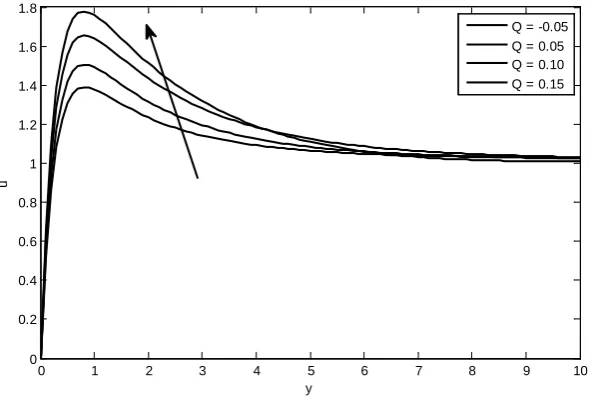
Figs. 2(a) and 2(b) depict the velocity (u) and temperature (T) profiles for different values of the heat source parameter Q. It is noticed from the figure 2(a) that when heat is generated the buoyancy force increase, which induces the flow rate to increase giving rise to the increase in the velocity profiles. The effect of Q on temperature profiles are shown in 2(b). It is clear that the heat generation increases, the temperature is also increases.
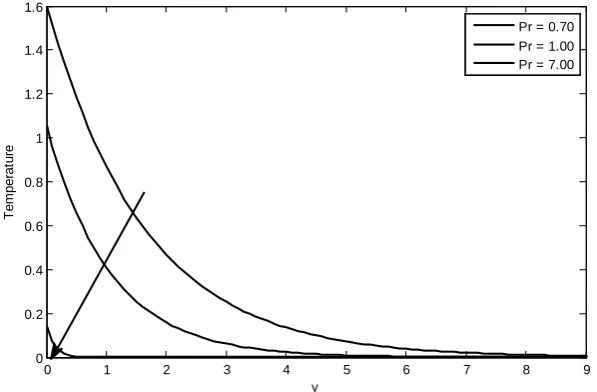
Figs. 3(a) and 3(b) are shown that the behavior of the velocity (u) and temperature (T) for different values of the Prandtl number Pr. The numerical results show that the effect of increasing values of Pr results in a decreasing velocity. From Fig. 3(b), it is observed that an increase in Pr results in a decrease of the thermal boundary layer thickness and in general lower average temperature within the boundary layer. The reason is that smaller values of Pr are equivalent to increase in the thermal conductivity of the fluid and therefore heat is able to diffuse away from the heated surface more rapidly for higher values of Pr. Hence in the case of smaller Prandtl numbers as the thermal boundary layer is thicker and therefore the rate of heat transfer is reduced.
The influence of the viscous dissipation parameter i.e., the Eckert number (Ec) on velocity and temperature are shown in Fig. 4(a) and 4(b). The velocity and temperature both are increases with increasing Eckert number. It expresses the relationship between the kinetic energy in the flow and the enthalpy. It embodies the conversion of kinetic energy in to internal energy by work done against the viscous fluid stresses. Greater viscous dissipative heat causes a rise in the temperature as well as the velocity.
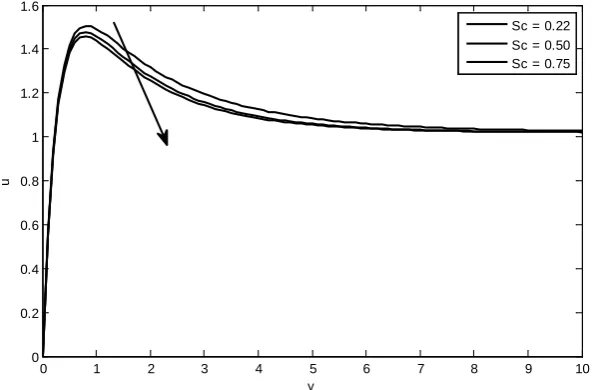
The effects of Schmidt number on the velocity (u) and concentrations (C) are displays in Figs. 5(a) and 5(b). As the Schmidt number increases, the concentration decreases. This causes the concentration buoyancy effects to decrease yielding a reduction in the fluid velocity. Reductions in the velocity and concentration distributions are accompanied by simultaneous reductions in the velocity and concentration boundary layers.
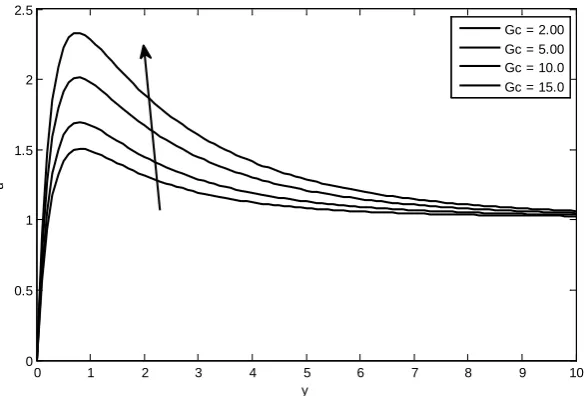
The velocity profiles for different values of the thermal Grashof number Gr are described in Fig. 6(a). It is observed that an increase in Gr leads to arise in the values of velocity. Hence the positive values of Gr correspond to cooling of the plate. In addition, it is observed that the velocity increases rapidly near wall of the plate as Grashof number increases and then decays to the free stream velocity. For the case of different values of the solutal Grashof number Gc, the velocity profiles in the boundary layer are shown in Fig. 6(b). It is observed that an increase in Gc, leads to a rise in the values of velocity.
The influence of magnetic parameter or Hartmann number M, on the velocity (u) is shown in Fig.7. An increase in M reduces the velocity. The application of a transverse magnetic field to an electrically conducting field gives rise to a resistive type of force called Lorentz force. This force has the tendency to slow down the fluid. This trend is apparent from Fig.7.
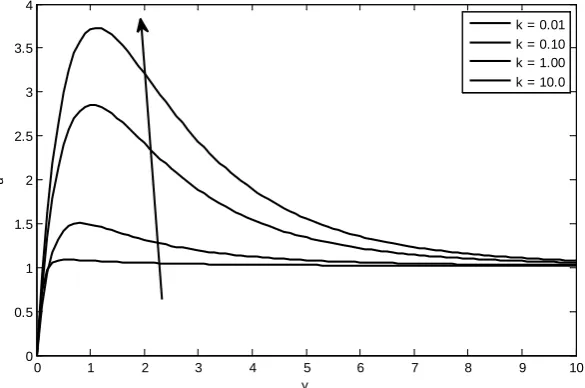
Fig. 8 depicts the velocity profiles for different values of permeability parameter k. Clearly as k increases the peak value of velocity across the boundary layer tends to increase rapidly near wall of the porous plate
CONCLUSIONS
We summarize below the following results of physical interest on the velocity, temperature and concentration distribution of the flow field.
1. A growing magnetic parameter or Prandtl number or Schmidt number or chemical reaction parameter retards the
velocity of the flow field at all points.
2. The effect of increasing Grashof number or modified Grashof number or permeability parameter or Eckert number
3. A growing Prandtl number decreases temperature of the flow field at all points
4. The Eckert number or Heat source increase the leads to increase the temperature at all points.
5. The growing Schmidt number or Chemical reaction parameter decreases the concentration of the flow field at all
points.
REFERENCES
1. Abdel-Nasser A Osman Abo-Dahad S M and Mohamed R A., Analytical solution of thermal radiation and
chemical reaction effects on unsteady MHD convection through porous media with heat source/sink, Mathematical Problems in Engineering, Vol.2011, Article ID 205181, pp.1-18, 2011.
2. Ahmed S., Effects of unsteady free convective MHD flow through a porous medium bounded by an infinite
vertical porous plate, Bull. Cal. Math. Soc., 90, pp.507-522, 2007.
3. Basanth Kumar Jha and Ravindra Prasad., Free convection and mass transfer effects on the flow past an
accelerated vertical plate with heat source, Mechanics Research Communications, Vol. 17, pp. 143-148, 1990.
4. Chambre PL and Young JD., On the diffusion of chemically reactive species in a laminar boundary layer flow, The
Physics of fluids, Vol. 1, pp. 48-54, 1958.
5. Chamkha A J and Khaled A R., Hydromagnetic combined heat and mass transfer by natural convetion from a
permeable surface embedded in fluid saturated porous medium, International Journal of Numerical methods for Heat and Fluid Flow, 10(5), pp.455-476, 2000.
6. Chamkha AJ., Unsteady MHD convective heat and mass transfer past a semi-infinite vertical permeable moving
plate with heat absorption, Int. J. Sci. Engg., 13 (4), pp. 359-364, 2010.
7. Chaudhary R C and Arpita Jain., MHD heat and mass diffusion flow by natural convection past a surface
embedded in a porous medium, Theoretical Applied Mechanics, Vol. 36, No.1, pp.1-27, 2009.
8. Cookey C. Ogulu A and Omubo-Pepple VB., Influence of viscous dissipation and radiation on unsteady MHD free
convective flow past an infinite heated vertical plate in a porous medium with time dependent suction, Int. J. Heat Mass Transfer, 46, pp. 2305-2311, 2003.
9. Cussler EL., Diffusion mass transfer in fluid systems, Cambridge University Press, 1988.
10. Das UN Deka RK and Soundalgekar VM., Effects on mass transfer on flow past an impulsively started infinite
vertical plate with constant heat flux and chemical reaction, Foushing im ingenicurwesen, Vol. 60, pp. 284-287, 1994.
11. Das UN Deka RK and Soundalgekar VM., Effects on mass transfer on flow past an impulsively started infinite
vertical plate with a chemical reaction, The Bulletin GUMA, Vol. 5, pp.13-20, 1999.
12. Gireesh Kumar J Ramakrishna S and Sivaiah M., Effects of chemical reaction on transient MHD convection flow
past a vertical surface embedded in a porous medium with oscillating temperature, Ultra Scientist, Vol. 21(3) M, pp. 889-896, 2009.
13. Girish Kumar J Kishore PM and Ramakrishna S., Mass transfer effects on MHD flows exponentially accelerated
isothermal vertical plate in the presence of chemical reaction through porous media, Advances in Applied Sciences Research, 3(4), pp.2134-2140, 2012.
14. Hemanth Poonia and Chaudhry R.C., MHD free convection and mass transfer flow over an infinite vertical porous
plate with viscous dissipation, Theoreq. Appl. Mech., Vol. 37(4), pp.263-287, 2010.
15. Israel – Cookey C Ogulu A and Omubo – Pepple VM., The influence of viscous dissipation and radiation on
unsteady MHD free convection flow past an infinite heated vertical plate in a porous medium with time dependent suction, Int. J. Heat Mass Transfer, 46, 13, pp.2305-2311, 2003.
16. Jonah Philliph K Rajesh V and Vijaya Kumar Varma S., Effects of thermal radiation and MHD on the unsteady
free convection and mass transform flow past an exponentially accelerated vertical plate with variable temperature, International Journal of Mathematical Archive, Vol. 3(4), pp. 1392-1404, 2012.
17. Kishore PM Rajesh V and Vijayakumar Verma S., The effects of thermal radiation and viscous dissipation on
MHD heat and mass diffusion flow past an oscillating vertical plate embedded in a porous medium with variable surface conditions, Theoret. Appl. Mech., Vol.39, No.2, pp.99-125, 2012.
18. Muthucumaraswamy, R., and Kulaivel, T., Chemical reaction effects on moving infinite vertical plate with uniform heat flux and variable mass diffusion, Forschung im-Ingenieurwesen, 68, pp.101-104, 2003.
19. Seethamahalakshmi Ramana Reddy G V and Prasad B D C N., Effects of the chemical reaction and radiation
absorption on an unsteady MHD convective heat and mass transfer flow past a semi-infinite vertical moving in a porous medium with heat source and suction, IOSR Journal of Engineering, Vol.1, Issue 1, pp.028-036, 2011.
20. Sharma PR Dadkeech IK and Gurminder Singh., Heat and mass transfer effects on unsteady MHD free convective
flow along a vertical porous plate with internal heat generation and variable suction, Int. J. of Math Archive, 3(5), pp. 2163-2172, 2012.
21. Sharma PR Singh G., Unsteady MHD free convective flow and heat transfer along a vertical porous plate with
variable suction and internal heat generation, Int. J. Appl. Math and Mech., 4, pp. 1-8, 2008.
22. Soundalgekar VM., Viscous dissipation effect on unsteady free convective flow past an infinite vertical porous
plate with constant suction, Int. J. Heat Mass Transfer, 15, pp.1253-1261, 1971.
23. Sudheer Babu M Satya Narayana PV Sankar Reddy T and Umamaheswara Reddy D., Radiation and chemical
24. Vajravelu K., Natural convection at a heated, semi-infinite vertical plate with internal heat generation, Acta Mech., 34, pp.153-159, 1979.
APPENDIX
𝛼𝛼1=
−1+�1+4�𝑀𝑀+1𝑘𝑘�
2 , 𝛼𝛼2=
−1−�1+4�𝑀𝑀+1𝑘𝑘�
2 , 𝛼𝛼3=
𝐺𝐺𝑟𝑟 𝛽𝛽2�𝛽𝛽22+ 𝛽𝛽2−�𝑀𝑀+1𝑘𝑘��
, 𝛼𝛼4= 𝐺𝐺𝑐𝑐
𝛾𝛾22+ 𝛾𝛾2−�𝑀𝑀+1
𝑘𝑘� ,
𝛼𝛼5= −[1 +𝛼𝛼3+𝛼𝛼4], 𝛼𝛼6= 𝛽𝛽 −𝐺𝐺𝑟𝑟𝛽𝛽9
22+ 𝛽𝛽2−�𝑀𝑀+1𝑘𝑘�,𝛼𝛼7=
−𝐺𝐺𝑟𝑟𝛽𝛽3
(2𝛼𝛼2)2+ (2𝛼𝛼2)−�𝑀𝑀+1𝑘𝑘�,
𝛼𝛼8= (2𝛽𝛽 −𝐺𝐺𝑟𝑟𝛽𝛽4
2)2+ (2𝛽𝛽2)−�𝑀𝑀+1𝑘𝑘�, 𝛼𝛼9=
−𝐺𝐺𝑟𝑟𝛽𝛽5
(2𝛾𝛾2)2+ (2𝛾𝛾2)−�𝑀𝑀+1𝑘𝑘�, 𝛼𝛼10=
−𝐺𝐺𝑟𝑟𝛽𝛽6
(𝛼𝛼2+𝛽𝛽2)2+(𝛼𝛼2+𝛽𝛽2)−�𝑀𝑀+1𝑘𝑘�,
𝛼𝛼11= (𝛾𝛾 −𝐺𝐺𝑟𝑟𝛽𝛽7
2+𝛽𝛽2)2+(𝛾𝛾2+𝛽𝛽2)−�𝑀𝑀+1𝑘𝑘�, 𝛼𝛼12=
−𝐺𝐺𝑟𝑟𝛽𝛽8
(𝛾𝛾2+𝛼𝛼2)2+(𝛾𝛾2+𝛼𝛼2)−�𝑀𝑀+1𝑘𝑘�
𝛼𝛼13= −[𝛼𝛼6+𝛼𝛼7+𝛼𝛼8+𝛼𝛼9+𝛼𝛼10+𝛼𝛼11+𝛼𝛼12],
𝛼𝛼14=
−1+�1+4�𝑖𝑖𝜔𝜔4+𝑀𝑀+1𝑘𝑘�
2 , 𝛼𝛼15=
−1−�1+4�𝑖𝑖𝜔𝜔4+𝑀𝑀+1𝑘𝑘�
2 , 𝛼𝛼16=
−𝐺𝐺𝑟𝑟𝛽𝛽15
𝛽𝛽112+ 𝛽𝛽11−�𝑖𝑖𝜔𝜔4+𝑀𝑀+1𝑘𝑘�,
𝛼𝛼17= (𝛼𝛼 −𝐺𝐺𝑟𝑟𝛽𝛽12
2+𝛼𝛼15)2+(𝛼𝛼2+𝛼𝛼15)−�𝑖𝑖𝜔𝜔4+𝑀𝑀+𝑘𝑘1�
, 𝛼𝛼18= −𝐺𝐺𝑟𝑟𝛽𝛽13
(𝛽𝛽2+𝛼𝛼15)2+(𝛽𝛽2+𝛼𝛼15)−�𝑖𝑖𝜔𝜔4+𝑀𝑀+1𝑘𝑘�
𝛼𝛼19= (𝛾𝛾 −𝐺𝐺𝑟𝑟𝛽𝛽14
2+𝛼𝛼15)2+(𝛾𝛾2+𝛼𝛼15)−�𝑖𝑖𝜔𝜔4+𝑀𝑀+1𝑘𝑘�
, 𝛼𝛼20=−[𝛼𝛼16+𝛼𝛼17+𝛼𝛼18+𝛼𝛼19]
𝛽𝛽1=−𝑃𝑃𝑟𝑟+�𝑃𝑃𝑟𝑟
2+4(−𝑄𝑄)
2 , 𝛽𝛽2=
−𝑃𝑃𝑟𝑟−�𝑃𝑃𝑟𝑟2+4(−𝑄𝑄)
2 , 𝛽𝛽3=
−2𝑃𝑃𝑟𝑟𝐸𝐸𝑐𝑐(𝛼𝛼2𝛼𝛼5)2
(2𝛼𝛼2)2+𝑃𝑃𝑟𝑟(2𝛼𝛼2)+𝑄𝑄,
𝛽𝛽4= −2𝑃𝑃𝑟𝑟𝐸𝐸𝑐𝑐(𝛽𝛽2𝛼𝛼3)
2
(2𝛽𝛽2)2+𝑃𝑃𝑟𝑟(2𝛽𝛽2)+𝑄𝑄, 𝛽𝛽5=
−2𝑃𝑃𝑟𝑟𝐸𝐸𝑐𝑐(𝛾𝛾2𝛼𝛼4)2
(2𝛾𝛾2)2+𝑃𝑃𝑟𝑟(2𝛾𝛾2)+𝑄𝑄, 𝛽𝛽6=
−4𝑃𝑃𝑟𝑟𝐸𝐸𝑐𝑐 𝛼𝛼2𝛼𝛼3𝛼𝛼5𝛽𝛽2
(𝛼𝛼2+𝛽𝛽2)2+𝑃𝑃𝑟𝑟(𝛼𝛼2+𝛽𝛽2)+𝑄𝑄,
𝛽𝛽7=(𝛽𝛽2+−4𝛾𝛾2𝑃𝑃𝑟𝑟𝐸𝐸𝑐𝑐 𝛽𝛽)2+𝑃𝑃𝑟𝑟2(𝛾𝛾𝛽𝛽22𝛼𝛼+3𝛾𝛾𝛼𝛼24)+𝑄𝑄, 𝛽𝛽8=(𝛼𝛼2+−4𝛾𝛾2𝑃𝑃𝑟𝑟𝐸𝐸𝑐𝑐 𝛼𝛼)2+𝑃𝑃𝑟𝑟2(𝛾𝛾𝛼𝛼22𝛼𝛼+4𝛾𝛾𝛼𝛼25)+𝑄𝑄,
𝛽𝛽9=−𝛽𝛽12[2𝛼𝛼2𝛽𝛽3+ 2𝛽𝛽2𝛽𝛽5+ 2𝛾𝛾2𝛽𝛽5+ (𝛼𝛼2+𝛽𝛽2)𝛽𝛽6+ (𝛽𝛽2+𝛾𝛾2)𝛽𝛽7+ (𝛼𝛼2+𝛾𝛾2)𝛽𝛽8]
𝛽𝛽10=
−𝑃𝑃𝑟𝑟+�𝑃𝑃𝑟𝑟2+4�𝑖𝑖𝜔𝜔 4𝑃𝑃𝑟𝑟−𝑄𝑄�
2 , 𝛽𝛽11=
−𝑃𝑃𝑟𝑟−�𝑃𝑃𝑟𝑟2+4�𝑖𝑖𝜔𝜔 4𝑃𝑃𝑟𝑟−𝑄𝑄�
2 ,
𝛽𝛽12=(𝛼𝛼 2𝑃𝑃𝑟𝑟𝐸𝐸𝑐𝑐 𝛼𝛼2𝛼𝛼5𝛼𝛼15
2+𝛼𝛼15)2+𝑃𝑃𝑟𝑟(𝛼𝛼2+𝛼𝛼15)−�𝑖𝑖𝜔𝜔4𝑃𝑃𝑟𝑟−𝑄𝑄�, 𝛽𝛽13=
2𝑃𝑃𝑟𝑟𝐸𝐸𝑐𝑐 𝛽𝛽2𝛼𝛼3𝛼𝛼15
(𝛽𝛽2+𝛼𝛼15)2+𝑃𝑃𝑟𝑟(𝛽𝛽2+𝛼𝛼15)−�𝑖𝑖𝜔𝜔4𝑃𝑃𝑟𝑟−𝑄𝑄�
𝛽𝛽14=(𝛾𝛾 2𝑃𝑃𝑟𝑟𝐸𝐸𝑐𝑐 𝛾𝛾2𝛼𝛼4𝛼𝛼15
2+𝛼𝛼15)2+𝑃𝑃𝑟𝑟(𝛾𝛾2+𝛼𝛼15)−�𝑖𝑖𝜔𝜔4𝑃𝑃𝑟𝑟−𝑄𝑄�,
𝛽𝛽15=𝛽𝛽−111[𝛽𝛽12(𝛼𝛼2+𝛼𝛼15) +𝛽𝛽13(𝛽𝛽2+𝛼𝛼15) +𝛽𝛽14(𝛾𝛾2+𝛼𝛼15)]
𝛾𝛾1= −𝑆𝑆𝑐𝑐+�𝑆𝑆𝑐𝑐
2+4𝐾𝐾𝑟𝑟𝑆𝑆𝑐𝑐
2 , 𝛾𝛾2=
−𝑆𝑆𝑐𝑐−�𝑆𝑆𝑐𝑐2+4𝐾𝐾𝑟𝑟𝑆𝑆𝑐𝑐
2 , 𝛾𝛾3=
−𝑆𝑆𝑐𝑐+�𝑆𝑆𝑐𝑐2+4�𝑖𝑖𝜔𝜔 4−𝐾𝐾𝑟𝑟�𝑆𝑆𝑐𝑐
2 ,
𝛾𝛾4=
−𝑆𝑆𝑐𝑐−�𝑆𝑆𝑐𝑐2+4�𝑖𝑖𝜔𝜔 4−𝐾𝐾𝑟𝑟�𝑆𝑆𝑐𝑐
GRAPHS
Figure - 1(a): Velocity profile for different values of chemical reaction parameter ‘Kr’ when Gr = 5, Gc = 2, Ec = 0.001, Pr = 0.7, Sc = 0.22, M = 1.0, k = 0.1, Q = 0.05.
Figure - 1(b): Concentration profile for different values of chemical reaction parameter ‘Kr’ when Sc = 0.22
Figure - 2(a): Velocity profile for different values of Heat source parameter ‘Q’ when Gr = 5, Gc = 2, Ec = 0.001, Pr = 0.7, Sc = 0.22, M = 1.0, k = 0.1, Kr = 0.2.
0 1 2 3 4 5 6 7 8 9 10
0 0.2 0.4 0.6 0.8 1 1.2 1.4 1.6
y
u
Kr = 0.2 Kr = 2.0 Kr = 5.0
0 1 2 3 4 5 6 7 8 9 10
0 0.1 0.2 0.3 0.4 0.5 0.6 0.7 0.8 0.9 1
y
C
Kr = 0.2 Kr = 2.0 Kr = 5.0
0 1 2 3 4 5 6 7 8 9 10
0 0.2 0.4 0.6 0.8 1 1.2 1.4 1.6 1.8
y
u
Figure - 2(b): Temperature profile for different values of Heat source parameter ‘Q’ when Gr = 5, Gc = 2, Ec = 0.001, Pr = 0.7, Sc = 0.22, M = 1.0, k = 0.1, Kr = 0.2.
Figure - 3(a): Velocity profile for different values of Prandtl number ‘Pr’ when Gr = 5, Gc = 2, Ec = 0.001, Kr = 0.2, Sc = 0.22, M = 1.0, k = 0.1, Q = 0.05.
Figure - 3(b): Temperature profile for different values of Prandtl number ‘Pr’ when Gr = 5, Gc = 2, Ec = 0.001, Kr = 0.2, Sc = 0.22, M = 1.0, k = 0.1, Q = 0.05.
0 1 2 3 4 5 6 7 8 9 10
0 0.5 1 1.5 2 2.5
y
T
em
per
at
ur
e
Q = -0.05 Q = 0.05 Q = 0.10 Q = 0.15
0 1 2 3 4 5 6 7 8 9 10
0 0.2 0.4 0.6 0.8 1 1.2 1.4 1.6
y
u
Pr = 0.7 Pr = 1.0 Pr = 7.0
0 1 2 3 4 5 6 7 8 9
0 0.2 0.4 0.6 0.8 1 1.2 1.4 1.6
y
T
em
per
at
ur
e
Figure - 4(a): Velocity profile for different values of Eckert number ‘Ec’ when Gr = 5, Gc = 2, Kr = 0.2, Pr = 0.7, Sc = 0.22, M = 1.0, k = 0.1, Q = 0.05.
Figure - 4(b): Temperature profile for different values of Eckert number ‘Ec’ when Gr = 5, Gc = 2, Kr = 0.2, Pr = 0.7, Sc = 0.22, M = 1.0, k = 0.1, Q = 0.05.
Figure - 5(a): Velocity profile for different values of Schmidt number ‘Sc’ when Gr = 5, Gc = 2, Ec = 0.001, Pr = 0.7, Kr = 0.2, M = 1.0, k = 0.1, Q = 0.05.
0 1 2 3 4 5 6 7 8 9 10
0 0.5 1 1.5 2 2.5 3 3.5 4 4.5 5
y
u
Ec = 0.001 Ec = 0.100 Ec = 1.000
0 1 2 3 4 5 6 7 8 9 10
0 2 4 6 8 10 12 14
y
T
em
per
at
ur
e
Ec = 0.001 Ec = 0.100 Ec = 1.000
0 1 2 3 4 5 6 7 8 9 10
0 0.2 0.4 0.6 0.8 1 1.2 1.4 1.6
y
u
Figure - 5(b): Concentration profile for different values of Schmidt number ‘Sc’ when Kr = 0.2
Figure - 6(a): Velocity profile for different values of Grashof number ‘Gr’ when Gc = 2, Kr = 0.2, Ec = 0.001, Pr = 0.7, Sc = 0.22, M = 1.0, k = 0.1, Q = 0.05.
Figure - 6(b): Velocity profile for different values of modified Grashof number ‘Gc’ when Gr = 5, Kr = 0.2, Ec = 0.001, Pr = 0.7, Sc = 0.22, M = 1.0, k = 0.1, Q = 0.05.
0 1 2 3 4 5 6 7 8 9 10
0 0.1 0.2 0.3 0.4 0.5 0.6 0.7 0.8 0.9 1
y
C
Sc = 0.22 Sc = 0.50 Sc = 0.75
0 1 2 3 4 5 6 7 8 9 10
0 0.5 1 1.5 2 2.5 3
y
u
Gr = 5.00 Gr = 10.0 Gr = 15.0 Gr = 20.0
0 1 2 3 4 5 6 7 8 9 10
0 0.5 1 1.5 2 2.5
y
u
Figure - 7: Velocity profile for different values of magnetic parameter ‘M’ when Gr = 5, Gc = 2, Kr = 0.2, Ec = 0.001, Pr = 0.7, Sc = 0.22, k = 0.1, Q = 0.05.
Figure - 8: Velocity profile for different values of permeability parameter ‘k’ when Gr = 5, Gc = 2, Kr = 0.2, Ec = 0.001, Pr = 0.7, Sc = 0.22, M = 1.0, Q = 0.05.
Source of support: Nil, Conflict of interest: None Declared
0 1 2 3 4 5 6 7 8 9 10
0 0.2 0.4 0.6 0.8 1 1.2 1.4 1.6
y
u
M = 1.00 M = 5.00 M = 10.0 M = 15.0
0 1 2 3 4 5 6 7 8 9 10
0 0.5 1 1.5 2 2.5 3 3.5 4
y
u