DEVELOPING STUDENTS’ SPEAKING THROUGH DRAMA PERFORMANCE OF SMK NEGERI 1 METRO
A THESIS
GRADUATE PROGRAM OF ENGLISH DEPARTMENT
TEACHER TRAINING AND EDUCATION FACULTY
LAMPUNG UNIVERSITY
2018 BY
ABSTRACT
DEVELOPING STUDENTS’ SPEAKING THROUGH DRAMA PERFORMANCE OF SMK NEGERI 1 METRO
BY
SUCI LESTARI
The research was conducted to reveal the significant difference in students’ speaking skill before and after the implementation of drama, to find out the aspects of speaking skill improve the most, and to reveal the aspects of drama performance improve the most.
This is a quasi-experimental research with one group pre-test post-test design. It applied drama performance on students’ speaking skill. The samples, who were taken purposively, were 28 students of tenth grader. The instruments used in this study were speaking pretest and posttest in drama performance.
DEVELOPING STUDENTS’ SPEAKING THROUGH DRAMA PERFORMANCE OF SMK NEGERI 1 METRO
A THESIS BY
SUCI LESTARI
Submitted in a Partial Fulfillment of The Requirements for S-2 Degree
GRADUATE PROGRAM OF ENGLISH DEPARTMENT
TEACHER TRAINING AND EDUCATION FACULTY
LAMPUNG UNIVERSITY
PRONOUNCEMENT
Dengan ini saya menyatakan dengan sebenarnya bahwa:
1. Thesis dengan judul "Developing Students’ Speaking through Drama Performance of SMK Negeri 1 Metro" adalah hasil karya sendiri dan saya tidak melakukan penjiplakan atau pengutipan atas karya penulis lain dengan cara yang tidak sesuai dengan tata etika ilmiah yang berlaku dalam masyarakat akademik atau yang disebut plagiarisme.
2. Hak intelektual atas karya ilmiah ini diserahkan sepenuhnya kepada Universitas Lampung.
Atas pernyataan ini, apabila dikcmudian hari ternyata ditemukan adanya ketidakbenaran, saya bersedia menanggung akibat dan sanksi yang diberikan kepada saya, dan saya bersedia dan sanggup dituntut sesuai hukum yang berlaku.
Bandar Lampung, March 2018
Suci Lestari
CURRICULUM VITAE
The researcher’s name is Suci Lestari. She was born on April 5th, 1977 in Sumber Gede, Lampung Tengah. She is the second children of three children of H. Hisyam and Dra. Hj. Umi Rahmawati.
The researcher pursued her Bachelor Degree on Literature (SS) from North Sumatra University in 2000. Thus, the researcher continued her teaching license (Akta IV) at the Institute of Teacher Training and Education of Jakarta (IKIP Jakarta/known as UNJ at the present moment) in 2003. Furthermore, in 2015, the researcher was registered as a student of the 3rdbatch of Master English Education at Lampung University.
The researcher started teaching English at SMAN 1 Punggur in 2003 as an honorary teacher. In 2006, the researcher served the country as a civil servant teacher at SMAN 1 Punggur. Thus, the researcher has been moving to SMKN 1 Metro in 2009 up to the present time.
Bandar Lampung, March 2018
DEDICATION
By offering my praise and gratitude to Allah SWT for the abundant blessings to me, I would proudly dedicate this piece of work to:
My beloved parents, H. Hisyam and Dra. Hj. Umi Rahmawati.
My endless love and sweetheart husband, the late of Muhammad Iksan, S.Pd., who had lived together in sad and happiness for 13 years. In your sickness, you gave me support in my study, Magister English Program without seeing me in Magister graduation ceremony. By full of my energy, I try to finish my study and thesis without you. 14 august 2016, you left me to take a rest forever besides Allah S.W.T. Peace in Heaven my dearest husband. I always pray for you. I love you, you will always in my heart for the rest of my life. None can replace you.
My adopted brother Juni Bayu Saputra, S.Pd., M.Pd.
My wonderful friends of the 3rdbatch of Master of English Education.
MOTTO
ACKNOWLEDGEMENTS
Alhamdulillahirabbil’alamin, praise to Allah SWT, the Almighty and
Merciful Allah, for blessing the researcher with faith, health, and opportunity to finish this thesis entitled “Improving Students’ Poetry Appreciation by Using an Online Learning Service.”
Gratitude and honor are addressed to all persons who have helped and supported the researcher until completing this thesis, since it is necessary to be known that it will never have come into its existence without any supports, encouragements, and assistance from several outstanding people and institutions. Therefore, the researcher would like to acknowledge her respect and sincere gratitude to:
1. Hery Yufrizal, M.A. Ph.D., as the first advisor, for his assistance, ideas, advice, and cooperation in triggering the researcher’s spirit for conducting research on the literature in language teaching.
2. Dr. Ari Nurweni, M.A., as the second advisor, for her advice, criticism, and cooperation in encouraging the researcher to finish this thesis.
3. Dr. Muhammad Sukirlan, M.A., as the examiner 1 , for his advice, ideas, and critical input in reviewing this thesis.
4. Prof.Ag.Bambang Setiyadi, M.A., Ph.D., as the examiner 2, for his advice, ideas, and critical input in reviewing this thesis.
5. Dr. Flora, M.Pd., as the Chief of Master of English Education Study Program, for her unconditional help, support, and motivation, and all lecturers of Master of English Education Study Program who have supported me during the completion process of this thesis.
6. All of my big families for their never ending prayer and support.
7. The Headmaster of SMK Negeri 1 Metro, Dra. Hj. Dwi Widyaningsih M.M. 8. My beloved English teachers at SMK Negeri 1 Metro.
10. All lovely friends of the 3rd batch of Master of English Education, for their solidarity, care, cooperation, togetherness, craziness, and irreplaceably unforgettable happy moments.
Finally, the researcher fully realizes that this thesis may contain some weaknesses. Therefore, constructive comments, criticisms, and suggestions are always appreciatively welcomed for better composition. After all, the researcher expects this thesis will be beneficial to the educational development, the readers, and particularly to those who will conduct further research in the same area of interest.
Bandar Lampung, March 2018 The researcher,
TABLE OF CONTENTS
ABSTRACT... i
PRONOUNCEMENT ... iii
CURRICULUM VITAE ... iv
DEDICATION ...v
MOTTO ... vi
ACKNOWLEDGEMENTS ... vii
TABLE OF CONTENTS... ix
LIST OF TABLES ... xi
APPENDICES ... xii
I. INTRODUCTION ...1
1.1 Background of the Study ...1
1.2 Problem Identification ...7
1.3 Research Question ...7
1.4 Research Objective ...8
1.5 Significance of the Research...8
1.6 Definition of Term ...9
II. LITERATURE REVIEW...11
2.1 Review of Related Studies ...11
2.2 Speaking Skill ...13
2.3 Drama...23
2.4 Conceptual Framework ...36
2.5 Hypotheses ...36
III. RESEARCH METHODS ...38
3.1 Research Design...38
3.2 Research Variable ...39
3.3 Research Population and Sample...40
3.3.1 Population ...40
3.3.2 Sample ...41
3.4 Data Collection and Research Instrument...42
3.5 Data Analysis ...45
3.5.1 Prerequisite Test...48
3.5.2 Hypothesis Test ...50
IV. RESULT AND DISCUSSION ...51
4.1 The Report of Implementation...51
4.1.1 Teaching and Learning Process ...52
4.1.2 The Result of Tryout Test ...55
4.1.3 Result of Validity and Reliability ...55
4.2.1 The Result of the Pretest in Speaking Skill ...56
4.2.2 The Result of the Posttest ...56
4.2.3 The Difference in Students’ Speaking Skill before and after the Implementation of Drama...57
4.3 The Result of Pretest and Posttest Data in Aspects of Speaking Skill...59
4.3.1 The Result of the Accuracy Aspect ...59
4.3.2 The Result of the Fluency Aspect ...60
4.3.3 The Result of the Grammar Aspect ...61
4.3.4 The Result of the Vocabulary Aspect ...62
4.3.5 Description about the Gain Tables...63
4.4 The Result of the Pretest and Posttest Data in Aspects of Drama Performance...67
4.4.1 The Result of the Voice Aspect ...68
4.4.2 The Result of the Memorization/Improvisation Aspect...68
4.4.3 The Result of the Facial Expression Aspect ...69
4.4.4 The Result of the Blocking Aspect ...70
4.5 The Aspects of Speaking Skill Improve the Most ...72
4.6 The Aspects of Drama Performance Improve the Most. ...73
4.7 Discussion ...73
4.7.1 The Significant Difference in Students’ Speaking Skill after the Implementation of Drama...73
4.7.2 The Aspects of Speaking Skill Improve the Most ...76
4.7.3 The Aspects of Drama Improve the Most ...77
V.CONCLUSION ...79
5.1 Conclusion ...79
5.2 Implication and Suggestion...81
REFERENCES...83
LIST OF TABLES
Table 3.1 Scoring Rubric for Drama Performance ...40
Table 3.2 Scoring Rubric for Speaking Skill ...41
Table 3.3 The summary for homogeneity test ...47
Table 4.1 Steps in Teaching Learning Process ...50
Table 4.2 Descriptive Statistics of Pretest Data ...56
Table 4.3 Descriptive Statistics of Posttest Data in Speaking Skill ...57
Table 4.4 Results of Pretest and Posttest ...57
Table 4.5 Results of Paired Samples T-Test ...58
Table 4.6 The Result of Calculation on the Aspect of Accuracy...59
Table 4.7 The Result of Calculation on the Aspect of Fluency ...60
Table 4.8 The Result of Calculation on the Aspect of Grammar...61
Table 4.9 The Result of Calculation on the Aspect of Vocabulary ...62
Table 4.10 Result of Pretest and Posttest Data in Aspects of Speaking Skill...63
Table 4.11 Descriptive Statistic of Gain Accuracy...63
Table 4.12 Descriptive Statistic of Gain Fluency ...64
Table 4.13 Descriptive Statistic of Gain Grammar...65
Table 4.14 Descriptive Statistic of Gain Vocabulary...66
Table 4.15 Result of Pretest and Posttest Data in Aspects of Drama Performance ...67
Table 4.16 The Result of Calculation on the Aspect of Vocabulary ...68
Table 4.17 The Result of Calculation on the Aspect of Memorization/ Improvisation ...69
Table 4.18 The Result of Calculation on the Aspect of Facial Expression...70
APPENDICES
Appendix 1: Lesson Plan for Snow White...88
Appendix 2: Instrument for Pre-Test and Post-Test ...100
Appendix 3: Scoring Rubric for Drama Performance...104
Appendix 4: Scoring Rubric for Speaking Skill ...106
Appendix 5: Lesson Plan for Bawang Merah and Bawang Putih ...108
Appendix 6: Instrument for Pre-Test and Post-Test ...118
Appendix 7: The Result of Tryout Test ...124
Appendix 8: Inter Rater of Validity of Test ...126
Appendix 9: The Difference between R1 and R2 of Tryout Test ...127
Appendix 10: The Result of Pretest in Speaking Skill...129
Appendix 11: The Result of Posttest in Speaking Skill ...131
Appendix 12: The Result of Pretest in Drama Performance...133
Appendix 13: The Result of Posttest in Drama Performance ...135
Appendix 14: Result of Gained Score...137
I. INTRODUCTION
This research deals with an analysis of students’ performances and competencies of English drama for the tenth grade students of SMK N 1 Metro. This chapter presents and discusses the background of the study, problem identification, research question, research objective, and significance of the research.
1.1 Background of the Study
Drama helps the students to release their English competence. Dialogue and improvisation are effect forms of drama (Dobson, 1981, p. 48). The goal is to have alternative device to stimulate students in interacting with their friends. Students can be motivated to speak up especially when they were interacted with their friends.
As we know that in the classroom, there are many characteristics of students. The characteristics were varies, for example: introvert, extrovert, talkative etc. So, in this case, we can give a chance to all students to participate in. So, they can be more active to practice speaking English. In addition, when students perform in drama, they have responsibility to become skit / role. In this situation, they can practice the conversations suitable with scenario. They also should do with emotion. We ensure that acting out are both learning and a language producing activities (Harmer, 2007, p. 271).
springboard for real-life language use. Situations that learners are likely to encounter when using English in the real world can be simulated and a greater range of registers can be practiced than are normally available in classroom talk (Thornbury, 2005, p. 96).
Speaking is one of the four language skills that should be developed beside the other three language skills. According to Spratt et.al (2005, p. 34) speaking is a productive skill like writing, it involves using speech to express meaning to other people. We can develop learners’ speaking skills by focusing regularly on particular aspect of speaking, e.g. fluency, pronunciation, grammatical accuracy or body language. As speaking is such a complex skill, learners in the classroom may need a lot of help to prepare for speaking.
Burn & Joice (1993, p. 3) argue that one of the most important aspects of speaking is that it always occurs within a context. When someone speaks, he/she is both using language to carry out various social functions and choosing forms of language which relate in a relevant way to the cultural and social context.
Kayi (2006) says that teaching speaking is a very important part of second language learning. The ability to communicate in a second language clearly and efficiently contributes to the success of the learners in school and success later in their life. Thus, it is essential that language teacher pay great attention to the teaching of speaking.
be mastered by students or people if they want to interact with people around the world and get success later in their life.
Based on the above discussion, it shows that mastering speaking skill is very important for the students in order to make the students are able to communicate in English with other people from other countries easily. Especially if they want to go abroad, it is an obligation for them to be able to communicate in English since English functions as the first international language in countries all over the world. In addition, mastering English for the students of SMK level is very important since they want to continue their study to the higher level or they want to get a job.
especially in mastering speaking skill.It can be identified from the students’ score in speaking skill that goes lower under minimum passing grade.
Based on the researcher’s teaching experience, it was found out that there were many problems related to the teaching of speaking. Most of the students were not really motivated in speaking task. Some of them really wanted to express their ideas or feeling about the material being taught, but they do not know how to express their idea. This was due their limited vocabulary. Some of them knew how to construct sentences but they were reluctant to speak. They were afraid of making mistakes in pronouncing the words, or pronouncing sentences. Besides, they were afraid of being laughed at by other students, so that they just keep silent and bore their ideas and feeling in their mind. Harmer (2007, p. 271) states that students are often reluctant to speak because they are shy and are not predisposed to express themselves in front of other people, especially when they are being asked to give personal information or opinion.
In addition, teacher does not use special or particular strategy or various media in teaching English. Mostly, teacher only uses board marker and white board to explain the material taught and never analyzed the students’ problems in learning English especially speaking skill. As a result, the students are not motivated to study and getting bored soon.
English drama into class, and some schools set up English drama clubs as a part of their after-school extracurricular program. Some eager parents send their children to private English drama class after school. They all hope and believe that these drama classes will help improve their children’s English ability, especially in speaking.
allows the student to express his individuality, and the material, if it is culture-related, brings to life the cultural context of the foreign language." Campbell’s (2008) study proved the effectiveness of using drama on students' achievement whereas the effect of drama in foreign language teaching and learning has been the aim of many studies such as Gomez (2010), Baraldi (2009), Ntelioglou (2006). It was due the fact as stated in the previous paragraph that speaking activities involving a drama element, in which students take an imaginative leap out of the confines of the classroom; provide a useful springboard for real-life language use. Situations that learners are likely to encounter when using English in the real world can be simulated and a greater range of registers can be practiced than are normally available in classroom talk (Thornbury, 2005, p. 96). It is easier for learners to be engaged in a lesson through drama than through instructions or explanations. It can be advantageous for them. Even if a learner has a mute role, they may listen attentively while silently playing the part of a tree or a river Celce-Murcia (2001).
1.2 Problem Identification
There are some problems which are identified dealing with the students’ speaking skill in drama performance at the students of SMK Negeri 1 Metro, in the academic year of 2016/2017. They are as follows:
1. Some of the students really wanted to express their ideas or feeling about the material being taught, but they do not know how to express their idea.
2. Students’ limitation in their vocabulary mastery.
3. Some of the students knew how to construct sentences but they were reluctant to speak.
4. Students are afraid of making mistakes in pronouncing the words or English grammar.
5. Students are afraid of being laughed at by other students, so they just keep silent and bore their ideas and feeling in their mind.
6. Teacher often does not use special or particular strategy or various media in teaching English. Teacher only used board marker and white board to explain the material taught and never analyzed the students’ problems in learning English especially speaking skill. As a result, the students are not motivated to study and getting bored soon.
7. Students’ score in speaking skill goes lower under minimum passing grade.
1.3 Research Question
1. Is there any significant difference in students’ speaking skill before and after the implementation of drama?
2. What aspects of speaking skill improve the most? 3. What aspects of drama performance improve the most?
1.4 Research Objective
In line with the research question above, the researcher states the objectives of the study as follows:
1. To find out the significant difference in students’ speaking skill before and after the implementation of drama.
2. To find out the aspects of speaking skill improve the most. 3. To find out the aspects of drama performance improve the most.
1.5 Significance of the Research
implementation of drama as reference and provides them with some suggestions to have a related research.
1.6 Definition of Term
1) Speaking
Speaking is an interactive process of constructing meaning involving producing, receiving, and processing information. Its form and meaning are dependent on the context in which it occurs, including the participant, their collective experiences, the physical environment, and the purpose of speaking. 2) Drama
Drama is the form of composition designed for performance in the theater, in which actors take the roles of the characters, perform the indicated action, and utter the written dialogue (the common alternative name for a dramatic composition is a play) (Abrams 1971, p. 69). Based on Nicholson (2000), drama is the combination of thought, language and felling in range of energetic and creative ways, although there are recognizable practices in drama which students might acquire, reaching new understandings implies a creative and personal involvement with the work.
3) Performing Drama
II. LITERATURE REVIEW
This chapter is presented to review related literature covering: (1) review of theory which include the nature of speaking, the teaching of speaking, the problems in teaching and learning speaking, drama, Drama and English Teaching, Using Drama in Teaching Language; (2) conceptual framework; 3) review of related studies.
2.1 Review of Related Studies
awareness. Classrooms that have same characteristics to the research subject are assumed to have the same benefit of this Drama Technique.
Effendi (2014) tried to study “The Effect of Using Drama Technique in Teaching Speaking Skill to the Second Semester Students of Islamic Economics at Unisnu Jepara in 2013/2014”. This study focuses on Drama as a powerful language teaching tool that involves all of the students interactively all of the class period. Drama can also provide the means for connecting students’ emotions and cognition as it enables students to take risks with language and experience the connection between thought and action. The objective of the study is investigating the effect of using drama technique in teaching speaking skill. The study employed a quantitative method, with quasi experimental design with nonequivalent control group. The subjects are the second semester students of Islamic Economics at UNISNU Jepara in academic year 2013/ 2014. The data will be obtained from the result pretest/ posttest. The result in speaking without drama is 65% and the average score is 75,94. Then, the calculation of T-test shows that T count is higher than T Table. So, the speaking method by using drama is more effective than without using drama for helping student to improve their ideas of the second semester of Islamic Economy Students of UNISNU Jepara in the academic year of 2013/2014.
differentiates this research with the previous studies that among two studies, the first study with the same design is administered in the level of secondary students. Thus, the second research is conducted in the higher education level. This research is on the contrary administered in the level of intermediate (Vocational School) which is not done by the previous studies. Based on the similarities and the differences above, the researcher decides to administer the research in the level of intermediate students in senior high school.
2.2 Speaking Skill
Speaking is one way to communicate ideas and thought through a message orally. To enable students to communicate, we need to apply the language in real communication. According to Holtgraves (2008 in Rickheit and Strohner 2008, p. 207) speaking is speech or utterances with the purpose of having intention to be recognized by speaker and the receiver processes the statements in order to recognize their intentions (207).
Speaking, as one of the English language skill has some aspects. According to Spratt, et.al (2005) there are four aspects of speaking, they are: fluency, pronunciation, grammatical accuracy, and body language. Furthermore, Spratt, et.al explains that fluency is speaking at a normal speed, without hesitation, repetition or self- correction, and with smooth use of connected speech. Meanwhile, accuracy in speaking is the use of correct grammar, vocabulary and pronunciation (p.35).
According to Jones (2007, p. 18) fluency means using simple words to express meaning, even though longer words might be more descriptive. Also, fluency means speaking slowly and clearly, not speaking fast and unclearly. Fluency depends on knowing more vocabulary and on confidence – and on not worrying about losing face by making mistakes. Another component of fluency is being able to articulate easily and comprehensively. Meanwhile, Accuracy means not making too many mistakes. We certainly want our students to become more fluent, but we also want them to become more accurate. An overconfident, inaccurate speaker can be an irritating companion, though preferable to a silent one (p. 18).
From above description, it is known that accuracy and fluency are closely related, which leads us to the notion that accuracy as well as fluency is necessary for successful communication. Thus grammar and vocabulary is another important aspect that can smooth accuracy. In short those four factors are two factors which can determine the success of English language students in the future and the most essential linguistic behavior in classroom teaching.
2.2.1 Teaching Speaking
Having analyzed the students’ need and the current level of their spoken competence, teachers need to design teaching learning sequences which can help students and develop students’ ability to use oral language. According to Brown (2007, p. 331), there are seven principles for teaching speaking skill. They are (1) focus on both fluency and accuracy, depending on your objective; (2) provide intrinsically motivating technique; (3) encourages the use of authentic language in meaningful context; (4) provide appropriate feedback and correction; (5) capitalize on the natural link between speaking and speaking; (6) give students opportunities to imitate oral communication; and (7) encourage the development of speaking strategies.
By and large, letting students interact in communicative speaking activity is the best way in teaching speaking skill. EFL teachers should create a classroom environment where students have real life communication, authentic activities, and meaningful task that promote oral language (Kayi, 2006). He further, gives some suggestions for English language teachers while teaching oral language. In teaching oral language teachers should provide maximum opportunity for students to speak the target language by providing a rich environment that contains collaborative work, authentic materials and tasks, and shared knowledge.
activities. The most important thing for teachers to do is they should diagnose problems faced by students who face difficulty in expressing themselves in the target language and provide more opportunities to practice the spoken language.
2.2.2 The Problems in Teaching and Learning Speaking
activities because of the following (1) speaking practice is more difficult than sitting back and speaking to the teacher or wandering off into some dream world, (2) many students feel uncomfortable in their first attempts at speech in the second language, (3) many students are self-conscious and don’t like to make mistakes or to appear stupid in front of their peers, (4) they are afraid of failure, laughter and ridicule.
Furthermore, Brown (2007, p. 326) states that there are several characteristics of spoken language that can make oral performance easy as well as, in some cases, difficult. They are as follows:
1. Clustering.
Fluent speech is phrasal, not word by word, learners can organize their output both cognitively and physically (in breath groups) through such clustering
2. Redundancy
The speaker has an opportunity to make meaning clearer through the redundancy of language. Learners can capitalize on this feature of spoken language.
3. Reduced forms.
Contractions, elisions, reduced vowels, etc., all form special problems in teaching spoken English students who don’t learn colloquial contractions can sometimes can sometimes develop a stilted, bookish quality of speaking that in turn stigmatizes them.
4. Performance variables
hesitate. For example, in English our “thinking time” is not silent; we insert certain “fillers” such asuh, um, well, you know, I mean, like, etc. one of the most salient differences between native and nonnative speakers of language is in their hesitation phenomena.
5. Colloquial language
Make sure your students are reasonably well acquainted with the words, idioms, and phrases of colloquial language and that they get practice in producing these forms.
6. Rate of delivery
Another salient characteristic of fluency is rate of delivery. One of your tasks in teaching spoken English is to help learners achieve an acceptable speed along with other attributes of fluency.
7. Stress, rhythm, and intonation
That is the most important characteristic of English pronunciation. The stress-timed rhythm of spoken English and its intonation pattern convey important messages. For example, the word “what” result different meaning if we put different stress, rhythm, and intonation. The word “what” with high stress, rhythm, and intonation means exclamation/interjection. On the other hand, when it is combined with low stress, rhythm, and intonation the meaning might be question.
8. Interaction
Lightbown & Spada (2001) state that classroom tasks and patterns of interactions which are far from the students’ level of competence do not promote their communicative competence. When they find that such kinds of task and patterns of interactions are difficult, then they tend to discourage to have speaking practice.
The problem coming from the students as stated by Lucantoni (2002, p. 48) is when students think that they are based on what they say. They then prefer keeping silent to speaking language. The next is there is tendency of some students to dominate the interaction, Gebhart (1996, p. 54) suggest some factors that can contribute to make interactive classroom (1) reducing the centrality of position of the teacher. Although the reduction the teacher’s centrality can facilitate interactive classroom, the teacher can maintain control of what goes on in the classroom while giving freedom to the students to initiate interaction among themselves and with the teacher; (2) appreciating for the uniqueness of individuals. The teacher is expected to be sensitive to each individual’s background and affective state; (3) giving chances for the students to express themselves in meaningful ways; (4) giving opportunities for the students to negotiate meaning with each other and the teacher; and (5) giving choices, both in relation to what students say and how they say it.
become discourage when they make mistakes. They have to understand that making mistakes is part of the learning process.
2.2.3 Characteristics of Successful Speaking Activities
Encouraging students to be able to speak English fluently is not an easy matter. There are some difficulties for the students in speaking activities. Ur (1996: 121) states that there are four problems which may hamper the successful of speaking class. Those are as follows:
a. Inhibition
Speaking require real context and exposure to audiences. This often makes students inhibited in speaking in front of others. Students may be worried or afraid of making mistakes and being humiliated.
b. Nothing to say
Students often cannot think and find any words to say even though they may have some vocabularies and knowledge about the topics.
c. Low or uneven participation
Speaking class may face this problem especially in big classes. Students must wait for their turn to speak and before they have chance to speak, the time is over. A talkative or smart student who dominates the speaking class will make this problem worse,
d. Mother tongue use
problems mentioned above, Ur (1996: 121-122) suggests the teacher to use some activities as
follows:
1) Use group work
Brown (2007:178) states that group work can prompt interactive language, offer a comfortable affective climate, promote students responsibility and a move toward individualizing instruction.
2) Base the activity on easy language
Teachers should recognize the level of the students’ language and provide an easy activity to recall and produce.
3) Make a careful choice of topic and task to stimulate interest
Teachers should choose an interesting topic and task for the students in order to motivate their interest in the activity provided.
4) Give some instructions or trainings in discussion skill
Giving instruction or training on how discussion should be performed will ensure that the activities work well. There should be clear rules how discussion will be done and each students is given specific roles to get involves in it.
5) Keep students speaking in the target language
Teachers should monitor the students in speaking class to make sure they speak well at their best ability. To help teachers do this job, they can ask some students to monitor the others in turn.
1) Learners talk a lot: As much as possible of the period of time allotted to the activity is in fact occupied by learners talk. This may seem obvious, but often most time is taken up with teacher talk or pauses.
2) Participation is even: Classroom discussion is not dominated by a minority of talkative participants. All get a chance to speak, and contributions are fairly distributed.
3) Motivation is high: Learners are eager to speak because they are interested in the topic and have something new to say about it, or because they want to contribute to achieve a task objective.
4) Language is of an acceptable level: Learners express themselves in utterances that are relevant, easily comprehensible to each other, and of an acceptable level of language accuracy.
2.3 Drama
Drama provides a perfect opportunity for working on language generally, and pronunciation in particular careful study on the script (if one is used) is necessary before performance of it, and in particular, the ways in which stress placement contributes to the meaning of the lines, clearly it makes sense to combine this with the study of particular grammatical structures and lexical areas (Kelly, 2000, p. 84).
cognitive, social, emotional, and physical development. The benefits of regular use of interactive drama techniques can merge into all school subjects and everyday life. Drama is pedagogy that reaches students of multiple intelligences and different learning styles. It is a multi-sensory mode of learning that engages mind, body, senses, and emotions to create personal connections to the real world and helps to improve comprehension and retention (Prochazka, 2009, P. 7). Drama is the more general term, encompassing both: role-play and simulation, as well as other types of activities, such as play reading, recitation, and improvisation. They are potentially highly language productive, can be adapted to different levels of proficiency and for different topics, and because they allow learners experience autonomy in the speaking skill. They also have the added advantage of requiring few or no materials, and hence can be set up spontaneously and most teaching contexts (Thornbury, 2005, p. 98).
objectives are manifold, but they are all directed toward the growth and development of the participant rather than the entertainment or stimulation of the observer.”
Drama is the form of composition designed for performance in the theater, in which actors take the roles of the characters, perform the indicated action, and utter the written dialogue (the common alternative name for a dramatic composition is a play) (Abrams 1971, p. 69). Based on Nicholson (2000), drama is the combination of thought, language and felling in range of energetic and creative ways, although there are recognizable practices in drama which students might acquire, reaching new understandings implies a creative and personal involvement with the work.
Drama education, at its most inclusive, invites students not only to engage with the dramatic narratives of others, but also to find ways to communicate their own ideas. In drama, intellectual and emotional involvement with the narratives of others is integral to the learning, wherein moral, political and cultural values are open, temporarily and contingently, to renegotiation and interpretation. In this context, making drama, as all drama teachers are well aware, involves a rather messy process of discussion, questioning, speculation, experimentation and reflection; it requires students both to explore their own ideas and values and to interpret those with which they are less familiar. From this point of view, drama education is a living art form in which students might 'understand something new' about both their own lives and those of others.
helping students to form their ideas; helping students to test their ideas; helping students to communicate their ideas; and helping them to respond to different real-life situations. Teachers can use these skills for specific learning objectives by stepping into the fictional work of the students through using drama strategies, in particular, teacher in role.
Drama in education becomes functional role-play. Functional role-play is frequently assumed to be of a lot of artistic order than ‘drama as an art form’. It may indeed often be so, if the purposes of the functional role-play go no further than simple interactions for short-term pedagogic ends. However, study of these particular functional dramas is revealing: several use quite complex and elegant artistic structures.
As is the case with many basic skills, one of the important periods to improve speaking skill is, incontrovertibly, during primary education. Speaking skills acquired and developed during primary education are significant with regard to both acquisition and permanence. Therefore, it is essential that efficient and effective teaching techniques are employed in order to improve speaking skills during primary education. In our view, a favorable technique in aiding primary school students to acquire and develop oral communication skills is the use of creative and educational drama activities. No matter where this technique is applied, creative drama may be considered a technique of learning-a tool for self-expression, as well as art. The scope of creative drama may be briefly explained through six learning principles.
1) A student learns meaningful content better than other content.
3) The more sensory organs a student uses while learning, the greater the retention of the lessons.
4) A student learns best by doing and experiencing.
5) Effective participation is important in learning emotional conduct.
6) Learning becomes easier and more permanent in educational environments where there is more than one stimulus. (Abdulhak, 2008, P. 876).
Meanwhile, interactive drama techniques utilized in a language class have generally been divided into seven types, including games, mine, or pantomime, role playing, improvisation, simulation, storytelling, and dramatization.
Based on some definition above, the researcher concludes that the criteria in evaluating drama which is appropriate with speaking skill are: 1) voice; 2) memorization/improvisation; 3) facial expression/body language; and 4) blocking.
2.3.1 Performing Drama
Speaking activities involving a drama element, in which students take an imaginative leap out of the confines of the classroom; provide a useful springboard for real-life language use. Situations that learners are likely to encounter when using English in the real world can be simulated and a greater range of registers can be practiced than are normally available in classroom talk (Thornbury, 2005, p. 96).
combine this with the study of particular grammatical structures and lexical areas (Kelly, 2000, p. 84).
Furthermore, students can motivate to speak especially, when they are interacted with their friends. And they have some opportunities to speak up well. In this case, drama is a good medium to help students.
a. Course aims and student
There are some advantages to students for this course aims. For example: 1) Increase confidence in being able to handle a variety of situations in English. 2) Increase awareness of the importance and effectiveness of reading and using
body language in communication with speakers of English.
3) Reinforce basic language and structures in English that are needed in daily life transactions.
4) Give attention to areas in need of improvement in pronunciation and the grammar of spoken English at an individual level.
5) Provide opportunities for students to ask about correct usage on an individual basis.
6) Allow students to let their creative juices flow and to have fun as they practice and perform the role plays.
2.3.2 Drama and English Teaching
following can be used in all language teaching and not merely with English even though in this study the researcher refer to English.
Play is an essential part of drama and language is certainly related to play. As Heikkinen (2005 in Lehtonen et. al. 2016) argues, play is found on language, which is the first and most important device humans create in order to express their thoughts. I turn to serious playfulness to expound on the situation. Heikkinen (2005 in Lehtonen et. al. 2016) points out that serious playfulness always has a stake, either being symbolic, material or ideal. Thus, the stake can be a matter that should be learned during the drama exercise. Clipson-Boyles (1998, p. 11-12) shares a similar view by stating that drama activities necessitate careful planning for a certain purpose. Thus, the purpose or the stake in language teaching could be used for communication, group activities, memory assistance, practicing particular forms of speech or for practicing reading with expression. The use of playfulness, which is related to language and has learning benefits, could therefore be a fundamental asset in teaching English.
normal everyday speech. As a result, students speak in English in order to fulfill the assignments and inadvertently practice their language skills.
2.3.3 Using Drama in Teaching Language
The use of drama in teaching language raises the students’ awareness towards the target language and culture. Learners should make use of drama to promote their comprehension of life experiences, reflect on particular circumstances and make sense of their extra linguistic world in a deeper way (Sarıçoban, 2004, p. 15 cited in Noaman, 2013). The educational benefits of drama, according to (Lenore 1993), are as follows:
a) Stimulates the imagination and promotes creative thinking, b) Develops critical thinking skills.
c) Promotes language development. d) Heightens effective speaking skills.
e) Strengthens comprehension and learning retention by involving the senses as an integral part of the learning process.
f) Increases empathy and awareness of others. g) Fosters peer respect and group cooperation. h) Reinforces positive self-concept.
i) Provides teachers with a fresh perspective on teaching.
Some other educational benefits of using drama in a foreign language class can be listed as follows (Mengü, 2002 cited in Noaman, 2013):
b) Exposing the learners to the target culture as well as the social problems a society may be undergoing.
c) Increasing creativity, originality, sensitivity, fluency, flexibility, emotional stability, cooperation, and examination of moral attitudes, while developing communication skills and appreciation of literature.
d) Helping learners improve their level of competence with respect to their receptive and productive skills.
e) Providing a solid basis for the learners to bridge the gap between their receptive and productive skills.
f) Offering students the space and time to develop new ideas and insights in a range of contexts.
g) Enabling students to develop new understandings and forms of knowing not accessible in other more traditional ways of learning.
In other words, the use of drama seems to be an effective technique in today’s communication-based, student-centered foreign language teaching. Since it is an authentic material, it helps students to promote their comprehension of the verbal / nonverbal aspects of the target language they are trying to master. Particularly, teachers, who wish to make language learning more colorful, motivating and interesting, can make use of drama in their language classes. Since drama is the reenactments of social events, students improve their personality and code of behavior. Thus, they can achieve more meaningful and realistic teaching from which students can benefit to a great extent.
drama/theatre texts in which the language analysis (i.e., the phonological and lexical components of language) is the matter of consideration. This analytical approach deals with language structures and language items that the teacher or the course designer must take into account. Once a literary text illustrating these structures is chosen, the teacher helps learners become aware of and practice them. This is an analytical approach to the use of drama in classroom where drama is the object of instruction. He also points to “the ‘b’ type experiential approach to drama theatre texts” as a second approach. In this approach, which is inductive, language is regarded as a tool rather than an object. Learning through the students’ experiences is the major concern, and this is acquired via their comments, responses, and expressions based on the text itself or its theme/topic. In the present study, the approach focused on the performing of the theme through role playing rather than discussing the language components of the drama.
contrast aspects of their own culture with those of the second one, and to interact with classmates, and through all this, they use their second language.
2.3.4 Teaching Steps Using Drama
The time needed for this activity will depend on several factors, including the size of the class, the language level of the students, and whether they are familiar with the work to be performed. If students have read the play before, the play can be reviewed and the activity can aim for more lengthy and complex performances and a higher level of interpretation.
There are some steps to follow in applying drama technique. Maley and Duff (1982) divide them into five sections: introductory exercises, creation and invention, word-play, problem solving, and the use of literary texts. Killen (1998) gives some major activities that teacher need to do which are preparing, briefing, oversight, debriefing and evaluation. Basically there are three main activities in performing Drama technique which are introduction of procedures, follow up action (practicing) and evaluation (practicing). Here are the brief procedures of acting out drama techniques in teaching speaking:
a. Mime
Mime is acting out an idea or story through gesture, bodily movement and expression, without using word. Mime activities can be carried out individually or in groups. There are some procedures to do this techniques:
1) Prepare material (flash card, articles, stories) 2) Explain the procedures
4) Mime games 5) Class discussion
b. Scripted Plays
1) Preparing: decide what learning outcomes, select the play, select the students who will play, tell the guidelines to students, arrange the support material 2) Briefing: tell the students that the class will be involved in presenting a play
and briefly explain why you have chooses this way for them to learn, brief the actors on their roles, explain to others what the teacher expect them to do during the performance, check that all students know what is expected of them.
3) Oversight: teacher monitors both the actors and the audience.
4) Debriefing: initiate a discussion about what happened in the play (why the actors needed to do what they did, and how the players and observers interpreted the various roles and interactions), teacher have each player explain her/his specific character and behavior and how they felt during the play, teacher helps the students to identify and assimilate what they learned from the play.
5) Evaluation: Discuss with students their opinion of the activities, did they enjoy the technique? Why? Could they suggest better way of using activities such as this? Was the learning outcome significant?
c. Unscripted Play
4) Select participants and explain their roles 5) Explain what to expect form the audience 6) Act the scenario
7) Class discussion
d. Drama Evaluation
Drama evaluation involved the evaluation of the performance. The videotape was played after the performance to allow students to practice expressing their opinions towards their own performance as well as their peers’ performances. That students were able to observe themselves enabled them to improve their performance and learn from their mistakes.
2.4 Conceptual Framework
Learning English as a foreign Language needs a set of techniques and process. The process of learning is an important part to master a language especially speaking. In improving the speaking learning process the researcher needs to find some efforts to be implemented in the process of English teaching and learning process. The researcher needs to find and suitable and effective activities to be implemented in the school. The program of the interactive drama technique is designed with the intention of creating a setting where the student are engaged in activities they would normally enjoy in the native language or sharing the kinds of activities their counterpart enjoy in the foreign culture.
By using drama in teaching speaking skill to the tenth grade students of SMKN 1 Metro, it can motivate and encourages the students to practice speaking English. It makes them enjoy expressing their feeling, ideas, opinion and even in messages and suggestions. Since it is fun activity, it helps students to take part in practice.
2.5 Hypotheses
hypothesis, symbolized by Haor H1, that are mutually exclusive and exhaustive. A null hypothesis is a statement that “No difference exists between groups A and B” whereas the alternative hypothesis is an opposite statement that “The mean for group A is higher than that for group B” (Richards and Schmidt, 2010: 266-267). The hypotheses of this research are explained as follows:
Ho: There is no significant difference in students’ speaking skill before and after the implementation of drama.
III. RESEARCH METHODS
This chapter presents the context of the study, research methodology, which includes: research design, research variable, population and samples, setting, research procedure, instruments, and procedures of data collection with presents the statistic formulas such as; the normality test, the homogeneity test and the differences between means with t-test. Each of them would be discussed separately in the following section.
3.1 Research Design
quasi-experimental design is used. Quasi-quasi-experimental design is a research design that does not meet the most stringent criteria of external or internal validity, for example, one that has limited generalizability or one in which the design does not control for all but a single variable. Because of the complexities of teaching and learning in classrooms, much quantitative educational research is based on quasi-experimental designs (Richards & Schmidt, 2010, p. 476).
The researcher tried to fulfill experiment criteria by using one group pretest-posttest design. It measured the result from the tests and had the control group. The researcher could use experiment group as control group so the two groups were from the same subject. The participants in this study were not selected randomly but through predetermined criteria of selection (Campbell and Stanley, 1966 in Irsan, 2016, p. 60). The participants were also given ‘treatments’ through some predetermined conditions set for the study. The design is as follows:
Pre-test Treatment Post-test
T-1 X T-2
Notes :
X1 : Treatment using drama T1 : Pre-test
T2 : post- test
3.2 Research Variable
organism variable towards the students’ drama performance. This experimental study involves two kinds of variables. Variable is something that varies from one case to another. It is in line with Richard & Schmidt (2002, P. 576) who state that variable is a property whereby the members of a set or group differ from one another.
The first variable is independent variable (X). This independent variable is also recognized as experimental or treatment variable. The independent variable of this study is the teaching technique. The teaching technique is the factors of this study which are measured, manipulated, or selected to determine their relationship with the observed phenomenon. The teaching technique that is used in this study is drama and demonstration.
The second variable of this study is dependent variable (Y). It is the factor which is observed and measured to determine the effect of the independent variable. The dependent variable in this study is speaking skill.
3.3 Research Population and Sample
3.3.1 Population
(2004) say that population is the set of all elements. The population may be all the individuals of particular type or a more restricted part of that group (p. 158).
In this research, the population is all the tenth grade students of SMKN 1 Metro in the academic year of 2016/2017. There are eleven classes in which each class consists of 28 students, and the total number of the students is 308 students. In addition, based on the test from each core competence, it is known that the students’speaking skill is almost the same among eleven classes.
3.3.2 Sample
After determining the population, a researcher should do the next plan that is determining the sample, because sample is any group of individuals that is selected to represent a population (Richard & Schmidt, 2002, p. 465). Furthermore, sample is also known as the group from which information is obtained, preferably selected in such a way that the sample represents the larger group or population (Fraenkel & Walen, 1993, p. 20).
The sample of this research was determined by using purposive sampling. There are eleven classes of the tenth grade of SMKN 1 Metro, in which the total number of the students are 308 students. However, the researcher just handles one class, that is X accounting. Therefore, a class of X accounting was determined to be the sample of this research.
3.4 Data Collection and Research Instrument
The collection of data is an extremely important of all research endeavors, for the conclusion of a study are based on what data reveal. As the result, the kind of data to be collected, the method of collection to be used, and the scoring of the data need to be considered with care. The term data is referred by Fraenkel & Walen (1993, p. 112) as the kinds of information researchers obtain on the subjects of their research. An important decision for every researcher to make during the planning phase of an investigation, therefore, is what kinds of data he or she intends to collect. The device the researcher used to collect data is called an instrument. The data collections are elaborated as follows:
In this research, the data was in form of quantitative data. It means that the data is implied in using numerical data or statistic (Gall et al., 2003, p. 135). Thus, the technique of collecting the data is performance test. The researcher uses the subjective test in form of drama performance test to get the scores of the effectiveness of teaching technique in teaching speaking skill. At this point, the students would be given an instruction to perform an oral dialogue based on the given theme (see Appendix 1).
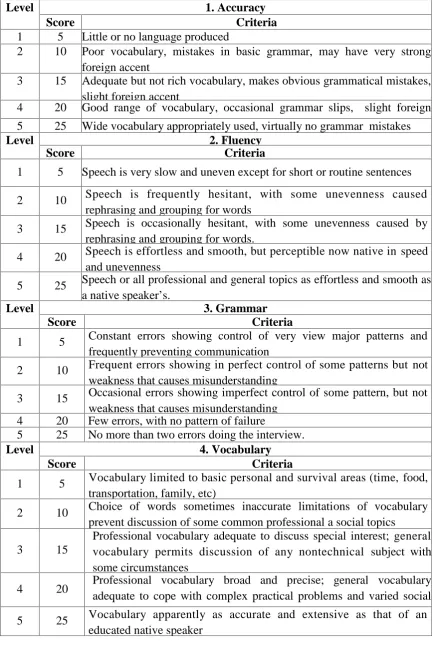
The assessment is scored on a point scale based on well-defined criteria (a rubric) that is presented in advance. The scoring is done by the teacher. There are four criteria/aspects that are employed in this scoring rubric. Further explanation about the scoring rubric is illustrated as follow.
Table 3.1 Scoring Rubric for Drama Performance
Level 1. Voice
Score Criteria
2 6-10 Could not understand what was being said due to unclear and low speech.
3 11-15Voice and language was not very clear; could have been much louder. 4 16-20Student spoke clearly but it was difficult to understand some of the
script; could have been louder accent
5 21-25Voice was loud and clear; words were easily understood
Level 2. Memorization/Improvisation
Score Criteria
1 1-5 Script was not at all memorized; no improvisation used.
2 6-10 Script was partially memorized; student did not attempt improvisation. 3 11-15 Script was partially memorized; spontaneously creates an ineffective
improvisation as compared to those of students of the same experience 4 16-20 Script was almost fully memorized-some improve used to make up for
missed lines.
5 21-25 Script was fully memorized; student improvised in place of lines. Level 3. Facial Expression/Body Language
Score Criteria
1 1-5 Contained little to no facial expression, gesture or movement. 2 6-10 Uses limited physical movement in performance.
3 11-15 Needed more facial expressions gestures & movement.
4 16-20 Contained some facial expression, gestures & body movement. 5 21-25 Great use of gestures, facial expression and body movement!
Level 4. Blocking
Score Criteria
1 1-5 Only stand on the corner and frequently turn back to audience 2 6-10 Needed more blocking–always face audience and use the stage!
3 11-15 Could have used more of the stage; must concentrate on facing forward. 4 16-20 Almost used entire stage – turned away from audience only once or
twice.
Table 3.2 Scoring Rubric for Speaking Skill
Level 1. Accuracy
Score Criteria
1 5 Little or no language produced
2 10 Poor vocabulary, mistakes in basic grammar, may have very strong foreign accent
3 15 Adequate but not rich vocabulary, makes obvious grammatical mistakes, slight foreign accent
4 20 Good range of vocabulary, occasional grammar slips, slight foreign accent
5 25 Wide vocabulary appropriately used, virtually no grammar mistakes
Level 2. Fluency
Score Criteria
1 5 Speech is very slow and uneven except for short or routine sentences 2 10 Speech is frequently hesitant, with some unevenness caused
rephrasing and grouping for words
3 15 Speech is occasionally hesitant, with some unevenness caused by rephrasing and grouping for words.
4 20 Speech is effortless and smooth, but perceptible now native in speed and unevenness
5 25 Speech or all professional and general topics as effortless and smooth as a native speaker’s.
Level 3. Grammar
Score Criteria
1 5 Constant errors showing control of very view major patterns and frequently preventing communication
2 10 Frequent errors showing in perfect control of some patterns but not weakness that causes misunderstanding
3 15 Occasional errors showing imperfect control of some pattern, but not weakness that causes misunderstanding
4 20 Few errors, with no pattern of failure
5 25 No more than two errors doing the interview.
Level 4. Vocabulary
Score Criteria
1 5 Vocabulary limited to basic personal and survival areas (time, food, transportation, family, etc)
2 10 Choice of words sometimes inaccurate limitations of vocabulary prevent discussion of some common professional a social topics
3 15
Professional vocabulary adequate to discuss special interest; general vocabulary permits discussion of any nontechnical subject with some circumstances
4 20 Professional vocabulary broad and precise; general vocabulary adequate to cope with complex practical problems and varied social situation
In scoring the students’ drama performance and speaking skill the researcher needs a ratter. Rater is a person who assigns a score or rating to a test taker’s oral or written performance on the basis of a set of rating criteria (Richards & Schmidt, 2010, p. 481). The technique used in the scoring students’ speaking skill is inter-rater technique (see Appendix 2). Therefore, the researcher was helped by one of the English teacher from SMKN 1 Metro as the second rater. Furthermore, to know the reliability from both the rater, the researcher applies inter-rater reliability. inter-rater reliability is the degree to which different examiners or judges making different subjective ratings of ability (e.g. of L2 writing proficiency) agree in their evaluations of that ability. If different judges rank test takers in approximately the same order, using a rating scale that measures different aspects of proficiency, the rating scale is said to have high inter-rater reliability (Richards & Schmidt, 2010, p. 297).
3.5 Data Analysis
sample to draw conclusions about the population from which the sample presumably was drawn (Gall, et al., 2003, p. 135-136).
The procedures of analyzing the data applied are: (1) computing descriptive statistics for the groups representing each combination factors. It means that the researcher finds the mean scores of the students on the problems representing each of the four combinations of factors. The researcher uses prerequisite test included normality and homogeneity test; (2) doing hypotheses testing using t-test.
In descriptive statistics, the researcher analyzes the result of speaking skill test in form of scores of the effectiveness of teaching method in teaching speaking skill. It means that the researcher computes the scores of mean, median, mode, standard deviation, andhistogram, students’ skill(Gall, et al., 2003, p. 135-136).
Mean (X ) is calculated by dividing the sum of all scores by the number of scores. The following formula is used in frequency distribution:
n X f
X
i iWhere:
fiXi= sum of frequency multiplied by midpoint n = number of value
Median (Me) is the middle point in a distribution of scores.
fw
cfb
n
i
L
Me
2
Where:i = interval (class width)
cfb = the cumulative frequency in all interval bellow the interval containing the median
fw = the frequency of cases within the interval containing the median
Mode (M0) is the most frequently occurring score in a distribution. The formula is:
2 1 0f
f
f
i
L
M
i Where:L = the lower limit of the interval within which the mode lies i = interval (class width)
f1 = the frequency of the interval containing mode reduced by that of the previous interval
f2 = the frequency of the interval containing mode reduced by that of the following interval
Standard Deviation (s/SD) is a measure of the extent to which scores in a distribution deviate from their mean). The formula is:
1
2 2
n
n
X
f
X
f
s
i i i i Where:3.5.1 Prerequisite Test
3.5.1.1 Normality Test
After the researcher finds those scores, the researcher computes normality and homogeneity test. Normality is a requirement before conducting correlation and comparison. Homogeneity is a requirement before comparing sample of the class. These proved the samples are normal and homogenous or those are not. To test population normality, Lillifors test is used. The procedure of this test is as follows:
1. Determining Hypothesis
H0: Sample comes from normal population.
H1: Sample does not come from normal population.
2. Level of significance: α = 0,05 3. Statistical test
L = Max |F(zi)–S(zi)| With:
F(zi) = P (z≤ zi) Z–N (0,1)
S (zi) = proportion of number z≤ zitoward the sum of zi
zi=
s
s
darddeviat
ion
s
x
x
itan
,
1 1 1 2 2 2 2 n X or n n X X or n X X sn
rank
z
s
(
i)
The sample is in normal distribution if the highest value of
|
F
(
z
i)
s
(
z
i)
|
or L0 is lower than Lt.3.5.1.2 Homogeneity Test
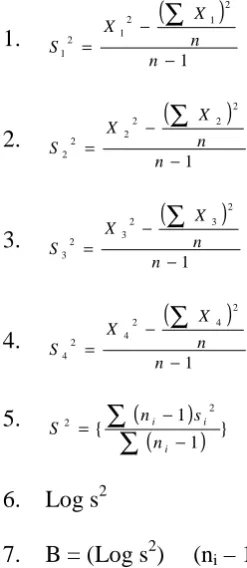
Homogeneity test is used in order to find out whether the research population has same variance or not. The homogeneity of the population is tested by Barlett test. The following formula as follows:
1.
1 2 1 2 1 2 1 n n X X S 2.
1 2 2 2 2 2 2 n n X X S 3.
1 2 3 2 3 2 3 n n X X S 4.
1 2 4 2 4 2 4 n n X X S5.
} 1 1 { 2 2
i i i n s n S6. Log s2
[image:65.595.112.236.323.608.2]7. B = (Log s2)∑ (ni–1)
Table 3.3 The summary for homogeneity test
Sample Df 1/(df) si2 log si2 (df) log si2
1 2 3 4
8. x2= (ln10){B -∑ (ni-1) Log si2}
The data are homogenous if xo2is lower than xt2. H0: The data are homogenous.
H1: The data are not homogenous. 3.5.2 Hypothesis Test
Hypothesis test is used to know whether the hypotheses proposed by the researcher are proved or not. To get the answer the question, the researcher will use t-test. Because there are several formula used t-test to test with some guidance in it. At this time, the researcher uses the formula as follow
T obs :
Note: X= Mean S= Varian
n= Number of students The criteria are:
Ho: There is no significant difference in students’ speaking skill before and after the implementation of drama.