
AN EFFICIENT SYNTHESIS AND BIOLOGICAL EVALUATION
OF SPIRO[ACENAPHTHYLENE-1,2′-PYRROLIDINE]
DERIVATIVES AS POTENT ANTI-INFECTIVE AGENTS
Anshu Dandia
[a]*, Sukhbeer Kumari
[b]and Pragya Soni
[a]Keywords: Spiro[acenaphthylene-1,2’-pyrrolidines], Knoevenagel adduct, trifluoroethanol, antimalarial and antimicrobial activities. A series of spiro[acenaphthylene-1,2′-pyrrolidine] derivatives (4a-j) were synthesized by highly efficient one-pot three-component reaction of acenaphthenequinone, sarcosine and Knoevenagel adduct in 2,2,2-trifluoroethanol as a reusable green solvent. All the synthesized compounds were screened for their ‘in vitro’ antimalarial activity against the growth of Plasmodiumfalciparum, the malaria causing parasite. Some of them showed antimalarial activity with IC50 values as low as 0.003 and 0.005 mg mL-1. The compounds were evaluated for their antibacterial activity against Escherichiacoli, Staphylococcusaureus, Pseudomonasaeruginosa and Streptococcuspyogenes and for antifungal activity against Candida albicans, Aspergillusniger, and Aspergillusclavatus. Some of the compounds exhibited excellent antibacterial activity and compounds 4c and 4e demonstrated significant antifungal activities than the standard drugs.
Corresponding Authors Tel: +91-9414073436 Fax: 0091-141-2523637
E-Mail: [email protected]
[a] Department of Chemistry, University of Rajasthan, Jaipur, India
[b] Department of Chemistry, Malaviya National Institute of Technology, Jaipur, India
Introduction
Despite the enormous progress in medicinal chemistry, infectious diseases remain a biggest threat to society and have provided new challenges to researchers worldwide.1 Among these, malaria and microbial infections are the two most widespread and lethal infectious diseases in the world.2-4 Approximately 40 % of the world’s population is affected by malaria.5 Each of these diseases cause about 2 million deaths worldwide every year.6,7 The development and spread of multi-drug-resistant (MDR) and extensively drug resistant (XDR) microorganisms have stimulated research efforts globally. Therefore, the molecular manipulation of promising lead compounds is still a major line of approach to develop new drugs.8,9 So, the discovery of novel and potent antimicrobial agents is the best way to overcome microbial resistance and develop effective therapies.10
Plasmodium falciparum is the parasite responsible for most malaria cases (80%), which often prove fatal.11 The burden of malaria has not declined, partly because the parasites have become resistant to the available standard antimalarial drugs such as quinine and chloroquine.12-14 The alarming spread of drug resistant strains of P. falciparum underscores the urgency and continuous need for the discovery of new therapeutics.15
Considerable attention has been focused on spiro compounds in particular to spiropyrrolidines, due to their interesting biological activities.16 They have been found to possess antimicrobial, antitumor, antibiotic, anticonvulsant, potential antileukaemic, local anaesthetic and antiviral activities. Furthermore, they also act as inhibitors of human NK-I receptor activity.17,18
In context of this program, we have previously reported the synthesis of spiropyrrolidine derivatives in a variety of solvents.19 A literature survey revealed that a number of methods have been reported for the synthesis of spiropyrrolidines,20 but all these methods often involve the use of toxic solvents such as methylene chloride,21a acetonitrile,21b and dioxane21c or refluxing in petroleum-based solvents such as toluene22a and benzene.22b
Therefore, the search continues for a better solvent for the synthesis of spiropyrrolidines in terms of operational simplicity, reusability, economic viability, and greater selectivity.
In recent years, fluorinated alcohols (RFOH) have made a display of their unique properties to be as solvents, co-solvents and additives in the organic synthesis.23 The ready availability of fluorinated alcohols have initiated a boom in their applications in the past decade.24 Reactions in fluorinated alcohols are generally selective and do not result in by-product formation. Also, isolation of the products is simple and fluorinated alcohols can be easily recovered by distillation.25
O O
H
N COOH
R COOR'
NC
+ +
1
2
3
Reflux
TFE NOCH3
H NC
R'OOC R
4
20-30 min
O O
H O
NH H3C
COOH
N O NC
R'OOC H
R
N CH3 O H NC R'OOC
R
1 2
T. S.
N O
7
4
N
O
CH3 C O
OH CH2CF3
-CO2
5
N
O C
O
O H O
CH2CF3
6
CF3CH2OH
CN
R'OOC
R H Antimicrobial and antimalarial activities of the prepared
compounds have been investigated, and the results showed that some of the synthesized compounds have broad spectrum of antimicrobial and antimalarial activities.
Result and discussion
Chemistry
We have explored the improved methodology for the synthesis of spiro[acenaphthylene-1,2′-pyrrolidine] derivatives using trifluoroethanol. Utilization of our improved method reduced the reaction time with a concomitant increase in the yield and recovery of the solvent etc.
In order to develop a general, practicable and an environmentally benign method for the synthesis of spiro azaheterocycles, the reaction between acenaphthenequinone (1), sarcosine (2) and Knoevenagel adduct (3) was investigated (Scheme 1) in different solvents and the results are listed in Table 1. It is noteworthy to mention that the polar solvents afforded better yield than the nonpolar ones and the best result was obtained in TFE.
Scheme 1. Synthesis of spiro[acenaphthylene-1,2′-pyrrolidine] derivatives 4a-j
Table 1. Synthetic results of 4a under different reaction conditions Entry Solvent Temp.,
oC
Time, min
Yielda , %
1 Ethanol Reflux 58 80
2 Aqueous methanol Reflux 42 83
3 Methanol Reflux 120 76
4 Dichloromethane Reflux 270 48
5 Acetonitrile Reflux 180 68
6 THF Reflux 270 56
7 1,4-dioxane Reflux 270 61
8 [bmim]BF4 Reflux 65 82
9 TFE Reflux 20 94
a Isolated yield
With the optimized conditions in hand, we probed the scope of the reaction. As evidenced by the results in Table 2, different Knoevenagel adducts smoothly reacted, producing the corresponding spiro[acenaphthylene-1,2′-pyrrolidine] derivatives in generally good to excellent yields. All the products are known compounds and were characterized by comparing the IR, 1H NMR, and 13C NMR spectroscopic data and their melting points with the literature values.
Table 2. Synthetic results of spiro[acenaphthylene-1,2′-pyrrolidine] derivatives 4a-j
Product R R′ Time, min
Yielda,
%
Mpb (oC)
4a 4-F Me 20 94 196-198
4b 4-Cl Me 25 92 208-210
4c 4-Br Me 22 93 198-200
4d 4-CH3 Me 28 93 178-180
4e 4-OCH3 Me 30 92 146-148
4f 4-F Et 20 93 202-204
4g 4-Cl Et 23 92 170-172
4h 4-Br Et 30 93 162-164
4i 4-CH3 Et 25 94 180-182
4j 4-OCH3 Et 30 91 168-170 a Isolated yield, b Melting points of compounds are consistent
with reported values19b
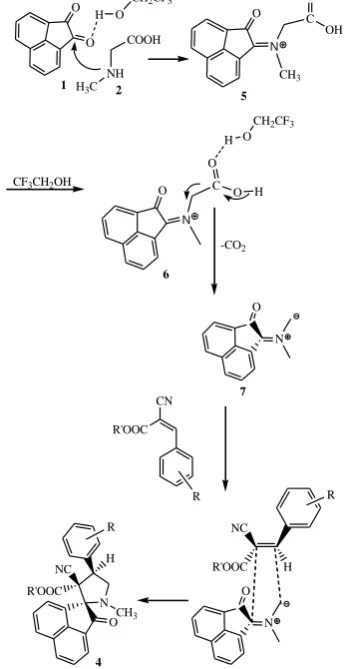
Scheme 2. Proposed mechanism for synthesis of spiro derivatives One of the major advantages of this protocol is the isolation and purification of the products, which has been achieved by simple filtration and crystallization of the crude products. After the reaction, TFE can be easily separated (by distillation) and reused four times without decrease in its activity. In this process, TFE act as Bronsted acid (pKa = 12.4 for TFE) and enhance the electophilic character of the carbonyl groups is by high hydrogen bond ability of the trifluoroethanol (CF3CH2OH), which facilitated the ‘in situ’ generation of azomethine ylide 7 by the reaction of acenaphthenequinone 1, sarcosine 2. Subsequent 1,3-dipolar cycloaddition reaction of dipolarophile 3 (Knoevenagel adduct) and azomethine ylide 7 afford spiro derivatives 4
Biology
Malaria and microbial infections severely influence the health and economies of the poor countries, therefore low-cost of antimalarial and antimicrobial drugs are equally important alongwith the view point of efficacy and safety. Spiro[acenaphthylene-1,2′-pyrrolidine] derivatives (4a–j) were tested for their in vitro anti-bacterial activity against Escherichia coli, Pseudomonas aeruginosa, Staphylococcus aureus, and Streptococcus pyogenus strains (Table 3). The MICs of synthesized compounds were carried out by broth micro dilution method as described by Rattan.28 Their anti-fungal activity was tested against the Candida albicans, Aspergillus niger, and Aspergillus clavatus strains (Table 4). In all cases, the minimal inhibitory concentration (MIC) values (the highest dilution showing at least 99% inhibition) were compared with standard drugs. The in vitro antimalarial (Table 5) assay was carried out in 96 well microtitre plates according to the micro assay protocol of Rieckmann and co-workers with minor modifications. Parasites were cultured with human erythrocytes (blood group O+) at 5% haematocrit in RPMI 1640 supplemented with 10% human plasma as previously described.29 All synthesized compounds were screened for their biological activities.
Antibacterial activity
Table 3. Minimum inhibitory concentrations of
spiro[acenaphthylene-1,2′-pyrrolidine] derivatives against E. coli, P. aeruginosa, S. aureus, and S. pyogenus microbial strains.
No Antibacterial activity (MICa, μg mL-1) E. Coli
MTCC442
P. Aeruginosa
MTCC 441
S. Aureus
MTCC96
S. Pyogenus
MTCC443
4a 125 125 62.5 500
4b 100 150 125 250 4c 250 125 250 125
4d 125 250 500 100
4e 250 500 25 12.5
4f 100 25 50 6.25
4g 250 500 100 250 4h 200 125 100 250
4i 62.5 100 200 200
4j 125 200 250 150 Ab 100 -- 250 100
Gb 0.05 1 0.25 0.5
Cb 50 50 50 50
Cb 25 25 50 50
Nb 10 10 10 10
aMIC = Minimum inhibitory concentration, the lowest
concentration of the compound which inhibits the growth of the bacterium by at least 99%. A-Amoxycillin; G-Gentamycin; C-Chloramphenicol; C-Ciprofloxacin; N-Norfloxacin;bStandard drug.
As shown in Table 3, some of the synthesized compounds showed excellent activity against the tested microbial strains, i.e., 4f (MIC = 6.25 μg mL-1) and 4e (MIC = 12.5 μg mL-1) against S. Pyogenus, compounds 4e and 4f (MIC = 25 μg mL-1) against S. Aureus and P. Aeruginosa respectively. Compound 4f (MIC = 50 μg mL-1) showed good activity against S. Aureus, compounds 4a and 4i (MIC = 62.5 μg mL-1) against S. Aureus and E. Coli respectively, compounds 4b (MIC = 125 μg mL-1) 4g (MIC = 100 μg mL -1), 4h (MIC = 100 μg mL-1) and 4i (MIC = 200 μg mL-1) against S. Aureus. Equivalent inhibitory activity as compared to Ampicillin was shown by compounds 4b (MIC = 100 μg mL-1) and 4f (MIC = 100 μg mL-1) against E. Coli, compounds 4c (MIC = 250 μg mL-1) and 4j (MIC = 250 μg mL-1) against S. Aureus, compound 4d (MIC = 100 μg mL-1) against S. Pyogenus. Compounds 4a, 4d and 4j (MIC = 125 μg mL-1), showed moderate activity against E. Coli, compounds 4c (MIC = 125 μg mL-1), and 4j (MIC = 150 μg mL-1), against S. Pyogenus. Rest of the compounds showed poor inhibitory activity against the tested microbial strains.
Antifungal Activity
Table 4. Minimum inhibitory concentrations of
spiro[acenaphthylene-1,2′-pyrrolidine] derivatives for C. albicans, A. niger, and A. clavatus fungal strains.
aMIC=Minimum inhibitory concentration, the lowest concentration
of the compound which inhibits the growth of the fungus by at
least 99%. N-Nystatin; Gr-Greseofulvin; b Standard drug.
From Table 4, some of the synthesized compounds showed significant activity against the tested fungal strains, i.e., 4e (MIC = 200 μg mL-1) and 4c (MIC = 250 μg mL-1) against C. Albicans. Equivalent inhibitory activity as compared to Greseofulvin was shown by compounds 4a, 4b,
4d, 4g and 4h (MIC = 500 μg mL-1), against C. Albicans. On the other hand, rest of the compounds showed poor MIC values compared to the reference compounds Nystatin and Greseofulvin.
No. Antifungal Activity (MICa μg mL-1)
C. Albicans A. Niger A. Clavatus
MTCC 227 MTCC 282 MTCC 1323 4a 500 >1000 >1000
4b 500 250 250 4c 250 500 500
4d 500 >1000 >1000 4e 200 250 500
4f >1000 1000 1000
4g 500 500 1000
4h 500 500 1000
4i 1000 250 500
4j 1000 500 1000
Nb 100 100 100
Antimalarial activity
Table 5. Minimum inhibitory concentrations of
spiro[acenaphthylene-1,2′-pyrrolidine] derivatives for P. falciparum
aMIC = Minimum inhibitory concentration, the lowest
concentration of the compound which inhibits the growth of the Plasmodiumfalciparum by at least 99%. bStandard drug.
From Table 5, it was clearly concluded that compounds
4b (MIC = 0.003 µg mL-1), 4e (MIC = 0.005 µg mL-1) and
4c (MIC = 0.012 µg mL-1) showed excellent activity as compared to both of the standard drugs against Plasmodium falciparum. Compounds 4a (MIC = 0.023 µg mL-1), 4d (MIC = 0.025 µg mL-1), 4f (MIC = 0.057 µg mL-1), 4h (MIC = 0.098 µg mL-1) and 4i (MIC = 0.15 µg mL-1), showed good activity as compared to the quinine. Equivalent inhibitory activity as compared to quinine was shown by compound 4g (MIC = 0.26 µg mL-1). Compound
4j showed poor activity as compared to both of the standard drugs.
Experimental
Melting points were determined on a Toshniwal apparatus. The purity of compounds was checked on thin layers of silica gel in various non-aqueous solvent systems, for e.g., benzene: ethylacetate (8:2). IR spectra (KBr) were recorded on a Magna FT IR–550 spectrophotometer and 1H NMR and 13C NMR spectra were recorded on Brukar Avance II 400
MHz spectrometer using DMSO-d6 at 400 MHz and 100
MHz, respectively and Brukar DRX-300 using DMSO-d6 at 300.15 MHz and 75.47MHz. TMS was used as internal reference. Mass spectrum of representative compound was recorded on JEOL SX-102 spectrometer at 70 eV. Elemental microanalyses were carried out on a Carlo-Elba 1108 CHN analyzer.
General procedure for synthesis of spiro[acenaphthylene-1,2′-pyrrolidine] derivatives (4a-j)
An equimolar mixture of acenaphthenequinone 1 (1 mmol), sarcosine 2 (1 mmol) and Knoevenagel adduct 3 (1 mmol) in 2,2,2-trifluoroethanol was refluxed for appropriate time (20-30 min). The progress of the reaction is mentioned by TLC. After completion of the reaction, the corresponding solid products 4 was obtained through simple filtration and
washed with TFE to furnish pure spiro[acenaphthylene-1,2′-pyrrolidine] derivatives. The TFE was distilled off (to recover for the next run).
Spectra of selected compounds
Compound 4a. Methyl
3′-cyano-4′-(4-fluorophenyl)-1′- methyl-2-oxo-2H-spiro[acenaphthylene-1,2′-pyrrolidine]-3′-carboxylate
Mp: 196-198 oC. IR (KBr, ν
max, cm-1): 2232 (CN), 1754 (CO), 1732 (CO). 1H NMR (400 MHz, DMSO-d
6) δ: 1.91 (s, 3H, CH3), 2.98 (s, 3H, OCH3), 3.62 (t, J = 9.2 Hz, 1H, CH), 3.76 (t, J = 8.8 Hz, 1H, CH), 4.83 (t, J = 9.6 Hz, 1H, CH), 7.32-8.13 (m, 10H, ArH). 13C NMR (100 MHz, DMSO-d
6) δ: 35.6, 46.2, 53.8, 59.4, 62.8, 81.8, 115.7, 121.1, 124.2, 125.3, 128.1, 128.6, 128.2, 130.3, 131.7, 132.1, 133.0, 133.4, 135.6, 140.3, 160.1, 165.3, 202.2. MS m/z: 415 [M + H]+. Anal. Calcd for C25H19FN2O3: C, 72.45; H, 4.62; N, 6.76. Found: C, 72.60; H, 4.53; N, 6.61.
Compound 4g. Ethyl 3′-cyano-4′-(4-chlorophenyl)-1′- methyl-2-oxo-2H-spiro[acenaphthylene-1,2′-pyrrolidine]-3′-carboxylate
Mp: 170-172 oC. IR (KBr, ν
max, cm-1): 2238 (CN), 1750 (CO), 1715 (CO). 1H NMR (400 MHz, DMSO-d
6) δ: 0.19 (t, j = 7.2 Hz, 3H, CH3), 1.89 (s, 3H, CH3), 3.36-3.43 (m, 2H, CH2), 3.52 (t, J = 8.8 Hz, 1H, CH), 3.71 (t, J = 8.8 Hz, 1H, CH), 4.81 (t, J = 9.2 Hz, 1H, CH), 7.11-8.09 (m, 10H, ArH). 13C NMR (100 MHz, DMSO-d
6) δ: 12.9, 34.1, 47.3, 57.2, 61.2, 62.7, 79.8, 115.3, 122.1, 122.3, 125.1, 127.4, 130.5, 131.1, 131.7, 132.5, 132.8, 132.9, 134.6, 141.3, 164.8, 200.9. MS m/z: 445 [M + H]+. Anal. Calcd for C
26H21ClN2O3: C, 70.19; H, 4.76; N, 6.30. Found: C, 70.28; H, 4.82; N, 6.22.
Compound 4i Ethyl 3′-cyano-1′-methyl-2-oxo-4′-p-tolyl-2H-spiro[acenaphthylene-1,2′-pyrrolidine]-3′-carboxylate
Mp: 180-182 oC. IR (KBr, ν
max, cm-1): 2236 (CN), 1755 (CO), 1738 (CO). 1H NMR (400 MHz, DMSO-d
6) δ: 0.13 (t, J = 7.6 Hz, 3H, CH3), 1.93 (s, 3H, CH3), 2.08 (s, 3H, CH3), 3.32-3.39 (m, 2H, CH2), 3.59 (t, J = 9.2 Hz, 1H, CH), 3.76 (t, J = 9.2 Hz, 1H, CH), 4.79 (t, J = 8.4 Hz, 1H, CH), 7.26-8.15 (m, 10H, ArH). 13C NMR (100 MHz, DMSO-d
6) δ: 9.3, 12.7, 34.1, 45.2, 57.9, 61.3, 62.1, 80.0, 115.2, 122.1, 122.8, 127.5, 127.9, 128.1, 130.2, 130.6, 131.4, 131.6, 132.8, 132.9, 133.3, 137.1, 141.2, 164.9, 201.1. MS m/z: 425 [M + H]+. Anal. Calcd for C27H24N2O3: C, 76.39; H, 5.70; N, 6.60. Found: C, 76.63; H, 5.89; N, 6.61.
Conclusion
The present investigation describes an efficient access to highly functionalized spiropyrrolidines via one-pot three-component reaction of acenaphthenequinone, sarcosine and Knoevenagel adduct in trifluoroethanol which are in excellent yields without use of any catalyst and additive. This method bestowed with merits like avoiding the use of any base, metal or Lewis acid catalyst, ease of product isolation/purification by non-aqueous work-up, high chemoselectivity, no side reaction, low costs and simplicity in process and handling and environmentally benign nature. These advantages of TFE made this process very useful for
Antimalarial activity (MICa µg mL-1)
Compound Mean IC50 Values
4a 0.023 µg mL-1
4b 0.003 µg mL-1
4c 0.012 µg mL-1
4d 0.025 µg mL-1
4e 0.005 µg mL-1
4f 0.057 µg mL-1
4g 0.26 µg mL-1
4h 0.098 µg mL-1
4i 0.15 µg mL-1
4j 0.42 µg mL-1
Chloroquineb 0.020 µg mL-1
the synthesis of spiro[acenaphthylene-1,2′-pyrrolidine] derivatives. Synthesized compounds were tested for their ‘in vitro’ antimicrobial and antimalarial activity. Promising biological results were obtained. Most of the compounds showed better antimalarial activity.
Acknowledgements
Financial assistance from the CSIR (02(0143)/13/EMR-II), New Delhi is gratefully acknowledged. One of the author (SK) is thankful to CSIR-JRF for research fellowship. We are also thankful to the Central Drug Research Institute (CDRI), Lucknow and SAIF Chandigarh for the spectral analyses and Microcare Laboratory, Surat, Gujarat, India for antimicrobial and antimalarial screening of the compounds reported herein.
References
1Salathe, M., Kazandjieva, M., Lee, J. W., Levis, P., Jones, M. W., Feldman, J. H., PNAS2010, 107, 22020-22025.
2Kaur, K., Jain, M., Reddy, R. P., Jain, R., Eur. J Med. Chem.2010, 45, 3245-3264.
3Shah, N. M., Patel, M. P., Patel, R. G., Eur. J Med Chem. 2012, 54, 239-247.
4Gogoi, S., Shekarrao, K., Duarah, A., Bora, T. C., Gogoi, S., Boruah, R. C., Steroids2012, 77, 1438–1445.
5Torok, D. S., Ziffer, H., J. Med. Chem.1995, 38, 5045–5050. 6Hurtley, S., Ash, C., Roberts, L., Science2010, 328, 841. 7Woodford, N., Expert Opin. Investig. Drugs2003, 12, 117. 8Rawal, R. K., Phabhakar, Y. S., Kati, S. B., De Clercq, E., Bioorg.
Med. Chem.2005, 13, 6771–6776.
9Bonde, C. G., Gaikwad, N. J., Bioorg. Med. Chem. 2004, 12, 2151–2161.
10Mungra, D. C., Patel, M. P., Rajani, D. P., Patel, R. G., Eur. J. Med. Chem.2011, 46, 4192-4200.
11Baird, J. K., N. Engl. J. Med. 2005, 352, 1565-1577.
12Winstanley, P. A., Ward, S. A., Snow, R. W., Microbes Infect.
2002, 4, 157–164..
13Biagini, G. A., O’Neill, P. M., Nzila, A., Ward, S. A., Bray, P. G., Trends Parasitol. 2003, 19, 479-487.
14Kremsner, P. G., Krishna, S., Lancet2004, 364, 285-294. 15Madapa, S., Tusi, Z., Sridhar, D., Kumar, A., Siddiqi, M. I.,
Srivastava, K., Rizvi, A., Tripathi, R., Puri, S. K., Shiva Keshava, G. B., Shukla, P. K., Batra, S., Bioorg. Med. Chem.
2009, 17, 203–221.
16(a) Augustine, T., Kanakam, C. C., Vithiya, S. M., Ramkumar, V., Tetrahedron Lett. 2009, 50, 5906–5909; (b) Karthikeyan, K., Kumar, R. S., Muralidharan, D., Perumal, P. T., Tetrahedron Lett.2009, 50, 7175-7179.
17(a) Basavaiah, D., Reddy, R. K., Org. Lett.2007, 9, 57-60; (b) Kumar, R. R., Perumal, S., Senthilkumar, P., Yogeeswari, P., Sriram, D., Eur. J. Med. Chem.2009, 44, 3821-3829. 18(a) Abou-Gharbia, M. A., Doukas, P. H., Heterocycles1979, 12,
637-640; (b) Kornet, M. J., Thio, A. P., J. Med. Chem. 1976, 19, 892-898; (c) Rosenmond, P., Hosseini-Mrerscht, M., Bub, C., Liebigs Ann. Chem.1994, 2, 151-154.
19(a) Dandia, A., Jain, A. K., Laxkar, A. K., Bhati, D. S., Tetrahedron2013, 69, 2062-2069; (b)Dandia, A., Jain, A. K., Laxkar, A., K., Bhati, D. S., Tetrahedron Lett. 2013, 54,
3180-3184; (c) Dandia, A., Jain, A. K., Sharma, S., TetrahedronLett. 2012, 53, 5859–5863; (d) Dandia, A., Jain, A. K., Bhati, D. S., TetrahedronLett.2011, 52, 5333–5337; (e) Dandia, A., Jain A. K., Laxkar, A. K., RSC Adv.2013, 3, 8422-8430.
20(a) Periyasami, G., Raghunathan, R., Surendiran, G., Mathivanan, N., Eur. J. Med. Chem. 2009, 44, 959–966; (b) Huang, Z., Zhao, Q., Chen, G., Wang, H., Lin, W., Xu, L., Liu, H., Wang, J., Shi, D., Wang, Y., Molecules 2012, 17, 12704-12717; (c) Prasanna, R., Purushothaman, S., Suresh, M., Raghunathan, R., TetrahedronLett. 2011, 52, 792–797; (d) Kumar, R. R., Perumal, S., Senthilkumar, P., Yogeeswari, P., Sriram, D., Tetrahedron 2008, 64, 2962-2971; (e) Ghandi, M., Yari, A., Jamal S., Rezaei, T., Taheri, A., Tetrahedron Lett.2009, 50, 4724–4726.
21(a) Galliford, C. V., Martenson, J. S., Stern, C., Scheidt, K. A., Chem. Commun. 2007, 631; (b) Fresneda, P. M., Castan˜eda,
M., Sanz, M. A., Bautista, D., Molina, P., Tetrahedron2007, 63, 1849–1856; (c) Li, X., Li, Z., Zheng, A., Li, G., Yu, X., Yi, P., J. Heterocycl. Chem. 2011, 48, 836.
22(a) Jayashankaran, J., Durga R., Manian, R. S., Sivaguru M., Raghunathan, R., TetrahedronLett. 2006, 47, 5535–5538; (b) Kumar, R. S., Rajesh, S. M., Perumal, S., Yogeeswari, P., Sriram, D., Tetrahedron: Asymmetry2010, 21, 1315–1327. 23(a) Dubrovina, N., Boener, A., Synthesis 2007, 19, 2925–2943;
(b) Begue, J. P., Delpon, D. B., Crousse, B., Synlett 2004, 18–29; (c) Khaksar, S.; Heydari, A., Tajbakhs, M., Vahdat, S. M., J. Fluorine Chem. 2010, 131, 1377–1381; (d) Khaksar, S. Mohammadzadeh, S., J. Fluorine Chem. 2012, 135, 87–90; 24(a) Povey, J., Smales, C., Hassard, S., Howard, M. J., J. Struct.
Biol. 2007, 157, 329–338; (b) Buck, M., Quart. Rev. Biophysics1998, 31, 297–355; (c) Eberson, L., Hartshorn, M. P., Perssona, O., Radnera, F., Chem. Commun. 1996, 2105– 2112; (d) Be´gue´, J.-P., Bonnet-Delpon, D., Crousse, B., Synlett 2004, 18–29; (e) Uneyama, K., Organofluorine Chem., Blackwell Publishing Ltd, Oxford, 2006.
25Khaksar, S., Yaghoobi, M., J. Fluorine Chem.2012, 142, 41–44. 26(a) Dandia, A., Laxkar, A. K., Singh, R., Tetrahedron Lett.2012,
53, 3012-3017 (b) Dandia, A., Jain A. K., Sharma, S., RSC Adv. 2013, 3, 2924-2934; (c) Dandia, A., Parewa, V., Jain, A. K., Rathore, K. S., Green Chem. 2011,13, 2135-2145; (d) Dandia, A., Parewa, V., Gupta, S. L., Rathore, K. S., J. Molecular Catal. A: Chemical2013, 373, 61-71; (e) Dandia, A., Singh, R., Joshi, J., Kumari, S., Eur. Chem. Bull.2013, 2, 683-686; (f) Dandia, A., Singh, R., Joshi, J., Maheshwari, S., Eur. Chem. Bull.2013, 2, 825-829; (g) Dandia, A., Gupta, S. L., Bhaskaran, S., Eur. Chem. Bull.2013, 2, 836-841. 27(a) Dandia, A., Singh R., Khaturia, S., Bioorg. Med. Chem. 2006,
14, 1303–1308; (b) Dandia, A., Singh, R., Khaturia, S., J. Fluorine Chem. 2007, 128, 524–529; (c) Dandia, A., Upreti, M., Rani, B., Pant, U. C., Gupta, I. J., J. Fluorine Chem.
1998, 91, 171-174; (d) Dandia, A., Arya, K., Sati, M., Sarawgi, P., J. Fluorine Chem. 2004, 125, 1273-1277; (e) Dandia, A., Arya, K., Bioorg. Med. Chem. Lett. 2007, 17, 3298-3304; (f) Dandia, A., Singh, R., Bhaskaran, S., Ultrason. Sonochem.2011, 18, 1113–1117; (g) Dandia, A., Singh, R., Sarawgi, P., J. Fluorine Chem. 2004, 125, 1835-1840; (h) Dandia, A., Singh, R., Khaturia, S., Mérienne, C., Morgant, G., Loupy, A., Bioorg. Med. Chem.2006, 14, 2409-2417.
28Rattan, A., Antimicrobials in Laboratory Medicine. Churchill B.I., Livingstone, New Delhi, 2000, 85-108.
29Trager, W., Jensen, J. B., Science1976, 193, 673.
![Table 4. Minimum inhibitory concentrations of spiro[acenaphthylene-1,2′-pyrrolidine] derivatives for C](https://thumb-us.123doks.com/thumbv2/123dok_us/7834711.2089816/3.595.47.289.425.728/table-minimum-inhibitory-concentrations-spiro-acenaphthylene-pyrrolidine-derivatives.webp)
![Table 5. Minimum inhibitory concentrations of spiro[acenaphthylene-1,2′-pyrrolidine] derivatives for P](https://thumb-us.123doks.com/thumbv2/123dok_us/7834711.2089816/4.595.46.291.114.279/table-minimum-inhibitory-concentrations-spiro-acenaphthylene-pyrrolidine-derivatives.webp)
