International Journal Advances in Social Science and Humanities
Available online at: www.ijassh.com
RESEARCH ARTICLE
Effective Usage of Electronic Information Resources by Faculty Members
and Students of Madanapalle Institute of Technology and Science (MITS)
Library, Madanapalle, A.P: A Study
Venkateswarlu Y Ch.*
Madanapalle Institute of Technology and Science Madanapalle, Andhra Pradesh, India.
*Corresponding Author: Email: [email protected]
Abstract
Electronic resources have attained great significance and popularity among library resources in academic libraries in today’s digital era. The paper is an outcome of a study made to examine the knowledge and use of e-resources, purpose, methods of learning and problem faced by the faculty and students while using the e-resources. The study reveals that faculty and students are more familiar with use of e-resources made available by the MITS Library. Many faculty members and students felt that e-resources were important for effective teaching and research. Majority of the faculty expressed their desire to undergo training for upgrading their knowledge and skills in using e-resources.
Keywords:Information Use, Electronic Information Resources, Databases.
Introduction
The advent of electronic information services has created a new set of demands for information providers. These services includes new reference models, new means for information delivery and demands the education of users of new resources and technologies. It has also prompted for re-examination of the rights and responsibilities of information providers, intermediaries and end users.
Electronic Resources (ER) are very useful to all institutions and individuals to get instant, relevant, comprehensive information on their desktops. Today’s users have their information needs met via a number of options. They need not come physically to the library to use print formats but can stay at home or the office and access online library resources and services via campus network or remote authentication methods at any time. In order to exploit the current information explosion, use of e-resources in the libraries is necessary and important. This is very important for academic libraries since most of them call for more and more research work. Many libraries are convinced by this important factor to move towards e-resources, which are found to be less expensive and more useful.
Madanapalle Institute of Technology
and Science (MITS) A.P.: A Profile
The MITS Central Library
The Library with its modern collection of knowledge resources and innovative information services provides the required learning resources to students, faculty. The Library related to Engineering, Technology, Management and allied subjects. The collection comprises of 48,480 volumes of books with 7,380 titles, 103 National and International printed Journals and Subscribe E-Resources like IEEE, Springer, Elsevier, J-Gate, ASME and Mc Graw Hill. In addition, there are 2000 bounded volumes of Journals, 3,500 Compact Discs (CD’s), 75 Video Cassetts and 1,200 Standards (IS). All the operations of Library are automated using SOUL 2.0 (Software for
University Libraries) software. DELNET
Database, UGC-N-List, Galileo Integrated Digital Library and E-books, Inter and Intranet facilities, etc. are available in the Library. There is campus wide networking with a brand-width of 1Mbps in the college. All the faculty members and students can access e-resources from their respective departments.
Scope of the Study
The study is based on the survey of user perceptions about e-resources of the faculty members and students of Madanapalle Institute of Technology and Science, Madanapalle, A.P. The scope of the study is limited to the use of e-resources and its aim is to fulfil the teaching, learning & research activities of the users. It covers the available e-resources and services at MITS Central Library, Madanapalle, A.P.
Objectives
The objectives of the present study are as follows.
To assess the amount of knowledge and
frequency in the use of the different types of e-resources made by the faculty and students.
To find out the purpose and use of the
e-resources and services by the faculty and students.
To know the problems encountered by the
faculty and students while accessing and using e-resources.
To know the adequacy of information in
e-resources.
To suggest suitable measures to improve the
e-resources and services for the benefit of users.
Methodology
The present study is limited to survey of the users consisting of faculty members and Second year Postgraduate students. There were 157 faculty members in various departments, and both Undergraduate and Postgraduate students total of 3,000 (Diploma, UG 2,760 & PG 240)
users in the college. The study was conducted by using a Questionnaire method. A well Structured Questionnaire was designed scientifically. The Questionnaire was distributed to faculty members and students to a sample for 175. However, only 116 of them responded and the same were used for analysis.
Data Analysis
Gender Wise Respondents
The data was collected from the faculty members and students, and the same data was analyzed as gender wise in Table 1.
Table 1: Gender wise respondents
Respondens Questionnaire
s Distributed Questionnaires Received Percentage
Male 35 45 80 (68.96%)
Female 15 21 36 (31.04%)
Total 50 66 116 (100%)
The above Table 1 shows that the gender wise respondents. It is found a majority 80 (68.96%) of the respondents belongs to male community and 36 (31.04%) respondents belongs to female community. It is pertinent to note the male community is majority compared to female community.
Faculties and Students Familiarity with E-Resources
The distribution of faculty members and students according to their familiarity to use e-resources is shown in Table 2.
Table 2: Faculties and students familiarity with E-resources
Use No. of Respondents Percentage
Familiar 96 82.75
Not Familiar 20 17.25
Total 116 100.00
It is evident from the Table 2 that 82.75 percent of the faculty members and students are familiar with e-resources, while 17.25 percent of the faculty members and students replied in the negative.
Frequency of Using the Digital Library The distribution of faculty members and students according to the frequency of using the digital library is shown in Table 3.
Table 3: Distribution of faculty members and students according to their frequency of using the digital library
Frequency No. of Respondents Percentage
Daily 23 19.83
2 or 3 Times a Week 43 37.07
Once in a Week 28 24.14
Once in a Month 15 12.93
Rarely 07 06.03
Total 116 100.00
Frequency of Using the E-Resources
The distribution of faculty members and students according to their frequency of using the e-resources is shown in Table 4.
Table 4: The distribution of faculty members and students according to their frequency of using the e-resources in percentages
Frequency
CD-ROM Databases Online Journals Online Internet E-Mail Engines Search Catalogue MITS
Daily 16.87 13.77 14.68 21.23 22.10 23.02 9.08
2 or 3 Times a
Week 35.24 29.14 36.88 35.88 27.32 30.55 24.32
Once in a Week 27.67 22.87 28.23 28.75 32.68 33.24 31.10 Once in a
Month 12.43 16.43 9.76 9.12 15.61 9.88 21.26
Rarely 7.79 17.79 10.45 5.02 2.29 3.31 14.24
Total 100.00 100.00 100.00 100.00 100.00 100.00 100.00
It is evident from Table 4 that 35.24 percent of the faculty members and students are using the CD-ROMs two or three times in a week, 27.67 percent once in a week, 16.87 percent daily, 12.43 percent once in a month and 7.79 percent rarely use the CD-ROM databases. Majority of the faculty members and students (29.14%) using the online databases two or three times in a week, 22.87 percent once in a week, 17.79 percent rarely, 16.43 percent once in a month and 13.77 percent daily use 36.88 percent of the faculty members and students are using the online journals two or three times in a week, 28.23 percent once in a week, 14.68 percent daily, 10.45 percent rarely and 9.76 percent once in a month use.
It is also evident from Table 5 majority of the faculty members and students (35.88%) are using the internet two or three times in a week, 28.75 percent once in a week, 21.23 percent daily, 9.12 percent once in a month and 5.02 percent rarely use. Most of the faculty members and students (32.68%) are using the e-mail once in a week, 27.32 percent two or three times in a week, 22.10 percent daily, 15.61 percent once in a month and 2.29 percent rarely use.
It is also evident from Table 4 that 33.24 percent of the faculty members and students are using the search engines once in a week, 30.55 percent two or three times in a week, 23.02 percent daily, 9.88 percent once in a month and 3.31 percent rarely use. Most of the faculty members and students (31.10%) are using the MITS catalogue once in a week, 24.32 percent two or three times in a week, 21.26 percent once in a month, 14.24 percent
rarely and 9.08 percent of the faculty members and students are using the catalogue daily.
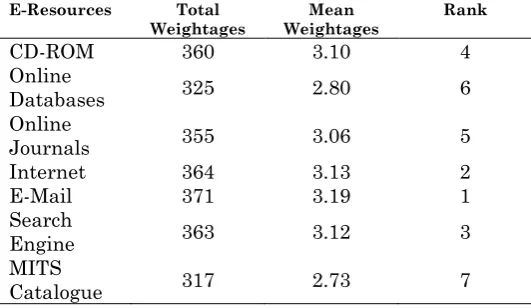
Relative Frequency Use of E-Resources In order to know the relative frequency in the use of the different types of e-resources by the faculty members and students, weightages of 5,4,3,2 and 1 are assigned to responses of daily, two or three times a week, once in a week, once in a month and rarely used respectively. Total weightage is calculated for each e-resource. Mean weightage is calculated by dividing the total weightage by the number of faculties included in the sample. Based on the mean weightage the e-resources have been ranked.
The distribution of faculty members and students according to their relative use of different types of e-resources, total weightage, mean weightage and rank are shown in Total 5.
Table 5: The distribution of faculty members and students according to their relative frequency of e-resources
E-Resources Total
Weightages
Mean Weightages
Rank
CD-ROM 360 3.10 4
Online
Databases 325 2.80 6
Online
Journals 355 3.06 5
Internet 364 3.13 2
E-Mail 371 3.19 1
Search
Engine 363 3.12 3
MITS
Catalogue 317 2.73 7
compared to other e-resources and it has got first rank. It is followed by Internet, search engines, CD-ROM, online journals, online databases and MITS catalogue, which have got second, third, fourth, fifth, sixth and seventh ranks respectively for their use.
Purpose of Using E-Resources
The distribution of faculty members and students according to purpose of using e-resources is shown in Table 6.
Table 6: The distribution of faculty members and students according to their purpose of using the e-resources
Purpose No. of
Respondents
Percentage
Teaching 52 44.82
Research 73 62.93
Publishing Articles/
Books 59 50.86
Keeping Up-To-Date in
your Subject Area 53 45.68 Getting Relevant
Information in the
Area of Specialization 45 38.79 Getting Current
Information 36 31.03
It is evident from Table 6 that 62.93 percent of the faculty members and students indicates that the e-resources are used for research purpose, 50.86 percent for purchasing articles/ books, 45.68 percent for keeping up-to-date in subject area, 44.82 percent for teaching purpose, 38.79 percent for getting relevant information in the area of specialization and 31.03 percent of the faculty members and students are using e-resources for getting current information.
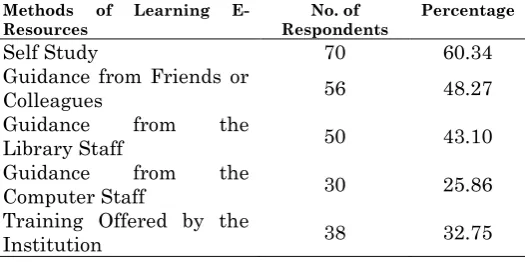
Methods of Learning to Use E-Resources The distribution of faculty members and students learned to use e-resources is shown in Table 7.
Table 7: The distribution of faculty members and students according to the learned to use e-resources
Methods of Learning E-Resources
No. of Respondents
Percentage
Self Study 70 60.34
Guidance from Friends or
Colleagues 56 48.27
Guidance from the
Library Staff 50 43.10
Guidance from the
Computer Staff 30 25.86
Training Offered by the
Institution 38 32.75
It is evident from Table 7 that 60.34 percent of the faculty members and students are learning
the necessary skills to use e-resources through self-study, 48.27 percent learned through the guidance from friends/ colleagues, 43.10 percent guidance from library staff, 32.75 percent training offered by the institution and 25.86 percent of the faculty members and students are learning to use e-resources guidance from the computer staff.
Adequacy of Information in E-Resources The distribution of faculty members and students according to the adequacy of information in e-resources is shown in Table 8.
Table 8: The distribution of faculty members and students according to the adequacy of information in e-resources
Opinion No. of Responses Percentage
Always 75 64.66
Some Time 41 35.34
Total 116 100.00
It is evident from Table 9 that 64.66 percent of the faculty members and students indicate that the information available in the e-resources always adequate and 35.34 percent indicate the information available in the e-resources is some time adequate.
Problems Faced While Using E-Resources The distribution of faculty members according to problems faced while using e-resources is shown in Table 9.
Table 9: The distribution of faculty members and students according to problems faced while using the e-resources
Problems No. of
Responses Percentage
Slow Access Speed 59 50.86 Difficult in Finding Relevant
Information 43 37.06
It Takes Too Long To View /
Download Pages 63 54.31
Too much Information
Retrieved 41 35.34
Difficult in Using E-Resources
due to lack of IT Knowledge 31 26.72 Limited access to Computers 28 24.13
percent ‘limited access to computer’ is the main problem to use e-resources.
Major Findings of the study
Majority 80 (68.96%) of the respondents
belongs to male community, followed by female 36 (31.04%).
Most of the faculty members and students
(82.75%) are familiar with the usage of e-resources.
About 37.07 percent of the faculty members
and students are using the digital library two or three times a week and 6.03 percent have rarely used them.
Most of the faculty members and students
23.02%, 22.10%, 21.23%, 16.87%, 14.68%, 13.77% and 9.08% are using search engines, e-mail, internet, CD-ROM’s, online journals, online databases and MITS catalogues ‘daily’ respectively.
Most of the faculty members and students are
mainly using e-mail services compared to other e-resources. Online databases and MITS catalogues are less using compared to other e-resources.
Majority of the faculty members are students
(62.93%) are using e-resources for research purpose.
Majority of the faculty members and students
(60.34%) are learning the required skills for the usage of e-resources through ‘self study’
Majority of the faculty members and students
(64.66%) felt that the information available in the e-resources is always ‘adequate’.
Majority of the faculty members and students
(54.31%) and (50.86%) have encountered the following problems in getting access to e-resources, viz., delays in the downloading of pages, slow access of bandwidth etc.
Suggestions
Based on the finding of the present study the following suggestions are recommended to improve the use of e-resources among the users in Madanapalle Institute of Technology and Science, Madanapalle, A.P.
User friendly training programmes regarding
on how to use e-resources effectively should be organized at regular intervals.
The problem of slow access speed can be
overcome by increasing the bandwidth.
Awareness should be generated on the online
journals to obtain current information.
More computer terminals should be installed in
the library for easy access to faculty and students.
Increasing resources should be allocated for
enriching e-resources for the benefit of users.
E-Resources should be made easy to use and
easy to learn to users. The library web page should provide online guide to e-resources and various search options beyond key words to e-resources. This will help the users to fine the desired content and will also maximize the use of e-resources and satisfaction of users.
Introduce proper feedback system to know
about proper use of digital library resources and services [1-5].
References
1. Glenda Thorston (2000) Impact of Electronic
Resources on Collection Development: The Role of Librarians and Library Consortia, Library Trends, 48(4).
2. Ramesh Babu, B and Rajendran, P. (2008):
Library Resources and Services in the Digital
Era, International Conference, SRM
University, Chennai, pp. 135-138.
3. Smith Abby (2001) Strategies for Building
Digitized Collections, DLF, Madras, CLRI, (Available: http: http:www.cir.org.)
4. Zhanavandan S, Esmail S Mahammed,
Nagarajan M (2012) Use of Electronic Resources at Krishnaswamy of Engineering and Technology Library, Cuddalore, Library
Philosophy and Practice, Annamalai
University, Tamil Nadu, pp.1-7.
5. Zhang Liyi, Ye Pinghao, Liu Qihua, Rao Lijum