665
© 2017 by the Serbian Biological Society How to cite this article: Šantić M, Pallaoro A, Markov M, Jardas I. Morphometric and meristic traits of megrim, Lepidorhombus whiffiagonis (Walbaum, 1792) from the eastern central Adriatic Sea. Arch Biol Sci. 2017:69(4):665-70.
Morphometric and meristic traits of megrim, Lepidorhombus whiffiagonis (Walbaum,
1792) from the eastern central Adriatic Sea
Mate Šantić1,*, Armin Pallaoro2, Martina Markov3 and Ivan Jardas2
1Department of Biology, Faculty of Natural Science and Mathematics, University of Split, Ruđera Boškovića 33, 21000 Split, Croatia
2Institute of Oceanography and Fisheries, Šet. I. Meštrovića 63, 21000 Split, Croatia
3City of Šibenik, Physical planning and Environment Protection Department, Trg Pavla Šubića, 1, 22000. Šibenik, Croatia
*Corresponding author: [email protected]
Received: February 14, 2017; Revised: March 13, 2017; Accepted: March 25, 2017; Published online: April 4, 2017
Abstract: The relationship between classical morphometric measurements (12) and meristic traits (8) was examined in 435 specimens of megrim (214 males, 221 females) caught in the eastern central Adriatic Sea. Total length of all specimens ranged from 9.0 to 34.6 cm. Morphological differences between males and females was not marked. Biometric analysis of the morphometric and meristic traits indicated a homogenous morphology stock of Lepidorhombus whiffiagonis in the eastern central Adriatic Sea. Changes in some morphometric traits obtained in conjunction with an increase in body length showed that smaller specimens have longer standard length, head, pectoral fins and preanal distance than adult specimens. The positive correlation recorded for the maximum body height indicated that the body slightly shortened with megrim growth. The morphometric and meristic traits of megrim from different Mediterranean and northeastern Atlantic areas are mostly in accordance with previously published articles.
Key words: fish; teleostei; Scophthalamidae; morphology; classical biometric measurements
INTRODUCTION
The megrim, Lepidorhombus whiffiagonis, is a benthic fish that inhabits the Mediterranean and eastern At-lantic [1]. It is common in the central and southern Adriatic, inhabiting muddy and sandy beds at depths between 20-260 m [2]. It spawns in winter from Janu-ary to March [3]. In the eastern Adriatic Sea, megrim is one of the main target species of commercial trawl fisheries with an annual catch of about 5 tons [4].
Although the distribution and abundance [5], feed-ing habits [6], age and growth [7] of L. whiffiagonis have been studied in the Adriatic Sea, the morphometric and meristic traits of this abundant species have not been sys-tematically analyzed. Some data on individual meristic characteristics of the megrim are available [2,8-10,11-13], however, morphometric data are scant and incomplete. Some classical morphometric relations have been re-ported for megrim in the Adriatic Sea [2], northeastern Atlantic [9,14] and the waters of the Turkish coast [15)].
Morphological differences based on general body type have been used to compare and distinguish be-tween different species and groups [16]. Morphometric and meristic studies have provided useful results for identifying marine fish stocks and describing their spa-tial distribution [17]. However, for the description of species, knowledge of its morphometric and meristic traits is necessary, especially because specimens from different areas differ from one another in morphology [2]. Classical dimensions are most often used in studies of the morphometric characteristics of fish [16].
biometric description of L. whiffiagonis in the Adriatic Sea. The presented data are a step forward in improving the knowledge of the biology of these species.
MATERIALS AND METHODS
Fish sampling
Megrim were collected from three localities in the eastern central Adriatic Sea: the Kornati archipelago, Murter channel, and areas south of Žirije (Fig. 1). The investigated areas are situated on the continental shelf mostly at depths of 90 to 120 m. Megrim specimens were sampled with a commercial vessel with bottom trawls using a 22-mm stretched mesh size cod-end. The duration of each haul was 2-3 h; trawling speed fluctuated from 5-7 km/h. Samples were collected from 2009 to 2011, with a total of 435 specimens (214 males and 221 females).
Biometric measurements
Biometric measurements were performed on fresh fish. In the laboratory, the specimens were boiled to facilitate the separation of the muscular tissue from the vertebral column. After this step, the number of vertebrae was counted. Twelve classical morphometric and eight meristic traits were measured.
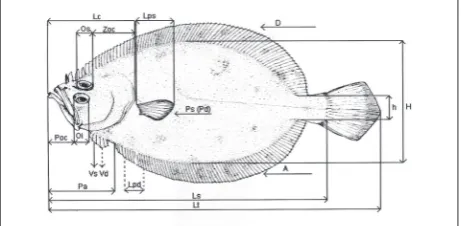
The analyzed classical morphometric traits were as follows: total length (Lt), standard length (Ls), head length (Lc), maximum (H) and minimum body heights (h), preanal distance (Pa), length of pectoral fin on the eye side of the body (Lps), length of pectoral fin on the blind side of the body (Lpd), diameter of the upper eye (Os), diameter of the lower eye (Oi), preocular (Poc) and postocular distances (Zoc).
The analyzed meristic traits were as follows: num-ber of rays in dorsal (D) and anal (A) fins, numnum-ber of rays in ventral fins on the eye side of the body (Vs) and on the blind side of the body (Vd), number of rays in pectoral fins on the eye side of the body (Ps) and the blind side of the body (Pd), number of vertebrae (Vert.), and the number of gill raker on the first gill arch (Gr.).
The total and standard lengths were measured with a fish meter to the nearest 0.1 cm. The other ten
morphometric traits were measured with a caliper to the nearest 0.01 mm. The entire sample was catego-rized into cm-length classes. Measurements of the head were expressed as percentages of head length, whereas the other body measurements were expressed as percentages of the total length (Lt). The standard length was expressed as the percentage of the total length (Ls/Lt). The minimum height was expressed as the percentage of the maximum body height (h/H). Sex was determined macroscopically according to the shape and appearance of gonads.
Statistical analysis
The arithmetic mean, standard deviation and variabil-ity coefficient were used in the processing of biometry
Fig. 2. Morphometric measurements of megrim: Lt – total length, Ls – standard length, Lc – head length, H – maximum body height, h – minimum body height, Poc – preocular distance, Zoc – postocular distance, Os – upper eye diameter, Oi – lower eye diameter, Pa – preanal distance, Lps – length of the pectoral fin on the eye side of the body, Lpd – length of the pectoral fin on the blind side of the body.
data. The significance of difference between the stud-ied male and female traits was defined using a t-test (p<0.05) after testing for normality of the distribution [18]. Linear regression was applied to the examined morphometric relations in comparison to the increase in total length.
RESULTS AND DISCUSSION
A total of 435 specimens of L. whiffiagonis were exam-ined for morphometric and meristic traits. The sample
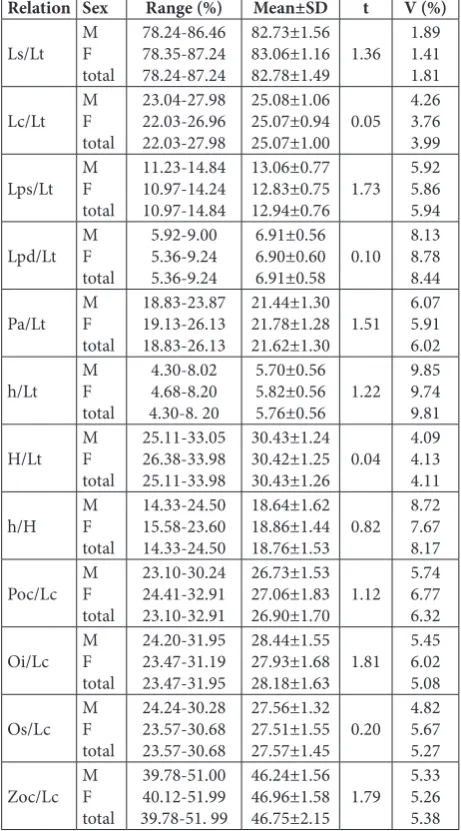
Table 1. Relative relations of the morphometric traits of males (n=214), females (n=221) and the total sample (n=435) of megrim from the eastern central Adriatic Sea.
Relation Sex Range (%) Mean±SD t V (%)
Ls/Lt MF
total 78.24-86.46 78.35-87.24 78.24-87.24 82.73±1.56 83.06±1.16 82.78±1.49 1.36 1.89 1.41 1.81
Lc/Lt MF
total 23.04-27.98 22.03-26.96 22.03-27.98 25.08±1.06 25.07±0.94 25.07±1.00 0.05 4.26 3.76 3.99
Lps/Lt MF total 11.23-14.84 10.97-14.24 10.97-14.84 13.06±0.77 12.83±0.75 12.94±0.76 1.73 5.92 5.86 5.94
Lpd/Lt MF total 5.92-9.00 5.36-9.24 5.36-9.24 6.91±0.56 6.90±0.60 6.91±0.58 0.10
8.13 8.78 8.44
Pa/Lt MF
total 18.83-23.87 19.13-26.13 18.83-26.13 21.44±1.30 21.78±1.28 21.62±1.30 1.51 6.07 5.91 6.02
h/Lt MF
total 4.30-8.02 4.68-8.20 4.30-8. 20 5.70±0.56 5.82±0.56 5.76±0.56 1.22 9.85 9.74 9.81
H/Lt MF
total 25.11-33.05 26.38-33.98 25.11-33.98 30.43±1.24 30.42±1.25 30.43±1.26 0.04 4.09 4.13 4.11
h/H MF
total 14.33-24.50 15.58-23.60 14.33-24.50 18.64±1.62 18.86±1.44 18.76±1.53 0.82 8.72 7.67 8.17
Poc/Lc MF total 23.10-30.24 24.41-32.91 23.10-32.91 26.73±1.53 27.06±1.83 26.90±1.70 1.12
5.74 6.77 6.32
Oi/Lc MF
total 24.20-31.95 23.47-31.19 23.47-31.95 28.44±1.55 27.93±1.68 28.18±1.63 1.81 5.45 6.02 5.08
Os/Lc MF
total 24.24-30.28 23.57-30.68 23.57-30.68 27.56±1.32 27.51±1.55 27.57±1.45 0.20 4.82 5.67 5.27
Zoc/Lc MF total 39.78-51.00 40.12-51.99 39.78-51. 99 46.24±1.56 46.96±1.58 46.75±2.15 1.79 5.33 5.26 5.38
F – females; M – males; t – values of t-test; V – variability coefficient
Table 2. Regression (a, b) and determination coefficients (R2) of linear regression for the total sample of megrim from the eastern central Adriatic Sea (n=435).
Relation a b R2
Ls /Lt 84.824 -0.085 0.415
Lc/Lt 27.460 -0.110 0.637
Lps/Lt 14.086 -0.061 0.558
Lpd/Lt 7.350 -0.019 0.156
Pa/Lt 24.309 -0.126 0.815
h/Lt 6.647 -0.035 0.354
H/Lt 29.713 0.036 0.256
h/H 19.981 -0.051 0.149
Poc/Lc 24.761 0.087 0.253
Oi/Lc 29.141 -0.046 0.142
Os/Lc 29.889 -0.101 0.363
Zoc/Lc 43.531 0.165 0.619
Table 3. Meristic traits of females (n=221), males (n=214) and the total sample (n=435) of megrim from the eastern central Adriatic Sea.
Meristic traits Sex Range Mean±SD t V (%)
D M 80-92 85.83±2.66 0.16 3.11
F 80-92 85.97±2.35 2.74
total 80-92 85.90±2.50 2.91
A M 60-72 66.36±2.43 0.96 3.67
F 62-72 66.73±2.06 3.09
total 60-72 66.55±2.24 3.38
Ps M 10-13 11.90±0.42 0.15 3.61
F 11-12 11.89±0.32 2.70
total 10-13 11.98±0.37 3.15
Pd M 8-11 9.56±0.59 2.34 6.17
F 9-11 9.79±0.53 5.47
total 8-11 9.68±0.57 5.90
Vs M 5-6 5.98±0.13 0.45 2.11
F 5-6 5.99±0.12 2.00
total 5-6 5.98±0.12 2.04
Vd M 5-7 6.00±0.18 0 2.99
F 6 6.00±0 0
total 5-7 6.00±0.12 2.05
G.r. M 17-21 18.49±0.80 0.35 4.33
F 17-21 18.54±0.81 4.37
total 17-21 18.52±0.80 4.34
Vert. M 39-42 40.87±0.45 0.13 1.12
F 40-42 40.86±0.40 1.93
total 39-42 40.86±0.42 1.05
was composed of 221 females and 214 males. The total lengths (Lt) of all samples ranged from 9.0-34.6 cm. Total lengths of females ranged from 11.5-34.6 cm, and of males from 9.0-29.5 cm.
Morphometric measurements for the males, fe-males and the total megrim sample are presented in Table 1. Morphological differences between megrim males and females in the eastern central Adriatic were not observed. Namely, the differences in the mean val-ues of the measured morphometric relations between males and females were not statistically significant in any individual case. The morphometric relations for males, females and the total sample showed relatively low values of variability coefficients, except in relation to the minimum body height and total length (h/Lt). The relatively low values of the variability coefficients (<10%) suggest that there was no morphological dif-ference between the collected specimens. Values of this coefficient within populations are usually far greater than 10% in fish [19]. The results in our study point to the possibility of a homogenous morphology stock of L. whiffiagonis in the eastern central Adriatic Sea. However, low values of variability coefficient were observed for silver perch (Leiopotherapon plumbeus), and red mullet (Mullus barbatus), which indicate min-imal or very low intrapopulation variation [20,21].
The available data on the classical morphometric characteristics of megrim are very rare. In the north-eastern Atlantic and Turkish waters, the head length
constitutes 23.5-28.1% of the total length [9,14,15], and the maximum of the body height constitutes 1/3 of the total body length [2,15]. The length of the pec-toral fin on the eye side of the body makes up to 12.8% of the total length [14]. The diameter of the lower eye constitutes 26-28% of the head length [14,15]. These data are very close to the data presented in our study.
The coefficients of linear regressions for morpho-metric traits are shown in Table 2. These coefficients indicate that fish with a smaller body length have a longer standard length (Ls/Lt), head (C/Lt), pectoral fins (Lps/Lt; Lpd/Lt), as well as a greater preanal dis-tance (Pa/Lt) and minimum body height (h/Lt). At the same time, they have a shorter maximum body height (H/Lt). The positive correlation recorded for the maximum body height points to the fact that the body is slightly shortened. Similar to the result of the present study, a positive correlation for the morpho-metric relation H/Lt, and a negative correlation for the relations Lps/Lt and Os/Lc were observed (megrim sampled in the Mediterranean Sea and northeastern Atlantic) [9]. As for other morphometric relations, small specimens have smaller preocular (Poc/Lc) and postocular distances (Olo/C) and a larger eye diameter (Oi/Lc; Os/Lc) than the larger L. whiffiagonis speci-mens. Preocular and postocular distances increase relative to megrim body length.
Meristic data are shown in Table 3. Significant dif-ferences in meristic traits between males and females
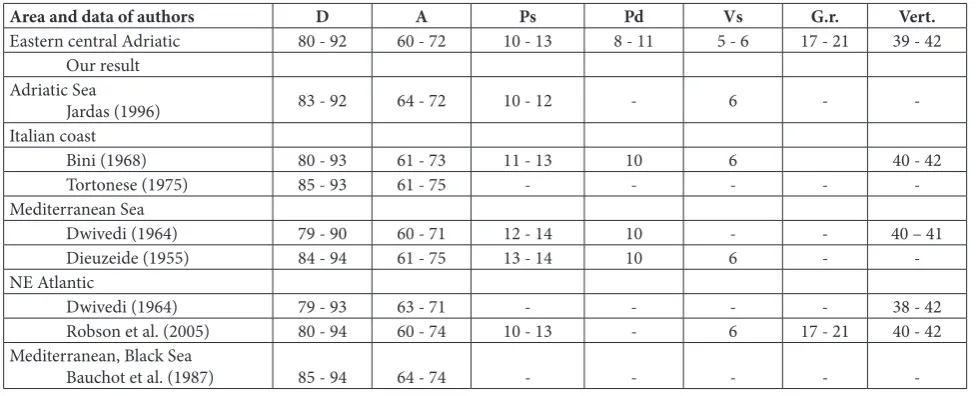
Table 4. Meristic traits of megrim from the Adriatic Sea, Mediterranean and NE Atlantic.
Area and data of authors D A Ps Pd Vs G.r. Vert.
Eastern central Adriatic 80 - 92 60 - 72 10 - 13 8 - 11 5 - 6 17 - 21 39 - 42
Our result Adriatic Sea
Jardas (1996) 83 - 92 64 - 72 10 - 12 - 6 -
-Italian coast
Bini (1968) 80 - 93 61 - 73 11 - 13 10 6 40 - 42
Tortonese (1975) 85 - 93 61 - 75 - - - -
-Mediterranean Sea
Dwivedi (1964) 79 - 90 60 - 71 12 - 14 10 - - 40 – 41
Dieuzeide (1955) 84 - 94 61 - 75 13 - 14 10 6 -
-NE Atlantic
Dwivedi (1964) 79 - 93 63 - 71 - - - - 38 - 42
Robson et al. (2005) 80 - 94 60 - 74 10 - 13 - 6 17 - 21 40 - 42
Mediterranean, Black Sea
-were not recorded (t-test). The dorsal fin was com-posed of 80 to 92 rays and the number of anal fin rays ranged between 60-72. The number of gill rakers on the first gill arch ranged between 17-21, and the num-ber of vertebrae varied from 39-42. The meristic traits of megrim from the eastern central Adriatic Sea were compared with the available literature data (Table 4). The number of rays in the ventral fins on the eye side of the body (Vs) is almost the same for all compared locations (Adriatic, Italian waters, Mediterranean Sea and northeastern Atlantic). Also, a similar range of gill rakers on the first gill arch were noted in eastern central Adriatic and northeastern Atlantic. Variations in the range of the number of rays in pectoral fins on the eye side of the body (Ps) and the blind side of the body (Pd) was very small for this species in the Adri-atic, Mediterranean and northeastern Atlantic. The number of vertebrae also show small variations in all investigated areas. It has been experimentally estab-lished that the number of vertebrae is genetically fixed within narrow limits, and that a certain extent some aberrations could probably be affected by the tempera-ture during the so-called sensitive period [22]. Some small differences exist in the range of the number of rays in the dorsal (D) and anal (A) fins when our re-sults are compared to those from other areas. These differences were probably related to the larger analyzed sample and the wider size-interval of L. whiffiagonis
specimens in our study. The meristic traits of megrim in our study are mostly in accordance with previous published papers.
In conclusion, the results of this study show that there are no morphological differences between males and females. Biometric analysis has revealed changes in some morphometric traits during fish growth and points to the possibility of the existence of a homog-enous morphology stock of the megrim in the eastern central Adriatic. Moreover, there are no significant morphological differences between the megrim popu-lation in the eastern central Adriatic Sea and those in other parts of the Mediterranean [8-12] and the northeastern Atlantic areas [9,13].
Acknowledgments: The authors gratefully acknowledge the help of professional fisherman in collecting the material for this study. We also want to thank the Croatian Ministry of Science, Education and Sports for its financial support.
Author’s contribution: M. Šantić designed the manuscript, con-ducted some meristic measurements, calculated the statistical analysis of the biometric traits and wrote the manuscript. M. Mar-kov and A. Pallaoro performed the laboratory measurements of all morphometric and some meristic traits I. Jardas and A. Pallaoro supervised all research activities, read the manuscript and criti-cally analyzed the manuscript.
Conflict of interest disclosure: The authors declare no conflict interest.
REFERENCES
1. Nielsen JG. Pleuronectiformes. In: Whitehead PJP, Bauchot ML, Hureau JC, Nielsen J, Tortonese E, editors. Fishes of the north-eastern Atlantic and Mediterranean. Vol 3, Paris: UNESCO; 1986. p. 1015-73.
2. Jardas I. Jadranska ihtiofauna. Zagreb: Školska knjiga; 1996. 523 p.
3. Grubišić F. Ribe, rakovi i školjke Jadrana. Zagreb, Rijeka: ITRO Naprijed, GRO Liburnija; 1988. 239 p.
4. Fishery and Aquaculture Statistics, FAO yearbook; 2014. 76 p. 5. Karlovac O. Plosnatice roda Lepidorhombus (Pisces) u
Jadranu. Pom Zbor. 1975;13:501-10.
6. Šantić M, Pallaoro A, Jardas I, Podvinski M, Kirinčić M. Feeding habits of megrim, Lepidorhombus whiffiagonis (Wal-baum, 1792) from the central Adriatic Sea. J Appl Ichthyol. 2009;23:279-81.
7. Šantić M, Stagličić N, Pallaoro A, Markov M, Jardas I. Age and growth of megrim Lepidorhombus whiffiagonis (Scop-thalamidae) from eastern Adriatic Sea. Cybium. 2013;37:255-61.
8. Dieuzide R, Novella M, Roland J. Catalogue des poissons des Cotes Algeriennes. Bull Trav Publ Stat Aquicult Pech Castig. 1955;3:1-384.
9. Dwivedi SN. Ecologie, morphologie comparées des deux espèces du genere Lepidorhombus: L. whiffiagonis et L. bosci. Etude de leurs race set populations. Rev Trav Inst Pêches Marit. 1964;28:321-99.
10. Bini G. Gadidae. In: Atlante dei pesci delle coste italiane. Vol 4, Osteitti. Milano: Mondo Somerso; 1968. p. 93-4.
11. Tortonese E. Osteichthyes (Pesci ossei). Vol 11, Fauna d’ Ita-lia. Bologna: Calderini;1975. 636 p.
12. Bauchot ML. Scophtalamidae. In: Fischer W, Schneider M, Bauchot ML, editors. Fishes FAO d’ identification des espèces pour les besoins de la pêche. Méditerranèe et Mer Noire. Vol 2. Rome: FAO; 1987. p. 1173-4.
13. Robson SM, King PA, Mc GrathD.The morphometric and meristic characteristics of common megrim Lepidorhombus whiffiagonis and four-spot megrim Lepidorhombus bosci from off the west coast of Ireland. Ir Nat J. 2005;28:116-9. 14. Furnestin J. Le cardine (Lepidorhombusmegastomus Donovan
15. Başusta N, Akyurt O, Girgin A. The first record of megrim, Lepidorhombus whiffiagonis (Walbaum 1782) in Iskarun Bay. Split: Bilj Inst Oceanogr Ribar; 2000. p. 6.
16. Straüss RE, Bond CC. Taxonomic methods: morphology. In: Schreck CB, Moyle P, editors. Methods for fish biology. Bethseda, Maryland: American Fisheries Society; 1990. p. 125-30.
17. Ihssen PE, Booke HE, Casselman JM, Mc Glade JM, Payne NR, Utter FM. Stock identification: Materials and methods. Can J Fish Aquat Sci. 1981;38:1838-55.
18. Sokal RR, Rohlf FJ.Biometry. San Francisco: WH Freeman and Company; 1981.
19. Carvalho I. Evolutionary aspects of fish distribution: genetic variability and adaptation. J Fish Biol. 1993;43:57-73. 20. Mamuris Z, Apostolidis AP, Panagiotaki P, Theredorou AJ.
TriantaphyllidisC. Morphological variation between red mul-letpopulations in Greece. J Fish Biol. 1998;52:107-17. 21. Quilang JP, Basiao ZU, Pagulayan RC, Roderos RR.. Barrios
EB. Meristic and morphometric variation in the silver perch, Lepiotherapon plumbeus (Kner, 1864), from three lakes in the Philippines. J App Ichthyol. 2007;23:561-67