Research Article
a
September
2017
Computer Science and Software Engineering
ISSN: 2277-128X (Volume-7, Issue-9)
An Efficient Hybrid Forecasting Approach for Wind Speed
Time Series
Bhargavi Munnaluri, Dr. K. Ganesh Reddy
Department of CSE, Shri Vishnu Engineering College for Women (A), Vishnupur, Bhimavaram, West Godavari District, Andhra Pradesh, India
Abstract— Wind forecasting is one of the best efficient ways to deal with the challenges of wind power generation. Due to the depletion of fossil fuels renewable energy sources plays a major role for the generation of power. For future management and for future utilization of power, we need to predict the wind speed. In this paper, an efficient hybrid forecasting approach with the combination of Support Vector Machine (SVM) and Artificial Neural Networks(ANN) are proposed to improve the quality of prediction of wind speed. Due to the different parameters of wind, it is difficult to find the accurate prediction value of the wind speed. The proposed hybrid model of forecasting is examined by taking the hourly wind speed of past years data by reducing the prediction error with the help of Mean Square Error by 0.019. The result obtained from the Artificial Neural Networks improves the forecasting quality. Keywords—RES, NWP, ARMA, ANN, SVM
I. INTRODUCTION
Renewable Energy Sources (RES) plays a major role for the production of power. It is known that one of the best significant factors of wind power generation is the wind speed, it is viewed as one of the most metrological parameter. A series of factors such as difference in temperature, pressure, humidity, earth’s rotation, and some local parameters also influence the wind speed [1].
Wind speed is stochastic by nature, making wind power forecasting a highly challenging task, particularly for short time frames. Forecasting methods include the numeric weather prediction (NWP) method, the statistic method, and the intelligent method. Among them, the NWP methods have more forecasting precision on time frames but require more physical information ; the statistical method and the intelligent methods are based on current local observations are suitable for short-term wind power output forecasting and employ the persistence method, multiple linear regression (MLR), and an auto-regressive and moving average (ARMA) models are the different forecasting methods.
The prediction models for the wind speed are categorized into physical, statistical (also called time-series) , and knowledge based (also called hybrid models) methods [2]. Physical models require data regarding climatic conditions. In statistical models different techniques are used. Hybrid models widely based on Artificial Neural Networks (ANN) [3, 4]. Radial bias function [5], fuzzy logic and Support Vector Machine (SVM) [6]. Hybrid methods are also based on divide and conquer approach for accurate forecasting of wind speed.
Short-term forecasting of wind speed minimizes scheduling errors with a great impact of reliability and also impact on ancillary service costs [7]. Long-term forecasts are provided for site location, planning of wind mills, and selection of optimal size wind machine for a particular site [8].
Artificial Intelligence Techniques consists of Support Vector Machine (SVM) and Artificial Neural Networks (ANN), are analyzed with different statistical methods. Models using past data of wind can provide good results. Rarely wind speed series can alter due to the intrinsic complexity and volatility nature of wind. Consider the hourly wind speed data into the original data of artificial intelligence technique and they try to improving the prediction models by themselves. Due to some conditions like irregularity, non-stationary and the flections in the wind, made a challenge for the prediction of wind speed analysis.
Currently, intelligent methods based on artificial neural networks (ANN) or support vector machines (SVM) have gained more attention from researchers due to the applications of artificial intelligence in power systems.
Many improvements in forecasting for short-term time series can be realized by utilizing intelligent approaches .When these models are applied to different wind farms, their forecasting accuracy varies due to the distinct characteristics of the data.
ISSN(E): 2277-128X, ISSN(P): 2277-6451, pp. 13-17
wind speeds, a very short term hybrid wind power forecasting model consists of support vector machine (SVM) and the artificial neural network (ANN) is proposed in Section III. The conclusions are shown at section IV.
II. METHODOLOGY 2.1 Support Vector Machine:
Support Vector Machine is a learning method for the classification and regression problems. SVM’s are based on planes of decision that define the decision boundaries, decision plane is a boundary and it is defined as set of objects having different class members. Support Vector is a machine learning algorithm.
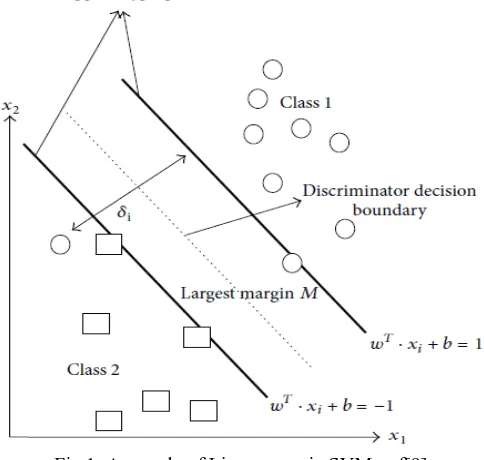
It helps in classifying data points between two classes with the help of hyper-planes. It is defined as maximum distance to the closest data point from both the classes. It is clearly explained in figure: 1.
SVM is also an algorithm used in a non-linear mapping technique to transform original training data into a high dimensional future space data. The wind speed data set is used for training and testing analysis. Here, wind speed data set consists of nine fields such as {date, time, direction, QDD, wind speed, QUP, temperature, humidity, season}. Based on the SVM classification three parameters {temperature, humidity and season} show that negligible impact in the wind speed prediction.
The rest of the parameters {date, time, direction, QDD, wind speed, QUP} show that there is a significant effect in the wind speed predication. Hence all these parameters are given to ANN as an input parameter for training the data set.
Fig 1. A sample of Linear-margin SVM ,ref[9]
2.2 Artificial Neural Networks:
ANN is also one of the most popular computational models. It is a model with a feed-forward network having connections from the first-layer output to the first-layer input. Both SVM and ANN are having similar type of structures and functionality.
ISSN(E): 2277-128X, ISSN(P): 2277-6451, pp. 13-17
Artificial Neural Network models are suited for the wind speed prediction and these models do not require any mathematical computations, and they automatically adapt to changes in the input values and ANN also minimize the mean square error.
ANN models are also deals with the large data sets. The basic idea of ANN is to initialize the parameters with weights and train them. ANN has layers of processing elements that makes computations independently, which are shown in figure: 2. Each processing element makes computations based on weighted sum of its inputs, to perform training of ANN, we have some training samples with unique features, and to perform its testing we have some testing samples with other unique features. The stated equation has given as:
Where w represents weights [w1, w2, w3 ...wn] X represents delayed inputs and
b is bias function.
To calculate the error there should be a comparison between the desired or target output and actual output. The error is calculated by evaluating mean square error. The equation is given as
Where P= Prediction values a= actual values and N= number of input values
III. RESULTS 3.1 Data Sets
A set of data wereinvestigated in this paper. By using different parameters of wind speed a comprehensive study were made, potential wind station 225 Ijmuiden , most recent co-ordinates X : 98450; Y : 497450, measured at 18.5 meter height, POTENTIAL WIND MEANS: coordinated to the wind speed at 10 M height over open land with roughness length 0.03 METER.
TIME IN GMT
DD = WIND DIRECTION IN DEGREES NORTH QQD = QUALITY CODE DD
UP = POTENTIAL WIND SPEED IN 0.1 M/S QUP = QUALITY CODE UP
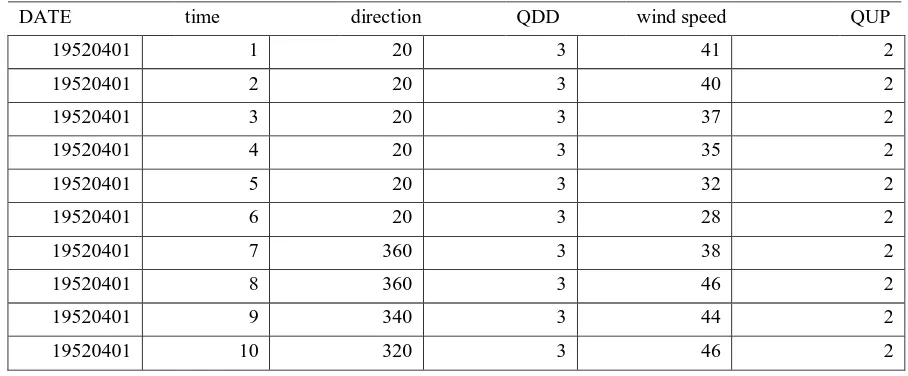
The basic parameters are shown in table: 1.
Table 1: summary of data sets
DATE time direction QDD wind speed QUP
19520401 1 20 3 41 2
19520401 2 20 3 40 2
19520401 3 20 3 37 2
19520401 4 20 3 35 2
19520401 5 20 3 32 2
19520401 6 20 3 28 2
19520401 7 360 3 38 2
19520401 8 360 3 46 2
19520401 9 340 3 44 2
19520401 10 320 3 46 2
ISSN(E): 2277-128X, ISSN(P): 2277-6451, pp. 13-17
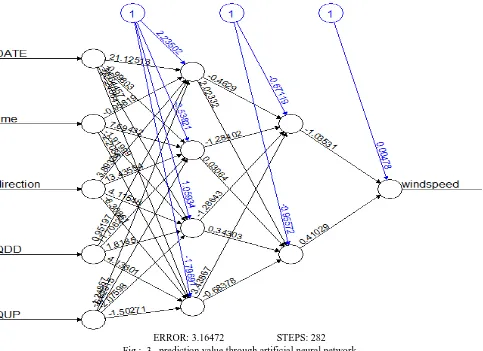
ERROR: 3.16472 STEPS: 282 Fig : 3. prediction value through artificial neural network
Fig. 3 shows good performance of the proposed hybrid model for forecasting. When wind power output is fluctuating, the hybrid model is better than the individual models. Hence the overall prediction accuracy is improved in the hybrid model compared to the other individual models.
The following graphs show the tests and results of experiments carried out in ANN. The graph shown below represents the particular time at which the wind blows with a particular frequency, X-axis represents the time and Y-axis represents the frequency of wind at a particular time series.
Fig : 4. Histogram of data and wind speed
ISSN(E): 2277-128X, ISSN(P): 2277-6451, pp. 13-17
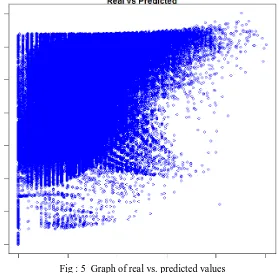
Fig : 5 Graph of real vs. predicted values
IV. CONCLUSION
In this project, I proposed an efficient hybrid forecasting approach which combines the Artificial Neural Networks (ANN) and Support Vector Machine (SVM) to improve the prediction quality of wind speed forecasting. The literatures available for wind speed modelling reveals that majority of the models are utilized for electrical power demand forecasting. Though many short term models are presented, the accuracy of the models still need to be improved. However, a hybrid method can integrate the advantages of other single models, to improve the model prediction ability and enhancing forecasting efficiency. By using SVM and ANN we are getting the less prediction error of 0.019 by using mean square prediction error, which shows that the prediction error is minimized and it gives good accurate prediction when compared to other methods.
REFERENCES
[1] A hybrid forecasting approach applied to wind speed time series Jamming Hub*, Jinzhou Wang, Gooey Zeng
[2] T. J. Parr ore and R. G. Miller, “Generalized exponential Markov and model output statistics: a comparative
verification,” Monthly Weather Review, vol. 113, pp. 1524–1541, 1985.
[3] M. Bingil, B. Shin, and. Yasser, “Application of artificial neural networks for the wind speed prediction of target station using reference stations data,” Renewable Energy, vol. 32, no. 14, pp. 2350–2360, 2007.
[4] E. Cadenzas and W. Rivera, “Short term wind speed forecasting in La Vento, Oaxaca, Mexico, using artificial neural networks,” Renewable Energy, vol. 34, no. 1, pp. 274–278, 2009.
[5] H. Beyer, T. DeGeneres, J.Hausmann, M.Hoffmann, and P. Roan, “Short term wind speed and power output of a wind turbine with neural networks,” in Proceedings of the 5th European Wind Energy Association Conference and Exhibition, pp. 349–352, 1994
[6] M. A. Mohandas, T. O. Malawian, S. Redman, and A. A. Husain, “Support vector machines for wind speed prediction,” Renewable Energy, vol. 29, no. 6, pp. 939–947, 2004.
[7] Canvasser RG, Seetharaman K. Day-ahead wind speed forecasting using f-ARIMA models. Renew Energy 2009; 34:1388e93.
[8] Mohandas M, Malawian T, Redman S, Husain AA. Support vector machines for wind speed prediction. Renew Energy 2004; 29:939e47