Vol. 1 No. 1; May 2012
Page | 64
A Study of Educational Reform & Teacher Training in Oman
Khalid Salim Saif Al Jardani Sultanate of Oman, Oman E-mail: [email protected]
Received: 30-05- 2012 Accepted: 25-05- 2012 Published: 31-05- 2012 doi:10.7575/ijalel.v.1n.1p.64 URL: http://dx.doi.org/10.7575/ijalel.v.1n.1p.64
Abstract
Training plays an important part in supporting educational reform in Oman. This report looks at the effectiveness of the 2005 Primary Teachers’ Course (PRIT) for cycle 1 (grades 1-4) in preparing and supporting English teachers in implementing the new national curriculum. A number of key issues are identified, such as the importance of training courses and their need to focus on teachers’ requirements and interests. The need to update the course and introduce more activity types and modes of input is discussed. The article ends with suggestions for ways to continue supporting teachers in implementing the new curriculum. These include an on-going system of support where the trainer develops links with supervisors and senior teachers, and also the development of self-assessment and small-scale classroom-based research strategies, with which teachers can investigate their own practice.
Keywords: Training courses, Primary, English teachers 1. Background
The rapidly changing global economy requires a high degree of adaptability, and a strong background in mathematics, science, technology and languages. The English Language Curriculum Department (ELCD) of the Sultanate of Oman Ministry of Education (1999) has developed a new English language curriculum designed to provide pupils with the knowledge, skills and attitudes that they will need to succeed. The new curriculum, approach and objectives for teaching English, as well as approaches to teacher training and learner assessment, were developed to:
• meet expectations for higher levels of achievement from the school programme; • promote learner-centred methodology;
• create less dependence on transmission–oriented modes of teaching;
• create less dependence on the textbook as the primary source of teaching and learning; • place less emphasis on a linguistic product being seen as the outcome of every lesson;
• place greater emphasis on the role of English in continuing technological and economic development, and promoting knowledge of the world (ELCD, 1999).
The ELCD announced the reforms in 1999 with the publication of the Curriculum Framework. Training for teachers had begun earlier (in 1996) when the ELCD’s training section started to instruct teachers and encourage them to teach the old syllabus using a learner-centred approach. Therefore, the reform was not a sudden change for teachers who had been teaching for some years in the Sultanate.
Vol. 1 No. 1; May 2012
Page | 65
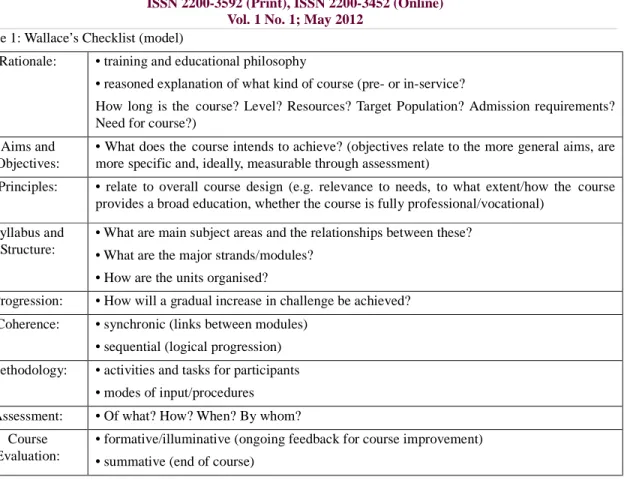
Table 1: Wallace’s Checklist (model)
Rationale: • training and educational philosophy
• reasoned explanation of what kind of course (pre- or in-service?
How long is the course? Level? Resources? Target Population? Admission requirements? Need for course?)
Aims and Objectives:
• What does the course intends to achieve? (objectives relate to the more general aims, are more specific and, ideally, measurable through assessment)
Principles: • relate to overall course design (e.g. relevance to needs, to what extent/how the course provides a broad education, whether the course is fully professional/vocational)
Syllabus and Structure:
• What are main subject areas and the relationships between these? • What are the major strands/modules?
• How are the units organised?
Progression: • How will a gradual increase in challenge be achieved? Coherence: • synchronic (links between modules)
• sequential (logical progression) Methodology: • activities and tasks for participants
• modes of input/procedures Assessment: • Of what? How? When? By whom?
Course Evaluation:
• formative/illuminative (ongoing feedback for course improvement) • summative (end of course)
2. Method
Wallace's model (1991) contains a list of issues that he suggests are important to consider in developing a training program. Wallace’s model is related directly to models of teacher training (Richards, 1998, p. 45). Wallace’s list was used in this study to develop criteria for evaluating the Primary Teachers’ Course (PRIT) for cycle 1 (grades 1-4) as it introduces the New National Curriculum for teaching English. The main criteria were: rationale; aims and objectives; syllabus and structure; progression; coherence; methodology; assessment; and course evaluation and its use as feedback to upgrade the course (Wallace, pp. 141–64). This study made use of a survey approach and collected data using document analysis, a questionnaire and interviews.
Document analysis (Wallace, 1991; Krippendorff, 1980; Bell, 1999) was done by the researcher based on the Wallace checklist and then used to enable course participants to analyse the tasks, activities and documents used during the course. In order to ensure valid results, the questionnaire contained simple, direct language that was appropriate to the target participants (Swetnam, 2004). The questionnaire was piloted and further adjustment was made. The questionnaire consists of a number of section covering all training aspects: training and the new reform, aims and objectives of the course, course structure, involvement, resources available, input, assessment used, course evaluation and follow up after the course. After administering and analysing the questionnaire, interviews were held with three participants.
3. Participants
The 22 survey participants came from three regions in Oman as they were having the course at the time of the study. Five of the teacher participants were from Muscat region, five from Musandam region and twelve from Wusta region. This group of participants was chosen to ensure that all were working with the same version of the training course which was analysed. The research questionnaire was given to participants at the end of the course.
Vol. 1 No. 1; May 2012
Page | 66 4. Findings
4.1 General comments
It was found that the course covered most aspects of the new reform, including the child-centred approach, learning by doing, independent learning strategies and the activity-based approach. The course also introduced new practices such as teacher reflection, writing notes about what happened during a lesson and ways to support learners, after each lesson and new assessment procedures used in schools such using grades instead of marks and give more weight for the continuous evaluation. This training on assessment procedures was especially important because otherwise, the procedures might be interpreted differently by teachers with different backgrounds (Al-Jardani, 2002).
The participants reported that the course helped them to understand the needs and interests of their learners based on their levels and ages. The participants also felt that the course did a good job of covering the relevant theoretical principles.
However, the participants felt that more work was needed on practical skills. It was also found that teachers need basic skills in using computer applications as stated in the interviews.
4.2 Length of the course
There seems to have been enough time for teachers to process the new reform and to understand issues related to teaching young learners. However, some of the teachers felt the long breaks in the middle of the program hindered the training. They were teaching in General Education Schools which still used the old curriculum, and they had trouble remembering some of the key concepts of the new curriculum as they were not using it. Others saw it as a good chance to process concepts and understand the new input they received.
4.3 Resources
The trainer was an experienced teacher trainer and aware of the underlying principles of the new reform and the English for Me textbook curriculum that participants were preparing to teach. The training site had adequate facilities to achieve the training goals. However, most participants come from remote regions, and they said that they would have preferred to have the trainer visit them in their regions and observe their teaching situations. The teachers reported that all the required curriculum materials were available in time for the courses. The teachers also felt the trainers provided them with enough supplementary books for background reading and practical ideas. These included methodology books, practical techniques books and EFL course books. However, some participants still felt that more references were needed. The teachers also asked to have a borrowing system so that they could read at home.
4.4 Choice of Participants
There was disagreement about whether teachers should be required to take the training course before teaching the new syllabus. New teachers join the school system every year. Because of delayed time-tabling in the schools, it is often not clear which courses new teachers will teach, and it is not always possible to train every new teacher at the beginning of the year. As a result some teachers have to teach before training.
4.5 Input
The teachers seemed to be satisfied with the sequence of topics. They felt the activities used in the course were interesting and purposeful, and that the activities would ensure better understanding of learner behaviour and ways of supporting young learners. However, trainees also expressed a desire to analyse and evaluate the materials, activities not included in the course. Ellis (1986, p. 94) and Kouraogo (1987) have suggested that analysing and evaluating activities helps develop teachers’ awareness of materials they are going to work with. The teachers were of the opinion that the modes of input used within the course were varied and suitable. However, other modes of input (Ellis, 1986, p 92) could be added. They include video and audio recordings of actual lessons, transcripts of lessons, case studies and samples of pupils’ written work. These types of input would help bring the classroom and pupils into the training room.
Vol. 1 No. 1; May 2012
Page | 67
4.6 Assessment of participants
The trainer’s reports on the participants’ performance during the training course covered most of the issues. The reports were based on the trainer's observations, assignments and reports on micro-teaching. However, the reports were generally not utilized within the schools by the supervisors or the senior teachers to help the teachers work to improve their reported weaknesses.
The participants felt that the certificate given on completion of the course had a negative impact on their motivation. They saw no connection between the certificate and their performance evaluations. They also said that the format of the certificate should be changed to make it look more official. One way to increase the motivational effect of the certificate would be to use it as part of an evaluation process that could result in an offer of a longer contract for foreign teachers to teach in Oman.
4.7 Formative feedback
The effect of the formative feedback on the development of the course was clear. The teachers felt that their needs were considered and the course was carefully planned and adapted by the trainer based on their feedback.
4.8 On-going support
This training course was only one aspect of the training the teachers receive. They generally receive on-going support from the senior English teachers in their schools, the supervisors and the regional teacher trainers once they start teaching. However, the course did not have any clear follow-up procedure. Trainers say that they sometimes visit the participants; however, it is left for the supervisors to support the teachers in schools. It should be possible to plan in a systematic way to visit some teachers, especially those who need more support. This could be worked out in coordination with the senior teachers or the supervisors of the schools.
Another point to consider is that the course did not enrol practitioners other than teachers although there was a need to involve supervisors and significant others such as curriculum and assessment officers. Involving other relevant practitioners would have placed greater demands on the trainer to ensure rich and appropriate input and varied activities. Being involved with the course would have helped supervisors to become more aware of the new reforms in addition to involving them in doing actual tasks with the teachers. This would have given the supervisors the opportunity to get a better idea of the teachers’ strengths and weaknesses, and it help form good relationships between the supervisors and the teachers. If the senior teachers and the supervisors were provided with copies of the participants’ course reports, this would also help them to deal with specific needs identified by the trainers.
5. Discussion
This section looks at specific changes which could be made to improve the training course. These include adapting some of the course items or adding new input which would cater for participants’ needs and interests.
5.1 Syllabus renewal and continuous revision of course materials
The course was written more than eight years ago and has been updated partly based on the trainers’ ideas and backgrounds. There is a need for feedback from the course participants to be considered in revising the course. Support materials, especially recommended readings, also need to be updated. The readings and the articles now being given to the participants are more or less the same as in the past.
There are also some changes related to teaching this level (cycle 1, grades 1-4) such as the new assessment procedure. The system of assessment needs more explicit focus in the training course.
Participants are expected to receive two kinds of knowledge: subject matter knowledge and action system knowledge. The subject matter knowledge part of the syllabus includes revising some of the vocabulary and grammatical items in the curriculum. However, this was not covered at all. Even if we argue that teachers are mainly going to teach young pupils, they need to thoroughly grasp the target grammar and vocabulary items. Trainers need to consider both formative and summative feedback when planning new training courses. They need to consider the summative evaluation, the questionnaire they administered at the end of the course, to develop and plan a better course for the coming groups.
5.2 Case studies
Vol. 1 No. 1; May 2012
Page | 68
videos or readings. Such case studies can help participants reflect upon their understanding and observation of actual classroom experiences. Inviting teachers from similar educational contexts to discuss their practice with participants might also help the participants to gain greater insight into their teaching situation.
5.3 School visits
Participants made some school visits. They observed teachers and discussed the lessons with them for less than two hours, and then returned to the training centre. Sometimes they observed lessons and left without having discussions with the teachers as they were asked to observe as many lessons as possible. Giving the participants more chances to observe the class level they were going to deal with, and providing more time for them to discuss and reflect using the input they gained from the training room, would have been helpful.
Having participants teach at least one or two periods while being observed by the trainers, or the senior teacher of the school visited might have also helped them to link theory and practice. This could have been done in the last week for at least a full day.
5.4 Classroom research
In the future, teachers could be asked to carry out small-scale classroom-action research projects. They could collect classroom data to feed back into the course as part of their formative and summative evaluation. This would help to develop better teaching and assessment practice.
5.5 Reflective journals
Asking teachers to do specific reading tasks and keep journals could feed back into the course, and contribute to their formative and summative evaluation. Writing journals and diaries can help teachers reflect and express their thoughts and expectations.
5.6 Length of the course
Another consideration is the amount of time needed to bring about a transition by experienced teachers from a teacher–centred approach to learner–centred teaching. One hundred hours of training seem insufficient to help experienced teachers make such a major adjustment.
6. Limitations
6.1 The participants
There was only one group of participants. Thus, the data is limited in scope. Some of the participants were from Muscat. However, most were teaching in remote regions.
6.2 The questionnaire
Giving out the questionnaire at the end of the course and in the training room might have affected its validity. At the end of a course, when the training is still fresh, its long-term impact is not clear. Time is needed for participants to process the course and apply it in their classrooms.
Giving out the questionnaire in the training room might also have affected participants’ responses. Participants were informed that their names would not be released. Only three participants who were absent have not returned the questionnaire. Some teachers were working as temporary teachers were in a weaker position. This may have seriously hampered their ability to respond frankly. Moreover, they might not have taken the questionnaire and interview seriously because they are on temporary assignment.
6.3 The Interview
Just three participants, about 20% of the total group, were interviewed. The number was limited as interviews require a great deal of time to plan, carry out and to transcribe. They also involve choosing an appropriate time which suits both the researcher and the participants.
After doing the interviews, the researcher felt that there are topics which needed further clarification. An example of that is that most participants indicated that they were happy with the support provided by the training course. The support included help in understanding new reforms such as child-centred learning and the activity-based approach. Participants who were interviewed should have been asked about their understanding of these issues and then been asked to provide specific examples.
7. Conclusion
Vol. 1 No. 1; May 2012
Page | 69
learning; however, as mentioned in the introduction, participants and other teachers in the schools have difficulty in applying these concepts.
The course needs to be revised regularly to cater for the changing expectations and interests of the various participants. It should also provide more flexibility in the tasks, modes of input and assessment procedures that are used. A greater variety of reading material/resources should be available.
The new reforms need to be considered as more than implementing a new course book. They involve a number of other issues, such as instructional technology and appropriate supplementary teaching materials. Teachers need to be trained in the use of these items as well.
The course needs to expose participants to a rich reading selection related to methodology and teaching practice, to encourage them to engage in classroom research. Participants should be encouraged to keep their own reflective journals in which they record their thoughts on the training and school visits.
Although the course seems to fit most of the participants’ expectations, needs and interests, trainers need to develop a system of continuous support and feedback based on the needs identified during the training periods. This needs to be focused on real teaching practice. This plan should be implemented co-operatively with other mentors, such as supervisors and senior teachers.
References
Al Jardani, K. (2002). Self-assessment in the classroom. In P. Deshpande (Ed.), Proceedings of the Second National ELT Conference. Curriculum, testing and new technologies in ELT. (pp. 128-132). Al Khoud, Oman: The Language Centre, Sultan Qaboos University.
Bell, J. (1999). Doing your research project: A guide for first time researchers in education and social science (3rd ed.). Buckinghamshire: Open University Press.
ELCD (1999). English language curriculum framework. Sultanate of Oman: The English Language Curriculum Department, Ministry of Education.
Ellis, R. (1986). Activities and procedure for teacher training. ELT Journal, 40 (2), 91-99.
Kouraogo, P. (1987). Curriculum renewal and INSET in difficult circumstances. ELT Journal, 41 (3), 171-178. Krippendorff, K. (1980). Content analysis: An introduction to its methodology. London: Sage.
Richards, J. (Ed.). (1998). Beyond training: Perspectives on language teacher education. Cambridge: Cambridge University Press.
Swetnam, D. (2004). Writing your dissertation: The bestselling guide to planning, preparing and presenting first-class work (3rd ed.). Oxford, UK: Cromwell Press.
Wallace, M. (1991). Training foreign language teachers: A reflective approach. Cambridge: Cambridge University Press
Acknowledgment