AENSI Journals
Australian Journal of Basic and Applied Sciences
ISSN:1991-8178Journal home page: www.ajbasweb.com
Corresponding Author: Abdul Talib Bon, Universiti Tun Hussein Onn Malaysia, Faculty of Technology Management and Business, 86400 Parit Raja, Johor, Malaysia.
The Implementation DMAIC Concept Improving the Quality of Production Process
1Abdul Talib Bon and 2M. Kaliammah
1
Universiti Tun Hussein Onn Malaysia, Faculty of Technology Management and Business, 86400 Parit Raja, Johor, Malaysia. 2Universiti Tun Hussein Onn Malaysia, Faculty of Technology Management and Business, 86400 Parit Raja, Johor, Malaysia.
A R T I C L E I N F O A B S T R A C T Article history:
Received 30 September 2014 Received in revised form 17 November 2014 Accepted 25 November 2014 Available online 13 December 2014
Keywords:
Six Sigma, Quality of Production Process, DMAIC, Banbury process
Quality improvement concepts that have been used by companies to improve product quality and productivity to achive the optimization of profits in the company. Accordingly that, the application of Six Sigma concept focus on quality control to deepen the overall production system. This method focuses on reducing variation and improving quality in manufacturing production process. Many multinational companies are concerned about the Six Sigma as comprehensive and flexible systems for achieving success and maximize productivity and quality. DMAIC, which defined, measure, analyze, improve and control is a formal method of Six Sigma concepts to assist in the production process. Company X is one of company that used the concept of Six Sigma in manufacturing operations in the last five years to manage projects and improve quality, reduce costs and increase output. The main purpose of researcher to do research is to identify the application of Six Sigma concepts to improve the quality of production process in Company X. These research conducted by case study. Therefore, data obtained and collected through documentation data from the Company X and also through interviews. Further data were analyzed by comparing before and after the application of Six Sigma concepts by using MS word excel. Through the analysis was made applying the concept of Six Sigma as a quality management tool in controlling the quality of productivity process in the Company X. This study can also provide feedback on the performance of quality management systems within the company
© 2014 AENSI Publisher All rights reserved. To Cite This Article: Abdul Talib Bon and M. Kaliammah., The Implementation DMAIC Concept Improving the Quality of Production Process. Aust. J. Basic & Appl. Sci., 8(24): 40-45, 2014
INTRODUCTION
Every industry around the world are trying their best to improve the quality of the production process in order to make productivity more efficient and reduce production costs due to rapid growth of global competition. According to Stitt (1989), most companies have implemented various quality improvement of its own in an effort to overcome this dynamic pressure. Industry applied Six Sigma concepts to improve the quality of the production process became efency and continuing to focus on quality. The implementation of this concept to ensure the quality of the production process is in satisfactory condition and optimizes production in the company. Company X is one of the growing mutinasional company to improve product quality and continuous process in order to survive. The company continuously seeks to minimize defects in terms of improving the quality of rubber products and production processes. Therefore, since 2006, Company X has implemented Six Sigma in the operations of the company after finding deficiencies in the production process This is to improve the quality and enhance productivity with the added benefit to production and gain profit.
Problem Statement:
Literature Review:
Six Sigma is a structured methodology to improve processes that focus on reducing process variation and reduce defects in the product by using statistic. The objective of Six Sigma is to achieve less than 3.4 defects or mistakes per million opportunities. The higher the sigma number, the more consistent of the output or the smaller variety. Six Sigma is a management philosophy developed by Motorola that emphasizes setting goals that are important, collect data, and analyzing the results is a good way to reduce defects in products and services (Calloway, D. and Gleich, G., 2006). Six Sigma is a highly disciplined process that helps develop and enable near perfect. Pande, et al (2000) define Six Sigma as a comprehensive and flexible system for achieving, maintaining, and maximizing production. Six Sigma is uniquely controlled by a strong understanding of customer needs, disciplined use of facts, data, statistical analysis, and careful attention to managing, improving production processes (Abdul Talib Bon et al ,2011) and (Abdul Talib Bon et al ,2012). The variety of definitions regarding Six Sigma might create difficulties for the readers to understand the meaning of Six Sigma as a whole. Thus, the researcher simplifies the meaning of Six Sigma to ease the readers. Six Sigma simply means a measure of quality that strives for near perfection. It is a methodology that uses data and statistical analysis to measure and improve a company’s operational performance by identifying and eliminating “defects” in manufacturing and service industries. Six Sigma methodology is the implementation of strategies based on the measurement, which focuses on process improvement and variation reduction through the implementation of Six Sigma improvement projects. This is done through the use of two sub methodology of Six Sigma DMAIC and DMADV. DMAIC is an improvement methodology in the quality goals. Six Sigma or 3.4 defects per million opportunities, (Bertels, 2003). It is a structured and disciplined approach in five phases of DMAIC is to define, measure, analyze, improve and control. DMAIC is used to improve the production process is running. DMAIC process (Define, Measure, Analyze, Improve, and Control) is the most general framework to solve the existing processes falling below specification and looking for additional repairs (Mortimer 2006)
Research Methodology:
The instrument used by the researchers was the interview. Data be collected and analyzed to determine the application of the concept of Six Sigma in the production process. The interview technique used was structured interviews conducted orally and answers be recorded by the researcher in writing and recording tapes. Interviews be conducted at Company X with the project engineer and production manager and the questions asked were about the implementation of Six Sigma and its impact on the quality of production processes in the company's Banbury mix. It will help improve the documentation of the validity and reliability of the results obtained.
Analysis Data: Analysis Findings:
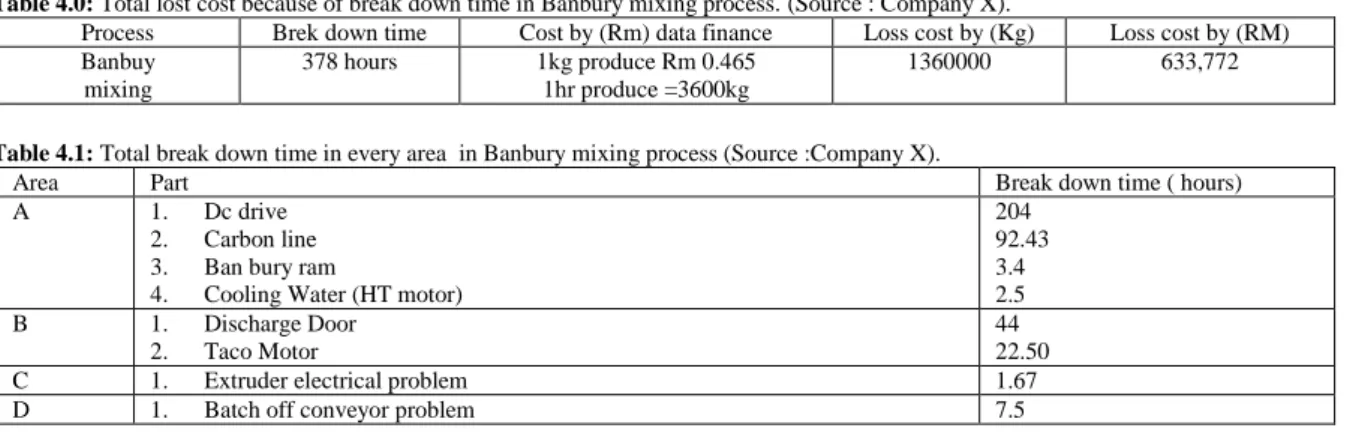
Result of this study was obtained from the use of methodologies such as interview conducted with the quality project engineer and production manager at the Company X. Through interviews with respondents to know more about the concept of applying Six Sigma in the manufacturing process a mixture of Banbury. In addition the documentation from Company X is used as a reference on the implementation of this concept in the Banbury mix. From the analysis found that the mixtured of Banbury there are four main areas. Through table 4.1 shows that the area A, the amount of the damage is high. Area A consists of the dc drive, carbon line, Banbury ram and cooling water (HT motors). Immediately, the dc drive and the carbon line shows the total break down time is high that are 204 hours and 92.43 hours. In this regard quality control improvement in these areas. The implementation of the concept of Six Sigma is focused by Company X in thi section to reduce the break down time and further improve the quality of the process. From that the production cost can be reduced.(Refer table 4.0 and 4.1 and figure 4.0).
Table 4.0: Total lost cost because of break down time in Banbury mixing process. (Source : Company X).
Process Brek down time Cost by (Rm) data finance Loss cost by (Kg) Loss cost by (RM) Banbuy
mixing
378 hours 1kg produce Rm 0.465 1hr produce =3600kg
1360000 633,772
Table 4.1: Total break down time in every area in Banbury mixing process (Source :Company X).
Area Part Break down time (hours)
A 1. Dc drive
2. Carbon line 3. Ban bury ram
4. Cooling Water (HT motor)
204 92.43 3.4 2.5
B 1. Discharge Door
2. Taco Motor
44 22.50
C 1. Extruder electrical problem 1.67
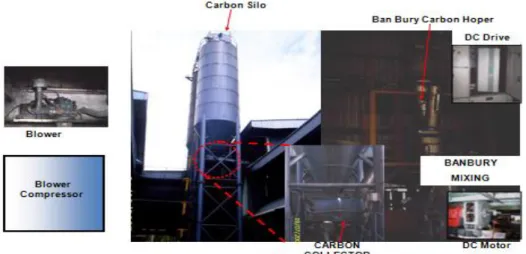
Fig. 4.0: Banbury machine which using in Banbury mixing process.
I Define Phase:
The results of the study, found that the Company X has the high break down time in the Banbury mixing process. According to the analysis found that a focus area as the majority of the break down time in area A. From there is specified that the dc drive and the carbon line shows the high amount of damage. From this improvement concept and rehabilitation focused of these areas .( Refer figure 4.1).
Fig. 4.1: The area having problem in Banbury mixing.
II Measurement Phase:
The measurement phase is carried out to improve performance in solving the problem of break down time in the Banbury mix in the area A. The part of focus is dc drive and carbon line. The data required are the factors and components that cause the damage break down time happen in the process. This phase begins with finding the total time of break down time in the Banbury mix in each area . Area A shows the highest amount in break down time and mainly in the dc drive and the carbon line is not functioning. The using of 5W1H method be as a planning for level measurement can be made more effective.
Table 4.2: Analysis of 5W1H method.
Where Banbury mixing process (area A) Who Operator and maintenance technicians.
When During the process flow
Why Output reducing due to machine breakdown and repairing. What Mechanical & electrical part breakdown.
How Countermeasure and improvement through Six Sigma.
III Analyze Phase:
Table 4.3: Phenomena analysis of Dc Drive.
Normal Condition Abnormal Condition
Wire in good condition.
Teco motor in order.
PCB board function
Wire loose and wire dusty.
Teco motor not in order.
PCB board malfunction.
Fig. 4.2: Diagram Ishikawa for problem Dc Drive mulfunction.
Table 4.4: Phenomena Carbon Collector.
Normal condition(Carbon Collector function) Abnormal condition(Carbon Collector malfunction)
Carbon hoper good condition
Rotary feeder function
Filter good condition
Hoper carbon jam
Rotary feeder malfunction & jam
Filter damage &jam
Fig. 4.3: Diagram Ishikawa for problem carbon line Banbury malfunction.
1.1 Improvement Phase:
1.2 Control Phase:
The control phase is conducted improvement to increasing the level of problem of break down time in Banbury mixing process in area A. This condition can be continuously improved to reduce the break down time in the process. In the control phase is an assessment has been made to ensure the repairs and changes done to the reduction in the break down time is reached or not. Besides ensuring the quality of the production process is in good condition. Company X has provided some evaluation forms to ensure ongoing improvements and changes made in the process to examine the quality of the process. Figure (Appendix F) refers to as examples of materials used by Company X to assess the state of the mixture in the Banbury area A that complies with the improvements already made. Evaluation form to help Company X to ensure the quality of the process is controlled or not. In addition, Company X must provide training programs and courses for technicians so that they better understand the improvements in the process, a mix of Banbury. This is so that they can be carried out in accordance with changes in the process. Also, can transfer technical expertise to the technicians to focus on the quality of the production process.
Fig. 4.4: Improvement evaluation form in Banbury mixing process in area A (Source : Company X).
Conclusion:
companies can make this company as an example and apply the concepts of Six Sigma in the manufacturing process to ensure the quality of quality control.
REFERENCES
Abdul Talib Bon, Lim Ping Ping, 2011. Implementation of Total Productive Maintenance (TPM) in Automotive Industry. 2011 IEEE Symposium on Business, Engineering and Industrial Applications (ISBEIA), Langkawi, Malaysia.
Abdul Talib Bon, Esam M.A. Mustafa, Umol Syamsyul Rakiman, 2012. Total quality management practices in Service organizations in malaysia: a review. Proceedings International Conference of Technology Management, Business and Entrepreneurship 2012 (ICTMBE2012), Renaissance Hotel, Melaka, Malaysia, 18-19 Dec 2012.
Antony, J., 2004. “Some Pros and Cons of Six Sigma: An Academic Perspective.”The TQM Magazine, 16(4): 303-306.
Antony, J. and R. Banuelas, 2002. “Key Ingredients for the Effective Implementation of Six Sigma Program.” Measuring Business Excellence, 6(4): 20-27.
Balestracci, D., 2006. TQM, Six-Sigma, Lean and Data, Quality Digest, pp: 17.
Banuelas, R. and J. Antony, 2002. “Critical Success Factors for the Successful Implementation of Six Sigma Projects in Organizations.” The TQM Magazine, 14(2): 92-99.
Bertels, T., 2003. “Rath & Strong’s Six Sigma Leadership Handbook.” New Jersey:John Wiley & Sons. 47 Causs, C.F., 1777-1855. “The History of Six Sigma.” http://www.scribd.com/doc/5205707/The-History-of-Six-Sigma.
Edward D. Arnheiter and John Maleyeff, 2005. “The integration of lean management and six sigma .” Emerald insight, 17: 5-18.
Elliott, G., 2004. “The Journey to Steps to Six Sigma” Handbook of BusinessStrategy, 5(1): 201-205. Henderson, K.M. and J.R. Evans, 2000. “Succesful Implementing of Six Sigma: Benchmarking General Electric Company” Edisi, 7: 262-268.
Ingle, S. and W. Roe, 2001. “Six Sigma Black Belt Implementation.” The TQM Magazine, 13(4): 273-280. Klefsjo, B., H. Wiklund and R.L. Edgeman, 2001. “Six sigma seen as a methodology for total quality management”, Measuring Business Excellence, 5(1): 31-35.
Kumar, D., 1942. “Six Sigma best practices: a guide to business process execellence for diverse industries.” pp: 25-28.
Magnusson, K., D. Kroslid and B. Bergman, 2003. Six Sigma-The Pragmatic Approach, Lund, Student litteratur.
Marcellus, R.L. and M. Dada, 1991. “Interactive Process Quality Improvement.” Management Science, 37: 1365-1376.
Mortimer, A.L., 2006. “Six Sigma: A Vital Improvement Approach When Applied to The Right Problems, In The Right Environment.”, Assembly Automation, 26(1): 10-17.
Pande, P.S., R.P. Neuman and R.R. Cavanagh, 2001. “The Six Sigma Way: How GE, Motorola and Other Top Companies are Honing Their Performance.” New York: McGraw-Hill, pp: 67-76.
Savolainen, T., 2007. “Dynamics of Organizational Learning and Continuous Improvement in Six Sigma Implementation.” The TQM Magazine, 19(1): 6-17.
Smith, G., 1993. ``Benchmarking success at Motorola'', Copyright Soceity of Management Accountants of Canada, March.
Stitt, J.B., 1989. "Don.t Overlook the Fundamentals", Quality Progress, pp: 44.