M E T H O D O L O G Y
Open Access
Fast valve power loss evaluation method
for modular multi-level converter operating
at high-frequency
Fen Tao
1, Zhujun Xie
2, Jie Cheng
1, Chenghao Li
2, Lu Zhao
1and Jinyu Wen
2*Abstract
There is no common accepted way for calculating the valve power loss of modular multilevel converter (MMC). Valve power loss estimation based on analytical calculation is inaccurate to address the switching power loss and valve power loss estimation based on detailed electro-magnetic simulation is of low speed. To solve this problem, a method of valve power loss estimation based on the detailed equivalent simulation model of MMC is proposed. Results of valve power loss analysis of 201-level 500MW MMC operating at 50Hz~1000Hz are presented. It is seen that the valve power loss of a MMC increased by 12, 40 and 93 % under 200Hz, 500Hz and 1000Hz operating frequency. The article concludes that in a device with isolated inner AC system, MMC operating at higher frequency will be more competitive than typical 50Hz/60Hz MMC with moderate increase of operating power loss and significant reduction of the size of the AC components.
Keywords:Modular multilevel converter (MMC), Medium-high frequency, Valve power loss, Conduction power loss, Switching power loss
Introduction
The Modular Multi-Level Converter (MMC) has been making its way for wide application in both medium and high voltage applications. The MMC is able to synthesize a very high quality sinusoidal waveform by generating a large number of voltage levels [1–3]. Each IGBT in the sub-modules(SM) is normally switched only at a equiva-lent frequency of 100-150Hz under Nearest Level Modu-lation (NLM). As a result, the power loss can be reduced to about 1 % per converter station [4].
Currently, there are no commonly accepted standards for determining the power loss for MMC. The IEC has a draft standard (IEC 62751) in preparation [5]. An intui-tive way of obtaining the valve power loss valve power losses of a converter station is comparing the measured power at the AC side and the DC side. However, the dif-ference between these two measured values is small, and a good accuracy will be very difficult to reach [5]. Also,
such method is not able to observe the distribution of value power loss and the factors that impact valve power losses. For most cases, therefore, the losses have to be estimated from component characteristics, using suitable mathematical models of the converters [6]. From trad-itional PWM modulated two-level and three-level volt-age source converter (VSC), the valve power loss can be obtained analytically [7, 8]. valve power lossvalve power losses The analytical method requires variables such as power factor, dc voltage, valve current and switching oc-casion of the semiconductors.
For MMC, some of the necessary input parameters such as valve currents and switching occasions are diffi-cult to be obtained by purely analytical methods [9]. Ref-erence [10] proposed a method based on piece-wise analytical formulas to evaluate the valve power lossvalve power losses, and accurate conduction power loss can be obtained. But the additional switching loss caused by voltage balancing control is estimated to its upper limit, which makes power loss evaluation result of [10] conservative.
To achieve accurate valve power loss evaluation, elec-trical variables such as the valve currents and the firing * Correspondence:[email protected]
2State Key Laboratory of Advanced Electromagnetic Engineering and
Technology (Huazhong University of Science and Technology), Wuhan, Hubei Province 430074, China
Full list of author information is available at the end of the article
pulses of each IGBT are required. Electro-magnetic sim-ulations are therefore recommended to obtain these var-iables. Reference [11] proposed interpolating analytically integrable equations to calculate voltage and currents during the switching event so as to accurately represent the switching power losses. But such integrable equa-tions are difficult to realize in simulation tools. By ana-lyzing the simulated voltage and current waveforms, power losses are evaluated with different converter oper-ation points in [12], where the detailed electro-magnetic simulation model of MMC was applied.
The method of [12] is accurate, except that it is based on detailed switching model of MMC and therefore the valve power loss estimation requires sig-nificant of simulation time. It may take one week to simulate 5-seconds dynamics of a 401-level MMC [13]. Therefore, the valve power loss evaluation based on detailed switching model is time consuming and inconvenient to analyze the impacts affecting valve power loss of MMC, which typically involves repeat-edly simulation. To solve such challenges, a valve power loss evaluation method based on fast MMC simulation model is proposed in this paper.
Operating at ac frequency higher than 50/60Hz, MMC can significantly reduce the size of AC transformer, AC inductor and sub-module capacitors. Such high fre-quency MMC can bring great benefits to front-to-front connected dc/dc converters [14] which consist of two ac/dc converters coupled by an AC transformer or other AC link such as LCL circuit. There are few literatures analyzing the valve power loss of MMC under high fre-quency operation [15]. Therefore, it would be beneficial to study the relationship between valve power loss and operating frequency.
In this paper, an accurate and fast valve power loss evaluation method is proposed based on detailed equiva-lent electro-magnetic simulation of MMC.
Method
Average value model for power loss study
Basic operating principles of mmc
Figure 1 (a) shows a three-phase MMC consisting of an upper arm and a lower arm for each phase unit, each arm has N half-bridge sub-modules (denoted as SM1-SMN) and one inductor L in series. The top-ology and control method of MMC has been well studied in [16, 17].
To calculate valve power loss accurately, firing pulses forT1,T2, arm current and SM capacitor voltage are re-quired from electro-magnetic simulation results. But, as pointed out in [13], detailed switch model of MMC costs excessively long simulation time. Thus, a fast simulation model of MMC is proposed as a substitution to obtain the above variables for valve power loss.
Fast simulation model for MMC
Figure 1 (b) shows schematic of the fast MMC simula-tion model (taking one phase as an example). In this model, each arm is represented by a controlled voltage source with the magnitude ofUarm.
The user defined component ‘Calculate SM Voltages’
takes arm current Iarm and firing pulse SC(1:N) of each SM as the inputs to get capacitor voltage for each SM. The‘Modulation and Voltage Balancing Control’module takes reference voltageUref, arm currentIarmand capaci-tor voltageUC(1:N)as inputs to generate the firing pulses of each sub module [18].
The voltage of SM can be expressed as:
UCið Þ ¼t UCiðt−ΔtÞ þ
SCi
C
Zt
t−ΔT
ISMið Þτ dτ ð1Þ
In eq.(1), Δt is the integration step,UCi(t) is the
volt-age of SM capacitor,UCi(t−Δt) is the SM voltage in
pre-vious integration,SCiis a signal function with values of 1
and 0, which represents switch-on state and bypass state of SM,ISMiis the arm current flowing into SM.
By trapezoid integral:
UCið Þ ¼t UCiðt−ΔtÞ þΔ t
2 ⋅
SCi
C ðIarmAð Þ þt IarmAðt−ΔtÞÞ ð2Þ
IarmAis the upper arm current of phase A and it is the
same ofISMi.
The output voltage of numberith SM is:
USMi¼UconiþSCi⋅UCi ð3Þ
Uconiis the on-state voltage of an IGBT or diode, it
ex-hibits when device is in the conducting state. The on-state voltage depends on its current in a non-linear man-ner and it is usually represented as a piecewise-linear ap-proximation [19] with a threshold voltage U0 and a
slope resistanceRcon, as shown by equation (4):
Uconi¼Rconi⋅ISMiþU0i ð4Þ
Depending on the directions of arm current and switch on/off state of SM, there are 4 values forUconi:
Uconi¼
Rconi D1⋅ISMiþU0i D1;ISM>0and SC¼1
Rconi T1⋅ISMi−U0i T1;ISM <0and SC¼1
Rconi T2⋅ISMiþU0i T2;ISM>0and SC¼0
Rconi D2⋅ISMi −U0i D2;ISM<0and SC¼0 8 > > < > > :
ð5Þ
UupA¼ XN
i¼1
USMi¼ XN
i¼1
UconiþSCi⋅UCi
ð Þ ð6Þ
In.(6),Nis the number of SMs in one arm.
Taking this calculated voltage as reference value of the voltage controlled voltage source(VCVS) shown in Fig. 1 (b), a numerical arm of MMC can be established.
This fast simulation model is able to obtain almost identical simulation results as the detailed switching model while simulation speed can be improved by approximately 10,000 times. In addition, it provides the pulse signal of each IGBT, capacitor voltage of
each SM and waveform of arm current for power loss study.
Valve power loss calculation method based on fast simulation model
Categories of valve power losses
The power losses are usually estimated from component characteristics, using suitable mathematical models of the converters. The valve power loss can be subdivided into 5 iterms:1) IGBT conduction losses; 2) diode conduction losses; 3) IGBT switching losses; 4) diode recovery losses; 5) IGBT and diode cut-off losses. The formulas for each item of valve power loss has been well
developed in [4–8]. To be concise, they are listed in the Appendix.
Junction temperature and parameters adjustment
The valve power loss requires the parameters such as the threshold voltage, conduction resistance and switch-ing energy of the power semiconductors (as presented in (12, 13, 14, 15, 16, 17, 18, 19 and 20) in the Appendix). These parameters are related to the PN junction temperature of power semiconductors. In return, PN junction temperature also depends on the heat generated by loss power. Thus, to accurately estimate valve power loss, power loss and junction temperature of each device need to be calculated iteratively.
Since the junction temperature cannot be measured directly, it will be estimated using a thermal circuit as presented in literatures [12] and [19]. Input for the ther-mal circuit is the measured temperature of the heat sink while output is the estimated PN junction temperature.
Procedure of iterating the PN junction temperature can be described as follows:
1) The heat sink temperature will be measured and an initial value of PN junction temperature is given; 2) Based on the present PN junction temperature,
parameters such as the threshold voltages,
conduction resistance and switching energy will be calculated from the datasheet provided by the manufacture;
3) From the obtained parameters of step 2) and the simulated arm currents, sub-module capacitor voltages and the switching state of each sub-module, valve power loss of the power semiconductor will be estimated;
4) Based on the estimated valve power loss, the measured heat sink temperature and the thermal circuit of the power semiconductor, a new estimated PN junction temperature is obtained;
5) Substitute the obtained new PN junction temperature of step 4) into step 2) and repeat step 2) to 4) until the difference between the previous estimated PN junction temperature and the present estimated PN junction temperature falls within a pre-defined deviation
Flow chart of valve power loss
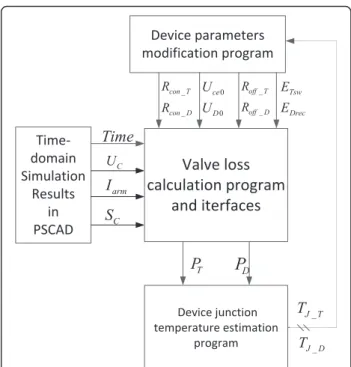
A common valve power loss program for MMC is de-signed in this paper. Flowchart of the program is shown in Fig. 2. It is based on Matlab/GUI with interface to PSCAD/EMTDC.
Firstly, simulation results of fast model in PSCAD are saved as. OUT file. Then the data of capacitor voltages (Uc), arm current(Iarm) and switching states of each sub-modules(SC) of the six arms will be read by the ‘Valve
power loss calculation program’developed in Matlab. By reading initial parameters of semiconductor devices from
‘Device parameters modification program’, the power loss and junction temperature of each device can be estimated.
In the next calculation step, the initial parameters of de-vices are adjusted according to its junction temperature. And then, the power losses are calculated again with the simulation results data of this time step.
Because the switching pattern of each sub-module var-ies from one fundamental circle to the next, the loss cal-culation result should be the average value of several fundamental cycles (time duration per circle is 20 ms for 50Hz ac frequency).
In the simulation results reading program mentioned above, the operating frequency on ac side of MMC can be recognized.
Parameters design for high frequency MMC To ensure the valve power loss calculation results under different operation frequency are comparable, the value of SM capacitor and arm inductor should be designed commensurate to the operating frequency.
Value of arm inductor against operating frequency
Though arm inductor can be designed to suppress in-rush current in transient or suppress circulating current
between the arms, it is usually seen as the connection inductor between ac grid and converter [20].
The apparent capacity (per unit) of connection in-ductorXcan be determined by:
SLð Þ ¼pu
IN2X
VNIN¼
sinδN
j j;φ¼0 ð7Þ
For HVDC application, |δN| is usually set between 5.7°
and 17.5°. Then SL(pu)should be 0.1 ~ 0.3, thusXcan be determined in the range of 0.1 ~ 0.3pu.
Since the per unit value of arm inductor is constant, the actual inductance is inversely proportional to operat-ing frequency. In the followoperat-ing high frequency MMC study, the arm inductance is adjusted according to the operating frequency to make sure that valve power loss calculation results are comparable.
Value of SM capacitor against operating frequency
The value of SM capacitor can be determined by the limitation of voltage fluctuation range, illustrated by:
C0¼ Δ
WSM
2εðUCÞ2
ð8Þ
Where, ε is maximum fluctuation limit percentage of SM voltage and it is usually set as 10 %. ΔWSM is the
fluctuant energy of the capacitor.
ΔWSMð Þ ¼k
2PS
kNω0
1− kcosφ 2
2
" #3
2
ð9Þ
Where, PS is the apparent power of MMC and ω0 is operating angular frequency.krepresents voltage modu-lation ratio. Substituteeq.(9) intoeq.(8), the capacitor of SM can be calculated by:
C0¼
Ps
3kNω0εðUCÞ2
1− kcosφ 2
2
" #3
2
ð10Þ
From eq.(10), it can be concluded thatC0is inversely proportional to operating frequency under certain oper-ating conditions.
From the information disclosed in [15], we can see that capacitor occupies almost half the volume of a SM. Thus, high frequency MMC can significantly reduce the volume of SMs therefore reduce the volume and weight of a MMC.
Results
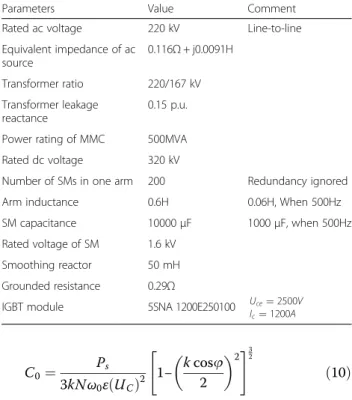
A three phase Modular Multi-level Converter was mod-eled in PSCAD/EMTDC. The system layout is shown in Fig. 3 and the parameters under different operating con-ditions are shown in Table 1.
Accuracy verification of the proposed method
To verify the proposed average value model of MMC can be applied for valve power loss, the valve power loss calculation results of fast model, detailed model and analytical method are shown in Table 2. The results are
Fig. 3Simulation results of arm current
Table 1Converter parameters and operation conditions
Parameters Value Comment
Rated ac voltage 220 kV Line-to-line
Equivalent impedance of ac source
0.116Ω+ j0.0091H
Transformer ratio 220/167 kV
Transformer leakage reactance
0.15 p.u.
Power rating of MMC 500MVA
Rated dc voltage 320 kV
Number of SMs in one arm 200 Redundancy ignored
Arm inductance 0.6H 0.06H, When 500Hz
SM capacitance 10000μF 1000μF, when 500Hz
Rated voltage of SM 1.6 kV
Smoothing reactor 50 mH
Grounded resistance 0.29Ω
IGBT module 5SNA 1200E250100 Uce¼2500V
Ic¼1200A
Table 2Converter parameters and operation conditions
Detailed model
Fast model Analytical method
Switching frequency/Hz 98.5 95.25 95
Switching loss/kW 17.23 17.01 36.24
Conduction loss/kW 444.78 442.20 440.00
Total loss/kW 462.01 459.21 476.24
illustrated as the conduction loss and switching loss of a 50 MW 21-level MMC.
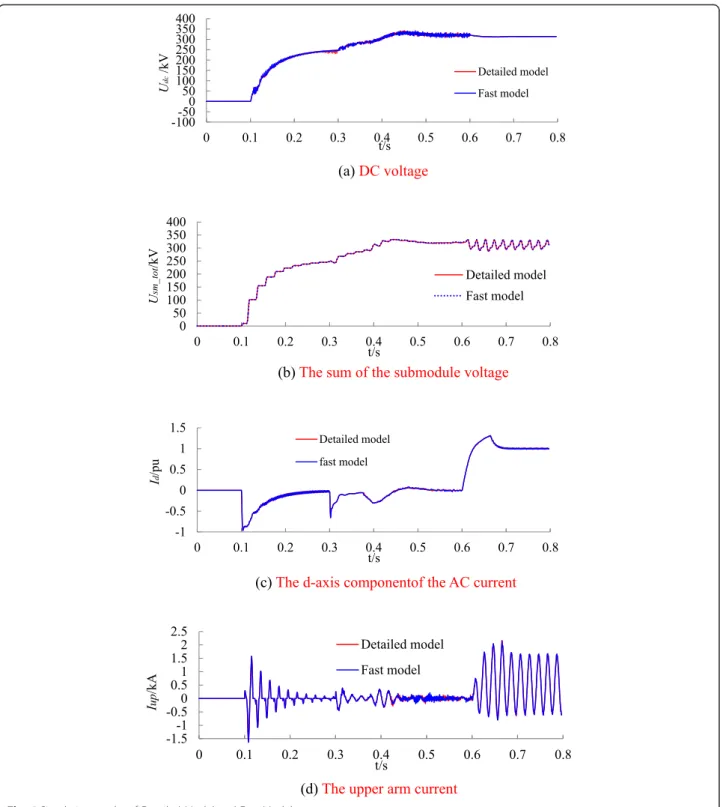
By comparison, the result of detailed model and fast model is shown in Fig. 4.UdcandUsm_totare the DC
volt-age and the sum of the Submodule voltvolt-age respectively.Id
and Iupare the d-axis component of the AC current and
the upper arm current, respectively.
Apparently, the performance curve of the detailed model and fast model are basically in coincidence. The error of the conduction loss, switching loss and total loss between fast model and detailed model is about 0.58, 1.29 and 0.61 %. Thus, it can be concluded that the fast model of MMC proposed in this paper can provide high accuracy in valve loss calculation. The running time of
the detailed model and fast model is 187,045 s and 502.2 s respectively, which can be concluded that the speed of the calculation process is significantly improved.
On the other hand, the analytical method can also produce an approximate value of conduction loss by ap-plying mean and rms current of each arm. [6] Since switching occasions cannot be resented analytically, the switching loss is estimated by multiplying switching energy and average switching frequency. However, the turn-on and turn-off energy of IGBT and recovery energy of diode should depend on the instantaneous current and dc voltage instead of their mean and rms value. Thus, analytical method presents a large error, about 110 %, on switching loss.
Since the detailed model of MMC takes excessively long simulation time, the further study of this paper is based on the fast model shown in Fig. 1 (b).
Verification of MMC models under different frequency
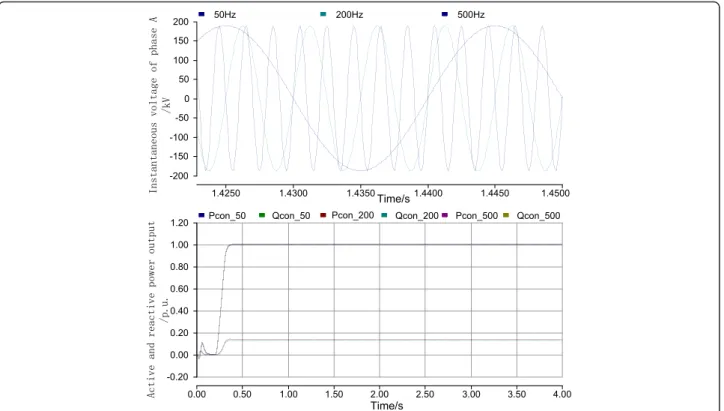
Figure 5 shows the simulation results of the MMC under 50Hz, 200Hz and 500Hz AC frequency while operating at the same power level.
Figure 5 (a) shows the instantaneous voltage of phase A and Fig. 5 (b) shows the active and reactive power output of MMC. It can be seen the voltage magnitudes and power output are exactly the same regardless of the different operating frequencies.
The simulation result of Fig. 5 verifies that the following power loss and comparison of MMC under different operat-ing frequency are carried under same boundary conditions. The only variable is the operating frequency of MMC.
Power loss of each device in a SM
Valve power loss of four typical operation conditions for an MMC, namely, (P,Q) = (1, 0), (-1, 0), (0, 1), (0, -1) are analyzed in this section. Under each condition, the power loss distribution of each IGBT and diode in a SM is different.
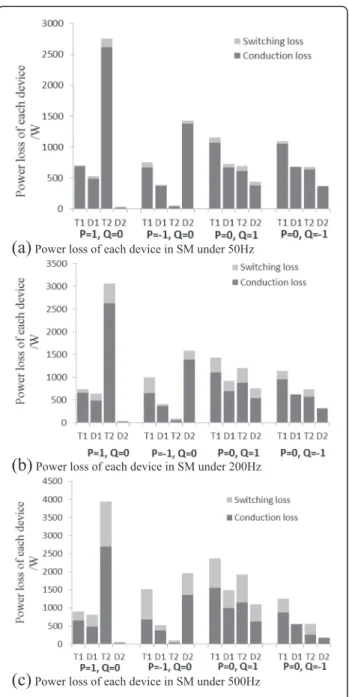
Figure 6 shows the calculated power loss of SM1 on upper arm of phase A under four rated conditions at different AC frequencies. The conduction loss of de-vices is illustrated in dark grey color and switching loss in light grey.
Figure 6 (a)-(c) show that under the condition of (P, Q) = (1,0), power loss of the lower IGBT(T2) con-stitutes the majority of power loss of a SM. Under the condition of (P, Q) = (-1,0), power loss of D2 is significantly higher than the other three semicon-ductor switches. Power losses under the conditions of (P, Q) = (0,1) and (P, Q) = (0,-1) are more evenly dis-tributed among the four semiconductor switches.
Figure 6 also shows that increase of the operating fre-quency only increases the switching power loss while the conduction loss is almost un-affected.
Power loss of MMC with different active power levels
This section calculate the power loss under different power output conditions by setting reactive power to be zero and changing the active power from -1.0 p.u. to 1.0 p.u. with step size of 0.1 pu. The power loss results and a second-order polynomial fitting curve between power output and power loss are shown in Fig. 7.
Comparison between Fig. 7 (a) and (b) shows the power loss of a MMC is higher at inverting mode than rectifying mode. Figure 7 also shows the relationship of
the power loss and the active power follows a second-order polynomial.
Figure 8 shows the percentage of valve power loss power versus the corresponding active power level of the 201-level MMC with power rating of 500 MW.
The total power loss at rated power is 4.097 MW at 50Hz AC frequency, which is approximately 0.8 % of rated power. With AC frequency increased up to 200Hz and 500Hz, the power loss ratio increased up to 0.95 and 1.2 % respectively.
Discussion
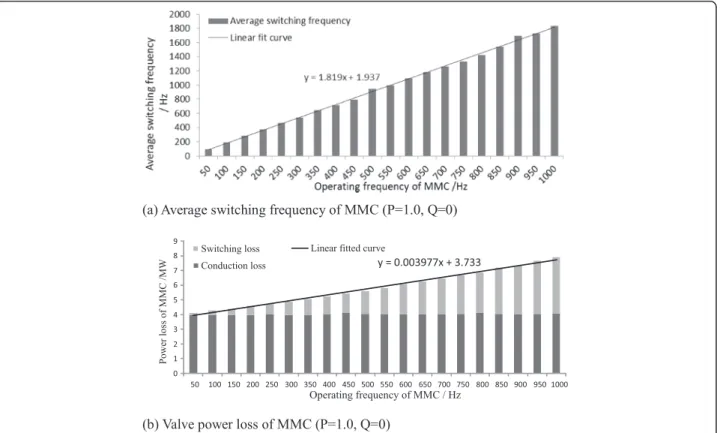
To further illustrate the relationship between valve power loss and operating frequency, operating frequency of MMC is varied from 50Hz to 1000Hz at a step of 50Hz. Figure 9 (a) and (b) respectively shows the average equiva-lent switching frequency and total valve power loss of MMC. The equivalent switching frequency is defined as:
fsw avg ¼ 1 T0⋅
1 6N⋅
X6
j¼1 XN
j;i¼1
gsw T1ð Þ þi gsw T2ð Þi
" #
ð11Þ
In (11), gsw_T1 and gsw_T1 is the number of switching
instances of IGBT1 and IGBT2 in one sub-module,
Fig. 6Valve power loss of SM under different operation frequency
during time period T0. T0 is selected to be 1 s to take into effect that switching pattern of a sub-module varies from one fundamental cycle to another funda-mental cycle.
It can be seen from Fig. 9 (a) that the equivalent switching frequency increases linearly with operating AC frequency. And switching frequency of a MMC is about 1.8 times of operating AC frequency with the nearest level control modulation and voltage balan-cing control [21].
Figure 9 (b) shows switching loss also increases linearly with the increasing of operating frequency while
conduction loss remains almost unchanged. Thus, total valve power loss would increase linearly with operating frequency. At the operating frequency of 1 kHz, the switching loss is almost the same as the conduction power loss, making the total power loss of a MMC up to 1.6 %.
We can empirically conclude from Fig. 9 that a MMC operating at 500Hz AC frequency will increase the total power loss by 40 % while the size of ac inductors and sub-module capacitor can be reduced approximately by 10 times.
Conclusions
A fast electro-magnetic simulation model of MMC is de-veloped for accurate power loss. It can obtain almost identical simulation results as the detailed switch model while simulation speed can be improved by approxi-mately 10,000 times.
A more accurate program for estimating valve power loss of MMC and junction temperature of devices is proposed, by linking PSCAD/EMTDC and Matlab. The accuracy of power loss calculation is verified by comparison with detailed model of MMC.
Relationships between power losses, the power transfer level and operating frequencies are presented and fitted, with a case of 201-level MMC working at 50Hz ~ 1000Hz.
Fig. 8Valve power loss percentage of MMC under different power output
Analysis shows that compared with 50Hz operation, the valve power loss of MMC increased by 12, 40 and 93 % under 200Hz, 500Hz and 1000Hz. Since the volume of arm inductor, SM capacitor and transformer of an MMC can be reduced inversely proportional to the operating frequency. Thus, MMC operating at higher frequency will be more competitive than typically 50/ 60Hz MMC for potential applications in offshore front-to- front connected dc-dc converters.
Appendix
Conduction losses of IGBT and diode
Denote the on-state voltage asUDfor diodes andUcefor
IGBTs. The conduction loss can be evaluated mathemat-ically as follows:
PTcon¼Uce⋅Ic¼ðRT⋅IcþUce0Þ⋅Ic ð12Þ
PDcon¼UDID ¼ðRDIDþUD0Þ ID ð13Þ
Where Uce0 and UD0 are respectively the threshold voltages for IGBT and diode. RTand RDare respectively the slope resistance for IGBT and diode.
Switching losses of IGBT and diode
IGBT switching energies Eon and Eoff are normally quoted by the manufacturer as a function of current. Diode switching energies are referred to as recovery en-ergy Erec and can also be expressed as a function of current.
Eon ¼ a1þb1⋅Icþc1⋅Ic2
Udc
UdcN ð
14Þ
Eoff ¼ a2þb2⋅Icþc2⋅Ic2
Udc
UdcN ð
15Þ
EDrec¼ a3þb3⋅IDþc3⋅ID2
Udc
UdcN ð
16Þ
The fitting parameters a1, b1, c1, a2, b2, c2and a3, b3,
c3can be found on the datasheet from manufacturer.
The total IGBT and diode switching losses are calcu-lated by summing all the turn-on energies Eon and the turn-off energies Eoff or the recovery energies Erec over an integration time intervalT0.
PT sw¼
1
T0⋅ Xm
j¼1
ETonð Þ þj EToffð Þj
ð17Þ
PDrec¼
1
T0⋅ Xn
k¼1
EDrecð Þk ð18Þ
Where, m is the number of switching circles (on and off ) experienced by the IGBT during the integration time T0, n is the number of recovery occasions experi-enced by the diode during the integration timeT0.
IGBT and diode cut-off losses
The cut-off power losses are calculated as:
PToff ¼Uce⋅Ic leak Tj ð19Þ
PDoff ¼UD⋅ID leak Tj ð20Þ
The value of leakage current can be found in datasheet from manufacturer and the typical value is 10 mA (Tj =25 °C) and 60 mA (Tj =125 °C) for IGBT.
About the Authors
F. Taoreceived the B. Eng. degree in electrical engineering from the Huazhong University of Science and Technology, Wuhan, China, in 2007, where she is currently working as engineer in planning department of PowerChina Hubei Electric Engineering Corporation. His research interest is Design, planing and operation of power system.
Z.J. Xiereceived the Bachelor degree in electrical engineering from the Huazhong University of Science and Technology, Wuhan, China, in 2014, where he is currently working toward the B. Eng. degree. His research interest is modular multilevel converter and power flow control in dc grids.
L. Zhaoreceived the B. Eng. degree in electrical engineering from the Wuhan University, Wuhan, China, in 2011, where he is currently working as group leader in planning department of PowerChina Hubei Electric Engineering Corporation. His research interest is Design, planing and operation of power system.
C.H. Lireceived the B. Eng. degree in electrical engineering from the Huazhong University of Science and Technology, Wuhan, China, in 2009, where he is currently working toward the Ph.D. degree. His research interest is multi-terminal high-voltage direct-current control and dc grids.
J. Chengreceived the B. Eng. degree in electrical engineering from the Wuhan University, Wuhan, China, in 2010, where she is currently working as assistant manager in planning department of PowerChina Hubei Electric Engineering Corporation. His research interest is Design, planing and operation of power system.
J.Y. Wen(M’10),received his B. Eng. and Ph.D. degrees all in electrical engineering from Huazhong University of Science and Technology (HUST), Wuhan, China, in 1992 and 1998, respectively.
He was a visiting student from 1996 to 1997 and research fellow from 2002 to 2003 all at the University of Liverpool, UK, and a senior visiting researcher at the University of Texas at Arlington, USA in 2010. From 1998 to 2002 he was a director engineer in XJ Electric Co. Ltd. in China. In 2003 he joined the HUST and now is a professor at HUST. His current research interests include renewable energy integration, energy storage application, DC grid, and power system operation and control.
Competing interests
The authors declare that they have no competing interests.
Authors’contributions
FT proposed the fast valve power loss estimation method and drafted the manuscript. ZJX implemented the valve power loss estimation algorithm. LZ carried valve power loss estimation of MMC operating under different frequency. CHL designed the parameters of MMC operating under high frequency. JC verified the fast MMC simulation model. JYW designed the case studies. All authors read and approved the final manuscript.
Acknowledgement
This work was supported by the PowerChina Hubei Electric Engineering Corporation.
Author details
1PowerChina Hubei Electric Engineering Corporation, Wuhan, Hubei Province
430040, China.2State Key Laboratory of Advanced Electromagnetic
Engineering and Technology (Huazhong University of Science and Technology), Wuhan, Hubei Province 430074, China.
References
1. Dorn, J., Huang, H., & Retzmann, D. (2007).Novel voltage-sourced converters for HVDC and FACTS applications(pp. 1–6). Osaka: CIGRE Symposium. 2. Dorn, J., Huang, H., & Retzmann, D. (2008).A new multilevel voltage sourced
converter topology for HVDC applications(pp. 1–8). Paris, France: Proc. CIGRE. 3. Deore, S. R., Darji, P. B., & Kulkarni, A. M. (2013). Switching function analysis
of half- and full-bridge modular multi-level converters for HVDC applications.IET Generation, Transmission & Distribution, 7(11), 1344–1356. 4. Jones, PS, Davidson, CC.‘‘Calculation of power losses for MMC-based VSC
HVDC stations,”Power Electronics and Applications (EPE), 2013 15th European Conference on, Lille, 2013, pp. 1–10.
5. IEC 62751:‘Determination of power losses in voltage sourced converter (VSC) valves for high-voltage direct current (HVDC) systems’. 2013. 6. Oates, C, Davidson, C.‘‘A comparison of two methods of estimating losses
in the Modular Multi-Level Converter,’’Power Electronics and Applications (EPE 2011), Proceedings of the 2011-14th European Conference on, Birmingham, 2011, pp. 1–10.
7. Pang, H, Tang, G, He, Z.‘‘Evaluation of losses in VSC-HVDC transmission system,’’Power and Energy Society General Meeting-Conversion and Delivery of Electrical Energy in the 21st Century, 2008 IEEE, Pittsburgh, PA, 2008, pp. 1–6. 8. Zhang, Y, Adam, GP, Lim, TC, Finney, SJ, Williams, B.W.‘‘Voltage source
converter in high voltage applications: Multilevel versus two-level converters,’’AC and DC Power Transmission, 2010. ACDC. 9th IET International Conference on, London, 2010, pp. 1–5.
9. Zygmanowski, M, Grzesik, B, Fulczyk M, Nalepa, R.‘‘Analytical and numerical power loss analysis in Modular Multilevel Converter,’’Industrial Electronics Society, IECON 2013 - 39th Annual Conference of the IEEE, Vienna, 2013, pp. 465–470.
10. Zhang, Z., Xu, Z., & Xue, Y. (2014). Valve power lossValve power losses Evaluation Based on Piecewise Analytical Method for MMC–HVDC Links.IEEE Transactions on Power Delivery, 29, 1354–1362.
11. Rajapakse, A. D., Gole, A. M., & Wilson, P. L. (2005). Electromagnetic Transients Simulation Models for Accurate Representation of Switching Losses and Thermal Performance in Power Electronic Systems.IEEE Transactions on Power Delivery, 20, 319–327.
12. Tu, Q., Xu, Z.,‘‘Power losses evaluation for modular multilevel converter with junction temperature feedback’’2011 IEEE Power and Energy Society General Meeting, San Diego, CA, 2011, pp. 1–7.
13. Peralta, J., Saad, H., Dennetiere, S., Mahseredjian, J., & Nguefeu, S. (2012). Detailed and Averaged Models for a 401-Level MMC–HVDC System.IEEE Transactions on Power Delivery, 27, 1501–1508.
14. Jovcic, D., & Lin, W. (2014). Multiport High-Power LCL DC Hub for Use in DC Transmission Grids.IEEE Transactions on Power Delivery, 29, 760–768. 15. Luth, T., Merlin, M. M. C., Green, T. C., Hassan, F., & Barker, C. D. (2014).
High-Frequency Operation of a DC/AC/DC System for HVDC Applications.
IEEE Transactions on Power Electronics, 29, 4107–4115.
16. Adam, G. P., & Williams, B. W. (2014). New emerging voltage source converter for high-voltage application: hybrid multilevel converter with dc side H-bridge chain links.IET Generation, Transmission & Distribution, 8, 765–773.
17. Rohner, S., Bernet, S., Hiller, M., & Sommer, R. (2010). Modulation, losses,and semiconductor requirements of modular multilevel converters.IEEE Trans Ind Electron, 57(8), 2633–2642.
18. Yu F, Lin W, Wang X and Xie D. Fast voltage-balancing control and fast numerical simulation model for the modular multilevel converter, IEEE Transactions on Power Delivery, early access on IEEE Xplore. 19. ABB.‘Applying IGBTs’. pp. 1-40.
20. Qingrui, T, Zheng, X, Hongyang, H, Jing, Z.‘‘Parameter design principle of the arm inductor in modular multilevel converter based HVDC’’,Power System Technology (POWERCON), 2010 International Conference on, Hangzhou, 2010, pp. 1–6.
21. Qingrui, T., Zheng, X., & Lie, X. (2011). Reduced Switching-Frequency Modulation and Circulating Current Suppression for Modular Multilevel Converters.IEEE Transactions on Power Delivery, 26(3), 2009–2017.
Submit your manuscript to a
journal and benefi t from:
7Convenient online submission 7Rigorous peer review
7Immediate publication on acceptance 7Open access: articles freely available online 7High visibility within the fi eld
7Retaining the copyright to your article