AUSTRALIAN JOURNAL OF BASIC AND
Open Access Journal
Published BY AENSI Publication
© 2016 AENSI Publisher All rights reserved
This work is licensed under the Creative Commons Attribution International License (CC BY). http://creativecommons.org/licenses/by/4.0/
To Cite This Article: Asmaa N. Al-Janabi, Raheam A. Al
Aust. J. Basic & Appl. Sci., 10(9): 8-18, 2016
General Asymptotic Regional Gradient Observer
1Asmaa N. Al-Janabi, 2Raheam A. Al-Saphory,
1Department of Mathematics, College of Science, Al
2Department of Mathematics, College of Education for Pure Sciences, Tikrit University, Tikrit, IRAQ. 3Department of Mathematics, College of Science, Al
Address For Correspondence:
Asmaa N. Al-Janabi, 1Department of Mathematics, College of Science, Al E-mail: [email protected]
A R T I C L E I N F O
Article history:
Received 3 March 2016; accepted 2 May 2016; published 26 May 2016
Keywords:
exactly -observable, -detectability, -observers, -strategic sensors, Diffusion system.
The notion of observer theory was introduced for finite dimensional li been extended to multi-variables systems in
dimensional linear systems characterized by strongly continuous semi
1975). The study of observer concept via the sensors and actuators structure was developed by El Jai and Pritchard in (El Jai and Pritchard 1988)
considered system state as in (El Jai andAmouroux19 been introduced by Al-Saphory and El Jai in
2011) consists in studying the asymptotic behavior of the systems not in the whole the doma sub-region of a spatial domain
concrete-real problems, in mechanic, thermic, environment in
et al., 2010). Commercial buildings are responsible for a significant fraction of the energy consumption and
greenhouse gas emissions in the U.S. and worldwide. Consequently, the design, optimization and control of energy efficient buildings can have a tremendous impact
Mathematically, building models are complex, multi with wide varieties of disturbances(Burns
AUSTRALIAN JOURNAL OF BASIC AND
APPLIED SCIENCES
8414 -2309 : 8178 EISSN
-ISSN:1991
Journal home page: www.ajbasweb.com
© 2016 AENSI Publisher All rights reserved
This work is licensed under the Creative Commons Attribution International License (CC BY). http://creativecommons.org/licenses/by/4.0/
Janabi, Raheam A. Al-Saphory, Naseif J. Al-Jawari., General Asymptotic Regional Gradient Observer , 2016
General Asymptotic Regional Gradient Observer
Saphory, 3Naseif J. Al-Jawari
Department of Mathematics, College of Science, Al-Mustansriyah University, Baghdad, IRAQ. Department of Mathematics, College of Education for Pure Sciences, Tikrit University, Tikrit, IRAQ. Department of Mathematics, College of Science, Al-Mustansriyah University, Baghdad, IRAQ.
1Department of Mathematics, College of Science, Al-Mustansriyah University, Baghdad, IRAQ.
A B S T R A C T
The main purpose of this paper is to study and characterize the existing of general asymptotic regional gradient observer which observe the current gradient state of the original system in connection with gradient strategic sensors. Thus, we give an approach based to Luenberger observer theory of linear distributed parameter systems which is enabled to determinate asymptotically regional gradient estimator of current gradient system state. More precisely, under which condition the notion of asymptotic regional gradient observability can be achieved. Furthermore, we show that the measurement structures allows the existence of general asymptotic regional gradient observer and we give a sufficient condition for such asymptotic regional gradient observer in general case. We also show that, there exists a dynamical system for the considered system is not general asymptotic gradient observer in the usual sense, but it may be general asymptotic regional gradient observer. Then, for this purpose we
present various results related to different types of sensor boundary conditions in two dimensional distributed diffusion systems.
INTRODUCTION
The notion of observer theory was introduced for finite dimensional linear system by Luenberger
variables systems in (Luenberger, 1966). This theory is generalized to infinite dimensional linear systems characterized by strongly continuous semi-group operatorsby(Gressang and Lamont, study of observer concept via the sensors and actuators structure was developed by El Jai and (El Jai and Pritchard 1988). The purpose of an observer is to provide an state estimation for the (El Jai andAmouroux1988). The concept of asymptotic regional construction has Saphory and El Jai in (Al-Saphory, 2002), (Al-Saphory and El Jai, 2002
consists in studying the asymptotic behavior of the systems not in the whole the doma
of a spatial domain Ω. The main reason for introducing the concept is motivated by certain real problems, in mechanic, thermic, environment in(El Jai, et al.,1995),(Burns et al
Commercial buildings are responsible for a significant fraction of the energy consumption and greenhouse gas emissions in the U.S. and worldwide. Consequently, the design, optimization and control of energy efficient buildings can have a tremendous impact on energy cost and greenhouse gas emission. Mathematically, building models are complex, multi-scale, multi-physics, highly uncertain dynamical systems
(Burns et al., 2009).
General Asymptotic Regional Gradient Observer. Mustansriyah University, Baghdad, IRAQ.
The main purpose of this paper is to study and characterize the existing of general asymptotic regional gradient observer which observe the current gradient state of the original system in connection with gradient strategic sensors. Thus, we give an ach based to Luenberger observer theory of linear distributed parameter systems which is enabled to determinate asymptotically regional gradient estimator of current gradient system state. More precisely, under which condition the notion of asymptotic onal gradient observability can be achieved. Furthermore, we show that the measurement structures allows the existence of general asymptotic regional gradient observer and we give a sufficient condition for such asymptotic regional gradient eral case. We also show that, there exists a dynamical system for the considered system is not general asymptotic gradient observer in the usual sense, but it may be general asymptotic regional gradient observer. Then, for this purpose we sensor structures, domains and boundary conditions in two dimensional distributed diffusion systems.
near system by Luenberger and has This theory is generalized to infinite (Gressang and Lamont, study of observer concept via the sensors and actuators structure was developed by El Jai and . The purpose of an observer is to provide an state estimation for the . The concept of asymptotic regional construction has Saphory and El Jai, 2002), (Al-Saphory, consists in studying the asymptotic behavior of the systems not in the whole the domain but in an internal . The main reason for introducing the concept is motivated by certain
et al., 2009)and (Burns
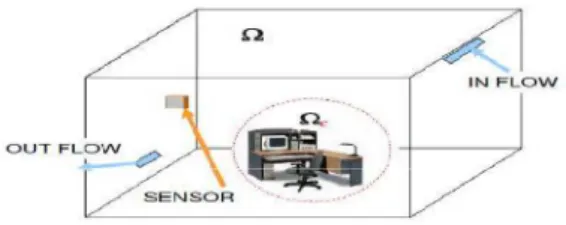
Fig. 1: Room control model with sensor, in flow and out flow
In this paper we use a model problem to illustrate that distributed parameter control based on PDEs, combined with high performance computing can be used to provide practical insight into important issues such as optimal sensor/actuator placement (may be best or strategic sensors/ actuators) and optimal supervisory building control. In order to illustrate some of the ideas, we consider the problem illustrated by a single room shown in (Figure 1). This model one can reformulated (Burns et al., 2010) as spatial case of more general model of distributed parameter systems and represented in the next section (see Figure 2).
In this paper, we introduced an approach which allow to construct a general asymptotic -observers in a given sub-region of the domain Ω, in connection with sensors structures this approach based on the concept of asymptotic regional gradient detectability as in (Al-Saphory and El Jai, 2002) and (Al-Saphory et al., 2010).
This paper is organized as follows:
Section 2 is devoted to the problem statement and preliminaries. We recall that the definitions of -stability and asymptotic - detectability and we give some definitions about asymptotic - observers. Section 3, we have given a characterize for existing a general asymptotic regional gradient observer to provide a general asymptotic regional gradient estimator of gradient state for an original system via sensors structures and we show that there exist a general asymptotic -observers in the subregion is not general asymptotic - observer in the whole the domain Ω.
2. Problem Statement:
Let Ω be a regular bounded open subset of , with smooth boundary Ω and be subregion of Ω, [0,T],
> 0 be a time measurement interval. we denoted = Ω× 0, , = Ω× 0, . We considered
distributed parabolic system is described by the following equation:
, = , + , 0 = Ω
, = 0
!
(1)
Augmented with the output function
" . , = $ , (2)
We have
= %
& '(& & (,&)*
With '(& ∈ , - . Suppose that − is elliptic, i.e., there exits / > 0 such that
∑(,&)*'(& ( &≥ / ∑ 2&)* &23 a.e. on , ∀ = *, … , ∈
Where is a second order linear differential operator, which generator a strongly continuous semi-group
678 9: on the Hilbert space ; and is self-adjoin with compact resolvent. The operator ∈ < =, ; and
$ ∈ < >, ; , depend on the structure of actuators and sensors (El Jai and Pritchard 1988). The space
;, ? and C be separable Hilbert spaces where ; is the state space, ? = <3 0, , = is the control space and
C = <3 0, , > is the observation space where D and E are the numbers of actuators and sensors (see Figure
2).
Under the given assumption, the system (1) has a unique solution (Luenberger, 1966):
, = 78 + H 78 − I I JI (3)
The measurements are obtained through the output function by using of zone, point wise which may located in Ω (or Ω . (El Jai and Pritchard 1988)
" . , = $ , (4)
• We first recall a sensors is defined by any couple (D, f ), where D is its spatial support represented by a nonempty part of ΩK and f represents the distribution of the sensing measurements on D. Depending on the nature of D and f , we could have various type of sensors. A sensor may be pointwise if D={b} with L ∈ΩK and
M = N . −L , where N is the Dirac mass concentrated at b. In this case the operator C is unbounded and the output function (2) can be written in the form
" = L,
It may be zonal when O ⊂ΩK and M ∈ <3 O . The output function (2) can be written in the form
" = Q , M J
R
In the case of boundary zone sensor, we consider O(=Г(⊂ Ω and M(∈ <3 Г( , the output function (2) can be written as
" . , = $ . , = Q ,
ГS M( J
ƞ
• We define the operator
T: ∈ ; → T = $78 . W C
We note that T∗: C → ; is the adjoint operator of K defined by
T∗"∗= Q 7
8∗ Y $∗"∗ Y JY
• Consider the operator
∇: [* Ω → [* Ω
→ ∇ =
*, … ,
and the adjoint denotes by∇∗ is given as
∇∗: [* Ω → [* Ω
→ ∇∗ = \
where \ is a solution of the Dirichlet problem
]∆\ = −div ab \ = 0 cb Ω Ω !
• For a nonempty subset ⊂Ω consider the regional gradient restriction operator
de: [* Ω → [*
→ de = ∣e
It’s adjoint is denoted by de∗.
• χgω: h[
* Ω → [*
→χgω = ∣ω
!
where ∣ω is the restriction of to ω . It’s adjoint is denoted by χgω∗.
• Finally, we introduced the operator [ = de∇T∗ from C into [* .
The problem is how to build an approach which observe (estimates) an asymptotic regional gradient state in subregion in of Ω in general case only.
3. Sensor and Asymptotic Gk-Detectability:
This concept of regional detectability is introduced and extended by Al-Saphory and El-Jai as in (Al-Saphory and El Jai, 2002), (Al-(Al-Saphory, 2011) and (Al-(Al-Saphory et al., 2010) and then for the boundary case see (Al-Saphory, 2002) and (Al-Saphory et al., 2016). In this section, we extend some definitions and characterizations to the concept of asymptotic regional gradient detectability in order to construct an general asymptotic -observer for the current gradient state of the original system. For this purpose we need some definitions and characterization as in (Al-Saphory et al., 2013) and (Al-Saphory et al., 2015).
3.1 Definitions and Characterizations: Definition 3.1:
lm [ = lm de∇T∗= [*
Definition 3.2:
The systems (1)–(2) are said to be weakly regionally gradient observable on (weakly –observable) if
lm[
--- = lm d--- = [e∇T∗ *
Remark 3.3:
The definition 3.2 is equivalent to say that the systems (1)-(2) are weakly –observable if
nop [∗= nop Tq∗d
e∗= {0}
Definition 3.4:
A sensor O, M is gradient strategic on ( -strategic) if the observed system is weakly -observable.
Definition 3.5:
The system (1)is saidto be gradient stable (Ω -stable) if the operator generates a semi-group which is gradient stable on the [* Ω . It is easy to see that the system (1) is Ω -stable, if and only if for some positive constants t, /, we have
‖∇78 . ‖vwΩ x≤ toz{, ∀ ≥ 0
If 78 : is Ω -stable semi-group in [* Ω , then for all ∈ [* Ω , the solution of associated system satisfies
lim→∞‖∇ . , ‖vw Ω x = lim→∞‖∇78 . ‖vwΩ x = 0 (5)
Definition 3.6:
Thesystems (1)-(2) are said to be asymptotic gradient detectable (asymptotic Ω -detectable) if there exists an operator [Ω: > → [* Ω such that − [Ω$ generates a strongly continuous semi-group 7vΩ :
which is asymptotically -stable on [* Ω .
Definition 3.7:
The system (1)is saidto be regional gradient stable ( -stable) if the operator generates a semi-group which is gradient stable on the [* . It is easy to see that the system (1) is -stable, if and only if for some positive constants te~, /e~, we have
‖de∇78 . ‖vwe x ≤ te~oz{•~ , ∀ ≥ 0
If 78 : is -stable semi-group in [* , then for all ∈ [* Ω , the solution of associated system satisfies
lim→∞‖de∇ . , ‖vwe x= lim→∞‖de∇78 . ‖vwe x = 0 (6)
Definition 3.8:
Thesystems (1)-(2) are said to be asymptotic regional gradient detectable (asymptotic -detectable) if there exists an operator [e~: >→ [* such that 6 − [e~$9 generates a strongly continuous semi-group
7v•~ : which is asymptotically -stable on [* .
Remark 3.9:
In this paper, we only need the relation (6) to be true on a sub-region of the region Ω
lim→∞‖∇ . , ‖vwe x = 0
Now, to study the relation between the asymptotic -detectable and -strategic sensors. Let us consider the systems (1)-(2) which are observed by E sensors O(, M( *€(€> with O(⊂Ω and M(∈ [* Ω for a =
1, … , E. We assume that the operator has a complete set of eigenfunctions denoted by ‚ƒ& in [* Ω orthonormal in [* associated with the eigenvalues „ƒ of multiplicity pƒ and suppose that the system (1) has unstable modes. We have the following sufficient condition for existence of asymptotic -detectability in terms of the strategic sensors structure.
Theorem 3.10:
Suppose that there are E zone sensors O(, M( *€(€> and the spectrum of contains … eigenvalues with non-negative real parts. The system (1) together with output function (2) is - detectable if and only if :
1. E ≥ p
ƒ= ƒ (& =
ˆ ‰ Š ‰
‹‚ƒ& L( , M( . >Œ•RS for zone sensors ‚ƒ& L( for pointwise sensors
< ‚\ , Mƒ& ( . >Œ•ГS for boundary zone sensors
!
where sup pƒ= m <∞ and j = 1, … , pƒ. Proof:
The proof is limited to the case of zone sensors. Under the assumptions of section 2, the system (1) can be decomposed by the projections ™ and l − ™ on two parts, unstable and stable. The state vector may be given by
, = * , , 3 , š where * , is the state component of the unstable part of the system (1), may
be written in the form
w , =
* * , + ™ › * , 0 = * Ω
* , = 0 œ
!
(7)
and 3 , is the component state of the stable part of the system (1) given by
• , =
3 3 , + l − ™ ›
3 , 0 = 3 Ω
3 , = 0 œ
! (8)
The operator * is represented by a matrix of order ∑•ƒ)*pƒ ,∑•ƒ)*pƒ given by
*= diag „*, … , „*, „3, … , „3, … , „•, … , „• and ™ = *š, 3š, … , •š . The condition (2) of this theorem, allows that the suit O(, M( *€(€> of sensors is -strategic for the unstable part of the system (1), the subsystem (7) is weakly -observable(Al-Saphory et al., 2015), and since it is finite dimensional, then it is exactly -observable. Therefor it is -detectable, and hence there exists an operator [e* such that ( *− [e*$ which is satisfied the following:
∃te*, /e* > 0 such that¢o8wzv•w£ ¢vwe x ≤ te*oz{•w
and then we have
‖ * . , ‖vwe x ≤ te*oz{•w ‖™ . ‖vwe x.
Since the semi-group generated by the operator 3 is stable on [* , then there exist te3, /e3 > 0 such that
‖ 3 . , ‖vwe x≤ te3oz{•• ‖ l − ™ . ‖vwe x
+ Q te3oz{•• ‖ l − ™ . ‖vwe x‖ ¤ ‖ J¤
and therefor , → 0 when →∞. Finally, the system (1)-(2) are -detectable (Al-Saphory et al., 2010).
Reciprocally, if the system (1) together with the output function (2) is -detectable, there exists an operator [e∈ < >, [* , such that − [e~$ generates a -stable, strongly continuous semi-group
7v• : on the space [* , which is satisfied the following: ∃te, /e> 0 such that¢de∇7v• . ¢vwe x ≤ teoz{• .
Thus, the unstable subsystem (7) is -detectable. We recall that a system is weakly -observable, i.e.
T∇∗d
e∗ ∗ . , = 0 ⟹ ∗ . , = 0 (Al-Saphory et al., 2015). For ∗ . , ∈ [* , we have
T∇∗de∗ ∗ . , = % o¦§¨ < ‚ƒ
¨ . , de∗∇ ∗ . , >vwe x,< ‚ƒ¨ . , M& . , >vwΩ *€(€>
•
ƒ)*
= % o¦§¨ < ∇‚ƒ
¨ . , ∗ . , >vwe x< ‚ƒ¨ . , M& . , >vwΩ *€(€>
•
ƒ)*
= % o¦§¨ < ‚ƒ
¨ . , ∗ . , >vwe x< ‚ƒ¨ . , M& . , >vwe x *€(€>
•
ƒ)*
If the rank ƒ ƒ ≠ pƒ for m, m = 1, … , …, there exists ∗ . , ∈ [* , such that T∇∗de∗ ∗ . , = 0, this leads
∑•ƒ)*< ‚ƒ¨ . , ∗ . , >vwe x< ‚& . , M& . , >vwΩ = 0. The state vectors ƒ may be given by
we then obtain ƒ ƒ = 0 for m, m = 1, … , … . Consequently, the subsystem (7) is not weakly -observable and therefore the suite O(, M( *€(€> of sensors is not -strategic. Thus, the system (1)-(2) is not
-detectable. Finally we have the rank ƒ≠ pƒ for all m, m = 1, … , ….□
Now, it is clear that:
1.A system which is - detectable, is - detectable.
2.A system which is exponentially - detectable, is asymptotically - detectable.
3.A system which is asymptotically -detectable, is *- detectable, for every subset *of but the converse is not true.
4. General Asymptotic -observers:
The purpose of this section is to introduced an approach which enable to achieve the existence of general asymptotic regional gradient observer ( -observer) in general case is derived from (El-Jai and Amouroux, 1988), (Al-Saphory and El-Jai, 2002) and (Al-Saphory et al., 2010).This approach which allows to construct the current gradient state in of the systems (1)-(2) in connection of asymptotically -detectability and -strategic sensors in order to characterize the asymptotic regional gradient observability. Thus, it’s necessary to approximate the dynamic characteristics of the observer in subspace spanned by a finite number of suitably chosen bases. Let us consider the operator has a complete set of eigenfunctions ª & in [* Ω orthonormal to [* associated with the eigenvalues „ of multiplicity p and suppose that the system (1) has unstable modes. Then, we present sufficient conditions for existing a -observer in order to provide an approximation to the gradient state of observed system.
4.1 Definitions: Definition 4.1:
Suppose there exists a dynamical system with state « . , ∈ ¬ given by
- , = ®
e~« , + e~ + [e~" « , 0 = « Ω
« , = 0
!
(9)
Where ®e~ generator a strongly continuous semi-group 7¯
•~ : on separable Hilbert space ¬ which is
asymptotically –stable. Thus, ∃t¯
•~, /¯•~ > 0 such that °7¯•~ . ° ≤ t¯•~oz{±•~ , ∀ ≥ 0.
and let e~∈ < ?, ¬ , [e~∈ < C , ¬ such that the solution of (9) similar to (3)
« , = 7¯•~ « + Q 7¯•~ − I e~ I + [e~" I JI
Thesystem (9) defines asymptotic regional gradient estimator for deq , where , is the solution of the systems (1)-(2) if
lim→∞‖« . , − de∇ , ‖vwe x = 0
and de∇ maps O into O ® where « , is the solution of system (9). And (9) specifies an asymptotic -observer of the system given by (1) and (2) if the following holds:
1- There exists te~∈ < >, [* and ²e~∈ < [* such that te~$ + ²e~de∇T = le~. 2- deq − ®e~deq = [e~C , e~= deq B.
3- The system (9) defines an asymptotic -estimator for de∇T , .
The object of an asymptotic -estimator (asymptotic -observer) is to provide an approximation to the gradient state of the original system. This approximation is given by
¶ = te~" + ²e~«
Definition 4.2:
The systems (1)-(2) are general asymptotic regional gradient observable ( -observable) if there exists a dynamical system which is -observer for the original system.
4.2 k·Gk-observer reconstruction method:
The problem of studying asymptotic -observability may be through the observation operator $, that means, we can the characterize the -observer by a good choice of the sensors structure. For this objective suppose the system has E sensors O( , M( *€(€>.
, = , + , 0 = Ω
, = 0
! (10)
In this case the output function (2)
" = $ . , (11)
Let be a given subdomain of Ω and suppose that ∈ ℒ [* Ω , and de∇ , = e∇ , there exists a system with state « , such that
« , = de∇ , (12)
From equation (11) and (12) we have
¹"«º = »de$∇ ¼
If we assume that there exist two bounded linear operators
te~: C → [* and ²e~: [* → [* , such that te~$ + ²e~ e = l, then by deriving
« , in (12) we have
« , = d
e∇ , = de∇ , + de∇
= de∇ te~" , + de∇ ²e~« , + de∇
Now, consider the system (which is destined to be the -observer)
½̂ , = ®
e~«̂ , + e~ + [e~" . , «̂ , 0 = « Ω
«̂ , = 0
!
(13)
Where ®e~ generates a strongly continuous semi-group 7¯
•~ : on separable Hilbert space ¬ which is
asymptotically gradient stable thus,
∃t¯•~, /¯•~ > 0 such that °de∇7¯
•~ . ° ≤ t¯•~o
z{±•~ , ∀ ≥ 0
.
and let e~∈ < ?, ¬ , [e~∈ < C , ¬ such that the solution of (13) is given by
«̂ , = 7¯•~ «̂ + Q 7¯•~ − I e~ I + [e~ L(, I JI
Now, we present the main result which enable to observe asymptotically the current gradient state in , by the gradient state of the system (13).
Theorem 4.3:
Suppose that the operator®e~ generates a strongly continuous semi-group which is -stable on
[* , then, the system (13) is -observer for systems (1)-(2), that is,
lim
¿→∞ de∇ , − «̂ , = 0
If the following conditions hold:
1- There exists te~∈ < >, [* and ²e~∈ < [* such that
te~$ + ²e~de∇T = le.
2- de∇T − ®e~de∇T = [e~C , e~= de∇TB.
Proof:
Let « , = deq , and «̂ , be a solution of (13) and let us denote the observer error by the following form
o , = « , − «̂ ,
We have
o , = « , − «̂ , = d
eq , + deq − ®e~«̂ , − e~ − [e~" ,
= ®e~o , − ®e~« , + deq , − [e~" , + deq − e~
= ®e~o , + Àdeq , − ®e~deq , − [e~$ , Á + deq − e~
= ®e~o , + Àdeq − ®e~deq − [e~$Á , + deq − e~ = ®e~o ,
Consequently o , = 7¯e~ deq . − «̂ . . the -stability of the operator allows to obtain
‖o , ‖vwe x ≤ t¯•~oz{±•~ ‖deq − «̂ ‖vwe x
Now, let the approximate solution to the gradient state of the original system is
¶ , = te~" . , + ²e~«̂ , , then we have
ô , = , − ¶ , = , − te~" . , − ²e~«̂ , ,
= , − te~$ , − ²e~deq , + ²e~ deq , − «̂ ,
= ²e~ deq , − «̂ , = ²e~ « , − «̂ , = ²e~o ,
Finally, we have
lim¿→∞«̂ , = « , . □
Thus, we can deduced a sufficient condition for existence -observer is formulated in the following theorem.
Remark 4.4:
We can deduced that
1. The theorem 4.3 gives the conditions which guarantee that the dynamical system (9) is a -observer for the system (1)-(2).
2. From theorem 4.3 we get the relation between the regional gradient strategic sensor and -observer.
3. A system which is an -observer is -observer.
4. If a system is -observer, then it is *-observer in every subset * of , but the converse is not true. This is may be explain in the following example;
Example 4.5:
Consider the system
, = Â*
•
Õ , + Â3 , 0, ' , > 0
, 0 = 0, ' 0, = ', = 0 > 0
! (14)
Where Â*> 0, Â3> 0 and Ω= 0, '. Let L(∈Ω are the locations of the pointwise sensors L(, NÄS). Then the augmented output function is given by:
Å . , ¿ = HΩ , N − L( J .(15)Now, consider the dynamical system
½ , = Â
*
•½
Õ , + Â3« , − [$ « , − , 0, ' , > 0
« , 0 = « 0, ' « , = 0 > 0
! (16)
Let = /, Æ be a subregion of Ω. The eigenfunctions and the eigenvalue related to the operator (Â* Õ•+ Â3
are given by:
ª = ÇÈz{3 Éw•YabbÊ Ãz{
Èz{ and „ = 1 − Ç Ë Èz{É
3
.
Now, if ÄÌS∈ ∩ 0, ' then the sensor is not -strategic (Al-Saphory et al., 2015) for unstable subsystem of (14) and therefor the system (14)-(15) is not -detectable in Ω (Al-Saphory et al., 2010). Then the dynamical system (16) is not – observer for the system (14)-(15). Thus, the system (14)-(15) is -detectable if ÄSz{
Èz{ ∉ ∩ 0, ' . That means, the sensors L(, NÄS) are -strategic to unstable subsystem of
(14) and therefor the systems (14)-(15) are -detectable. Therefor, the dynamical systems (16) are – observer for the system (14)-(15) (Al-Saphory et al., 2010). □
5. Application to k·Gk-observer:
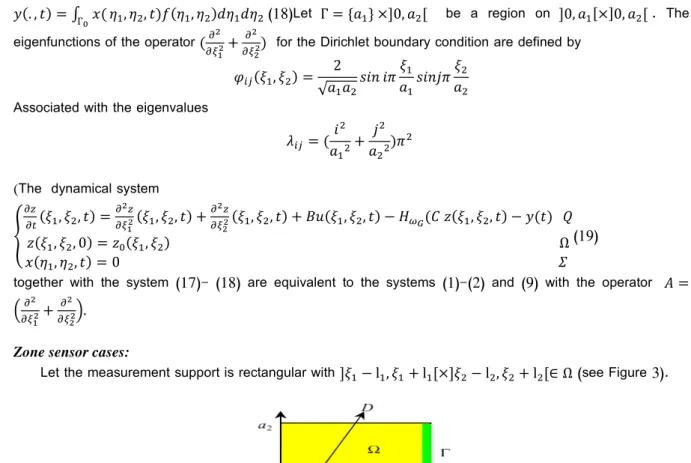
In this section, we give some results related to different types of measurements domains and boundary conditions. We consider the distributed diffusion systems defined on two dimensional domain 0, '* × 0, '3 on Ω.
*, 3, =
•
Ãw• *, 3, + •
Õ• *, 3,
*, 3, 0 = *, 3 Ω
, , = 0
!
(17)
" . , = HГÑ *, 3, M *, 3 J *J 3(18)Let Г = {'*} × 0, '3 be a region on 0, '* × 0, '3 . The
eigenfunctions of the operator Õ w•+
•
Õ• for the Dirichlet boundary condition are defined by ª(& *, 3 = 2
√'*'3Yab aÊ *
'*YabÔÊ 3
'3
Associated with the eigenvalues
„(& = a 3
'*3+
Ô3
'33 Ê 3
(The dynamical system
½
*, 3, =
•½
Ãw• *, 3, + •½
Õ• *, 3, + *, 3, − [e~ $ « *, 3, − "
« *, 3, 0 = « *, 3 Ω *, 3, = 0
!
(19)
together with the system (17)- (18) are equivalent to the systems (1)-(2) and (9) with the operator = Ç Ã•
w•+ •
Õ•É.
Zone sensor cases:
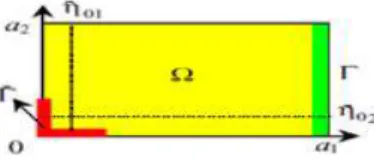
Let the measurement support is rectangular with *− l*, *+ l* × 3− l3, 3+ l3 ∈ Ω (see Figure 3).
Fig. 3: Location of internal zone sensor O.
If M* is symmetric about *= * and M3is symmetric with respect to 3= 3 then we have get the following result:
Corollary 5.1:
The dynamical system (19) is -observer for the system (17)-(18) if (ÃÑw
Ìw and
&ÃÑ•
Ì• ∉ ², ∀a, Ô = 1, … , ….
In the case where Г⊂ Ω and M ∈ <3 Г , the sensor O, M may be located on the boundary in Г = *−
l*, *+ l* × {'3}, then we have:
Corollary 5.2:
One side case (see Figure 4):
suppose that the sensor O, M is located on Г = *− l*, *+ l* × {'3} ⊂ Ω , and M is symmetric with respect to *= * then the dynamical systems (19) are -observer for the system (17)-(18) if
(ÃÑw
Ìw ∉ ², ∀a, Ô = 1, … , ….
Two side case (see Figure 5):
suppose that the sensor O, M is located on Г = 0, *+ l* × {0} ∪ {0} × 0, 3+ l3 ⊂ Ω , and !M|Гw is symmetric with respect to *= * and the function !M|Г•is symmetric with respect to 3= 3, then the
dynamical system (19) is -observerfor the system (17)-(18) if (ÃÑw
Ìw 'bJ
&ÃÑ•
Ì• ∉ ², ∀a, Ô = 1, … , ….
Fig. 5: Location of boundary zone sensor two side case
ii. Pointwise sensor cases:
In this cases if if L = L*, L3 ∈ Ω then, we have:
Corollary 5.3:
Internal case (see Figure 6):
The dynamical system(19) is -observer for the systems(17)-(18) if (Äw
Ìw 'bJ
&Ä•
Ì• ∉ ², ∀a, Ô = 1, … , ….
Fig. 6: Location of Internal pointwise sensors.
Filament case (see Figure 7):
Suppose that the observation is given by the filament sensor where × = lm  is symmetric with respect to
the line L = L*, L3 , if (Äw
Ìw 'bJ
&Ä•
Ì• ∉ ², ∀a, Ô = 1, … , …. Then the dynamical system (19) is -observer
for the systems(17)-(18).
Fig. 7: Location of Internal pointwise sensors (filament case).
Boundary case (see Figure 8):
The dynamical system (19) is -observerfor the systems(17)-(18) if &ÄÌ•
• ∉ ², ∀Ô = 1, … , ….
Fig. 8: Location of boundary pointwise sensor b.
Remark 5.4:
Conclusion:
The concept have been studied in this paper is related to the existing and characterizing an -observer only for a distributed parameter systems. More precisely, we have given an approach for building a -estimatorwhich reconstruct a gradient state in considered sub-region . Also, we show that there exists a dynamical system is not -observer in usual sense but it is -observer. For the future work, one can extension of these results to the problem in identity case and in reduced order case as in (Saphory and Al-Mullah, 2015Al-Saphory and Jaafar 2015).
ACKNOWLEDGMENTS
Our thanks in advance to the editors and experts for considering this paper to publish in this estimated journal and for their efforts.
REFERENCES
Al-Saphory, R., 2002.’’Asymptotic Regional Boundary Observer in Distributed Parameter Systems via
Sensors Structure’’, Sensors, 2: 137-152.
Al-Saphory, R., 2011.’’Strategic sensors and regional exponential observability’’, ISRN Applied Mathematics. Article ID 673052, 1-13.
Al-Saphory, R., A. El Jai, 2002.’’Regional Asymptotic State Reconstruction, International Journal of System Science, 33: 1025-1037.
Al-Saphory, R., N. Al-Jawari and A. Al-Janabi, 2015. "Regional Gradient Strategic Sensors
Characterizations", Journal of Advances in Mathematics, 10: 1-15.
Al-Saphory, R., N. Al-Jawari, A. Al-Janabi, 2016. ’’Regional Boundary Gradient Strategic Sensors
Characterizations’’, Mathematical Theory and Modeling, 5: 14.
Al-Saphory, R., N. Al-Jawari, A. Al-Qaisi, 2010.’’Regional gradient detectability for infinite dimensional
systems’’. Tikrit Journal of Pure Science, 15(2): 1-6.
Al-Saphory R., M. Al-Joubory, M. Jasim, 2013. ’’Regional Strategic Sensors Characterizations’’, Journal Mathematics Computer Science, 3: 401-418.
Al-Saphory, R., Sh. Al-Mullah, 2015.’’Regional Exponential Reduced Observability in Distributed
Parameter Systems, Journal of Advance in Mathematics, 11: 4.
Al-Saphory, R., Z. Jaafar, 2015.’’Regional Exponential General Observability in Distributed Parameter
systems’’, Journal of Advance in Mathematics, 11: 4.
Burns, J., J. Jorggaard, M. Cliff and L. Zietsman, 2009.’’A PDE approach to optimization and control of high performance buildings, Workshop in Numerical Techniques for Optimization Problems with PDE Constraints, No. 04/2009, DOI: 10.4171/OWR/2009/04. 25-31 January. Houston, Denmark.
Burns, J., J. Jorggaard, M. Cliff and L. Zietsman, 2010.’’Optimal sensor design for estimation and optimization of PDE Systems, 2010 American Control Conference. Marriott Waterfront, Baltimore, MD, USA. June 30-July 02.
El Jai, A., M. Amouroux, 1988.’’Sensors and Observers in Distributed Parameter Systems, International Journal of Control., 47(1): 333-347.
El Jai, A., A.j. Pritchard, 1988.’’Sensors and Controls in The Analysis of Distributed Parameter Systems, Ellis Hardwood Series in Mathematics and Applications, Wiley, New York.
El Jai, A., E. Zerrik, M.C. Simon, M. Amouroux, 1995.’’Regional Observability of a Thermal Process., IEEE Transactions on Automatic Control., 40: 518-521.
Gressang, R.V., G.B. Lamont, 1975.’’Observers For Characterized by semi-groups, IEEE Trans. Automat. Contr., pp: 523-528.