AUSTRALIAN JOURNAL OF BASIC AND
APPLIED SCIENCES
ISSN:1991-8178 EISSN: 2309-8414 Journal home page: www.ajbasweb.com
Open Access Journal
Published BY AENSI Publication
© 2016 AENSI Publisher All rights reserved
This work is licensed under the Creative Commons Attribution International License (CC BY).
http://creativecommons.org/licenses/by/4.0/
To Cite This Article: V.Sameswari and E.Ramaraj, Priority based hybrid distance vector routing protocol in Manet. Aust. J. Basic & Appl. Sci., 10(2): 212-223, 2016
Priority based hybrid distance vector routing protocol in Manet
1V.Sameswari and 2E.Ramaraj
1
Ph.D., Research Scholar, Dept. of Computer Science and Engg., Alagappa University, Karaikudi-630 003, Tamil Nadu, India.
2 Professor, Dept. of Computer Science and Engg., Alagappa University, Karaikudi-630 003, Tamil Nadu, India.
Address For Correspondence:
V.Sameswari, Ph.D., Research Scholar, Department of Computer Science and Engineering, Alagappa University, Karaikudi-630 003., Tamil Nadu, India. E-mail: [email protected]
A R T I C L E I N F O A B S T R A C T Article history:
Received 04 December 2015 Accepted 22 January 2016 Available online 14 February 2016
Keywords:
Adhoc On-demand Distance Vector, Destination Sequenced Distance Vector, Network Simulator-2, Priority Based Hybrid Distance Vector, Packet Delivery Ratio, Throughput, End-to-End Delay.
Mobile Adhoc Network (MANET) is a mobile, which is formed by radio waves without any central coordinator. The primary issue of Adhoc On-Demand Distance Vector (AODV) routing protocols has high latency for route discovery and minimum routing overhead. The primary issue of Destination Sequence Distance Vector (DSDV) routing protocol has a minimal reaction time for route discovery and maximization of end-to-end delay. Thus, this paper elects two kinds of routing protocols AODV and DSDV routing protocols. The new Priority Based Hybrid Distance Vector Routing protocol (PBHDV) is hybridized of two above said protocol on the basis of priority. The new approach of PBHDV improves the packet delivery ratio, minimizing end-to-end delay and increasing throughput. The proposed approach has implemented and tested in NS2, which is compared with some other existing protocols.
INTRODUCTION
The network is a collection of computers interconnected by network cables or radio waves for communicating from sender to receiver. It has divided into two parts there is,
1. Wired Network
2. Wireless Network
In Wired Network, the nodes are connected through network cables such as twisted pair, coaxial cable, and fiber optic cable. It is referred as Static network. In Wireless Network, the nodes are connected through some radio waves. It is referred as Dynamic network. It is divided into two forms, that is:
1. Cellular Network
2. Mobile Ad-Hoc Network (Manet)
The current research focuses on only Mobile Ad-Hoc Network (Manet). The collections of mobile nodes are connected by a router using wireless radio waves that are called MANET. It also has distributed computing environment. The Manet’s are mobile which helps in communicating with each other without any central coordinators. It can dynamically change their locations in each and every time.
Routing Protocol:
The routing protocols are performing a vital role in MANETs, which is used to find the route and select the best route in MANET’s. In two ways, the router makes a route between source and destination by using routing protocols.
1. Static routing protocols
The network administrator (Sameswari.V and Dr. E.Ramaraj, 2014) has defined the static routing protocols which cannot discover routes, but, it can only forward packets between the source and destination pair. Dynamic routing protocols are used by routers to perform discover routes. Routers then automatically forward the packets between routes. The dynamic routing protocol has three broad categories. They are,
1. Distance-vector
2. Link-state
3. Hybrid
These cases of dynamic routing protocols are employed to identify the new routes and elect the best route for the destination.
2.1 On-Demand Routing Protocols:
The on-demand routing protocol creates and maintains routes between source and destination, only when it's needed. It does not contain a permanent route for the network. It has many types such as AODV, DSR and TORA.
2.1.1 Ad-Hoc On-Demand Distance Vector Routing Protocol (AODV):
Ad-Hoc On-Demand Distance Vector routing protocol (AODV) (Sameswari.V and Dr.E.Ramaraj, 2014) is using a multi-hop wireless technology based on distance vector routing protocol and it is an improved method of Destination-Sequenced Distance-Vector (DSDV) routing algorithm. In AODV, when needed, the routes are created for communication between source and destination through intermediate neighboring nodes it sometimes called immediate nodes. The aim of AODV is to lessen the number of broadcast messages sent throughout the network.
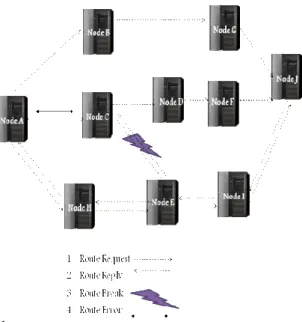
The AODV routing protocols (Sameswari.V and Dr.E.Ramaraj, 2014) are basically behaving as in two methods they are, Route Discovery and Route Maintenance. Whenever the source wants to communicate the destination, the source node keeps the Destination Sequence Number (D_SN). The Route Discovery and Route Maintenance methods are utilizing three types of messages in AODV. They are,
1. Route Request (RREQ)
2. Route Reply (RREP)
3. Route Error (RERR)
Fig. 1: AODV Routing Protocol
In every transmission, the RREQ are using the Source Address (S_ID), Destination Address (D_ID), Source Sequence Number (S_SN), Time To Live (TTL), Destination Sequence Number (D_SN) and Hop Count (H_C). The source node and intermediate node are kept at the next hop information. It determines an up-to-date path about the destination. The source initiates the Route Request (RREQ) and flooded the RREQ messages in network over all intermediate nodes and then, the intermediate nodes received and send the RREQ to destination using the next - hop address and Broadcast Identifier (B_ID).
removed by using B_ID and S_ID. The RREP message is received from ‘D’ to ‘S’ within the timeline. If the routes are broken, the intermediate nodes are conveying the Route Error (RERR) message to the source node. Ultimately, the source node deleted the broken path and reinitiates the connection using new B_ID and same D_SN.
2.2 Table Driven Routing Protocol
In table driven routing protocols (Sameswari.V and Dr.E.Ramaraj, 2014), every node maintains the routing tables which contains the updated routing information or topological information about the network. It's sometimes referred to as proactive routing protocol. It has many types such as DSDV, GSR, WRP, FSR and OLSR. The brief concept of the DSDV routing protocol is given below:
2.2.1 Destination Sequenced Distance Vector (DSDV):
Destination Sequenced Distance Vector routing protocol (DSDV) is a core protocol of table-driven routing protocol. It is working on the basis of distributed Bellman-Ford routing algorithm which provides the loop free routing as well as distance based routing. Every node maintains the routing table which contains all available destinations. Whenever the router gets the information from neighboring nodes, then it creates the routing table. The routing table (Sameswari.V and Dr.E.Ramaraj, 2014) maintains routing information, distance from one node to another node, cost, hop count, first entry, destination sequence number and shortest distance towards the destination. The sequence number is created by destination for freshness of routes. Each node proactively maintains the routing table which is periodically broadcast the routing information to its neighbors. The routing information updates are shared via an available shortest path. The nodes are exchanging the routing information updates within the neighbors which used to avoid the counter-to-infinity problem in faster convergence. The DSDV updates two types of messages,
1. Periodical Update Messages
2. Trigger Update Messages
These messages consist of three fields such as the Destination Address, Sequence Number and Hop Count. In periodical updates, the node broadcasts entire routing table. In trigger update messages, the node updates the small update in between the periodical updates.
Fig. 2: DSDV Routing Protocol
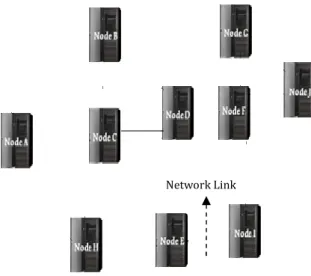
Fig. 3: Mobility in DSDV Routing Protocol
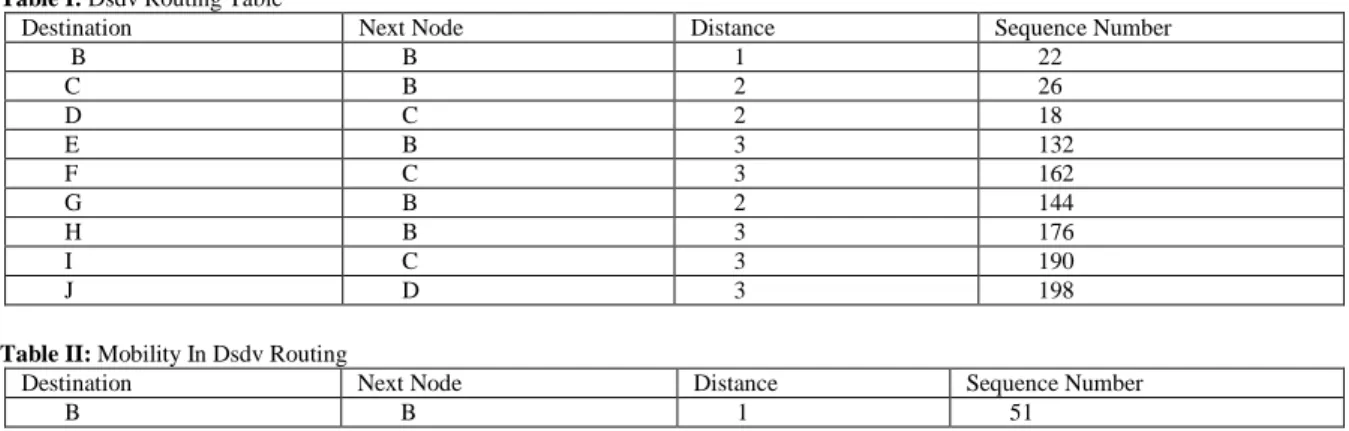
The fig.2 shows the DSDV routing protocol. Whenever the connection is created between the source and destination, the routing protocol checks the routing table regarding the connection is available or not. If the connection is available, the protocol using the existing path otherwise it creates a new path to establish the connection. Each and every entry is stored in the routing table. The tableI shows the routing table for DSDV routing protocol (fig. 2).
Table I: Dsdv Routing Table
Destination Next Node Distance Sequence Number
B B 1 22
C B 2 26
D C 2 18
E B 3 132
F C 3 162
G B 2 144
H B 3 176
I C 3 190
J D 3 198
Table II: Mobility In Dsdv Routing
Destination Next Node Distance Sequence Number
B B 1 51
The above fig. 3 and tableII shows the current performance of the node movement. During transmission, node B is moving their original place to some other place; suddenly, the routing protocol changed their position and assigned the value 51 instead of 22. This modification also stored in a routing table by using trigger updates. The new sequence number and distance are received by all destination nodes.
Network Simulator:
Network Simulator2 (NS2) (Sameswari.V and Dr.E.Ramaraj, 2015) plays a vital role in networking research environment as well as it is a discrete event simulator. It is given the big support to simulate mobile adhoc network routing protocols. In NS2, thousands of mobile nodes are connected at any time and is handle list of events such as sending a packet, receiving a packet, dropping a packet and forwarding a packet. The main goal of the simulation is to analyze the various performance metrics of MANETs routing protocol.
Related Work:
S. Mohapatra and P.Kanungob (2011) described the performance analysis of AODV, DSR, OLSR and DSDV Routing Protocols using NS2 Simulator. This paper (Mohapatra.S and Kanungob.P, 2011) carried out the overall performance of AODV, DSR, OLSR and DSDV protocols using the NS2 simulator. The delay, throughput, control overhead and packet delivery ratio are the four common quality measures used for the comparison of the performance of the above protocols.
Mobility
Ronghui Hou a, Sikai Qu c, King-Shan Lui b, Jiandong Li (2013) proposed coding and interference aware routing protocol in wireless networks. Coding Ronghui Hou et. al (2013) and the interference aware routing protocol provide best path bandwidth estimation with high throughput paths.
V.Rajeshkumar, P.Sivakumar (2013) proposed a comparative Study of AODV, DSDV and DSR Routing Protocols in MANET Using Network Simulator-2”. The author describes (Rajeshkumar.V and P.Sivakumar, 2013) a performance comparison of reactive and proactive protocols AODV, DSR and DSDV based on metrics such as throughput, control overhead, packet delivery ratio and average end-to-end delay by using the NS-2 simulator.
H.Al-Maqbali, K. Day, M. Ould-Khaoua,A. Touzene, N. Alzeidi (2014) proposed a new hybrid approach of grid-based routing in MANETs. This routing scheme is hybridized the form of reactive and proactive routing protocol mechanisms. The author proposed routing scheme Al-Maqbali.H et. al (2014) is called Tree-based Grid Routing Protocol (TGRP) using shortest-path trees. The stability of the TGRP paths leads to extensive system performance compared to other protocols in terms of end-to-end delay and packet delivery ratio.
Proposed Method:
This research paper proposes Priority Based Hybrid Distance Vector routing protocol (PBHDV) in MANET. Two different kinds of routing protocols such as Adhoc On-demand Distance Vector (AODV) routing protocol and Destination Sequenced Distance Vector routing protocol (DSDV) are hybridized on the basis of priority. Priority based protocols are selected according to the weighted path of the network.
The new proposed PBHDV approach selects the AODV routing protocol, only if the value of the weighted path is high, otherwise selects the DSDV routing protocol. The PBHDV routing protocol is used for improving the routing performances during the transmission such as a packet delivery ratio, TimeVsLost, End-to-End delay, throughput in MANET.
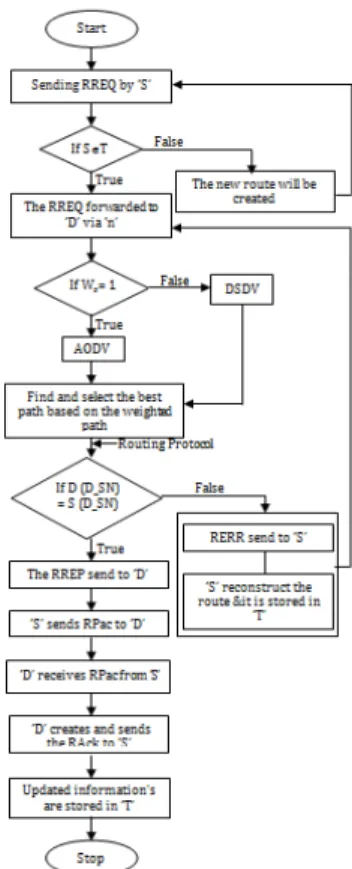
The fig. 4 represents Block Diagram of PBHDV routing protocol. In the proposed approach of PBHDV, all available routes are stored in ‘T’. The Source (S) node wants to communicate with Destination node (D). The ‘S’ broadcasts the RREQ to its neighbor’s. ‘S’ look into the routing table (T) for the routes, that are exists or not. If the route is available in ‘T’, the PBHDV routing protocol initiates their process, otherwise creates a new route to establish a connection. The routing protocol calculates weighted path for every connection by using a PBHDV routing protocol. If the weighted path is identifiable as well as high, this approach selects the AODV routing protocol otherwise, selects the DSDV routing protocol. The routing protocols find and choose the best route for communication using PBHDV. The routing protocol periodically broadcasts the RREQ throughout the network. At that time, the PBHDV routing protocols checks the Destination Sequence Number (D (D_SN)) of ‘D’ and ‘S’ sending Destination Sequence Number (S (D_SN)) is equal or not.
The PBHDV routing protocol has updated the routing information by using sequence numbers. In existing, if the updated routing information’s are periodically broadcasts within the network, then the bandwidth of DSDV routing protocols is shattered. Only, in PBHDV routing protocols, the nodes are easily propagated the information to its neighbors. After communication, ‘D’ sends the RAck to ‘S’. All updated routing information’s are stored in ‘T’. Finally, the process will be terminated.
In PBHDV Algorithm, the ‘S’ sends the route packets (RPac) to desired ‘D’ through various intermediate nodes (n). The ‘S’ sends the RREQ to ‘D’, if the route is available. Otherwise, it creates a new route. Now, the weighted path (Wp) is calculated such as the distance of (i, j) that means distance between one node to another as well as is calculated dist (hi+1). hi - meant for 1-hop and 2-hop neighbors. The DSDV holds 1-hop neighbors. The AODV holds the 2-hop and 3-hop neighbors. After that, the bandwidth is calculated it shows available bandwidth, the maximum bandwidth of channel capacity, consume bandwidth, remaining bandwidth, within the timeline how many packets are sent from ‘S’ to ‘D’, packet type, total packet size, sending packet size and receiving packet size.
The Weighted Factor (Wf) is computed by using Request To Send (RTS), Clear To Send (CTS), Data, Medium Access Control Header (MAChdr) and Internet Protocol Header (IP header). The bandwidth of weighted path (Bw(Wp)) is stored in the intermediate node ‘n’. Lastly, the ‘D’ receives the Route Packet (RPac) which creates and sends the Route Acknowledgement (RAck) to ‘S’. All routing information’s are stored in ‘T’ (Surjeet, Arun Parkash and Rajeev Tripathi, 2014), (Sumathi.N and Dr.C.P.Sumathi, 2013).
PBHDV Algorithm:
1. If ‘S’ ∈ ‘T’, then ‘S’ starts the communication between ‘S’ and ‘D’. Else
‘S’ creates and propagates the RREQ packets throughout the network. a) Calculate the weighted path.
//l- No. of links //bw- bandwidth //dist- distance
Where,
WP=W (i, j) -distance between i and jth nodes of weighted path called as WP.
i) If the weighted path is identifiable (i.e. 1), then execute AODV routing Protocol. Else
Fix ∞, Execute DSDV routing Protocol.
ii) Calculate weighted path for finding best path, WP =dist (hi+1)
iii) Calculate bandwidth for weighted path: BwAvailable= CCapacity-BW Utilized
BWUtilized= Np*Sp*10 / Time
// Np =No. of packets, Sp= Size of the Packet
BwResidual (Bwmax- Utilized / Time) / Wf
Wf = {RTS + CTS + (Data + MAChdr +IPhdr)}/ Data
Here,
If (D _ID = N_ID) Then send the RTS packet; Elseif
Send CTS packet; Elseif
Send Data packet;
iv) BwAvailable, BWUtilized, BwResidual and hop distance are stored in ‘T’.
v) Bandwidth of weighted path is stored in ‘n’.
b) If D (D_SN) = S (D_SN), then ‘D’ receives the RREQ from ‘S’. c) ‘D’ creates and send back the RREP to ‘S’.
d) ‘S’ sends the RPac to ‘D’ via ‘n’. else
i. ‘n’ send back a RERR packet to ‘S’.
ii. The ‘S’ receives the RERR, and then rebroadcast the RREQ throughout the network. 2. ‘D’ receives RPac.
3. ‘D’ create and sends the RAck to ‘S’. 4. Updated routing information’s are stored in ‘T’. 5. End.
RESULTS AND DISCUSSION
6.1 Simulation Parameter:
1 if W (i, j) ∈n,
The Network Simulator-2 (NS-2) simulation model contains two types of circumstances, such as topological circumstances and Network traffic circumstances. The topological circumstances show about a simulation area and movements of mobile nodes in prefixed simulation time. The traffic circumstance shows about every transmission within the Manet environment such as packet type, packet size, packet rate in every transmission and number of traffic flows.
The tableIII shows setting up of simulation parameter. The proposed simulation approach has chosen 500x500m topological area which is called a simulation area. This approach has taken 25, 50, 75 and 100 mobile nodes and the simulation time is twenty five seconds. Every nodes movement maximum speed is 0.25, 0.50, 0.75m/s and so on. Every node transmission range is 250m. The network traffic flow is calculated by Constant Bit Rate (CBR) such as UDP (Universal Datagram Protocol)/TCP (Transmission Control Protocol).
Table III: Simulation Parameter Setup
PARAMETER VALUES
Simulator Ns-2
Studied protocols DSDV and AODV
Proposed Protocol PBHDV
Simulation Area 500x500m
Simulation Starting Time 0.00seconds
Simulation ending Time 24.99 seconds
Node Movement Model Two Ray Ground
Number of nodes 25, 50, 75, 100.
Transmission Range 10.0ms
Packet Size 512 bytes/packets
Mobility Pause Time 25 seconds
Movement Speed 0.25 m/s
Bandwidth 10 Mb/s
Traffic type CBR
Simulation duration 25seconds
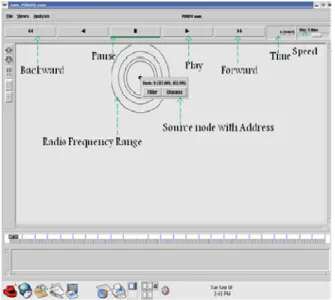
The fig. 5 shows about to create the connection between one node to another which includes the source node with address radio frequency range and time.
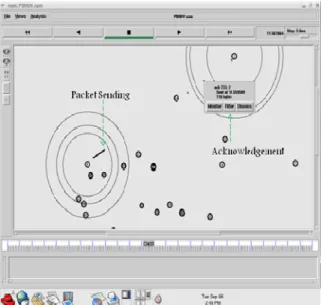
Fig. 6: Packet sending in PBHDV
The fig. 6 shows about the connection between two nodes as well as packet sending from ‘S’ to ‘D’. After receiving the packet, the ‘D’ sends the RAck to ‘S’ according to the maximum speed of the simulation environment.
6.2 Performance Metrics:
The following performance metrics are considered for evaluation:
• Packet Sent (PS):
In PBHDV approach, the source node sends the routing packet to the desired destination using S_ID, D_ID, B_ID and global SN with 25, 50, 75 and 100 nodes in the given period of time. This research paper calculates the total number of packet sending from the source to destination node which is computed from the trace file.
• Packet Received (PR):
The Packet Received (PR) method calculates the total number of packets is received by the destination node and also, the total number of time they spend for sending and receiving the packet.
Table IV: Performance Comparison In Pbhdv
METRICS PBHDV
Nodes 25 50 75 100
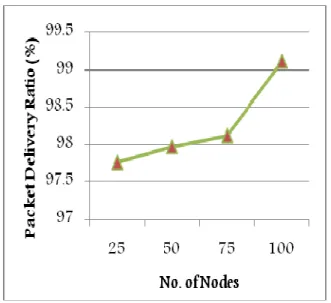
PDR% 97.76 97.97 98.12 99.12
Average End-to-End Delay (ms) 113.23 139.93 151.64 96.522
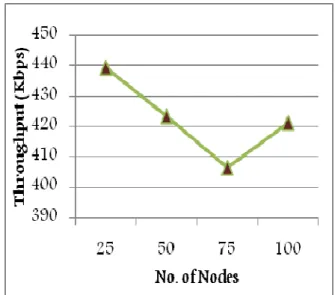
Throughput (kbps) 439.23 423.3 406.57 421.16
• Packet Delivery Ratio (PDR):
Fig. 7: Packet Delivery Ratio for PBHDV
• Average End-To-End Delay:
The tableIV displays the Average End-to-End Delay (AD) of the given period of time twenty five seconds with 25, 50, 75 and 100 nodes respectively. It indicates the overall delay in this proposed approach as well as it involves all delays caused by buffering during route discovery latency, queuing at the interface queue, retransmission delays at the MAC, propagation delay and transfer times. The average end-to-end delay is computed by using this formula AD = TD/PR. The fig. 8 shows the average end-to-end delay chart for PBHDV approach. During simulation, the 25 nodes are given the output of the 113.23ms Average End-to-End Delay, the 50 nodes are given the output of the 139.93ms Average End-to-End Delay, the 75 nodes are given the output of the 153.64ms Average End-to-End Delay and finally, the 100 nodes are given the output of the 96.522ms Average End-to-End Delay for PBHDV.
Fig. 8: Average End-to-End Delay for PBHDV
• Throughput:
given the output of the 406.57kbps Throughput and finally, the 100 nodes are given the output of the 421.16kbps Throughput for PBHDV.
Fig. 9: Throughput for PBHDV
6.3 Comparison between Existing and Proposed Approach for PBHDV:
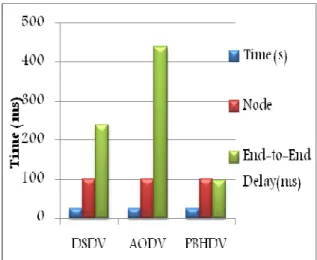
The proposed PBHDV routing protocol is compared with some existing protocols such as Adhoc on-demand routing protocol of the on-on-demand routing protocol and destination based distance vector routing protocol of table driven routing protocol. The tableV describes the comparison between the existing of AODV & DSDV and the proposed of PBHDV for PDR, Throughput and End-to-End Delay.
Table V: Comparison Between Existing And Proposed Approach For Pdr
METRICS DSDV AODV PBHDV
PDR (%) 49.8 87.00 99.12
Throughput (kbps) 213.62 213.62 421.16
End-to-End Delay(ms) 238.45 439.12 96.522
Fig. 10: Comparison Between Existing and Proposed approach for Packet Delivery Ratio
Fig. 11: Comparison Between Existing and Proposed approach for Throughput
The Fig. 11shows the comparison chart for throughput between existing and proposed approach that has taken 100 nodes within the simulation time of 25 seconds. In this approach, the existing of DSDV is given the output of 213.98kbps of throughput and the existing of AODV is given 213.62kbps throughput also, the PBHDV is given 421.16kbps of throughput. So, the proposed approach of PBHDV is produced the better results compare than existing of DSDV and AODV.
Fig. 12: Comparison Between Existing and Proposed method for End-to-End Delay
The Fig. 12 describes the comparison chart for End-to-End Delay between existing and proposed approach that has taken 100 nodes within the simulation time of 25 seconds. In that comparison, the existing of DSDV is given the output of 238.45ms of End-to-End Delay and the existing of AODV is given 439.12ms of End-to-End Delay also, the PBHDV is given 96.522ms of End-to-End Delay. During simulation, the new approach of PBHDV is produced the better results than existing of DSDV and AODV.
Conclusion:
This paper has proposed a new approach Priority based Hybrid Distance Vector Routing Algorithm in MANET (PBHDV). The simulation performance result shows the efficiency of the proposed algorithm such as Packet Delivery Ratio, Average end-to-end delay and Throughput. The proposed algorithm of PBHDV has produced better results than existing protocol of DSDV and AODV. In future, the researcher may hybrid DSR and OLSR routing protocol.
REFERENCES
Bijan Paul., Kaysar Ahmed Bhuiyan., Kaniz Fatema and Partha Pratim Das, 2014. Analysis of AOMDV, AODV, DSR and DSDV Routing Protocols for Wireless Sensor Network. Sixth International Conference on Computational Intelligence and Communication Networks, 978-1-4799-6929-6/14.
Mohapatra, S., and P. Kanungob, 2011. Performance analysis of AODV, DSR, OLSR and DSDV Routing Protocols using NS2 Simulator, International Conference on Communication Technology and System Design. SciVerse ScienceDirect, Procedia Engineering, 30: 69-76.
Rabia Ali. and Dr.Fareeha Zafar, 2011. Bandwidth Estimation in Mobile Ad-hoc Network (MANET). IJCSI International Journal of Computer Science, 1694-0814, 8: 5.
Rajeshkumar, V., P. Sivakumar, 2013. Comparative Study of AODV, DSDV and DSR Routing Protocols in MANET Using Network Simulator-2. International Journal of Advanced Research in Computer and Communication Engineering, 2: 12.
Ronghui Hou., Sikai Qu., King-Shan Lui., Jiandong Li., 2013. Coding- and interference-aware routing protocol in wireless networks. Elsevier, Computer Communications, 36: 1745-1753.
Sabin Bhandari and Sangman Moh., 2014. Feasibility Study of DSDV and AODV Routing Protocols in Mobile Sensor Networks. Contemporary Engineering Sciences, 7(30): 1641-1647.
Sameswari, V. and Dr.E. Ramaraj, 2014. A Study of Table-Driven and On-Demand Routing Protocols in MANET. Int.J.Computer Technology & Applications (IJCTA), ISSN: 2229-6093, 5(2): 522-529.
Sameswari, V. and Dr.E.Ramaraj, 2014. Shortest Route Discovery Using Hybrid (Aodv and Olsr) Routing Protocols in Manet. UGC Sponsored National Conference on Data Science and Engineering- Proceedings published in Elsevier, pp: 273-279.
Sameswari, V. and Dr.E. Ramaraj, 2015. Performance Comparison between Static and Dynamic Network Environment Using Network Simulator-2. International Journal of Applied Engineering Research, ISSN 0973-4562 10: 55.
Sandeep Gupta., Prof.Abhishek Mathur., 2014. Enhanced Flooding Scheme for AODV Routing Protocol in Mobile Ad hoc Networks. International Conference on Electronic Systems, Signal Processing and Computing Technologies, 978-1-4799-2102-7/14.
Sumathi, N. and Dr.C.P. Sumathi., 2013. Energy and Bandwidth Constrained QoS Enabled Routing for MANETs. International Journal of Computer Networks & Communications (IJCNC), 5: 2.
Surjeet., Arun Parkash and Rajeev Tripathi., 2014. Bandwidth Constrained Priority-Based Routing Algorithm for Mobile Ad Hoc Networks. Int. J. Communications, Network and System Sciences, 7: 141-150.