ISSN:1991-8178
Australian Journal of Basic and Applied Sciences
Journal home page: www.ajbasweb.com
Corresponding Author: F.S. Taip, Universiti Putra Malaysia, Department of Process and Food Engineering, Faculty of Engineering, Seri Serdang, 43400, Selangor, Malaysia.
Tel: +603-89466357; Fax: +603-89464440; E-mail: [email protected]
Effect of Pre-Treatment on the Physical Properties of Pumpkin Powder
Jackson Lim Hwa Keen, Farah Saleena Taip, Mohd. Nordin Ibrahim, Norashikin Abdul Aziz, Mohammad Rezaul Islam Shishir
Universiti Putra Malaysia, Department of Process and Food Engineering, Faculty of Engineering, Seri Serdang, 43400, Selangor, Malaysia
A R T I C L E I N F O A B S T R A C T
Article history:
Received 10 January 2016 Accepted 15 February 2016 Available online 28 February 2016
Keywords:
Pumpkin powder, air frying, powder properties
The preservation of pumpkin in powder form and ensuring its quality using different pre-treatments prior to drying is an important concern. The objective of this study is to determine the effect of pre-treatment on the physical properties of different parts of pumpkin powder. Different parts of pumpkin (skin, flesh, seed and unpeel) were pre-treated with blanching and soaking in Ca(OH)2 solution and then dried in air fryer at temperature of 80˚C and air flow 5.11m/s before being grounded and sieved (250 µm and 710 µm). The Ca(OH)2 pre-treatment showed low moisture content (5.51%-6.38%), low water activity (0.313-0.396), small particle size (112.04-213.46 µm) and high bulk density (505.51-375.75 kg/m3) in different portions of pumpkin powder as compare to blanching pre-treatment. For the color change, it is dependent on the parts of pumpkin and whether pre-treatment is applied. In conclusion, the pre-treatment with Ca(OH)2 could be recommended way in prior to drying of pumpkin ensuring the better quality of powder.
© 2016 AENSI Publisher All rights reserved. To Cite This Article: Jackson Lim Hwa Keen, Farah Saleena Taip, Mohd. Nordin Ibrahim, Norashikin Abdul Aziz, Mohammad Rezaul Islam Shishir., Effect of Pre-Treatment on the Physical Properties of Pumpkin Powder. Aust. J. Basic & Appl. Sci., 10(7): 146-151, 2016
INTRODUCTION
In Malaysia, the production of pumpkins increased from 3000 tons in year 1961 to 21306 tons in year 2012 (FAO, 2012). Among all the species,
Cucurbita moschata as labu manis and Cucurbita moschata Duchesne as labu loceng are the most
common cultivated in Malaysia (Norshazila et al., 2014). Pumpkins are rich in β-carotene, which could prevent attack from certain types of cancers (See et
al., 2007) and cardiovascular diseases (Gaziano et al., 1992).
Nowadays, pumpkin powder is the major product of pumpkin fruit in processing, since it can be stored for a long time and used in manufacturing of formulated foods (Que et al., 2008). Kha et al. (2011) reported that pre-treatments prior to drying are one of the most important factor that affect the final powder product quality in term of physicochemical properties produced in drying. Pre-treatment, such as blanching is a familiar thermal treatment generally used for a variety of vegetables before drying or freezing.
The main purpose of blanching treatment is to inactivate enzymes, which causes the off flavors and color changes of the product (González-Fésler et al., 2008). However, blanching is also responsible for the undesirable change, such as pigment modification, tissues softening and nutrient losses (González-Fésler
et al., 2008; Ahrné et al., 2003). Besides that, soaking in the edible chemical solution is also another familiar method of pre-treatment. However, certain solution may have adverse effect on the product, for example metabisulfate causes allergenic effect to some consumers due to the presence of SO2 (Aydin and Gocmen, 2015). Soaking in the calcium solution might give better quality to the final product, such as improvement in texture, color, prevention in microbiological growth and respiration rate (Alandes
et al., 2009). However, some calcium will cause the
bitterness or flavor different, such as calcium chloride (Luna-Guzmán and Barrett, 2000). In Malaysia, calcium hydroxide is commonly used for food preparation. Therefore, it may be used as an alternative to preserve the food quality in order to maintain the color and extend the shelf life.
During the drying process, the food may lose heat sensitive nutrients and color and changing the physical properties depending on drying condition, such as temperature and drying time (Henriques et
al., 2012). The powder produced with different
pre-treatment might affect the powder properties such as, moisture content, particle size, bulk density, tapped density, water activity and color (Prajapati et al., 2011). The presence of moisture content in a powder can also affect the powder density and its flowability (Tze et al., 2012).
produce the food product compared to skin and seed. There have several researches done on pumpkin flesh powder production and its application in bakery products (Kulkarni and Joshi, 2013; Norfezah et al., 2010; Das and Banerjee, 2015), but still there have limitations about the effect of pre-treatment prior to drying for ensuring better quality of pumpkin powder. Since, the pumpkin seed and skin are a rich source of nutrients (Norfezah et al., 2010), the producing of pumpkin skin and seed powder could be also an alternative food additive in different food formulations together with wheat flour. Thus, this is fundamental need to explore the effect of pre-treatments in order to ensure the better quality of pumpkin powder. Therefore, the aim of this study is to investigate the effect of pre-treatment on physical and color properties of different portions of pumpkin powders produced by air frying.
MATERIALS AND METHOD
Sample Preparation:
Ripe pumpkins (Cucurbita maxima) were obtained from Long Ei Plantation Sdn Bhd. The flesh was sliced (3.0cm x 1.5cm x 0.2cm) and the skin was cut into the shape of rectangular (2.0cm x 1.0cm). Finally, the seeds were washed and drained. Powders from 3 different pumpkin parts: skin, flesh and seed will be produced and analyzed.
Pretreatments:
Two typea of pretreatments were conducted on the pumpkin samples before drying: calcium impregnation and blanching. For blanching process, the samples were immersed in the distilled water (70˚C) (Kumar et al., 2001) for 1 minute and then dried with absorbent paper. For calcium impregnation, the samples were soaked in Ca(OH)2 solution(1:7, v/v, 1 part of Ca(OH)2 : 7 part of water) for 25 minutes and then washed with tap water before being dried with absorbent paper.
Air frying drying:
The air fryer (Philips HD 9220/20, Japan) was used and the temperature was set at 80˚C with an average air flow of 5.11 m/s. The air velocity was measured by a Testo 425 Compact Thermal Anemometer (Germany) (±0.01 m/s) placed in the chamber. The duration of drying for the seed was 1 hour 15 minutes whereas for the flesh, skin and unpeeled sample, it was 2 hour 45 minutes. After drying, the dried products were grounded into powder and sieved by using laboratory standard steel sieve shaker (Minor Sieve Shaker, Endecotts, London, England) at the size of 250 µ m (60 mesh) and 710 µm (24 mesh, for the seeds).
Analysis of powder properties:
The material properties including water activity, true density, particle size and color were determined
by the method described in Ng et al. (2012) except moisture content, bulk and tapped densities. The moisture content was determined by oven drying at 105˚C for 24 hours (AOAC, 2005). Water activity meter (GDX Instrumention Scientifique, France) was used to measure the powder water activity. Bulk density and tapped density of powders were measured followed by Sahin-Nadeem et al. (2013) and Ozdikicierler et al. (2014). The value of bulk and tapped density were used to calculate Carr index (Carr, 1965). The particle size of the powder was measured using a particle size analyzer (Malvern Mastersizer 2000, Malvern Instrument Ltd, UK). The color of powder was determined by using a color reader (CR-10; Konica Minolta Sensing America’s Ltd., Ramsey, NJ, USA).
Statistical analysis:
Statistical analyses were performed using SAS 9.1 (SAS Institute Inc, Cary, NC, USA) to evaluate the mean, standard deviation and significant difference (p <0.05) by analysis of variance (ANOVA) and Duncan’s multiple range test. All the measurement was conducted in triplicate. The diagrams of average value were generated by using Microsoft excel version of 2010.
RESULTS AND DISCUSSION
Effect of pre-treatment on moisture content of different pumpkin portions before drying:
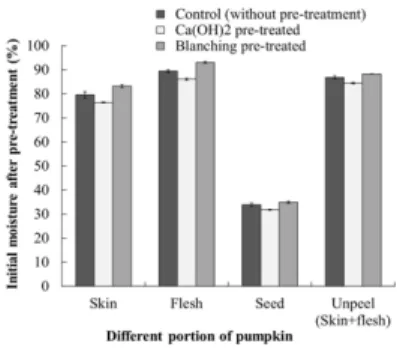
Figure 1 shows that the Ca(OH)2 pre-treatment reduced the moisture content by 2.1-3.35%, while blanching pre-treatment increased the moisture content by 0.96-3.62% in all parts as compared to control sample (untreated pumpkin portion). The seed part showed the minimum moisture content by around 31.86% pre-treated with Ca(OH)2, while flesh part showed the maximum one by around 93.05% pre-treated with blanching.
Reduction of the moisture content by the Ca(OH)2 pre-treatment can be explained by the osmosis process that caused the tissue to shrink (González-Fésler et al., 2008) and consequently, reduced the moisture content of the sample by gaining the calcium from the soaking medium (Barrera et al., 2009). For the blanching pre-treatment, the heats from the blanching medium modify the tissue of the fruit. It resulted in rupture of the membrane by elimination of the membrane resistances as well as decreased the cell wall resistance towards water due to the damage of the cell wall in the cell (González-Fésler et al., 2008).
Effect of pre-treatment on moisture properties of pumpkin powder:
moisture content by around 0.06-0.51% and water activity by around 0.007-0.035 in pumpkin powder (all parts) as compared to control powder (untreated pumpkin portion powder)In contrast, blanching pre-treatment increased both of the moisture content (around 0.26-0.8) and water activity (around 0.008-0.077) in all portion of pumpkin powder, if compared with control powder. The result displays that the skin (Ca(OH)2 treated) powder has had the minimum moisture content (around 5.51), while the flesh (blanched) powder showed the maximum moisture
content (7.55%). However, flesh (Ca(OH)2 treated) powder had the minimum water activity and seed (blanched) powder had the maximum one (Table 1). It could be explained that the seed powder has high oil content and it is not easy to absorb water, so more free water is available in the seed powder. All the powder results present that the water activity is below 0.6, indicating these are microbiologically safe (Quek et al., 2007).
Fig. 1: Initial moisture content of different portion of pumpkin after the pre-treatment with Ca(OH)2 and blanching.
Effect of pre-treatment on physical properties of pumpkin powder:
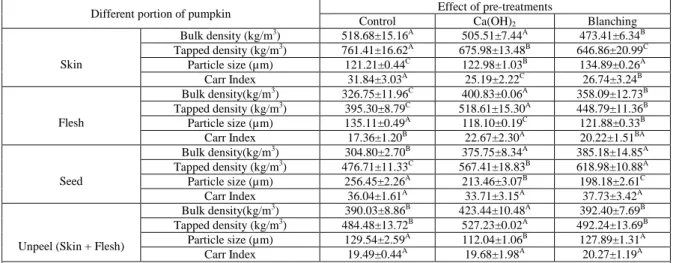
The result of physical properties of pumpkin powder under different types of pre-treatments shows that the pre-treatments are significantly different (p <0.05) for all parts of pumpkin powder except for
unpeel powder (Table 2). The pre-treatment effect of Ca(OH)2 and blanching on different portions of pumpkin powder showed significantly (p <0.05) different in particle size varied from 112.04 to 213.46 µm and 121.88 to 198.18 µm, respectively.
Table 1: Moisture properties of different portion of air-fried pumpkin powder pre-treated with Ca(OH)2 and blanching. Different portion
of pumpkin
Moisture content based on pre-treatment (%) Water activity based on pre-treatment
Control Ca(OH)2 Blanching Control Ca(OH)2 Blanching
Skin 5.78±0.02B 5.51±0.04C 6.04±0.06A 0.373±0.003A 0.338±0.006B 0.382±0.028A Flesh 6.89±0.07B 6.38±0.02C 7.55±0.09A 0.333±0.004B 0.313±0.006C 0.410±0.010A Seed 6.02±0.07A 5.74±0.06C 6.38±0.05B 0.403±0.006B 0.396±0.002B 0.449±0.004A Unpeel (Skin +
Flesh) 5.61±0.04
B 5.55±0.06B 6.41±0.03A 0.325±0.003A 0.314±0.003B 0.333±0.007A Values are mean ± standard error, Superscript (A,B,C,…) = Treatment significant (p <0.05) in order to row, Control = Control without
pretreatment, Ca(OH)2 = Pre-treated with limewater, Blanching = Pre-treated with blanching The reduction of powder particle size caused by
Ca(OH)2 pre-treatment could be reasoned to the shrinkage of tissues, which allows osmosis process to occur (the water flows from low concentration to high concentration). In contrary, Agar et al. (1999) also reported that calcium treatment can firm the sample. This can be further explained by the addition of the Ca2+ contributed to the stabilization of membrane systems and forming the Ca-pectates, which increased the rigidity of the middle lamella and cell wall. After that the drying process will reduce the moisture content in the sample and change the structure of the sample to be more crispy and brittle.
Blanching pre-treatment resulted in breakage of membranes and caused great damage in cell walls, which allowed moisture to flow into the tissue more
easily (González-Fésler et al., 2008) thus, increasing the moisture content. However, the maximum range of particle size was found in seed part, while the minimum ranges of particle was observed both in flesh and unpeel parts.
Table 2: Physical properties of different portion of air-fried pumpkin powder pre-treated with Ca(OH)2 and blanching.
Different portion of pumpkin Effect of pre-treatments
Control Ca(OH)2 Blanching
Skin
Bulk density (kg/m3) 518.68±15.16A 505.51±7.44A 473.41±6.34B Tapped density (kg/m3) 761.41±16.62A 675.98±13.48B 646.86±20.99C
Particle size (µm) 121.21±0.44C 122.98±1.03B 134.89±0.26A
Carr Index 31.84±3.03A 25.19±2.22C 26.74±3.24B
Flesh
Bulk density(kg/m3) 326.75±11.96C 400.83±0.06A 358.09±12.73B Tapped density (kg/m3) 395.30±8.79C 518.61±15.30A 448.79±11.36B Particle size (µm) 135.11±0.49A 118.10±0.19C 121.88±0.33B
Carr Index 17.36±1.20B 22.67±2.30A 20.22±1.51BA
Seed
Bulk density(kg/m3) 304.80±2.70B 375.75±8.34A 385.18±14.85A Tapped density (kg/m3) 476.71±11.33C 567.41±18.83B 618.98±10.88A Particle size (µm) 256.45±2.26A 213.46±3.07B 198.18±2.61C
Carr Index 36.04±1.61A 33.71±3.15A 37.73±3.42A
Unpeel (Skin + Flesh)
Bulk density(kg/m3) 390.03±8.86B 423.44±10.48A 392.40±7.69B Tapped density (kg/m3) 484.48±13.72B 527.23±0.02A 492.24±13.69B
Particle size (µm) 129.54±2.59A 112.04±1.06B 127.89±1.31A
Carr Index 19.49±0.44A 19.68±1.98A 20.27±1.19A
Values are mean ± standard error, Superscript (A,B,C,…) = Treatment significant (p <0.05) in order to row, Control = Control without pretreatment, Ca(OH)2 = Pre-treated with limewater, Blanching = Pre-treated with blanching
The reduction in bulk density was due to the presence of inter particle liquid bridges, which makes the particle further apart and produce a more open structure. The increase in mass due to increased moisture is lower than the subsequent volumetric expansion of the bulk. The higher the humidity, the more particles are combined into larger clusters. This results in leaving open spaces between them, which in turn lowers the bulk density (Goula, 2005). The particle size and its compact arrangement reduces the void spaces of skin powder might also be another reason to increase the bulk density (Tze et al., 2012).
Carr Index is a measurement of flow property correlated with bulk and tapped density. The CI
value was significantly (p <0.05) indifferent in different portions of pumpkin powder except for skin, in which the pre-treatment caused the flowability of skin powder to be better by decreasing the CI around 5.1-6.65 in pre-treated powder as compared to untreated powder. In case of flesh powder, the CI increased by 5.31 in Ca(OH)2 pre-treated flesh powder and by 2.86 in blanched flesh powder. Table 2 shows that the CI range of different parts of pumpkin powder (17.36-36.04) indicates that the powder flowability is in fair to poor range, in which unpeel powder is fair, flesh powder is passable and skin and seed is poor (Lebrun et al., 2012).
Fig. 2: Color properties of different portion of pumpkin powder during air frying pre-treated with Ca(OH)2 and blanching: (a) Lightness and (b) Color difference.
Effect of pretreatment on color properties of pumpkin powder:
Figure 2(a) shows that the Lightness (L*) increased with the pre-treatment. For the Ca(OH)2 treated powder, the samples showed the highest L* value (54.17-64.10) followed by the blanched treated powder (53.73-63.80) and control samples
fruit; this can be due to the loss of the Ca2+ ions in the fruit cell. Similarly, the Lightness (L*) increase in blanching as compared to control powder may be due to the blanching process, which is able to stop the color changes resulted from enzymatic reaction (González-Fésler et al., 2008) in fruits and vegetables.
Figure 2 (b) represents the effect of pre-treatment on total change of different pumpkin portion of pumpkin powder. Different pre-treatment can cause different degree of color change in powder product. The Ca(OH)2 treated powder showed that the total change of color value is between 5.37-14.04, while blanching pre-treated powder showed that the total change of color of around 4.95-15.49. However, the skin powder with blanching pre-treated showed the highest total color change (15.49), while the lowest color change observed in blanched seed powder (4.95).
Conclusion:
The pre-treatments were significantly (p <0.05) different on different portion of pumpkin powder properties in general. The Ca(OH)2 pre-treatment was observed in moisture reduction in all portion of pumpkin before drying and pumpkin powder after drying as compared to control sample/control powder, while the blanched pre-treatment was responsible to increase the moisture content in all portion of pumpkin/pumpkin powder both in before/after drying as compared to control sample/control powder. The powder produced pre-treated by Ca(OH)2 had low final moisture content (5.51-6.38%), low water activity (0.313-0.396), small particle size (112.04-213.46 µ m), high bulk density (505.51-375.75 kg/m3), compare to the all portion of the blanched pumpkin powder and all portion of the control pumpkin powder. In contrary, pretreatment increased the lightness and color difference in pumpkin powder compared to control powder. Therefore, further investigation is required to analyze some chemical compounds of the final products related to pigment loss in order to explore the scientific fact.
ACKNOWLEDGEMENT
This work was supported by the Ministry of Education Malaysia, under the Fundamental Research Grant Scheme (Project no: ).
REFERENCES
Agar, I.T., R. Massantini, B. Hess-Pierce and A.A. Agar, I.T.R. Massantini, B. Hess-Pierce and A.A. Kader, 1999. Postharvest CO2 and ethylene production and quality maintenance of fresh-cut kiwifruit slices. Journal of Food Science, 64(3): 433-440.
Ahrné, L., F. Prothon and T. Funebo, 2003.
Comparison of drying kinetics and texture effects of two calcium pretreatments before microwave-assisted dehydration of apple and potato. International Journal of Food Science and Technology, 38(4): 411-420.
Alandes, L., I. Pérez-Munuera, E. Llorca, A. Quiles and I. Hernando, 2009. Use of calcium lactate to improve structure of “Flor de Invierno” fresh-cut pears. Postharvest Biology and Technology, 53: 145-151.
AOAC, 2005. Officials method of analysis, 18th edn Washington, DC: Association of Official Analytical Chemist.
Ayub, M., S. Wahab and Y. Durrani, 2003. Effect of water activity (Aw) moisture content and microbial count on the overall quality of bread. International Journal of Agriculture and Biology, 5(3): 274-278.
Barrera, C., N. Betoret, P. Corell and P. Fito, 2009. Effect of osmotic dehydration on the stabilization of calcium-fortified apple slices (var. Granny Smith): Influence of operating variables on process kinetics and compositional changes. Journal of Food Engineering, 92: 416-424.
Carr, R.L., 1965. Evaluating flow properties of solids. Chemical.Engineering, 72: 116-168.
Das, S. and S. Banerjee, 2015. Production of pumpkin powder and its utilization in bakery products development: a review. International Journal of Research in Engineering and Technology 4 (5): 478-481.
Dutta, D., A. Dutta, U. Raychaudhuri and R. Chakraborty, 2006. Rheological characteristics and thermal degradation kinetics of beta-carotene in pumpkin puree. Journal of Food Engineering, 76: 538-546.
Feng, H. and J. Tang, 1998. Microwave finish drying of diced apple slices in a spouted bed. Jouranl of Food Science, 63: 679-683.
Food and Agriculture Organization (FAO), 2012. FAOSTAT- FAO statistical database. Accessed
from:http://faostat3.fao.org/download/Q/QC/E. on 30/11/2014.
Gaziano, J.M., J.E. Manson, J.E. Buring and C.H. Hennekens, 1992. Dietary antioxidants and cardiovascular disease. Annals of the New York Academy of Science, 669: 249-259.
Gonçalve, E.M., J. Pinheiro, M. Abreu, T.R.S. Brandăo and C.L. Silva, 2007. Modelling the kinetics of peroxidase inactivation, colour and texture changes of pumpkin (Cucurbita maxima L.) during blanching. Journal of Food Engineering, 81: 693-701.
González-Fésler, M., D. Salvatori, P. Gómez and S.M. Alzamora, 2008. Convective air drying of apples as affected by blanching and calcium impregnation. Journal of Food Engineering, 87: 323-332.
dehumidifi ed air: II. The effect on powder properties. Journal of Food Engineering, 35-42.
Henriques, F., R.P.E. Guiné and M.J. Barroca, 2012. Influence of drying treatment on physical properties of pumpkin. Croation Journal of Food Technology, Biotechnology and Nutrition, 7: 53-58.
Hopfinger, J.A., B.W. Poovaiah and M.E. Patterson, 1984. Calcium and magnesium interactions in browning of ‘Golden Delicious’ apples with bitter pit. Scientia Horticulturae, 23: 345-351.
Kha, T.C., M.H. Nguyen and P.D. Roach, 2011. Effects of pretreatments and air drying temperatures on colour and antioxidant properties of gac fruit powder. International Journal of Food Engineering, 7(3): 1-7.
Kulkarni, A.S. and D.C. Joshi, 2013. Effect of replacement of wheat flour with pumpkin powder on textural and sensory qualities of biscuit. International Food Research Journal, 20(2): 587-591.
Kumar, H.S.P., K. Radhakrishna., P.K. Nagaraju and D.V. Rao., 2001. Effect of combination drying on the physic-chemical characteristics of carrot and pumpkin. Journal of Food Processing Preservation, 25: 447-460.
Lebrun, P., F. Krier, J. Mantanus, H. Grohganz, M. Yang, E. Rozet and P. Hubert, 2012. Design space approach in the optimization of the spray-drying process. European Journal of Pharmaceutics and Biopharmaceutics, 80(1): 226–234.
Manganaris, G.A., M. Vasilakakis, G. Diamantidis and I. Mignani, 2005. Effect of calcium additives on physicochemical aspects of cell wall pectin and sensory attributes of canned peach (Prunus persica (L.) Batsch cv Andross). Journal of the Science of Food and Agriculture, 85: 1773-1778.
Martín-Diana, A.B., D. Rico, J.M. Frías, J.M. Barat, G.T.M.T. Henehan and C. Barry-Ryan, 2007. Calcium for extending the shelf life of fresh whole and minimally processed fruits and vegetables: a review. Trends in Food Science and Technology, 18: 210-218.
Norfezah, M.N., A. Hardacre and C.S. Brennan, 2011. Comparison of waste pumpkin material and its potential use in extruded snack foods. Food Science and Technology International, 17(4): 367-37
Norshazila, S., J. Irwandi, R. Othman and H.H. Yumi Zuhanis, 2014. Carotenoid content in different locality of pumpkin (Cucurbita Moschata) in Malaysia. International Journal of Pharmacy and Pharmaceutical Sciences, 6(3): 29-32.
Ozdikicierler, O., S.N. Dirim, F. Pazir, 2014. The effects of spray drying process parameters on the characteristic process indices and rheological powder properties of microencapsulated plant (Gypsophila) extract powder. Powder Technology, 253: 474–480
Poovaiah, B.W., 1986. Role of calcium in prolonging storage life of fruits and vegetables. Food Technology, 40: 86-89.
Prajapat, V.K., K.N. Prabhat and S.S. Rathore,
2011. Effect of pretreatment and drying methods on quality of value-added dried aonla (Emblica officinalis Gaertn) shreds. Journal of Food Science and Technology, 48(1): 45–52.
Que, F., L. Mao, X. Fang and T. Wu, 2008. Comparison of hot air-drying and freeze drying on the physicochemical properties and antioxidant activities of pumpkin (Cucurbita moschata Duch.) flours. International Journal of Food Science and Technology, 43: 1195-1201.
Quek, S.Y., N.K. Chok and P. Swedlund, 2007. The physicochemical properties of spray dried watermelon powders. Chemical Engineering and Processing, 46: 386-392.
Saftner, R.A., J. Bai, J.A. Abbott and Y.S. Lee, 2003. Sanitary dips with calcium propionate, calcium chloride or a calcium amino acid chelate maintain quality and shelf stability of fresh-cut honeydew chunks. Postharvest Biology and Technology, 29: 257-269.
Sahin-Nadeem, H., C. Dinçer, M. Torun, A. Topuz, F. Özdemir, 2013. Influence of Inlet Air Temperature and Carrier Material on the Production of Instant Soluble Sage (Salvia Fruticosa Miller) by Spray Drying. LWT - Food Science and Technology, 52: 31-38.
Schieber, A. and R. Carle, 2005. Occurrence of carotenoid cis-isomers in food: technological, analytical and nutritional implications. Trends in Food Science and Technology 16: 416-422.
See, E.F., W.A. Wan Nadiah and A.A. Noor Aziah, 2007. Physico-chemical and sensory evaluation of breads supplemented with pumpkin flour. ASEAN Food Journal, 14(2): 123–130.