J O U R N A L F O R N U R S E S I N S T A F F D E V E L O P M E N T !Volume 24, Number 2, E1–E6!CopyrightA2008 Wolters Kluwer Health l Lippincott Williams & Wilkins
PROJECT FOUNDATION
The Vermont Nurse Internship Project (VNIP) is a state-wide nurse leadership initiative that includes repre-sentation from academia, various practice settings, and regulatory agencies. This coalition has developed a nurse internship model that supports the transition from school to practice in diverse settings. With 6 years of experience in working with interns and their pre-ceptors, the nurse leaders who developed the VNIP have learned many lessons and have established evidence-based practices related to intern and precep-tor development. Two unique features of this project include the collaboration between education, practice, and regulation and statewide standardization of an expanded preceptor curriculum.
THE VNIP—A STATEWIDE NURSING
WORKFORCE DEVELOPMENT PROJECT
In 1998, the Vermont Organization of Nurse Leaders (VONL) recognized that there was a nursing shortage.They commissioned research to determine the future impact on health care in Vermont (Vermont Nursing Report, 2006) and then developed strategies for ad-dressing it. The strategic goals that resulted from this work include the following:
V. Create a formal nursing internship program that provides adequate practical clinical experience for novice nurses to function at a competent level when they enter the work force. This would force a marriage of schools of nursing and fields of practice that could strengthen both institutions, while promoting the preparation of nurses able to handle the currently complex and demanding field of health care.
VI. Expand clinical opportunities for students by increasing the use of clinical staff as preceptors in specialty areas (Current State of Nursing in Vermont, 1999, p. 10).
In the fall of 1999, the VNIP was initiated with grant funds for a 1-year, part-time position that would spearhead the development and pilot test of an intern-ship that could be implemented in multiple agencies across the state. Seven years later, it continues with a full-time director and specific clerical support. The project now works to serve strategic goals through continued collaborative work with schools and agen-cies. A key component of the VNIP work is preceptor
Competence and
Innovation in Preceptor
Development: Updating
Our Programs
Susan A. Boyer, MEd, RN
...
T
o meet the challenges inherent to the 21st century healthcare environment, preceptors require specific preparation for their teaching/mentoring role, as well as resource materials and policies that support this instructional work. One of the challenges facing the Vermont nurse leaders was teaching direct care providers how to develop critical thinking skills in novice staff members. The Vermont Nurse Internship Project approached this challenge in a collaborative manner and has ‘‘raised the bar’’ for preceptor development with statewide, standardized, research- and theory-based preceptor instruction and support. Based on 7 years of intensive work with preceptor development, the nurse leaders have added to the role and responsibilities of the preceptor by delineating the Protector and Evaluator components of the role and specifying critical thinking development, documentation of evidence, and team leading responsibilities....
...
...
...
...
...
...
...
...
...
...
...
...
...
...
...
...
...
..
...
Susan A. Boyer, MEd, RN, is Executive Director, Vermont Nurses in Partnership, Inc., Windsor, Vermont.
development. Preceptors are the delivery agents for the internship, and they shape the culture of the workplace as one of nurture and support. . .or not.
Vermont is the only state in the nation that has standardized preceptor and intern development on a statewide basis. The VNIP has also expanded the de-velopment of preceptors to include how to develop critical thinking capability in others, the protector role, and application of the Competence Outcomes and Per-formance Assessment (COPA) model and clearly defined expectations for evaluation or competence validation.
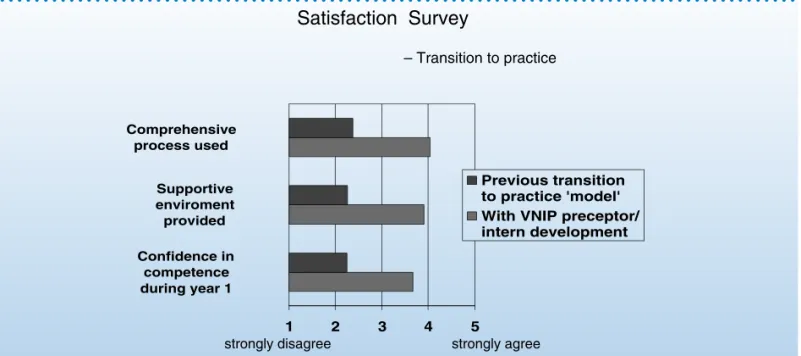
Research- and theory-based educational preparation for the preceptor role is essential to success for both the intern and preceptor. As of May 2006, the VNIP has delivered preceptor education to over 1,300 Vermont-employed healthcare providers. Feedback from program participants has been used to shape the educational delivery, modify the content, and evaluate the effec-tiveness of agency support/resources for preceptors. Anecdotal feedback assures us that we have been successful in changing the workplace culture to one of support and nurture for the new graduate and new-to-specialty nurse. Managers, educators, and colleagues re-port marked improvement in the ‘‘transition-to-practice’’ process (see Table 1). Quantitative data show the positive impact on recruitment, retention, and vacancy rates (see Table 2).
21ST CENTURY PRECEPTOR DEVELOPMENT
To ensure that preceptor development is effective for 21st century healthcare needs and demands, VNIPre-evaluated the approach to preceptor education and support. In 2001, academic educators joined the pre-ceptor development team in evaluating and revising the educational preparation for preceptors. They worked with staff development specialists to modify the cur-riculum to fit the existing position requirements and brought an approach that teaches the foundations of research and theory behind the ‘‘skills’’ or ‘‘tools’’ used. This approach is in direct contrast with the tradi-tional staff development process that provided a ‘‘just enough, just in time’’ type of preparation. One of the findings in the ‘‘Novice-to-Expert’’ Theory (Benner, 1984) was that nurses often knew about ‘‘how to do’’ some-thing without knowing ‘‘why to do’’ it. With this in
TABLE 1 Outcomes—Transition Process
...
TABLE 2 Outcomes—Recruitment and Retention
...
For the initial pilot test, 49% of the nurse interns came from out-of-state residence and/or schools.
Retention data from tertiary care center—Retention of those who completed their orientation in 1999 was 75%, whereas the new graduates who completed an internship showed a 93% retention rate for each of the following 2 years.
Position vacancy rate—At one participating agency, the medical–surgical unit had suffered an unrelenting vacancy rate of 20%. This agency credits the internship/ preceptor program with the current vacancy rate of 0% for the entire nursing department.
mind, instead of teaching preceptors how to use forms and tools, we instruct about why/how (or why not) these forms, tools, and approaches are effective. We are building a cadre of care providers and educators who use this comprehension of communication, teaching/ learning process, and interpersonal relationships in all of their interactions with clients and colleagues.
Experiential Learning
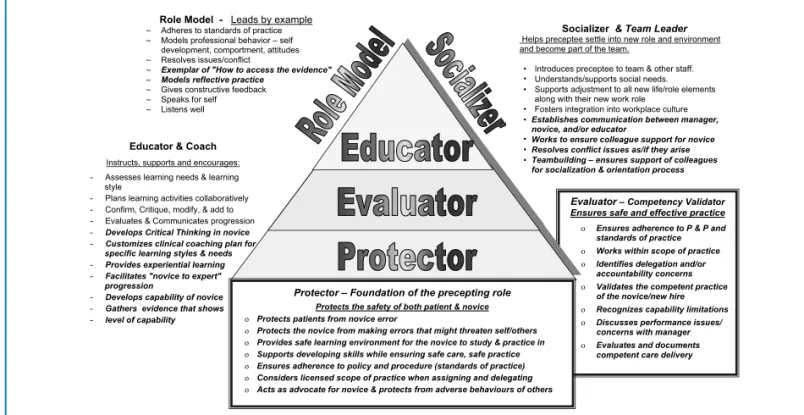
When educating preceptors, the roles of socializer, edu-cator, and role model (Alspach, 1988) have traditionally been considered as the core responsibilities. These components are fundamental but do not include the most important roles of the preceptor. Along with the traditional expectations, preceptors fill the functions of protector, evaluator, and team leader/builder. To sup-port these additional roles, we have added educational content specific to the foundation components of safety administrator (protector) and competency vali-dator (evaluator), in addition to focusing attention on how the preceptor’s team leadership skills are essential to the socializing and protecting roles (see Figure 1).
With healthcare systems focused on the prevention of errors, the role of protector, or safety administrator, is the essential foundation of the preceptor’s job. The preceptor protects safety for the client, novice, and, sometimes, colleagues of the new hire. Being a
‘‘protector’’ is not a new role. As professional nurses, we are constantly on guard to ensure safe and effective care for clients. At the same time, the preceptor needs to provide a safe learning environment, one where the novice feels safe to learn, to ask questions, and to even make mistakes and learn from them. A safe learning environment includes a teaching/learning approach that builds simple to complex, encourages independent prac-tice, plans for success, ensures consistent observation, provides ongoing feedback/encouragement and moni-tors to protect the safety of both novice care providers and clients. In the protector role, the preceptor must establish a team approach to the development of nov-ices. This requires the preceptor to be a team leader, communicator, and conflict resolver. The preceptor re-cruits the full healthcare team to support both the devel-opment and evaluation of the novice. After assessing the learning needs, team members provide support and instruction as the novice develops and practices specific skills and tasks. To ensure safe and effective care for clients, the preceptors will not allow the novice to prac-tice independently until basic capability or ‘‘competence’’ is demonstrated. Competence evaluation is another as-pect of evidence-based care. Demonstration of capable practice is the ‘‘evidence’’ that is collected that validates that this person can provide care in a safe and effective manner. The preceptors are challenged to respond to the question, ‘‘What evidence do you have that this
person can do this in a safe and effective manner?’’ When preceptors have the answer to this question, they have fulfilled their protector role as it relates to provid-ing safe and effective care. When the novice has been able to provide evidence of his or her capability to pro-vide safe, effective care in a supportive environment, the preceptor has fulfilled his or her protector role as it relates to protecting the novice.
Defining competence is the first step in any eval-uation process. In the VNIP, performance scoring guidelines are based on the performance categories delineated in the Novice-to-Expert Model (Benner, 1984). This requires further exploration and discus-sion for preceptors because the competent level of practice within ‘‘Novice to Expert’’ often requires 2 to 3 years of development. For use in an orientation or internship, the capability level for independent prac-tice is actually that of advanced beginner. The VNIP coalition defined this basic level of competence as ‘‘Capable’’—familiar with skill/equipment but may need assistance and seeks help when unfamiliar with process/skill. The evaluation assessment avoids the termcompetentwhile building on the link between the minimum requirements for safe and effective care and the Novice-to-Expert Model (see Table 3).
The ongoing emphasis on competency assessment brings into focus the role of evaluator or competence validator. This role highlights the evaluation and ex-amination aspects of the preceptor’s responsibilities. The preceptor must determine and communicate the transition in his or her role between being the educa-tor who teaches and nurtures and being the compe-tency validator who is there to evaluate performance instead of assisting. Evaluation is an essential compo-nent of ensuring safe and effective care for patients. The evidence of capability is documented and retained in the employee record. This is also the evidence that may be used to determine that this novice is not suit-able for the setting within which he or she is a novice
practitioner. To accomplish this effectively, the com-petence assessment tool needs to be based on ‘‘clearly defined expectations,’’ which are specific, measurable, performance-based criteria. The VNIP has accom-plished this through use of the framework established by Lenburg (1999): the COPA Model. Within this model, each care provider has competency outcomes and performance criteria statements identified that address specific behaviors representing each of the eight core practice competencies: assessment and in-tervention, communication, critical thinking, human caring and relationship skills, teaching, management, leadership, and knowledge integration. This framework shifts the focus away from the traditional ‘‘grocery list’’ of tasks and procedures and instead highlights the direct care behaviors that comprise the critical think-ing, organization, leadership, and interpersonal skills that are essential to effective practice in health care. An additional advantage of using this framework includes its applicability for all direct care providers. Having a universal approach for both the preceptor instruction and the resulting competency assessment fosters a team approach to development and support for pre-ceptors and staff.
Team leading is a factor within all the work that the preceptor undertakes. In the role of team leader, the preceptor recruits colleague support and assistance for the development and observation of the novice. The preceptor builds the communication, teamwork, and interpersonal interactions that provide for successful teaching/learning, while creating a workplace culture of support and nurture. The preceptor ensures com-munication among manager, novice, and/or educator and resolves conflicts if they arise. Ensuring colleague support for the novice is often the greatest challenge. Too often, the attitude of colleagues has been, ‘‘There are two of them, and they can take that extra admission and the post-op patient!’’ Instead, we need a work-place culture that recognizes the additional work in-volved in precepting and the time investment required for success, one that views the success of the novice as a joint responsibility rather than ‘‘the preceptor’s job.’’ The African proverb, ‘‘It takes a village to raise a child’’ is an appropriate axiom for this role, because it takes the entire work team to create the workplace culture and socialization that ensures safe, effective practice and the retention of novice nurses.
In updating the ‘‘educator role,’’ we need to teach preceptors how to develop critical thinking skills in the novices and colleagues with whom they work. Often, the selected preceptor has been in practice long enough that he or she did not receive any instruction specific to critical thinking within basic nurse educa-tion. Thus, there is a need to teach on three different levels: What is critical thinking? How do you do it? How
TABLE 3 Performance and Self-Assessment Scoring Key
...
1. Identified limitation—requires direct guidance and support; little or no experience with skill
2. Capable—familiar with skill/equipment but may need assistance; seeks help when unfamiliar with process/skill 3. Performs independently—knowledgeable to perform
these tasks safely as a result of training and experience 4. Proficient—extensive experience in this area/skill; able
to teach and mentor others
5. Expert—develops the capability/thinking of colleagues and ensures evidence-based practice
do you foster it in others? Preceptors report that it is far more difficult to develop the right question to ask than to give the novice an answer from their more ‘‘expert’’ experience base. It is crucial to remember that answering the question for the novices is equal to doing their critical thinking for them.
Another critical thinking challenge that preceptors face is evaluation. Some find it hard to visualize how to measure this vital skill in a colleague or novice. The VNIP competency tool identifies some of the critical thinking behaviors with critical element statements such as the following:
! Practices within limits of experience/capability ! Seeks assistance/information correctly
! Integrates data obtained from multiple sources ! Explains diagnostic reasoning
! Prioritizes care needs and tasks correctly
! Applies population- and disease-specific consider-ations in planning and providing care
! Initiates/supports discharge planning throughout care This list of behaviors provides clearly defined expec-tations for both the preceptor and the novice in relation to critical thinking in daily practice. The other seven core practice competencies are defined with behavioral outcomes in the same manner, and they outline the entire role of the nurse in the identified setting. Each specialty area has additional pages that outline the practice that is unique to the specialty.
INSTRUCTIONAL PROCESS
For the initial preceptor development, a preassignment and a 2-day workshop lay the foundation for instruc-tion. Content areas include roles/responsibilities, novice-to-expert theory, competency development/assessment, delegation and accountability, teaching/learning theory, communication, personality styles and generational/ cultural barriers to communications, critical thinking, preceptor program experiences, team building, and development of clinical coaching plans. The teaching method for each topic includes small group work, case scenarios, and/or individual surveys, thus addressing different learning styles and maintaining interactive learning throughout the sessions. The self-learning module and workshop are approved for a total of 18.6 contact hours of continuing education, yet workshop participants consistently request more time and more instruction related to communication, conflict man-agement, and working with ‘‘problem’’ learners. Other requested topic areas include change theory, emotional intelligence, and more on reflective practice.
Along with standardizing the educational preparation and competency expectations, the VNIP has created standardized clinical coaching plans. These coaching
plans provide a guideline for the educational process for novices who have specific learning needs. They are teaching plans that are based on specific learning goals, and the concept is similar to that of using standardized patient care plans. These coaching plans simplify the process for preceptors and the novices with whom they work by offering specific learning activities and measurable, behavior-based outcomes that serve the particular performance goal. Each page starts with bul-leted reminders to ensure follow-through on documen-tation, computer skills, planning of learning experiences, and discussion time. The coaching plans require spe-cific documentation that supports critical thinking de-velopment, encourages case scenario exploration and ‘‘what ifs,’’ and fosters the feedback cycle.
Preceptor education participants have consistently requested practice with the tools with which they will be working. Prior to implementation of the internship project, there was no consistency in forms or ap-proach. In fact, different units within an agency often used different systems and format. Basing the VNIP competency assessment on the COPA model frame-work and the establishment of clinical coaching plans has standardized the approach for both the develop-ment and evaluation of competence. Within Vermont, all the acute care, public health, and most of the visit-ing nurse and long-term care agencies are usvisit-ing the same competency expectations for new-graduate intern-ships. Most of these sites use the same form and process for all orientation of new staff.
The VNIP has standardized preceptor development statewide. All preceptor education is taught from the same teaching plan and outcome objectives. Presenta-tion resources are developed by content experts and shared with colleagues across the state. This vital instruction is offered in all regions of the state and for all direct care providers—from across the continuum of care. The team approach to precepting is fostered by having the entire allied health team sharing in a joint educational program, initiating the mutual account-ability for the success of the novice. All educational content pertains to communication, interpersonal skills, and teaching/learning skills that are applicable in all prac-tice settings, specialties, and sectors. Mixed-participant groups bring a rich shared history and enhance the ongoing teamwork of all participants. There are more commonalities than differences when we focus on this crucial support for experiential learning.
SUMMARY
Development and support for preceptors are enhanced by standardization of the curriculum and inclusion of the full healthcare team. There are three major program components that are essential to success in precepting.
! Development and support for preceptors—Preceptor preparation is improved with theory- and research-based education that is inclusive of specific instruc-tion related to critical thinking development and to the protector and evaluator roles. Building a support system includes establishment of proto-cols that define roles, delineate time to teach, and recognize and/or reward preceptors.
! Clearly defined performance expectations— Performance criteria stated in specific, measur-able, behavior-based terms support the develop-ment of the novice. The VNIP has used the COPA model as a framework to ensure that all of the critical roles and expectations of the professional nurse are included and addressed in measurable terms. These competency evaluation and docu-mentation are the evidence collection processes that validate that the individual can provide safe and effective care according to agency and spe-cialty protocols.
! Clinical coaching plans—Very few preceptors have complete, comprehensive instruction for their role as educators. They are direct care providers who have focused their professional development on clinical expertise. Teaching is a specialty that rarely receives the time investment that might be necessary for developing individualized teaching plans. A resource that the clinical educator and staff development specialist can provide to fill this gap is clinical coaching plans. These plans provide a structured teaching/learning map that acts as a guideline for the teaching process and critical thinking development and offers specific, measurable outcomes for the novice. The use of clinical coaching plans for planning and tracking the learner’s progression eases the workload for the preceptor, provides consistency in teaching/ learning activities, ensures communication between preceptors, and supports the novice with clearly defined expectations.
The roles and responsibilities of the preceptor in the 21st century include protector, evaluator, socializer, role model, and educator. A core component of the pre-ceptor’s educator role is the development of reflective
practice and critical thinking skills in the novice. In other words, it is not enough that preceptors are prepared with a sound understanding of critical think-ing. They must also learn and practice the skill of developing critical thinking and work organization skills in others. All these role components are evi-denced in expectations of precepting in Vermont healthcare settings, no matter what level of novice, orientee, or student is being precepted. The experi-ence of the VNIP has demonstrated that detailed instruction in these role components improves the performance and results of a preceptor program, thus greatly affecting the internships, orientations, and student experiences that these programs support.
To ensure safe and effective practice, preceptors require development and support that assist them in meeting the essential competencies for their role and responsibilities, as defined and applied in the 21st century. With both the nursing shortage and increased medical complexity affecting our work assignments, this becomes a more challenging and difficult role, and the preparation for it is even more crucial to safe and effective patient care.
REFERENCES
Alspach, G. J. (1988).From staff nurse to preceptor—A preceptor
training program: Instructor’s manual. Secaucus, NJ:
Hospital Publications, Inc.
Benner, P. (1984).From novice to expert: Excellence and power
in clinical nursing practice. Menlo Park, CA: Addison-Wesley. Anderson, K., Ceppetelli, E., Hayward, J., Kaeding, T., Lord, J., Menchini, P., et al. (1999). Current state of nursing in Vermont. Retrieved October 26, 2006, from http://www.vahhs.org/lucie/ VONl/VONL%20 Presentationhtm
Lenburg, C. (1999, September 30). The framework, concepts and methods of the Competency Outcomes and Performance
Assessment (COPA) model.Online Journal of Issues in Nursing.
Retrieved October 26, 2003, from http://nursingworld.org/ojin/ topic10/tpc10_2.htm
Kaeding, T. (1998). Vermont nursing report. Retrieved October 26, 2006, from http://www.vahhs.org/lucie/VONl/nursingreport.htm
ADDRESS FOR CORRESPONDENCE: Susan A. Boyer, MEd, RN, Vermont Nurses in Partnership, Inc., 289 County Road, Windsor, VT 05089 (e-mail: [email protected]).