CASE STUDY
Thermal Analysis, Heat Sink Design and Performance
Verification for GE Fanuc Intelligent Platform’s WANic
3860 Packet Processor PCI Card
Challenge
When GE Fanuc Intelligent Platforms, a leading provider of embedded computing solu-tions for a wide range of industries and applicasolu-tions, needed to determine the thermal characteristics of their new WANic™ 3860 Packet Processor, they turned to the experts at Advanced Thermal Solutions, Inc. (ATS). ATS is a leading electronics cooling provider which offers comprehensive thermal management analysis and design services tailored to help bring telecommunications, networking, embedded computing and other high performance electronic products to market faster, ensure their reliability and reduce development costs.
The WANic 3860 Packet Processor is a high-performance 4-port Gigabit Ethernet PCI-X card which provides secure, high-speed connectivity and complex security pro-cessing with wire speed performance. It features the Cavium OCTEON® 16 core 500 MHz CN3860-NSP (Network Services Processor), which needs to be kept at a junction temperature below 110°C to maintain reliable operation.
A previous model, the WANic 3850, utilized an active heat sink for cooling the Cavium component. However, GE Intelligent Platforms’ design team wanted a complete and thorough thermal examination of the WANic 3860, so that a passive cooling solution could be used, offering much greater reliability, reductions in cost and implementation time. In response, ATS provided several thermal management analysis and design services for GE Fanuc Intelligent Platforms, including:
1.
Thermal analysis of the PCI board design2.
CAD and Computational Fluid Dynamics (CFD) modeling, simulation and analysis3.
Rapid design and development of the prototype heat-sink4.
Wind tunnel and chassis testing and verification1. Thermal Analysis
ATS’ thermal management experts studied several key factors including volumetric flow
rate, pressure drop and component temperature. The company’s engineers started by researching and simulating the thermal characteristics of the Cavium OCTEON CN3860, DDR2 memory DIMM, and other critical components. By using this approach, analytical junction temperatures were produced for each device as well as an estimate
of the airflow necessary to ensure proper cooling of the WANic card. It also reduced the number of CFD (computational fluid dynamics) iterations that needed to be performed, and validated those CFD findings.
2. CAD and CFD Modeling, Simulation and Analysis
Based on the results of the thermal analysis, ATS engineers used SolidWorks® 3D CAD software to produce a detailed model of the board assembly. Then they ran multiple
airflow simulations, at various flow rates, using CFD software from CFDesign®. The result was a detailed set of CFD images showing the airflow patterns and providing a temperature profile of the card. A CAD model of the card is shown in Figure 1.
As part of the design process, AtS tests
heat sinks in its thermal fluids laboratory,
using sophisticated equipment such as its
CWT-100™ series open-loop wind tunnel,
to verify any analytical or computational
simulation results.
3. Rapid Prototype Design and Manufacture
Using the data from the initial analytical and CFD studies, ATS designed a
high-perfor-mance heat sink (ATS-725), based on the company’s patented maxiFLOW™ flared fin
architecture that, when installed, would adequately cool the Cavium CN3860 package and ensure proper performance of the WANic PCI card. ATS maxiFLOW heat sinks
feature a low profile, spread fin array to maximize their surface area for more effective
convection (air) cooling.
In the case of the WANic PCI card, the ATS-725 heat sink was found to keep the junction
temperature of Cavium CN3860 at or below acceptable levels with an airflow of 1.39 m/s
(275 LFM) or greater within a PCI card slot, at an ambient air temperature of 55°C. The design team then had heat sink samples fabricated at ATS’ manufacturing facility in Norwood, MA, USA.
4. Wind Tunnel Testing and Verification
As part of the design process, ATS tests heat sinks in its thermal fluids laboratory, us -ing sophisticated equipment such as its CWT-100™ series open-loop wind tunnel, to verify any analytical or computational simulation results. When the ATS-725 was tested, elements in the open-loop wind tunnel were arranged to simulate the PCI slot
condi-tions, thus validating CFD testing. Test findings also produced the heat sink’s thermal
resistance and pressure drop characteristics.
The analytical design of the ATS-725 passive heat sink for cooling the Cavium CN3860 was the initial phase of the WANic card thermal characterization. Because of the com-plexity of the heat transfer from the Cavium component to the ambient, ATS performed further testing of the maxiFLOW™ heat sink installed on the WANic card, and inside an Intel SR2400 server chassis, under several test conditions.
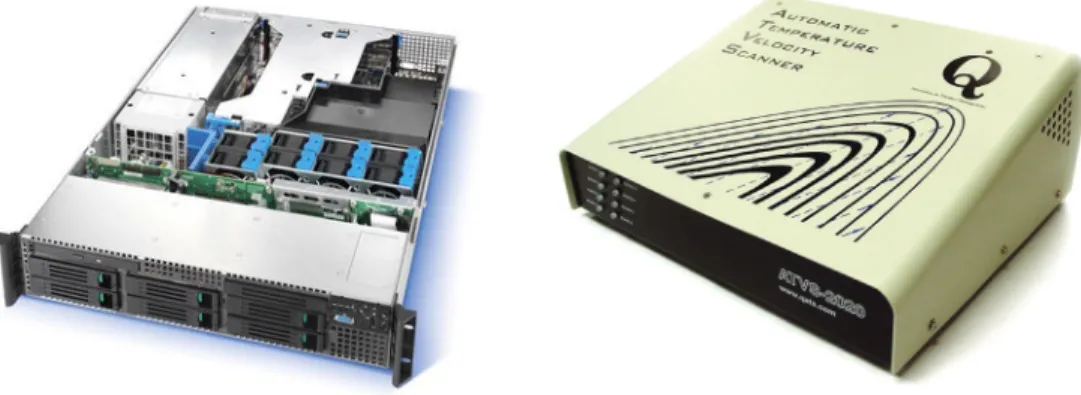
Thermocouples and ATS’ ATVS-2020™, Automatic Temperature and Velocity Scanner, multi-channel, hot-wire anemometer system were used to measure case temperature as well as approach air velocity. Sample chassis and instruments are shown in Figure 3.
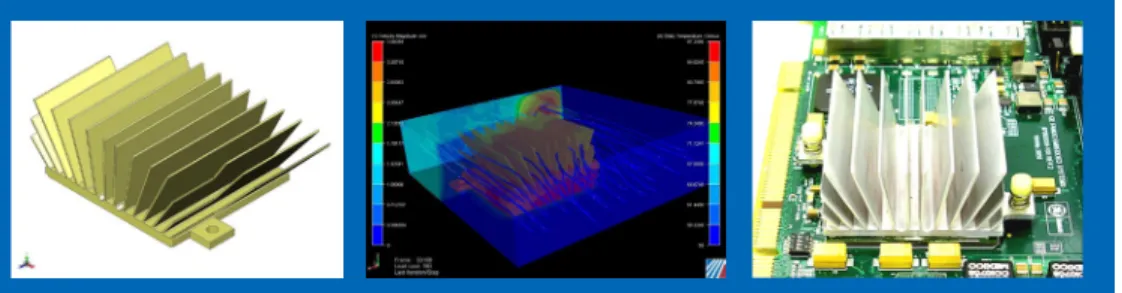
Figure 2. SolidWorks Images of the ATS-725 maxiFLOW™ Heat Sink Along with its CFD Simula-tion and Prototype.
Figure 3. An Intel SR2400 Server Chassis (Left) and an ATS ATVS-2020 Automatic Tempera-ture and Velocity Scanner (Right) Were Used to Test the ATS-725 Heat Sink Performance on a WANic 3860 Card.
For one validation test, a sample WANic card was installed in the chassis and variable
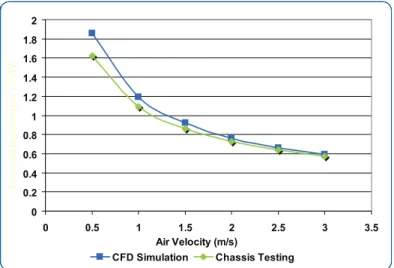
airflow. Component temperatures were recorded over a range of airflow levels to pro -duce a thermal resistance graph.
In a separate test, the WANic card was modeled in CAD and simulated with CFD. The PCB was modeled as a standard 12 layer board with bulk thermal properties as follows:
a thermal conductivity of 85.66 W/m-K in the X and Y directions, thermal conductivity of 0.33 W/m-K in the Z direction, 432.54 kg/m3 density, and 837.00 J/kg-K specific heat.
The results of these two testing methods showed close agreement, with an error of
2-13% from 0.5-3 m/s (100-600 LFM) air velocity. A final stage of testing included
CFD simulation of the complete WANic card, including the ATS-725 heat sink. This simulation also showed close agreement with the chassis testing. CFD results showed a consistently higher thermal resistance of 2-13%, and this was mainly due to a lack of radiation heat transfer in the simulation. Once the base simulation was correlated with experimental results, future scenarios could be investigated within CFD to predict processor upgrade thermal performance. Figure 4 shows the CFD simulation and the
final heat sink designed.
Figure 4. CFD Simulation of the GE Fanuc Intelligent Platform’s WANic Packet Processor PCI Card with the ATS-725 maxiFLOW™ Heat Sink Installed, Along Side a Sample Card.
Solution
ATS’ Thermal Management Analysis & Design Services produced valuable analytical, computational and experimental data that allowed for a high-performance, optimized passive heat sink solution to be designed for the card’s ideal operating conditions.
30,574 852,639 0 100,000 200,000 300,000 400,000 500,000 600,000 700,000 800,000 900,000
Mean Time Between Failure (Hours)
Active HS with 12V Fan ATS-725 Passive maxiFLOW HS
Figure 6. Comparison of Cooling Solutions for the GE Intelligent Platforms WANic 3860 Card In Terms of Mean Time Between Failures
0 0.2 0.4 0.6 0.8 1 1.2 1.4 1.6 1.8 2
0 0.5 1 1.5 2 2.5 3 3.5
Air Velocity (m/s)
The rm al Re si st ance (°C/ W)
CFD Simulation Chassis Testing
Figure 5. The Results of CFD Simulations and Chassis Testing of the ATS 725 maxiFLOWTM
Heat Sink. GE Fanuc Recommends and Airflow of at least 275 LFM if a Passive Heat Sink is
Used
Not only did the ATS-725 maxiFLOWTM heat sink solution offer significant cost savings but
it also provided 27 times the reliability of the active solution. As a result of the collabora-tion between GE Fanuc Intelligent Platforms’ design team and ATS thermal management experts, the company was able to quickly introduce the new card to the market with cost savings and increased reliability.
Visit www.qats.comor call 781-769-2800 to learn more about ATS’ Thermal Management