Design and Analysis of Dry Cylinder Liners Used in Diesel Engines
1M. Anand Kumar , 2A.A.V.Prasad Rao, 3J Hari Narayana Rao 1M. Tech. Student, 2Associate.Professor,
Dept of ME, KITS, Divili. 3Research Scholar
Abstract
:-A Cylinder liner is a cylindrical part to be fitted in to an engine block to form a cylindrical space in which the piston reciprocates very smoothly. It is one of the most important functional parts to make up the interior of an engine. Generally cylinder liners are made of Cast Iron, Cast steel, Nickel CI, Nickel chrome CI. The aim of this project is to design and analyze a dry cylinder liner for Hino-X diesel engines. A Hino–X engine cylinder dry liner used in one of Ashok Leyland model manufactured by The amount of heat generated, heat transfer rate of the component, temperature produced inside the cylinder are to be calculated using ANSYS analysis package. Various surface coatings like ceramic, aluminum alloys and Nickel chrome alloy steel are used to study the, heat flux, , thermal stresses, thermal displacement, thermal gradient ,nodal temperatures of the cylinder liner. Modeling is done in Pro/Engineer and analysis is done coupled field analysis in ansys. After comparing the results, the best coated cylinder dry liner for this type of diesel engine can be suggested.
I. INTRODUCTION
The cylinder liner forms the cylindrical space in which the piston reciprocates. The reasons for manufacturing the liner separately from the cylinder block (jacket) in which it is located are as follows; The liner can be manufactured using a superior material to the cylinder block. While the cylinder block is made from a grey cast iron, the liner is manufactured from a cast iron alloyed with chromium, vanadium and molybdenum. (cast iron contains graphite, a lubricant. The alloying elements help resist corrosion and improve the wear resistance at high, temperatures.)The cylinder liner will wear with use, and therefore may have to be replaced. The cylinder jacket lasts the life of the engine. At working temperature, the liner is a lot hotter than the jacket. The liner will expand more and is free to expand diametrically and lengthwise. If they were cast as one
piece, then unacceptable thermal stresses would be set up, causing fracture of the material To increase the power of the engine for a given number of cylinders, either the efficiency of the engine must be increased or more fuel must be burnt per cycle. To burn more fuel, the volume of the combustion space must be increased, and the mass of air for combustion must be increased. Because of the resulting higher pressures in the cylinder from the combustion of this greater mass of fuel, and the larger diameters, the liner must be made thicker at the top to accommodate the higher hoop stresses, and prevent cracking of the material. If the thickness of the material is increased, then it stands to reason that the working surface of the liner is going to increase in temperature because the cooling water is now further away. Increased surface temperature means that the material strength is reduced, and the oil film burnt away, resulting in excessive wear and increased thermal stress.
2. CYLINDER IN IC ENGINE
The cylinder of an I.C. engine acts as the structural member and retains the working fluid in a closed space with movable piston wall. It is tested to high explosive pressure, which is approximately 3-8 times the maximum compression pressure and high temperature ranging between 1800K and 2400K. Thus the cylinder of an I.C. engine should be able to withstand high working pressure and should be able to transfer heat efficiently without thermal distortion taking place. For small engines operating at low speed, the cylinder block is cast as one piece. However for large engines a separate cylinder liner is used. It facilitates easy repair or replacement of the liner in the event of wear and tear of the cylinder.
3.CYLINDER LINER
in Japan, but some countries(or companies) call this Cylinder sleeve. Cylinder liners are generally made of closed grained pearlitic cast iron, nickel CI, nickel-chrome CI, cast steel and forged alloy steel. The inner surface of the liner is heat treated to obtain a hard and smooth surface. The basic dimensions of the cylinder liner are determined on the basis of strength and rigidity to prevent ovalization of the liner during assembly and operation. The dimensions should conform to IS:6750 – 1972. A cylinder liner should be designed and/or checked in the following modes of failure: A cylinder liner is designed by treating it as either thick cylinder or thin cylinder depending upon the bore to thickness ratio. A cylinder liner should be checked for thermal stress caused by high temperature difference between the outer and inner surfaces of the liner. In a cylinder liner, longitudinal stress is produced in addition to hoop stress, though marginal which causes extension of the cylinder. The side thrust caused by obliquity of the connecting rod on the cylinder liner induces bending stresses.
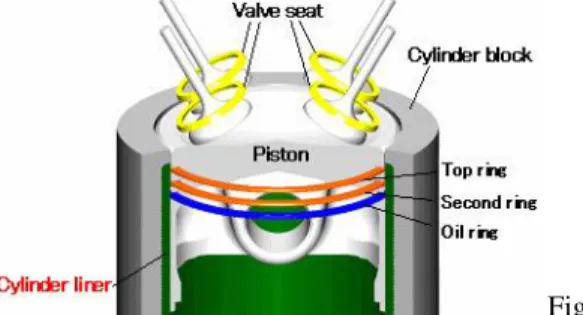
Fig:3.1 Fig; 3.1 Cross-section of a cylinder in an internal
combustion engine
Fig; 3.2 cylinder with piston ,and cylinder liner
4 . NEED OF CYLINDER LINERS
The cylinder liner forms the cylindrical space in which the piston reciprocates. The reasons for manufacturing the liner separately from the cylinder block (jacket) in which it is located are as follows The liner can be manufactured using a superior material to the cylinder block. While the cylinder
block is made from a grey cast iron, the liner is manufactured from a cast iron alloyed with chromium, vanadium and molybdenum. (cast iron contains graphite, a lubricant. The alloying elements help resist corrosion and improve the wear resistance at high temperatures.)The cylinder liner will wear with use, and therefore may have to be replaced. The cylinder jacket lasts the life of the engine. At working temperature, the liner is a lot hotter than the jacket. The liner will expand more and is free to expand diametrically and lengthwise. If they were cast as one piece, then unacceptable thermal stresses would be set up, causing fracture of the material.
then bored radially around the top of the liner so that they join with the tangentially bored holes. On some large bore, long stroke engines it was found that the under cooling further down the liner was taking place. Why is this a problem? Well, the hydrogen in the fuel combines with the oxygen and burns to form water. Normally this is in the form of steam, but if it is cooled it will condense on the liner surface and wash away the lube oil film. Fuels also contain sulphur. This burns in the oxygen and the products combine with the water to form sulphuric acid. If this condenses on the liner surface (below 140º) then corrosion can take place. Once the oil film has been destroyed then wear will take place at an alarming rate. One solution is to insulate the outside of the liner so that there was a reduction in the cooling effect.
5 . TYPES OF CYLINDER LINERS
Generally, two types of cylinder liners are used in I.C. engines: dry liners and wet liners. A cylinder liner does not come in direct contact with the cooling medium is called the dry liner, whereas a wet liner comes in contact with the cooling medium. This type of liner is supported at two positions and a water jacket is formed between the liner and the cylinder block in which cooling water is circulated.
1. Dry Cylinder Liners 2. Wet Cylinder Liners
6 .DRY CYLINDER LINERS
As shown in fig, this type of liner is made in the shape of a barrel with flange at the top which keeps it into position. The entire outer surface bears against the cylinder block casting and hence has to be machined very accurately both from the inside and the outside. It is put in position by shrinking the liner. This introduces some stresses due to shrinkage and hence the liner bore has to be machined accurately again after the liner has been put into the cylinder casting. Too loose a liner will result in poor heat dissipation because of absence of a good contact with the cylinder block. This will result in higher operating temperatures. If the lubrication is also deficient, it may cause scuffing. Too tight a liner is even worse than the too loose case. It produces distortion of cylinder block, liner cracking, hot spots and scuffing. Even if a correct liner is fitted in a cylinder block which itself is badly distorted, it will result in poor sealing action of rings if the liner is thin because then it will also tend to adopt the shape of the distorted block in which it is fitted. Even if the liner is thick enough to resist change of shape, there will be some hot spots which will lead to scuffing on the inner surface of the liner.
6.1ADVANTAGES OF DRY LINERS
1. There is no danger of water leakage either in to the crankcase or the combustion chamber. 2. Due to the absence of a heavy flange at the top of
the liner, cylinder centers can be reduced. 3. There is better cooling of the upper part of the
liner.
6.2DISADVANTAGES
1. Complicated casting
2. Decreased heat flow through the composite wall.
6.3 DRY CYLINDER LINERS IN DIESEL ENGINES
In diesel engines a dry liner is used in which the liner barrel does not make direct contact with the cooling water. In the most common dry liner, a flange is provided on the upper outer circumference in an axial direction and a grind relief groove is provided below the flange at the outer circumferential surface of the liner barrel. The dry liner is inserted into the cylinder bore of the cylinder block and the flange is fastened along with the gasket, between the lower surface of the cylinder head and the upper surface of the cylinder block by tightening of the head bolts.
However, in recent years demand has steadily mounted for thin-walled dry liners in order to make the engine lighter and more compact. One critical problem that must be dealt with to meet this demand is reduction of tensile stress on the inner circumferential surface of the liner at the grind relief groove below the flange caused by repetitive stress induced by combustion pressure and piston slap during engine operation.
The tight-fit type of the dry liner has no gap between the outer circumferential surface of the liner and the inner circumferential surface of the bore of the cylinder block and press-fit is carried out during assembly. However in the tight-fit type of the liner, a gap appears just as with the loose-fit type liner when deformation occurs in the cylinder block or the liner in the vicinity of the grind relief groove.
As prior technology for reducing tensile stress on the liner inner circumferential surface at the grind relief groove below the flange, there is for instance a proposal to provide partly press-fit portions below the grind relief groove (see Japanese Utility Model Laid-open No. 6-82466). However changing partly the dimension of the liner barrel is difficult for using conventional center less grinding.
6.4 Formation of sliding surface
The cylinder liner, serving as the inner wall of a cylinder, forms a sliding surface for the piston rings while retaining the lubricant within. The most important function of cylinder liners is the excellent characteristic as sliding surface and these four necessary points.
(1)High anti-galling properties
(2)Less wear on the cylinder liner itself (3)Less wear on the partner piston ring (4)Less consumption of lubricant
6.5 Heat transfer
The cylinder liner receives combustion heat through the piston and piston rings and transmits the heat to the coolant.
Figure 6.1 Heat transfer
6.6 Compression gas sealing
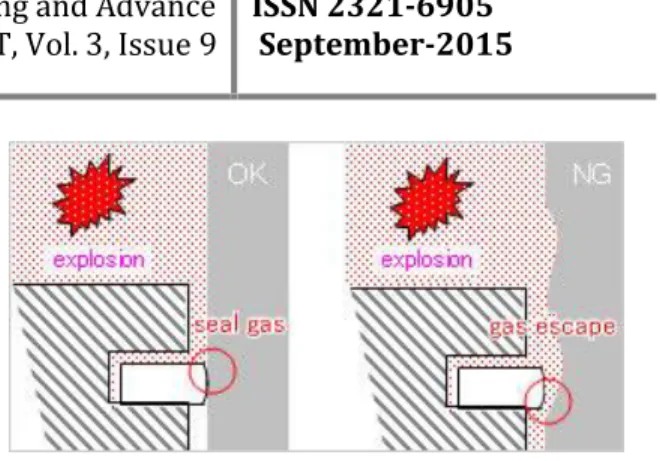
The cylinder liner prevents the compressed gas and combustion gas from escaping outside.
Figure6.2 :Providing air tightness of cylinder liner It is necessary that a cylinder liner which is hard to transform by high pressure and high temperature in the cylinder.
A cylinder wall in an engine is under high temperature and high pressure, with the piston and piston rings sliding at high speeds. In particular, since longer service life is required of engines for trucks and buses, cast iron cylinders that have excellent wear-resistant properties are only used for cylinder parts. Also, with the recent trend of lighter engines, materials for engine blocks have been shifting from cast iron to aluminum alloys. However, as the sliding surface for the inner cylinder, the direct sliding motion of aluminum alloys has drawbacks in deformation during operation and wear-resistance. For that reason, cast iron cylinder liners are used in most cases.
6.7 ENGINE APPLICATIONS OF DRY CYLINDER LINERS
Cylinders liners are called several names in industry. It can also be referred to as sleeves. Thus, cylinder liners and cylinder sleeves are one and the same thing.
The barrel or bore that the piston moves up and down may be either integral with the engine block, or be a completely replaceable separate item. Most diesel engines come with replaceable cylinder liners. The most common agricultural tractor with a sleeveless or liner less engines are some of the Ford / New Holland engines. Most of the other, including, John Deere, Farmall, Allis Chalmers, IH, Case, David Brown, Massey Ferguson, Perkins, Cummins and Kubota are predominantly sleeved engines.
machine, without the need for transport to a machine shop. However, the larger diesel engines will require removal from the machine and transport to the machine shop for full liner /sleeve replacement.
Another advantage of using sleeves / liners is that the engine block can be manufactured with less expensive cast iron, while the liners are manufactured with special alloys, making it tougher, harder, and resistant to heat and wear. These added alloys can have chromium, nickel, or molybdenum.
Engines with the bore directly into the engine block, like Ford Tractor engines, are referred to as “wet sleeves,” as the coolant circulated directly onto it, being cooled by convection. The blocks with are referred to as “dry sleeves” are cooled via conduction heat transfer.
After the initial wear and tear or operation, the engine block itself is re-bored to a larger diameter to fit oversized pistons. With repeated re-boring, there comes a time where re-boring has reached its limits, and a replacement cylinder liner has to be bought and installed. Thus, a sleeveless engine can be made into a sleeves engine when necessary.
Ford Tractor engines typically have liners fitted with a ridge or flange at the top. This acts as an added sealing feature, separating the water jacket from the combustion chamber and cylinder head
The sealing of the water jacket and from the cylinder head is also supported by using specially made o rings that can be fitted to the top and bottom of the liner, depending on application and engine design.
7. QUALITIES OF A GOOD DRY CYLINDER LINER
A good liner must possess the following qualities:
Strength to resist the gas pressure Sufficiently hard to resist wear
Strength to resist the thermal stresses due to the heat flow through the liner wall.
Corrosion resisting.
Capable of taking a good bearing surface. It should by symmetrical in shape to avoid
unequal deflection due to gas load and unequal expansion due to thermal load. No distortion of the inner surface due to
restraining fixings.
7.1 MATERIALS DRY CYLINDER LINER
The liner material should be strong, hard and corrosion resistant and produce a good bearing surface. The liner materials in order of preference are:
1. A good grade grey cast iron with homogenous and close grained structure, i.e., Perlitic and similar cast irons.
2. Nickel cast iron and Nickel chromium cast iron
3. Nickel-chromium cast steel with molybdenum in some cases.
The cast iron liners can be centrifugally cast. In large engines, usually the cast steel cylinders are used, but may be with cast iron liners. For air-craft engines, the liners are often turned of alloy steel forgings to get very light cylinders.
7.2. LINER DISTORTION
Cylinders, cylinder blocks and liners should be designed so as to reduce the distortion to a minimum. The liner distortion can be produced due to the following reasons:
Due to temperature stresses: As indicated above, a compressive stress is induced on the inside and a tensile stress is indeed on the outside of the wall. Any defect in the casting on the liner wall will change the stress distribution and the liner may go out of round. Similarly any ribs or bosses on the outer wall of the liner will impose local restraint on the liner wall, they bring under tensile stresses. A circumferential rib will try to distort the liner out of parallel while an axial rib will distort it out of round. Therefore ribs and bosses on the outer wall of the liner should be avoided as far as possible.
1. Distortion may also occur due to the axial expansion of the liner. Due to this reason, one end should be left free.
2. Distortion is also caused by the gas pressure. 3. Distortion may also be caused by bolting on
the cylinder head or any other part.
4. Distortion due to fixing, especially at the lower water joint. Here rubber rings are used and it is not compressible, if it is pushed out of shape, it must have room to move.
7.4 COMPARISON OF DRY AND WET CYLINDER LINERS:
1. Dry type liners may be provided either in the original design or even afterwards, whereas the wet type have to be included in the original cylinder design.
2. A leak proof joint between the cylinder casting and the liner has to be provided in case of wet pipe, whereas there is no such requirement in the case of dry liners.
4. In case of a cylinder block with siamesed adjacent cylinder bores (i.e., without any coolant passage between the adjacent bores for reducing the overall cylinder length), only dry liners can be used.
5. In case of wet liners, the casting of cylinder block is very much simplified
6. Better cylinder cooling is ensured in the case of wet liners because the coolant is in direct contact with the liner in this case. Besides better outside surface finish and more uniform wall thickness of the wet liner improves both the heat conduction and the uniformity of cylinder cooling.
7. Dry type cannot be finished finally before they are fitted to the cylinder block because of the shrinkage stresses produced, whereas wet type can be finished before fitting.
8. For perfect contact between the liner and the block casting in case of dry liners, very accurate machining of both the block and the outer liner surfaces is required, whereas no such necessity is there for wet liners.
8. INTRODUCTION TO PRO-ENGINEER
Pro-ENGINEER Wildfire is the standard in 3D product design, featuring industry-leading productivity tools that promote best practices in design while ensuring compliance with industry and company standards. Integrated Pro-Engineer / CAD/CAM/CAE solutions allow to design faster than ever, while maximizing innovation and quality to ultimately create exceptional products.
Customer requirements may change and time pressures may continue to mount, but product design needs remain the same - regardless of project's scope, need the powerful, easy-to-use, affordable solution that Pro-ENGINEER provides.
8.1 PRO-ENGINEER WILDFIRE BENEFITS
•Unsurpassed geometry creation capabilities allow superior product differentiation and manufacturability
•Fully integrated applications allow us to develop everything from concept to manufacturing within one application
•Automatic propagation of design changes to all downstream deliverables allows you to design with confidence
•Complete virtual simulation capabilities enable to improve product performance and exceed product quality goals
•Automated generation of associative tooling design, assembly instructions, and machine code allow for maximum production efficiency
Pro-ENGINEER can be packaged in different versions to suit our needs, from Pro-ENGINEER Foundation XE, to Advanced XE Package and Enterprise XE Package, Pro-ENGINEER Foundation XE Package brings together a broad base of functionality. From robust part modeling to advanced surfacing, powerful assembly modeling and simulation, our needs will be met with this scaleable solution. Flex3C and Flex Advantage Build on this base offering extended functionality of choosing.
8.2 DIFFERENT MODULES IN PRO-ENGINEER
PART DESIGN ASSEMBLY
DRAWING
SHEETMETAL
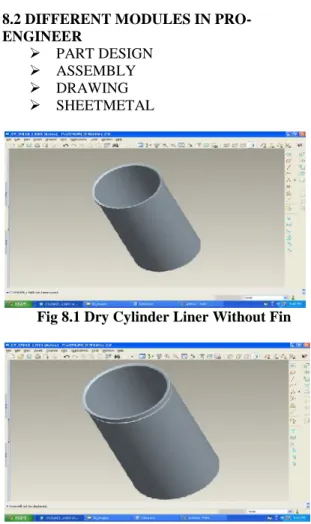
Fig 8.1 Dry Cylinder Liner Without Fin
Fig. 8.2 Cylinder Liner With Fin (Inside Cylinder) 9. INTRODUCTION TO ANSYS
typically used for the design and optimization of a system far too complex to analyze by hand. Systems that may fit into this category are too complex due to their geometry, scale, or governing equations.
ANSYS is the standard FEA teaching tool within the Mechanical Engineering Department at many colleges. ANSYS is also used in Civil and Electrical Engineering, as well as the Physics and Chemistry departments.
ANSYS provides a cost-effective way to explore the performance of products or processes in a virtual environment. This type of product development is termed virtual prototyping.
9.1 STEPS INVOLVED IN ANSYS
In general, a finite element solution can be broken into the following these categories.
1. Preprocessing module: Defining the problem
The major steps in preprocessing are given below defining key points /lines/areas/volumes - define element type and material /geometric /properties - mesh lines/areas/volumes/are required The amount of detail required will depend on the dimensionality of the analysis (i.e. 1D, 2D, axis, symmetric)
2. Solution processor module: assigning the loads
,constraints and solving. Here we specify the loads (point or pressure), constraints (translation, rotational) and finally solve the resulting set of equations.
10. Coupled field analysis of cylinder liner coated and uncoated materials
I. UNCOATED DRY CYLINDER LINER
Surface of dry Cylinder Liner
Fig. 10.1. Surface of dry Cylinder Liner For dry Cylinder Liner–Cast Iron
Element Type: solid 20 nodes 90
Material Properties: Thermal Conductivity– 25.2W/mk
Specific Heat–506 J/kg k Density - 0.00000719kg/mm3 For Fin–Aluminum Alloy 6101
Element Type: Solid 20 node 90
Material Properties: Thermal Conductivity– 220W/mk
Specific Heat–895 J/kg k Density - 0.0000027kg/mm3
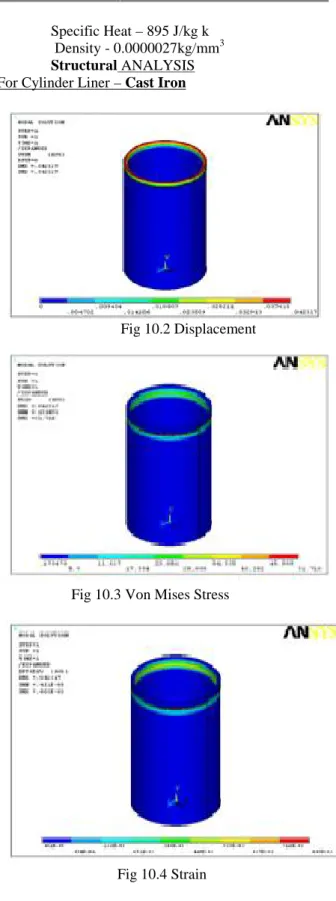
Structural ANALYSIS
For Cylinder Liner–Cast Iron
Fig 10.2 Displacement
Fig 10.3 Von Mises Stress
Fig 10.4 Strain
(A). CYLINDER LINER COATED WITH CERAMIC (PSZ)
Surface of Cylinder Liner
Fig 10.5. Surface of Cylinder Liner
Fig 10.6.Temperature
Fig 10.7 Thermal gradient
( B).CYLINDER LINER COATED WITH NICKELCHROME ALLOY STEEL
Surface of Cylinder Liner
Fig 10.8 Surface of Cylinder Liner
Fig 10.9 Thermal flux
RESULTS
Displacement (mm)
Von Mises Stress (N/mm2)
Strain Nodal Temperature (K)
Thermal Gradient (K/mm)
Thermal Flux (W/mm2)
Without Coating
0.042317 51.716 0.805e-3 558 7.586 0.458192
PSZ Coating 0.045538 41.875 0.722e-3 558 34.545 0.282513
Al2O3 0.032518 38.31 0.473e-3 558 19.223 0.480566
Nickel Chrome Coating
0.035057 49.772 0.488 e-3 558 22.924 0.416832
CONCLUSION
After comparing the results, the best coated
cylinder dry liner for this type of diesel engine can
be suggested. In this cylinder liners with coating
materials used, PSZ coating, Al
2O
3,Nickel
Chrome materials.
In this these three materials
best material is Al
2O
3 .REFERNCES
[1]
Brain, Marshall.
"HowStuffWorks "Basic
Engine
Parts"".
HowStuffWorks,
Inc.
Retrieved 3 May 2012.
[2] Kennett, Pat (June 1986). "The
Cummins
Beat". TRUCK (London, UK: FF Publishing
Ltd): 54
[3]
"Internal Combustion Engine"
. The Gale
Encyclopedia
of
Science.
Gale
Group
via
Research. Retrieved
3 May 2012.
[4]
Kennedy, Rankin (1912 edition of 1905
book.). The De Dion-Bouton Engine and Cars.
The Book of Modern Engines and Power
Generators. London: Caxton. pp. 78
–
89
[5] I. Suorsa, E. Pagounis, K. Ullakko, J. Magn.
Magn. Mater. 272-276, 2029 (2004).
[6] M.A. Marioni et al., J. Magn. Magn. Mater.
290-291, 35 (2005).
[7] R.D. James, R. Tickle, M. Wuttig, Mater Sci
Eng A 273-275, 320 (1999).
[8]
9. M.J. Dapino, Struct. Eng. Mech. 17, 303 (2004).AUTHOR’S PROFILES:
M. ANAND KUMAR
currently pursuing his M.Tech in Thermal Engineering in Kakinada Institute of Technology and Sciences, Divili, Andra pradesh, India affiliated to JNTUK University.
A.A.V.PRASAD RAO
Presently working as Associate professor in Kakinada Institute of Technology and Sciences, Divili, Andra pradesh India.
J HARI NARAYANA RAO