143
Increasing the availability of information using
modern technologies of the open Web to build user
interfaces for mobile devices
Bogdan Karolić, The Higher Education Technical School of Professional Studies, Novi Sad, Serbia, [email protected]
[Student Paper - Undergraduate Research]
Abstract
The availability of information at any given time and from any place is critical to almost every modern institution, whether it is a service company, production company, educational institution, or health care provider. In this paper, we investigate the potential use of advanced Web technologies for building user interfaces that will enable access to information regardless of the type of the device or architecture. The information system of The Higher Education Technical School of Professional Studies in Serbia was used for this research study.The school finished two years of planning and development, which allowed the information system to be actively used by approximately 1000 enrolled students and 60 staff members including teachers. Although the information system was in the exploitation phase, its development was still in progress at the time of this research study. As a result, an opportunity emerged from the new user interface upgrade to address the increasing demand for access to information via smartphones. The main hypothesis that this research attempted to investigate was that modern Web technologies such as HTML5, CSS3, and JavaScript could be used to build user interfaces, to increase the information availability generated by several types of devices. The application created as a result of this research study was given to a select group of students to assess. Monitoring and analysis of the student usage along with their satisfaction with the new application has shown that HTML5, CSS3, and JavaScript are technologies that can be used to address the need for access to information at any time, from any place,and from any device.
Keywords: Information systems; Information availability; Mobile applications; Web applications; HTML5; CSS3;
JavaScript
Introduction
144 can be modified at runtime. These are possible because of reflexive properties of JavaScript (Le Pallec, Marvie, Rouillard & Tarby, 2010).
Due to the rise in use of HTML5, CSS3, and JavaScript, these modern technologies were considered for the development of the information system at the Higher Education Technical School of Professional Studies in Novi Sad, Serbia. The new application was in development for approximately two years. One of the key system requirements was to provide the ability to upgrade the system at any time and in any direction. After extensive assessments and careful planning, the Service-Oriented Architecture (SOA) architecture was selected to build the information system. The fundamental principles of this architecture are modularity and code reuse to enable the ability to upgrade at any time. This upgrade is achieved by extending the functionality of existing modules, or by building completely new modules of certain application layer. In this case, the SOA architecture has been implemented in three layers (i.e. three-tier architecture):
1. Database layer, built on Microsoft SQL Server platform;
2. Service layer, built in the form of Microsoft WCF SOAP services;
3. User interface layer, implemented as a Web application using Microsoft Silverlight technology.
The HTML5, CSS3, and JavaScript are primarily technologies used to build user interfaces. In order to investigate all shortcomings and advantages, an upgrade of the third layer of the information system was required. The upgrade process, involved an implementation of a completely new user interface using the modern technologies of HTML5, CSS3, and JavaScript. The new user interface was to be used in parallel with the existing user interface. As previously noted, this was implemented in the form of a Web application using Microsoft Silverlight technology.
Microsoft Silverlight technology is one of the most common technologies for building Rich Internet Applications (RIA) applications. RIA have become very popular in recent years, because they combine the best features of desktop and Web applications, while eliminating most of their disadvantages. Some of the main advantages of RIA applications over standard Web applications are: better response time, improved information flow, enhanced interactivity, enhanced user experience, and more control provided to the user.
The most common technologies for building RIA applications are Adobe Flash, Microsoft Silverlight, and JavaFX. Although each of these technologies follow a philosophy of its own, they all require installation of an appropriate Web browser plug-in. Otherwise, the Web browser would not be able to execute and run the code of the RIA application. This lack in approach by developers of the most common RIA technologies violates the basic principles on which the open Web was built. These principles are:
145 (W3C) is an international community whose mission is to develop Web standards. One of their primary goals is to make these benefits available to all people, regardless of their hardware, software, network infrastructure, native language, culture, geographical location, physical, or mental ability;
• Web on Everything – The number of different kinds of devices that can access the Web has grown immensely. Mobile phones, smartphones, personal digital assistants, interactive television systems, voice response systems, kiosks, and even certain domestic appliances can all access the Web.
Mikkonen & Taivalsaari (2011) assert that web applications should be built on technologies that are open, accessible, and interoperable. They should run in a standards compatible web browser without plugins, extensions, or custom runtimes ().
Research Questions, Hypotheses, and Goal
Based upon the two basic principles of the open Web, set by the W3C consortium, the research questions for this research study are;
RQ1: To what extent do RIA applications built using the most common technologies for developing RIA applications such as Adobe Flash, Microsoft Silverlight and JavaFX, fit into the concept of the open Web?
RQ2: Do RIA applications built using the most common technologies for developing RIA applications such as Adobe Flash, Microsoft Silverlight and JavaFX provide access to their content to all users of the Web, regardless of their hardware, software, network infrastructure, native language, culture, geographical location, physical, or mental ability?
RQ3: Do RIA applications built using the most common technologies for developing RIA applications such as Adobe Flash, Microsoft Silverlight and JavaFX, allow access to their content to all users of the Web, regardless of the type of device ?
RQ4: Will the development of a new user interface for the information system using modern technologies of the open Web such as HTML5, CSS3 and JavaScript, provide access to information to the to an expanded the user base, and increase the satisfaction of existing users?
Below represents the hypotheses for this research study.
146 H2: RIA applications built using modern technologies of the open Web such as HTML5, CSS3, and JavaScript provide better access to information compared to the RIA applications built using common technologies such as Adobe Flash, Microsoft Silverlight, and JavaFX.,
The goal of this research was to find alternative solutions for building the user interface of the information system of the Higher Education Technical School of Professional Studies in Novi Sad, Serbia. The need for the new user interface was to address the rise in the use of smartphones and tablets, rather than due to dissatisfaction with the existing user interface or technology. Moreover, it is due to the general trend of increasing use of smartphones and tablets to access resources on the Web. During the planning phase to determine the technologies to be used for development, the only disadvantage of the Microsoft Silverlight technology, was the need for system users to install the appropriate Web browser plug-in to use the system. The need to install a plug-in could be an obstacle to adoption for the development of the user interface layer of the information system. However, this disadvantage did not outweigh the benefits of the Microsoft Silverlight technology. Some of the benefits include rapid development, along with simple integration with other layers of the information system, which are also built using technologies from Microsoft. Most of the users had a desktop PC with Windows operating system installed, which aligns with the platform recommended for the Microsoft Silverlight technology.
The problem arose when smartphones and tablet computers changed the way that users access the Web. Analysis of the Internet use via the mobile phone shows that users of smart phones are pushing mobile internet use forward (Ling & Svanæs 2011). Due to the increased presence of these devices on the market, more users of the information system possess some kind of portable device. Therefore, it is necessary to provide access to the information system using these devices. However, the current user interface of the information system at the time was not optimized for these mobile devices. This is due to the fact that the technology being used for developing the interface such as Microsoft Silverlight, was not supported on the two most common mobile platforms - iOS and Android. Plug-ins are not available in many devices. It is difficult to make these available due to the resources required by the plug-in developer to port the plug-in to the wide range of existing mobile platforms (Orduña, García-Zubia, Irurzun, López-de-Ipiña & Rodriguez-Gil 2011). Thus, we decided to conduct a research study to assess how practical and applicable are modern technologies of the open Web such as HTML5, CSS3, and JavaScript for the purpose of building user interfaces for mobile device. Moreover, the aim of this research study was to assess how complicated would it be to integrate the user interface layer of the information system with the rest of the existing layers that are already functional.
Methodology
147 In addition, the results can assist with determining the development of a new user interface for the information system optimized for mobile devices.
The survey was conducted in a written form, on a sample of 585 students of the school and 43 members of the teaching staff. First, in this short survey, the participants were asked to answer questions related to their desktop and laptop computers, the primary operating system, primary Web browser used to access the Web, as well as the Web browser used to access the information system. Afterwards, the participants were asked to answer questions related to their mobile devices and the operating systems installed on these devices. Finally, the participants were asked to answer questions about their plans for computer equipment purchases in the near future. For example whether or not they plan to purchase a smartphone, desktop, laptop, or tablet PC.
The results of this survey provided evidence of the extent to which students and teachers use the school information system, their access, and their interest in accessing the information system using a mobile device. After the data collection, the development team analyzed the data, combined the results with the findings of other studies, and begun the development of RIA application using modern technologies of the open Web such as HTML5, CSS3, and JavaScript technology. As previously noted above, the objective of this research was not the development of a new user interface of the information system to replace the existing system, but the development of a user interface that would be used in parallel. This new user interface would enable different types of devices such as smartphones, tablet computers, or other mobile devices.
148 Since security is one of the most important segments of every information system, the development team devoted significant attention to ensure it was addressed. Because of its importance, security deserves a paper on its own, but we will provide a brief overview of the measures and principles followed during the design and development of the new user interface. Since the school information system has been built on a three-tier architecture, the development team implemented security measures at all three layers. At layer one, the user interface layer, Client-side validation of input data was implemented to detect an unsupported data format entered by the user. At a layer two, the service layer, the use of a secure HTTPS protocol was implemented to ensure secure communication with the user interface layer. Implementation of this protocol also provides user protection against eavesdropping and retrieval of sensitive data by malicious users. Finally, at the third layer, the database layer, the system of triggers, functions, stored procedures, user authentication levels and authorization was implemented to protect the database from unauthorized access and execution of actions to maintain referential integrity of the database. The security measure implemented was the policy on the protection of user data, which explicitly prohibits the storage of any sensitive data about users in mobile devices. This is critical because mobile devices are more susceptible to theft than standard computers, because of their portability.
Results
The results of the first survey conducted are presented in a tabular view below to provide insight into to what extent and how students and the teaching staff of the school use the information system. Table 1 shows the computer equipment available to students and the teaching staff.
Table 1: Computer equipment owned by the students and the teaching staff
Desktop computer
Laptop
computer Smartphone
Tablet computer
Do not own a
computer Total
Students 489 124 68 12 64 757
Teaching
staff 35 19 12 2 0 68
Based on the data from the Table 1, most of the students possessed a desktop or a laptop computer, although there were a small percentage of students that did not possess any form of computer equipment. Although certain percentage of the students and the teaching staff possessed smartphones and/or tablets, these devices were still in minority in comparison to desktop and laptop computers.
149 Table 2: The most common operating systems of the students and the teaching staff on desktop and laptop PCs
Windows XP
Windows 7
Windows
8 Linux Mac OS X
I do not
know Total
Students 198 396 3 9 2 5 613
Teaching
staff 31 22 0 0 1 0 54
Table 3 provides insight into the popularity of mobile platforms for smartphones and tablet computers.
Table 3: The most common operating systems of the students and the teaching staff on smartphones and tablets
iOS Android Windows
Mobile
Windows Phone
Blackberry
OS Symbian
I do not
know Total
Students 24 32 3 1 3 7 10 80
Teaching
staff 4 7 0 0 1 0 2 14
Based upon the data from tables 4 and 5 we can conclude which are the most popular Web browsers with students and the teaching staff for Web access in their daily activities, as well as the most common Web browser used to access the school’s information system. Although this data is not complete, because the majority of participants were unaware of their Web browser version, it can be supplemented with the data obtained by analyzing the log files on the server that runs the information system.
Table 4: The most common Web browsers of the students and the teaching staff for daily activities
Internet Explorer
Mozilla Firefox
Chrome Opera Safari
I do not
know Total
Students 114 181 223 24 1 42 585
Teaching
staff 7 20 12 1 0 3 43
Table 5: The most widely used Web browsers to access the information system of the school
Internet Explorer
Mozilla Firefox
Chrome Opera
I do not know
I do not use information system
Total
Students 226 157 79 18 12 93 585
Teaching
150 Tables 6 and 7 do not provide information about the hardware and software possessed by students and the teaching staff, but rather, provides insight into their plans for future purchase of new computer equipment, as well as their opinion about providing the ability to access information system via smartphones and tablet computers.
Table 6: The plan for purchase of a new equipment of the students and the teaching staff in the near future
Desktop computer
Laptop
computer Smartphone
Tablet computer
I do not
plan a
purchase
Total
Students 94 211 154 28 302 789
Teaching
staff 11 14 7 1 17 50
Table 7: The opinion of the students and the teaching staff about providing an access to the information system via smartphones and tablet computers
I would definitely use it
Good idea, but I will not use it because I do not have the appropriate device
Unnecessary addition to the existing service
No opinion Total
Students 156 240 131 58 585
Teaching
staff 8 23 12 0 43
151 Figure 1: Results of monitoring a user satisfaction with newly built application
Discussion
Given that Adobe Flash, Microsoft Silverlight, and JavaFX, all used for developing RIA applications, require installation of the appropriate browser plug-in, it can be concluded that:
RIA applications built using standard RIA technologies do not meet the first principle of the open Web - Web for all, because they are unable to secure the delivery of their content to users of the Web without installation of the appropriate plug-ins to their Web browsers. This limitation of standard RIA technologies could be easily overcome if the user has control over the device that used for accessing the Web to install another Web browser with the appropriate plug-in version. Although this approach is not perfect, it could potentially solve the problem of incompatibility of the Web browser with an appropriate plug-in necessary to start a RIA application. However, this approach cannot help in some circumstances. Two of the two most common are:
1. Some devices simply do not allow the user to install another Web browser, other than the one that is already installed by the device manufacturer. In general, there are some solutions to this problem, that usually require some knowledge of the device software (& often a hardware) platform. Therefore, this solution cannot be considered as an effective solution for ordinary users of the Web. Besides that, these solutions very often violate the conditions under which the device manufacturer provides a guarantee to the user of the device.
2. Some devices are distributed with an operating system whose creators disabled, or rather banned, installation of certain plug-ins for Web browsers for security reasons. As in the previous case, there are some solutions, but they are largely impractical and usually violate the terms under which a warranty to the device is provided.
5 6 7 8 9 10
Version 0.6 Version 0.7 Version 0.8 Version 0.9
Th
e
a
v
e
ra
g
e
s
co
re
Application version
Response speed
The clarity of the layout
The ease of navigation
Speed of ge ng the requested information
From this analysis it can be concluded that
technologies do not meet the second principle of the open Web they are unable to secure the delivery of their content to devices software or hardware platform
required to run RIA application.
Based on these two conclusion developing RIA applications into the concept of the open Web
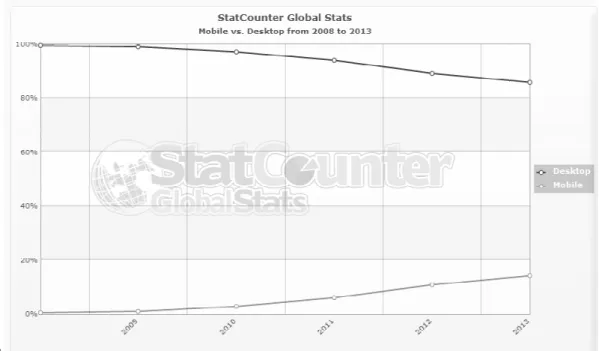
account the general trend of decreasing of the market of desktop and laptop computers in of smartphones and tablet computers, which can be seen in Figure 2.
ss
Figure 2: The ratio of the number of desktop computers and mobile devices used by users to access the Web in the period from 2008 to 2013 (
Web site http://gs.statcounter.com/#mobile_vs_desktop
Figure 2 depicts the number of desktop computers used to access the mobile devices being used for the same purpose
at first, and then more rapid change in a way to access the Web, is primarily caused by the two mobile platforms, which currently occupy
computers. These are the iOS
platform, which occupies 25% of the market
platforms is that their creators firmly rejected the possibility to provide to install the Web browser plug
standard RIA technologies such as
lysis it can be concluded that RIA applications built us
not meet the second principle of the open Web - Web on Everything, they are unable to secure the delivery of their content to devices. Manufacturers of
software or hardware platforms set restrictions to prohibit the installation of the software required to run RIA application.
conclusion, RIA applications built using the most common technologies for such as Adobe Flash, Microsoft Silverlight,
into the concept of the open Web. This claim becomes even more important when you take into account the general trend of decreasing of the market of desktop and laptop computers in
s and tablet computers, which can be seen in Figure 2.
The ratio of the number of desktop computers and mobile devices used by users to access the Web in the period from 2008 to 2013 (the data and the diagram are taken from the
http://gs.statcounter.com/#mobile_vs_desktop-ww-yearly
the number of desktop computers used to access the Web decreased in
used for the same purpose from 2008 to 2013. This phenomenon of gradual at first, and then more rapid change in a way to access the Web, is primarily caused by the two mobile platforms, which currently occupy 86% of the market of smartphone
iOS platform, which occupies 61% of the market,
25% of the market. What is important to note about these two platforms is that their creators firmly rejected the possibility to provide an
browser plug-ins, which automatically means that RIA applications such as Adobe Flash, Microsoft Silverlight, and
152 RIA applications built using standard RIA Web on Everything, because anufacturers of device the installation of the software
, RIA applications built using the most common technologies for , and JavaFX do not fit . This claim becomes even more important when you take into account the general trend of decreasing of the market of desktop and laptop computers in favor
The ratio of the number of desktop computers and mobile devices used by users to data and the diagram are taken from the
yearly-2008-2013)
run on these two platforms. This must turn to some other technologies
they want their applications to be accessible to
Statistics by StatCounter, whose results are presented in Figure 2, showed that the share of mobile devices used to access the Web rose to
Similarly, the survey results of
devices, which they can use to access the Web. Although one respondent may have more than one portable device, the fact that
information system. By combining the results of these two studi
active users of the information system of the school, between 123 and 142
users will not be able to access the information generated by the information system at point of time. This is due to constraints,
technologies for development of RIA applications (Microsoft Silverlight technology, in this case)
This problem of decreased availability of information generated by the information system of school, we attempted to solve by building an alternative user interface
technologies of the open Web
CSS3 are technologies whose development is still in progress, their specificat yet. Therefore, particular attention
specific functions in the most widely used prior to development of the new user interface.
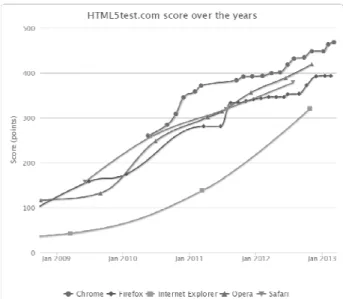
that show which Web browsers advanced the most in the implementation technologies. The values that are closer to the maximum value of 5
Figure 3: The support of elements of HTML5 technology in different computers (the data and the diagram are taken from the
http://html5test.com/results/desktop.htm
This leads to the conclusion that the creators of RIA applications must turn to some other technologies that are supported on the most popular mobile platforms, if they want their applications to be accessible to the widest possible user base.
atCounter, whose results are presented in Figure 2, showed that the share of mobile devices used to access the Web rose to 14.27% at the time of this
of this research study shows that 628 respondents own
devices, which they can use to access the Web. Although one respondent may have more than one portable device, the fact that 94 of 761 devices, or 12.35% still cannot
information system. By combining the results of these two studies, we can conclude: active users of the information system of the school, between 123 and 142
will not be able to access the information generated by the information system at
due to constraints, such as demands imposed by the conventional technologies for development of RIA applications (Microsoft Silverlight technology, in this case)
This problem of decreased availability of information generated by the information system of we attempted to solve by building an alternative user interface
technologies of the open Web such as HTML5, CSS3, and JavaScript. Given that HTML5 and CSS3 are technologies whose development is still in progress, their specificat
particular attention was devoted to determining the level of support of their specific functions in the most widely used Web browsers, both on desktop
new user interface. The following two graphs browsers advanced the most in the implementation
that are closer to the maximum value of 500 represent a better advance.
of elements of HTML5 technology in different Web computers (the data and the diagram are taken from the Web
http://html5test.com/results/desktop.html)
153 the creators of RIA applications that are supported on the most popular mobile platforms, if
the widest possible user base.
atCounter, whose results are presented in Figure 2, showed that the share of at the time of this research study. that 628 respondents own 94 portable devices, which they can use to access the Web. Although one respondent may have more than cannot access the school’s es, we can conclude: Out of 1000 active users of the information system of the school, between 123 and 142 (12.35% or 14.27%) will not be able to access the information generated by the information system at a certain demands imposed by the conventional technologies for development of RIA applications (Microsoft Silverlight technology, in this case).
This problem of decreased availability of information generated by the information system of the we attempted to solve by building an alternative user interface, using modern and JavaScript. Given that HTML5 and CSS3 are technologies whose development is still in progress, their specifications are not final to determining the level of support of their browsers, both on desktop and mobile platforms, he following two graphs demonstrates results browsers advanced the most in the implementation of modern Web 00 represent a better advance.
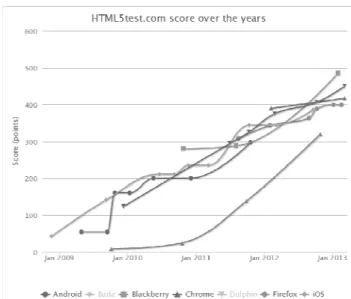
Figure 4: The support of elements of HTML5 technology in different smartphones (the data and the diagram are taken from the
http://html5test.com/results/mobile.html
The above graphs show that
smartphones are advancing from year to year in providing a greater support to the individual elements of the HTML5 technology. In
further development and support are equally devoted creators of mobile platform. This fact is very important to the developers of because it gives them the ability to focus their
Web and RIA applications using HTML5 technology in combination with
such as CSS3 and JavaScript, developers are given the opportunity to distribute the same application to users of a deskt
computers).smartphone With this approach widest possible user base,
smartphones, as well as of any ot
Based on the Figures 3 and 4, it can be concluded that the
the further development of HTML5 technology and related technologies JavaScript. If this trend continues,
The future may not be as secure as Adobe Flash, Microsoft Silverlight times when plug-ins for Web
retain their place in the development of desktop applications and native applications for smartphones and tablet computers, but
to evolve. This research study was conducted to determine the usability of HTML5, CSS3 JavaScript technologies for building
of elements of HTML5 technology in different s (the data and the diagram are taken from the Web
http://html5test.com/results/mobile.html)
graphs show that the most modern Web browsers for desktop computers s are advancing from year to year in providing a greater support to the individual
HTML5 technology. In practice, this means that there is
further development and support are equally devoted creators of Web browsers on a desktop platform. This fact is very important to the developers of Web
because it gives them the ability to focus their efforts to only one technology. By developing and RIA applications using HTML5 technology in combination with
CSS3 and JavaScript, developers are given the opportunity to distribute the same application to users of a desktop or mobile platform (smartphone
With this approach, an application created only once can reach the , that consists of users of desktop, laptop
s, as well as of any other devices that are designed to access the Web.
Based on the Figures 3 and 4, it can be concluded that the Web browser makers are committed to the further development of HTML5 technology and related technologies
continues, HTML5 and related technologies will have a secure future he future may not be as secure for standard technologies used to develop
Microsoft Silverlight, and JavaFX. These technologies were popular in pas Web browsers dominated the Web. However, these technologies may retain their place in the development of desktop applications and native applications for
s and tablet computers, but may not survive in a modern Web pl
study was conducted to determine the usability of HTML5, CSS3 JavaScript technologies for building a user interface to access the information system using
154 of elements of HTML5 technology in different Web browsers on
Web site
browsers for desktop computers and s are advancing from year to year in providing a greater support to the individual one technology whose browsers on a desktop and and RIA applications, efforts to only one technology. By developing and RIA applications using HTML5 technology in combination with similar technologies CSS3 and JavaScript, developers are given the opportunity to distribute the same smartphones and tablet application created only once can reach the consists of users of desktop, laptop, tablet computers, her devices that are designed to access the Web.
browser makers are committed to the further development of HTML5 technology and related technologies such as CSS3 and HTML5 and related technologies will have a secure future.
155 smartphones and tablet computers. The application created as a result of this study, combined with the results of the surveys conducted during the study and results of other studies dealing with a similar problem, have shown that the modern technologies of the open Web, although still insufficiently standardized, are at the stage where they can be used to build a relatively complex user interfaces. With their further development and further standardization, as well as with the development of tools for their usage, the process of building applications with these technologies will become even simpler and more standard.
References
Desruelle H., Blomme D., & Gielen F. (2011). Adaptive mobile Web applications through fine-grained progressive enhancement. Proceedings of the Third International Conference on Adaptive and Self-Adaptive Systems and Applications.
Le Pallec X., Marvie R., Rouillard J., & Tarby J. C. (2010). A support to multi-devices Web application. Proceedings of the 2010 ACM Symposium on User Interface Software and Technology.
Ling, R., & Svanæs, D. (2011). Browsers vs. apps: The role of apps in the mobile Internet. Internet and Society: Challenges, Transformation and Development University of Beijing
Mikkonen T., & Taivalsaari A. (2011). Apps vs. open Web: The battle of the decade. Proceedings of the Workshop on Software Engineering for Mobile Application Development.
Orduña P., García-Zubia J., Irurzun J., López-de-Ipiña D., & Rodriguez-Gil L. (2011). Enabling mobile access to remote laboratories. Prceedings of the IEEE Engineering Education 2011, Learning Environments and Ecosystems in Engineering Education.
Acknowledgements
The author's sincere gratitude goes to Shonda Brown for her assistance with the editorial task for this paper.
Biography